On 7 June 1956 a group of European women calling themselves ‘The Housewives’ sent several letters to the office of the mayor of Nairobi regarding a change in bus policy, proposed by the sole provider of passenger transport in the colony, the Kenya Bus Service (KBS). The Housewives included several documents in the packet: a cover letter authored by the group listing demands and including suggestions as to how bus services could be improved, two long letters from individuals detailing negative experiences with Africans on Nairobi buses, as well as one small piece of stationary with an official seal embossed in the corner and the words ‘With Compliments from the Housewives’ written in calligraphy across the front. The overall theme of the letters condemned the new ‘one-class, one fare’ bus policy that would do away with first, second, and third-class seating on Nairobi buses, making the entire bus the same price for anyone riding.Footnote 1 The Housewives explained in the letter that they would be willing to pay more if the bus company promised to hire more Europeans to work as inspectors and conductors, although it would have been impossible for KBS to afford European employees on the additional payments of a small number of European riders. At this point, the majority of KBS customers were African workers, not colonial settlers. The Housewives closed the letters by providing a reminder that the KBS was owned by a London bus company, which also ran the buses in Salisbury, Rhodesia, where ‘they have separate buses for Europeans and Africans and it works extremely well’.Footnote 2
By 1956, while the Housewives were collecting complaints and drafting letters, Nairobi's African, and especially Kikuyu residents, were just emerging from Operation Anvil, a screening and detention program launched in April 1954 that was one of the most violent British military exercises of the colonial era.Footnote 3 This was just one exercise in a near decade long insurgency by Kikuyu forest fighters, which the British called Mau Mau, but which was more akin to a Kikuyu civil war prompted by the European theft of Kikuyu land in what would come to be known as the White Highlands.Footnote 4 Operation Anvil saw thousands of Kikuyu, Embu, and Meru residents of Nairobi deported and detained.Footnote 5 Although Kenyan independence was less than a decade away, the British Empire and European settlers insisted they were in Kenya to stay and instead of planned decolonization, they touted the development of a ‘multiracial society built on partnership’, which institutionalized the racist colonial hierarchy already in place, with Europeans at the top, South Asian laborers in the middle, and Africans at the bottom.Footnote 6 It was in this tense and traumatic context that the Housewives’ letters reveal an stark expression of power relations in society, at the end of colonial rule, and an illuminating glimpse into African resistance to colonial power in the intimate environment of the colonial bus. Although there was a tiered price for seating, the letters reveal a porous boundary between Europeans in first- and second-class seating with mostly African riders and drivers, while the sheer parameters of the bus itself produced a physical closeness and generated performances of discrimination, discipline, resistance, solidarity, and violence.
While on the surface these letters are filled with the normalized racist settler colonial logic of contagion and exclusion, there are also deeper insights to be gained from reading against the grain for the actions (and inaction) of African bus workers and riders, particularly Muslim women riders, during this time in Nairobi's history. These letters make a case for the bus as a unique place for African people to build and perform solidarity during waning settler power in late-colonial Kenya, perhaps addressing an important question Fred Cooper asks about urban life in colonial Africa: how are forms of space connected to forms of protest?Footnote 7 The seemingly innocuous space of the colonial bus can be a lens through which we can witness the racial politics of decolonization in Nairobi.Footnote 8 Colonial buses provided a stage for resistance to settler logics of elimination, and an intimate space where Africans could build and express solidarity. The letters reveal racist settler colonial attitudes but also give a glimpse of largely unseen behavior and interactions of African men and women, in Nairobi, during a highly militarized time in a violent era.
The settler women's letters provide insight into two groups of women in late-colonial Nairobi — Nubian women and European settler women. The bus can be interpreted as an extension of domestic territory for both groups of women in Nairobi. Nubian women, members of the population of Sudanese soldiers and their families who had settled in Nairobi with permission from the Crown, were known to be empowered in the domestic and economic sphere, many gaining status and wealth through the distilling and distribution of gin.Footnote 9 The European settler women, meanwhile, were, by the act of taking the bus, likely not the aristocratic, wealthy settlers of the 1930s, but rather members of a poorer and more diverse settler population who poured into the colony after 1939.Footnote 10 Like most urban transportation, the intimate space of the bus or train car blurs the boundaries between public and private and brings issues of inequality to the fore. Its intimate, mobile space has long made public buses an important site for making politics personal.
In their letters, the Housewives were employing what scholars of settler colonialism would call ‘elimination logics’ aimed at making indigenous or native people disappear, or at least diminishing them, especially in the most intimate places.Footnote 11 There was a significant amount of violence inflicted on African people in Kenya during colonialism, especially in the 1950s, which makes the genocidal logic of elimination even more significant in this case.Footnote 12 Although Kenya and South Africa, among other African nations, had settler colonial populations, much of the key literature theorizing settler colonialism focuses on the Americas, Australia, Israel, and Palestine and the architect of the field of settler colonialism, Patrick Wolfe, leaves Africa out of his analysis entirely.Footnote 13 One of the most important conceptual issues in Wolfe's theory of settler colonialism is that, for Americans and others, settlers aim to eliminate people because they want their land, or they eliminate people's land because they want their labor. As Robin Kelly argues, in Africa, settlers wanted the land and the labor, but not the people.Footnote 14 Kelly argues that by ignoring Africa, Wolfe fails to account for labor regimes in which the native is simultaneously eliminated and exploited, like Kenya. Although Kelly agrees that settler colonialism in Africa was also functioning under the logic of elimination, he elaborates, ‘what was being eliminated was the metaphysical and material relations of people to land, culture, spirit and each other’.Footnote 15
Even though whites were never the majority in places like Kenya, Algeria, and Southern Rhodesia, there was still the logic of elimination at work along with a genocidal impulse.Footnote 16 Take the many public exhibits of torture, hangings, and concentration camps committed by the British colonial administration as evidence of these impulses and logics at work.Footnote 17 One of the key features of settler colonialism in Africa, however, was that the genocidal impulse was curtailed by the dependence on indigenous labor.Footnote 18 Because of this feature, they also needed strong racial hierarchies and differentiation between white and native, which is reflected in the Housewives’ suggestions for segregating the colonial bus, but because the African population dwarfed settler numbers, they could not maintain these distinctions.Footnote 19 What African cases of settler colonialism reflect, in particular in Kenya, was that settler positions were fragile and weak and this weakness and anxiety motivated their violence.Footnote 20 Decolonization in settler colonial African states was much more violent and protracted than in non-settler societies, showing how settlers can become even more violent as their position weakens.Footnote 21
Another key feature to the framing of settler colonialism is continued settler supremacy over time, which is why Kenya and other African nations are often not included in this analysis, as settlers are no longer perceived to be in power in these places. However there are still settlers in Kenya who own and control vast tracts of land and businesses and structure the nature of tourism in the area.Footnote 22 This is another reason Kelly argues that it is important to bring African nations back into the analytical frame of settler colonialism because they show that settler societies do indeed fall, they are not indestructible and that if decolonization is a process, not an event, then ‘all these struggles can be seen as part of a global assault on settler rule’ and the ‘trace is the refusal to accept the permanence and the terms of settler domination … it is in these spaces that the decolonial imagination lives’.Footnote 23 In this way, the letters of the Housewives reveal an important granularity in the global assault on settler rule and a glimpse into the spaces of the decolonial imagination where African women and men stood up for one another in the safety of the bus. In some ways, the letters show that KBS buses were places where colonial segregation and settler supremacy was explicitly challenged by African residents, during a time when the settlers still considered Nairobi to be the white, colonial garden city of East Africa but when their power was waning. With political organizations outlawed in the years leading up to the particularly brutal assault on Nairobi, along with the violent removal of many Africans from Nairobi, the KBS vehicles that rolled through Nairobi, if not safe places, were at least contested spaces where Africans performed resistance under a particularly violent era of colonial rule in Kenya. In the face of settler colonial logics of elimination, where people were diminished to erasure, their interests ignored, their lives and struggles obscured, the Nubian women on the bus provide an important reminder of the everyday places where the battles of liberation were fought, and where the process of decolonization played out. Importantly, although Nubians had lost some of their ‘special African’ status that was related to their earlier military service among European colonial administrators and settlers, they were still largely unaffiliated with Mau Mau and therefore their conflict with the European women is even more telling in terms of settler colonial control. It was being strongly resisted by those loyal to the Crown.
In this context, colonial buses were intimate battlegrounds, spaces with extremely porous interpersonal boundaries and when thinking about how forms of space connected to forms of protest, transportation infrastructures emerge as rich sites of state power and socioeconomic circulation as well as political self-making through performances of resistance and solidarity. In buses, eye contact is difficult to avoid and the shared experience of boring commutes and dangerous thrills on the road can bond riders together. It is in these quotidian qualities that transportation vehicles and systems are rich sites of urban life, although often underexplored. As increasing attention has come to mobility studies over time, particularly African mobility, scholars and urban planners, transportation engineers, and labor activists are asking additional, complex questions about how infrastructures facilitate opportunity, operationalize suffering, and shape urban space.Footnote 24 Histories of urban transportation in colonial Africa are imperative to understanding how transportation, like the matatu minibus taxis that provide most of the mobility in postcolonial Nairobi and other paratransit sectors, bind contemporary African cities together.Footnote 25
The regulation of movement in colonial Kenya
Early in the colonial project in Kenya, to control and ‘make legible’ the many groups of people populating the land between the port in Mombasa and Lake Victoria, the colonial government set up a system that directly linked ethnic identity to space in a massive placemaking practice called the Native Reserve System, regulated by the kipande (pass) system.Footnote 26 Ignoring evidence of intermarriage and in some cases simply creating ‘tribal’ identities entirely,Footnote 27 the ethnic geography of Kenya was manufactured by a racist colonial administration, built on profound misunderstandings and misguided assumptions about African social life.Footnote 28 Official colonial protocol operated under an assumption that Africans were so deeply ‘tribal’ that sustained interaction with members of different ‘tribes’, including Europeans, would result in psychological breakdowns from intercultural shock.Footnote 29 Mobile Africans who lived or worked far from their ‘ethnic homelands’ were referred to as ‘detribalized natives’, a category that remained problematic for the colonial administration throughout their rule in Kenya.Footnote 30
Although Nairobi was officially off-limits to the native African population, it quickly became a diverse and plural place where various interests fought for access to resources, space, and services. By 1914, there were over 18,000 Africans living in the city, even with the pass system in place.Footnote 31 It was impossible to police settlements throughout the entire city because people were living and dwelling along the ‘boundaries, the edges and the cracks of town’.Footnote 32 By the 1930s, the population of Africans in Nairobi had grown to over 30,000.Footnote 33 As the African population grew, the city became a booming, multicultural city of Europeans, South Asians who originally came to Kenya as laborers with the railways, and Africans from surrounding farms.Footnote 34 After 1939, there was an increase in ‘poor whites’ that poured into Nairobi in the years leading up to the 1952 Emergency.Footnote 35
Although much of Nairobi's congestion has been blamed on matatu minibus taxis, the city has always had a traffic issue. By the 1930s Nairobi was not only congested with people, but with cars. In 1929 Nairobi had the highest rate of cars per capita in the world.Footnote 36 By 1936, transport, traffic, and parking in Nairobi was becoming a problem and the government organized the city center by pushing commuters and bus stops further away from the Central Business District (CBD).Footnote 37 At this time, the colonial government paid more attention to parking than to driving, accidents, reckless drivers, or transportation for the masses. In 1938, the Kenya Welfare Association sent a letter complaining about drunk driving on the roads in Nairobi. Reginald Mombasa writes, ‘It is felt that all citizens of Nairobi of all races have the right to feel assured that the authorities are taking all of the necessary steps to protect them from careless drivers or from drivers incapacitated through alcohol’.Footnote 38 As the colony grew and was populated, the need for a public transportation system was becoming apparent. Not only because of the drunk driving, but also because there was nowhere to park.
By the mid-1930s, the idea of investing in Kenya was looking better to British companies because they were promised a monopoly over any business ventures undertaken in the colony.Footnote 39 For passenger road service, two institutions were created and discussed at length in the 1936 document laying out the terms of the monopoly of the Kenya Bus Service Limited Company and the erection of a powerful Transport Licensing Board (TLB), which would oversee licensing all vehicles in Kenya. In 1936, as KBS maintained their small fleet of buses and their growing circumference of service, the TLB had little to do and had few applicants. But, by the 1940s, when African veterans returned from the Second World War, where they had been drivers, a popular idea spread among the returning soldier population that they should get licenses, buy cheap vehicles from the military, and start transport services to supplement the growing number of the underserved, invisible residents of the African settlements in and around Nairobi.Footnote 40 The TLB chairman was instrumental in shutting out the African veterans from the transport industry and successfully protecting the interests of KBS. Some returning soldiers ended up driving personal taxis, discussed in the next section. Nubian soldiers were absorbed into the ranks of the KBS itself and throughout the 1940s and 1950s, nearly the entirety of the KBS employee pool was made up of Nubians who were often drivers in the military.Footnote 41
Kikuyu taxis: moving radical politics to and from Nairobi
By the mid to late 1940s Nairobi was changing with the influx of Kikuyu veterans.Footnote 42 Their idleness fueled growing nationalist and anticolonial feelings, especially among Kikuyu, who were largely displaced by European settlement just outside of Nairobi.Footnote 43 After the Second World War, demobilized soldiers came back to a different Kenya, where the war effort had promoted the expansion of settler agriculture.Footnote 44 Therefore, there was even less land for these returning soldiers than there had been when they left, prompting more exodus from the reserves to the nearby city of Nairobi. Only upon receipt of land and marriage, could a Kikuyu man become an adult.Footnote 45 This lack of land then, not only compromised their day to day living, forcing them to move to the city, but because they had no land (but money to spend) they were kept from getting married and attaining adulthood, leading to a crisis in the fabric of social obligations or, what John Lonsdale described as the ‘moral economy’ of Kikuyu society.
This was the time when soldiers returning with money that they could not spend on wives, land, and children, applied for licenses from the TLB but were rejected. It is important to point out here that the monopoly agreement that KBS held in Nairobi was for passenger transport over eight passengers. The soldiers were attempting to apply for licenses to register lorry vehicles that the army was selling off, to start transport businesses.Footnote 46 Ironically, many of these Kikuyu men resorted to driving private taxis and subsequently, the Kikuyu taxi association and the Allied Transport Workers Union, formed an important political base for the Mau Mau movement that depended deeply on their mobility.
The Allied Transport Workers Union was the first and largest workers’ union in Kenya.Footnote 47 Throughout the 1940s, leaders used this block of workers to spread political thought and action in Nairobi. This union of taxi drivers, mostly veterans, worked to radicalize the nationalist political movement that was coalescing in Nairobi.Footnote 48 The importance of movement and mobility cannot be overlooked because the taxis were key in carrying anticolonial political leaders, and subsequently anticolonial political ideas, from the city to the countryside throughout the late 1940s and early 1950s, up until the Emergency in 1952. In fact, Kikuyu taxi drivers were some of the first people to participate in Mau Mau oathing rituals, and in turn greatly facilitated the oathing of others in and around the city.Footnote 49 Using the Kikuyu taxis, radical politics in Nairobi were on the move, and the taxi drivers spread the message.
Eventually the colonial administration recognized the power in the type of mobility Kikuyu taxis provided, because they called for strict controls at the borders for any Kikuyu person traveling in a motor vehicle. There were limitations on the number of Kikuyu allowed to travel in motor vehicles, which included a rule that Kikuyu people ‘coming to Nairobi daily must either walk or use the public transport services’.Footnote 50 Kikuyu taxis were also forced to put a yellow stripe on their cars, marking them conspicuously.Footnote 51 In 2004, under the Michuki rules, a set of regulations for matatus, every matatu vehicle was required to put a yellow stripe on the side of their vehicle. This stripe essentially marked both matatus and Kikuyu taxis as oppositional or rebellious, dangerous vehicles.
Multiracial master planning
In 1944, with growing unrest throughout the colony, and particularly Nairobi, Sir Phillip Mitchell was sworn in as governor. He brought with him common paternalist ideas that Africans needed help from the British to become civilized and eventually enjoy some autonomy while the British acted as mere trustees, staying behind to watch over their wards.Footnote 52 In order to achieve this, he was armed with the conceptual weapon of ‘multiracialism’ and economic development. Mitchell wanted to override any pesky racial tension between the radical nationalists and the European settlers by focusing on economic production and keeping everyone separate but equal. The colonial landscape was one of inequality, and that inequality and exclusion was built into the environment yet contested at every turn.Footnote 53 As noted earlier, Nairobi was officially off-limits to Africans who were not accounted for nor employed. The city was not meant to be an integrated, diverse urban metropolis. It was meant to be a white city in the sun. However, urban planners in Nairobi did play lip service to this new realm of tolerance and anti-fascist sentiment, which attempted to make colonialism more palatable by introducing the idea of multiracialism.
The concept of multiracialism was built into the environment through the work of urban planners, with the help of sociologists. The sociologist on the planning committee was supposed to deal with the social ‘interactions’ in the city. Two reports are of interest for Nairobi's foray into multiracial planning: a 1945 report by the sociologist Mary Parker, and the master plan of 1948.Footnote 54 The plan called for separate but equal development of city structures. Both Parker's report and the master plan called for a multiracialism that allowed the different ‘cultures’ and ‘races’ to have their own separate estates or ‘locations’, self-contained neighborhoods that held everything in one place so that people would not have to leave their area and ‘interact’ with people of a different culture or race.Footnote 55 The politics of planning affects who has access to urban space. Who is and who is not represented on a map, and how these representations came to exist, offers important insights into the way the state thinks about its constituents.
Violence in Nairobi: Mau Mau and Operation Anvil
As tensions grew, Kikuyu fragmentation became better defined and, by the early 1950s, more moderate Kikuyu politicians, like Jomo Kenyatta, were spreading their disapproval regarding oathing and violence to gain political representation.Footnote 56 The Land and Freedom Army's movement was well underway and the secret society was growing and gaining momentum, largely facilitated by the Kikuyu taxi drivers who were able to disseminate ideas and messages from the city to the reserves, thus coalescing a somewhat fragmented operation. The movement was easily infiltrated by criminal elements who were used to gather guns and supplies and before long, violence broke out in a powerful way. On 7 October 1952, Senior Chief Waruhiu, a Christian and leading government spokesperson was assassinated. With this news, the colonial administration declared the colony under a ‘State of Emergency’ and referred to the Kikuyu fighters in the forest as Mau Mau. Throughout the 1950s in Kenya, ‘as the full weight of government power was brought to bear, the assertive character of radical politics was transformed into a desperate resistance’ that cost many lives and caused much suffering until it was defeated in 1960.Footnote 57
Nairobi during the Emergency was highly militarized, with soldiers scattered throughout the growing city populated by Africans, South Asians, and European settlers who were more diverse and less wealthy than the settlers of the 1920s and 1930s.Footnote 58 The city was chaotic due to thousands of Kikuyu fleeing counterinsurgency campaigns.Footnote 59 In 1952 and 1953, Mau Mau had the support of most Africans in Nairobi, although there were some loyalists there as well. In fact, in 1953, the first African settlement of Makadara was given to loyal Kikuyu by the Crown.Footnote 60 By 1956, when the Housewives were writing their letters, most Africans in Nairobi were loyalists, but had all been oathed.Footnote 61
Only two years before the Housewives’ letters were written, one of the largest military operations in Kenya's colonial history, Operation Anvil, a massive screening and detention exercise, violently displaced 24,000 Kikuyu, Embu and Meru people to drive Mau Mau sympathizers out of Nairobi.Footnote 62 During the violent oppression, the colonial government descended on the African population of Nairobi and searched their homes and private quarters. They terrorized large portions of the urban African population looking for pass violations among other things. At that time, the daily life of many African people was arduous.
Over time, these demographics, along with the poor treatment of Africans in African settlements, assembled an urban colonial landscape that was not simply ‘a palimpsest reflecting the impress of asymmetrical power relations undergirding colonial society, but also a terrain of discipline and resistance’.Footnote 63 The colonial bus was an important moving public space that shaped and followed the terrain of discipline and resistance in a material way. Compared to the other places that European and African women would meet — the domestic sphere, the street, the house, the market — the colonial bus was simultaneously one of the most intimate and public places in Nairobi. The colonial bus, depending on where one was in Nairobi, was overflowing with African passengers, and held very few European passengers. The drivers and conductors of the buses were also Africans. The colonial bus was an intimate public/private stage where resistance was performed as settler power declined. Perhaps even before the settlers realized it was over, the feelings they had on the buses during the mid to late 1950s should have alerted them to a changing of the tides. Although, at the same time settlers had little reason to believe that their power was so short lived, because it was only earlier in the year 1956, that Africans had finally gained the right to form political organizations.Footnote 64
With compliments from the Housewives
By the 1950s, KBS was being criticized by everyone, from Africans heading to work to European housewives going to shop in town.Footnote 65 In 1956, KBS executives and Nairobi City Council (NCC) officials started discussing an end to segregation on Nairobi's buses, making all vehicles ‘one-class and one-fare’.Footnote 66 Nairobi's double-decker buses were segregated into three different fare classes. Between 1953 and 1959 the fare for first class was 15 to 20 cents, second-class fare was 10 to 15 cents, and third-class fare, called the ‘minimum fare’, was an even lower rate meant for low-income people specifically.Footnote 67 KBS also reserved at least part of the lower floor for whites.Footnote 68 The segregation of the buses into these classes belied the fact that most of the users of KBS transportation services were Africans and that many times the buses were filled with mostly African people. Most African people would pay for second-class seating or minimum rates — and some, if we are to believe the reports from the Housewives, would not pay a fare at all.Footnote 69 If the photos of KBS buses picking up African passengers downtown in colonial Nairobi are any indication, we can imagine how crowded these buses were. Standing, swaying, and bouncing along the road in a sea of strangers, shoulder to shoulder.
The one-class, one-fare policy was not a progressive effort put forth by KBS management to recognize the humanity of their African ridership, but an economic decision that intended to squeeze more out of their already burdened African customers. The one-class, one-fare policy was surely part of the push by the Colonial Office to adopt a multiracial Constitution and is a good example of multiracial logic at work in social policy using urban transportation infrastructure to institutionalize inequality.Footnote 70 In short, because Africans were the majority of the riders, generally paying for second class seating or even minimum fare seating, making the fare one-class would likely raise the price on African tickets, even if it was lowering the price for first-class customers. Thus, it was about raising prices on African consumers, institutionalizing racial inequality under the guise of multiracial living. Multiracialism was popular among Europeans because it granted them the ability to see their future in Africa lasting indefinitely. (In fact, the KBS monopoly over transport in Nairobi was due to last until 1985!).Footnote 71 Through multiracialism the colonial administration moved away from ideas about decolonization and towards themes of ‘partnership’ in societies ‘that would progress toward nationhood through a series of gradual constitutional reforms’ and ‘in effect, multiracialism preserved settler privilege and colonial control while creating the illusion of democracy and self-government’.Footnote 72 Although the imperial administration thought multiracialism would keep them in power, most Africans rejected it, and even when colonial administrators were not listening, ‘ordinary Africans were speaking back to their British Rulers’ in lots of ways.Footnote 73 From these letters, bus behavior can be read as one of the ways ordinary Africans were speaking back to their ‘partners’ in subtle and not so subtle ways.
The European women were loath to lose their segregated and privileged space on KBS buses, indicating settler colonial logic at work insisting on distinct separation and organization into hierarchies, when true elimination could not be maintained.Footnote 74 Not only did the European women disagree with the proposal, but they argued for completely segregated buses and offered to pay higher fares to keep sitting in their separated, first-class sections. They threatened to stop taking the bus altogether and claimed they would be finding other means of transportation, not that this would matter much to the bottom line of KBS, whose primary customer base were Africans. These letters reflect how little the settlers seem to matter on a bus filled with African riders, some of whom were intoxicated and rowdy to the point of striking an innocent European bystander.
Their cover letter lays out their case:
We have had numerous complaints recently about the condition of the Kenya Buses, and the treatment received by passengers. It should be noted that in most cases the complaints have not been directed towards the conductors, but against the almost impossible conditions under which they work. The husband of another member was in an incident on Saturday this week, when the conductor of the bus was quite unable to control the Africans who had been drinking, one of whom hit the face of the European who tried to assist the conductor. We have had several verbal complaints of people who had all seats occupied by Africans not paying the first-class fare and in some cases paying no fare at all who will not allow European first-class passengers to sit in the seats for which they are paying. While the cleanliness of some buses on certain routes improved, we get complaints of dirty floors and seats, particularly on the Ngong Road and Ruaraka routes.Footnote 75
The social situations described in the letters and the way they were written reflect the beliefs, values, and practices of 1956 Nairobi, where European settler women attempted to make their power visible in the city by controlling the public space of the colonial bus, but ultimately documented their own weakness in the waning days of colonial rule.
One of the authors of the letters names the East African Women's League (EAWL) as an alternative avenue for recourse when it comes to addressing bus behavior. The EAWL were another, more established and well-documented, group of European women who lobbied legislators on behalf of various women's issues.Footnote 76 Over time, one of the responsibilities that fell to the EAWL in the colony was managing and ‘correcting’ the behavior of poor European women who engaged in intimate relationships with African men.Footnote 77 Notably, the EAWL published a book in 1965, describing how the group reinscribed what was to become Kenya into something they could make legible: it is called They Made it Their Home and is the story of their settlement.Footnote 78
Like the Housewives, the EAWL made it their mission to police urban space, building and renaming streets after notable British people. The emphasis on ‘home making’ by both the EAWL and the Housewives is reflective of the gendered idea of home. The home, the domestic space, was their duty to maintain and run, and could be a point of pride and marker of resilience for settler women (see the Karen Blixen Museum in Nairobi). The emphasis on managing the domestic sphere and ‘making a home’ in a foreign land, especially by those who deemed themselves superior, seemingly prompt claims towards ownership of various spaces — even those only slightly linked to the domestic domain, like the bus used to carry out domestic chores. These groups were affiliated with things that impacted women's daily lives and it is no surprise that the bus was part of that extended domestic sphere. It is somewhat well documented that, although men provide most transportation services, women have often been heavier users of public transportation services, because of a need to take more trips, more frequently.Footnote 79 It makes sense that a bus then, would be an extension of the domestic sphere for European women who may not have access to a car, but it was also an extension of the domestic realm for the Nubian women mentioned in the letters who were taking the bus as part of their everyday work transporting Nubian gin.Footnote 80 By looking at the bus as an extended domestic sphere for both African and European women, the activities, interactions, conflicts, and alliances become more complicated and telling.
Shenzies kabisa
One of the two personal letters included in the Housewives’ packet along with their stationary card and cover letter, was authored by an elderly man, who was shocked and disappointed that KBS would entertain the interests of their African customers over the preferences of their European clientele. In a telling reference he groups himself with ‘European ladies and elderly men’ in a way that reinforces the idea of the bus as an extension of the domestic sphere where there are vulnerable people and he references the population of poor Europeans who were steadily populating Nairobi throughout the 1940s.Footnote 81 He writes:
The dissatisfaction of the unfortunate Europeans who, of necessity, have to use the buses is very great and with good reason. The dissatisfaction is not only because some buses are dirty and noisy with rattling windows and other parts, but because of the uncontrolled, unchecked behaviors most Africans who push Europeans out of the way and force themselves onto the bus occupying all seats and leaving European ladies and elderly men to stand. Many are extremely rude, dirty and smelly. At peak hours when tired European workers try to get on the bus they are pushed aside and if able to get on, left to stand. Seats reserved ‘for the ladies only’ are of no mind whatsoever as Africans take no notice and yesterday I saw a well-dressed African deliberately pass a seat occupied by only Africans and occupy one ‘For ladies only.’
This language captures what anthropologist Janet McIntosh has documented in Kenya as a common settler mindset, whereby ‘most settlers considered Africans to be intellectually inferior, vaguely polluting and potentially dangerous’.Footnote 82 The fact that there are still settlers in Kenya who share this mindset, interviewed at length by McIntosh, many of whom are wealthy landowners or business owners, speaks to the ‘continuity of settler colonialism’ as an ongoing process in Kenya.
The letter included more general transportation-based complaints that one may hear in any city in the world across time and place. Examples of bad behavior by young Africans include not offering their seats to older people, loudness, rudeness, and general chaos. As the letter continued, the racist tropes emerged as the author described Africans as ‘shenzies kabisa’ (a Swahili insult meaning total or absolute idiots) and signaled racist themes of dirt and contagion. The author described his commute as such:
Recently I boarded a bus at Kilimani School and had to stand all the way to Nairobi whilst seven African (adults) and five children occupied first class seats. And I am over 70 years of age! Travelling on most buses is becoming a nightmare and unfortunately cannot be avoided by many Housewives and elderly people. To make the buses all one class will allow ‘shenzies kabisa’ as well as all other Africans to sit anywhere and because of the dirt, smell and rudeness make present conditions more intolerable that they are. The way Kenya Bus Company acts leads one to the conclusion that because they have had a monopoly for several years and because most of their profit is from African passengers, they totally disregard the European public and treat them with disdain.Footnote 83
This elderly settler man specifically condemned the one-class, one-fare policy on physical and moral grounds. As his letter shows, he was irritated at sharing space and offended at the idea that Africans will be able to ‘sit anywhere’ which would be ‘intolerable’. He has some bulleted suggestions at the end of his letter:
Instead of making conditions worse by creating a one-fare bus, I suggest that –
A) The KBS run certain buses for Europeans only; or
B) They reserve special compartments for Europeans; or
C) Other firms and companied be asked and allowed to run buses for Europeans only.Footnote 84
He finishes his letter with the following statement of claims to reverse racism, writing:
The anti-white spirit among the Africans is growing and present conditions of travel in buses is accentuating it. I speak as a resident of a resident of over forty years and as someone who worked among them for over thirty years.
The idea that travels in buses, and the conditions of that travel exacerbates the racial tension in Nairobi is notable and parallels what psychologists of segregation were observing in the United States at the same time.Footnote 85 The particular materiality of the intimate aspects of the public bus, like the proximity to strangers, the circulation of people and ideas over urban space and time, and the way that these environments provide opportunities for close observations of inequality, has allowed them to serve as an important urban place where race, gender, and power often play out in public struggle.Footnote 86 Research on proxemics takes seriously the study of how people unconsciously structure and react to micro-spaces in their houses, buildings, and ultimately towns in ways that reflect and reinforce power hierarchies.Footnote 87 Transportation is no different. In fact, the types of interactions people have on mass transit can be particularly intimate due to the physical closeness to strangers that it produces. Material forms of infrastructure, like a bus or train car, are ultimately relational and these material spaces frame social interactions.Footnote 88 In other words, physical closeness of people in enclosed spaces feels intimate, but the relationship of intimacy is absent, which can make people feel ill at ease and even combative.
The public and proximal nature of mass transportation makes the bus a critical place where social justice issues become visible, especially issues around race, gender, and class, and a historically rich site for protest. In fact, just six months before these letters were written in Kenya, buses were taking center stage in the fight for equality in the Southern United States when Rosa Parks, Claudette Colvin, and others, refused to give up their seats to white passengers on segregated public buses in Alabama. Parks’ actions in particular are seen to have sparked the Montgomery Bus Boycott, which is often understood as the earliest mass protest of the civil rights era in the United States.Footnote 89 In the same year Rosa Parks refused to move to the back of the bus, Martin Grossack's study of racial segregation on buses in the United States showed that it was detrimental to the mental health of all passengers, Black and white. Many Black respondents pointed to experiences on the bus as pivotal moments in their understanding of their own Blackness. As Grossack documents, many Black children, like their white counterparts, wanted to watch the bus driver up-close, but were ‘yanked away by their mothers’ toward the back of the bus where they often explicitly or implicitly understood that they were not treated like their white counterparts.Footnote 90 In this way, these type of practices in intimate spaces reinforced and institutionalized racism into public infrastructure.
Grossack argued that buses were particularly sensitive places in the segregated United States because schools and shops were separated but existed in their own spheres without overlapping. Because the bus is a small, intimate space, when shared between two groups who are treated unfairly in society, the separation and hierarchy between them becomes clear to both groups of people.Footnote 91 At the same time, tension builds between the two separate groups, solidarity is also building within the groups, as those who are marginalized commiserate together. In colonial Nairobi, KBS buses were both a site for settler women to exert their power and a place for the staging of resistance to that power. The logic of settler colonialism, founded on the concept of ‘elimination in order to replace’, produces a racialization that ‘results from colonizers being confronted with the threat of having to share social space with the colonized’.Footnote 92 In this light, the Housewives’ complaint letters pledging their resistance to new KBS policies that did away with the segregation on city buses can be seen clearly as a warning cry, not about bus service, price, or gender (which it would eventually become), but about the increasing physical and symbolic closeness occurring between Europeans and Africans that KBS buses already enabled, and were threatening to expand.
Although most African passenger behavior on the bus was probably unremarkable, through the lens of these complaints, the KBS bus emerges as a place where African passengers did transgressive things safely. Outside of a private home, but not out in the open street, the bus allowed for Africans to assert themselves with little consequence or qualm. Take for instance seemingly small things like not giving up one's seat for white passengers to larger transgressions like being drunk in public and physically assaulting Europeans. These actions point to African passengers who had at least some rapport with fellow African conductors and inspectors on the vehicles or recognized that they would not be held responsible by them. Or maybe the African passengers just realized that the African inspectors had limited power in the world of racialized settler colonialism. This solidarity was not lost on the European settlers who called for their own racially segregated buses and staff to service them along every part of the journey.
She flatly refused
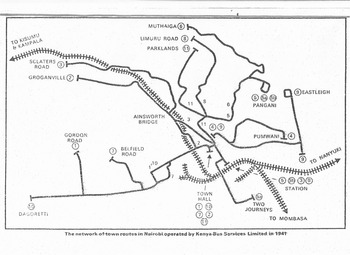
The other personal letter included in the packet sent to the mayor by the Housewives tells the story of a European woman's experience on a Dagoretti bus travelling through the western neighborhoods of Nairobi, one of which would have been Kibera (Fig. 1).
Map of Kenya Bus Service routes in Nairobi in 1941. The Housewives encountered the Nubian women in a bus on route number ten (marked by the number ten within a circle) coming from Dagoretti to Nairobi town.
Source: This image comes from the personal archive of Malcom Chase, used with his permission.

The author sent the letter because she heard the Housewives were collecting complaints to send to the bus company, begging questions about the extent of the group's networking and publicity reach.Footnote 93
I understand that you are working for European women of Nairobi to get better treatment from Kenya Bus Company, and if possible, a bus for Europeans only. I am most grateful to you and your committee and you will receive heart-felt thanks from all the European housewives especially on the Dagoretti route, which runs from Dagoretti corner, the Kibera, the King George VIth and the KAR lines all crowding on about 7th and 8th of the month and Saturday and Sunday afternoons, when so many are drunk.
Perhaps you would care to hear one of my recent experiences on the Dagoretti Bus – I have travel on it daily to and from the office. I did report it to the EAWL [East African Women's League] hoping they would help!
A friend of mine and I were waiting at the Colonial Stores bus stop for the Dagoretti double decker bus one morning last month, and as we boarded the bus a young Nubian woman pushed us aside and put her huge basket of bottles right in the doorway of the first class while she went upstairs. My friend asked her to move it so that we could get in (there is a place for baskets etc. under the stairs) this she flatly refused to do, so we asked the conductor who did not deign to answer, nor did the two African Inspectors help at all.
My friend then tried to move it herself but before she could move it a second and older Nubian woman pushed her way past me and thumped my friend on the back with her closed fist so hard that she nearly fell headlong over the basket but just managed to catch the side of the door in time. Without hesitating, I gave the woman 6 of the best on her back! She turned round and seized me by the front of my blouse and raised her fist to strike me. My friend gave her a good smack. The woman then realized that it would be better to leave me alone and picked up the basket and we were allowed to enter and sit down. We felt so shaky and upset at the whole nasty business and neither the conductor nor the inspectors came to our aid!!
I could tell you many more incidents, most of which I have reported to Mr. Kennard on two occasions I have asked the police for protection on the buses or help us at the Harding Street bus stop at the ‘peak’ hours.
I might add that this Bus Company is owned by a London Bus Company, which also runs the buses in Salisbury, Rhodesia. There they have separate buses for Europeans and Africans and it works very well.
These letters clearly show a shift in the reign of settler violence. It was weakening, as just a few decades earlier in the 1920s, Brett Shadle described settler violence against Africans as ‘the lingua franca of colonial Kenya’.Footnote 94 Although interpersonal violence committed by settlers against African men was freely admitted to by the perpetrators, settlers rarely mentioned beatings of women and, disturbingly but not surprisingly, settler violence against women was generally reported as sexual in nature.Footnote 95 This letter provides a glimpse into an instance of interpersonal, non-sexual violence between settler women and African women, while exposing the limits of settler violence and the limits of colonial power as it was understood by African residents of Nairobi.
You can read the history of settler violence in the unapologetic way the letter-writer described how quickly and violently both European women reacted, ‘without hesitation’ and with a ‘good’ smack. Violence, for settlers, was good, and a necessary part of everyday life in Kenya. It was also heavily racialized, meaning that ‘all whites presumed the right to inflict violence on any African (and quite often, Indian as well), while intra-white assaults could easily end up in court’.Footnote 96 In this bus, in 1956, the resistance and reciprocity of interpersonal violence was not one-sided, but crossed age and gendered lines, and brought both African women of different ages together as well as African men who were on the bus and in positions of authority. In this letter, one African woman unapologetically refused to obey the European women's demand to move the basket of bottles, and another African woman unafraid to instigate a violent encounter with the white women, thumped one woman on her back and grabbed the clothes of the other.
The Housewives generally stated that ‘in most cases the complaints have not been directed towards the conductors, but against the almost impossible conditions under which they work’.Footnote 97 They complained that the KBS employees, who were all African, were incapable of controlling the bus population. In this case, however, the inspectors and conductor of the bus did not aid the European women. The African conductors and inspectors asserted themselves by ignoring the European women, thereby creating solidarity with African women, and in a way rendering the European women invisible.
There may be an additional layer of intimacy at play between the African women on the Dagoretti bus and the African conductor and inspectors who ignored the European women's calls for help in addition to general anti-settler sentiment. There is a chance they were both members of the same community, Sudanese ex-soldiers and their families who settled on what was once a forest patch on the far western outskirts of Nairobi they called Kibra. Over time, members of this community, marked by Muslim dress, came to be known as Nubians, although they referred to themselves as Sudanese and were most likely a common sight on the Dagoretti bus that passed by what had, by 1956, become Kibera, a bustling, diverse neighborhood of Africans who had a right to live on the land by permission of the Crown and who were protected by their previous military service.Footnote 98
Another important point to note with regards to Nubian solidarity on the colonial bus is that Nubian women often transported their home-brewed gin in baskets on KBS buses where the drivers and inspectors were also all Nubian.Footnote 99 The basket of bottles the white women were attempting to move may have had lots of valuable gin, or at least valuable bottles. Nubian gin was the drink of the military and women were the main distillers, making thousands of quarts a day.Footnote 100 They exported the gin from Kibera by ‘delivering gin to customers houses, offices, bars, or shops…with bottles hidden in baskets or tied around their waists.’Footnote 101 In archival records documented by Johan de Smedt, a letter to the superintendent of police alleged that ‘the Nubian drivers of KBS are largely concerned with the distribution of Nubian gin’.Footnote 102 According to a KBS Bus operations account in 1949, the entire workforce of 140 drivers and 140 conductors employed by KBS were ‘all native’, many of whom were probably Nubian.Footnote 103
Nubians in Nairobi
Kibera, located in what is now West Nairobi, was not a hotbed of Land and Freedom Army sympathizers, like the Eastland areas were seen to be, especially in 1956. Instead, Kibera housed a population of Sudanese soldiers and their families who had settled in the area with permission from the Crown.Footnote 104 In other words, it was not suspected guerilla fighters or Mau Mau oath takers boarding the bus with these settler housewives, but the ‘good Africans’ who were loyal soldiers. Nubians who served as soldiers in the King's African Rifles (KAR), ended up in Kenya to guard to railway in the late 1890s. By 1902, half of the men in the East African Rifles (later the KAR) were Sudanese due to the fact that ‘the Southern Sudan was a source of slave soldiers for the independent Sudanese kingdoms of Sennar, Tegali, Darfur and ultimately Egypt’ and over time these quasi-slave soldiers developed an ethnic or cultural consciousness through their shared military service, kinship built by adopting orphans and intermarrying other ex-slaves, while also developing their own distinctive language, dress and cultural practices.Footnote 105
In 1911, the British Crown granted permission for these Sudanese soldiers to settle on a piece of land within the city limits of Nairobi, near the army barracks, but at that time, a significant distance away from the city center, explaining why they called the settlement Kibra, meaning ‘forest’.Footnote 106 The placename indicates how far on the outskirts of town and off major paths it was located. By the 1930s, and for the next 30 years, Nairobi grew to meet and then surround and overtake Kibera. The government struggled to evict, remove, relocate, and reorganize Kiberans, who had become a dynamic community of ex-soldiers, their families, and local people.Footnote 107 When the Second World War erupted, the Sudanese soldiers were able to strengthen their claim to Kibera under their good military service, many of them working as drivers and mechanics, which may explain why some of them took to transportation services in Nairobi.
The war also caused illegal brewing to boom in Kibera and the production of the ‘Nubian Gin,’ which became a support system for older women who were denied pensions and ‘who had no chance of marriage’.Footnote 108 In fact, some ‘Nubian’ women, in 1956, were probably Kikuyu women married to Sudanese ex-soldiers. Throughout the 1940s Kibera shrunk in size as Kikuyus were removed due to the Mau Mau panic, and it was also targeted for criminal activity due to the production of illegal gin. During the era of the Emergency, there was more military around and increasing amounts of gin, with Nubian interviewees claiming that some 70 to 90 per cent of families were involved in gin production at some point.Footnote 109
The role of Nubians cannot be overlooked in the history of Nairobi as they were and are a particularly unique group of people that benefited from colonial contradictions and shifting racial and ethnic hierarchies that increasingly impacted claims to land.Footnote 110 Similar communities of Africans in other colonial neighborhoods like Kileleshwa and Kilimani with no military connections were bulldozed, while Kibera was perpetually protected by elites in colonial government, like Lord Lugard himself.Footnote 111 In contemporary Kenya, Kibera residents still constantly battle removal efforts by the government, resisting policies often that are often couched in progressive catchphrases like ‘urban upgrading’, much like the final years of settler colonial rule in Kenya, which were couched in ‘multiracial partnership’.Footnote 112
Colonial white supremacy, multiracial logics, and gendered public space
On 19 June 1956, just twelve days after the Housewives’ original packet of letters arrived at Nairobi's mayor's office, the East African Standard newspaper reported that women ‘of all races’ in Nairobi were to get ‘priority seating during rush hours’. According to the newspaper, a ‘Ladies Only’ bus stop was going to be set up at peak times in between ‘4pm and 5:15pm on weekdays and 12:30pm and 1:15pm on Saturdays’. The newspaper directly cited letters where ‘housewives’ complained of ‘scrambles’ and about ‘one-class bus service’ reporting that the same letters from housewives suggested that women would be prepared to ‘pay more rather than travel on a one-class service’ and that ‘Africans’ do not have ‘no sense of consideration for other passengers’. It is not clear from the newspaper reporting if these letters from ‘housewives’ were the same letters from the Housewives.
While the mayor is portrayed in the article to have been swayed by letters from women in the colony, a response to the letters dated 20 June 1956 shows that his office was quite dismissive of the Housewives’ issues:
Facts must be faced. Segregation of races or the introduction of buses for one race only would be unacceptable in present-day Kenya. Special buses for Europeans would not be an economic proposition so therefore the bus company should not entertain the idea.
2. No one can expect the behavior of the African to conform to that of the British people – ever.
3. It would go a long way towards alleviating present discontent if European drivers, conductors and inspectors were employed on those routes where this kind of trouble is being experienced. This would probably involve the Company in a great deal of additional expenditure because not many routes would be involved but possible the European bus users would not object to a small increase in fares to cover the cost of providing European staff.Footnote 113
This reflection sums up overall British colonial policy generally and multiracial logic specifically: that African people and European people were never to be held to the same standards of conduct, while also explicitly recognizing that to allow overt segregation based on race would put the modernity of the empire into question. Obviously, segregation of ridership by race was unacceptable in a modern society, but racist attitudes toward much of the ridership was standard. In cursive at the bottom of the typed memo, there is a note that says:
I don't think there is any comment I can usefully make on this question, which crops up again and again. It is a local government problem only. Because the city council may license a company and give them a monopoly, but basically the problem is an economic one.Footnote 114
The next memo from two days later, 22 June 1956, follows with more advice on the issue and reminds the mayor that he has ‘a meeting with “the housewives” on the 16th of July to consider this matter’. The memo reads:
The CLG has commented at (161) but as he points out this is basically a political problem but unfortunately it is the local authority which has to solve it. I don't not think you need any briefing from me on a point like this and I would only add my personal view that from the female European point of view is pretty frightful to put it mildly.
On 28 June 1956, less than thirty days after their letters were first received, the very first ‘Ladies Only’ bus stop went into effect in Nairobi. The East African Standard newspaper reports, ‘Buses on certain routes will be cleared of all passengers… and only women will be allowed to board them. The scheme is experimental, but there is no time limit’. Surely, the women were satisfied with their few hours of gender segregation a week because they successfully ended the one-class service proposal. This corresponds to another aspect of settler colonial erasure: ‘Keeping the dominant minority quiet demanded the appearance of holding the majority down and the reality of retaining its advances under state control’.Footnote 115 It is not clear from the archives how long the women's only bus stops and priority seating lasted in Nairobi. Even if it was for a short time, judging by the quick rate of action and the meaningless solution put forward and accepted, what is clear is that although the Housewives wielded some power in the urban space of colonial Nairobi there were hard limits on their power to impact things. These women were able to be publicly placated, presented as more modern and tolerant than they were, while their racist settler views were widely shared and socially accepted, but economically nonviable.
Roots of a transportation takeover
Later that year, in November 1956, after the one-class, one-fare policy was dead, different settler businessmen and colonial administrators tried to get KBS transportation fares lowered to help African workers, to no avail.Footnote 116 In a series of letters exchanged with the managing director of East African Railways and Harbours, A. F. Kirby, the Minister for Local Government, Health and Housing H. B. Havelock describes his concerns for the residents of Makadara, an African settlement built for loyal Kikuyu on the east side of the city, who were spending a significant amount of their earnings in transportation costs to get to work in the Central Business District. Havelock was curious if the railway would be of any help. The railway refused to assist the government in providing any additional transportation. The combination of high costs and bad service made an impression on many entrepreneurial Africans after the Second World War, who thought that providing transportation would be a good investment.
In 1959, due to several factors, not least the lackluster service the KBS provided for the African residents of Nairobi, just a few years after the one-class, one-fare proposal was abandoned, the first informal ‘pirate taxis’ emerged from Makadara neighborhood.Footnote 117 The pirate taxis started picking up the forlorn commuters waiting for KBS buses, which only came once an hour.Footnote 118 Ultimately, these pirate taxis led to the fall of the KBS because KBS was never meant to serve the real urban residents of Nairobi. KBS buses were more like props on the set of a city in a colonial spectacle. It wasn't until pirate taxis emerged, and subsequently matatu vehicles expanded, that the city got the amount of service an urban center like Nairobi demanded.Footnote 119
On one hand, these letters, the cancellation of the one-class bus service in Nairobi, and the subsequent priority seating scheme from the mayor's office, reveals the reaches and limits of settler power in 1956 Nairobi. Read against the grain, these letters show how resistance to settler colonial power can be seen in unexpected places. They help us understand the way that public transportation can become a transformational place for marginalized people to express political will. The letters reveal various levels of solidarity in a tense moment. They also provide a vivid glimpse into the lives of two important groups of women living in Nairobi, vying for control over crucial, but largely overlooked, public spaces like buses and bus stops.
Conclusion
In the past several years, there has been a rash of cell phone videos showing white women calling the police to complain and report Black people for a variety of everyday activities as though they are committing crimes such as: Black people barbequing, Black children selling cold water on a hot day, Black women waiting for rides from carsharing apps. The white women on tape calling the police are often dubbed ‘Karen’ or ‘Becky’ throughout the United States, a trend that came from within the Black community, expressed through hip-hop and other popular culture. Although seemingly less alarming than the viral videos of police brutality, the Karen videos are just as insidious when one realizes that these are often two ends of the same nightmare. A white woman's call of distress can easily initiate police brutality and violence, even death.
There is a parallel between the ‘Karens’ all over the United States and ‘the Housewives’ of colonial Nairobi. The Housewives were colonial Karens, which is to say that they used their race and their gender as weapons against Africans in the name of ‘public safety’ and as a way of policing public space. Similarly, the viral videos that document the injustice and violence of the police state, these letters showed how far they would go and the limits of colonial Karens. The letters give us clues into how KBS buses were places where Africans in Nairobi were able, at least at times, to push back, literally, and figuratively, on colonial white supremacy and challenge the settler colonialism logic of elimination and exploitation. It appears KBS buses were one of these places where Africans could give expression to the white supremacy they were experiencing every day, revealing an important place where Africans may have felt able to take up space, to challenge colonial oppression, or just stand their ground, even as it moved underneath their feet.
Acknowledgements
This essay draws on archival research made possible in part by grants from Fulbright-Hays, the Andrew Mellon Foundation, and Brooklyn College. It was workshopped with the African Studies Reading Group at Washington University in St. Louis, in October, 2020. I thank the participants of the reading group and especially Tim Parsons for his comments and encouragement. Subsequent drafts also benefitted from constructive comments from Sid Harring and other CUNY colleagues. Meghan E. Ference is an assistant professor of anthropology at Brooklyn College, CUNY. Her contact information is mference@brooklyn.cuny.edu.