


Introduction
Over three decades of research have demonstrated that individuals with emotional disorders exhibit biased attentional patterns in the processing of threatening information that may be involved in the aetiology and maintenance of such disorders (Bantin et al., Reference Bantin, Stevens, Gerlach and Hermann2016; Bar-Haim et al., Reference Bar-Haim, Lamy, Pergamin, Bakermans-Kranenburg and van IJzendoorn2007). Experimental modification of attentional biases via brief, computerized programs was first introduced to patient populations in 2009 (Amir et al., Reference Amir, Beard, Burns and Bomyea2009a; Schmidt et al., Reference Schmidt, Richey, Buckner and Timpano2009). Efforts to further study attentional bias modification (ABM) programs as interventions were quickly met with great enthusiasm, as ABM offers a number of advantages over traditional psychotherapy, including cost-effectiveness and ease of dissemination (Bar-Haim, Reference Bar-Haim2010; Beard et al., Reference Beard, Weisberg and Amir2011). With under a decade since this approach was first applied to patient populations, research testing the clinical utility of ABM is in its infancy, and many questions remain regarding this experimental intervention.
A number of meta-analyses have examined the efficacy of ABM (Beard et al., Reference Beard, Sawyer and Hofmann2012a; Hakamata et al., Reference Hakamata, Lissek, Bar-Haim, Britton, Fox and Leibenluft2010; Heeren et al., Reference Heeren, Mogoașe, Philippot and McNally2015; Price et al., Reference Price, Wallace, Kuckertz, Amir, Graur and Cummings2016). While estimates of effect sizes vary, findings are generally in agreement that when ABM produces changes in attentional biases, changes are also observed in self-reported and behavioural symptoms (MacLeod and Clarke, Reference MacLeod and Clarke2015). For example, Clarke et al. (Reference Clarke, Notebaert and MacLeod2014) examined 29 studies and reported that only three were inconsistent with the notion that when ABM successfully modifies bias, there is a corresponding impact on symptoms. Nonetheless, numerous studies have failed to demonstrate that the intervention succeeds in modifying the proposed mechanism of action (i.e. attentional bias) (Boettcher et al., Reference Boettcher, Berger and Renneberg2012; Carlbring et al., Reference Carlbring, Apelstrand, Sehlin, Amir, Rousseau, Hofmann and Andersson2012). In an attempt to reconcile mixed findings, researchers have examined the impact of various task and participant features but such analyses have not generally produced consistent results (Beard et al., Reference Beard, Sawyer and Hofmann2012a; Hakamata et al., Reference Hakamata, Lissek, Bar-Haim, Britton, Fox and Leibenluft2010; Heeren et al., Reference Heeren, Mogoașe, Philippot and McNally2015).
Despite its potential utility as an intervention, little research has examined how patients perceive ABM. Moreover, it is unclear to what extent perceptions of ABM influence outcomes. Given mixed findings in the ABM literature, such research is critical given that perceptions of treatment credibility and expectancy for improvement are among the most robust predictors of outcome in other psychological treatments (Greenberg et al., Reference Greenberg, Constantino and Bruce2006). In one of the few qualitative ABM studies, Beard et al. (Reference Beard, Weisberg and Primack2012b) assessed socially anxious individuals’ perceptions of cognitive bias modification (CBM) tasks, including ABM, after receiving a brief description and demonstration. Participants expressed mixed reactions, describing ABM as ‘repetitive and boring’ and reporting that they did not understand the purpose or relevance of the task to their anxiety.
We examined patient perceptions of ABM across two studies. Data were collected as secondary measures as part of two larger studies examining the efficacy of CBM. In the current manuscript, our aims were to characterize patient perceptions of ABM and to examine whether perceptions of ABM are associated with clinical outcome. In Study 1, participants completed a traditional ABM program and received a hand-out with minimal information about the purpose of the task. Participants also completed an interpretation bias modification (IBM) program. In Study 2, participants completed an adaptive ABM (AABM) program and received more extensive rationale and instructions for changing attentional biases. Participants in Study 2 also received instructions to approach feared situations. We included data from two ABM protocols to examine whether patient perceptions were consistent across diverse settings and in the context of different treatment packages. We noted this to be particularly important, as ABM has increasingly been investigated as an adjunctive treatment to cognitive behavioural therapy and/or other CBM programs (Sportel et al., Reference Sportel, de Hullu, de Jong and Nauta2013).
Study 1
Participants were enrolled in a randomized controlled trial of a CBM package for social anxiety disorder. The trial compared CBM to a placebo computer program. Treatment outcome results are presented elsewhere (Beard, Weisberg, and Amir, Reference Beard, Weisberg and Amir2011) and suggest that CBM resulted in reduced anxiety compared to the placebo condition.
Study 1: Method
Participants
The current study included participants randomly assigned to the CBM package (n = 20), of which 15 completed qualitative interviews. Three participants dropped out with lost contact, and two participants declined to complete the qualitative interview. Participants varied in age (range = 18–79 years, mean = 33.5, SD = 17.2) with a mean of 13.2 years of education (SD = 2.0) and 87% were female. Eleven participants self-identified as White, two as African-American, one as Asian, and one as mixed race.
Inclusion criterion was a diagnosis of social anxiety disorder established by a post-doctoral fellow (C.B.) using the Structured Clinical Interview for the DSM-IV (First et al., Reference First, Spitzer, Gibbon and Williams2002). Exclusion criteria were: (a) current suicidal intent; (b) substance dependence; (c) psychosis or current manic episode; (d) current cognitive behavioural therapy; (e) change in pharmacological treatments within 12 weeks prior to study entry. Participants provided written consent and study procedures were approved by the Brown University Institutional Review Board.
Intervention package
The CBM package was completed over 4 weeks (eight 30-min sessions completed two times per week) and consisted of both ABM and IBM (see Beard et al. (Reference Beard, Weisberg and Amir2011) for details). In the first session, participants received a packet with basic information about cognitive biases and were told that the program would help them to develop better mental habits related to anxiety through repeated practice.
ABM
The ABM task was a dot probe task designed to direct attention away from threat. The task consisted of 160 trials and included paired neutral and disgust faces.
IBM
The IBM task was a modified version of a previously used word-sentence association paradigm (Beard and Amir, Reference Beard and Amir2008) designed to extinguish threat interpretations and encourage benign interpretations of ambiguous situations.
Measures
Liebowitz Social Anxiety Scale-Self Report (LSAS-SR)
Participants completed the LSAS-SR at pre- and post-treatment. The LSAS-SR is a 24-item scale that assesses fear and avoidance of social interaction and performance situations (Liebowitz, Reference Liebowitz1987). The self-report version shows strong psychometric properties and is highly correlated with the clinician-administered version (Fresco et al., Reference Fresco, Coles, Heimberg, Liebowitz, Hami, Stein and Goetz2001).
Quantitative measure of initial perceptions of ABM
Following a brief rationale and completion of the first CBM session, participants rated perceived credibility of CBM with the Credibility/Expectancy Questionnaire (CEQ; Borkovec and Costello, Reference Borkovec and Costello1993; Devilly and Borkovec, Reference Devilly and Borkovec2000). We examined mean credibility (three items rated 1–9, e.g. ‘At this point, how logical does the treatment seem?’) and expectancy (two items rated 0–100%, i.e. mean per cent improvement that participants expected).
Qualitative measures of perceptions of ABM
At post-treatment, participants completed a semi-structured, individual qualitative interview with the following prompts: perceived helpfulness/credibility of ABM (and IBM), session format, changes (or lack thereof) in thinking/behaviour, adverse reactions, stimuli relevance, and attributions for symptom changes. Questions probed general feedback about the overall CBM package as well as specifically about ABM. Initial responses were paraphrased and repeated back to the participant to ensure understanding. Participants completed the interview via telephone with a post-doctoral fellow not otherwise connected with the study, and received US$20 in compensation. Interviews were audio recorded and transcribed verbatim.
Coders and a priori expectations
Coders included two clinical psychologists (E.C. and J.P.) and two post-doctoral fellows (C.B. and C.S.). C.B., C.S. and E.C. have expertise in information processing biases in anxiety and varying levels of experience administering ABM. C.B., C.S. and E.C. believed participants would find ABM unusual and boring. J.P. has expertise in the treatment of depression in men and extensive experience in qualitative methods. J.P. had no a priori beliefs about patient experiences with ABM.
We conducted an iterative analysis guided by conventional content analysis through which categories were developed inductively (Hsieh and Shannon, Reference Hsieh and Shannon2005). Following complete data collection, we independently printed and reviewed initial transcripts. Open coding of transcripts generated an initial coding framework, which was added to and refined iteratively during the analytic process. We met together on several occasions to discuss transcripts and coded initial categories until theoretical saturation was achieved, meaning that additional insights had been exhausted during the coding process (Strauss and Corbin, Reference Strauss and Corbin1998). Remaining transcripts were coded using a template organizing style. One author (H.B.) independently applied the codes to all transcripts. In our final meetings, we finalized codes, developed broader categories, and identified over-arching themes through comparison across transcripts. All authors agreed upon the final themes and quotations within each theme.
Study 1: Results
Quantitative data
Quantitative data from Study 1, including LSAS reduction as well as credibility and expectancy ratings have been reported in detail elsewhere (Beard et al., Reference Beard, Weisberg and Amir2011) and are described briefly here in order to place qualitative data in context and compare with Study 2. Participants experienced a 22-point average decrease in LSAS (pre: mean = 81.00, SD = 18.23; post: mean = 58.95; SD = 24.23). Because the CEQ was added to the protocol during the trial, only a subset of participants (n = 11) provided baseline credibility and expectancy ratings. Higher baseline credibility ratings were strongly and significantly associated with greater pre–post treatment reductions in LSAS (r = .73, p = .01). Although not reaching significance, higher expectancy ratings were moderately correlated with greater reductions in LSAS (r = .53, p < .09).
Qualitative data
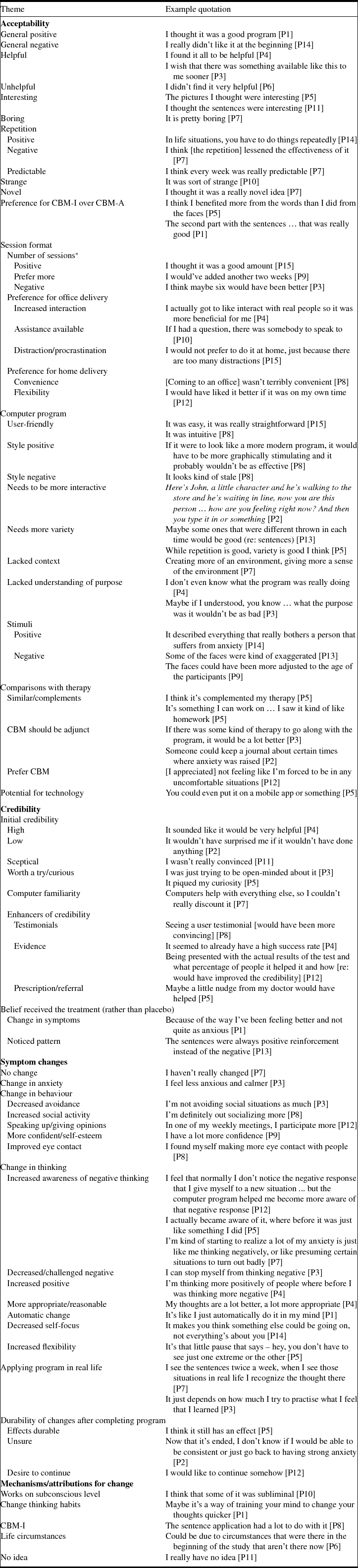
Interviews ranged in length from 18 to 36 minutes (mean = 27, SD = 5.3). Themes emerged related to ABM's acceptability, credibility, perceived symptom change, and perceived mechanisms of action or attributions for change. Only qualitative feedback about ABM (and not IBM) is presented here. Specifically, some questions referred either to ABM or IBM (e.g. ‘What did you think of the program with the faces?’). Of note, Study 1 included a ‘packaged’ CBM treatment that included both ABM and IBM. Hence, some comments from Study 1 may reflect perceptions of this overall CBM treatment package. See Table 1 for example quotations for each theme.
Study 1: themes and quotations

*Similar comments were made regarding the frequency and length of sessions.
Acceptability and satisfaction
Participants were generally satisfied with the program, and all but one characterized it as helpful. Participants (P) expressed sentiments such as ‘I wish something like this had been available to me sooner’ [P3] and ‘Keep doing [CBM studies] because there's more people out there who need help’ [P14]. Six participants said that the program overall or ABM specifically was interesting, but three participants described the program as boring or tedious. However, only two participants found the repetition bothersome, and four thought it was beneficial. Four participants preferred greater variety in the stimuli, and suggested including additional computer tasks. One participant experienced ABM as ‘strange’ [P10].
Participants were satisfied with the session format (e.g. session length, frequency). With two exceptions, participants were either happy with eight sessions or said that they would have liked more sessions. Participants were divided on whether they would prefer to complete the program at home or in an office. Seven participants indicated that holding the sessions in an office would help keep people on track and free from distractions that may hinder compliance with the program or focus on the tasks; however, five participants thought that completing the sessions from home would be more convenient. All participants found the program to be user-friendly. Participants did not report problems understanding program instructions. While participants generally reported that the ABM faces looked like everyday people, the majority (n = 10) thought that the expressions were exaggerated or that the pictures looked out of date.
One of the chief themes made evident in the interviews was the low face validity of ABM, which appeared to negatively impact its acceptability. Participants expressed doubts about the utility of ABM, including ‘I just thought it was kind of useless’ [P3] and ‘I didn't know why I was doing it’ [P2]. The majority of participants (n = 11) said that they did not understand ‘the point’ [P7] of ABM or expressed similar sentiments.
Three participants praised the novelty of using a computer program to influence anxiety, and appreciated the potential to extend the program's accessibility by putting it online or on a mobile ’phone application. Specific suggestions for improving the program were similar to activities that are often included in evidence-based therapy, e.g. ‘maybe like walking around or going somewhere in the actual situation’ [P2].
Credibility
Prior to initiating the program, most participants were optimistic about its credibility, with eight claiming that it had high credibility and four reporting scepticism. While some participants had been wary that a computer program could help their anxiety, they were hopeful that it would be effective. Testimonials, evidence from past studies, and a prescription from a doctor were mentioned as ways to increase the treatment's initial credibility. Because the interview was administered at post-treatment, it is possible that retrospective reporting of perceived credibility prior to initiating the program may have been positively biased by perceived benefit from treatment.
Perceived symptom changes
With one exception, all participants reported at least a modest decrease in anxiety. One participant's claim that ‘I'm a little less anxious . . . and I'm able to deal with [social situations] a little bit better’ [P3] typifies most participants’ comments. Participants recognized the need for practising what they learned from the program in real life. Most participants (n = 11) reported that their behaviour had changed, and the changes centred on decreased avoidance of social situations (n = 4), increased social activity (n = 4), and increased willingness to speak up or share an opinion (n = 4). Finally, two participants were unsure about the durability of these changes or expressed a desire to continue the program.
Perceived mechanisms of action and attributions for change
Only one participant correctly identified the mechanism of action in ABM (i.e. disengagement from threat stimuli) [P6]. Not surprisingly, participants attributed changes in anxiety to the program in general (n = 6) and/or to the IBM task specifically (n = 5) rather than the ABM task. Five participants stated that practice in their real life was necessary to realize benefits from the program. Five participants commented on the ‘subliminal’ [P10] nature of the program or speculated on its effect on the brain (i.e. ‘something to do with the left and right, affecting different sides of the brain’ [P4]). Four participants also attributed changes in symptoms to life circumstances (e.g. started school, new job).
Study 1: Discussion
Overall, participants perceived the CBM package to be helpful and provided examples of positive changes in their lives. However, participants expressed doubts specifically about the utility of ABM, suggesting that ABM lacked credibility in part because participants could not identify its mechanism. Moreover, failure to identify the treatment mechanism may have led participants to attribute positive changes to IBM rather than ABM. Thus patients generally described symptom improvement, yet did not consistently report the ABM component as credible and/or expressed dissatisfaction with ABM. We note that because participants completed both ABM and IBM, it is unclear to what extent either intervention produced symptom change.
It is commonly assumed that ABM produces symptom change via reduction in attentional bias (Clarke et al., Reference Clarke, Notebaert and MacLeod2014). However, patient perceptions, including preference but also awareness of said mechanism, may actually influence the intervention's impact on the mechanisms, and in turn, symptoms. While data from non-clinical populations suggest that explicit instructions about the task (i.e. contingency between probe and neutral stimulus) may enhance ABM's effect on bias change (Krebs et al., Reference Krebs, Hirsch and Mathews2010; Nishiguchi et al., Reference Nishiguchi, Takano and Tanno2015), the effect in clinical populations is unknown.
In addition to participants’ lack of understanding of ABM, other factors emerged that may affect its implementation. Many participants desired more variety in the tasks and more interactive tasks. ABM's greatest potential lies in its ability to be completed anywhere at any time, and some individuals suggested the appeal of online at home delivery. However, many individuals preferred the formality of scheduled sessions delivered at a provider's office. Preference for office delivery is interesting in light of a recent meta-analysis that revealed that ABM is only effective when delivered in the laboratory or clinic, and not when delivered at home (Price et al., Reference Price, Wallace, Kuckertz, Amir, Graur and Cummings2016). One possible explanation for this finding is that office delivery may be associated with enhanced treatment credibility relative to home delivery, although this remains to be investigated.
Study 2
In Study 2, we made several modifications to the ABM task and its delivery, including using idiographic stimuli, a hybrid delivery system including both office and home sessions, providing explicit rationale about the nature of attentional biases and their modification via ABM, and making the program more interactive so that patients moved up in ‘levels’ during ABM. Consistent with feedback from some participants in Study 1, in addition to ABM we included directions to approach feared social situations.
Study 2: Method
Participants
Participants were enrolled in one of two open trial studies examining the adaptive ABM (AABM) program. Participants in the first open trial (n = 15) have been reported on in a previous paper describing the AABM program (Amir et al., Reference Amir, Kuckertz and Strege2016). Participants were included in the current analyses if they (a) provided a post-treatment LSAS and (b) completed the perceptions of AABM measure following the first treatment week. Of the 23 people who met eligibility criteria across the two open trials, 19 provided qualitative feedback about AABM at various points throughout treatment. Participants varied in age (range = 26–62 years, mean = 40.0, SD = 12.0) with a mean of 16.6 years of education (SD = 2.1) and 39% were female. Fourteen participants self-identified as White, four as Hispanic, two as African-American, one as Asian, and two did not provide information on race or ethnicity. Inclusion/exclusion criteria were identical to Study 1. Participants provided written consent and study procedures were approved by the San Diego State University Institutional Review Board.
Intervention package
Treatment involved 4 weeks of (1) AABM training (40-min sessions consisting of two blocks of 360 trials) completed once a week in the laboratory, and as many times at home as participants wished, and (2) approach of social situations between laboratory visits. The mean number of AABM trials completed was 4528 (SD = 2277).
AABM
The AABM was a modified spatial cueing task (Amir et al., Reference Amir, Kuckertz and Strege2016; Posner, Reference Posner1980) that directed attention (1) away from threat and (2) towards positive words. Negative, positive and neutral words were generated idiographically per participant.
Prior to initiating AABM, a clinician described the nature of attentional biases in anxiety and that the goal of AABM was to change how people attend to emotional information. Participants also received a pamphlet with detailed information about attentional biases and were told that AABM would help them to more easily disengage their attention from threat and more quickly direct their attention to positive information. Participants received explicit instructions during the task at various intervals with instructions about how to modulate their attention presented via pop-up windows.
AABM differs from previous ABM programs in several ways and is described in detail elsewhere (Amir et al., Reference Amir, Kuckertz and Strege2016). Participants first completed a ‘practice’ phase in order to: (1) become familiarized with the program while gradually introducing more attentionally demanding elements (e.g. flanking letters), and (2) calculate baseline negative and positive attentional bias scores. Negative bias scores were calculated based on response latency difference for invalid threat trials minus invalid neutral trials and positive bias scores based on valid neutral trials minus valid positive trials. After the practice phase, participants moved up by one ‘level’ by either (a) decreasing their ‘best’ (i.e. lowest) negative attentional bias by 1 ms, and/or (a) increasing their ‘best’ (i.e. highest) positive attentional bias by 1 ms. Bias was measured and updated continuously such that it became more difficult to modify their ‘best’ bias scores as the number of trials accumulated. Thus if participants were unable to change their positive or negative biases over many trials (>100), they had the option to ‘recalibrate’ such that the program reset their best bias levels to their current level, hence lowering the difficulty of the program. Participants could check their level at any time by pressing a keyboard button, and also saw their level at the beginning and end of each session.
Instructions to approach social situations
Participants were enrolled in one of two open trials. In both open trials, we asked participants to independently approach social situations that they typically avoid between sessions and to complete homework forms recording these events (at least two per week). Participants in the second open trial (n = 8) received additional guidance prior to program initiation including expanded rationale, assistance in creating a fear hierarchy, and completion of a practice exposure exercise with a clinician present. As these open trial studies were otherwise identical in procedure, we combined data from these two open trials for the current study.
Measures
Liebowitz Social Anxiety Scale-Clinician Administered (LSAS-CA)
Participants completed the LSAS-CA at pre- and post-treatment (see Study 1).
Quantitative measure of initial perceptions of AABM
The Computer Training Attitudes Measure (CTAM) was developed for the current study to assess patient perceptions of AABM. The CTAM includes three items: (1) ‘I feel that the computer program that I completed last week was useful in terms of reducing my anxiety’, (2) ‘I feel that the computer program that I completed last week helped me in terms of exposing myself to social situations’, and (3) ‘I enjoyed the computer task that I completed last week’. Higher scores indicate greater agreement and more positive perceptions of AABM (4-point scale, range = 3–12). Cronbach's alpha was good (α = .89). The CTAM was administered weekly starting at the second training visit. We present quantitative data from the first CTAM completed so as to predict relationship between initial perceptions and change in symptoms and treatment mechanism.
Qualitative measures of perceptions of AABM
The CTAM includes a prompt ‘Please provide feedback about the training you completed last week’ with space for the participant to provide written comments. Participants were asked for qualitative feedback after each week of training. We included qualitative data from any week, therefore many of these participants provided feedback on multiple occasions.
Coders and a priori expectations
Coders included two clinical psychologists (N.A. and C.B.) and one advanced clinical psychology doctoral student (J.K.). N.A., C.B. and J.K. had expertise in information processing biases in anxiety and extensive experience administering ABM. N.A. believed that participants would find the task repetitive. C.B. and J.K. believed that participants would vary in their perceptions of AABM, with some participants finding the program boring and repetitive but others finding the program engaging and challenging. C.B. and J.K. believed that some participants would better be able to link the AABM task to their everyday lives compared with Study 1, but that others would still report confusion about the task purpose. Coding procedures were identical to Study 1. J.K. independently applied the codes to all transcripts in Study 2.
Study 2: Results
Quantitative data
Participants experienced a 29-point average decrease in LSAS (pre: mean = 85.13, SD = 21.74; post: mean = 55.96; SD = 19.77), t (22) = 6.46, p < .001. Higher level reached in the AABM was significantly correlated with greater reductions in LSAS (r = .46, p = .026). The CTAM was significantly correlated with LSAS reductions, indicating that more positive initial perceptions of AABM predicted greater decreases in social anxiety symptoms across treatment (r = .45, p = .030). More positive initial perceptions of AABM also predicted higher levels reached in the AABM program (r = .43, p = .038).
Qualitative data
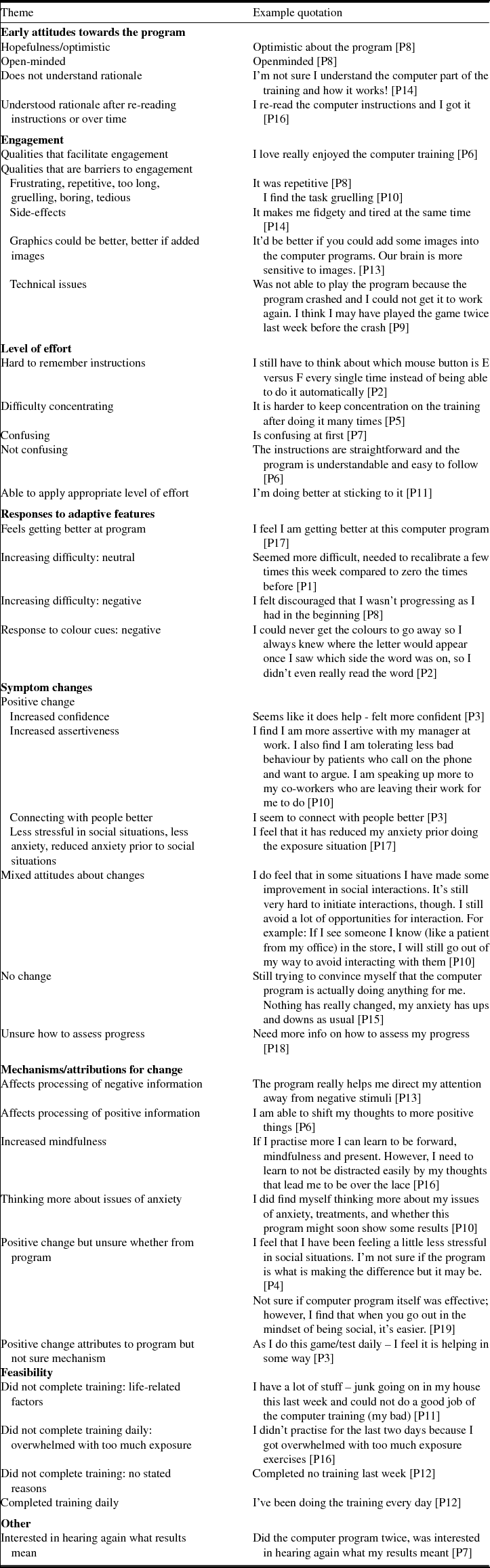
Themes emerged related to early perceptions of the program, facilitators and barriers to engagement, unintended consequences of adaptive features, perceived symptom changes, and perceived mechanisms of action or attributions for change. Of note, participant feedback varied to a large extent within each theme. See Table 2 for example quotations for each theme.
Study 2: themes and quotations
Early perceptions of the program
Similar to the quantitative measure of initial perceptions (CTAM), early qualitative perceptions of the program varied. Two participants expressed optimism and hopefulness about AABM's ability to help them, although one noted that they were unsure of how it would help. However, three participants expressed confusion over the rationale for the program or doubt over its utility. For example, one participant stated, ‘I am failing to see how exposure to certain words or clicking here or there is really going to help me’ [P15]. Some comments suggested that these sentiments could be ameliorated by review of the rationale, as one participant noted after several weeks of treatment that, ‘I re-read the computer instructions and got it’ [P16]. This seemed to make a difference in the participant's approach towards the program, as the following week they commented, ‘Finally I understood the computer exercise last week and I did it conscious and present’ [P16].
Facilitators of and barriers to engagement
Participants provided both positive and negative feedback about their engagement with the program; however, the majority noted aspects of the program that were problematic or could be improved. Although three participants found the task interesting or enjoyable, eight participants reported that the program was too long, boring, tedious or frustrating. One participant stated, ‘if anything, the tedious, brain-numbing tasks only give me anxiety’ [P15].
Some participants commented on the level of effort required for this program. One participant noted that the program is confusing at first, and another noted that after the third week of training, ‘I still have to think about which mouse button is E versus F every single time instead of being able to do it automatically’ [P2]. Two participants noted difficulties sustaining concentration or that ‘it's hard to keep my attention focused on the screen’ [P10]. However, some feedback was positive. One participant stated that ‘the instructions are straightforward and the program is understandable and easy to follow’ [P6]. One participant noted that towards the end of the program, it was easier to apply the appropriate level of effort, stating, ‘I'm doing better at sticking to it’ [P11].
Unintended consequences of adaptive features
While there was some variability in participant perceptions of the newly included adaptive ABM features, comments suggested that these features had unintended negative consequences. Four participants reported a negative reaction regarding the progressive nature of the program (i.e. moving up in levels based on bias change) and the re-calibration function, which was included in the program as a way of making it easier to move up in levels after 100 trials if no change had occurred. For example, one participant stated, ‘I felt discouraged that I wasn't progressing as I had in the beginning’ [P8]. One participant seemed to misunderstand the purpose of the feature, stating ‘I don't [re-calibrate] anymore, as it seems that this would constantly set me back to the beginning’ [P12].
Although less frequent, there were some positive comments about AABM features. One participant reported a positive perception of the progressive nature of the program and another seemed to appreciate that the program utilized idiographic stimuli, stating, ‘Creating my own content (what I am thinking) was the best experience’ [P16].
Perceived symptom changes
Participants varied in perceived clinical change. Five participants noted areas in which their social anxiety symptoms had improved, such as increased confidence in social situations, increased assertiveness, improved ability to connect with people, and reduced anxiety prior to and during social situations. For example, one participant stated, ‘I find I am more assertive with my manager at work. I also find that I am tolerating less bad behaviour by patients who call on the phone and want to argue. I am speaking up more to my co-workers who are leaving their work for me to do’ [P10]. Another participant commented on the effect of AABM on completion of exposure exercises, stating, ‘I feel that it has reduced my anxiety prior to doing the exposure situations’ [P17]. However, four participants reported at some point during the study that they had not experienced any change in social anxiety. In addition, participant comments sometimes reflected mixed beliefs about whether or not they had experienced change, such as, ‘I thought it was helping up until last week, but since then I have suffered a lot of general anxiety and difficult situations’ [P10].
Perceived mechanisms of action and attributions for change
Although participants received information prior to training about the perceived mechanisms of change for AABM, only a few participants cited such mechanisms. Two participants noted new ways of processing negative information, with one stating, ‘The program really helps me direct my attention away from negative stimuli’ [P13] and another describing that ‘I have noticed that negative thoughts do not dwell in my mind as much as it did previously’ [P6]. One of these participants further noted, ‘I am able to shift my thoughts to more positive things’ [P6]. Other explanations for positive changes included thinking more about issues of anxiety as well as a focus on mindfulness. Three participants attributed positive change to the program but either were unsure of the mechanism or did not comment on it directly (e.g. ‘as I do this program/test daily – I feel it is helping in some way’) [P3], and two participants reported positive change but were unsure as to whether or not these changes occurred as a result of the program.
Study 2: Discussion
Qualitative data produced fairly consistent themes between Studies 1 and 2. In Study 2, we queried specifically about perceptions of AABM, rather than the treatment package as a whole. Many participants commented that AABM was too long, boring, tedious or frustrating. Negative feedback was somewhat more consistent in Study 2 versus Study 1, perhaps due to the greater number of trials in the Study 2 AABM task. However, findings were somewhat contrary to our expectations, as we had designed the Study 2 AABM program to be more interactive and thus potentially more engaging.
As in Study 1, the majority of participants in Study 2 experienced reductions in social anxiety. Of note, both studies involved multiple therapeutic components (i.e. Study 1: ABM + IBM, Study 2: AABM + instructions to approach feared situations), thus the relative contributions of each component to anxiety reduction are unclear.
Overall discussion
ABM was initially conceptualized as operating on implicit mechanisms (Bar-Haim, Reference Bar-Haim2010; Hertel and Mathews, Reference Hertel and Mathews2011), with few participants realizing the contingency between stimuli valence and probe location. Indeed, previous research demonstrates that the majority of participants who completed ABM believed that they were in the control condition (Amir et al., Reference Amir, Beard, Taylor, Klumpp, Elias, Burns and Chen2009b). Working under the assumption that ABM operated under conditions of participant naiveté, early research studies did not focus on providing participants with detailed rationale for the program. However, data from both Studies 1 and 2 suggest that it may be important to do so, given that baseline credibility and patient perceptions predicted better treatment outcomes (see also Beard et al., Reference Beard, Weisberg and Amir2011). In addition to predicting anxiety reductions, initial perceptions of the adaptive ABM predicted the extent to which participants successfully modified their attentional biases. Across both studies, qualitative data suggested that credibility and understanding of ABM mechanisms was poor. Thus poor credibility, understanding of mechanisms, or overall impressions of ABM may explain the failure of many studies to actually modify bias (Boettcher et al., Reference Boettcher, Berger and Renneberg2012; Carlbring et al., Reference Carlbring, Apelstrand, Sehlin, Amir, Rousseau, Hofmann and Andersson2012).
Our findings underscore the potential value of providing patients with rationale for ABM. While we provided varying degrees of rationale for ABM across Studies 1 and 2, data suggest that neither were sufficient. Participants received a written rationale at the beginning of treatment, but were not reminded of this rationale or given the opportunity to ask a clinician questions during the program. Considering that other treatments for anxiety frequently review the rationale throughout treatment (e.g. approaching feared situations, reducing safety behaviours), it is perhaps not surprising that a single presentation was insufficient to produce a lasting understanding of ABM mechanisms.
In addition, our findings underscore the importance of improving patient engagement with ABM. Although some patients did describe the task as interesting or enjoyable, many reported that they did not enjoy the task. In line with several other research groups seeking to enhance enjoyableness of ABM tasks (Dennis-Tiwary et al., Reference Dennis-Tiwary, Egan, Babkirk and Denefrio2016; Notebaert et al., Reference Notebaert, Clarke, Grafton and MacLeod2015), in Study 2 we designed an adaptive ABM program with modifications aimed at increasing engagement. Unexpectedly, negative comments were somewhat more consistent in Study 2. These findings suggest the need to carefully consider and test proposed adaptations to ABM programs so as to minimize unexpected consequences, with particular considerations given to type of population being served. For example, the progressive nature of the task (i.e. moving up in ‘levels’) was frustrating to some participants. While such adaptations may potentially enhance goal-setting in healthy populations, these efforts may backfire in anxious or depressed populations that are characterized as having a ‘catastrophic response to failure’ (Beats et al., Reference Beats, Sahakian and Levy1996). For instance, anxious participants who experience initial difficulty moving up in levels may subsequently reduce effort. Moreover, individuals with social anxiety disorder may have felt the added pressure of negative evaluation when they failed to perform well on the task, leading to particularly negative reactions towards the program.
A major goal of ABM research has been to predict which patients are likely to benefit, often based on initial level of attentional bias (e.g. Kuckertz et al., Reference Kuckertz, Gildebrant, Liliequist, Karlström, Väppling and Bodlund2014). Given that ABM is presumed to operate via modification of attentional bias, it is also presumed that one must have an attentional bias at baseline to modify. However, a major obstacle to reaching such personalized treatment prescriptions lies in the poor reliability of measures used to assess attentional bias (Price et al., Reference Price, Kuckertz, Siegle, Ladouceur, Silk and Ryan2015; Schmukle, Reference Schmukle2005). In contrast, our three-item measure (CTAM) demonstrated good reliability and was predictive of both change in bias and reduction in anxiety. While our ability to define and reliably measure attentional bias undoubtedly remains a significant challenge, results from both studies suggest that simply administering a brief perceptions measure moderately predicts which patients are most likely to benefit from continued ABM. Thus, it may be possible to quickly and inexpensively identify some patients who may benefit from current ABM programs, although our data indicate that ABM needs major modifications before it will be an acceptable and credible treatment more broadly.
We developed the CTAM for Study 2 because we were interested in preliminary perceptions and satisfaction, rather than expectations for improvement, as measured by the CEQ in Study 1. Thus these measures provide different information regarding the relationship between perceptions and outcome. Future research should include both measures (CEQ and CTAM) in order to determine to what extent these measures reflect similar constructs. Furthermore, additional validation of the CTAM is needed.
Results should be interpreted in the context of this study's limitations. First, we wish to emphasize that data were obtained as secondary outcomes in the context of two studies examining the efficacy of broader treatment packages. However, ABM has increasingly been investigated as an adjunctive treatment and thus our findings may be of particular clinical relevance. Nonetheless it is not clear whether inclusion of other treatment components may have influenced patient perceptions of ABM. Second, we collected data from a modest number of participants. Results await replications in larger samples. Third, our samples were not large enough to examine how different groups of people experienced ABM (e.g. men compared with women, people of colour compared with White participants). Fourth, given that our studies were focused on social anxiety disorder, the current results may not generalize to other disorders targeted by ABM (e.g. generalized anxiety disorder, alcohol dependence). Fifth, it is possible that participants censored negative experiences from their reports. While we made several efforts to minimize demand effects (i.e. having a clinician not affiliated with the broader treatment study conduct interviews via telephone rather than treatment location in Study 1; having participants provide written feedback as part of a larger questionnaire packet to a research assistant rather than clinician in Study 2), it is still possible that social desirability affected results. Despite these limitations, our findings may be useful for guiding hypotheses in future studies examining patient perceptions of ABM.
In summary, we wish to reflect upon the current status of ABM as a treatment option in the larger context of evidence-based treatment development. Accumulating data from the field, as well as the results presented in the current investigation, suggest that ABM may be an efficacious treatment for anxiety disorders under some but not all circumstances. However, questions abound regarding its effect size, mechanism of action, delivery, credibility and acceptability. In particular, our results suggest that much work is still needed regarding how and what to present as rationale to patients for ABM. It is worth noting that nearly 60 years after the introduction of exposure techniques to treatment of anxiety disorders (Wolpe, Reference Wolpe1958), researchers are still struggling in terms of understanding the mechanisms of treatment (Craske et al., Reference Craske, Treanor, Conway, Zbozinek and Vervliet2014; Foa and McLean, Reference Foa and McLean2016), let alone how to present these mechanisms to patients. Thus, in contrast to those who have discouraged further research on ABM as a clinical tool (Emmelkamp, Reference Emmelkamp2012), we emphasize the need to consider the potential benefits of this intervention in the context of its relative youth.
Acknowledgements
We thank Ashley Perry for her assistance with transcription in Study 1. We thank Marlene Strege, Kerry Kinney and Anna Stoermann for their assistance running participants in Study 2.
Funding: Study 1 was funded by the NIMH (grant number: MH083330) awarded to Dr Beard.
Conflict of Interest: Dr Beard, Dr Amir and Ms Kuckertz have received grants from the NIMH during the time this research was conducted and prepared for publication (R34MH097820, R01MH106477, F31MH107176). Dr Amir was formerly a part owner of Cognitive Retraining Technologies, LLC (‘CRT’), a company that marketed anxiety relief products. Dr Amir's ownership interest in CRT was extinguished on 29 January 2016, when CRT was acquired by another entity. Dr Amir has an interest in royalty income generated by the marketing of anxiety relief products by this entity. The remaining authors declare that they have no conflicts of interest.



Comments
No Comments have been published for this article.