Introduction
Housing tenure is an important determinant of health and wellbeing for older people. Previous research has linked home-ownership to better mental and physical health and higher wellbeing both at the individual (Harris et al. Reference Harris, Cook, Victor, Rink, Mann, Shah, DeWilde and Beighton2003; Howden-Chapman et al. Reference Howden-Chapman, Chandola, Stafford and Marmot2011; Sixsmith and Sixsmith Reference Sixsmith and Sixsmith2008) and the area levels (Badland et al. Reference Badland, Foster, Bentley, Higgs, Roberts, Pettit and Giles-Corti2017; Brimblecombe, Dorling and Shaw Reference Brimblecombe, Dorling and Shaw1999). It has been suggested that such positive relationships between home-ownership and health outcomes are driven by a combination of environmental, economic and psycho-social factors (Cairney and Boyle Reference Cairney and Boyle2004; Lindblad and Quercia Reference Lindblad and Quercia2015; Manturuk Reference Manturuk2012).
When examining the impact of tenure on mental or physical health outcomes, it is important to understand the social and policy context of housing. In many societies, home-ownership is considered to be the ideal and most preferred tenure. In these contexts, social structures generally value and reward home-ownership through policies that disproportionately favour home-owners (e.g. tax deductions; Bierre et al. Reference Bierre, Howden-Chapman, Signal and Cunningham2007; Kemeny Reference Kemeny1981). On the other hand, in countries where home-ownership is not the normative type of tenure or an indicator of social success, the disparities across tenure types are less prominent (Von dem Knesebeck et al. Reference Von dem Knesebeck, Lüschen, Cockerham and Siegrist2003).
Local contexts, such as neighbourhood and housing environments, have also been shown to influence health and wellbeing outcomes. Compared to home-owners, renters generally face more housing-related stressors and difficulties, such as damp, mould or cold (Ellaway and Macintyre Reference Ellaway and Macintyre1998; Packer, Stewartbrown and Fowle Reference Packer, Stewartbrown and Fowle1994; Windle, Burnholt and Edwards Reference Windle, Burnholt and Edwards2006) and are more likely to live in unsafe and less-developed neighbourhoods (Lindblad, Manturuk and Quercia Reference Lindblad, Manturuk and Quercia2013). Renters also tend to experience more psychological stress arising from the insecurity of their tenure status (Cairney and Boyle Reference Cairney and Boyle2004; Gurney Reference Gurney1995). Owner-occupants, on the other hand, have stronger place attachment (Oswald et al. Reference Oswald, Jopp, Rott and Wahl2011; Woldoff Reference Woldoff2002) and report an increased sense of security, freedom and control, which enable them to live a socially and physically more active life and to remain in the community as they age (Sixsmith and Sixsmith Reference Sixsmith and Sixsmith2008; Wiles et al. Reference Wiles, Leibing, Guberman, Reeve and Allen2012).
Housing tenure and sense of control
Autonomy and perceived control are common themes in relation to the positive effects of home-ownership (Rohe, Van Zandt and McCarthy Reference Rohe, Van Zandt and McCarthy2002; Saunders Reference Saunders1990). Manturuk (Reference Manturuk2012) has proposed three mechanisms through which home-ownership can exert positive effects on health outcomes: residential stability, neighbourhood trust and sense of control. This theoretical model was tested with a large sample of low-income urban residents in the United States of America (USA). Results indicated that sense of control mediated the relationship between home-ownership and health outcomes but there was no evidence for the impact of residential stability or neighbourhood trust. More recently, Lindblad and Quercia (Reference Lindblad and Quercia2015) have extended the model by including financial interests as another potential mediator. Sense of control fully mediated the link from home-ownership to mental health, while partially mediated the link to physical health. Financial interests and residential mobility, however, did not have significant mediating effects on health outcomes. These empirical findings suggest that sense of control plays a critical role in the tenure–health relationship.
According to the safe haven hypothesis, a house affords home-owners with physical and ontological security (Kearns et al. Reference Kearns, Hiscock, Ellaway and McIntyre2000). It functions as a shelter and protection from the physical environment, thus fulfilling basic physiological and safety needs. At the same time, home-ownership may provide a sense of autonomy, control and status, thus promoting self-esteem and self-actualisation. Kearns et al. (Reference Kearns, Hiscock, Ellaway and McIntyre2000) tested the safe haven hypothesis with an adult population sample in Scotland and found that home-owners reported deriving higher levels of autonomy, control and pride from their homes than renters. In addition, owners were more likely to describe their homes as a haven or refuge. Importantly, these associations were amplified by age, indicating that deriving a sense of control and autonomy from one's ownership status becomes more significant later in life, when people generally spend more time in their homes (Garin et al. Reference Garin, Olaya, Miret, Ayuso-Mateos, Power, Bucciarelli and Haro2014; Iwarsson et al. Reference Iwarsson, Wahl, Nygren, Oswald, Sixsmith, Sixsmith, Széman and Tomsone2007).
In a qualitative study, Dupuis and Thorns (Reference Dupuis and Thorns1998) interviewed older New Zealanders to elucidate how home-ownership might contribute to ontological security in old age. Home was described as a refuge, especially at the time of grief, and a place that provides privacy and freedom. Home-ownership was described as a source of control and autonomy. A common theme that arose was the ability to make modifications in the home environment, which allowed the expression of personality. Similarly, drawing upon a Danish national survey on housing preferences, Andersen (Reference Andersen2011) observed that, above and beyond financial considerations, people strive to become home-owners for non-economic, lifestyle reasons. In particular, freedom of choice, power to control the home and possibilities for activities were mentioned as the most important motives for ownership by couples aged 60 or older. In another study, Courtin, Dowd and Avendano (Reference Courtin, Dowd and Avendano2017) examined the effects of becoming a home-owner on depression after the age of 50. They found that acquiring a home in older age was associated with decreased depression symptoms for up to two years but this association was moderated by the reason to move. Transition into home-ownership was beneficial for those who decided to move because of positive factors linked to the new neighbourhood and house.
These findings also resonate with more recent approaches to understanding wellbeing in the ageing population. Since the new millennium, there has been a growing body of research defining quality of life (QoL) in old age from a more agentic perspective, emphasising sense of control and autonomy as key indicators (Bowling et al. Reference Bowling, Seetai, Morris and Ebrahim2007; Towers et al. Reference Towers, Yeung, Stevenson, Stephens and Alpass2015; Wiggins et al. Reference Wiggins, Netuveli, Hyde, Higgs and Blane2008). Accordingly, QoL can be understood as capacity to actively influence one's environment (i.e. exerting control), to engage in desired interactions (i.e. pleasure and self-realisation) and to participate in the wider community without restrictions (i.e. feeling autonomous). The safe haven hypothesis and related research suggest that housing tenure is associated with an increased sense of control and autonomy (Kearns et al. Reference Kearns, Hiscock, Ellaway and McIntyre2000). It is, however, unclear whether home-ownership can promote other aspects of QoL (such as pleasure and self-actualisation) or it primarily facilitates feelings of control and autonomy.
Housing tenure and socio-economic status
To better understand the relationship of home-ownership with indicators of QoL, it is crucial to isolate the effect of tenure from other confounding demographic influences. In research with older adults, tenure and assets are often used as measures of socio-economic status (SES), as they index accumulation of wealth over the lifecourse. Home-owners tend to be more affluent, more educated, employed and living in a relationship, whereas those socially more disadvantaged with less financial resources are more likely to be renting (Rossi and Weber Reference Rossi and Weber1996; Smith and Egger Reference Smith and Egger1992; Szabo et al. Reference Szabo, Allen, Alpass and Stephens2017). Although there has been substantial research on the impact of housing tenure and SES on QoL outcomes, findings are not conclusive.
Some studies suggest that housing tenure is a significant predictor of health even when other demographic variables and income are controlled for (Macintyre et al. Reference Macintyre, Ellaway, Der, Ford and Hunt1998, Reference Macintyre, Hiscock, Kearns and Ellaway2001; McMunn, Nazroo and Breeze Reference McMunn, Nazroo and Breeze2009). For example, Rohe and Stegman (Reference Rohe and Stegman1994) surveyed low-income American families both before purchasing a house and 1.5 years after purchase. Results were compared to a control group of low-income renters with similar demographic characteristics over the same period. They found that when low-income renters became home-owners, life satisfaction substantially increased compared to the control group. Other investigations have observed that the effects of housing tenure are attenuated when controlling for these factors (Baker, Bentley and Mason Reference Baker, Bentley and Mason2013; Bucchianeri Reference Bucchianeri2011; Pierse et al. Reference Pierse, Carter, Bierre, Law and Howden-Chapman2016) or that the association of housing tenure with older adult's wellbeing is influenced by the broader social context, such as country of residence (Von dem Knesebeck et al. Reference Von dem Knesebeck, Lüschen, Cockerham and Siegrist2003).
To examine the potential for social context to influence the benefits of home-ownership, Von dem Knesebeck et al. (Reference Von dem Knesebeck, Lüschen, Cockerham and Siegrist2003) investigated the impact of SES on self-rated health outcomes (including physical health, depression and functionality) for older adults in Germany and the USA. They operationalised SES in terms of income, occupational status, education, housing tenure and assets. In Germany, where life-long renting is a common and socially supported practice, tenure status had no significant effect on self-rated health outcomes, with current personal income serving as the best predictor of each outcome. In contrast, in the USA, where approximately 80 per cent of older adults are home-owners, both income and home-ownership were significant predictors of health outcomes above and beyond other SES measures.
It has also been suggested that the effect of housing tenure might vary as a function of SES. Specifically, a study conducted with German adults demonstrated that the association between home-ownership and life satisfaction was more pronounced for low-income participants (Zumbro Reference Zumbro2014). These results highlight the importance of not only controlling for SES but also modelling its interaction with home-ownership in studies examining the health impacts of housing tenure.
Housing tenure as a stress buffer
In addition to a positive direct impact of tenure on QoL, ageing researchers have theorised that home-ownership might act as a protective factor against the harmful effects of life stressors (Costa-Font Reference Costa-Font2008; Dunn Reference Dunn2000). As people age, they are more likely to experience changes in their functional abilities and lose control and autonomy in many areas of life, which can evoke stress. Home-owners generally have more control over their home environment to make it accessible and suitable for their changing needs (Oswald et al. Reference Oswald, Wahl, Schilling, Nygren, Fänge, Sixsmith, Széman, Tomsone and Iwarsson2007). In addition, owning a house provides a sense of security. The possibility of losing one's home is a major stressor among older renters (Crane and Warnes Reference Crane and Warnes2010; Shinn et al. Reference Shinn, Gottlieb, Wett, Bahl, Cohen and Baron Ellis2007). Home-ownership, therefore, might play an important role in mitigating life stress, especially in old age.
So far, however, very little research has investigated the potential of housing tenure as a stress-buffer. One of the few studies including tenure as a moderator was conducted by Cairney and Boyle (Reference Cairney and Boyle2004), who found that tenure moderated the relationship between stress and psychological problems. Stress was generally associated with higher levels of psychological distress; however, this relationship was stronger for renters. Similarly, in a longitudinal study of people with disabilities, Kavanagh et al. (Reference Kavanagh, Aitken, Baker, LaMontagne, Milner and Bentley2016) found that deterioration in mental health after acquiring a disability was influenced by housing tenure. Specifically, the mental health of participants in private rentals decreased to a greater extent over time compared to owner-occupants. Pollack, Griffin and Lynch (Reference Pollack, Griffin and Lynch2010) also demonstrated that the impact of housing affordability on self-reported health and health-care utilisation was moderated by housing tenure. Difficulties arising from housing unaffordability were more likely to be associated with poorer self-reported health and cost-related health-care non-adherence in renters than owners. These results suggest that tenure may function as a buffer against the negative impact of a variety of stressors on QoL.
Loneliness is a frequent stressor among older people and is one of the main predictors of poor QoL in older age (Victor et al. Reference Victor, Scambler, Bond and Bowling2000). Weiss (Reference Weiss1973) underlined the experience of loneliness as an unpleasant emotional state associated with a sense of restlessness and yearning caused by a deficiency in relational provisions. This seminal work delineates two types of loneliness: emotional loneliness, associated with a sense of abandonment, anxiety and emptiness, and caused by an absence of close emotional attachments; and social loneliness, caused by an absence of an engaging and desirable social network. The divergence of emotional loneliness and social loneliness constructs have been consistently observed in multi-dimensional assessments of loneliness (Dahlberg and McKee Reference Dahlberg and McKee2014). Both aspects of loneliness have been associated with a reduced sense of control and autonomy (Clinton and Anderson Reference Clinton and Anderson1999; Moore and Schultz Reference Moore and Schultz1987). Those who feel lonely (emotionally or socially) tend to perceive less control over their environment and believe that they do not have the required personal and social resources to influence the outcome of stressful life events (Cacioppo and Hawkley Reference Cacioppo and Hawkley2009; de Jong Gierveld Reference de Jong Gierveld1998).
It has been suggested that the impact of loneliness on QoL is contingent on people's demographic characteristics and social standing (Valtorta and Hanratty Reference Valtorta and Hanratty2012). Although research has shown that, indeed, home-owners and those with higher SES report lower levels of loneliness (Pinquart and Sorensen Reference Pinquart and Sorensen2001; Victor et al. Reference Victor, Scambler, Bowling and Bond2005), to our knowledge, no previous study has investigated housing tenure as a moderator in the relationship between loneliness and QoL, thus testing its capacity to function as a buffer of a key stressor associated with older age.
The present study
Research questions were tested with a sample of older New Zealanders. In New Zealand, older adults (aged 65 or above) account for approximately 15 per cent of the total population. According to the latest census, 62.1 per cent of older adults live with a partner, 22.1 per cent are in active employment and 74.5 per cent own their usual residence (Statistics New Zealand 2014). Although the rate of home-ownership is declining, it is still the preferred tenure in this age group. The rate and norms around home-ownership in the New Zealand context are comparable to those documented in the USA and the United Kingdom (Andrews and Sánchez Reference Andrews and Sánchez2011; Foye, Clapham and Gabrieli Reference Foye, Clapham and Gabrieli2017). Promoting home-ownership is also an important policy goal in New Zealand (Ministry of Business, Innovation and Employment 2014; New Zealand Housing Strategy 2004).
Three main hypotheses were investigated. First, we examined the unique influence of tenure on QoL beyond SES. Based on the findings of Von dem Knesebeck et al. (Reference Von dem Knesebeck, Lüschen, Cockerham and Siegrist2003), it was expected that, after controlling for SES, home-ownership would be associated with increased QoL over time (Hypothesis 1). In addition, we examined the interaction between tenure and SES in the prediction of QoL. In light of previous findings (Zumbro Reference Zumbro2014), we predicted that the positive longitudinal relationship between SES and QoL would be greater for home-owners (Hypothesis 2). Finally, we tested housing tenure as a moderator in the relationship between loneliness and QoL. It was expected that loneliness would predict decrements in QoL over time and that home-ownership would buffer the harmful effects of loneliness on QoL (Hypothesis 3).
To reduce the variance between housing tenure groups introduced by different demographic and socio-economic profiles associated with home-ownership status, we applied a case-control matching procedure based on age, gender, ethnicity, SES, urban/rural place of residence, working status and household composition. This technique allowed us to investigate the impact of housing tenure on QoL over time by reducing variation attributable to demographic differences between groups. Further, we aimed to test the safe haven hypothesis and its discriminant validity in a longitudinal framework by modelling three distinct domains of QoL (i.e. control and autonomy, pleasure, and self-actualisation). Multivariate analyses were performed to estimate the individual and combined impact of housing tenure, SES and loneliness on control and autonomy, pleasure, and self-actualisation over time, and to isolate the unique variance explained in each domain.
Method
Design
Data were collected in 2010 and 2012 via postal survey as part of the New Zealand Health, Work, and Retirement study. Participants were drawn from two cohorts of participants randomly selected from the New Zealand Electoral Roll: in 2006, N = 12,494 persons aged 55–70 years were approached for participation, and between 2009 and 2010, N = 7,502 additional persons aged 50–84 were approached. In both 2006 and 2010, Māori (indigenous New Zealanders)Footnote 1 were over-sampled to ensure an appropriate representation of this key ethnic group. A combined total of 3,311 participants (16.6% of original random samples) completed the survey in 2010. A follow-up study was conducted in 2012 with a 90 per cent retention rate resulting in a sample of 2,984. In both waves, participants received a postal survey along with a consent form and a freepost response envelope. The survey included questions pertaining to health and wellbeing, social support, work and retirement, and general demographics. For further details about the sampling and data collection procedure, see Towers et al. (Reference Towers, Stevenson, Breheny, Allen and Pahana2017). This research project was approved by the School of Psychology's Human Ethics Committee at Massey University in New Zealand.
Sample and case-control matching
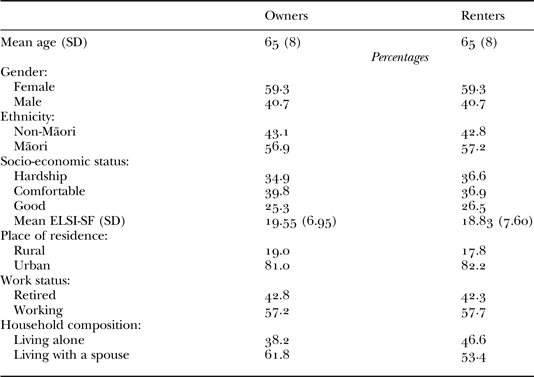
In 2010, N = 2,815 participants provided information about their ownership status in regard to their primary place of residence. Of these, N = 332 were renting and N = 2,483 were owner-occupants. Initial analyses indicated significant differences based on housing tenure in a variety of demographic factors including ethnicity, SES and household composition. To distinguish the effects of tenure from other demographic factors, a case-control matching procedure was applied. For each renter, we selected a home-owner of the same age, gender, ethnicity and SES. With respect to age, a tolerance of plus or minus one year was allowed. When multiple eligible controls were available, the pairs were also matched based on place of residence, working status and household composition. This resulted in a final sample size of N = 664 (N = 332 renters, N = 332 owner-occupants). The demographic characteristics of the sample are reported in Table 1. There were no differences between renters and owners in age, gender distribution, ethnicity, SES, place of residence or working status. However, owners were significantly more likely to be living with a spouse than renters (61.8% versus 53.4%); χ2(1) = 4.64, p = 0.030, Cramer's V = 0.08. Subsequent analyses controlled for household composition.
Demographic description of the sample by tenure group

Notes: SD: standard deviation. ELSI-SF: Economic Living Standards Index Short Form.
Measures
Demographics and SES
Demographic information used for the case-control matching included age, sex, ethnicity (non-Māori versus Māori), household composition (living alone versus living with spouse), working status (retired versus employed), place of residence (rural versus urban) and SES. SES was assessed with the short-form version of the Economic Living Standards Index (ELSI-SF; Jensen, Spittal and Krishnan Reference Jensen, Spittal and Krishnan2005). The ELSI-SF is a 25-item non-monetary indicator of SES in New Zealand assessing a range of financial restrictions in community involvement and social participation (e.g. not being able to visit the hairdresser once every three months because of cost), restriction in living conditions and household facilities (e.g. not having electricity in the house because of cost), economising behaviour (e.g. staying in bed for warmth or not picking up prescriptions because of cost), financial problems (e.g. inability to pay for accommodation or utilities), overall satisfaction with living standards and self-reported adequacy of income. A composite score is derived by summing all items (range: 0–31), with higher scores indicating better economic living standards. The composite score is divided into three levels reflecting severe or significant hardship (range: 0–16), fairly comfortable living standards (range: 17–24) and good living standards (range: 25–31).Footnote 2
Loneliness
The 11-item De Jong Gierveld Loneliness Scale was used to measure social and emotional aspects of loneliness (de Jong Gierveld et al. Reference de Jong Gierveld, van Groenou, Hoogendoorn and Smit2009). Items are rated on a three-point scale (anchored at 1 = no, 2 = more or less, and 3 = yes). Sample items include ‘I experience a general sense of emptiness’ (emotional loneliness) and ‘I can call on my friends whenever I need them’ (reverse-scored, social loneliness). Both social (α = 0.86) and emotional loneliness (α = 0.84) showed acceptable internal consistency.
Quality of life
The CASP-12 is a QoL measure specifically designed for older adults to assess capacity for personal and social agency in the forms of control and autonomy, pleasure, and self-realisation (Wiggins et al. Reference Wiggins, Netuveli, Hyde, Higgs and Blane2008). Participants rate statements such as ‘I feel that what happens to me is out of my control’ (control and autonomy), ‘I feel that the future looks good for me’ (self-realisation) and ‘I feel that my life has meaning’ (pleasure) on a four-point scale (anchored by 0 = never and 3 = often) with scores recoded as needed such that increasing scores indicate a better QoL. The scales demonstrated acceptable internal consistency both in 2010 (control and autonomy: α = 0.67; pleasure: α = 0.82; self-realisation: α = 0.80) and 2012 (control and autonomy: α = 0.63; pleasure: α = 0.85; self-realisation: α = 0.82).
Data analysis
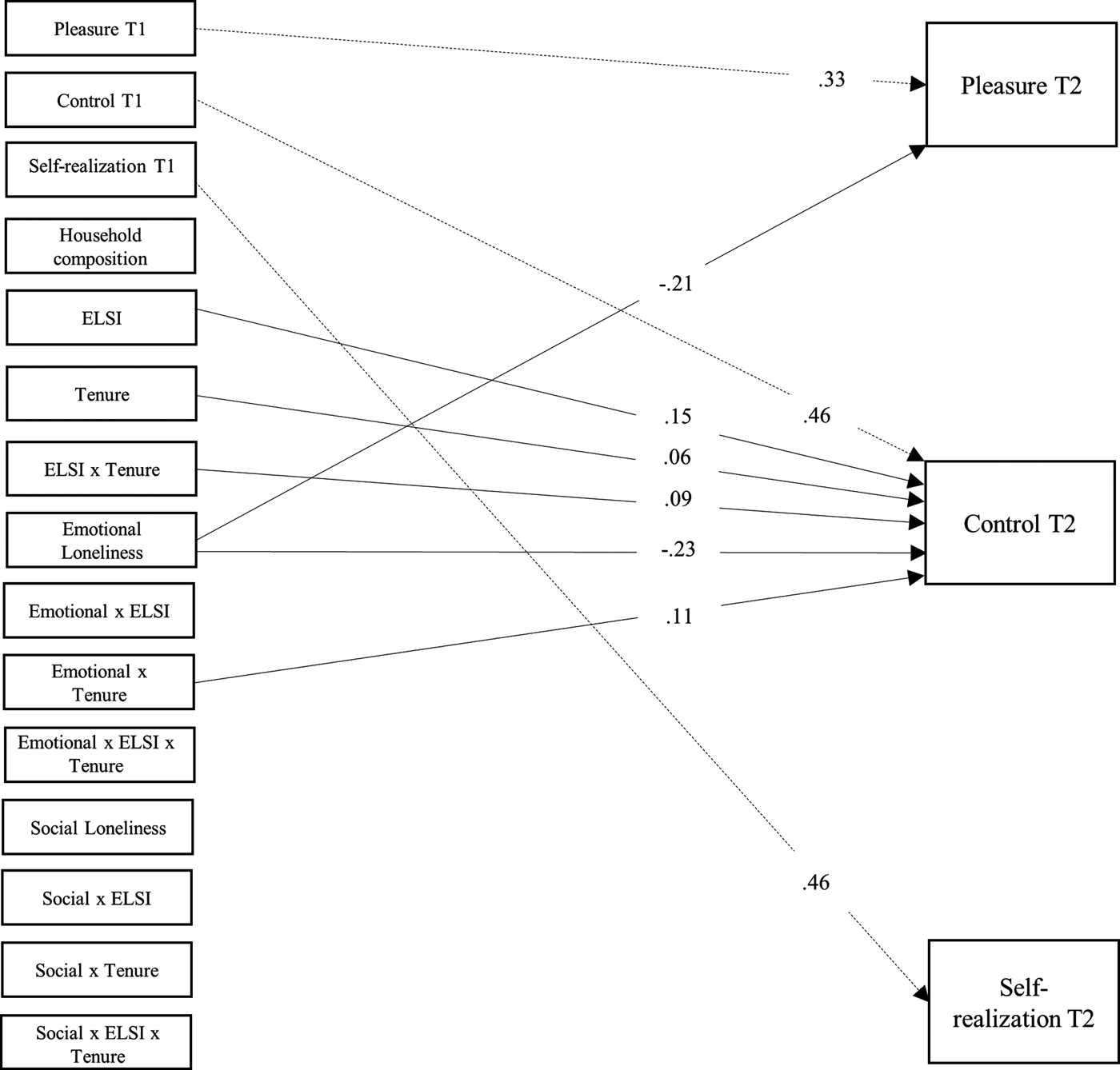
Structural equation modelling was performed in Mplus using maximum likelihood estimation with robust standard errors. The dependent variables (DVs) were control and autonomy, pleasure, and self-realisation measured in 2012. To facilitate assessment of predictors of longitudinal change, each DV was auto-regressed on to its 2010 measurement. Household composition was included as a control variable. Our measure of SES (ELSI-SF), housing tenure, social loneliness and emotional loneliness were entered as main effect predictors. Seven interaction terms were added to the model: ELSI-SF × tenure, emotional loneliness × tenure, social loneliness × tenure, emotional loneliness × ELSI-SF, social loneliness × ELSI-SF, emotional loneliness × tenure × ELSI-SF, social loneliness × tenure × ELSI-SF. The ELSI-SF × tenure interaction term was included to investigate the combined effects of home-ownership and SES on QoL. To test tenure as a moderator in the relationship between loneliness and QoL, the emotional loneliness × tenure and social loneliness × tenure interaction terms were entered. In addition, we explored a potential interaction effect between emotional loneliness, social loneliness and ELSI-SF and two three-way interactions among emotional loneliness, ELSI-SF and tenure, and social loneliness, ELSI-SF and tenure. The model accounted for the shared variance among the DVs and the predictor variables by allowing error terms to be correlated. Simple slope analyses for significant interaction effects were conducted using ModGraph (Jose Reference Jose2013). The following fit indices were used to evaluate model fit: chi-square and degree of freedom ratio (χ2/df), comparative fit index (CFI), root mean square error of approximation (RMSEA) with its confidence interval (CI), and the standardised root mean square residual (SRMR). A χ2/df smaller than 2.5, a CFI higher than 0.95, an RMSEA lower than 0.06 and SRMR lower than 0.08 were considered to indicate acceptable model fit (Hu and Bentler Reference Hu and Bentler1999; Tabachnick and Fidell Reference Tabachnick and Fidell2007).
Analytic model displaying significant parameter estimates (beta values) only.

Results
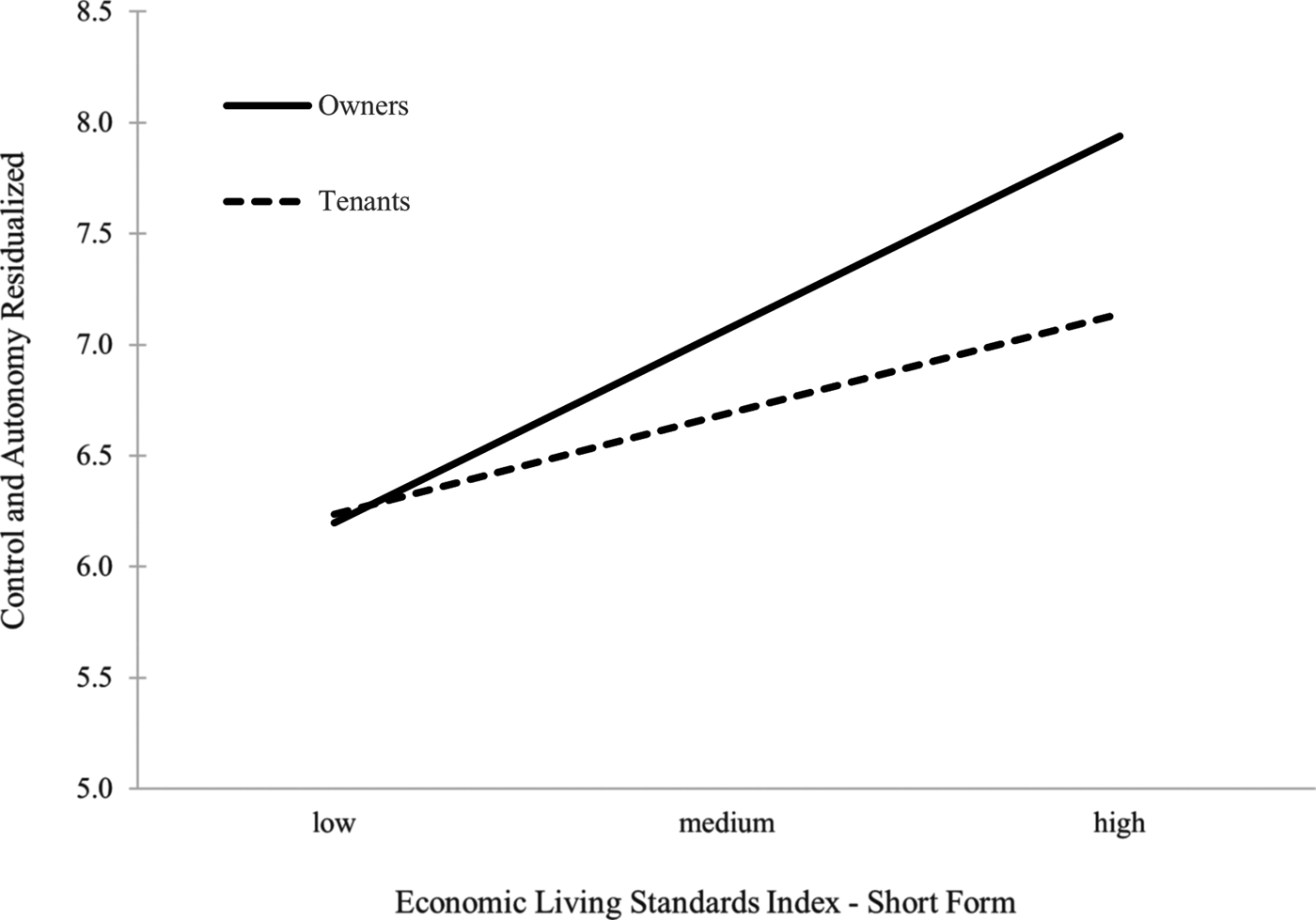
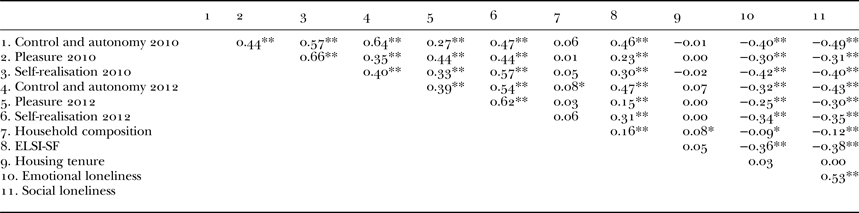
Bivariate correlations between the study variables are reported in Table 2. The analysis model yielded an acceptable fit to the data (χ2 = 18.55, df = 6, p = 0.005, χ2/df = 3.09, CFI = 0.987, RMSEA (90% CI) = 0.056 (0.028, 0.086), SRMR = 0.014; Figure 1). ELSI (β = 0.15, p = 0.001) and housing tenure (β = 0.06, p = 0.046) were both significant positive predictors of control and autonomy over time. However, they had no significant longitudinal impact on pleasure or self-realisation. Furthermore, ELSI and housing tenure significantly interacted to predict control and autonomy over time (β = 0.09, p = 0.026). Simple slope analyses were conducted to interpret the interaction effect. Analyses showed that housing tenure enhanced the positive effects of ELSI on control and autonomy over time (Figure 2). ELSI was associated with much greater increments in control and autonomy in the owner group; t(660) = 21.91, p < 0.001. For the tenant group, the association was positive but substantially weaker; t(660) = 9.80, p < 0.001.
Housing tenure enhances the relationship between socio-economic status (measured in the form of economic living standards) and control and autonomy over time.

Correlations among the variables of interest

Notes: Household composition: 0 = neither married nor in a de facto relationship, 1 = married or in a de facto relationship. Housing tenure: 0 = renter, 1 = owner. ELSI-SF: Economic Living Standards Index Short Form.
Significance levels: * p < 0.05, ** p < 0.01.
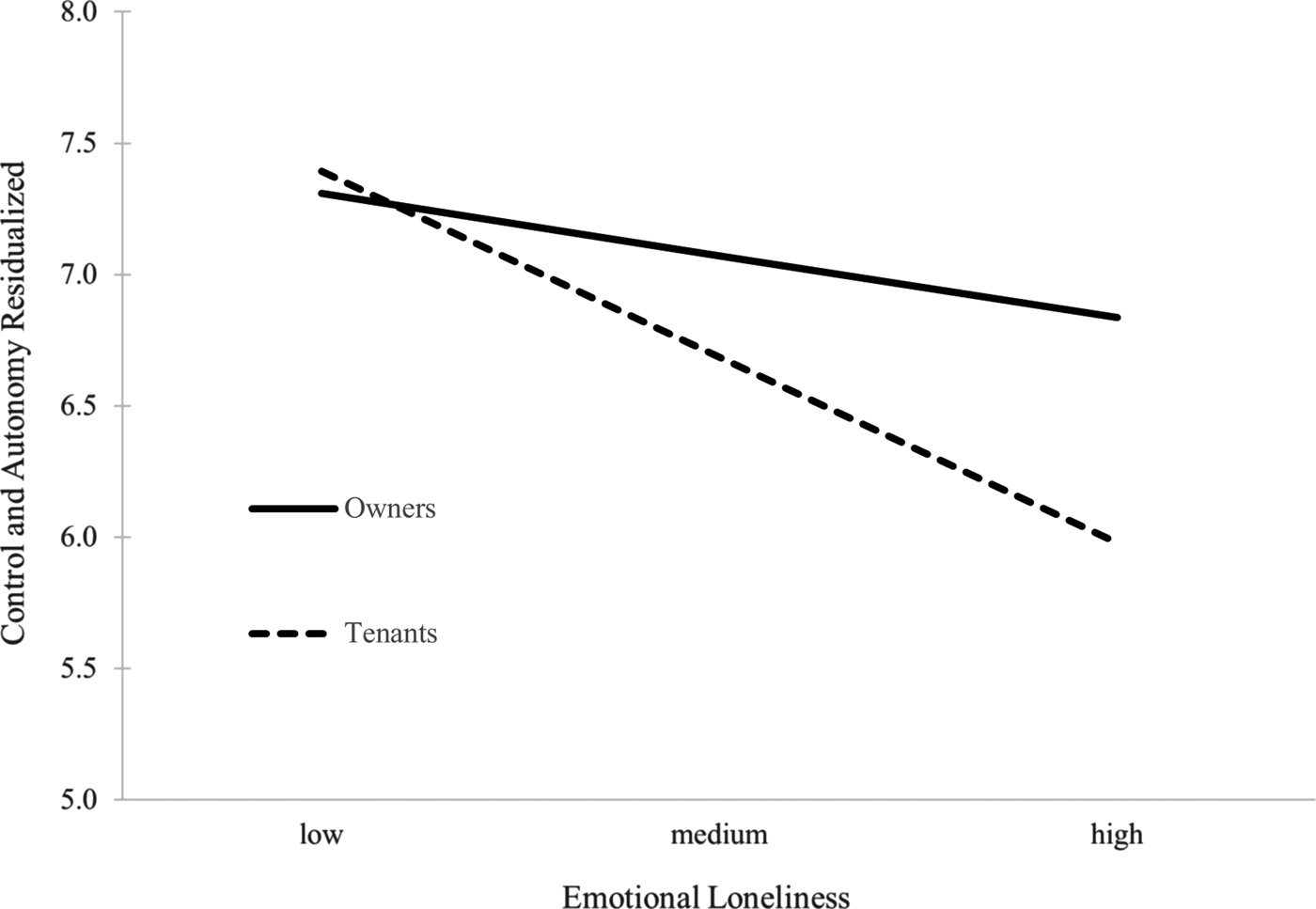
Emotional loneliness negatively predicted control and autonomy (β = −0.23, p < 0.001) and pleasure (β = −0.21, p < 0.001) over time. The interaction term between emotional loneliness and housing tenure predicting control and autonomy was also significant (β = 0.11, p = 0.035). Analyses indicated that tenure buffered the negative effects of emotional loneliness (Figure 3). Specifically, emotional loneliness was related to decreased levels of control and autonomy for tenants (t(660) = −4.15, p < 0.001) but not for owners (t(660) = −1.50, not significant). There was no significant three-way interaction of tenure, SES and emotional loneliness or social loneliness in the prediction of QoL.
Housing tenure buffers the relationship between emotional loneliness and control and autonomy over time.

Discussion
The objectives of the present study were to test whether home-ownership promotes QoL over time among older New Zealanders, whether this differs across SES groups and whether housing tenure moderates the negative effects of loneliness. To address this, the current study drew upon longitudinal data on self-reported QoL from a random community sample of older persons. To isolate the effect of housing tenure from other socio-economic factors (such as income, employment status or assets), the current analyses modelled the main effect of SES, and employed a matched sampling design to reduce issues of interdependence between housing tenure and other socio-demographic characteristics. Finally, an analysis model simultaneously estimating predictors of three dimensions of QoL was implemented to identify whether the influence of tenure functioned through promotion of a sense of control and autonomy for older persons, or associations of QoL with home-ownership represented a more general promotion of life quality (as assessed by pleasure and self-realisation).
The effect of home-ownership beyond socio-economic status
First, we aimed to gain a better understanding of how variation in SES within tenure categories impacts QoL over time. Results indicated that both SES and housing tenure were significant predictors of control and autonomy. This finding demonstrates that when accounting for variation in SES both between and within tenure categories, home-ownership still contributes unique variance to the model by exerting a positive effect on control and autonomy in New Zealand. Von dem Knesebeck et al. (Reference Von dem Knesebeck, Lüschen, Cockerham and Siegrist2003) documented the same effect in the USA but not in Germany.
As hypothesised, neither ELSI nor housing tenure had significant effects on pleasure and self-realisation over time. This is in line with theoretical models, such as the safe haven hypothesis (Kearns et al. Reference Kearns, Hiscock, Ellaway and McIntyre2000), which suggest that the benefits afforded by home-ownership influence specific aspects of life quality, as opposed to promoting a more generally enhanced QoL. Indeed, while longitudinal changes pleasure were associated with baseline loneliness, changes were not associated with economic indices. The current results suggest that home-ownership can contribute to the human need for control and autonomy but it does not necessarily lead to an increased sense of self-fulfilment and pleasure. This finding is in line with previous quantitative and qualitative studies that highlighted control, freedom of choice and sense of power as the most important gains older home-owners attribute to their house (Andersen Reference Andersen2011; Kearns et al. Reference Kearns, Hiscock, Ellaway and McIntyre2000; Saunders Reference Saunders1990).
As previous research has suggested that the psychological benefits derived from home-ownership might vary by SES (Zumbro Reference Zumbro2014), we tested for an interaction between housing tenure and SES in the prediction of QoL over time. Our findings indicted that housing tenure and SES significantly interacted in the prediction of control and autonomy. Specifically, higher economic living standards were associated with increased sense of control and autonomy over time and this effect was stronger for home-owners. For participants with low economic living standards, feelings of autonomy and control were not influenced by their tenure status. However, among those with higher economic living standards, the gap between home-owners and tenants in control and autonomy feelings became larger.
In contrast to Rohe and Stegman (Reference Rohe and Stegman1994) and Zumbro (Reference Zumbro2014), who found that home-ownership led to higher levels of life satisfaction for low-income families, our findings suggest that older adults with good or comfortable living standards gained significantly more control and autonomy from their ownership status than their peers (with similar demographic and socio-economic characteristics) residing in rental dwellings. An important difference between the present study and the research conducted by Rohe and Stegman and Zumbro is that their outcome variable was life satisfaction, whereas we assessed control and autonomy, pleasure, and self-actualisation as indicators of QoL. Although concurrent analyses indicated that SES was significantly associated with all three aspects of QoL at baseline, housing tenure and SES exerted significant longitudinal effects only on control and autonomy.
Becoming a home-owner could have a stronger positive impact on the evaluation of life as a whole for older individuals of lower SES compared to those whose life conditions were already comfortable. On the other hand, to be able to exert control and actively influence one's environment and to participate in the community without restrictions, some basic financial and economic resources are often necessary. This would explain why the effects of home-ownership on sense of control and autonomy are more pronounced in the higher SES groups.
Home-ownership as a buffer against loneliness
The interaction of emotional loneliness and housing tenure in the prediction of future ratings of control and autonomy indicates that tenure also functioned as a buffer against the harmful effects of emotional loneliness for older people. Emotional loneliness was associated with lower levels of control and autonomy feelings and pleasure over time. However, social loneliness was unrelated to changes in QoL. These findings partially support previous research suggesting that feelings of emotional loneliness contribute to decline in wellbeing and health among older adults (Cacioppo et al. Reference Cacioppo, Hughes, Waite, Hawkley and Thisted2006; Luanaigh and Lawlor Reference Luanaigh and Lawlor2008). In addition to this main effect, emotional loneliness interacted with housing tenure in predicting changes in control and autonomy.
Specifically, feelings of loneliness were related to a decreased sense of control and autonomy for tenants, but not for home-owners. This finding is in line with the safe haven hypothesis suggesting that home can provide a refuge from stressors for owner-occupants (Kearns et al. Reference Kearns, Hiscock, Ellaway and McIntyre2000). Home-owners also tend to be more integrated into the neighbourhood and have more relationships, while tenants are less invested to develop social connections in the community (Sixsmith and Sixsmith Reference Sixsmith and Sixsmith2008; Wiles et al. Reference Wiles, Leibing, Guberman, Reeve and Allen2012). Renting is also associated with a lowered sense of financial and ontological security (Kearns et al. Reference Kearns, Hiscock, Ellaway and McIntyre2000), which in combination with loneliness can lead to feelings of powerlessness and lack of autonomy. Interestingly, tenure did not interact with emotional loneliness to predict pleasure and self-realisation, indicating that ownership status may not have the capacity to promote every aspect of QoL. Furthermore, there was no interaction between tenure and social loneliness. This suggests that home-ownership acts as a buffer only when older adults experience emotional loneliness, but it does not necessarily function as a protective factor when people find their social relationships to be unsatisfactory. This further supports the benefits of home-ownership, specifically in relationship to psychological wellbeing.
Limitations and strengths
The predictor variables together explained 6, 4.4 and 3 per cent of unique variance in the statistical models of change in control and autonomy, pleasure, and self-realisation, respectively. This indicates a small to medium effect. However, it is worth highlighting that change was estimated using residualised scores. The Time 1 score is always the single best predictor of the later assessment and by including it in the predictive model the range of variance that can be uniquely explained by other predictors becomes more restricted. On the other hand, residualised scores are adjusted for baseline variance and are less restrictive and more plausible than difference scores, especially for measures that are not stable over time (Gollwitzer, Christ and Lemmer Reference Gollwitzer, Christ and Lemmer2014).
Although the focus of the present study was on understanding the impact of housing tenure in the older population, most of the sample were young-old adults transitioning from work to retirement, as indicated by the high percentage of participants in active employment (approximately 57%). It is unclear whether the effects of housing tenure get stronger over time or the gap between home-owners and tenants is closing as people reach the fourth age. Findings should also be replicated with similar groups in other socio-cultural contexts. In New Zealand, home-ownership is the norm and renters are mainly low-income residents. It is unclear whether home-ownership would have similar benefits with respect to autonomy and control in countries where life-long renting is a common practice and renters are better protected by law.
In addition to the longitudinal design, the paper possesses some other clear strengths. The positive effects of home-ownership were investigated over time by predicting change in sense of control and autonomy, pleasure, and self-realisation with a matched sample of home-owners and tenants, thus reducing selection bias and controlling for socio-demographic confounders. Furthermore, the present study examined home-ownership not only as a predictor of QoL but also as a protective factor against loneliness. To our best knowledge, this was the first investigation of housing tenure as a moderator in the relationship between loneliness and QoL.
Finally, we used a comprehensive and broad spectrum measure of SES that was designed for and validated with older New Zealanders. It is important to recognise that people's relative socio-economic position is influenced by a range of factors, including income, education, occupation, access to resources or accumulation of wealth (Baker Reference Baker, Cockerham, Dingwall and Quah2014). It has been recommended that the conceptualisation of SES for older people in affluent societies should take into account material resources and deprivation, physical circumstances and restrictions in social participation (Fergusson et al. Reference Fergusson, Hong, Horwood, Jensen and Travers2001; Jensen, Spittal and Krishnan Reference Jensen, Spittal and Krishnan2005). In the New Zealand context, the range of income for older adults in retirement is very limited because of universal superannuation. By using ELSI, a broad-spectrum, non-monetary measure of SES, we obtained a more realistic estimation of the socio-economic position of our participants.
Concluding comments and future directions
The study provides further evidence for the relationship between home-ownership and QoL in the control and autonomy domain. Furthermore, it demonstrates the capacity of housing tenure to act as a protective factor against life stressors in old age, such as loneliness. There are a number of potential mechanisms through which tenure can exert its protective impact. In addition to housing quality (Macintyre et al. Reference Macintyre, Ellaway, Hiscock, Kearns, Der and McKay2003), social support, sense of security and place attachment have been suggested as important variables influenced by home-ownership that are predictive of QoL (Oswald et al. Reference Oswald, Jopp, Rott and Wahl2011; Woldoff Reference Woldoff2002). Understanding by what means housing tenure facilitates wellbeing of older adults should be a focus of future research.
A house can provide a sense of freedom, autonomy, control and status for occupants, which are key indicators of QoL in old age. However, our research indicates that older renters in New Zealand do not derive the same benefits from their homes as owners. Although home-ownership is still the norm and preferred tenure among New Zealanders, achieving home-ownership has become increasingly difficult (Ministry of Social Development 2014). In a housing market where demand is higher than the supply, renters are especially vulnerable and are likely to perceive a reduced sense of control over their housing decisions.
There is consensus among policy makers and health-care professionals that enabling older people to age in their own communities and, when possible, continue living in their own homes should be the main objective of policies designed to promote healthy ageing (Organisation for Economic Co-operation and Development 1994). Furthermore, studies suggest that remaining in the community, as opposed to admission into residential care, is the most favoured option by older people themselves (Burnholt and Windle Reference Burnholt and Windle2001). However, according to a systematic review by Gibson et al. (Reference Gibson, Petticrew, Bambra, Sowden, Wright and Whitehead2011), interventions are generally aimed at improving area characteristics and housing conditions as opposed to promoting affordable home-ownership or alternative types of tenure. Based on our findings and in line with the international literature, it is recommended that policies around ageing should have a priority focus on providing secure and stable housing, whether rented or owned, for all older people to enable them to maintain their sense of control and autonomy, thus promoting QoL.
Acknowledgements
This work was funded by the Health Research Council of New Zealand (HRC05/311), The Foundation for Research Science and Technology (MAUX0606), the Ministry of Science and Innovation (MAUX1205), and the Ministry of Business, Innovation and Employment (MAUX1403). This research project was approved by the School of Psychology's Human Ethics Committee at Massey University. The authors declare no conflicts of interest.