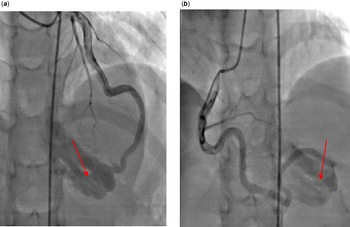
Coronary artery fistulas are rare cardiac anomalies. Echocardiography has a key role for the diagnosis of congenital and acquired heart defects, but it has limitations in detail coronary visualisation and shunt assessment of the fistulas. Here, we present an interesting case of two coronary artery fistulas originating, respectively, from right coronary artery and left anterior descending artery, and draining into the right ventricular apex at the same site.
Case presentation
A 9-year-old boy, on incidental detection of murmur, otherwise asymptomatic, presented for outpatient cardiology review. His cardiovascular examination was unremarkable except for grade 3/6 continuous murmur heard at the level of the lower left sternal border.
Transthoracic echocardiography revealed dilated coronaries measuring 5 mm each & a continuous turbulent flow in colour Doppler analysis of left anterior descending artery coursing along the lateral wall of left ventricle and draining into the right ventricular apex. There was another abnormal vessel with continuous turbulent flow around the same drainage site, but it could not be profiled well. Cardiac chambers were normal sized with normal left ventricle systolic function.
CT coronary angiography confirmed two tortuous dilated coronary artery fistulas draining into the right ventricular apex at the same site. First fistulous vessel was originating from the diagonal branch of left anterior descending artery and second one was from the distal segment of right coronary artery.
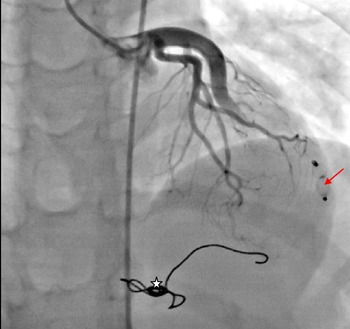
Patient was taken to the cath lab for haemodynamic assessment of the shunt (Qp:Qs 1.6:1) and percutaneous closure of fistulas, if suitable. We successfully occluded the left-sided fistula with 6 mm Amplatzer vascular plug II and right-sided fistula with 6 mm * 14 mm MReye (Cook medical) coil (Figs 1 and 2). Check angiogram after 10 minutes showed no residual fistulous flow with no ST-T changes in ECG. He was discharged the following day on dual anti-platelet therapy daily to prevent thrombosis in the proximal cul-de-sac. The patient had been doing well at 6 months follow-up with normal ECG and echocardiography.
Selective LMCA ( a ) and right coronary artery (RCA) ( b ) angiogram images showing dilated tortuous coronary artery fistulas originating, respectively, from diagonal branch of LAD and distal RCA and draining into the right ventricular apex at the same site (red arrows).

Fluroscopic image showing occlusion of left-sided coronary artery fistula (CAF) with Amplatzer vascular plug II (red arrow) and right-sided CAF with MReye coil (white star).

Discussion
Coronary artery fistula is a rare abnormal direct communication between an epicardial coronary artery and a cardiac chamber (cameral) or a major blood vessel (arterio-venous), without intervening myocardial capillary bed. Reference Yun, Nam and Chun1 Historically, coronary angiography has been used as a reference standard imaging modality for diagnosis of coronary artery fistulas with a reported incidence of 0.08% to 0.3% Reference Mangukia2,Reference Mavroudis, Backer, Rocchini, Muster and Gevitz3 ; but with the advent of novel cardiac imaging techniques, particularly echocardiography and cardiac CT, there is an increasing rate of detection of these fistulas. Reference Yamanaka and Hobbs4,Reference Lim, Jung, Lee and Lee5
Coronary artery fistulas are mostly solitary; frequently originating from right coronary artery (50–60%) than left side (45%). Reference McNamara and Gross6,Reference Qureshi7 But at times they could be multiple; only 3–5% of coronary artery fistulas are reported to originate from both coronary arteries (as in the case presented above). Reference Ata, Turk, Bicer, Yalcin, Ata and Yavuz8
Although coronary artery fistulas are mostly asymptomatic; but if untreated, haemodynamically significant fistulas cause clinical symptoms of heart failure, pulmonary hypertension, or angina in 19% of patients <20 years and in 63% of older patients. Reference Chia, Chan, Tan, Ng and Chiang9 In general, the indication for intervention is haemodynamically significant shunt, regardless of symptoms to prevent the occurrence of fistulous-related complications such as aneurysmal formation, infective endocarditis, arrhythmias, premature atherosclerosis, and sudden death, Reference Liberthson, Sagar, Berkoben, Weintraub and Levine10 and also there is low probability of spontaneous closure of coronary artery fistuls (1–2%). Reference Cotton11–Reference Buccheri, Luparelli, Chirco, Piraino, Andolina and Assennato13
The ACC/AHA Guidelines for the Management of Adults with CHD recommend either surgical ligation or transcatheter closure as both have comparable success rates, morbidity, and mortality (<1%) outcomes. Reference Buccheri, Luparelli, Chirco, Piraino, Andolina and Assennato13–Reference Uyar, Akpinar, Senarslan, Sahin and Uc15 Percutaneous approach is recommended over surgery, if anatomy of the fistula is favourable for the transcatheter technique.
Implications in clinical practice
Our case is unusual in a way that it involved a combination of two separate coronary artery fistulas from both the coronary systems draining into the same site. We stress on the importance of using different multimodality imaging techniques for detailed anatomic delineation of the fistulas to guide the selection of appropriate interventional techniques.
Acknowledgements
None.
Financial support
The authors received no specific grant from any funding agency, commercial, or not-for-profit sectors.
Conflicts of interest
None.