1. Introduction
Children with specific language impairment (SLI) form a non-homogenous group by demonstrating variable deficits in different components of grammar (syntax, morphology, phonology) as well as in vocabulary and lexicon in the absence of other factors that typically accompany language problems (such as hearing impairment, low non-verbal IQ, neurological damage, or socio-emotional deprivation); see e.g., Bishop (Reference Bishop2006) for a comprehensive overview. It is widely recognized that children with SLI are notoriously delayed in the emergence of first words and continue to exhibit limited vocabularies as they grow older, even into adulthood (Elbro, Dalby & Maarbjerg, Reference Elbro, Dalby and Maarbjerg2011, and references within).
A core cross-linguistic feature in lexicon research is a deficit in the acquisition of verbs evident in monolingual children with SLI (Kambanaros, Psahoulia & Mataragka, Reference Kambanaros, Psahoulia, Mataragka, Vogindroukas, Okalidou and Stavrakaki2010b; Rice, Reference Rice, Levy and Schaeffer2003; Sheng & McGregor, Reference Sheng and McGregor2010; Stavrakaki, Reference Stavrakaki2000), which we have recently extended to bilingual children with SLI (Kambanaros, Grohmann & Theodorou, Reference Kambanaros, Grohmann, Theodorou and Botinis2010a). This is based on measures of vocabulary size and on the total number of different words produced in spontaneous speech. Experimental research into bilingual (a)typical lexical development is on the increase; however, as far as we are aware, no study has yet tackled children who grow up in a speaker community of diglossia (e.g., Norway, Switzerland) or are otherwise exposed to two very closely related varieties from early on (such as German–Dutch or Dutch–Flemish combinations).Footnote 1
The target groups of children for the present study include Greek Cypriot children who grow up with their native non-codified variety of Cypriot Greek as well as the official language of the country, Demotic Greek (referred to by linguists as Standard Modern Greek). The main goal is to explore grammatical category dissociations with a focus on verbs versus nouns in the expressive language on the task at hand in bilectal children from two perspectives: Do bilectal children with SLI differ from typically developing children? And do bilectal children generally differ from either monolingual or bilingual children? That is, the present study does not investigate picture-naming in all of a child's languages (or varieties or dialects, etc.); rather, it assesses expressive use of the concepts depicted in the task for Greek (with lexical items from either variety, Cypriot or Standard, as justified below).
Investigating grammatical category dissociations at the lexical/word level constitutes an emerging area of more specific research in SLI. So far, two groups of studies have examined word retrieval for both categories, nouns and verbs, in the same group of children with SLI across different languages. A study on English (Sheng & McGregor, Reference Sheng and McGregor2010), arguably a minimally inflected language, and research on Standard Modern Greek (Kambanaros et al., Reference Kambanaros, Psahoulia, Mataragka, Vogindroukas, Okalidou and Stavrakaki2010b), a highly inflected language, both revealed that verbs are more vulnerable to word retrieval difficulties in SLI than nouns. This cross-linguistic finding constitutes first evidence identifying dissociations for grammatical word class processing in the light of developmental language disorders. Such line of research may shed light on the role of grammatical category in the organization of the lexicon in children, shared across languages.
The present paper reports single-word picture-naming accuracies in young Greek Cypriot children with SLI, and their age- and language-matched unimpaired peers, in order to explore a possible dissociation in naming for nouns and verbs – and, if there is one, how this dissociation may be explained using a psycholinguistic framework of language production (e.g., Levelt, Reference Levelt1989, Reference Levelt2001) applicable to bilectal populations (de Bot, Reference de Bot2004). It extends our earlier small-scale research (Kambanaros et al., Reference Kambanaros, Grohmann, Theodorou and Botinis2010a), as laid out in detail in the following section, by employing the same methodology and investigating the same language – Greek. What makes this extension special, however, is the particular population investigated: Greek Cypriot children, who grow up with their native variety of Cypriot Greek in a diglossic setting alongside Standard Modern Greek as the official language, which children learn formally in the course of their education. With both varieties very closely related to one another, these children will be termed bilectal, borrowing the notion of “(discrete) bilectalism” for individuals within diglossic speaker communities from Rowe & Grohmann (Reference Rowe and Grohmann2013). In this sense, it remains to be seen whether the children under investigation behave more like monolingual or rather like bilingual children.
A major aim of this paper is, then, to address the question whether grammatical category deficits arise in children with SLI (in the absence of forthright neurological signs) from damage to knowledge about certain aspects of word meaning or to loss of access to morphosyntactic information about one category of words. In addition, we hope to kick-start more research into the relevance of bilectalism for (a)typical language development by relating findings from bilectal children to mono- versus bilingual children (with or without language impairment).
2. Lexical processing of verbs and nouns
2.1 On verbs and nouns
Verbs and nouns are (near-)universal categories across languages but differ very much in their denotations. As proposed within the natural partitions hypothesis (Gentner & Boroditsky, Reference Gentner, Boroditsky, Bowerman and Levinson2001), nouns and verbs are highly variable in meaning. Verbs express events at large, that is, what happens to things (articulating the Vendlerian classification into states, activities, achievements, and accomplishments), while nouns typically denote enduring entities (such as people and animals as well as objects and concepts). Since verb processing requires an understanding of relational concepts, (transitive) verbs also appear semantically more complex, whereas (concrete) nouns are usually non-relational and only need single-object reference.
Apart from encoding relational concepts, verbs encode diverse concepts such as the path (e.g., push versus pull) or the manner of an action (e.g., jump versus hop); moreover, the central meaning of a verb is linked to two kinds of information, thematic role assignment and argument structure. Furthermore, the same verb often has multiple meanings when accompanied by different nouns, making its underlying meaning less transparent compared to the noun, as in to catch a ball versus to catch Mary versus to catch a cold, for example. Cross-linguistic research suggests that the meanings of verbs are less similar across languages (Gentner, Reference Gentner2006). They are also more constrained by the structure of a specific language than those of concrete nouns – that is, selection at large: case of the objects they take, transitivity, ergativity, telicity, and so on.
Further common explanations for a potential noun advantage coming out of the research focus on a range of factors. These include differences in the acquisition patterns, variability in verb and noun meanings, the complex relationship between verbs and nouns vis-à-vis features such as transitivity, differing linguistic and non-linguistic levels of processing, methodological issues, and parental input. For extensive descriptions of noun–verb disparities in typical language acquisition across languages in reference to these factors, the reader is referred to Gentner (Reference Gentner2006), Imai, Lianjing, Haryu, Okada, Hirsh-Pasek, Golinkoff and Shigematsu (Reference Imai, Lianjing, Haryu, Okada, Hirsh-Pasek, Golinkoff and Shigematsu2008), Maguire, Hirsh-Pasek and Golinkoff (Reference Hirsh-Pasek and Golinkoff2006), and McDonough, Song, Hirsh-Pasek, Golinkoff and Lannon (Reference McDonough, Song, Hirsh-Pasek, Golinkoff and Lannon2011), among others.
2.2 Picture naming
Children learn from a very young age to name pictures as part of early word learning (see Tsybina & Eriks-Brophy, Reference Tsybina and Eriks-Brophy2010, and references within for a clinical perspective). Yet, naming a picture upon request is considered a highly complex linguistic task, since multiple stages are involved with distinct components. When attempting to name a picture, there must be some activation of the concept corresponding to the picture seen (activated via picture-processing mechanisms). Based on psycholinguistic models of lexical production such as Levelt (Reference Levelt1989) and subsequent work, the semantic and syntactic information (i.e. the lemma information) of a lexical entry is needed for grammatical encoding. In the case of an object name (e.g., spade), a noun lemma is activated which specifies other grammatical information about the noun, such as plurality and grammatical gender (depending on the language). In response to an action picture, a verb lemma is activated (Levelt, Reference Levelt1989), specifying information about the verb's argument structure (the noun phrases that go with the verb to make it grammatically acceptable), tense, person, and number, among others – again, highly dependent on the specific language.
For example, the verb dig has two semantic arguments, an agent and a theme; syntactically we say that, as a transitive verb, it takes one object (e.g., The dog digs a hole). At the second stage of word retrieval, the lexeme or word form corresponding to the selected lemma is phonologically specified. Lexemes contain information about the phonology (number of syllables, prosody, segmentation) and morphology (verb/noun inflections) of a word. According to Levelt's model, problems with verbs and/or nouns may arise at any stage in the process of lexical retrieval, i.e. in lexical semantics, lemma, lexeme, or articulation. The reader is referred to Figure 1 for a schematic representation of the different stages involved in naming a picture.
A schematic representation of the different stages involved in picture naming and potential naming errors for each stage after breakdown.

Features intrinsic to the stimulus, such as (picture) complexity and imageability, can influence success in naming. The latter is described as the mental effortlessness with which a word can create a sensory image. For example, the word bed arouses a mental image with relative ease and would thus be rated highly imageable; in contrast, the verb dream(ing) would be rated rather low in imageability. Children with verb difficulties may have trouble identifying the action component when naming static pictures and fail to name actions for that reason (Davidoff & Masterson, Reference Davidoff and Masterson1996). However, Bird, Howard and Franklin's (Reference Bird, Howard and Franklin2003) imageability hypothesis predicts that words learned early tend to be more imageable than later-learned words, independent of language and grammatical word class. Note that verb–noun dissociations were also found in both studies when video-taped stimuli of actions and objects were used instead of pictures.
Furthermore, different characteristics of words can affect naming accuracy such as word frequency, word length, and age of acquisition. These can give an indication as to where the level of the deficit may lie. High-frequency words may be easier to name than low-frequency words, and deficits are assumed to reflect lexical access impairment (Masterson, Druks & Gallienne, Reference Masterson, Druks and Gallienne2008). Age of acquisition reflects the influence of experience with a word and subsequent lexical selection, with earlier acquired words easier to retrieve than later acquired words (Masterson et al., Reference Masterson, Druks and Gallienne2008). Young children place more weight on perceptual feature information for mapping words to concepts, therefore mapping a specific verb onto an action word is considerably more cognitively challenging than mapping an object concept on to a word; see e.g., Maguire et al. (Reference Maguire, Hirsh-Pasek and Golinkoff2006).
2.3 Object and action naming in SLI
Very few studies have compared verb and noun retrieval in typically developing children (but see Imai et al., Reference Imai, Lianjing, Haryu, Okada, Hirsh-Pasek, Golinkoff and Shigematsu2008; Kambanaros, Grohmann & Michaelides, in press; Kauschke, Lee & Pae, Reference Kauschke, Lee and Pae2007; Masterson et al., Reference Masterson, Druks and Gallienne2008; McDonough et al., Reference McDonough, Song, Hirsh-Pasek, Golinkoff and Lannon2011) – and even fewer studies have involved children with SLI. Moreover, from our literature search, no published studies involving bilingual children with and without SLI was found on the topic.
Early research such as Lahey and Edwards (Reference Lahey and Edwards1996, Reference Lahey and Edwards1999) showed that pre-schoolers with SLI were less accurate and slower at naming pictures of common objects than age-matched peers with typical language development (TLD). The most frequent error type was semantic associate errors (e.g., foot for shoe). The authors suggested that such lexical confusion was related to a breakdown at the level of the word form; that is, children with SLI were unable to process form information successfully to retrieve the target word. This was attributed to children with SLI having weakly differentiated and inadequately organized semantic representations.
In a most recent study, Sheng and McGregor (Reference Sheng and McGregor2010) examined the accuracy, latency, and error patterns in the naming of object and action line drawings in a group of children with SLI and compared their responses to vocabulary and age-matched peers. Object and action stimuli were matched on age of acquisition, log word frequency, word familiarity, semantic set size, word length, name agreement, and picture complexity. By and large, object names were longer than action names, and action pictures were significantly more visually complex than object pictures. Imageability of the action and object stimuli was not taken into consideration.
The authors found that the most common error in action naming for the children with SLI was visual errors – mainly misinterpretation, that is, an error that bears a perceptual similarity with the target (but not a semantic one). For example, for the target picture yawning, the response shouting was noted. This substitution is based on an action that involves both a similar body part (e.g., mouth/lips) and body movement (e.g., open mouth position). But most importantly, the two actions might appear difficult to discriminate in a static line-drawing form given that the same motion and body part (i.e. open mouth) is inherent to the conceptualization of both verbs. Of particular interest was the result that the age-matched children also produced a higher rate of misperception errors in action naming, even more than the children with SLI. This type of perceptual error suggests difficulties within the conceptual system prior to (lexical) semantics for children, yet could be related to the different underlying lexical representations for transitive versus intransitive verbs, as in kissing versus singing (Davidoff & Masterson, Reference Davidoff and Masterson1996), or that the imageability of the action pictured stimuli was not controlled for. Furthermore, the SLI group did not use a larger number of general-all-purpose (GAP) verbs to substitute for more specific verbs compared to the age-and language matched groups. In fact, GAP verb use was comparable across the three groups in terms of the total number produced.
In contrast, object pictures most often elicited semantic errors of the taxonomic kind such as coordinates (e.g., “wolf” for goat), subordinates (e.g., “cobra” for snake), and circumlocutions (e.g., “horseback thing” for saddle) for language-impaired and language-unimpaired children. However, the children with SLI made more omissions when naming objects and produced fewer taxonomic errors compared to age-matched peers. Overall, objects elicited more omissions than actions in children with SLI and vocabulary-matched children but not age-matched controls. With regard to naming latency, object naming was significantly faster than action naming for children with and without SLI.
In the by-item analyses, the children with SLI, based on their valid responses for 83% of the object and only 58% of the action targets, performed similarly to vocabulary-matched controls on naming speed, but both groups were slower than the aged-matched group.Footnote 2 The authors explain their results for action and object naming in support of both Kail & Leonard's (Reference Kail and Leonard1986) storage deficit hypothesis and Rice's (Reference Rice, Levy and Schaeffer2003) unified model of SLI. Both hypotheses account for the lexical and semantic deficits in SLI as a by-product of a general delay in language development. It is proposed that the lexicons of children with SLI resemble those of younger typically developing children. Overall, children's difficulties during word retrieval arise because only sparse information about lexical concepts has been mapped, and there are weak semantic associations between related concepts.
3. The current study
Modern Greek is a highly inflected fusional language with a complex morphology (Holton, Mackridge & Philippaki-Warburton, Reference Holton, Mackridge and Philippaki-Warburton1997; Ralli, Reference Ralli2003). Morphophonological word forms are (by and large, unambiguously) inflected according to grammatical category; for instance, karfon-o “hammer-1sg.pres” is a verb and sfir-i “hammer.nom.sg” a noun. Overall, nouns and verbs are differentiated by different suffixes which encode grammatical information such as phi-features (person, number, and, with nouns, gender); nouns are also obligatorily case-marked. Information about grammatical category and morphosyntactic features (such as person, tense, and mood for verbs or gender and case for nouns) are highly prominent as they must be accurately projected, marked, and expressed during single-word production (e.g., [lexical stem + affix]). Verbs and nouns in Greek are considered of similar morphological complexity, given that each word class has several conjugational patterns. However, a fundamental distinction is made between verbal and nominal domains, with verbs exhibiting more complex morphophonological operations (Ralli, Reference Ralli2003).
Cypriot Greek, the dialect of the Modern Greek language spoken in Cyprus and acquired as a first language by the vast majority of local children before the age of five, is an under-described variety. In the context of diglossia in Cyprus (Newton, Reference Newton1972, and a large body of literature since), Standard Modern Greek is the sociolinguistically “High” variety used in schools throughout the entire education system, while Cypriot Greek is the “Low” variety used almost exclusively in oral form and for daily communication (i.e. informal contexts); for more recent perspectives and references, see Grohmann and Leivada (Reference Grohmann, Leivada and Di Sciullo2012), Kambanaros and Grohmann (to appear), and Rowe and Grohmann (Reference Rowe and Grohmann2013). Children are formally introduced to Standard Modern Greek when they enter primary school, but exposure may be more frequent among urban pre-schoolers due to media influence, such as TV programs from Greece broadcast in Standard Modern Greek.
In the present study, we address the nature of verb–noun dissociations in Greek Cypriot children with SLI building on the results of our previous small-scale studies for Cypriot Greek (Kambanaros & Grohmann, Reference Kambanaros, Grohmann, Franich, Keil, Iserman and Chandlee2010; Kambanaros et al., Reference Kambanaros, Grohmann, Theodorou and Botinis2010a) and Standard Modern Greek (Kambanaros et al., Reference Kambanaros, Psahoulia, Mataragka, Vogindroukas, Okalidou and Stavrakaki2010b). While formal differences between the dialect and the standard language – i.e. Cypriot Greek and Standard Modern Greek – abound on the phonetic, phonological, morphological, and syntactic side (from some recent discussion and references, see Grohmann & Leivada, Reference Grohmann, Leivada and Di Sciullo2012), these are irrelevant for single-word naming. The relevant aspects of the two grammars are constant: both are highly inflected linguistic varieties in which all word forms need to be properly inflected, through [stem + affix (+ affix)]. Of course, individual lexical items may vary between the two varieties (see Sections 4.2 and 5.4 below). However, these differences do not affect argument structure or other grammatical properties.
We have previously claimed that word-finding or lexical retrieval deficits for object and action names in Greek-speaking children with SLI (and/or word-finding difficulties) resulted from underlying morphophonological processing differences and inadequate storage of phonological and semantic information in the lexicon for grammatical word classes (Kambanaros & Grohmann, Reference Kambanaros, Grohmann, Franich, Keil, Iserman and Chandlee2010; Kambanaros et al., Reference Kambanaros, Grohmann, Theodorou and Botinis2010a).Footnote 3 We will revisit the main positions that have emerged in the recent exploration on this topic for Greek and English, and reconsider our findings in light of a more detailed psycholinguistic interpretation of our results. Our main goal is to determine whether bilectal children with SLI present with general word-finding difficulties that include nouns and verbs uniformly or whether bilectal children with SLI have a verb deficit per se, that is, show a grammatical word class dissociation favoring nouns given the current evidence irrespective of language type. Note, for example, that nouns and verbs are typically not morphologically differentiated in English and many verbs are created from existing nouns, as in (the) hammer versus (to) hammer. Of equal importance is the task to decipher whether potential noun–verb differences reflect conceptual-semantic representation or other types of differences such as grammatical ones. Finally, findings from previous studies (for English) attribute weaknesses in word retrieval to degradations in phonological and semantic representations as well as reduced general processing speed (Lahey & Edwards, Reference Lahey and Edwards1996, Reference Lahey and Edwards1999; Mainela-Arnold, Evans & Coady, Reference Mainela-Arnold, Evans and Coady2010). We aim to contribute to the current understanding of such weaknesses in word retrieval in bilectal children with SLI by examining a highly inflected language, Greek.
Beyond reporting whether Greek Cypriot children with SLI are less accurate than age-matched peers with TLD acquiring Greek on naming pictures of objects and actions, the aims of this study are five-fold:
1. to investigate grammatical word class effects (i.e. N < V or V < N or V = N) in naming performances between bilectal children with SLI and their peers with TLD;
2. to examine naming errors with reference to psycholinguistic models of word processing (e.g., Levelt, Reference Levelt1989);
3. to describe the effects on naming accuracies induced by lexical (e.g., word frequency) and other psycholinguistic variables (e.g., age of acquisition and picture imageability and complexity);
4. to contribute to the current understanding of how verbs and nouns are organized in the mental lexicon of children with SLI by comparing our findings for Greek with English;
5. to determine whether bilectal children behave more like monolingual or rather like bilingual children on the action and object picture-naming task employed here.
4. Method
4.1 Participants
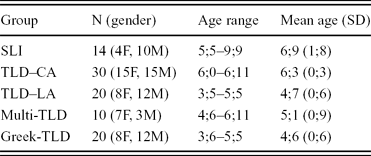
Sixty-four Greek Cypriot bilectal children participated in the present study; they were divided into three experimental groups:
• 14 children with SLI (4 girls and 10 boys), aged between 5;5 and 9;9 years (mean age: 6;9, standard deviation 1;8), serving as the clinical research group (henceforth, “SLI”);
• 30 first-graders with TLD (15 girls and 15 boys), aged between 6;0 and 6;11 years (mean age: 6;3, standard deviation 0;3), serving as the chronological age control group for the children with SLI (henceforth, “TLD–CA”);
• 20 pre-school children with TLD (8 girls and 12 boys), aged between 3;5 and 5;5 years (mean age: 4;7, standard deviation 0;6), serving as the language-matched age control group for the children with SLI (henceforth, “TLD–LA”).
The children with TLD were recruited randomly from three public primary schools and one kindergarten in the Nicosia and Limassol districts after approval from the Ministry of Education and Culture and upon written parental consent. No child classified as TLD received speech and language therapy or special education services. The children with SLI were recruited from speech and language therapists from public primary schools and therapists from private practices. All children with SLI were in mainstream education and in the school grade corresponding to their chronological age. Twelve of the children with SLI were receiving speech therapy at the time of the study, and three attended special education services separate from their classmates and the regular classroom (i.e. pull-in/out service model; see Dockrell & Lindsay, Reference Dockrell, Lindsay, Norbury, Tomblin and Bishop2008).
Participant selection criteria included a Cypriot Greek-speaking family background and no history of neurological, emotional, or behavioral problems. Hearing and vision were adequate for test purposes and all participants exhibited normal performance on a screening measures of non-verbal intelligence (Raven's Colored Progressive Matrices; Raven, Raven & Court, Reference Raven, Raven and Court2000) or as reported by school psychologist. The children had normal articulation, showed no gross motor difficulties, and came from families of medium to high socio-economic status.
The children with SLI were diagnosed prior to the study using a battery of norm-referenced tests for Standard Modern Greek by the first and fourth authors, both certified speech and language therapists with over thirty-five years clinical experience between them, with guidance by the second author, an expert in theoretical and comparative linguistics. The non-verbal performance of all children with SLI was assessed using the Raven's Colored Progressive Matrices (Raven et al., Reference Raven, Raven and Court2000).Footnote 4
For the purpose of the present study, the children with TLD serving as language-matched controls were matched with the SLI group based on the children's scores on the standardized Standard Modern Greek version (Vogindroukas, Protopapas & Sideris, Reference Vogindroukas, Protopapas and Sideris2009) of the Renfrew Word-Finding Vocabulary Test (Renfrew, Reference Renfrew1997). Appendix 1 contains information from both the CA and the LA children.
In addition, the performance of our experimental groups with regard to verb- and noun-naming accuracy was compared to two groups of typically developing pre-schoolers from Cyprus and Greece who were tested on the same research tool (i.e. the COAT and GOAT, respectively, as presented in Section 4.2):
• 10 multilingual children with TLD from Cyprus (7 girls and 3 boys), aged between 4;6 and 6;11 years (mean age: 5;1, standard deviation 0;9), serving as a multilingual control group for the TLD–LA experimental group (henceforth, “multi-TLD”);
• 20 monolingual pre-school children with TLD from Greece (8 girls and 12 boys), aged between 3;6 and 5;5 years (mean age: 4;6, standard deviation 0;6), serving as the monolingual control group for the TLD–LA experimental group (henceforth, “Greek-TLD”).
The pre-schoolers from monolingual Greek backgrounds residing in mainland Greece tested on the GOAT are described in Kambanaros, Georgopoulos, Lymberidis and Skoufi (Reference Kambanaros, Georgopoulos, Lymberidis and Skoufi2013).Footnote 5 The multilingual children from Cyprus were exposed to Cypriot Greek and a second language (either English or Russian) because of a one-parent–one-language background home, with schooling instruction in Standard Modern Greek, are reported in Kambanaros, Grohmann, Michaelides and Theodorou (published online 19 July Reference Kambanaros, Grohmann, Michaelides and Theodorou2012, doi:10.1080/14790718.2012.705846).
All relevant participant details are listed in Table 1.
Details for all participants.
N = number (of participants); F = female; M = male; SD = standard deviation; SLI = (children with) specific language impairment; TLD = (children with) typical language development; LA = language age-matched; CA = chronological age-matched; multi = multilingual
We chose to use pre-schoolers that are at least two years younger than our experimental with SLI given the lower level of language performance than expected for the chronological age of the impaired group (see Appendix 1). In addition, we note the difficulty of “simple” bilingual children in Cyprus: In the context of diglossia, all children acquire Cypriot Greek (the sociolinguistically “Low” variety, which may itself come in different forms or lects) and Standard Modern Greek (the “High” variety with the orthographic system that has to be learned by all children in school). That is, even “true bilingual” children growing up with, say, Greek and Russian or Greek and English, still exhibit this additional factor. The bigger picture of this research, then, aims at identifying this “additional factor” which we assume to be (discrete) bilectalism here (Rowe & Grohmann, Reference Rowe and Grohmann2013) and characterizing its relevance for child language development. For example, if bilectal children develop in their linguistic varieties differently from bilingual children, how so? Or is bilectalism best understood as a form of (simultaneous or sequential) bilingual first language/dialect acquisition, or is it more like early second language/dialect acquisition? Some of these questions are starting to be asked now, as can be witnessed in recently published research such as Siegel (Reference Siegel2010) or Aronin and Singleton (Reference Aronin and Singleton2012), among others.
4.2 Materials
The Cypriot Object and Action Test (COAT) from Kambanaros et al. (in press), adapted from Kambanaros (Reference Kambanaros2003) was administered to assess lexical retrieval of object and action names. The COAT consists of seventy-four colored photographs measuring 10 × 14cm. There is evidence that colored photographs could facilitate children's naming abilities, given that (for at least) object recognition and naming, accuracy is significantly improved by the use of color in target pictures (Rossion & Pourtois, Reference Rossion and Pourtois2004).
Object names (35 pictures) were single, concrete inanimate nouns and included manipulated instruments such as garage tools, garden equipment, kitchen utensils, household items, and office and personal implements used for activities of daily living. Object names were not controlled for gender: five nouns were masculine, 14 feminine, and 16 neuter. This gender distribution is typical for Greek (neuter > feminine > masculine), with the distance between feminine and masculine being greater than that between neuter and feminine (Ralli, Reference Ralli2003; Stephany, Reference Stephany and Slobin1997, p. 188). All verbs (39 pictures) were picturable monotransitive actions with either simple internal word structures of [root + affix] or more complex ones of [root + affix + affix]. Actions were restricted to (perhaps outdated) stereotypical roles, that is, a woman is shown performing household activities such as sweeping, and a man is performing more manly duties such as hammering. These stereotypical roles depicted in the pictures are deemed to be appropriate for the tested age groups in their cultural background (see also Durkin & Nugent, Reference Durkin and Nugent1998).
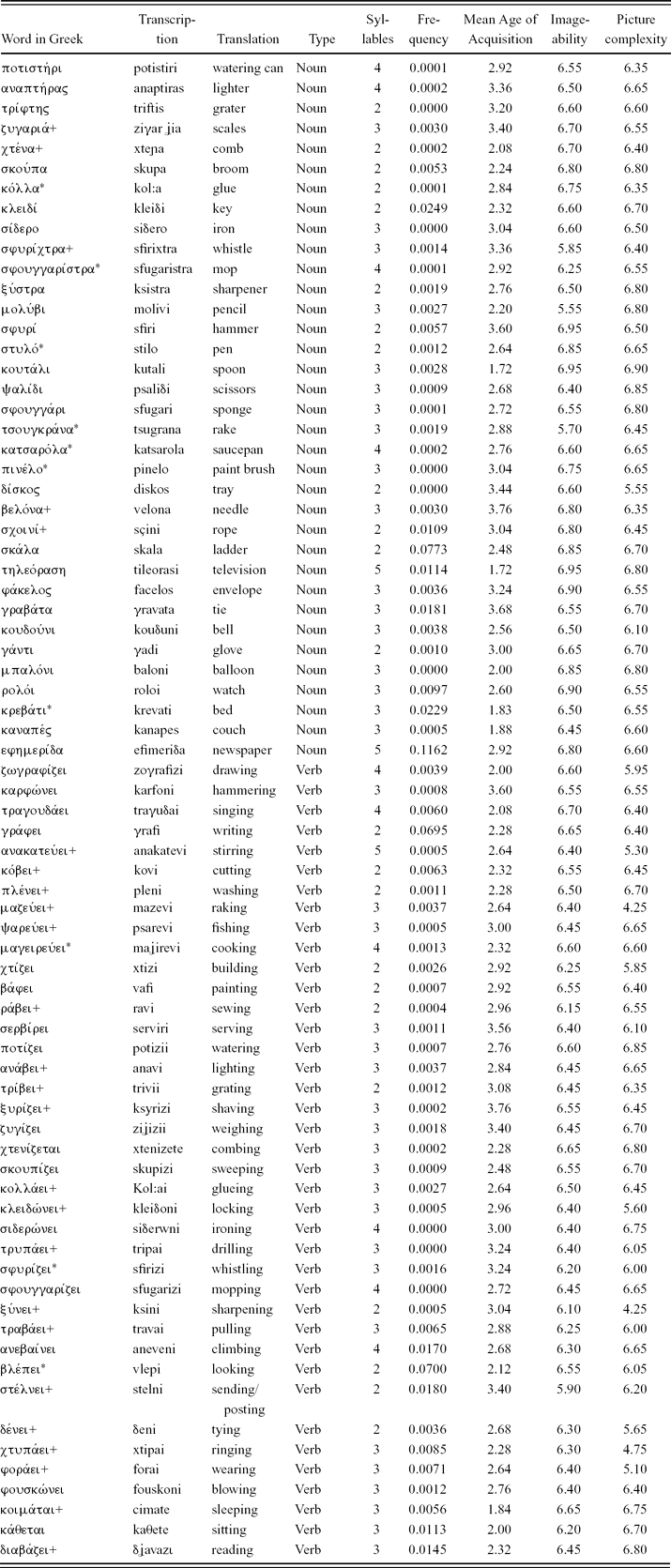
All action names corresponded either to an instrumental verb, where an instrument is part of the action (e.g., cutting), or to a non-instrumental verb (e.g., climbing).Footnote 6 Six object and twelve action names had acceptable alternative responses in Cypriot Greek that differed lexically or phonologically from Standard Modern Greek (see Appendix 2 for all examples). All test items are presented with number of syllables, frequency ratings, rated age of acquisition, rated imageability, and rated picture complexity values in Appendix 2. Independent samples of adults provided ratings for the psycholinguistic characteristics for each word (see Kambanaros et al., in press).
4.3 Procedure
Participating children with and without SLI had to score at least 90% correct (maximum seven errors) on the comprehension sub-test of the COAT in order to be included in the naming study.Footnote 7 The object and action picture-naming tasks were presented in random order within at most two sessions. Testing was conducted individually in a quiet room provided at each of the participating schools by the first and/or fourth author of the study.
For the production task, children were asked to name the object or action in the photograph in a single word (one-word target response). For the object pictures, the stimulus question uttered by the examiner was: “Tell me in one word: What is this?”. Similarly, for the action pictures, the stimulus question was: “Tell me in one word: What is he/she doing?”. Action names were required in the third person singular present tense, since Modern Greek lost the infinitive; the citation form is either the first or the third person singular present tense – in picture-naming tasks such as the COAT, it would be third person, reflecting the descriptive situation.
Two examples were provided before testing. The stimulus question was repeated once for children who did not respond. If no response was given, the item was scored as incorrect. No time limits were placed and self-correction was allowed. Responses were recorded and transcribed verbatim by the first author and checked by the second and fourth authors.
4.4 Qualitative analysis
Errors made by the children for object and action names were classified into semantic errors, phonological errors, grammatical word class substitutions, word-form related errors (e.g., lack of response, “I don't know”), visual errors, and unrelated responses.Footnote 8 Semantic errors were further divided into semantic types and semantic descriptions or circumlocutions. The latter involved describing the target action/object concept using more than one word (e.g., “hitting the nail” for “hammering”) or a GAP verb in place of a single lexical verb (e.g., “making a house” for “building”). Semantic type errors included coordinate (e.g., “comb” for “brush”), superordinate (e.g., “tool” for “hammer”), and associative errors (e.g., “bucket” for “mop”), all semantically related single lexical labels for the target word.
Phonological errors were responses that shared the same onset and number of syllables with the target word (e.g., “coat” for “comb”). Grammatical word class errors were noun-to-verb substitutions where the action name was provided instead of the object name, or vice versa (e.g., instead of the verb “sweeping”, the noun “broom” was produced). Visual errors included responses where there is no semantic relationship between the child's response and the target object/action word (e.g., “scales” instead of “clock”). Unrelated responses included real-word responses lacking a relationship of any form with the target word (e.g., “tie” instead of “globe”).
5. Results
Appropriate single-word responses from either variety were counted as correct. That is, if the Greek Cypriot bilectal children store lexical items separately, as has been argued for bilingual development (e.g., Meisel, Reference Meisel, Hyltenstam and Obler1989, and much subsequent work), in a Cypriot Greek lexicon and in a Standard Modern Greek lexicon, we counted as correct any response from the combined lexicon(s). However, in order to explore naming in a bilectal setting, dialectal substitutions (target alternatives in Cypriot Greek) were also counted in a separate analysis and are reported in Section 5.4.
5.1 Accuracy
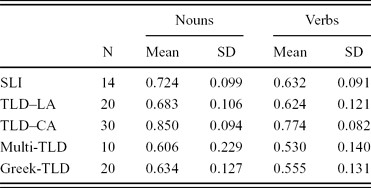
The five groups of children – children with SLI (“SLI”), chronological age-matched children with TLD (“TLD–CA”), language-matched children with TLD (“TLD–LA”), multilingual children with TLD (“multi-TLD”), and monolingual children with TLD (“Greek-TLD”) – were compared on two dependent variables simultaneously (percentage correct on nouns and percentage correct on verbs) using a multivariate analysis of variance (MANOVA) test. Descriptive statistics for action and object naming accuracies are presented in Table 2; object naming accuracy is higher than action naming accuracy in all five groups, and performance by children with TLD–CA was higher than performance by the remaining groups of children. The lowest performing group were the multi-TLD children.
Descriptive statistics of noun and verb accuracies by group (number of correct divided by total responses or % correct).
N = number (of participants); SD = standard deviation; SLI = (children with) specific language impairment; TLD = (children with) typical language development; LA = language age-matched; CA = chronological age-matched; multi = multilingual
Since the five groups were of unequal sample size, Pillai's trace was used for the multivariate test, and was significant: V = .466, F(8,178) = 6.762, p < .001. The univariate tests of between-subjects effects revealed group effects on both outcomes; the difference between the groups was significant on both noun and verb percentage correct (F(4,89) = 13.176, p < .001, partial η2 = .372 for nouns and F(4,89) = 16.533, p < .001, partial η2 = .426 for verbs). The similar partial eta squared (η2) values imply that more than a third of the variance in the noun and verb accuracies can be explained by group membership.
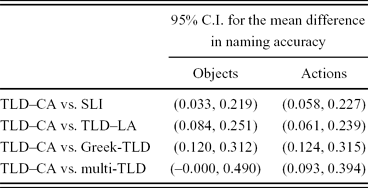
Because the standard deviations on the outcome variables are different across groups, and due to unequal sample sizes, the Games-Howell post hoc procedure was used, as it is considered the most powerful method when assumptions are not optimal (Field, Reference Field2009). The 95% confidence intervals suggesting significant differences among groups appear on Table 3. The TLD–CA group performed significantly better than all the other groups on both object and action naming (the marginally significant difference with the multi-TLD group on noun accuracy is probably due to the large standard deviation of the latter group). Other group differences were not significant, although on both outcome variables the order of performance accuracy was SLI > TLD–LA > Greek-TLD > multi-TLD. Larger sample sizes would allow a more accurate investigation of such differences.
Post-hoc multiple comparisons (Games-Howell) between the TLD–CA and the other groups.
C.I. = Confidence Interval; SLI = (children with) specific language impairment; TLD = (children with) typical language development; LA = language age-matched; CA = chronological age-matched; multi = multilingual
For all five groups, performance on nouns is higher on average than performance on verbs, as can be seen in Table 2. Paired t-tests were used to compare noun–verb accuracies within each group. The differences were significant in four of the groups: t(13) = 2.86, p = .013 for children with SLI; t(29) = 4.43, p < .001 for age-matched peers, t(19) = 2.97, p = .008 for the language-matched controls; and t(19) = 4.31, p < .001 for the Greek-TLD group. In the multi-TLD group the difference was not significant t(9) = 1.39, p = .197. Similar results were obtained with non-parametric Wilcoxon signed rank tests.
5.2 Error analysis
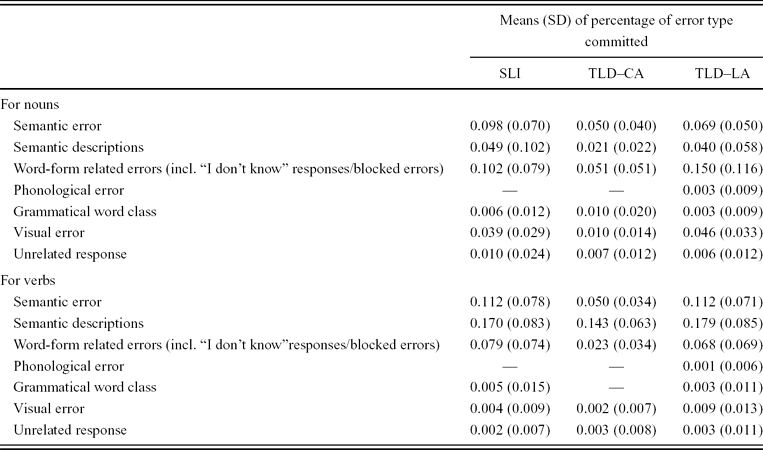
Error analysis involved only the experimental groups reported in the method section. The descriptive statistics on the analysis of the errors for the groups SLI, TLD–CA, and TLD–LA appear in Table 4. Phonological errors, grammatical word class substitutions, visual errors, and unrelated responses occurred rarely. We compared the percentage of incorrect responses for action and object names in the three groups for semantic errors, semantic descriptions, and word-form related errors only, since these types of errors had a mean occurrence of about 5% or more in at least one group. Because the assumptions of sphericity and homogeneity of variance were violated, we ran non-parametric statistics (six Kruskal-Wallis tests) for differences between the groups on the six error types (see Section 4.4 above).
Means and standard deviations of percentage of error types by group.
SD = standard deviation; SLI = (children with) specific language impairment; TLD = (children with) typical language development; LA = language age-matched; CA = chronological age-matched
Comparisons on semantic errors were significant for verbs (χ2 = 14.243, df = 2, p = .001) and non-significant for nouns (χ2 = 5.389, df = 2, p = .068). The three groups did not exhibit significant differences on semantic description errors (χ2 = .980, df = 2, p = .613 for nouns; χ2 = 2.270, df = 2, p = .321 for verbs), but they differed on word-form related errors (χ2 = 11.686, df = 2, p = .003 for nouns; χ2 = 11.519, df = 2, p = .003 for verbs). Subsequently, non-parametric pair-wise comparisons on the error analyses where significant differences were detected across the groups revealed that children with SLI produced significantly more semantic errors for verbs (z = –2.782, p = .005) as well as word-form related errors for nouns (z = –2.076, p = .038) and for verbs (z = –2.959, p = .003) than the TLD–CA group. Similarly, the younger TLD–LA children produced significantly more errors than the TLD–CA children (z = –3.394, p = .001 semantic errors for verbs; z = –3.219, p = .001 word-form related errors for nouns; z = –2.664, p = .008 word-form related errors for verbs). The differences between the children with SLI and TLD–LA were not significant.
The Wilcoxon signed rank test was used to compare the different error types for object and action words within each group of children. Semantic errors were significantly more for verbs than for nouns only for the TLD–LA group (z = –2.689, p = .007). All three groups revealed significantly more semantic description errors for action compared to object names (z = –2.483, p = .013 for SLI; z = –4.723, p < .001 for TLD–CA; z = –3.661, p < .001 for TLD–LA). Word-form related errors for nouns versus verbs were not significantly different for the SLI group, but they appeared more often for nouns than for verbs in TLD–CA (z = –3.778, p < .001) and in TLD–LA (z = –3.181, p = .001).
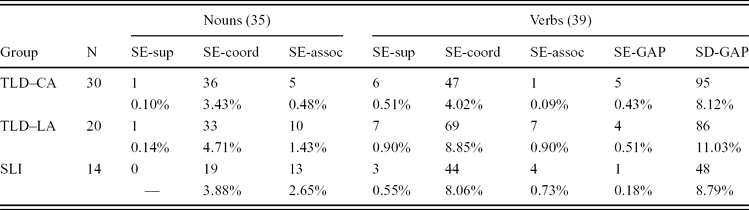
The counts and percentages of the various types of qualitative errors for nouns and verbs appear separately in Table 5. With regard to nouns, coordinate errors are the most common for all three groups. Associative errors appear less often and the percentages are higher for the SLI group; superordinate errors are very rare. When examining verbs, semantic descriptions using a GAP verb are the most common error made by all groups, with a higher percentage of occurrence for the TLD–LA group. Coordinate errors for verbs is also a common error committed more often by the TLD–LA and SLI groups. Other errors appear less frequently.
Frequency counts and percentages of types of errors by group. (Percentages are calculated by dividing the occurrence of a specific error by the total number of responses given by all the members of a group.)
SE = semantic error; SD = semantic description; GAP = general all purpose (verb); assoc = associate; coord = coordinate; sup = superordinate; N = number (of participants); SLI = (children with) specific language impairment; TLD = (children with) typical language development; LA = language age-matched; CA = chronological age-matched
5.3 Regressions for predicting test performance
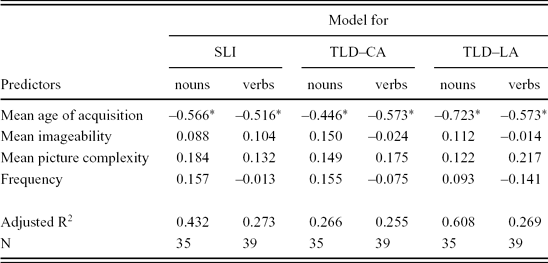
After examining the differences between the three comparison groups on object and action naming performances, and on the proportion of error types, we wanted to rule out plausible confounding effects on naming accuracy. Mean age of acquisition, imageability, picture complexity, and frequency of the lemma are psycholinguistic variables that could possibly influence how well children perform when asked to name the word. Using ratings by independent samples of adults, when considering nouns, only the correlation between mean age of acquisition and picture complexity was significant (r = –0.403, p = .016); in the case of verbs, mean age of acquisition was negatively correlated with word frequency (r = –0.329, p = .041) and imageability (r = –0.386, p = .015), and imageability was positively correlated with picture complexity (r = 0.383, p = .016). We ran multiple linear regression models separately for object and action lemmas (and separately for each of the three groups) to predict word naming accuracy using the psycholinguistic variables mentioned above as independent variables. All four predictors were entered simultaneously in the models; their intercorrelations do not raise suspicions for multicollinearity.
The regression results appear in Table 6. Although the sample size is not large (35 observations for predicting the accuracy on the object lemmas and 39 for action lemmas), all six models were significant with at least a quarter of the variance explained by the predictors in terms of adjusted R2. The standardized regression coefficients across models are very consistent. Imageability, picture complexity, and frequency of the lemma are not significant predictors. In fact, only the mean age of acquisition of a word is significant in predicting accuracy in both object and action names (for all three sample groups). The respective standardized betas range from –0.723 up to –0.446, which implies that an additional standard deviation increase in the mean age of acquisition of a word (age of acquisition was measured on an ordinal scale of 0–2, 2–4, 4–6 years; see Kambanaros et al., in press, for results on the piloting study of the COAT) results in a decrease of about a half standard deviation in naming performance.
Standardized multiple regression coefficients (beta) in the models predicting noun and verb performance using psycholinguistic variables by group.
* Significant at the .01 level.
SLI = (children with) specific language impairment; TLD = (children with) typical language development; LA = language age-matched; CA = chronological age-matched; N = number (of participants)
5.4 Alternative responses in Cypriot Greek
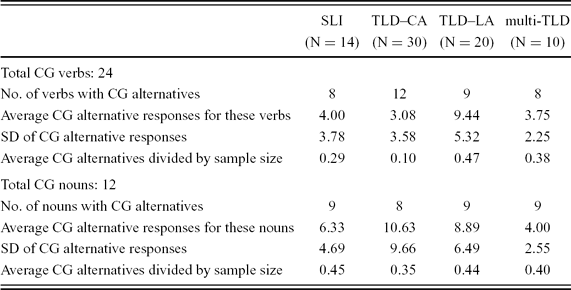
Out of the total of 39 verbs, between eight and 12 elicited responses classified as Cypriot Greek (CG) alternatives. More such CG responses were given by the TLD–LA group compared to (bilectal) children with SLI and the multi-TLD group (Table 7). However, if we take into account the sample size, for the verbs that have CG alternatives, the TLD–LA group use such alternatives at a frequency of 47% of their responses, followed by 38% for the multi-TLD, and 29% for the children with SLI. The older typically developing children (TLD–CA) provided CG alternatives for 12 words, but overall (this was the larger group) only 10% of their responses were coded as CG alternatives, a percentage a lot smaller than any of the other groups.
Descriptive statistics on the Cypriot-Greek alternative responses.
SLI = (children with) specific language impairment; TLD = (children with) typical language development; LA = language age-matched; CA = chronological age-matched; multi = multilingual; N = number (of participants); CG = Cypriot Greek; SD = standard deviation
Similarly, between eight and nine nouns (out of 35 total) elicited responses classified as CG alternatives. More such responses were given by the TLD–LA group (44%) and the children with SLI (45%) compared to the multi-TLD (40%) and the TLD–CA groups (35%).
6. Discussion
The present study investigated noun and verb picture-naming accuracy in two groups of children: those with typical language development (TLD) and children with specific language impairment (SLI) in a highly inflected language (Greek), where nouns and verbs are clearly differentiated on the basis of inflectional suffixes. Therefore, word meanings and grammatical category are derived from the suffix as outlined in Section 3.
Our first aim was to investigate any potential grammatical word class effect during confrontation picture naming in children with and without SLI. The findings revealed a significant naming difference between verbs and nouns in Greek. Nouns (or object names) were overall better retrieved by children with SLI than verbs (or action names). Likewise, for the two groups of children with TLD, a grammatical class effect favoring nouns over verbs was found for the school-aged children who served as the chronological age group for the children with SLI (TLD–CA) as well as for the younger pre-schoolers who served as the language-matched controls (TLD–LA). Overall, the results corroborate that the noun–verb asymmetry is not unique to SLI.
Similarly to what has been reported for English by Sheng and McGregor (Reference Sheng and McGregor2010), our Greek Cypriot children with SLI performed significantly worse than their age-matched peers but analogous to that of language-matched peers on the verb- and noun-naming tasks. Together these data suggest that (i) cross-linguistically the lexical (word-level) skills of children with SLI are on par with younger typically developing children, and (ii) no evidence of deviant or disrupted acquisition for children with SLI in (at least) the lexical domain. Our findings constitute the first evidence from Greek, a morphologically complex language, in support of the delayed language acquisition hypothesis as described by Rice's (Reference Rice, Levy and Schaeffer2003) unified model of SLI. Specifically, we identified areas of linguistic competence (verb/noun naming) where children with SLI perform at levels of language similar to the younger children at the same general language level.
Also, despite language differences such as morphological complexity, the same grammatical class effect was observed at the group level in English and Greek (nouns > verbs), lending support to the hypothesis that grammatical category is an organizing principle shared across languages irrespective of language family. At the individual level, 11 children with SLI showed a grammatical dissociation in favor of nouns, two children in favor of verbs, and one child revealed equal word retrieval difficulties for both word classes. This result highlights the heterogeneous nature of SLI and effects on the grammatical lexicon. Yet, this finding of a significant effect of word class for Greek does suggest, as also supported by Sheng and McGregor (Reference Sheng and McGregor2010) for English, that naming action pictures is fundamentally more difficult than naming object pictures for children with SLI and young typically developing children. In addition, the finding also gives rise to the conclusion that nouns might predominate in (early) word learning of Greek (see Papaeliou and Rescorla, Reference Papaeliou and Rescorla2011, for first evidence from Greek based on parental report).Footnote 9
Our second aim concerned the type of naming errors made by children with SLI and those with TLD for verbs and nouns, and how these could be explained within Levelt's (Reference Levelt1989) psycholinguistic framework of word processing (see Figure 1 above), adapted to bilingual populations by de Bot (Reference de Bot2004). In general, the children with SLI demonstrated similar error profiles to both groups of children with TLD. This supports further Sheng and McGregor's (Reference Sheng and McGregor2010) finding for SLI in English. Overall, for Greek Cypriot children, object naming was characterized mainly by word-form related errors; in contrast, semantic errors, mainly descriptions (or circumlocutions), predominated in action naming. The quantitative differences on the error distribution between the children with SLI and their chronological age-matched peers was significant, but it was non-significant when compared with the language-matched children. Since error type cannot differentiate the two groups, this is further evidence that children with SLI are delayed – but not atypical. We thus support Sheng and McGregor's (Reference Sheng and McGregor2010, p. 1716) claim that the lexical networks in children with SLI are structurally similar to those in children with TLD.
Notwithstanding these similarities with the English study, there were several differences in the error summary of children with SLI across the two languages, most strikingly for verbs. In the English study, visual errors, mainly misperception followed by unrelated errors, predominated in action naming; in these cases, children were unable to visually discriminate the target action from semantic neighbors or associates. Of major interest was the large amount of off-task behaviors that action picture-naming induced in both the SLI and the TLD groups such as naming parts of the scene including objects and other visual aspects (e.g., for the target verb smiling, “pretty” or “girl” was produced). The authors explained this as a difficulty inherent to the picture-naming task itself, namely that children had trouble either identifying the intention of the picture and/or adhering to the instruction of the task. All the same, it is possible that the selection of test items from different syntactic (transitive versus intransitive) and conceptual-semantic categories (e.g., actions involving body parts, animate and non-animate nouns) complicated the activation and retrieval process for children with SLI given the underlying (neuroanatomical) differences in the representation of the different word types/categories in the brain.
What is more, we assume visual-perceptual errors for verbs to be a result of non-lexical strategies employed by English-speaking children with SLI (and TLD) to retrieve action names, and this stands in stark contrast to the results from Greek reported here. In our study, both children with SLI and children with TLD largely produced semantic descriptions or circumlocutions for verbs, revealing access to the semantic information of the word but not to its phonological representation. These included a description of one or more components of the action involved (e.g., “raking” → “sweeping the garden”, “hammering” → “hitting the nail with a hammer”, “stirring” → “mixing the food with a spoon”), giving an indication of the target meaning. Our findings show that action naming – at least in Greek – is handled in more diverse ways by children than object naming.
Furthermore, in the present study, and in contrast to the findings by Sheng and McGregor (Reference Sheng and McGregor2010), Greek Cypriot children with SLI and TLD used a larger number of so-called “general all-purpose” (GAP) verbs (such as the equivalents of English make, do, put) to substitute for the more specific target verb (e.g., chtizi “builds” → ftiachni spiti “makes a house”, sideroni “irons” → kani ta rucha “does the clothes”, kollai “glues” → vazi γoma “puts glue”). There was no significant difference between children with SLI and age-matched controls on the use of GAP verbs unlike for younger language-matched controls who over-relied on the use of GAP verbs. We suggest that the (over)use of GAP verbs by Greek-speaking children with SLI and those with TLD is a compensatory strategy when they are unable to access specific or semantically complex verbs from long-term memory (see Kambanaros & Grohmann, Reference Kambanaros and Grohmann2013; Stavrakaki, Reference Stavrakaki2000).
Also, repeated encounters with high-frequency, generic GAP verbs may result in the formation of stronger representations in the mental lexicon making them more accessible. It is also possible that stronger activation levels and more associations within the mental lexicon are facilitated by rich semantic representations (see Mainela-Arnold et al., Reference Mainela-Arnold, Evans and Coady2010). Obviously, the large number of circumlocution errors for action names reflects the particular challenges in naming verbs, given that there are too many ways to interpret them (Gentner, Reference Gentner2006), hence the difficulties with resolving lexical competition.
Implementing Levelt's (Reference Levelt1989) model, verb–noun differences may be the result of a deficit in lexical production either in the lemma lexicon or in the lexeme/word-form lexicon. The former is related to the greater complexity in the underlying representations of verbs compared to nouns in terms of their conceptual-semantic or syntactic representation, respectively; the latter is based on the assumption that knowledge of word-form properties related to individual verbs and/or nouns is affected. It is unlikely that the difference retrieving verbs and nouns for Greek Cypriot children with SLI and TLD resulted from a central deficit at the initial stages of word retrieval as both groups of children showed negligible comprehension difficulties for the same target nouns and verbs (scores of 90% and above correct). It would be safe to claim, then, that the breakdown was not at the level of conceptual semantics (e.g., lemma meaning).
Likewise, given the very few grammatical word class substitution errors, lemma information about grammatical category could be successfully retrieved. Also, in the absence of inflectional errors (i.e. suffixation), any impairment at the level of morphological processing is ruled out. In the same way, no phonological errors were made by participating children, revealing that phonological representations for verbs and nouns were intact. Nevertheless, we argue that spoken naming difficulties for children with and without SLI for verbs and nouns are the result of a breakdown at the interface of the semantic lexicon and phonological representations, or access to them. This is supported by our major error types: the large number of word-form related errors (i.e. “I don't know” responses referred to also as blocked errors), particularly for nouns, and semantic errors for verbs. Word-form related or blocked errors are the result of form weak representations or fewer associative connections in the mental lexicon with less overall or sustained activation to facilitate naming. Semantic errors arose when the target word node was relatively unavailable and semantically related ones were activated and produced instead.
To sum up, given the immaturity of the language system (not yet adult-like and/or impaired), that young typically developing children and children with SLI have poor inhibitory processing abilities making it more difficult to deactivate semantic competitors. In the same light, maturationally speaking, a slower processing speed might hamper their ability to simultaneously activate phonological and semantic representations (see Huang & Snedeker, Reference Huang and Snedeker2011; Mainela-Arnold et al., Reference Mainela-Arnold, Evans and Coady2010).
The third aim was to investigate potential confounding variables (e.g., lexical and/or psycholinguistic) on children's naming accuracies related to the task at hand (naming) and the stimuli provided (pictures). Our word class effect was not an artifact of other variables that might have affected word retrieval, such as word frequency or picture complexity. Moreover, object and action naming was equally affected by the age of acquisition of the target words, a variable that affects the speed of getting from the lemma to the phonological word form (Levelt, Reference Levelt2001), providing further evidence for a breakdown in the links between lexical semantics and the word form lexicon.
To meet our fourth aim, we compared our results with the findings from Sheng and McGregor (Reference Sheng and McGregor2010). Overall, noun and verb naming patterns in English-speaking and bilectal Greek-speaking children with SLI were similar; action naming is significantly impaired compared to object naming. Nevertheless, the major differences between the present study and the one by Sheng and McGregor (Reference Sheng and McGregor2010) led us to suggest that how exactly noun/verb differences manifest in SLI (based on error types) may be language-dependent. These differences include the following:
(A) language-specific properties of the languages under investigation (Greek is highly inflected, whereas English is minimally inflected);
(B) methodological issues inherent to the picture-naming task in Sheng and McGregor's (Reference Sheng and McGregor2010) study (e.g., the absence of imageability measurements known to affect the processing of pictures) or the quality/clarity of the pictured noun and verb stimuli (e.g., black and white sketches versus colored photographs in the present study);
(C) the selection of the actual test items in Sheng and McGregor's (Reference Sheng and McGregor2010) study, that is, sub-categories within each category (e.g., intransitive versus transitive verbs, verbs incorporating body parts as part of their conceptual-semantic representation, and biological nouns versus artifacts);
(D) children with SLI were not tested on comprehension of the words in Sheng and McGregor's (Reference Sheng and McGregor2010) study (making it hard to differentiate between conceptual and lexical knowledge); and
(E) our results are explained with reference to psycholinguistic theory (Levelt, Reference Levelt1989).
The present study is revealing from a very different perspective. While the experimental method was not specifically designed to tap into Cypriot versus Standard Modern Greek, it did aim to elicit responses in Greek for which children were able to draw from their combined lexicon. Nevertheless, in order to shed light on the linguality of bilectal speech, we analyzed the number of Cypriot Greek responses (aka code-mixing) across groups. Our results showed that the younger typically developing Greek Cypriot children (including multilingual speakers) produced more dialectal responses than the older children with SLI and the age-matched controls. We attribute this to the “schooling factor” already identified as relevant for bilectal language development (see the Socio-Syntax of Development Hypothesis of Grohmann, Reference Grohmann, Rinke and Kupisch2011, and the extended discussion in Grohmann & Leivada, Reference Grohmann, Leivada and Di Sciullo2012): With the onset of public schooling, Standard Modern Greek input increases.Footnote 10 That is, by assumption, the older the children, the more input from, and enforced responses in, the standard or “High” variety they are exposed to. The fact that the children with SLI behave similarly to their chronologically age-matched peers is also revealing with respect to the delay versus deficit issue.
Our final aim was to determine whether bilectal children with and without SLI perform more like younger monolingual children or rather like bilingual pre-schoolers on the verb- and noun-naming task. For reasons of space, we focused only on accuracy (percentage of verbs/nouns correct) between our experimental groups and the comparative groups. Given the small sample sizes, we are unable to reach a conclusion at this point. We suggest that bilectal children perform neither like monolingual nor like multilingual peers. In fact, our SLI and TLD–LA groups performed better on naming verbs/nouns than the monolingual Greek children (from Greece), who in turn performed better than the multilingual group (from Cyprus). One goal of this line of research in the future should be to reappraise the hypothesis that a second language (but perhaps not multiple languages) may be beneficial to impaired language development, in particular to SLI (Armon-Lotem, Reference Armon-Lotem2010; Paradis, Reference Paradis2007).
Why, then, are action names more difficult for children with TLD and children with SLI? We suggest that the factors mentioned above all play a role: (i) naming verbs involves different cognitive and linguistic processes to the naming of nouns, (ii) verbs are acquired later than nouns, (iii) verbs are semantically more complex, and (iv) verbs are grammatically more complex (see Gentner, Reference Gentner2006).
Our work also adds to the body of research on verb processing in children with SLI by providing experimental data from a highly inflected language, Greek. As mentioned above, Cypriot Greek does differ from Standard Modern Greek in many ways, which go beyond the sound system and lexical inventory. With clear morphosyntactic differences, such as clitic placement (Terzi, Reference Terzi, Alexiadou, Horrocks and Stavrou1999, and much subsequent work), wh-question formation (e.g., Grohmann, Panagiotidis & Tsiplakou, Reference Grohmann, Panagiotidis, Tsiplakou, Janse, Joseph and Ralli2006), and a host of other structural properties of the grammar (see Grohmann & Leivada, Reference Grohmann, Leivada and Di Sciullo2012, for discussion and references), one possible conclusion might be that the two varieties are so much different as to allow classification as two separate languages. If that were the case, Greek Cypriots should be characterized as bilingual speakers of Cypriot Greek and Standard Modern Greek.
However, we are not yet at a point at which we can unequivocally sustain such a stance. After all, Cypriot and Standard Modern Greek are also very close to one another. In addition, qualitatively the standard variety spoken in Cyprus differs distinctly from that spoken in mainland Greece, for example (see also footnote 10 above). Likewise, there are quantitative differences, certainly as regards linguistic input to young children: On the one hand, children are confronted on a regular basis with Standard Modern Greek or the “High” variety only with entrance into the public school system, arguably later than the native language acquisition period. On the other hand, not every native speaker of Cypriot Greek hears Cypriot Greek exclusively, or even the same variety (see also footnotes 10 above and 11 below); in fact, many people make it an educational point of not talking to their children in the “dialect”. How successful they are, and what the relevance to the acquisition process and subsequent language development is remains to be seen – however, it also remains to be controlled for, something that seems very difficult to do, with too many variables and factors to be considered.
Lastly, in the context of diglossia, the distinction between the two varieties, for all practical and theoretical purposes, seems to lie in the sociolinguistic domain more so than in the formal grammatical domain, also for political reasons. We will not review the continuously growing body of work here but confine ourselves to a simple point: With no native speakers of Standard Modern Greek in the Greek Cypriot population, the bilingual classification in the traditional sense faces significant obstacles. Likewise, if the sociolinguistic situation is indeed that of diglossia, the “High” variety can hardly be a separate language (again, without changing the respective definitions accordingly). In terms of linguality, then, Greek Cypriot speakers are “bi-x”, where “x” needs to be further determined, possibly beyond “varietal”, “lingual”, “dialectal”, etc. (Grohmann, Reference Grohmann, Rinke and Kupisch2011; Grohmann & Leivada, Reference Grohmann, Leivada and Di Sciullo2012). One possible value for x could be “lectal” (Rowe & Grohmann, Reference Rowe and Grohmann2013). We therefore work on the assumption that Greek Cypriots are bilectal speakers of two discrete Greek lects, Cypriot Greek and Standard Modern Greek.Footnote 11
Let us close with a methodological issue that came up throughout this study. Of paramount importance is that neither the amount or type of speech and language therapy (e.g., semantically or phonologically based) individual children have received at or prior to the time of testing nor the exact sub-type of the disorder (e.g., grammatical versus phonological SLI) were taken into consideration. As unfortunate as this may be, it is a flaw that underlies the majority of studies on SLI, certainly in the linguistic literature, and it might be a factor that wants to be controlled for more carefully in future investigations, independent of the language(s) the research is carried out in.
On a more positive note, the clinical implications from the present findings may lead speech–language therapists in Cyprus to develop better language-specific assessment tools for identifying and treating lexical and/or verb deficits in children with SLI. This has already been done on an experimental level in several recent studies (Kambanaros & Grohmann, Reference Kambanaros, Grohmann and Tsangalides2011, to appear). In addition, a full testing battery has been adapted to Cypriot Greek, which is currently being analyzed for sensitivity and specificity by Eleni Theodorou, in her Ph.D. dissertation project at the University of Cyprus, “Language acquisition in Cypriot Greek with an application for SLI”. The results are promising, allowing us in the near future to diagnose with full confidence and accuracy SLI in bilectal children speaking Cypriot Greek and Standard Modern Greek. This, we believe, would be the first diagnosis testing battery that taps into the dialectal properties of the language in question and thus caters to a unique, but growing, population of young children with language and communication problems.
We want to close with a brief note on bilingualism proper. In our research team, we are now starting to investigate bilingual children who, on top of the bilectal situation, are also native acquirers of a host of other languages, such as the ubiquitous Russian (e.g., Karpava, Grohmann & Fokianos, Reference Karpava, Grohmann, Fokianos and Gabrys-Barker2012). However, in a diglossic environment such as Cyprus which is undergoing major changes in its social, cultural, and linguistic constitution, it is important to have a firm grip on the developmental and grammatical properties of the local language variety first; only then can we study proper bi- or multilingual language acquisition and impairment.
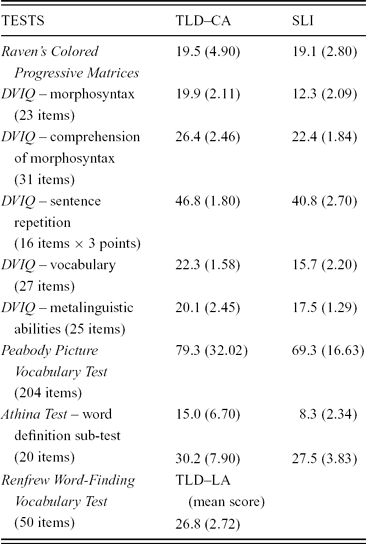
Mean scores (standard deviations) of children with SLI, age-matched peers (on the range of tests administered) and language-matched peers (on the word-finding vocabulary test)
All test items with number of syllables, frequency ratings, rated age of acquisition, rated imageability, and rated picture complexity values