Introduction
Pigeonpea (Cajanus cajan (L.) Huth) is a grain legume crop which is cultivated largely by smallholder farmers in many parts of the world. In Africa, the crop is produced mainly in eastern and southern Africa (Gwata et al., Reference Gwata, Silim and Mgonja2006; Høgh-Jensen et al., Reference Høgh-Jensen, Myaka, Sakala, Kamalongo, Ngwira, Vesterager, Odgaard and Adu-Gyamfi2007). In South Africa, pigeonpea is cultivated as a minor crop by smallholder farmers predominantly in the eastern region. The crop is cultivated primarily for human consumption but it can also be used as a livestock feed (Rao et al., Reference Rao, Coleman and Mayeux2002), household income generation (Shiferaw et al., Reference Shiferaw, Kebede and You2008) and improvement of soil fertility (Mapfumo et al., Reference Mapfumo, Giller, Mpepereki and Mafongoya1999). The formation of effective nodules on the roots of pigeonpea minimizes the requirement for applying nitrogenous fertilizer by growers. However, the symbiotic efficiency of the host plant genotypes has not been determined adequately. The information is important for expanding the crop to new production areas as well as for selecting rhizobial strains that produce optimum nitrogen (N) fixation with pigeonpea. Therefore, this study was designed to determine the variation in the N fixation ability of pigeonpea inoculated with the native rhizobia from diverse locations across South Africa.
Experimental
Forty soil samples of ~200.0 g each were collected from across the South African transect including locations that had no history of pigeonpea production or inoculation with rhizobial strains (online Supplementary Table S1). Five randomly selected pigeonpea genotypes, consisting of two improved exotic types (Ex-PP-MD-311 and Ex-PP-MD-321) and three unimproved local landraces (Mpuma-Red, Mpuma-Brn and Mpuma-B-Spot) were used in the study (online Supplementary Table S2). Two healthy seedlings of each genotype were raised in Leonard jars containing sterile quartz sand and N-free Hoagland's solution (Hassen et al., Reference Hassen, Bopape and Trytsman2014). In each jar (except for the control), the seeds were inoculated separately with soil (~3.0 g) from the specific location. The day length in the greenhouse was set at 14 h daylight at a temperature of 28°C and 10 h night at a temperature of 15–20°C. A split-plot experimental design was used and the data sets were subjected to analysis of variance using the PROC Mixed (SAS Institute, 2013).
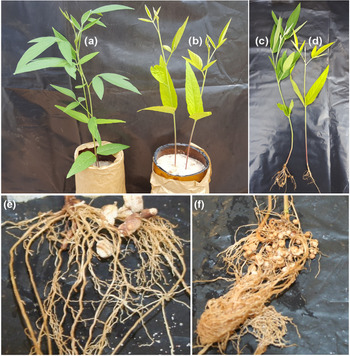
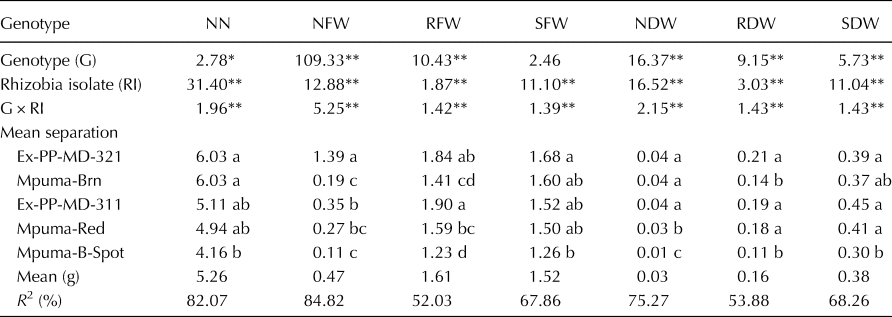
At 6 weeks after germination, the pigeonpea plants in the greenhouse that were inoculated with soil developed root nodules, but the control plants formed no nodules (Fig. 1). On most of the plants, the nodules occupied the upper part of the root system. The pigeonpea genotypes showed significant (P < 0.05) differences in the number of nodules and highly significant (P < 0.01) differences in the rest of the N fixation traits that were measured (Table 1). Similarly, there were highly significant (P < 0.01) genotype × rhizobial isolate interactions for all the traits. On average, ‘Ex-PP-MD-321’ developed >40.0% more nodules than ‘Mpuma-B-Spot’ and there was more than 10-fold difference in nodule fresh weight between the two genotypes. Similarly, ‘Ex-PP-MD-321’ in comparison with ‘Mpuma-B-Spot’ also achieved heavier nodule dry weight per plant and root dry weight per plant. Furthermore, the genotypes showed consistently low ratios between the shoot and root dry weight per plant. In contrast, ‘Mpuma-B-Spot’ showed a marked increment in the amount of dry matter that was partitioned to the shoot relative to the nodules. Soil sample #33 consistently performed well (online Supplementary Table S3).
Pigeonpea plants (a) inoculated with soil, (b) uninoculated (control), (c) nodulated and (d) with no nodules (control), (e) few, large nodules and (f) profuse, medium nodules among pigeonpea genotypes that were inoculated with soil samples from diverse locations in South Africa.

F-values, coefficients of determination and genotypic means from the analysis of variance for root nodulation traits evaluated in pigeonpea genotypes that were inoculated with individual soil samples from diverse locations in South Africa

NN, number of nodules per plant; NFW, nodule fresh weight (g) per plant; RFW, root fresh weight (g) per plant; SFW, shoot fresh weight (g) per plant; NDW, nodule dry weight (g) per plant; RDW, root dry weight (g) per plant; SDW, shoot dry weight (g) per plant.
**; * = significant at the 1.0 and 5.0% probability levels, respectively. In each column, means followed by a different small letter are significant at the 5.0% probability level.
Discussion
The results indicated the symbiotic compatibility between pigeonpea and soil rhizobia from a wide ecological amplitude across South Africa suggesting that pigeonpea nodulates effectively and promiscuously with native rhizobial populations including from areas where currently, the crop is not cultivated. The compatibility of indigenous rhizobia with the crop also suggested that seed inoculation with commercial inoculants is not a critical requirement for achieving effective N fixation. Moreover, there is no unequivocal evidence that artificial seed inoculation with commercial inoculants can significantly improve the productivity of pigeonpea on a field scale. From a practical viewpoint, pigeonpea cultivation can be expanded to such new areas if there are no other factors constraining the introduction of the crop to these prospective production areas. The promiscuity of the crop explains, at least in part, the successful production of this crop in many parts of world particularly in Africa (Høgh-Jensen et al., Reference Høgh-Jensen, Myaka, Sakala, Kamalongo, Ngwira, Vesterager, Odgaard and Adu-Gyamfi2007; Gwata and Silim, Reference Gwata and Silim2009).
The differential partitioning of dry matter between shoot and nodule dry weights indicated the potential of selecting for pigeonpea genotypes that can attain optimum productivity since significant positive associations between nodulation traits and plant productivity have been reported for several leguminous crops (Mohammed et al., Reference Mohammed, Jaiswal, Sowley, Ahiabor and Dakora2018; Roy et al., Reference Roy, Ghosh and Kundagrami2019). The fixation of N improves crop growth and several other key physiological activities that contribute to grain yield (Sinclair and Vadez, Reference Sinclair and Vadez2002). Although the fixation capacity is generally proportional to the grain yield, it does not necessarily translate into high grain yield in many legumes because of other inherent genetic and physiological factors (Sinclair and De Wit, Reference Sinclair and De Wit1975; Mohammed et al., Reference Mohammed, Jaiswal, Sowley, Ahiabor and Dakora2018) and environmental conditions (Hungria and Vargas, Reference Hungria and Vargas2000; Gwata and Siambi, Reference Gwata and Siambi2009). However, although the indigenous rhizobia in the soil demonstrated symbiotic effectiveness with pigeonpea, the specific genus responsible for N fixation was not determined. It was not feasible to assay separately each of the multiple nodules per plant in order to determine the rhizobial genus contained therein. Nonetheless, genetic diversity of the sampled rhizobial isolates from each soil sample was retained for further analysis using a variety of sophisticated approaches involving 16S rRNA and rec A housekeeping genes (Beukes et al., Reference Beukes, Boshoff, Phalane, Hassen, le Roux, Stepkowski, Venter and Steenkamp2019) or next-generation sequencing methods (Bopape et al., Reference Bopape, Hassen, Swanevelder and Gwata2020). The molecular characterization in combination with the agronomic evaluation of the rhizobial strains may provide an opportunity for more accurate selection of precise strains for enhancing effective root nodulation of pigeonpea in situations where the indigenous rhizobial populations are depleted or fail to produce optimum symbiotic N fixation. In conclusion, our results demonstrated promiscuity in the nodulation of pigeonpea with native rhizobial strains that were obtained from a wide ecological amplitude across South Africa. Pigeonpea showed differential N fixation ability, suggesting that there was potential to select for optimum host × rhizobial isolate combinations (for instance, ‘Ex-PP-MD-321’ × soil sample #33) and to expand the production area of the crop.
Supplementary material
The supplementary material for this article can be found at https://doi.org/10.1017/S1479262121000356
Acknowledgements
The authors wish to thank the Agricultural Research Council for the use of their greenhouse and laboratory facilities. The University of Venda is acknowledged for the provision of the pigeonpea germplasm and soil samples that were used in the study.