


Significant outcomes
-
∙ A more favourable dynamic of psychopathological symptoms in group of patients with schizophrenia receiving anaferon that contains ultra-high dilutions of antibodies to human interferon γ as the active pharmaceutical ingredient.
-
∙ The favourable dynamic of clinical symptoms correlates with high level of spontaneous production of interferon γ.
-
∙ Interferon γ inducer (anaferon) may be used in the complex therapy for patients with schizophrenia to enhance the effectiveness of therapy.
Limitations
-
∙ This trial had several limitations.
-
∙ First, double-blind, placebo-controlled randomised in parallel-group study was carried out on limited sample of patients under therapy at the hospital.
-
∙ Second, patients received tablets of anaferon and tablets of placebo according to a specific schedule which administration is the most appropriate at the hospital under control of medical staff.
-
∙ Third, used methods of nonparametric statistics, appropriate for the investigated group, can be broadened and updated in case of sample increase.
Introduction
The treatment of schizophrenia requires long-term administration of psychotropic medications associated with adverse effects and complications (Reference Lader1,Reference Staller2). Search for pathogenetically justified methods improving efficacy of schizophrenia treatment is vital. To date, large evidence has been collected confirming important role of immune system and neuroimmune interaction in schizophrenia pathogenesis (Reference Műller, Riedel, Gruber, Ackenheil and Schwarz3–Reference Műller, Wagner and Krause7). Of growing significance are the studies of impaired cytokine secretion by immunocompetent cells (ICC) of subjects with schizophrenia resulting in imbalance in Т-helper 1/Т-helper 2 (Th1/Th2) immune response (Reference Na and Kim8,Reference Watanabe, Someya and Nawa9).
Therefore, to optimise neuroimmune interaction and improve efficacy of schizophrenia treatment, interleukin (IL)- and interferon-based drugs are of particular interest. It is noteworthy, that use of well-known commercial interferon drugs in the treatment of some diseases may result in adverse effects such as depression and delirium, thus requiring caution and continuous monitoring of somatic and mental status of subjects (Reference Goeb, Cailleau and Lainé10–Reference Myint, Schwarz, Steinbusch and Leonard12). New generation medications containing ultra-high dilutions (or ultra-low doses) of antibodies to endogenous regulators capable of modulating the function of molecules to which they were derived rather than suppressing or potentiating it and exerting adaptive effects and ‘sparing’ balanced therapeutic effects seem promising and safe (Reference Bell and Koithan13–Reference Epstein, Shtark and Dygay15). One of them is anaferon, a medication containing ultra-high dilutions of affinity-purified antibodies to human interferon γ (IFN-γ) as the active pharmaceutical ingredient. Anaferon is an inducer of IFN-γ, has immunomodulatory activity and has been successfully used for treatment and prevention of various infectious diseases (Reference Epstein16–Reference Tarasov, Zarubaev, Gorbunov, Sergeeva and Epstein19). In our study, we for the first time used anaferon in patients with schizophrenia, and for this method of treatment of patients with schizophrenia a patent has been granted (Reference Vetlugina, Lobacheva, Semke, Sergeeva, Ehpshtejn and Mal’tseva20).
Aims of the study
Evaluation of clinical and immunomodulatory effect of ultra-high dilutions of antibodies to human IFN-γ, included in the complex therapy of patients with schizophrenia.
Subjects and methods
The study of efficacy of anaferon in the complex treatment of schizophrenia was a double-blind, placebo-controlled randomised in parallel-group clinical study. The study used anaferon that contains ultra-high dilutions of affinity-purified antibodies to human IFN-γ as the active pharmaceutical ingredient. Anaferon (tablet formulation) is manufactured by OOO ‘NPF’ Materia Medica Holding’ (Moscow, Russia) in compliance with good manufacturing practice (GMP). The ultra-high dilutions of antibodies to human IFN-γ were produced according to routine methods described in the European Pharmacopoeia (7th edn, 2011) using affinity-purified polyclonal rabbit antibodies to human IFN-γ (concentration 2.5 mg/ml) manufactured by Angel Biotechnology Holdings plc (Edinburgh, UK). Anaferon tablets were formulated by direct dry compression of lactose saturated with ultra-high antibody dilutions in a fluid-bed system. As prescribed by good clinical practice (GCP) requirements, the placebo tablets were prepared using the same method, but did not contain the active pharmaceutical ingredient.
The study enrolled 40 hospitalised subjects with schizophrenia. Inclusion criteria were as follows: diagnosis of schizophrenia in accordance with ICD-10 confirmed by psychiatrist provided at least 1-year follow-up; age of subjects – 18–55 years; presence of signed informed consent form. Exclusion criteria were as follows: decompensated somatic diseases which may affect the study performance; chronic alcoholism or drug addiction; participation in other clinical studies within 1 month before enrollment into this study.
According to the study protocol and assigned randomisation number, the patients were divided into two groups: main group (11 male and 9 female patients) receiving anaferon as part of the complex therapy (anaferon group) and comparative group – placebo group (12 male and 8 female patients). The main group and comparative group were comparable in terms of sex, age (33.4±10.69 and 33.2±9.4), duration of the disease (9.98±4.88 and 9.6±5.57) and age of the disease onset (23.40±8.27 and 23.65±6.06). The majority of subjects in anaferon and placebo groups were patients with episodic paranoid schizophrenia (F 20.0) with progressive or stable deficit – 16 and 13 subjects, respectively (χ2=1.129, p>0.05). The rest of the subjects were diagnosed with either simple-type schizophrenia (F 20.6) – two and four, respectively, or residual schizophrenia (F 20.5) – two and three subjects, respectively. The clinical status of most patients on admission to the in-patient department before the study initiation was characterised by exacerbated paranoid and hallucinatory-paranoid symptoms and specific emotional-volitional and associative disorders.
The subjects received anaferon or placebo along with antipsychotic therapy, which was adequate for degree of the underlying disease (Reference Krasnov, Gurovich, Mosolov and Shmukler21). Duration of the therapy was 30±5 days. Subjects in both groups were assigned to receive typical antipsychotics (haloperidol at doses of 10–30 mg/day or trifluoperazine (Thriftazinum) at doses of 20–40 mg/day or atypical antipsychotics (olanzapine at doses of 10–20 mg/day, quetiapine at doses of 200–800 mg/day, or risperidone at doses of 4–6 mg/day). Typical antipsychotics were administered to eight subjects in the main group and to 11 subjects in the comparative group, and atypical antipsychotics were administered to 12 subjects in the main group and to nine in the comparative group. Significant differences between the treatments were not identified (χ2=0.401, p>0.05). Anaferon or placebo was administered under control of medical staff following the regimen of two tablets at a time at regular intervals (normally at 08.00, 12.00, 16.00 and 20.00), four times daily. Use of any immunomodulating drugs including interferons was not permitted.
One subject from placebo group has withdrawn from the study after 1 week of the combined therapy; further the main group included 20 patients, placebo group – 19 patients.
Assessment of severity of symptoms and changes in them were made using clinical scales: Positive and Negative Syndrome Scale (PANSS); Clinical Global Impression (CGI); Abnormal Involuntary Movements Scale (AIMS).
IFN-γ level was measured by ELISA method and standard kits of reagents by Proteinoviy Kontur Company (Saint Petersburg, Russia). Spontaneous and induced production of IFN-γ by ICC was identified in supernatants of 48 h whole blood culture of patients in RPMI1640 medium with 2 mM glutamine and 80 µg/ml gentamycin. Phytohemagglutinin by Serva at final concentration of 50 µg/ml was used as stimulator; IFN-γ production was identified based on individual absolute amount of peripheral blood mononuclear cells (PBMC) and evaluated in pg/ml/106 PBMC. During measurement of interferon (reference normal value), the control group included 15 healthy subjects without signs of acute infectious diseases at the moment of examination.
Changes in psychopathological symptoms based on PANSS and AIMS scores, changes in IFN-γ level were evaluated at two study points – before anaferon or placebo (study point 1) administration and after 30±5 days of combined therapy (study point 2). Therapeutic efficacy according to CGI scale was assessed after 0±5 days of the combined treatment.
The following elements of descriptive statistics were calculated: arithmetic mean value M, standard error of the mean m, standard deviation σ, median value Me and interquartile range (LQ – lower quartile, UQ – upper quartile), 95% confidence interval, number of observations – for quantitative characters; proportions and percentage of subjects with certain character – for qualitative characters. Statistical significance of differences when comparing independent samples was evaluated using nonparametric Mann–Whitney test, for verification of differences between two samples of paired measurements Wilcoxon test was used. Statistical significance of differences in qualitative characters was assessed using χ2 or exact Fisher’s test. Spearman’s nonparametric rank analysis of variance was performed.
Results
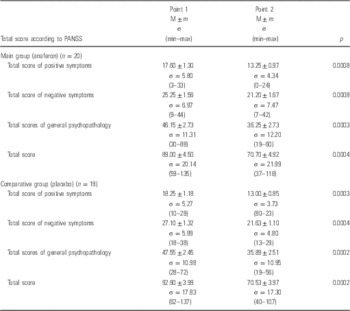
Registration of clinical symptoms based on PANSS scores in the groups demonstrated that complex therapy exerted pronounced clinical effect. By the end of the treatment both groups (Table 1) showed significant reduction of mean values of the total score of positive, negative, general psychopathology symptoms and the total PANSS score.
Changes in psychopathological symptoms according to Positive and Negative Syndrome Scale (PANSS) score in subjects with schizophrenia throughout the treatment

p – significance of difference between point 1 (before treatment) and point 2 (after treatment) according to Wilcoxon test.
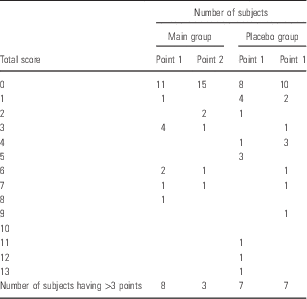
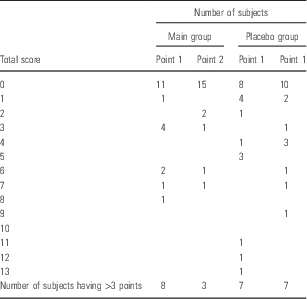
Clinical analysis based on AIMS scale revealed that the total score of symptoms of abnormal involuntary movements >3 points (moderate and severe) at study point 1 were reported in eight subjects of anaferon group and seven subjects of placebo group (Table 2). By the end of the treatment, the number of subjects with these clinical symptoms decreased 2.7-fold and this was reported in three subjects of the main group; in placebo group, the number of subjects remained unchanged.
Changes in Abnormal Involuntary Movements Scale (AIMS) in study groups throughout the treatment
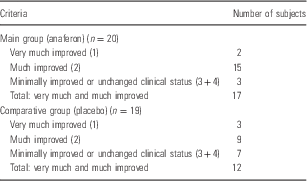
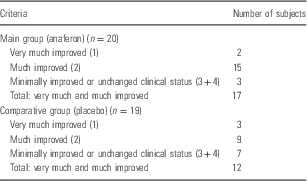
Assessment of therapeutic efficacy using CGI-C scale (Table 3) showed that very much and much improved clinical status was reported in 17 (85.0%) subjects of the main group receiving anaferon and in 12 (63.2%) subjects receiving placebo. Minimally improved or unchanged clinical status requiring further treatment was noted in three patients out of 20 in the main group and in seven patients out of 19 in placebo group, that is almost one in three subjects.
Efficacy of combined therapy of schizophrenia according to Clinical Global Impression (CGI-C)
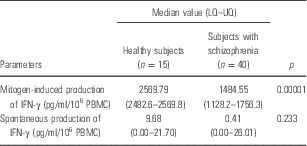
Comparative investigation of IFN-γ level in the general group of subjects at study point 1 and in healthy subjects demonstrated significant reduction of interferon-producing potential in vitro by ICC in subjects with schizophrenia (Table 4).
Level of interferon γ (IFN-γ) production in general group of subjects with schizophrenia and healthy subjects
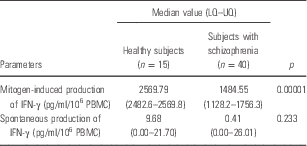
LQ, lower quartile; PBMC, peripheral blood mononuclear cells; UQ, upper quartile.
p – significance (vs.) control according to Mann–Whitney test.
Analysis of data on interferon production in subjects with schizophrenia in the main and comparative group revealed wide range of variations in its level. Significant differences between groups in changes of induced IFN-γ values were not found during the treatment: main group – before treatment 1564.23 (1251.9–1763.3), after treatment 1263.91 (981.14–1627.34) pg/ml/106 PBMC, p=0.093; placebo group – before treatment 1323.26 (981.37–1756.33), after treatment 1367.30 (848.48–2068.97) pg/ml/106 PBMC, p=0.748.
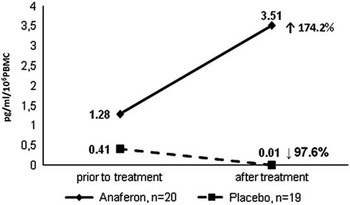
Figure 1 shows changes in spontaneous interferon production throughout the treatment, though insignificant, but having multidirectional nature in the study groups: the main group showed tendency for elevation, placebo group – for decrease.
Changes in spontaneous interferon γ (IFN-γ) production during combined therapy including anaferon and placebo. The tendency to increase in concentration of IFN-γ from 1.28 pg/ml/106 PBMC before therapy to 3.51 pg/ml/106 PBMC after therapy was noted in the main group of patients, receiving anaferon; in placebo group – the tendency to decrease from 0.41 pg/ml/106 PBMC before therapy to 0.01 pg/ml/106 PBMC after therapy. PBMC, peripheral blood mononuclear cells.

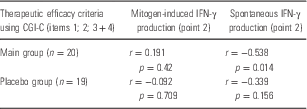
Further correlation analysis of data using Spearman’s rank test revealed interaction between spontaneous IFN-γ production and efficacy of the treatment assessed using CGI-C subscale (Table 5). Groups of patients with very much improved (item 1), much improved (item 2) clinical status and group of patients with minimally improved or unchanged (items 3+4) clinical status as compared with study point 1 were considered.
Correlation between interferon γ (IFN-γ) and therapeutic efficacy
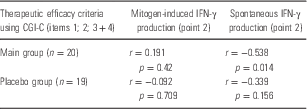
CGI-C, Clinical Global Impression.
The main group receiving anaferon revealed reverse correlation between spontaneous interferon production and CGI-С subscale values, that is high spontaneous IFN-γ correlated with very much improved clinical status (item 1) and much improved clinical status (item 2) at study point 2 (r=−0.538; p=0.014). Placebo group did not show such correlation.
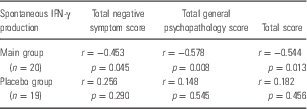
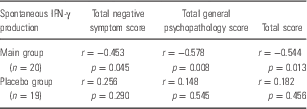
Correlation has also been found between spontaneous production of IFN-γ by ICC in subjects receiving anaferon with positive changes during combined therapy of negative symptoms, general psychopathology symptoms and total score of psychopathological symptoms assessed using PANSS scale (Table 6).
Correlation between interferon γ (IFN-γ) and psychopathological symptom score according to Positive and Negative Syndrome Scale
Discussion
The study of ability of ICC in 40 subjects with schizophrenia to synthesise IFN-γ in the culture in vitro has found its reduction (vs.) ICC of healthy persons. Reduced synthesis of IFN-γ and other cytokines by Th1, prevalence of Th2 and activation of humoral immune response in subjects with schizophrenia were observed in other studies (Reference YK, Myint and BH22–Reference Reale, Patruno and De Lutiis24). These data suggest pathogenic justification for use of anaferon – a drug containing ultra-high dilutions of affinity-purified antibodies to human IFN-γ as the active pharmaceutical ingredient – in the complex treatment of schizophrenia. Previously, it has been found that medication produces an immunomodulating effect: increases initially low IFN-γ levels, normalises elevated levels of IL-1β, optimises the Th1/Th2 balance of immune response, exerting ‘sparing’ therapeutic effect (Reference Epstein16,Reference Kondrat’Eva, Matveeva, Shemyakina, Logvinenko, Golikova and Kutuzova17). The paper reports of the first ever experience of using anaferon as an additional drug in complex antipsychotic therapy of patients with schizophrenia, which is supported by a patent (Reference Vetlugina, Lobacheva, Semke, Sergeeva, Ehpshtejn and Mal’tseva20).
Our study did not reveal significant differences in IFN-γ production by ICC in subjects with schizophrenia from the main and placebo groups. This may be associated with mild mechanism of action of ultra-high dilutions of antibodies to endogenous peptides, insufficient duration of therapy, and paucity of the main and comparative groups against such a significant variation range of IFN-γ in subjects with schizophrenia. At the end of the treatment period, the tendency to increase spontaneous interferon production was observed in the group receiving anaferon compared with placebo. As demonstrated in the previous studies (Reference Epstein25), the key mechanism of anaferon action is the ability to modulate the interferon system via acting on both the protein and the initial components of interferon-mediated signalling pathway. It has been proved (Reference Epstein25) that anaferon is a positive allosteric modulator of the IFN-γ receptor, is capable to improve the ligand–receptor interaction, to increase the cell membrane expression of the receptor and to promote the production of IFN-γ and other functionally coupled cytokines. At the same time, insufficient duration of anaferon-supplemented treatment might be the reason that the observed changes in the level of interferon were not statistically significant under conditions of the study.
During the period of observation and treatment (30±5 days) no intergroup differences were detected by the monitoring of changes in symptoms based on PANSS scores. At the same time, the complex therapy supplemented with the tablet formulation containing ultra-high dilutions of antibodies to human IFN-γ (anaferon) has lead to more favourable changes in abnormal involuntary movements reported on AIMS scale; pronounced and significant improvement of mental status according to CGI assessment was reported 1.3 times more frequently in anaferon group as compared with subjects receiving placebo.
One of the main mechanisms of schizophrenia pathogenesis are alterations in the function of brain neurochemical structures, abnormal cytokine secretion, impaired Th1/Th2 balance with prevalence of Th2 (Reference Na and Kim8) and disrupted neuroimmune interaction. Due to its stimulating effects on the expression of IFN-γ-Th1 marker (Reference Zhu, Yamane and Paul26) – and functionally coupled cytokines, anaferon normalises (modulates) the Th1/Th2 balance, and, likely, optimises, through psychoneuroimmunomodulatory mechanisms, the neuroimmune interaction and regulation of neurotransmitters. It increases sensitivity to antipsychotics, exerting global adaptive effect. This is reflected in the mental state of patients and better clinical dynamics, assessed by the CGI scale. Positive clinical effects of anaferon treatment were expressed by significant correlations among high spontaneous IFN-γ production, reflecting the mechanisms of endogenous cytokine therapy efficacy on the CGI-C scale, the positive dynamics of negative symptoms, general symptoms and total score of general psychopathology according to PANSS as obtained in the main group of subjects. No correlations of the kind were observed in the placebo group.
Pathophysiology of abnormal involuntary movements, or tardive dyskinesia, is complex and multifactorial, and has not been fully studied. Many researchers attribute the pathophysiology of tardive dyskinesia to alterations in the regulation of dopaminergic and other neurotransmitter systems (Reference Margolese, Chouinard, Kolivakis, Beauclair and Miller27,Reference Yoshida, Bies and Suzuki28). In addition, there are data indicating that one of the mechanisms underlying the pathogenesis of abnormal involuntary movements might be represented by immune dysregulation, particularly cytokine synthesis impairment (Reference HM, YL and Shi29). Anaferon ability to modulate the functional activity/production of endogenous IFN-γ and related cytokines might account for reduction of abnormal involuntary movements reported on AIMS scale in the main group of subjects.
No pathological changes in blood parameters have been revealed during the treatment. All observed variations are typical for patients with schizophrenia treated with antipsychotic medications. Biochemical blood analysis (transaminase and bilirubin levels) also did not show any negative changes. There were not any adverse events related to anaferon treatments.
Thus, the double-blind placebo-controlled randomised in parallel-group study of patients with schizophrenia has demonstrated more favourable changes in psychopathological symptoms in the group of subjects receiving anaferon – a tablet formulation containing ultra-high dilutions of antibodies of human IFN-γ – in complex standard psychopharmacotherapy. Correlation between positive changes in clinical signs and spontaneous IFN-γ production by ICC confirms involvement of anaferon in mechanism of psychoimmunomodulation and positive role of the drug in optimisation of neuroimmune interaction disturbed due to schizophrenia.
The data presented in the paper seem to uncover prospects for further research involving a longer term use of anaferon, which might provide more pronounced biological and clinical effects.
Acknowledgements
The authors thank Director General of OOO ‘NPF’ Materia Medica Holding’ (Moscow, Russia) Professor Oleg I. Epstein for kind providing anaferon tablets and placebo tablets to perform the study. The authors wish to thank Dr. Sergey A. Tarasov (‘NPF’ Materia Medica Holding’ Ltd, Moscow, Russia) for reading the manuscript and his fruitful comments. Authors of the article appreciate help of Referent of Director of Mental Health Research Institute (Tomsk, Russia) Svetlana Vladimirova in designing the article according to style and format of Acta Neuropsychiatrica. Authors Contributions: T.P.V. – idea of the study, organisation of research, literature search, manuscript writing and editing. L.О.А. – clinical studies; manuscript editing. S.S.А. – statistical analysis; manuscript editing. N.V.B. – experimental studies; manuscript editing. N.Т.I. – experimental studies; manuscript editing. S.А.V. – assessment of psychopathological symptoms of patients with schizophrenia on scales PANSS, AIMS, CGI; manuscript editing.
Financial Support
This work was performed at the expense of funding of Mental Health Research Institute.
Conflicts of Interest
The authors declare that they have no conflicts of interests.
Ethical Standards
The study was carried out in accordance with the Good Clinical Practice of European Union and Helsinki Declaration of the World Medical Association adopted at 18th WMA Assembly (Helsinki, June 1964) as amended (52nd WMA Assembly, Edinburgh, October 2000). The study was approved by the Local Independent Ethics Committee of the Mental Health Research Institute.