1 Introduction
Accents and dialects of English and Scots in Britain have been under active investigation for many decades, as reported through the Survey of English Dialects (Orton et al. Reference Orton, Barry, Halliday, Tilling and Wakelin1962–71) and the Linguistic Atlas of Scotland (Mather et al. Reference Mather, Speitel and Leslie1975–86), Wells’ three-volume compendium (Reference Wells1982), and a host of detailed studies of individual varieties. There are also welcome recent signs of the reintegration of variation data into theoretical discussion (see Henry Reference Henry, Chambers, Trudgill and Schilling-Estes2002, Cornips & Corrigan Reference Cornips and Corrigan2005a and Trousdale & Adger Reference Trousdale and Adger2007 for morphosyntax, as well as Anttila Reference Anttila, Chambers, Trudgill and Schilling-Estes2002 and Coetzee & Pater Reference Coetzee, Pater, Goldsmith, Riggle and Yu2011 for phonology). Nonetheless, the precise structural, geolinguistic and sociolinguistic patterning of many features of vernacular Englishes in the UK is still largely unknown.
A range of factors contribute to this situation. Accessing the vernacular is particularly challenging for the investigation of complex structural features, and there is a concomitant issue, namely that these also typically arise infrequently in free conversation. Where we do have variation data for a range of geographical locations, as in the SED and LAS, the focus is primarily on lexical dialectology and on the segmental phonology of the most traditional forms of speech, with rather little coverage of morphosyntax or indeed of more complex phonological features. Furthermore, critical differences in questionnaire design make these two surveys largely incompatible. We are therefore unable to compare types of features or to address major geopolitical issues such as the extent to which the English–Scottish border, for instance, is permeable to linguistic features of different kinds using data that have been collected by the questionnaire method.Footnote 2 The viability of these techniques has been robustly demonstrated in the very successful recent compilation of the Syntactic Atlas of Netherlands Dialects (www.meertens.knaw.nl/projecten/sand/sandeng.html), which has transformed our understanding of dialect contact in the transitional zone along the Dutch–Belgian border (Barbiers Reference Barbiers, Cornips and Corrigan2005).
In this article, we report on parallel, pilot investigations designed to address these problems and gaps in our current knowledge of geographically contiguous regions in the British Isles.Footnote 3 Our key aims are to trial novel data-gathering methodologies based on phonological and morphosyntactic questionnaires specially tailored to elicit coherent grammaticality judgements and to interpret the results from these with a view to making comparisons across linguistic levels.
For the purposes of this investigation, and to facilitate these aims, we have investigated one phonological feature (T-to-R) and one morphosyntactic one (the Northern Subject Rule) through an initial, light sample in one Scottish locality (Hawick, in the Borders, where the dialect might be described as Hawick Scots) and one in the north-east of England (the Westerhope ward of Newcastle upon Tyne, where the dialect might be described as Tyneside English). We ask three basic research questions. First, what knowledge do speakers from north-east England and south-east Scotland have about the structural and linguistic constraints on these two features? Second, how does this knowledge vary geographically and socially? Finally, how effective were the tasks we designed in allowing access to speakers’ linguistic knowledge? These questions, and our aims for this project, are therefore simultaneously dialectological, linguistic and methodological.
2 An introduction to the linguistic features
The linguistic features that we focus on here are relatively well-known characteristics of non-reference varieties of English/Scots spoken in the north of Britain. They are, however, not yet fully understood and there remain open questions about their precise structural and sociolinguistic patterning and their geographical extent, as we explain in this section.
2.1 The Northern Subject Rule
Northern English and Scots dialects share with many non-standard regional and extra-territorial varieties the possibility of variably expressing subject–verb concord in contexts where this would lead to ungrammaticality in the contemporary Standard (termed ‘hyper -s’, ‘singular/variable concord’ and ‘verbal non-agreement’ inter alia). For instance, while in the Standard the present tense is no longer morphologically marked in the first- and second-person singular and plural of all predicates (with the exception of be), third-person singular subjects are categorically suffixed by {-s}. By contrast, in vernacular Englishes this suffix can variably occur on verbs of other persons (singular as well as plural), and person–number concord in the past and present tenses of lexical and auxiliary be/have can also be variable, as the following extracts from a range of studies of the phenomenon in contemporary non-standard varieties show:
(1) they comes on your street and tells you (AAVE; Labov et al. Reference Labov, Cohen, Robins and Lewis1968: 26)
(2) Isn't there any girls going? (Sydney English; Eisikovits Reference Eisikovits and Cheshire1991: 242)
(3) They was talkin’ to a fella on the bus (Tobagonian English; Youssef Reference Youssef1995: 6)
(4) The lambs is oot the field (Scots; Miller Reference Miller, Milroy and Milroy1993: 109)
(5) I think the hunger strikes was the awakening I had (Northern Irish English; Corrigan Reference Corrigan2010: 59)
As one might expect from our knowledge of morphosyntactic variability cross-dialectally in English and other languages (as demonstrated in Tagliamonte Reference Tagliamonte, Chambers, Trudgill and Schilling-Estes2001 and Barbiers Reference Barbiers, Cornips and Corrigan2005, for instance), this type of variation was, of course, never wholly unconstrained even in early English. Indeed, while Visser (Reference Visser1963–73) does not systematically describe the social constraints associated with this phenomenon,Footnote 4 he does categorize the data according to the linguistic environments that appear to promote what he refers to as ‘shifting in number’ (1963–73: 69). The first of these, which, following Poplack & Tagliamonte (Reference Poplack and Tagliamonte1989: 65), Montgomery (Reference Montgomery, Fenton and McDonald1994: 347), Hazen (Reference Hazen1996: 28) inter alia, we can term ‘Type of Subject Constraint’ (TSC, hereafter), concerns the syntactic and semantic properties of the subject. The aspect of the TSC that has been the focus of most research is the difference in -s marking patterns observed between pronominals and full lexical NPs. This phenomenon was first articulated by Murray (Reference Murray1873):
In the PRESENT TENSE, aa leyke, wey leyke, yoo leyke, thay leyke, are used only when the verb is accompanied by its proper pronoun; when the subject is a noun . . . the verb takes the termination {-s} in all persons. (1873: 211)
The constraint is termed here the Northern Subject Rule (NSR), though various other terms referring to its northern roots including the ‘Northern Personal Pronoun Rule’ have been coined to describe it, despite the fact that it was extant in south-east England as early as 1500 (McIntosh Reference McIntosh, Gray and Stanley1983: 237–9).Footnote 5 Research on contemporary dialects affected by this constraint has demonstrated that there continue to be differences in the morphological marking of verbs when accompanied by various types of NP subject and indeed when these subjects occur in different clausal, discoursal and phonological configurations. Hence, Cheshire et al. (Reference Cheshire, Edwards and Whittle1989), Godfrey & Tagliamonte (Reference Godfrey and Tagliamonte1999), Henry (Reference Henry, Chambers, Trudgill and Schilling-Estes2002), Wright (Reference Wright2002) and McCafferty (Reference McCafferty2004) suggest that existential there favours -s. NPs conjoined with and (Montgomery et al. Reference Montgomery, Fuller and DeMarse1993; Godfrey & Tagliamonte Reference Godfrey and Tagliamonte1999; Beal & Corrigan Reference Beal and Corrigan2000; McCafferty Reference McCafferty2003) also favour -s marking as do those which occur in relative clause constructions (Montgomery et al. Reference Montgomery, Fuller and DeMarse1993; Godfrey & Tagliamonte Reference Godfrey and Tagliamonte1999). Similarly, indefinite pronouns favour -s (Godfrey & Tagliamonte Reference Godfrey and Tagliamonte1999), as do quantified NPs like all of them (McCafferty Reference McCafferty2003). Godfrey & Tagliamonte (Reference Godfrey and Tagliamonte1999) also point out that when subjects occur with verbs in habitual aspect contexts, they promote -s marking on the verb as they also do when they occur in narratives. They likewise argue that -s marking is to some extent phonologically conditioned, so that when the accompanying verb has a vocalic ending then -s is more likely, as it also is when the verb is followed by a lexeme beginning with a vowel.
Certain contemporary vernaculars which exhibit the TSC also incorporate an additional constraint that captures the fact that the proximity between the subject and verb can also play a role in whether or not the latter favours -s (Montgomery Reference Montgomery, Fenton and McDonald1994: 88). It is more likely that the verb will trigger -s marking in contexts where the subject and verb are not adjacent than it is when the two are proximate (i.e. the ‘Proximity to Subject Constraint’ or PSC). Hence, in the example from Durham given as (6) below from the SED (Orton et al. Reference Orton, Barry, Halliday, Tilling and Wakelin1962–71), speaks is marked with -s because it is not adjacent to They, whereas gan is Ø-marked since it occurs to the immediate right of the pronoun without any material intervening.
(6) They ganØand never speaks (SED: Du)
Recent accounts of NSR have focused either on the interplay between the factors controlling the TSC and PSC in contemporary dialects beyond the Northern English geographical boundary with which it was first associated (like Wolfram & Christian Reference Wolfram and Christian1976; Kallen Reference Kallen1991; Montgomery et al. Reference Montgomery, Fuller and DeMarse1993; Henry Reference Henry1995; Montgomery & Fuller Reference Montgomery, Fuller and Schneider1996; Montgomery Reference Montgomery1997; Filppula Reference Filppula1999; Godfrey & Tagliamonte Reference Godfrey and Tagliamonte1999; Schendl Reference Schendl, Dalton-Puffer and Ritt2000; Wright Reference Wright2002; McCafferty Reference McCafferty2003, Reference McCafferty2004; Rupp Reference Rupp and Vliegen2006; Tortora & den Dikken Reference Tortora and den Dikken2010; Zanuttini & Bernstein Reference Zanuttini, Bernstein, Lima, Mullin and Smith2011) or else on the extent to which NSR in all its aspects remains extant in Northern varieties (as in Beal & Corrigan Reference Beal and Corrigan2000; Pietsch Reference Pietsch, Kortmann, Herrmann, Pietsch and Wagner2005; Cole Reference Cole, Guzmán González and Fernández-Corugedo2008; Adger & Smith Reference Adger and Smith2010). Our orientation here is towards the latter, so our account in section 4 examines the dynamics of the two major constraints just described in communities at some remove from one another across the linguistic north.
2.2 T-to-R
Wells (Reference Wells1982) introduced the label ‘T-to-R’ to refer to a pattern in the realisation of underlying /t/, with a complex environmental conditioning, found only in certain parts of Britain. The phenomenon has been discussed under other names (Carr Reference Carr1991 calls it ‘weakening’, for example) and, before Wells, it was described without a specific name (for example, in Hughes & Trudgill Reference Hughes and Trudgill1979), but Wells’ discussion is typically seen as its locus classicus. As Wells’ name for it suggests, this phenomenon involves /t/ being realised as a rhotic, and this has often been assumed to indicate some (likely diachronic) link to flapping, in which /t/ is realised as [ɾ] (as is described for many varieties of English, including American, Irish and southern hemisphere dialects), because [ɾ] can be used as the realisation of a rhotic. Like flapping, T-to-R can occur in an intervocalic environment, across word boundaries. Unlike flapping, however, T-to-R is very restricted word-internally, and is subject to lexical conditioning in its cross-lexical environment: /t/ only undergoes the process in certain words. Wells’ description is worth citing, as it makes a number of claims, which we test below:
A widespread but stigmatized connected-speech process in the middle and far north involves the use of /r/ instead of /t/ in phrases such as shut up [ʃʊɹˈʊp], get off [ˈɡɛɹˈɒf]. The T-to-R rule takes as its input /t/ in the environment of a preceding short vowel and a following boundary plus vowel. . . Very occasionally the rule applies word-internally, as in what's the matter [ˈmaɹə]? (1982: 370)
As Wells describes the process, /t/ only rhoticises if it follows a short/lax vowel. We test this claim below. Wells does not overtly mention lexical specificity in his description of the process, but it is implicit in the fact that he lists specific phrases in which it can occur. In any case, subsequent work on the phenomenonFootnote 6 makes it clear that, while there is a degree of phonological conditioning, it can only occur in a ‘a small group of words’ (Broadbent Reference Broadbent2008: 142). One research question is therefore: which words allow T-to-R and which ones prohibit it?
A full list of the lexical items which have been claimed to permit T-to-R takes up relatively little space. Every word that we are aware of is listed in (7), grouped into broad categories according to position in word/morpheme and word category. We considered all these in our research, apart from those marked with an asterisk (comparing them with other, phonologically similar words, to see if T-to-R is also possible in them).Footnote 7
(7) Final /t/: conjunctions, particles, determiners
• but: Asprey, Broadbent, Carr, C&W, H&T, Wells
• not: Asprey, Broadbent, Carr, C&W, Shorrocks
• that: Asprey, Broadbent, Carr, C&W, Shorrocks
• what: Asprey, Broadbent, Carr, C&W, H&T, Shorrocks, Wells
Final /t/: complex determiners
• (a) bit (of): Asprey, C&W, DFMMW*
• (a) lot (of): Asprey, Broadbent, Carr, C&W, DFMMW
Final /t/: prepositions
• about: Asprey
• at: Asprey, C&W
Final /t/: pronouns
• it: Asprey, C&W, Shorrocks
Final /t/: monosyllabic verbs
• bet: Broadbent*
• fit: Carr
• get/got: Asprey, Broadbent, Carr, C&W, DFMMW, H&T, Wells
• hit: Carr, DFMMW
• let: Asprey, Broadbent, C&W
• met: Carr
• put: Asprey, Broadbent, Carr, C&W, DFMMW*
• shut: Asprey, Broadbent, Wells
• sit: Wells
• thought: Carr*
Final /t/: polysyllabic verbs with final stress
• allot: Carr
• delete: Carr
• excite: Carr*
• forget/forgot: Broadbent*
• incite: Carr*
Word-internal, morpheme-final /t/
• cutting: Shorrocks
• forgetting: Broadbent*
• getting: Broadbent, Shorrocks
• letting: Broadbent, Shorrocks*
• putting: Asprey, Broadbent, DFMMW, Shorrocks
• setting: Shorrocks
Morpheme-internal /t/
• Beethoven: Carr*
• better: Broadbent, Carr, Viereck
• bottom: DFMMW, Viereck
• matter: Carr, DFMMW, H&T, Viereck, Wells*
• tata: Asprey, Broadbent, Carr*
• water: Viereck
• whatever: Asprey, Broadbent*
One clear question is: do the words in (7) have anything in common? We consider some potential answers (including frequency of occurrence) in section 4. We should note that the list in (7) mixes reports of T-to-R from a number of varieties (as discussed below). It could well be that the set of T-to-R words varies from variety to variety, something which our methodology can capture (and there is evidence that it does, which we consider in section 4.3). It could also be that the authors are wrong in (some of) their claims. Indeed, some previous work on T-to-R is based on informal observation by authors who are not native speakers of the relevant dialects, so some testing of these claims is clearly needed. Where only one previous discussion mentions a particular word, we may be sceptical. For example, Carr assumes that T-to-R is metrically conditioned in verbs, writing that it ‘does not occur in verbs which are not stressed on the last syllable’ (1991: 46), but that it ‘operates foot-internally, where the target /t/ is in the coda of the head syllable’ in cross-lexical feet (hence the mention of allot, delete, excite, incite). Although some of Carr's claims were reconsidered in Docherty et al. (Reference Docherty, Foulkes, Milroy, Milroy and Walshaw1997), this prediction about metrical structure has not been tested. We consider it in section 4. A further point cries out for attention: a very small number of words with long/tense vowels preceding the /t/ are included in (7), such as about and thought.Footnote 8 The question as to whether T-to-R is possible (more widely?) following a long/tense vowel thus invites testing.
The definition of T-to-R thus involves two crucial characteristics: (i) it is a process which realises /t/ as a rhotic in a cross-lexical environment, perhaps only if a short/lax vowel precedes; and (ii) it is lexically restricted, so that the conditioning is not just phonological (thus, in principle, it might occur in not but not in knot). Point (i) means that it is a neutralising, structure-preserving process (i.e. it only involves categories which exist in underlying forms): it neutralises a dialect's /t: r/ contrast − mostly this entails that both are realised as [ɹ]. The realisation of /t/ as a tap [ɾ] can thus only count as a case of T-to-R if the underlying rhotic /r/ is commonly realised as [ɾ] in the variety, as in Liverpool, Scotland and the West Midlands.Footnote 9 For a variety to ‘have T-to-R’, it must show both characteristics (structure-preserving neutralisation and lexical specificity); this clearly differentiates the process from across-the-board flapping, or t-voicing. As all quantitative work on T-to-R makes clear, it is a variable phenomenon − as might be expected of a clearly non-standard-dialect process, the rhotic competes with several other possible realisations of /t/. Thus Petyt (Reference Petyt1985) finds it in 45 per cent of the non-[t] realisations of /t/ in Huddersfield (competing with [ʔ]), Docherty et al. (Reference Docherty, Foulkes, Milroy, Milroy and Walshaw1997) find it in 12.5 per cent of the realisations of /t/ overall in Newcastle (competing with [ , t, tʔ, ʔ]) and Clark & Watson (Reference Clark and Watson2011) discuss the different proportions of the rhotic in different words in older Liverpool speakers, showing that it has a rhotic 16.7 per cent of the time and bit 83.33 per cent, for example.
Where is T-to-R found geographically? Wells’ (Reference Wells1982) description of the spread of T-to-R is relatively vague (‘in the middle and far north’), limiting it only to the area north of the English Midlands. How far north does it spread? How far south? Our methodology is ideal for answering these questions and we consider some relevant results below. T-to-R is well attested in Tyneside English, as described in Carr (Reference Carr1991, Reference Carr1999), Docherty et al. (Reference Docherty, Foulkes, Milroy, Milroy and Walshaw1997) and Watt & Milroy (Reference Watt and Milroy1999) (and likely also in Viereck Reference Viereck1966, although his discussion does not cover all the characteristics that we would expect for T-to-R). Shorrocks (Reference Shorrocks1998) describes a T-to-R-type phenomenon in Bolton English, as do Petyt (Reference Petyt1985) and Broadbent (Reference Broadbent2008) for West Yorkshire, Stoddart et al. (Reference Stoddart, Upton and Widdowson1999) for Sheffield, and Hughes & Trudgill (Reference Hughes and Trudgill1979), Honeybone (Reference Honeybone2001) and Clark & Watson (Reference Clark and Watson2011) for Liverpool. Lodge (Reference Lodge1984) transcribes it at least once for Stockport. Docherty & Foulkes (Reference Foulkes and Docherty1999) and Asprey (Reference Asprey2008) show that it stretches further south than Wells describes − into East Midland Derby and the West Midlands, respectively (Lodge Reference Lodge1984 also briefly describes it for Coventry). Stuart-Smith indicates that it may extend into parts of Scotland in her description of this phenomenon in Glasgow: ‘If /t/ is not replaced with a glottal stop, it can be realized as a tap, particularly when /t/ is final in a short-vowelled syllable, as in e.g. get it, let it. . .’ (1999: 209). This patterning is very close to what Wells describes for T-to-R, so it may be the same phenomenon; Johnston goes so far as to claim that ‘flapping of /t/ in words like butter . . . may be encountered occasionally in West Mid (especially Glaswegian), Stirlingshire and West Lothian Scots dialects . . .’ The result is [ɾ], which has to be considered as /r/ here. Phonologically, this rule can be considered as a Scottish version of the Northern English T-to-R rule mentioned by Wells (1997: 504); as Johnston observes, [ɾ] is a common realisation of the rhotic in Scotland, so this is a case of neutralisation. These are surprising claims, which invite investigation, given the normal association of the phenomenon with the north of England. We discuss some relevant results below. The Dublin English sandhi realisation of /t/ as [ɹ], described by Hickey (Reference Hickey and Minkova2009) (and see also Kallen Reference Kallen, Auer, Hinskens and Kerswill2005), may also be T-to-R, and while these works do not provide any detailed description of the phenomenon in this variety, Corrigan et al. (Reference Corrigan, Edge, Lonergan, Migge and Chíosáin2012) report the patterning described by Wells.
Previous claims about the sociolinguistic patterning of T-to-R are (i) Petyt's (Reference Petyt1985: 153) observation that it is favoured by older speakers, (ii) Docherty et al.'s (Reference Docherty, Foulkes, Milroy, Milroy and Walshaw1997: 293–4) observation that, in Newcastle, ‘[ɹ] is favoured by working class females (particularly those in the older group, for whom [ɹ] accounts for 40% of all tokens) and rare in younger middle class speakers’, and (iii) Clark & Watson's (Reference Clark and Watson2011: 529) observation that, in Liverpool, ‘adolescent speakers are using significantly more t-to-r forms than speakers who were born 90 years ago’. Our methodology allows for the investigation of a sociolinguistically balanced sample, and we report on relevant results below.
3 Methodology
T-to-R and the NSR are similar phenomena in that both are subject to subtle structural constraints and pose intriguing theoretical issues. Previous work has not fully tested the interaction of these constraints − certainly not in the intuitions of native speakers, as the research was largely based on corpus data − so we do not have a full picture of the patterning of either phenomenon. We have only a limited understanding of their geographical spread or the way in which they pattern socially. In this section we describe a novel methodology that we devised to test claims and hypotheses about these two intriguing phenomena. Conducting parallel and simultaneous investigations into morphosyntactic and phonological features allows us (as well as saving resources) to compare the applicability of the methodology at both linguistic levels and to begin considering the extent to which there are similarities or differences in the geolinguistic patterning of syntactic and phonological variables across Britain.
In order to test our hypotheses, we needed a method for asking a balanced sample of native speakers which constructions, out of a set with structurally different forms, were recognisable to them and could be used in their local variety. The constructions tested were designed to exemplify forms which were predicted (on the basis of past observations) to be either possible/favoured or impossible/disfavoured, or to test constructions about which previous research is ambivalent. For example, in order to fully understand the dynamics of the T-to-R phenomenon, a detailed investigation needs to ask whether a /t/ can be realised as a rhotic in a wide range of words with diverse phonological environments (with preceding short and long vowels, with differing metrical structures and so on), and for the NSR we needed to ascertain whether the proximity of subject and verb does indeed affect the possibility of -s marking.Footnote 10
Direct questioning of informants about nonstandard grammatical issues may not generate accurate reflection, so the NSR phenomena were tested via speaker judgement tasks in the form of a carefully constructed questionnaire, by means of which informants were asked whether they recognised them as forms used by other people in their locale. This strategy reduces the possibility that the intuitions generated will be subject to what one might term ‘social interventions’. However, speaker judgements, while useful for tapping into linguistic phenomena (including constraints on their operation), may also be impacted upon by issues such as audience design, fatigue, memory, ordering effects and prescriptive norms (see Labov Reference Labov and Austerlitz1975, Reference Labov, Dobrin, Singer and McNair1996; Trudgill Reference Trudgill1986; Schütze Reference Schütze1996; Cowart Reference Cowart1997; Bell Reference Bell, Eckert and Rickford2002; Bucheli & Glaser Reference Bucheli, Glaser, Barbiers, Cornips and van der Kleij2002; Cornips & Corrigan Reference Cornips, Corrigan, Cornips and Corrigan2005b; Cornips & Poletto Reference Cornips and Poletto2005; forthcoming; Parrott Reference Parrott2007; Buchstaller & Corrigan Reference Buchstaller, Corrigan, McMahon and Maguire2011a, Reference Buchstaller, Corrigan, Gregersen, Parrott and Quistb). As such, the questionnaire has been designed and collected in order to mitigate these effects as far as practicably possible, thus improving the chances that the intuitions generated are accurate and hence do not fail in the sense of Labov (Reference Labov, Dobrin, Singer and McNair1996).
Unlike the NSR component of the questionnaire, however, the T-to-R part asked the subjects to reflect directly on the specific feature itself. The NSR sections could ‘hide’ the feature being investigated amongst distractor sentences, but this was not possible for the T-to-R investigation. Indeed, it was necessary to focus on only T-to-R in the questions so that enough candidate lexical items could be tested, and the introductory sections of the questionnaire needed to explain the phenomenon to participants in order for the questions asked to make sense (as explained in the following section). Given this distinction, the tasks used in this component of the questionnaire were rather different. In the T-to-R part, we asked the participants to tell us directly what they themselves think is possible and what is not. Given that we were asking questions about specific lexical items, we felt that it would be problematic to interrogate them about what other people do (as the NSR section of the questionnaire does) because very subtle lexical differences are involved, and it is possible that informants would think themselves unable to make such judgements about the competence of others.
Intuition-based tests have occasionally been disparaged as sources of evidence in phonology. They are also, however, indisputably central to some kinds of phonological investigation. In a minimal pair test, for example (see Labov Reference Labov1994: 353–4), informants are also asked about their own intuitions directly, since the point is to consciously access their own phonological system. Along the same lines, we believe that it makes little sense to query participants regarding the preferences of others concerning the occurrence of T-to-R in certain words and environments when we want to know exactly what an informant believes is going on in their own system. Indeed, in a detailed investigation of precisely this issue, Dollinger (Reference Dollinger2012: 76) notes that ‘Some researchers have shown that self-reporting might be the best option for low-frequency items.’ He further cites the assertion in Bailey et al. (Reference Bailey, Wikle and Tillery1997: 57) that ‘self-reports might be more valid and reliable measures of linguistic behavior than linguists have supposed’. Dollinger (Reference Dollinger2012: 103) concludes that ‘Overall, self-reporting should be seriously considered as a legitimate data collection method, especially so for dialectological projects. While some phonetic nuances cannot be operationalized in written format, basic phonemic differences can be fruitfully employed.’ Obviously, we concur with this position and thus it informed our questionnaire design.
The questionnaire was, in fact, split into four discrete parts (two syntactic components and two phonological) so as to ensure as much diversity as possible for the participants, and it was given to eight informants in two localities to determine the extent to which the NSR and T-to-R persist/exist there: Hawick, a rural and relatively isolated community in south-east Scotland, and Newcastle upon Tyne, an urban and far from peripheral community in north-east England. Hawick has a population of 14,801 (2001 census), of whom c. 65 per cent are economically active; the Westerhope ward of Newcastle (the part of Newcastle where fieldwork was carried out) has a population of 9,635 (2001 census), of whom 63.7 per cent are economically active (the whole urban region of Newcastle has a population closer to a million). The sample consisted of two informants in four sociolinguistic cells in each locality: two younger females, two older females, two younger males, and two older males. ‘Younger’ was defined as 15–25 and ‘older’ as 55+. The fieldwork was done during the summer of 2009, and was conducted and processed by Will Barras, Jonathan Burrows, Marleen Spaargaren and Laura Steventon.Footnote 11
3.1 Data collection instrument for the Northern Subject Rule
As already noted, the NSR task sought indirect judgements from informants as to whether they recognised vernacular linguistic variants as forms used by other people in their locale. The subjects are asked to rate sentences by assigning them a number (between 1 and 4), which corresponds to the verbal descriptors in (8) (see Labov Reference Labov, Dobrin, Singer and McNair1996).
- (8)
1: This type of sentence would never be used here – it seems very odd.
2: This type of sentence is not very common here but it doesn't seem too odd.
3: I have heard this type of sentence locally but it's not that common.
4: People around here use this type of sentence a lot.
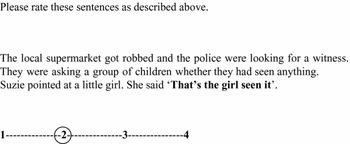
This instrument has the obvious benefit of placing very little prescriptive pressure on informants. Indeed, by asking them to state how frequently vernacular features are being used by others in their community – rather than directly asking whether they themselves use certain dialectal variants – this task gives informants the opportunity to distance themselves from these features. Furthermore, as we have argued elsewhere, indirect grammaticality judgement tasks are relatively simple to convey to informants – once they have mastered the notion of gradable acceptability (Buchstaller & Corrigan Reference Buchstaller, Corrigan, McMahon and Maguire2011a, Reference Buchstaller, Corrigan, Gregersen, Parrott and Quistb). Bearing in mind the reservations voiced by Fasold (Reference Fasold1984) and Labov (Reference Labov, Dobrin, Singer and McNair1996) inter alia already noted, they also produce results that are readily quantifiable (Cowart Reference Cowart1997: 72). Figure 1 illustrates a sample sentence of the kind administered in our questionnaire. For instance, if a sentence is used locally but is not very common, an informant would circle 2, as exemplified above.
Example of the indirect grammaticality judgment task for the NSR

All sentences to be judged were marked in bold and presented in a short text of two to three sentences in order to embed them contextually and to make them pragmatically more acceptable. Altogether there were 149 sentences (74 experimental sentences, 75 fillers), which alternated in randomised order. We divided these sentences into two questionnaires, of which we constructed two randomisations each. Every informant thus completed two questionnaires with a lengthy break in between – half of the informants filled out the first randomisation while the others did the second. Overall, every variable was represented in every condition in at least three sentences. This means, in practice, that every informant rated, for example, three sentences containing an instance of the NSR with the verb to like and three with to want. Consequently, the mean ratings represented in the tables for the NSR in section 4 are based – at the very minimum – on four people per location each rating three or more sentences containing the variable in the same condition.
3.2 Questionnaire for T-to-R
A similar grammaticality judgement task was devised for T-to-R. The central issue here is: which words (with which type of phonological shape) allow T-to-R to occur? We were explicit about the intention of the questionnaire on this point, as we needed to draw our informants' attention to the feature in question. This was done by enquiring into informants' intuitions about a range of words, each of which was presented in a respelled version of a sentence to provide a possible context for the informant. Because T-to-R is structure preserving, it is quite easy to represent its output orthographically − the rhotic is unambiguously representable as <r> following a long/tense vowel, or <rr> following a short/lax vowel. Because informants were directly asked about the phenomenon in question (unlike for the NSR), the phonological questionnaire asked about their own judgements, using the scale in (9).Footnote 12
- (9)
1: I would never pronounce this word with an r
2: I can sometimes pronounce this word with an r, but I wouldn't do it very often
3: It would be normal for me to pronounce this word with an r
Informants were given some detailed context for the judgement task to read, including a brief discussion of T-to-R (largely intended to persuade informants that we were interested in how they actually speak, rather than how they might think they should speak). An example of the fieldworkers’ preparatory discussion with participants is given in (10).
(10) In this block you will be asked about the pronunciation of words that are spelled with a t. In certain accents, some people sometimes pronounce words that are spelled with a t as if they had an r . . . These questions are aimed to find out if you have this feature in your accent, and, if so, which words allow their t to be pronounced as an r.
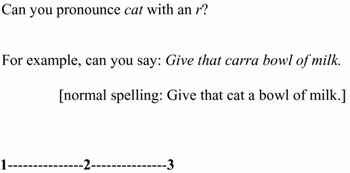
Figure 2 illustrates an example of the questions asked of informants. The word cat has never been reported as undergoing T-to-R, as (7) shows. It has a very similar phonological shape to that, however, which has been reported as possible with the phenomenon, so it may be that previous work has simply missed the possibility that cat can undergo the procedure. Given the fact that the process is variable and relatively rare, corpus investigations may not have reported its occurrence though, as it turned out, this option was quite emphatically rejected by our informants as a T-to-R word, as demonstrated in section 4.3.
Example of the grammaticality judgment task for T-to-R

We tested 72 words. The full list and rationale for their choice will become apparent in section 4.Footnote 13
As will be clear from the above, the precise details of the questionnaire methodology adopted in the morphosyntactic and phonological sections were subtly different but we do not consider this variance to be problematic. We believe that our work shows that questionnaire-based approaches can be suitable for studying both morphosyntax and phonology, but this does not mean that exactly the same methods or kinds of questions need to be asked in both cases. Each questionnaire must instead be tailored to the features under investigation.
4 Results
Our results essentially consist of average ratings of the constructions tested in the questionnaire for either the whole group of informants from one locality, or for sociolinguistic subgroups of them. For the NSR, ratings are out of 4 and, for T-to-R, out of 3: the higher the rating, the more acceptable or common the informants felt a particular form to be. When reporting on the two variables, informant responses are represented as average ratings over all questions in the same linguistic condition, for ease of comparison. Significance testing, however, is done on the full information available, namely, on the overall occurrence of ratings – 1, 2, 3 or 4 – by speaker groups or in specific linguistic contexts. We first consider the social and geographical embedding of the two phenomena and then, in sections 4.2 and 4.3, probe the extent to which the linguistic and lexical constraints on them hold, and consider the implications of our results for the analysis of the phenomena.
4.1 Geolinguistic and sociolinguistic results
Informants on both sides of the Scottish–English border recognise the NSR as a feature that is not very common in their locality but which does not strike them as particularly unusual either.Footnote 14 Essentially, NSR receives higher ratings in Newcastle (mean rating 2.11) than in Hawick (mean rating 1.98), with a similar spread in both localities (standard deviation 1.121 and 1.215 respectively). The results for T-to-R, on the other hand, reveal that it is accepted as a feature of Tyneside English (the average rating in the Newcastle responses was 1.42 (SD 0.69)), but it is not characteristic of Hawick English/Scots (average rating 1.07 (SD 0.36)). Given that the possible range of ratings is from 1.00 to 3.00, even the Newcastle rating seems low, but this is due to the lexically restricted nature of the phenomenon, discussed further below. The overall rating of 1.07 for Hawick might indicate that T-to-R is a feature of this variety to an extent, but an examination of the individual responses suggests that this is probably not the case. Almost all of the positive ratings for T-to-R in Hawick were given by one respondent, H-OF2, who gave a rating of 3 for all questions which contained underlying /r/ (not as a result of T-to-R) in the key word in any environment (e.g. butter, cigarette, dart, repeat), and for three questions which did not. Since she appears to have misunderstood the purpose of the exercise, her positive responses in these three latter cases can hardly be trusted. When we remove her positive responses to words with underlying /r/, the average Hawick rating drops to 1.02, suggesting that T-to-R is not, in fact, a feature of the variety. This implies that either the patterns described for Scots by Johnston (Reference Johnston and Jones1997) and Stuart-Smith (Reference Stuart-Smith1999), discussed in section 2.2, should not be equated with T-to-R (and are perhaps cases of simple flapping), or it may be that there is Scots T-to-R, but that it is not found in Hawick. In either case, it seems clear that the geographical spread of T-to-R simply does not creep far across the Scottish–English border (as Wells assumed, but without empirical evidence). As a consequence of this, the T-to-R results for Hawick are not discussed further, and we concentrate on Newcastle in section 4.3.
Differences between social groups within the Newcastle sample are not striking, which is an interesting finding in itself – T-to-R appears to be relatively stable in the community from our results. There is a significant, if not great, difference between the ratings given by the two age groups: older respondents give a lower average rating (1.30) than younger respondents (1.50).Footnote 15 This is largely a consequence of two of the older respondents, N-OF2 and N-OM2, mostly rejecting the possibility of T-to-R in the questionnaire. Likewise, there is a significant but rather small difference between the responses given by males (1.42) and females (1.41), with the difference largely consisting of a slight preference by the males for response 2.Footnote 16 In any case, we did not replicate Docherty et al.'s (Reference Docherty, Foulkes, Milroy, Milroy and Walshaw1997) finding that T-to-R is preferred by older women in Newcastle (we are closer to Clark & Watson's Reference Clark and Watson2011 finding for Liverpool that younger speakers use more T-to-R than older ones).
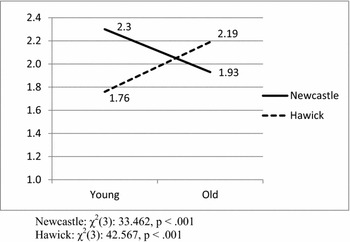
Previous research on the NSR has been ambivalent about the role of age. Beal & Corrigan (Reference Beal and Corrigan2000), comparing data from Newcastle collected between the 1960s and the 1990s, assert that the NSR is still productive in this variety (see also Collings Reference Collings2009). Other research, however, has questioned the persistence of the rule (Cole Reference Cole, Guzmán González and Fernández-Corugedo2008). We consider here whether informants representing two different generations give diverse average ratings to sentences containing NSR. If NSR were indeed on its way out of the system, we would expect younger speakers to be less accepting of sentences containing instances of the phenomenon. Diachronic persistence, on the other hand, should manifest itself in stable ratings across the generations. Figure 3 shows the average ratings for younger and older informants in both localities.
NSR ratings of younger and older informants in Newcastle and Hawick

While the difference in rating between the two age groups is significant in both varieties, the direction of the constraint is reversed on the two sides of the border. In Newcastle, young informants seem to be more accepting of the phenomenon, since they give a higher rating to sentences containing NSR than the older informants do (2.3 versus 1.93). By contrast, in Hawick, test sentences with NSR appear to be favoured by the older informants (2.19 versus 1.76). Bearing in mind the fact that these figures are based on the intuitions of only eight people per locality, the results shown in figure 3 could be taken to indicate that NSR is gradually falling into disuse in Hawick – since the younger generation seem to find it less acceptable. By contrast, younger speakers in Newcastle seem to embrace NSR more readily than their elders do. If these ratings directly correlate with linguistic production, we would indeed expect to find increasing use of NSR amongst the younger speakers in Newcastle and decreasing ratios in Hawick. We do not have any production results for this phenomenon from Hawick since the feature did not readily occur in the sociolinguistic interviews. However, in related research on Tyneside English, which is based on exactly this kind of data collected from 16 younger and 16 older speakers, it has been found that age is, in fact, not a significant factor in NSR production (see Collings Reference Collings2009). Hence, Newcastle youth, while maintaining the overall frequency of vernacular -s use, rate it as increasingly acceptable. This would seem to suggest at first blush that the NSR in Newcastle is robust and seems to be gaining even wider acceptance. However, our discussion in section 4.2 immediately below, which investigates the acceptability of the NSR in a range of linguistic conditions, potentially casts some doubt on this perhaps over-generalised conclusion. Indeed, we would argue on the basis of the evidence presented here that more research with a larger group of participants is needed to investigate the linguistic contexts in which NSR generates high acceptability ratings.
4.2 Structural linguistic results: NSR
Let us now examine the structural constraints that govern the acceptability of NSR. Firstly, we discuss constraints that have a similar effect in Hawick and Newcastle before moving on to highlight the key differences between the localities with respect to this particular feature.
Importantly, the PSC, according to which subject pronouns tend to favour the NSR only when there is intervening material between the subject and the verb, is not significant, in either Hawick or Newcastle. This accords with findings from several other contemporary dialects employing the NSR (see Pietsch Reference Pietsch, Kortmann, Herrmann, Pietsch and Wagner2005; Adger & Smith Reference Adger and Smith2010; Corrigan et al. Reference Corrigan, Edge, Lonergan, Migge and Chíosáin2012; Zanuttini & Bernstein Reference Zanuttini, Bernstein, Lima, Mullin and Smith2011: note 9; but also Godfrey & Tagliamonte Reference Godfrey and Tagliamonte1999).Footnote 17 Our informants in Hawick and Newcastle do not seem to differentiate at all between adjacent and non-adjacent pronouns (Newcastle χ2 (3): 5.943, p = .114, Hawick χ2(3): .706, p = .872, both n.s.). In related research we have found that the PSC does not, in fact, appear to operate across a range of communities in north-eastern England (see also Buchstaller & Alvanides forthcoming and Childs Reference Childs2012). Hence, the non-application of this constraint highlighted here does seem to be a relatively generalisable feature across the entire region – at the perceptual as well as at the production level (see Cole Reference Cole, Guzmán González and Fernández-Corugedo2008 as well as Collings Reference Collings2009).Footnote 18
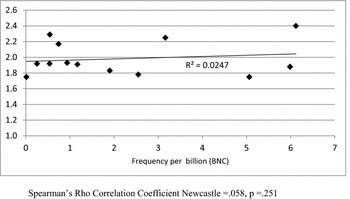
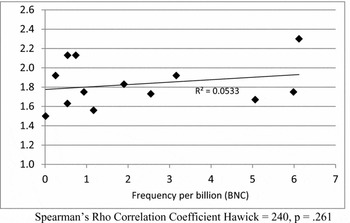
The next grammatical constraint investigated concerns the properties of the verb taking the s-affix when NSR applies. We first tested for the effect of 15 different lexical verbs on acceptability ratings. However, probably due to the large degree of freedom involved, our results proved inconclusive for both communities (NCL: χ2(42): 44.171, .380, Hawick: χ2(42): 54.998, p = .086, n.s.). Next, we tested whether acceptability rates might be conditioned by frequency effects. Figures 4 and 5 plot the rating of sentences containing NSR (on the y-axis) by the lexical frequency of these verbs per 1 billion (1,000 million) words in the British National Corpus (on the x-axis).Footnote 19 However, as we see in these scatterplots, the ratings for individual verbs and their frequency are not correlated, neither in Hawick nor in Newcastle. Indeed, the correlation coefficient is very low for both Newcastle and Hawick. Thus, as far as our data are concerned, lexical frequency of the verb appears not to be a predictor of NSR acceptability ratings.
Correlation of acceptability ratings with lexical frequency in Newcastle

Correlation of acceptability ratings with lexical frequency in Hawick20

Finally, we investigated whether the type of verb used in the test sentence exerts any influence on the occurrence of the NSR. The literature contains a number of classification systems for lexical verbs (see Comrie Reference Comrie1976, Reference Comrie1985; Tsunoda Reference Tsunoda1985; Svartvik Reference Svartvik1985, inter alia). In our investigation, we relied on the model proposed by Huddleston & Pullum (Reference Huddleston and Pullum2002), which classifies lexical verbs according to syntactic–semantic criteria. We chose representative verbs from each of the four most frequent categories, namely, verbs of communication (we tested ask and say), verbs of cognition (think and remember), and verbs of emotion (like and feel). We also tested for the extent to which the verbs eat and see (grouped under the category ‘other’) exert any influence on NSR acceptability. The potential effects of the lexical verbs have and be were included as options on account of previous findings by both Godfrey & Tagliamonte (Reference Godfrey and Tagliamonte1999) and Smith et al. (Reference Smith, Durham and Fortune2007), suggesting that a strong relationship between these verbs and the favouring of NSR were evident.
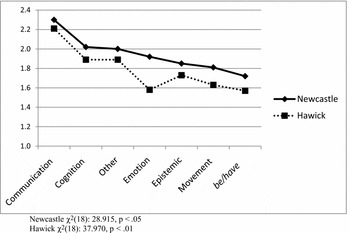
Figure 6 reveals that verb type did indeed prove to be a very good predictor of NSR acceptability ratings, both north and south of the border. The association between certain verb categories and NSR is significant in both communities.
NSR ratings in Newcastle and Hawick by verb types

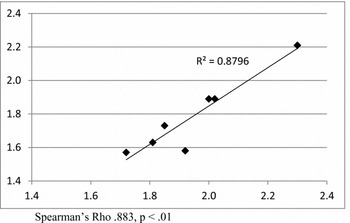
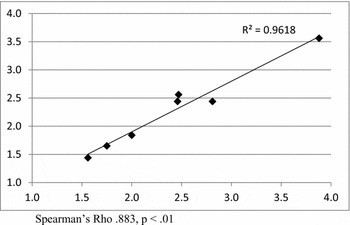
Hence, in Newcastle and Hawick, verbs of communication favour the acceptance of NSR most. These are followed by verbs of cognition, verbs in the ‘other’ category, like eat and see, and verbs of emotion. On the other side of the acceptability spectrum, lexical be and have favour NSR least in both communities (which is probably why they are seldom reported in connection with NSR phenomena).Footnote 21 Moreover, the two lines representing responses from each community run almost exactly parallel, except for verbs of emotion, which indicates a convergence of responses. We tested for the strength of this correlation by plotting the ratings from Newcastle and Hawick in a scattergram (as the x and the y-axis, respectively).
The close association between the acceptability ratings in the two localities is clearly visible in figure 7. It is also underlined by the high r2 value as well as the impressive Spearman Correlation Coefficient (.883). This finding leads us to conclude that, yet again, the two communities north and south of the border seem to be conditioned by a similar underlying linguistic system with only minor localised differences – in this case the rating for verbs of emotion.
Correlation between Newcastle and Hawick informants' rating for the occurrence of NSR with different verbal categories

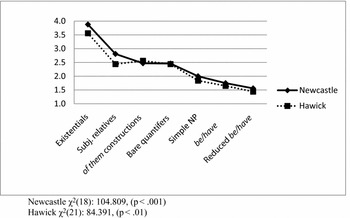
Finally, we investigated the preferences for NSR across a range of different syntactic constructions in both communities. It is important to bear in mind in this regard that the literature varies with respect to definitions of the NSR. Murray's (Reference Murray1873) original conception, for example, does not include relative or existential constructions, nor indeed the effect of lexical be and have. Large-scale corpus data, have, however, been able to demonstrate a fine-grained constraint hierarchy, with different syntactic constructions exerting a differential effect on the occurrence of verbal -s (see Godfrey & Tagliamonte Reference Godfrey and Tagliamonte1999; Wright Reference Wright2002; Cole Reference Cole, Guzmán González and Fernández-Corugedo2008). We thus decided to test NSR acceptability across a range of syntactic constructions. All of the types are exemplified in (11a–g) with test sentences from our actual questionnaire. The ratings for each construction are displayed in figure 8.
Acceptability rates by Newcastle and Hawick informants for NSR in different types of syntactic construction

- (11)
(a) Existentials – ‘There's rats in the garden’
(b) Bare quantifiers – ‘Both needs water’
(c) Subject relatives – ‘The people who wants them’
(d) Of them constructions – ‘All of them likes it’
(e) Simple declarative sentences – ‘My sister wants orange shoes’Footnote 22
(f) Occurrence of lexical be and have – ‘They was very sad’
(g) Reduction of be/have – ‘I's few friends’
As one might expect from the results of previous studies on other English vernaculars (Eisikovits Reference Eisikovits and Cheshire1991; McCafferty Reference McCafferty2003; Wright Reference Wright2002), existentials are most likely to trigger NSR in both communities. They are followed in terms of preference by three different constructions, subject relatives (we tested who and that), bare quantifiers (we tested both, many and some) and of them-constructions.Footnote 23 In both communities, the NSR sentences that are rated least acceptable contain lexical be or have, and they generate even lower ratings when reduced forms of these verbs are incorporated in the experimental sentences. This pattern is significant in both communities.Footnote 24
Note again the very close correlation between acceptability ratings in Hawick and Newcastle. The lines representing responses from each community depicted in figure 8 are running almost exactly parallel except for subject relative constructions and existentials. As previously, we decided to test the strength of association between the Newcastle and Hawick respondents – in this case, with respect to the full range of construction types. The scatterplot in figure 9 demonstrates that the constraint ranking between these two communities is almost identical. Indeed, the syntactic factors which condition the acceptability of the NSR in Newcastle and Hawick seem to be subject to near identical constraints, with an r2 of .96 and a Spearman Correlation Coefficient of .883.
Acceptability rates by Newcastle and Hawick informants for NSR in different types of syntactic construction

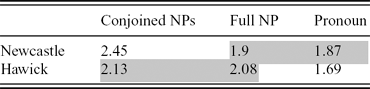
The classic NP/pro constraint does hold in both varieties tested in this study and our results show exactly the hierarchy we would have predicted given previous research on the variable: pronouns (other than 3SG) are judged to be less acceptable with verbal -s marking than (plural) NPs. However, orthogonal to this rule, we also tested another constraint that has been pointed out in the literature, namely, the conjoined vs single NP constraint. As table 1 shows, these two constraints intersect in slightly different ways in the two communities.
NSR ratings for three different subject types in Newcastle and Hawick
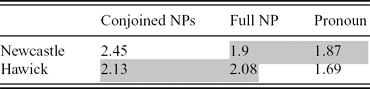
Newcastle: χ2(6): 18.507, p < .01
Hawick: χ2(6): 17.194, p < .01
As regards the influence of the type of subject on sentence acceptability, Table 1 demonstrates that the main rating differential in Newcastle lies between conjoined 3SG NPs (such as My sister and my brother, 2.45) versus non-3SG subjects (plural NPs, and the pronouns I and they, 1.9 and 1.87). In Hawick, on the other hand, the main difference in rating is between NPs of any kind (2.13 and 2.08) versus pronouns (1.69).
4.2.1 Consequences for the analysis of NSR
Consider again the classical conception of the NSR articulated by Murray: ‘In the PRESENT TENSE, aa leyke, wey leyke, yoo leyke, thay leyke, are used only when the verb is accompanied by its proper pronoun; when the subject is a noun. . .the verb takes the termination {s} in all persons’ (1873: 211). Much recent work on the syntactic-morphological analysis of this system of agreement concurs that the -s on the verb is a non-agreeing form or ‘default agreement’: Henry (Reference Henry1995), Börjars & Chapman (Reference Börjars and Chapman1998), Adger & Smith (Reference Adger and Smith2010), Tortora & den Dikken (Reference Tortora and den Dikken2010) (but see Zanuttini & Bernstein Reference Zanuttini, Bernstein, Lima, Mullin and Smith2011). Börjars & Chapman characterise the -s as a present tense affix, a characterisation that we agree with. Hence, it is the bare present tense form (leyke in Murray's example) which actually shows agreement, while first- or second-person and/or plural are all realized as Ø. It is thus actually misleading to refer to the -s in a system observing the NSR as ‘triggered by the NP subject’: in such a system the -s form is the unmarked present tense form, and so is not actually triggered by anything as such.
The absence of the subject proximity constraint immediately rules out applying Börjars & Chapman's (Reference Börjars and Chapman1998) analysis of NSR to the data in Newcastle and Hawick. They argue that the subject pronoun in these dialects, when it is adjacent to the verb, is a prefixed agreement marker. It would thus be an analogue of the French subject pronoun (je, tu, il, elle, . . .), which, according to a widely accepted analysis (see Roberts Reference Roberts, Biberauer, Holmberg, Roberts and Sheehan2010inter alia), is a subject agreement marker, agreeing with a null subject. The absence of -s with adjacent pronouns is then because ‘they are both inflections of the same type’ (Börjars & Chapman Reference Börjars and Chapman1998: 76). The strongest piece of evidence – in fact, the only supporting data − for this analysis is the subject proximity constraint, i.e. a pronoun separated from the verb cannot be a prefix, therefore it can co-occur with -s. But in Hawick and Newcastle, as in several other contemporary dialects, pronouns (other than 3SG) tend strongly not to co-occur with -s even when they are separated from the verb.Footnote 25
What is it about pronouns that make them trigger agreement where other NPs don't? Adger & Smith (Reference Adger and Smith2010) postulate a feature [pronominal] to be part of the composition of pronouns but not that of other NPs, which is the real trigger of agreement (realised as Ø) in the NSR system. It seems to us, though, that Occam's Razor would argue against postulating such a feature, given that pronouns have other properties which set them apart from other NPs: in particular, only pronouns make person distinctions and case distinctions, and only pronouns lack lexical content. Furthermore, the strict division between pronouns and other NPs only holds in the idealized version of the relevant dialects. In actual speech communities (Hawick and Newcastle, in our case), non-pronominal plural NP subjects sometimes trigger plural agreement, and pronominal subjects sometimes fail to trigger agreement.
Our findings can shed some light on the question of which morphosyntactic factors determine how good different NP types are as triggers of agreement. We therefore propose that personal pronouns are more likely to trigger agreement than other NPs because they have more formal features of the sort that trigger agreement, being marked for person as well as number (and in the third-person singular, even gender, although this has no effect on agreement in English). Consider again table 1, showing the effect of different NP types on agreement.
The non-pronominal subject NPs make up a scale as follows (where < means ‘less likely to trigger agreement’ or equivalently ‘more likely to occur with -s’):
(12) there < quantifier-headed NP,Footnote 26 relative pronouns < plural lexical NP
This suggests the following generalisation:
(13) When the subject is formally marked [PL], it triggers plural agreement.
Expletive there is not plural in any sense.Footnote 27 Quantified subjects like both or many of them have plural reference, i.e. they are ‘semantically plural’, but arguably are not formally [PL]. Their plurality derives from the complement (many of them /the girls), but the head, and hence the phrase itself, is not formally [PL]. In the case of bare quantifier arguments, as in Both drink too much, there is, arguably, a null plural complement of them. Relative pronouns (who, which, or Ø, the latter in that-relatives) are also not plural-marked, even when their correlate is plural. But plural lexical NPs are formally [PL] with their feature morphologically realised as plural -s. The generalisation (13) is in line with the explanation suggested above as to why pronouns are the most likely to trigger agreement, namely, they have more formal agreement-triggering features.Footnote 28
The hypothesis that verbal -s, when occurring in constructions with plural subjects in the NSR system, is a present tense suffix encoding no agreement raises the question of what the third singular -s actually is. There are two hypotheses: either it is, effectively, a different element, an agreement suffix triggered just by third singular subjects. Alternatively, it is the present tense suffix, appearing because third singular subjects, including third singular pronouns, do not trigger agreement. The latter hypothesis is in line with our idea that agreement is most likely to be triggered by subjects that have formal person and number features, if we adopt the view that third person is, in fact, absence of person, and that singular is absence of plural (as argued by Harley & Ritter Reference Harley and Ritter2002, and assumed by Henry Reference Henry1995 in her account of the NSR in Belfast English).
The fact that coordinations of NP are poor triggers of agreement (i.e. often co-occur with -s) is thus predicted by our hypothesis. A coordination of two singular NPs, as in (14), is obviously semantically plural.
(14) [My mother and my father] wants it.
However, it is not formally [PL], since neither conjunct is [PL]. The formal features of a coordinated phrase derive from the conjuncts, either from both conjuncts or, in the case of asymmetric coordination, from one of the conjuncts (typically the leftmost one as Johannesen Reference Johannesen1998 notes). Hence, the coordination of two NPs should be a poor trigger of plural agreement, naturally, the verb in these contexts should often occur with -s.
There is another possible explanation, though, for the frequency of the -s form on the verb with cases such as (14): the verb shows standard English third-person singular agreement with one of the conjuncts, so called ‘closest conjunct agreement’, a phenomenon familiar from many languages (see Bošković Reference Bošković2009).Footnote 29 This hypothesis is, furthermore, supported by the fact that conjoined NPs have been reported to trigger verbal -s even in non-NSR varieties of English (Cole Reference Cole, Guzmán González and Fernández-Corugedo2008; Visser 1970).Footnote 30
The choice between the two hypotheses sketched above should become observable by testing coordinations where the person, number and pronominal status of the conjuncts is varied. For example, under the closest conjunct hypothesis, a coordination such as he and you is predicted to trigger the Ø-form, while you and he will trigger -s. Under the ‘formal features hypothesis’, no difference is predicted between the two coordinations. In our first investigation of Hawick and Newcastle we did not include the required variety of coordination types to choose between the two hypotheses. We have recently conducted an investigation into this phenomenon and preliminary results show a weak closest conjunct agreement effect, the properties of which are difficult to determine at the present time. We will return to this question in future research.
4.3 Structural linguistic results: T-to-R
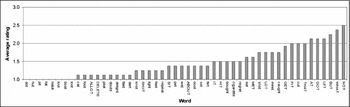
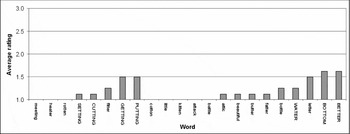
Turning now to the linguistic distribution of T-to-R as revealed in the Newcastle responses, we present first the result for all of the words that we tested, as an initial step in clarifying the linguistic constraints on T-to-R. For ease of presentation, we have split the findings into two figures, both of which show the average rating for a word across all speakers. Figure 10 shows the results for words with word-final /t/ and figure 11 gives those for words with word-medial /t/. Words in which T-to-R has previously been reported, as discussed in (7), are given in uppercase, and in figure 11 polymorphemic words are given first, followed by monomorphemic ones. These two figures thus reveal the full set of words tested for T-to-R. This includes: (i) words which had been previously reported as allowing T-to-R; (ii) words which have not been previously reported to allow T-to-R but which have a similar phonological structure to those which have, such as cat, cut, dot, knot, pit, set, shot, bottle; (iii) words which have not been previously reported to allow T-to-R and which have a phonological shape which is quite different to those which typically have, such as boot, dart, doubt, light, meet, fillet, habit (with long/tense vowels and diphthongs and with unstressed final syllables) and (iv) a few words or groups of words which allowed us to test the effect of phonological form, as explained below.
Average T-to-R ratings for word-final /t/ in Newcastle

Average T-to-R ratings for word-medial /t/ in Newcastle

Figures 10 and 11 reveal that T-to-R was reported by at least one speaker for most of the items in the questionnaire but that there is considerable variation in how respondents judged T-to-R in different lexical items (from an average score of 2.5 for not to entirely negative responses for sixteen words). Particularly striking is the fact that words which have previously been reported with T-to-R cluster towards the right-hand side of the graph (and of the two sections of the graph in figure 11) – nine of the ten most highly rated words have been previously reported with T-to-R, and only seven words which have previously been reported with T-to-R have an average rating below 1.5. The range of results raises the question of where to draw the line in terms of confidence in the results. It might be reasonable to claim that any positive result means that T-to-R is reliably possible in a particular word; on the other hand, we might expect a little noise in self-reporting and a rating of 1.125 (obtained by words such as cat, delete, dart and attic) means that only one informant gave the word a rating of 2 (which is, essentially, the ‘maybe’ rating), and this is not a resounding result. An average score at or near 2 is compelling, however, as it indicates considerable agreement among (at least a substantial number of) informants that T-to-R is possible, and an average around 1.5 is quite confident, too, especially as one speaker scored 1 for everything (this is N-OF2 − Newcastle Older Female 2 − who clearly aims to indicate that she does not see T-to-R as a feature of her speech), and this brings down the average of all words (equally).Footnote 31 Averages between 1.5 and 1.125 indicate a decreasing level of confidence.
The fact that T-to-R is reported as possible in quite a wide range of words (even if we set aside those with very low ratings) suggests either that previous descriptions of the phenomenon are incomplete or that the method employed here produces over-reporting (something which the structure of the responses, as described below, suggests is not the case). T-to-R is reported in some unexpected words, given the phonological description discussed in section 2.2. For example, relatively high average ratings are given for the words caught and meet (1.75), eat (1.625)Footnote 32 and bought (1.5), all of which have long/tense vowels in Tyneside English, with ratings as high as some words which have been previously reported with T-to-R (e.g. lot at 1.75 and it at 1.5). Conversely, T-to-R is judged not to be possible (as expected in the light of previous reporting) in the words pit, fat, dot and hut, all of which have short/lax vowels (compare the phonologically similar fit, that, not and cut, which have high ratings). An obvious question is whether there is any patterning behind the ratings. If there is no patterning, it may be the case that the elicitation method is not producing coherent results. If, on the other hand, patterns are revealed which make linguistic sense (or are, at least, linguistically non-random), then we can be confident that the elicitation method does give us an insight into the constraints on T-to-R. In order to determine which is the case, we compared the average T-to-R rating for words of different types; the results are shown in figure 12. The groups compared are words with:
- (15)
(a) previous reporting of T-to-R
(b) word-final /t/ preceded by short/lax vowel (as in fat)
(c) word-final /t/ preceded by long/tense vowel or diphthong (as in about)
(d) morpheme-internal /t/ followed by unstressed /ə(r)/ (as in better)Footnote 33
(e) morpheme-internal /t/ followed by unstressed /əl/ (as in little)
(f) morpheme-internal /t/ followed by unstressed /ən/ (as in kitten)
Average T-to-R rating per group

Figure 12 reveals that phonological environment does play an important role in the acceptability of T-to-R for our Tyneside respondents. For example, a preceding short vowel is significantly more conducive to T-to-R than a preceding long/tense vowel or diphthong.Footnote 34 In words where intervocalic /t/ is followed by /əl/ and /ən/, T-to-R is strongly dispreferred or impossible, although bottom is not similarly rejected. Most strikingly, the group of words which have previously been reported with T-to-R are rated most highly of all,Footnote 35 suggesting that there is something special about this group and that our methodology is successful in allowing informants to differentiate as to whether a word allows T-to-R or not. Part of this is explicable in terms of phonological environment – of the words which have previously been reported with T-to-R, 88.5 per cent have a preceding short vowel (compared with 58.5 per cent with a preceding short vowel for the previously unreported group), but this cannot explain the full effect, as a comparison with the ‘short vowel’ column in figure 12 shows.
A further finding is that word-internal T-to-R is much less likely than word-final. As figure 11 shows, no case of word-internal /t/ achieves a rating above 1.5, apart from better and bottom with 1.625. This may seem surprising, given that several such words have been reported with T-to-R before. In fact, it concurs with previous reports: word-internal T-to-R is almost always reported as massively dispreferred compared to word-final, all the way from Wells (Reference Wells1982: 370: ‘[v]ery occasionally the rule applies word-internally’) through Docherty et al. (Reference Docherty, Foulkes, Milroy, Milroy and Walshaw1997: 291: T-to-R is found ‘very occasionally both morpheme-internally and across morpheme-boundaries’) to Clark & Watson (Reference Clark and Watson2011: 530: T-to-R is found ‘word-medially in only 1.5% of all instances (always in the word ‘whatever’)’); Asprey (2009) also agrees. This is also clear from another of our results: T-to-R is much more acceptable in get (1.916) than in getting (1.5).Footnote 36 We return to the implications of this in section 4.3.1. The practically total absence of T-to-R preceding /əl/ and /ən/, and the greater acceptability following /ə(r)/ may be due to phonological reasons or may simply be on account of the words chosen − much of the success of /ə(r)/ is due to the word better (although letter also scored relatively high).
We tested a number of other factors, drawn from relevant discussion in previous literature, which we hypothesised might affect the acceptability of T-to-R. Given that the result of the process is a rhotic, its interaction with other aspects of English rhotic phonology becomes an issue. One question which our methodology can more readily investigate than traditional sociolinguistic interview methods is whether the presence of other rhotics in the nearby phonological environment causes the process to be dispreferred. This is the case in other phenomena. In the r-sandhi found in non-rhotic dialects, for example, Jones (Reference Jones1956) claims that r is not typically realised in contexts like roar_ of laughter or Victoria_ and Albert (see Mompeán-Gonzalez & Mompeán-Guillamón Reference Mompeán-Gonzalez and Mompeán-Guillamón2009) because of the rhotic which is immediately adjacent to the candidate insertion site. Moreover, Hall (Reference Hall2007) claims that the multiple occurrence of an underlying /r/ in a word can lead to the loss of one occurrence on the surface, even in rhotic varieties, so that secretary is realised as [sɛkətɛri], for example. Both of these phenomena may be related to the ‘long-domain resonance’ of r (Kelly & Local Reference Kelly and Local1986) and raise the question of whether T-to-R might be inhibited in an r-ful environment, too (why add further rs to a phrase, through the realisation of a /t/ as a rhotic, if multiple occurrence of r is disfavoured?). We tested this using the word get (one of the words most widely recognised as allowing T-to-R in previous research) followed by four words of similar status, some of which feature /r/ and some of which do not: Ethel and Erin (infrequent names with similar phonological structure) and about and around (phonologically similar and frequent prepositions).
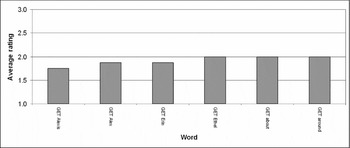
Get was also used to test the effect of metrical structure and post-lexically formed feet on the process. As discussed above, Carr (Reference Carr1991) predicts that T-to-R should be favoured if the syllable with /t/ is stressed and can thus function as a foot-head, forming a cross-lexical foot with a following unstressed syllable. This means that T-to-R should occur in get Alexis, where the initial unstressed syllable of Alexis can form a post-lexical foot with get, but not in get Alex, where the initial syllable of Alex is stressed, and so cannot form a foot with get. We included both of these sequences in the questionnaire.Footnote 37 The results for every occurrence of get are given in figure 13.
Average T-to-R ratings for phrases with get

Figure 13 shows that there is very little difference between any of the pairs tested: get Alexis scores very slightly lower than get Alex (1.75 vs 1.875 − the smallest possible difference, involving just one person giving get Alex one point more that get Alexis). If Carr's claim was correct, get Alex should not allow T-to-R at all, let alone be preferred over get Alexis. So it seems likely that foot structure is not relevant in this way.Footnote 38 The comparison of get Ethel with get Erin (2 vs 1.875) and get about with get around (both at precisely 2) implies that an adjacent /r/ has no effect on the likelihood of the process occurring. Additionally, other words with neighbouring /r/ in the questionnaire are no less likely to have a non-negligible T-to-R rating than words without /r/ (as in cigarette and regret, both with scores of 1.5).
It is clear from the above that T-to-R emerges from our results with the core properties identified in previous work on the phenomenon largely intact, but with their conditions slightly relaxed. We believe that these slight additions to the previously described patterning provide an authentic insight into speakers’ knowledge of T-to-R. It is favoured in word-final position, following a short/lax vowel, and it is lexically specific − it is possible/likely in what and fit but it is not possible in dot or pit, for example. It seems, however, that the previously reported set of words may need to be expanded, at least for Tyneside English: cut (average 2) fits with standard expectations for T-to-R words well, as perhaps does shot (1.750); regret (1.500) may be more surprising. Furthermore, T-to-R may not be entirely ruled out by a preceding long/tense vowel or diphthong. One of the few words in this category to have been previously reported with T-to-R, about, receives a non-negligible but also perhaps not compelling average of 1.375. Other words in this category do better, however.
It may be notable that the only long/tense vowels which produce results with some degree of confidence (1.5 and above) are /ɔ/ and /i/,Footnote 39 although there is no obvious phonological rationale for this restriction. It may not be coincidental, however. A study which applied the methodology developed for the current article to investigate T-to-R in Liverpool English, Caffrey (Reference Caffrey2011), also finds that a few words with non-short/lax vowels allow T-to-R, but the only words with averages of 1.5 or above have /ɔ/ (caught, bought), /i/ (feet, repeat), or /aʊ/, as in about (which was given the highest possible average score of 3 by Caffrey's informants, as were the following relatively expected set: lot, that, at, got, let, what, not, better, bit, forget, forgot, sat). Caffrey's results further indicate that, while there is a core set of words which are likely to be shared across all varieties of Northern English with T-to-R, the precise inventory of T-to-R words may vary slightly from variety to variety. For example, hit and eat score 1.5 and 1.625 in Newcastle, but both score 1 (i.e. T-to-R is not possible) in Liverpool; and shut and sit both score just over 2.9 in Liverpool, but only 1.25 and 1.375, respectively, in Newcastle. This is also compatible with Broadbent's (2008) claim that words like fit and cut (which score highly in Newcastle at averages of 2) cannot undergo T-to-R in West Yorkshire.
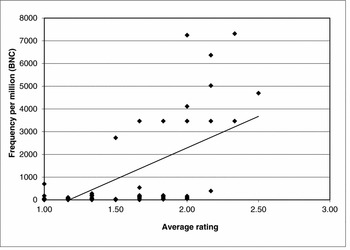
One further issue which has arisen in the T-to-R literature is whether lexical frequency can explain what the set of T-to-R words have in common. Broadbent, for example, asserts that lexical frequency is indeed a crucial part of the picture: ‘t-to-r remains in a small group of words because these words are used frequently by . . . speakers and because they share phonological shape’ (2008: 166). Broadbent ties this in with an exemplar approach to phonology, following work such as Bybee (Reference Bybee2001) and Pierrehumbert (Reference Pierrehumbert, Bybee and Hopper2001), claiming that it can explain frequency effects because the exemplar clouds of more frequent words are different and can have different properties to those of infrequent words (something that formal phonology struggles to model). To test this, we compared the average rating per word with its frequency (per million words) in the British National Corpus (BNC). Note that the pronoun it (average rating 1.5) is largely excluded from the analysis as it was massively more frequent in the BNC than any other word (at 24,508 occurrences per million). The results are shown in figure 14.
T-to-R rating compared with lexical frequency in the BNC

The simple correlation between Rating and Lexical Frequency is highly significant (Spearman's Rho .0627, p < .001), as the trend-line in figure 14 indicates. Excluding it from the analysis for the moment, only one word with a rating of less than 2.00 (about, with a rating of 1.375) has a frequency higher than 700 per million (about occurs at a frequency of 2730 per million), and it seems that frequency of occurrence can indeed account for which words allow T-to-R. However, we believe that the truth is more complicated than this, and that the simple result of statistical significance hides a picture in which frequency appears to explain a phonological pattern, but that this effect disappears on closer inspection (like the parallel situations in Dinkin Reference Dinkin2008 and Neilson & Honeybone in preparation). The pattern in figure 14 is rather unusual. If the acceptability of T-to-R simply correlated with frequency, we would expect the average rating of words to rise gradually with frequency, so that words cluster somewhere around the trend-line. However, the pattern in figure 14 is essentially categorical, not gradient. There is a two-way split in the responses: most words cluster along the bottom of the graph, with broadly comparable frequency (below 1,000 per million) but with a wide range of acceptability, almost stretching from the bottom of the scale to the top (thus there are three words, cut, fit and let, with a rating of 2.00 or more and quite low frequencies, at 165, 56 and 390 per million respectively, with only three words above them in term of acceptability: but, what and not) − for these words, frequency has no effect. There is also a group of words which have high lexical frequency and which are all quite acceptable as T-to-R; these words essentially cluster in the top right-hand corner of the chart (about, just discussed, is something of an outlier here but is balanced out by it, missing from the chart, which is extremely frequent but only has a rating of 1.5). Frequency thus does not seem to clearly predict the acceptability of T-to-R in a word. It is true that there is a group of words which are all frequent and which all allow T-to-R, but if these are set aside, words with comparable frequencies vary massively in terms of their propensity to undergo T-to-R.
The picture emerging from our results echoes that found by Clark & Watson (Reference Clark and Watson2011). They find a similarly categorical pattern in their production data from Liverpool English: there is a set of words in their corpus which allow T-to-R, and all of them are frequent, and there is another set of words which never occur with T-to-R, but which have a wide range of frequencies: there is no gradual increase in terms of the proportion of rhotic realisations of /t/ in words in a T-to-R environment in line with a gradual increase in frequency.Footnote 40 Both Clark & Watson's results and ours are deeply problematic for the exemplar explanation: exemplar clouds grow gradually with exposure to exemplars, and predict that gradient patterns will be found. The patterns for T-to-R from both intuition (shown in our results) and production (shown by Clark & Watson) reveal two distinct groups of words in terms of the interaction with frequency, however − which is exactly what is not predicted on exemplar assumptions, and is more compatible with formal approaches, which are more accommodating of categorical results.Footnote 41 If these assumptions are right, then, as with the discussion of the NSR in section 4.2, lexical frequency is not a crucial factor in explaining the patterning of T-to-R. What it exactly is that sets apart the group of words which allow T-to-R is discussed further in section 4.3.1.
4.3.1 Consequences for the analysis of T-to-R
T-to-R remains a phonologically fascinating phenomenon. Our results confirm that it is a variable,Footnote 42 neutralising, structure-preserving, productive yet lexically specific, cross-lexical process. They also reveal some new detail in its patterning and this combination of characteristics is what makes T-to-R notable. Its properties do not seem easily compatible with either formal phonological models, or with usage-based alternatives.
It is common in formal phonological theory to differentiate between (i) ‘early’, lexical phonology and (ii) ‘late’, ‘low-level’, or phrasal (‘post-lexical’) phonology − this distinction has been formalised, for example, in rule-based Lexical Phonology (Kiparsky Reference Kiparsky1982; Hargus & Kaisse Reference Hargus and Kaisse1993), and in Stratal Optimality Theory (Kiparsky Reference Kiparsky and Ritter2000; Bermúdez-Otero in preparation). It is also common to attribute specific properties to different types of phonological process along these lines (see, for example, Harris Reference Harris1989; Coetzee & Pater Reference Coetzee, Pater, Goldsmith, Riggle and Yu2011): early/lexical phenomena are the only ones expected to have exceptions, are where structure preservation is expected to apply, and are restricted to apply only within words. All of these properties derive from the idea that these are lexical phenomena − the lexicon is where exceptionality is expected to reside, only underlying phonological categories exist in the lexicon, and lexical entities are naturally bounded by word-edges. Late/phrasal phenomena have the opposite characteristics, and may thus occur across word boundaries − indeed morpholexical boundaries are not expected to be relevant to this type of phonology in some models, as they are erased by the time that phrasal structure is constructed. T-to-R mixes the properties that are expected of these two basic types of phenomenon: it does not apply across the board and is structure preserving, but it applies across word-boundaries. Carr's (Reference Carr1991) analysis is the first to note this and tries to reconcile the issues. As we discussed above, however, some of Docherty et al.'s (Reference Docherty, Foulkes, Milroy, Milroy and Walshaw1997) and our own results conflict with Carr's assumptions, indicating that his analysis must be flawed.
We have also shown above, on the other hand, that the usage-based analysis proposed by Broadbent (Reference Broadbent2008), which is couched in a framework where considerations such as those just mentioned may not be seen as important, also faces problems, because its predictions based on frequency of occurrence are not met. We note further here that another aspect of an exemplar-phonological usage-based analysis is also problematic: it might just be that T-to-R is no longer productive and is only or mainly found in stored chunks which were once phrases, such as get it or put it. Broadbent approves of this position, claiming, for example, that it is compatible with the observation that the most frequent word following a T-to-R /t/ is it. This storing of phrase-chunks is to be expected on exemplar assumptions (as Broadbent writes, ‘Bybee [2001]. . . assumes that frequent collocations will also be stored in the mental lexicon’ (2008: 164)), and it encourages Broadbent to assume that T-to-R is ‘no longer a productive process’ (2008: 148); she writes that ‘[i]f we assume that frequent collocations are stored, then we have a way of capturing the intuition that t-to-r is essentially becoming lexicalised’ (2008: 164). The fact that T-to-R is equally accepted by speakers in a range of contexts, however, is evidence against this: T-to-R in get Ethel is just as acceptable as it is in get about, and can you do tharragain? receives equally high ratings as we had to firra new tyre (all scoring an average of 2, despite the likely different frequency of occurrence of the relevant phrases). Clark & Watson's analysis of T-to-R in a spoken corpus also does not find any effect that might confirm this prediction of an exemplar model.
Any full analysis of T-to-R needs to be able to account for all its characteristics. Neither of the phonological approaches to T-to-R just discussed − a formal approach which assumes that T-to-R is a standard phonological rule or an exemplar approach − succeeds in this, and both make predictions which are contradicted by the data. We lack the space here to provide a full analysis of the phenomenon which takes all it properties into account; rather, we close this section by summarising these properties. Our results have been crucial in establishing these facts. Together, they provide a clear challenge to phonological theory. We have shown that T-to-R has the following characteristics:
- (16)
(a) Synchronic T-to-R is a phenomenon which occurs robustly in intervocalic position, across a word-boundary.
(b) T-to-R is much less likely in word-internal position than it is word-finally, and it is least likely across a word-internal morpheme boundary (it is slightly more likely word-internally if the word is monomorphemic).
(c) It is a variable phenomenon: speakers sometimes produce a rhotic (typically [ɹ] for Tyneside speakers) in the T-to-R environment, and sometimes produce an obstruent (which could be [t, tʔ, ʔ], etc.).Footnote 43
(d) The vowel preceding the target /t/ is more likely to be short/lax than long/tense, to a statistically significant degree.
(e) However, a few words with a preceding long/tense vowel are accepted with T-to-R with a fair degree of confidence (an average of 1.5 and above) and there is evidence of their use in production data.
(f) There seems to be a core set of words, which are widely accepted as T-to-R words (cross-dialectally and in terms of high average scores, of 1.916 or above), including not, what, but, let, get/got, at, that; for Tyneside English, our results show that this also includes fit and cut.
(g) There are other words in which T-to-R is possible, some of which have been noted before (e.g. it, lot), and some others which have not (e.g. eat, regret); but there are also many other words with the same phonological structure which do not allow T-to-R.
While no previous analysis accounts for all these observations, we believe that the three main pieces of previous phonological work on T-to-R all offer insights. Carr (Reference Carr1991) emphasises the importance of reconciling its seemingly contradictory characteristics; Broadbent (Reference Broadbent2008) stresses the importance of recognising that it is heading towards lexicalisation; and Clark & Watson (Reference Clark and Watson2011) show that the interaction between T-to-R and frequency of occurrence is complex but worth paying attention to. We note that either T-to-R is a bizarre, lexically specific but cross-lexical process, with a nearly but not completely strict phonological patterning, or a new analytical approach is required.
4.4 Methodological results and their implications
The discussion above shows that the questionnaire-based methodology that has been trialled here reveals results which are robust. They replicate some previous findings from different types of investigation into the NSR and T-to-R. This shows that our findings have a firm base which allows us to draw the sociolinguistic, geolinguistic and structural conclusions that we do above. Our results do not just tell us what we already know, however. Our methodology allows us to probe the phenomena in detail, testing both who recognises and accepts which constraints as part of their dialect, and how the linguistic conditioning on the phenomena pattern precisely, thereby extending our knowledge of them. It is this that has allowed us to consider new theoretical implications, as discussed in sections 4.2.1 and 4.3.1.
Corpus-based work is important and can disprove generalisations made purely on the basis of an author's observations or informal introspection, but it cannot probe the uncommon corners of a phenomenon − the necessary constructions may not occur often enough (or at all) in a corpus, even though they may be grammatically constrained. Corpora cannot tell us what is ungrammatical. A linguistically controlled questionnaire of the type that we have developed, which probes informants' (indirect) grammaticality judgements, can provide such detail. It could in principle be, for example, that all words allow T-to-R, but that the proportion of the time that it is realised in most of them is very small. We have shown here that this is not the case. All this bodes well for future work using the same methodology.
A notable feature of our fieldwork, and our commentary on it, is that it combines the investigation of phonology and morphosyntax. This is important for future dialectological work, given that large-scale dialectology needs extensive fieldwork in many localities. It is significant that our methodology produces useful results at both linguistic levels and can thus provide the basis for future combined investigations.
There is little previous work which addresses the study of variation at different linguistic levels. Cheshire et al. (Reference Cheshire, Kerswill, Williams, Auer, Hinskens and Kerswill2005) is a clear exception, and our results agree with theirs to the extent that we ‘found no evidence that there is less [sociolinguistic] variation in syntax than in the morphology or the phonology of a language’ (Reference Cheshire, Kerswill, Williams, Auer, Hinskens and Kerswill2005: 166). This is noteworthy as some previous work, e.g. Hinskens (Reference Hinskens1998), had suggested that this might be expected. In our results, there is significant and considerable variation in the NSR in terms of the age of informant; there is less variation in terms of the acceptability of T-to-R in Newcastle. On the other hand, our results are compatible with the general impression that geolinguistic variation at the morphosyntactic and at the phonological level is different in kind. Whereas T-to-R is almost categorically constrained by space (being practically absent in Hawick and variably present in Newcastle), the NSR is governed by subtly different probabilistic constraints in both localities. A possible interpretation of our results is that this feature is spread over a larger area than T-to-R happens to be, and if phonological dialectology involves more phenomena which are less widespread, this will indeed lead to a wider spectrum of dialectal variation.
5 Conclusion
In this article, we have reported the pilot application of a questionnaire designed to elicit (indirect) grammaticality judgements. While two variants of the questionnaire were required for our phonological and morphosyntactic investigations, both were designed to access linguistic knowledge through participants’ consideration of whether a specific pronunciation or sentence could be heard in their speech community. We argue that this approach facilitates comparability across types of features, while at the same time allowing each variant to be analysed rigorously on its own terms.
Overall, we argue that these instruments have been effective in accessing speakers’ linguistic knowledge and that they consequently form a helpful addition to the battery of methods for the investigation of variation, especially for less common variants. Our questionnaire-based approach can be tailored to explore specific structural and contextual effects, and hence permits a more nuanced account. The essential commonality of the method across different levels of the grammar also allows the incidence, frequency and sociolinguistic patterning of phonological and morphosyntactic features to be compared much more directly than previously.
However, there is clearly room for development of what is, after all, a preliminary study. While the questionnaire approach has worked well, the instruments require further refinement to ensure both flexibility of application to a wide range of other features, and sufficient depth of analysis of the specific contextual effects which might affect particular variables. In addition, there is a clear need to explore a greater range of individuals with more speakers per cell from a properly structured sample of localities to take some of our findings further. This calls for a larger-scale project, leading to a new Linguistic Atlas of the British Isles, in which broad, initial sampling would be combined with more detailed work on a selection of localities, allowing overview information to be combined with fuller structural detail.