Introduction
Within amateur musical circles in Benin, one is told that if a male blows too hard into a brass instrument his testicles might swell up, fall off, or even run away. Concerned parents warn their children against ‘blowing brass instruments’ (souffler les cuivres), telling stories of ‘testicular hernias’ and infertility, and many maintain that male brass players must take preventative measures and attach their testicles with string. Females, meanwhile, are cautioned that playing brass instruments will prevent pregnancy and are discouraged from the practice altogether. Accompanying this unease about blowing out, and the potentially dangerous effects of the forceful exhalation of air through instruments, is a complementary concern for breathing in, and the possible inhalation of micro-organisms or poison through the mouth.
Abraham, a twenty-five-year-old university student and trombone player, is one of many Beninese brass players I know who experience anxiety about their musical practice.Footnote 1 ‘There are stories, you see,’ he told me, alluding to rumours that blowing into brass instruments can harm one's physical health, ‘and we cannot be sure whether they are true.’ Abraham said that not knowing ‘the truth about brass instruments’ causes him to worry. When he entertains the idea that playing the trombone can cause bodily harm, he said he becomes nervous, his heart beats quickly, and he sweats. To calm himself, he will check his bodily posture, clean his mouthpiece, and take care not to blow too hard. Abraham does not let other people, especially strangers, use his instrument or mouthpiece. If you are not careful, he explained, an enemy can tamper or perform sorcery with them and you will be harmed.
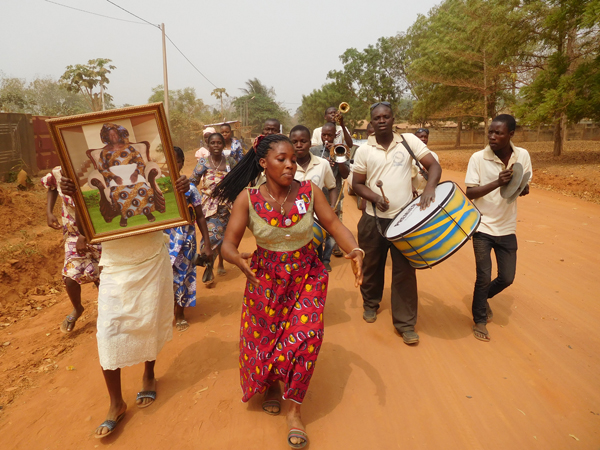
Abraham's worries are not unique. In the peri-urban region surrounding Cotonou, Porto Novo, Ouidah, Bohicon and Abomey, brass instruments are part of a widespread practice of amateur music making.Footnote 2 Musicians such as Abraham – predominantly working-class young males with minimal formal education – play in brass bands (les fanfares) for communal events such as funerals, church services and political rallies (Figure 1). While playing in brass bands is often pleasurable, and occasionally profitable, for labouring musicians it also incites anxieties: preoccupation with dilapidated instruments, scepticism of duplicitous middlemen, mistrust of envious bandmates, and an enduring fear of the occult, to name but a few. Above all, brass musicians express concern about the adverse effects that blowing out, and breathing in, through brass instruments might have on their bodies and, in particular, their sexual organs.
Fanfare La Voix des Anges de Sodohome performs during a funeral caravan in Lokossa, Benin.

Engaging with this anxiety of blowing, this article takes seriously my interlocutors’ concern with the physical consequences of playing brass instruments.Footnote 3 My main argument is that understandings of the precarious nature of breath are at the core of musicians’ experience of anxiety. I begin by describing the operative terms in the article's title – anxiety and blowing – and relevant literature, including anthropological work on bodies and affect, interdisciplinary perspectives on breath, and writing on uncertainty in contemporary Africa. The subsequent ethnographic sections – on blowing out and breathing in – present portraits of Beninese brass players alongside contextual and comparative examples. I show how their experiences of playing brass instruments elucidate concerns about fertility, fears of witchcraft and contagion, distrust of other people, and a permeating sense of bodily insecurity. I then extrapolate from my ethnography to posit three empirical and metaphorical relations between breath and the body – relating, penetrating and protecting – an endeavour that hints at a common phenomenology of breath across cultures. In the final section, I bring together ideas about anxiety, bodies and breath to show the value of using a ‘breathing body’, as Ingold (Reference Ingold2010; Reference Ingold2007) has it, as a device to think and to advance breath as a site of meaning making, feeling and scholarly inquiry.
Anxiety and uncertainty
What do my interlocutors mean when they speak about anxiety? Throughout my fieldwork, brass players expressed consistent feelings of anxiety concerning their musical practice. Musicians used a wide vocabulary to describe these feelings, including terms such as worry or problem (un souci), unease (être mal à l'aise), bother (une gêne), nervousness (nervosité), and, most commonly, anxiety (anxiété).Footnote 4 Due to the term's popularity in local discourse and rhetorical facility, I use the word ‘anxiety’ to refer to the connotations implied by these synonyms. Harking back to my conversations with Abraham, I see in his rendering of anxiety a quality of feeling that is subjective, affective and directed inwards: he feels anxious, and anxiety causes bodily suffering and personal angst. But it is also relational, situated and directed outwards: Abraham feels anxious about something, and his worries are triggered and assuaged by events and other people. Anxiety, then, is at once emotional and expectant, visceral and somatic.
Anxiety has recently featured in a robust discourse on postcolonial experience in Africanist anthropology. Drawing attention to scarce resources, limited choices and indefinite futures, scholars have characterized life in contemporary Africa with descriptors like uncertainty (Cooper and Pratten Reference Cooper and Pratten2015), contingency (Whyte and Siu Reference Whyte, Siu, Cooper and Pratten2015), anxiety (Mercer Reference Mercer2014; Berthomé et al. Reference Berthomé, Bonhomme and Delaplace2012), ambiguity (Geschiere Reference Geschiere2013; Ferme Reference Ferme2001; Piot Reference Piot1993), nervousness (Gaibazzi Reference Gaibazzi and Grätz2010; Weiss Reference Weiss2009) and doubt (Shipley et al. Reference Shipley, Comaroff and Mbembe2010; see also Pelkmans Reference Pelkmans and Pelkmans2013). This ‘uncertainty literature’, so to speak, suggests that anxiety and its correlates are not idiosyncratic to confined ethnographic settings, but rather symptomatic of a pervasive social experience characteristic of postcolonial places, something akin to a postcolonial ‘mood’ or ‘atmosphere’ (Cooper and Pratten Reference Cooper and Pratten2015: 3). While anxiety features in its lexicon, scholarship on uncertainty and insecurity in Africa is not really about emotion or feeling. Scholars have been more concerned with how people navigate situations of uncertainty, indeterminacy, poverty, violence and oppression – ‘how people think and act in relation to the uncertainties wrought by these conditions’ (ibid.: 13) – and less with subjective feeling or emotive experience as such.
By foregrounding the concept of anxiety and its affective experience, I push the uncertainty discourse a step further by questioning what situations of uncertainty actually feel like. I take my lead from Julie Soleil Archambault's work on uncertainty, intimacy and love in Mozambique. By exploring how everyday uncertainty instantiates in material culture practices and social relationships, Archambault conceptualizes uncertainty as more than a structural configuration; it is also a productive social practice that ‘can produce new ways of being and relating – new intimacies’ (Reference Archambault2017: 15). Thinking with anxiety, much like with intimacy and love, means attending to uncertainty's generative relationship with emotions and feelings – arguably, exactly what the uncertainty literature misses.
Les souffleurs du Bénin
My attention to breath, like anxiety, comes out of the discourse of my interlocutors. Breath (le souffle) and blowing (souffler, soufflant) feature centrally in brass instrument practice and in musical vocabularies. In Benin, brass players are commonly referred to as ‘blowers’ (les souffleurs) or ‘wind players’ (les ventistes). It is said that good brass players ‘blow well’ (il souffle bien) or have strong breath (un fort souffle), and that bad brass players ‘blow weakly’ or poorly (il souffle faiblement), intimating an elision of breath control, bodily strength and evaluations of musicianship. In musical contexts, ‘to blow’ differs from ‘to exhale’ in that it denotes the bodily skill of projecting air through a musical instrument to produce sound. Whereas exhalation is often involuntary, non-directional and relaxed, blowing exceeds exhalation in its intention, direction and force.Footnote 5
Such idioms of breath, which appear in French as well as in indigenous languages in Benin, point to the utility of breath as metaphor. Yet brass players do not only speak about breath metaphorically. As the following narratives illustrate, musicians attend closely to breath as a bodily function and index of health; and their affective (and, especially, anxious) experience of breathing encourages cautious behaviours, self-surveillance and a sense of bodily insecurity. I am thus careful not to dismiss their ‘anxiety of blowing’ as metaphorical; instead, I heed their conviction that breathing and blowing can cause bodily harm.Footnote 6 Like them, I conceptualize breath as a tangible medium that works quite literally.Footnote 7
Testicles, wombs, and beliefs about blowing out
Early on in my fieldwork, I was told that if a man blows too hard into a trumpet, his testicles might swell up and fall off. Not only can blowing into brass instruments cause trouble in the testicular region, it can also make a woman infertile, or cause digestive problems, or turn your lips different colours, or make your teeth fall out. What were these stories about? Did brass players take them to be true, or were they just rumours?
Eventually, I worked up the courage to ask my friend William about his testicles. William is a skilled trumpet player in his early forties and I trusted him as a knowledgeable musician. ‘If you blow too hard, can your testicles really swell up?’ I asked. William answered with an emphatic yes. Blowing is a strenuous physical exercise, he insisted. Although blowing hard is necessary, he told me – for, in Benin, a good brass player is a loud brass player – blowing too forcefully can cause stomach trouble, testicular discomfort, or, at worst, infertility. William explained that blowing into brass instruments demands a great force of air, whose source begins deep within the abdomen, surges through the upper chest and exits through the mouth. ‘If you have a sickness in the testicles you cannot play,’ he said, gesturing towards his lower abdomen and groin, ‘because the breath comes from here.’ If your muscles are not prepared, or not strong enough, the effort of expelling air from the body can cause strain and ‘sicknesses’: ‘One must be careful, if not one might blow a hernia [souffler une hernie].’Footnote 8
To ensure that such a fate does not befall him, William takes precautions. He said he is careful to maintain a relaxed posture when he plays the trumpet, and he practises breathing deeply and without tension. William told me that ‘good breath’ comes from the abdomen and lower stomach, whereas ‘bad breath’ comes from the chest and sides of one's torso. He explained that blowing with force is not good, as it makes you tired and can produce an ugly sound. To produce a ‘round’ and ‘sweet’ sound, he said, one must blow steady air through an open mouth with the tongue kept low – relaxed breathing is key. Moreover, William is attentive to his testicles: he practises his trumpet sitting down, so as to relieve his genitals from suffering both the force of blowing and the force of gravity. And, during long performances that demand hours on his feet, such as funeral processions or church concerts, William wears close-fitting underwear that holds his testicles tight to his groin.
William also takes care to prepare his body before a performance: he gets ample sleep, stretches his muscles, and abstains from sexual intercourse. Abstinence alone, however, is not enough to preserve breath. Brass musicians must also expand their breathing capacity through sport and physical exercise. William elaborated:
A brass player must play sport. Every morning! You must play sport to have breath. It is like those who go to work. This is my work. The breath is my job. You must do everything you can that will give you breath. Because your work is breath. If you do not have breath, you cannot blow. Even if you are a little sick, you cannot blow. You must prepare your health beforehand.
William's precautionary and preparatory measures underscore his attention to bodily health, and specifically his body's capacity to blow. In his portrait of the working musician, breath is both a lifeline and a livelihood, and good breath is a synecdoche for health and skill. In the wider brass instrument community, too, musicians regard respiration as an index of health; to speak of a healthy body is to speak of a body that breathes and blows.
These precautions notwithstanding, William conducts routine check-ups on his genitals to ensure that they are functioning correctly when he plays. William described his routine: he disrobes, stands before a full-length mirror, spreads his legs, breathes in deeply, and blows long tones on his trumpet. When he does this, William said that his testicles move slowly up and down, contracting with each breath, but they do not enlarge or become swollen. William assured me that his testicles are functioning properly and boasted that he has five children and is ‘very fertile’.
William's dramatic description of his testicle check-up, and explicit references to his fertility and my marital status, made me doubt whether the concerns he voiced for his bodily health were sincere. Perhaps he was just performing for a young, female anthropologist. Yet the following year, after our friendship had grown stronger, William disclosed that he suffers from what he calls ‘a performance injury’ (une blessure de performance): a hernia on the back of his neck, which he hides behind high-collared shirts (Figure 2). William said the hernia embarrasses him: ‘I am a star, so I can't have sicknesses like that.’ He is not sure what caused the hernia, but said his trumpet playing, specifically the strain that blowing puts on his oesophagus and neck, aggravates it and possibly makes it bigger. He also worries that playing the trumpet might cause a second hernia in his groin, hence his meticulous attention to genital health. ‘I suffer already,’ he told me, ‘and I do not want to suffer more.’
William plays the trumpet at a Celestial Church of Christ harvest festival in Cotonou, Benin.

Masculinity and virility
I understand William's fear of an inguinal hernia within a social context that predicates ideas of masculinity on fertility and virility, and pits them against homosexuality and impotence. William's concern for his (perceived) fertility reflects the importance of sexual reproduction in Beninese society (see Falen Reference Falen2011). It also represents a more specific fixation among male brass musicians with testicular health. Every musician I spoke to during my fieldwork was aware of widespread assertions that males must attach or bind their testicles while playing brass instruments, and approximately one in five male musicians told me that they wear sports underwear (un caleçon sportif) for protection when performing. While many men expressed scepticism that their testicles will actually ‘fall off’ or ‘run away’, most believed that blowing too hard can cause testicular swelling and hernias.Footnote 9 French and Beninese medical professionals in Cotonou attested that non-musicians, too, believe that forceful blowing can cause hernias in the lower diaphragm and groin. One Beninese nurse suggested that such thoughts are motivated by the prevalence of inguinal hernias in Benin and the real risk of sterility. Against this background, locally circulated stories of testicles swelling up and running away can be read as colourful allegories for inguinal hernias; these stories serve to warn brass players of the health risks of hernias and simultaneously reproduce social valuations of fertility.
William's sense of shame about his hernia further suggests a social milieu that correlates male virility with power – a relation borne out in my interviews with other musicians. The trombonist Abraham claimed: ‘In Benin here, you must have children. It's forced! If you do not produce children, you are unimportant. You cannot be a big man.’ Another trombonist, Celestin, put it more dramatically: ‘Without a penis and testicles, you cannot live. If you don't function well, your wife will leave you. You must be good down there.’ Such perspectives are buttressed by southern Benin's largely homophobic society and the mockery of sexual impotence in Beninese popular culture.Footnote 10 As I understand it, William makes an effort to hide the hernia on his neck and takes preventative measures to prevent one in his groin because he is mindful of these social mores – he wants to be seen by others as healthy, masculine and sexually potent.
The importance of virility to social status (not to mention male ego) is well illustrated by the experience of Apollinaire, a trombone player in Cotonou who suffers from a cyst on the side of his neck. When we first met in 2013, Apollinaire told me that he was going to travel to Europe to have a medical operation to remove the cyst. The trip never transpired, however, and by 2016 the cyst had almost tripled in size. When I last saw Apollinaire he was in near constant pain, as the cyst was pushing against his oesophagus and breaking through his skin. He complained that the pain hinders his musical practice: he can no longer ‘blow hard’ or for extended durations and is forced to decline invitations for gigs. But even worse, Apollinaire said, is his embarrassment about ‘the sickness’. He fears that his authority as a ‘big musician’ is undermined by this visible cyst, and he confided that there are rumours circulating that he also has a ‘testicular hernia’. I, too, heard defamatory gossip that Apollinaire could no longer blow and was probably infertile.
Fertility and gendered respiration
Female musicians are also anxious about blowing. Beatrice, a twenty-six-year-old trombonist from Porto Novo, is one of only two women I know who actively plays brass instruments in public. Benin's music scene is dominated by men and there is simmering animosity towards women in the performance sphere. Beatrice told me that her parents and church elders discourage her from playing the trombone, citing potential health risks. The most frequent caution she receives is that playing brass instruments will make her infertile – a severe condition in a society that defines a woman's role as child bearer and homemaker (see Falen Reference Falen2011).
Warnings of infertility instilled in Beatrice a fear that playing the trombone might cause her harm. When I asked what exactly could hurt her, Beatrice shrugged her shoulders, saying, ‘Playing trombone is like eating food. Sometimes it does you harm, and sometimes it does you good.’ If you inhale too much air, she said, you might stretch your lungs and strain your diaphragm and internal organs, which in turn can ‘do something’ to your womb. Although Beatrice's choirmaster told her that these stories are false, she is not sure whom to believe. Since one does not know exactly what blowing brass instruments might do to the belly, Beatrice reasoned, ‘one must take care’ (on doit faire doucement).
One way that Beatrice mitigates the potential harm of playing trombone is through practices of bodily discipline. She ensures that her body is healthy and physically prepared for performance, and is strict with her diet. Beatrice explained that there are certain foods that are good for brass players to eat – rice, corn flour and manioc – and foods that are bad – sweet potatoes, pounded yam, pork and alcohol. To justify her precautions, Beatrice recounted the story of a female musician who ‘blows in the military [brass band]’ and ‘contracted appendicitis’ from not chewing her food properly. ‘After that,’ Beatrice said in a serious tone, ‘she was forced to leave the trumpet.’ In addition to her dietary regime, Beatrice is vigilant about when and how she plays the trombone. She does not play in the mornings or immediately after meals, nor when she is ill. And, to avoid straining her diaphragm, Beatrice takes care not to blow too hard. She also vowed not to play the trombone during future pregnancies for fear of harming the baby.
Looming large in Beatrice's account is the theme of consumption. In her analogy between playing and eating, brass instruments are glossed as a substance, like food, that one consumes – metaphorically or otherwise – through the mouth and whose effects one ingests. Beatrice is able to draw equivalence between ingestion, inhalation and playing the trombone because she believes that their effects materialize in the same place: the belly, a site of consumption, respiration and reproduction. Recalling Bayart's (Reference Bayart1993) seminal theory, the example of Beatrice and her womb hints at what might be called a gendered ‘politics of the belly’: the idea that gendered expectations, social reproduction and forms of power also play out in female bodies.Footnote 11
Like William's concern for his testicles, Beatrice's worry for her womb is exacerbated by the significance of sexual reproduction and fertility in Beninese society. Yet, for the female body, the mechanics of blowing pose a different threat. The force of blowing does not cause an enlarged external appendage, but rather strained and stretched internal organs. An elder trumpet player, Mathias, explained: ‘Women cannot blow hernias because they do not have testicles.’ Still, he cautioned, female brass players must ‘blow carefully’ so that they do not ‘inflate’ (gonfler) their organs. This divergence suggests that blowing affects the respective reproductive anatomy of different genders in different ways.Footnote 12 At the same time, William's and Beatrice's stories converge on where they think breath is located: in the lower diaphragm or belly.
Pedagogy and knowledge
The stories of William and Beatrice draw attention to breath pedagogy and practice. Beninese brass players, like musicians around the world, utilize particular breathing methods they hope will improve their musical performance. Common practices I observed include repetitions of deep breathing, quick expulsions of air, and the entrainment of a posture that elongates the belly and chest. Musicians in training are taught to inhale through an open mouth and fill their diaphragm with ‘big air’ that will produce a ‘round sound’. Such discrete acts of breath praxis are entrained primarily in the Celestial Church of Christ, an African Initiated Church founded in Porto Novo in 1947 (see Adogame Reference Adogame1999). Benin's public schools offer little by way of arts and music education, and today the Celestial Church is the most prominent site of music education in southern Benin. Nearly all of my interlocutors learned to play brass instruments within this church. While it is probable that the Celestial Church's musical pedagogy has its roots in missionary music education, my interlocutors did not draw this connection. Rather, when I asked about the history of brass instrument pedagogy in Benin, musicians pointed to pedagogies of indigenous blown instruments.
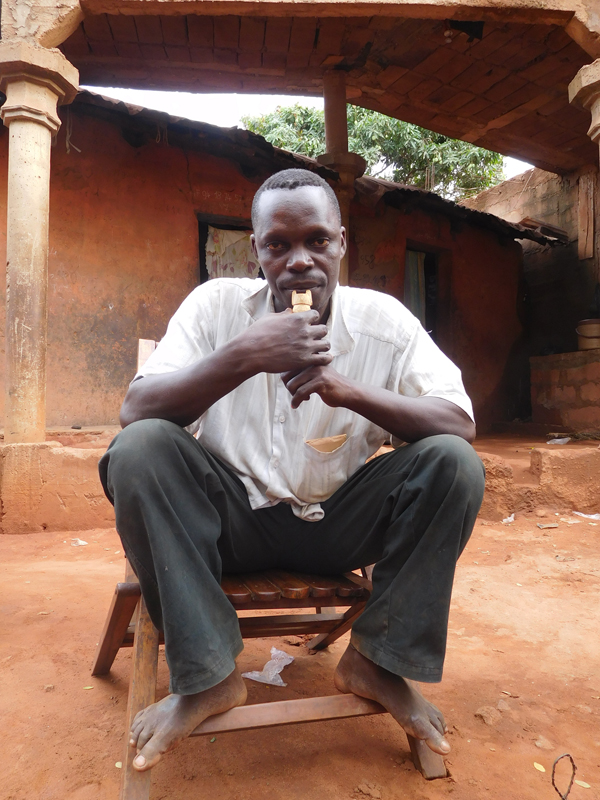
Maxime, a trombonist and student at the University of Abomey-Calavi, compared playing brass instruments with playing the kpètè, an end-blown wooden flute prevalent among the Fon ethnic group. Maxime is himself Fon; he was born in a small village outside Bohicon and moved to Cotonou five years ago to attend university. I once travelled with Maxime to his natal village, where he arranged my visit with Paulin, an elderly and accomplished kpètè player who specializes in the genre tchinkoume (Figure 3). When I asked Paulin about the relationship of brass instruments to the kpètè, he replied: ‘The theory and practice of the kpètè and the brass [instruments] are very much connected, because it is the breath above all.’ Paulin then recounted that young brass players in his village come to him for advice on performance and breathing techniques, and he instructs them as if they are kpètè players. He encourages students to complete daily breathing exercises and imparts the importance of breath control. In both kpètè and brass performance, he told me, one must ‘blow carefully’ so as to avoid ‘blowing a hernia’.
Paulin with his kpètè at home near Abomey, Benin.

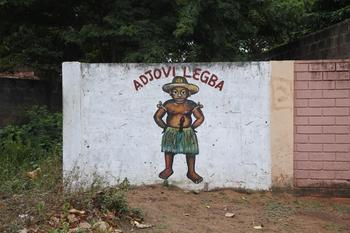
Alongside breath pedagogy, Paulin emphasizes the necessity of prayer and ritual precautions. He advises students to prepare for performances by soaking their instruments in water; this cleans the instruments and helps them ‘give a pure sound’. Water also has a purifying effect, he said, as ‘it throws out [jeter] the sand and gris-gris that is inside [the instrument]’.Footnote 13 Furthermore, Paulin urges his students to make sacrifices to Vodun before a performance in order to ensure ‘a safe passage’. Like many kpètè players in Benin, Paulin is a Legbasi (an adept of Legba). Legba is a deity in the Vodun pantheon and prominent trickster figure – he embodies humour, deceit and sexuality, is known for his prowess in music and dance (see Pelton Reference Pelton1980), and is frequently depicted with an enlarged phallus and a kpètè (Figure 4). The overtones of musical agility, sexual virility and mastery of blown instruments in Legba's tale are conspicuous, and Paulin drew my attention to them.Footnote 14
A wall mural identifying a shrine to Legba in Porto Novo, Benin.

My conversation with Paulin illustrates that associations between blowing, blown instruments and genitalia are long-standing in local musical practices. Notably, ideas and pedagogies around blown instruments seem to be independent of the material composition or origin of the instrument. Whereas the kpètè is made with wood from locally sourced trees (Paulin carved his from a mango tree), brass instruments are manufactured abroad and made of raw brass coated with lacquer or metal plating. Brass instrument mouthpieces are likewise made of metal, although they are both imported to and manufactured in Benin. My point here is that blown instruments and their mouthpieces, whether imported or locally manufactured, pose the same corporeal risks. Those risks derive from the manner of making sound on the instrument – the inhalation of air, contraction of the diaphragm, tightening of the lip muscles, and expulsion of air – and necessitate the same precautionary pedagogy.
These examples further suggest that breath pedagogy helps allay musicians’ anxieties around knowledge. Scholars have shown that, in contexts where local and imported knowledge frameworks intersect and collide, a surfeit of information can produce a paradoxical anxiety of ‘not knowing’ (Whyte Reference Whyte1997; Last Reference Last1981). This is also true for my interlocutors. Maxime spoke of his struggle to discern the truth about hernia rumours, intimating that the task of navigating multiple knowledges is itself a source of anxiety:
How to know whether [the rumours about hernias] are true or false? You must ask someone who knows, like a professor or a doctor. But their responses are not often the same. We must choose, and that is why we sometimes worry … There is a proverb in Fongbé about tasting the sauces of others, not just the sauce of your mother. You must ask many people. Everyone. You must always search for different responses. But how do you choose?
As we have seen, musicians actively manage their anxieties around not knowing through bodily control and discipline. Beatrice feels secure because she knows what foods to eat and how much (or little) air to blow. William, too, knows how to blow – as he said, ‘The breath is my job’ – and how to ensure that his genitals remain intact. Likewise, Paulin takes care to blow cautiously and advises his students to do the same. This discipline of breath assuages musicians’ anxieties of blowing, and abates fears of impotence and barrenness.
Mouthpieces, lips, and the dangers of breathing in
Accompanying musicians’ unease about blowing out and the negative effect the exhalation of air might have on testicles or fertility is a complementary concern for breathing in, and the possible ingestion of bacteria or poison through an instrument. David is a trumpet player in his late thirties and the leader of a Celestial Church brass band in Cotonou. Like many experienced trumpet players, David wears a marker of his musical practice on his face: at the spot where his mouthpiece touches his mouth, his lips are tinted pink and white. David is self-conscious about this ‘discoloration’, as he calls it. He dislikes that strangers can recognize him as a trumpet player just by looking at him, and laments that women do not find it attractive. David is also bothered that he does not know the cause of the discoloration; he asked fellow musicians and medical doctors, but their responses were different and conflicting.
Abel, a trumpet player and university student in his twenties, also has this discoloration. Abel thinks his lips changed colour because he did not receive a ‘proper education’ in trumpet performance. He lamented that there are no music schools in Benin, thus many musicians play instruments in ‘an incorrect manner’. Pointing to my own lips, Abel then remarked that I learned to play brass instruments at a music school abroad and my lips are a solid colour. Playing incorrectly can cause harm – ‘Brass instruments really do have consequences,’ he warned – but local doctors do not know enough about brass instrument practice to offer appropriate advice or treatment. Motivated by this frustration, and for lack of other resources, Abel improvises his own medicine: he makes a homemade lip balm out of palm oil and other organic ingredients and applies it prior to playing. Abel explained that the balm forms a material barrier that protects his lips from the strain of vibration and prevents the discoloration from spreading. The balm is thick, however, and obstructs his ability to play. Plus, he confessed, he is not sure if it is working.
Anxiety around lip colour is common among Beninese brass players. Most refer to the mark as an injury (une blessure) or skin discoloration (décoloration de la peau), and offer a multitude of explanations for its cause. Some say that blowing too hard, or blowing incorrectly, causes the discoloration. Others point to low-quality mouthpieces, blaming the Chinese-manufactured brands that are imported via Nigeria. Others say the cause is imbibing too much alcohol, or eating too many sweet potatoes, or inhaling evil spirits. Around half of the musicians I questioned alleged that lip discoloration is a result of sorcery. Lips are injured when they touch an object that has been charged with gris-gris and, in brass instrument performance, the mouthpiece is the obvious conduit. If an enemy gets hold of your mouthpiece, David explained, they can put invisible poison inside it or ‘do gris-gris’ (faire le gris-gris). When you then place your lips to your mouthpiece and breathe in, that poison will enter your body through your mouth. David claims to know musicians who have been poisoned, and even died, after sharing their mouthpiece with an adversary.
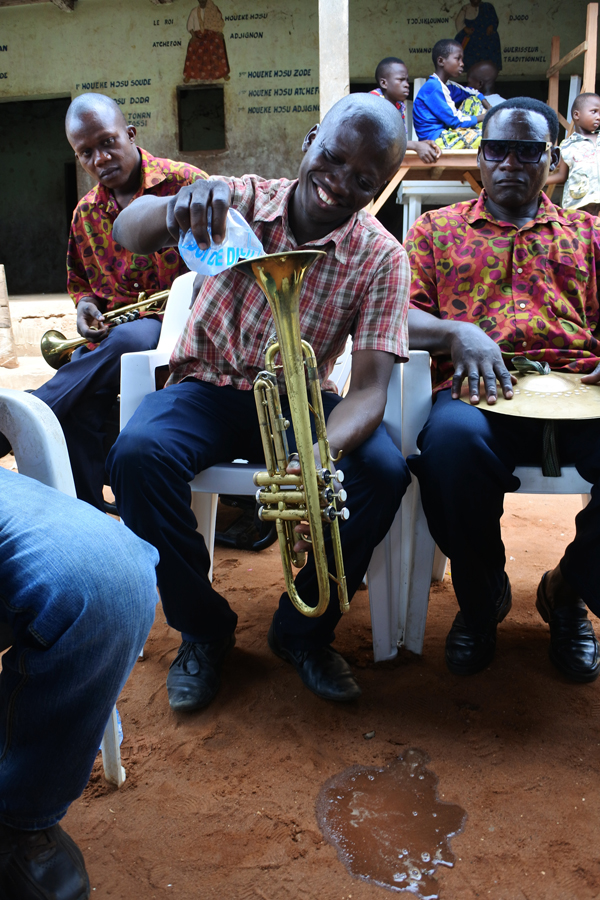
To avoid falling victim to sorcery, David takes precautionary measures. He regularly ‘purifies’ his mouthpiece in boiling water and cleans his trumpet with special formulas to rid its interior of dirt, bacteria, mould and poison. David is known for his homemade cleaning formula composed of water, lemon, palm oil and secret ingredients, which he sells to other brass players. David also washes his trumpet with water before every performance (Figure 5) – a behaviour that recalls Paulin and his kpètè. Furthermore, David always carries his mouthpiece on his person and refuses to loan it to anyone, not even close friends. Indeed, there is a consensus among Beninese brass instrumentalists that mouthpieces are intensely private objects. All of my interlocutors meticulously guard their mouthpiece from the reach of others, to protect it either from theft or from the shadowy potential of witchcraft.
David cleans his trumpet with water from a plastic sachet at a funeral reception in Allada, Benin.

Germs and mould
Motivating musicians’ concerns over mouthpieces and lips are various potential dangers of breathing in. Germs or bacteria to which instruments can play host pose one such hazard. Celestin, a thirty-two-year-old trombone player from Ouidah, told me that apprehension around sharing mouthpieces is caused by a fear of microbes. Sharing mouthpieces means exchanging bacteria via saliva – it exposes you to germs from other people. Cleaning a mouthpiece with water does not guarantee sanitation, Celestin insisted, since well water is ‘filled with viruses’. Even the ubiquitous plastic sachets called ‘Pure Water’ sold on the streets in West Africa have been parodied by public health studies for being impure (Osei et al. Reference Osei, Newman, Mingle, Ayeh-Kumi and Kwasi2013). In the face of these sanitary hurdles, many brass players purify their instruments with holy water and ritually wash their mouthpieces before playing, especially for church performances.
Brass players are also alert to mould and decomposing matter. Southern Benin has a coastal, humid climate that sees extended rainy seasons and, during the dry seasons, extreme desert winds and sand storms. Brass players in this environment are well acquainted with dirt and moisture: after performances, players routinely wipe streaks of sand and sweat off their instruments and wash mould out of their interior. These environmental conditions also pose frustrations for instrument maintenance: extreme humidity and dryness encourage accelerated corrosion of instrument lacquer, deteriorating felt pads, and crumbling bits of cork. Musicians make no assumptions about the physical purity of their instruments, and complaints about decomposing or ‘spoiled’ instruments (gâté in French, or e glbé in Fongbé) are frequently heard.Footnote 15
Beninese brass players place a high premium on cleanliness, yet concerns about sanitation in musical practice, instrument maintenance and hygienic etiquette are not unique to Benin. In the North American and European brass-playing communities in which I have participated, there is also an established custom of not sharing mouthpieces to avoid germs. As a brass player, I am intimately familiar with the repellent green slime that grows in the tubing of an instrument, and, with a particularly strong inhalation through the mouthpiece, can dislodge and relocate, nauseatingly, to the back of your throat. There is a whole ecosystem of gunk that festers and grows inside brass instruments and that one breathes in. It is perhaps obvious that musicians worldwide take exacting notice of germs and bacteria, and fall victim to them.Footnote 16
Infection and contagion
Anxiety around breathing in likewise feeds on apprehension about infection and contagion. Abel told me that inhalation invites any number of infections: ‘Sure, there is pollution and bacteria in the air, but you can also catch cancer, AIDS or Ebola.’ While most brass players I interviewed maintained that HIV is not airborne, Beatrice alleged that it is possible, saying ‘one doesn't know’ and it is therefore best to be prudent. She elaborated that one can also contract HIV from mouthpieces, indicating that viral contaminants reside in saliva as well as in the air.Footnote 17 For Abel and Beatrice, the anxiety of breathing in is indistinct; inhalation (especially in the context of playing brass instruments) puts one at risk of bacterium, virus and disease at the same time.
In addition to viral contagions, brass players share an ordinary concern over unclean air. Maxime often laments the poor air quality in urban Cotonou, which poses a challenge for brass musicians whose performances primarily take place outdoors. During long, arduous processions and ceremonies, as Maxime described, musicians breathe actively and deeply, inviting a wealth of pollution, exhaust and dust to enter their bodies. The air on the streets has been ‘worked already’, he said, and is composed of carbon dioxide rather than oxygen. Maxime called this ‘hot air’, dismissing its poor quality, and insisted that ‘cold air’, which is fresh and clean, is natural and more satisfying. Maxime explained that, because brass players breathe through their mouths, they sometimes inhale the air inside their instruments, recycling the hot air they blew out only moments before. Breathing hot air is harmful for your health, Maxime claimed, and during breaks in performances he covers his mouth with a gauze mask or piece of wax cloth to filter out dust and air pollutants (Figure 6).
Maxime wears a mask over his mouth as he waits to perform for a Celestial Church of Christ concert in Sèmè Podji, Benin. Photograph courtesy of Maxime Agbahoungba.

The comments of Abel, Beatrice and Maxime evince commonplace ideas about human–microbe relations and the ways that pathogens are exchanged. Contagions explode through networks of physical contact, and spread and circulate through mediums such as water, bodily fluid and air. Whereas contaminated water or saliva can be avoided, exposure to polluted or infected air is more difficult to control. Maxime's remark also underscores public understanding about air quality – specifically, the relative insecurity of air in an industrializing society.Footnote 18 In an urban cityscape rife with vehicular exhaust and scares of viral contagions, deep breathing invites and exaggerates exposure to invisible microbes, and brass players are made to feel anxious. This anxiety of contagion is particularly powerful at a time of frightening viruses in West Africa.
Witchcraft, rumour and distrust
A third perceived danger of breathing in pertains to social distrust and the threat of the occult. In this particular community of brass players, deception is ubiquitous. Bandleaders fabricate group finances so that they can hoard profits, and players are mendacious about performance opportunities and industry contacts to gain personal advantage. Musicians will also disparage one another out of envy or, remembering Apollinaire, spite. Such duplicity breeds, and is bred by, a local culture of social mistrust.Footnote 19 My interlocutors, too, speak frankly about their lack of trust in the Beninese. With an air of warning, Beatrice stated: ‘The Beninese are crazy! They are all bad. Here in Benin, one must take a position.’ For Beatrice, taking a position is a protective move: it means guarding oneself against sorcery and, above all, the trickery of other people. She is careful about whom she trusts, regularly prays at the Celestial Church, and carries protective amulets on her body. She recommended that I do the same.
A pervasive distrust of other people coupled with the perceived danger of sorcery makes for treacherous terrain. Prosper, a twenty-five-year-old trumpet player living in Cotonou, fell victim to sorcery in early 2015. Prosper alleges that another brass player, who was envious of his musical ability, poisoned his plate of food at a reception following a church concert. After eating, Prosper became terribly ill and his stomach swelled to a grotesque size. Thinking he was suffering from appendicitis, he went to a local medical clinic where doctors declared that his appendix was fine and he had in fact been poisoned.Footnote 20 Prosper later underwent two surgeries at Cotonou's major hospital to remove the poison from his stomach and intestine. Prosper now avoids eating at church events and refuses to share his mouthpiece, instrument or personal belongings with other musicians. He also dislikes holding hands, kissing and other forms of intimate contact. Prosper's apprehension around food, mouths and objects – all mediums through which germs are shared and gris-gris enacted – is grounded in mistrust. ‘People are jealous,’ he told me. ‘You must protect yourself.’
Such protective positions are commonplace in societies where fear of the occult and suspicion of intimate relations are everyday concerns (see Geschiere Reference Geschiere2013; Bonhomme Reference Bonhomme2012; Ashforth Reference Ashforth2005). Public suspicion in Benin, both of known persons and of strangers, is amplified by regional rumours and social panics (Ngokwey Reference Ngokwey1994).Footnote 21 For instance, the 1990s and early 2000s saw widespread rumours of ‘penis snatchers’ across sub-Saharan Africa (Bonhomme Reference Bonhomme and Horsfall2016; Reference Bonhomme2012). Stories of strangers shrinking another person's genitals by shaking their hand or simply making eye contact sparked panics, many of which resulted in the public killing of accused persons, with a case reported in Benin most recently in 2006 (Bonhomme Reference Bonhomme2012: 212–17). It is notable that my interlocutors’ anxieties around blowing hernias and poisoned mouthpieces emerge alongside enduring rumours of the occult, and panics about bodily risk and sexual organs in particular.
Fears of inhaling foreign substances through brass instruments are further aggravated by beliefs about the methods of sorcery. In Benin, as elsewhere in West and Central Africa, sorcery is always mediated (Bonhomme Reference Bonhomme2012; De Boeck Reference De Boeck, Honwana and De Boeck2005; Favret-Saada Reference Favret-Saada1980). Gris-gris can be enacted through objects that are touched or handled, or sent through mediums that the body absorbs, such as food, water or air. An example is the reported ritual poisoning of former Beninese President Nicéphore Soglo. During his presidential campaign in 1991, Soglo fell gravely ill, leading to widespread rumours about the cause of his affliction. Ndolamb Ngokwey recounts that a popular story alleged that Soglo ‘was victim of a local mystical gun known as chakatou which projects all kinds of metallic debris, thorns, pepper, and sand into the victim's body’ (Reference Ngokwey1994: 66). In widely publicized radio interviews, Soglo detailed the harm inflicted on his body – ‘I had become a disease machine, for I had fever, typhoid fever, malaria, sciatica, gangrenous abscess, amebiasis, etc.’ (ibid.: 67) – and fuelled rumours of sorcery, saying: ‘[W]e are in Africa and one needs to be prudent’ (ibid.: 69).Footnote 22
As we have seen, witchcraft proliferates in southern Benin and brass musicians are susceptible to the misfortune it brings about. While acts of witchcraft can be directed at anyone, my interlocutors believe that they are at acute risk: brass instruments and mouthpieces proffer material for the (invisible) manifestation of gris-gris, and the manner of breathing with these instruments renders one even more vulnerable. Moreover, and as illustrated by Prosper's story, musicians of noted talent invite jealousy – a vice said to motivate sorcerers. Because gris-gris can instantiate in multiple ways, it is that much harder to guard against. This ambiguity of witchcraft adds another layer of anxiety.
Conceptualizing breathing bodies
My ethnography shows how brass players’ sense of anxiety is embedded in, and even encouraged by, a local context rife with threats of contagion and infection, fears of the occult, and social distrust. It also demonstrates an anxiety centred on the body. I find congruence in the ideas that shaking the hand of a stranger may shrink a penis, blowing into a brass instrument may render one infertile, and vibrating lips inside a mouthpiece may turn them different colours – all involve bodily contact with an unknown person or object and consequential harm to (sexual) organs. I also see parity in the examples of the mystical gun that shoots debris through the air, the inhalation of poison through a microphone, and breathing in mould, pollution or poison through a brass instrument – all entail bodies absorbing toxins, be they spiritual or viral, via instruments and the medium of air.
These parallels highlight overarching themes of uncertainty and, in particular, corporeal insecurity. Musicians’ shared sense of bodily risk seems to me most acute in the act of breathing. Breathing opens the boundaries of the body, exposing it to the outside and inviting things inside, making it porous and permeable.Footnote 23 Breath itself is also precarious – it can carry contagion or pollution or gris-gris. Breath, like instruments and mouthpieces, carries the risk of infection yet, unlike them, cannot be purified or safeguarded. Breath is intensely private but public at the same time; one is forced to share it with other people.
The emphasis on breathing and blowing in my interlocutors’ discourse encourages my explorative thoughts on breath. In what follows, I distil experiences of blowing and breathing into three insights into the relationship between breath and the body. Reasoning inductively, these insights arise from the particular experiences of my friends in Benin but aspire to the general. My intention is to consider ‘blowing out’ and ‘breathing in’ not as musical practices or anatomical movements but as theoretical precepts.
Breath relating bodies
The first notion is that of breath relating bodies. Brass instrument performance involves multiple bodies: a human body – its mouth, lungs and anatomy – working in conjunction with the body of a musical instrument. Breath puts these bodies into relation. There is a first-order relation of breath supporting the vibration of lips inside a mouthpiece to produce sound. But there are higher relational orders, too: breath flows through internal and external bodily organs; breath infects human bodies with bacterial ones; breath moves between individuals and through materials and around space.
Brass players’ commentaries elucidated both the corporeal and metaphorical nature of the breath–body relationship. The substance of breath, the stuff of air, is a physical medium through which materials and forces can be transferred and exchanged. Breath, in its corporeal capacity, causes muscles to tear and genitalia to swell. And breath carries particles like poison or bacterium, and feeds these substances into the body through the mouth. Present, too, in my interlocutors’ musical vocabularies are metaphorical relationships. For example, it is ‘fast breath’ that produces a high musical pitch, and ‘slow breath’ that produces a low one. And it is ‘big breath’ or air in large quantities that produces ‘round sound’ and loud volumes, affords symbolic power, and indexes physical strength and masculinity. Compounding the corporeal and metaphorical are relations between the physical and supernatural worlds – relations formed and sustained through breathing practices (see Hill and Chaumeil Reference Hill and Chaumeil2011).
The relational character of breath prompts thinking about materiality and actor networks (Miller Reference Miller2005; Latour Reference Latour2005). In this actor-oriented frame, breath is agential: breath carries things, brings bodies into contact, and can even decide one's fate. The brass instrument, too, is agential in that it works to both amplify and distribute breath. The instrument itself is not animate – it does not blow or breathe – but it does circulate; it takes organic materials in and then emits them. In this bi-directional process, the mouthpiece materializes as the instrument's opening and, extending the mechanical metaphor, the spit valve emerges as an exhaust system; it flushes out the undesirable stuff. In this conceptualization of breathing into and with brass instruments, breath connects, puts into contact, and interacts with bodies.
Breath penetrating bodies
The second idea is that of breath penetrating bodies. Present throughout the preceding ethnographic portraits is an anxiety about things entering and disrupting bodies. We can think back to how musicians explained contagion and the ways that pathogens are exchanged. Poisoning, too, happens through various modalities, but poison is always inhaled or ingested or imbibed. We can remember President Soglo, whose body was pierced by the poisonous materials of an invisible gun. And we can recall what Maxime said about breathing in polluted air. Maxime sees the brass instrument as an intensifier of breathing: when playing he breathes in deeply, sucks in hard, inhales more of the dirty air. The atmosphere always enters one's body, but, in musical performance, the instrument intensifies the risk.
The capacity of air to invade and enter is exaggerated by the porosity of bodies (see Engelmann Reference Engelmann2015). As we saw, musicians sense that their bodies are penetrable, open to the ills of sorcery and disease despite efforts to close them. The cogency of hernia rumours, the potency of gris-gris and, indeed, the efficacy of witchcraft depend on penetrability – or, as Ngokwey puts it, ‘a belief in the vulnerability of the unprotected body to the non-natural intrusion of natural objects’ (Reference Ngokwey1994: 68). Phenomena such as spirit possession, eating and cannibalism – often discussed in Africanist anthropology (see, for example, Geschiere Reference Geschiere2013; White Reference White2000; West Reference West2007; see also Browning Reference Browning1998) – also involve bodies being penetrated. Noticing that ideas and rumours about penetration, both corporeal and spiritual, are long-standing in the African continent and its diaspora gives depth (if not detail) to the experiences discussed here.
Future engagement with this subject might imagine what other sorts of atmospheric things can penetrate bodies. Here I am thinking about intangible stuff that moves through airy atmospheres: sound waves, light, radiation, temperature, vibration, pressure, and so on. In the context of musical performance, the materiality of sound is particularly relevant – sound, after all, is airborne. In turn, we might consider the sonic capacity of penetrating air: if breath penetrates the body through the mouth and nose, it can also be said to penetrate – in its sounding form – through the ear, skin or other surfaces. The notion of sounding breath invites contemplation of sonic intimacies and publics, sonic force, sound pollution, and even sonic contagion. Shared experiences of sound as bodily threat – even sound as pain – create possibilities for cross-cultural empathy. It is in the relationship between breath and sound where cross-disciplinary matters of embodied experience, musical performance and affect come together, and where I see an opportunity for creative research.
Breath protecting bodies
Inhalation is how the outside world of visible and invisible powers comes to bear on the body: breath opens bodies, penetrates them, and makes them vulnerable. Yet breath also moves through binaries: it flows inside and outside, both enters and exits, opens and closes. Musicians not only inhale but also exhale – more accurately, they blow. While the risks of blowing are at the root of rumours about hernias and infertility, we saw that musicians adopt methods of blowing that thwart those risks. This prompts a third insight: the potential of breath to protect bodies.
In the face of corporeal vulnerability, my interlocutors seek protection in practices of bodily control. We can recall William wearing underwear that holds his testicles close against his groin, David guarding and cleaning his mouthpiece, and Beatrice monitoring her diet. These are examples of protecting the body by means of controlling how it moves and what it ingests or touches. We can also consider William's breathing practices, when he stands naked in front of a mirror and watches his diaphragm expand and testicles contract, or Beatrice taking care not to blow too hard and strain the muscles in her belly, or Maxime's evasion of hot and dirty air. These are examples of protecting the body by means of training, monitoring and controlling one's breath.
This discipline of breath is a means by which musicians manage, and sometimes mitigate, their anxieties. People are careful, attentive and well-practised; people know how to blow. Yet the compulsory act of breathing frustrates attempts to control the body. Regardless of how well we blow out, as humans we all breathe in our environments. We cannot escape the medium of air because breathing, as an opening act, is involuntary. Air's latent potential for harm means that to breathe – to be alive – necessarily involves risk. Rather than feel secure, or even nourished, in our breathing, we sometimes feel anxious precisely because we cannot hold our breath.
Conclusion
In the world of Beninese brass instrument practice, blowing and breathing can cause hernias, infertility, lip discoloration, viral infections, and even death. Musicians’ anxieties about the corporeal consequences of playing brass instruments combine with concerns in their larger social worlds: competing knowledge about musical and medical matters, a regional backdrop of social panics around genitalia and fertility, and a local context of viral contagion and public mistrust. Benin's particular airy atmosphere further exacerbates anxieties. Musicians worry about inhaling pollution but also gris-gris and germs – spirits and bacteria meet in the medium of air.
Above all, these musicians’ anxieties centre on the bodily acts of blowing out and breathing in. When playing brass instruments, these behaviours take particular forms: to blow out is to intentionally and forcefully expel air, while to breathe in is to involuntarily and necessarily risk the inhalation of poison or contaminants. Blowing, as a musical skill, is practised and perfected, yet pervasive rumours unsettle even those who blow well. When blowing out and breathing in invite acute bodily harm, the feelings and practices described here make perfect sense.
In conceptualizing this anxiety of blowing, I have explored breath as a bodily act and precept for thinking. Breath is relational: it carries things and brings bodies into contact. And breath penetrates: it enters and disrupts bodies, opens them and makes them vulnerable. Breathing practices can also be protective positions – attempts to close one's body to the outside, to make it less penetrable, more protected. But such bodily positions do not provide full protection. When brass players’ everyday sense of bodily security is predicated on controlling what enters and exits their body, the loss of bodily control affords a sense of unease.
The observation that breath's precarity nurtures concerns about bodily insecurity inclines me to consider breath as an operative entity by which anxieties circulate and generate. I am left with the sense that all kinds of things circulate with breath: not just bacteria or contagions, but also rumours, whispers, ideas, feeling and affect. In this rendering, breath reflects affective states of being but also absorbs or takes on those qualities.Footnote 24 Breath is affective: it creates series of relationships, conditions feelings and understandings, sets up intensities. And breath is anxious: it involves an awareness of and exposure to the outside, takes a protective position, and has an expectant quality. Like this, breath exceeds air's capacity to mediate and constitutes a shared structure of feeling. My interlocutors are not only breathing with and blowing into brass instruments; they are also breathing anxiety.
Acknowledgements
The research for this article received support from the Wenner-Gren Foundation for Anthropological Research and the University of Oxford's Clarendon Fund. In addition to two anonymous reviewers, I thank David Pratten, Jason Stanyek, Ian Copeland, Georgina Born and Ramon Sarró for their comments on earlier versions of this work.