Introduction
The presence of non-indigenous species, and in particular invasive ones, is globally considered as one of the most important causes of biodiversity loss at ecosystem, habitat and species level, and may also entail a significant social and economic impact favoured by climate change and anthropogenic disturbance. Particularly, in the case of the Mediterranean Sea, invasive species can enter the Basin from the Atlantic Ocean or the Red Sea through natural and anthropogenic dispersion. Natural dispersal would be facilitated by water warming, that allows tropical and subtropical species to widen their distribution (Bianchi, Reference Bianchi2007; Lasram et al., Reference Lasram, Tomasini, Guilhaumon, Romdhane, Do Chi and Mouillot2008; Parravicini et al., Reference Parravicini, Mangialajo, Mousseau, Peirano, Morri, Montefalcone, Francour, Kulbicki and Bianchi2015); while anthropogenic activities can act as vectors of introduction through maritime traffic (ballast waters and hull fouling), aquarium trade, aquaculture facilities and even voluntary introduction. Thorough knowledge of vectors and pathways of introduction and dispersion of invasive species, as well as knowledge of their impacts on biodiversity at species, habitat and ecosystem levels are necessary to elaborate adequate management strategies. Several of these species are clearly identifiable because of their recognizable diagnostic characters but the invasion process also involves cryptic species which still need in-depth study. One of these is the upside-down jellyfish Cassiopea Péron & Lesueur, 1810 (Cnidaria, Rhizostomeae), a benthic scyphozoan, commonly found in tropical and sub-tropical shallow coastal ecosystems. The genus belongs to the Cassiopeidae family and includes nine recognized species by molecular analysis (Holland et al., Reference Holland, Dawson, Crow and Hofmann2004; Morandini et al., Reference Morandini, Stampar, Maronna and Da Silveira2016; Arai et al., Reference Arai, Gotoh, Yokoyama, Sato, Okuizumi and Hanzawa2017) although many other species have been identified using morphological data.
Cassiopea spp. shows a unique posture among the scyphomedusae, the exumbrella adheres to the seafloor while the oral arms and the convex subumbrella are turned upwards. They live in a symbiotic relationship with photosynthetic dinoflagellate microalgae of the genus Symbiodinium which determine the highly variable typical colouration of the umbrella and share nutrient exchange; further it has been demonstrated that Symbiodinium represents a key factor in strobilation induction of Cassiopea polyps (Gohar & Eisawy, Reference Gohar and Eisawy1960; Hofmann et al., Reference Hofmann, Fitt and Fleck1996).
In the last few years, research on these gelatinous species has increased and Cassiopea has been considered a model species in studying symbiotic relationships due to the ease of culturing and maintaining polyps and medusae in the laboratory, but also because the Cassiopea/Symbiodinium interaction is a clear example of a successful cooperation under stressful environmental conditions (shallow waters, high temperatures, high levels of irradiation and potentially large changes in salinity) and therefore it is also interesting in a climate change context (Lampert, Reference Lampert, Goffredo and Dubinsky2016). Moreover, Cassiopea spp. may make an informative bioindicator/biomonitoring species since it can accumulate heavy metals and other chemical compounds and it could supply useful information for the application of coastal management actions (Templeman & Kingsford, Reference Templeman and Kingsford2012). Recently sleep behaviour was demonstrated (Nath et al., Reference Nath, Bedbrook, Abrams, Basinger, Bois, Prober, Sternberg, Gradinaru and Goentoro2017) (unusual in cnidarians due to the lack of a centralized nervous system) and so Cassiopea became a model organism for the study of behavioural biology.
The taxonomy and systematics of the genus Cassiopea are extremely difficult, mainly because the morphology of the species varies greatly in different habitats and at different stages of growth (Hopf & Kingsford, Reference Hopf and Kingsford2013). Moreover, in an attempt to solve phylogeography and systematics of the genus at a global scale through molecular analyses, Holland et al. (Reference Holland, Dawson, Crow and Hofmann2004) demonstrated the presence of cryptic species supporting the hypothesis that six nominal species belong to Cassiopea. These are C. frondosa from the western Atlantic, which is the only species morphologically distinguishable; (2) C. andromeda from the Red Sea, western Atlantic and Hawaiian Islands; (3) C. ornata, from the area around Indonesia, Palau and Fiji Islands; and three other species not yet named as distinct taxonomic units from (i) eastern Australia, (ii) Papua New Guinea and (iii) Hawaiian Islands and Papua New Guinea. In addition Arai et al. (Reference Arai, Gotoh, Yokoyama, Sato, Okuizumi and Hanzawa2017), using molecular markers, found two new different lineages in the Palau Islands (C. sp4 and C. sp6) which are different from the other species analysed by Holland et al. (Reference Holland, Dawson, Crow and Hofmann2004) and another distinct unit (C. sp 5) from GenBank (AB563740 and AB563739).
Although Cassiopea genus is widely distributed in tropical and sub-tropical waters, it is considered a non-indigenous species in Brazil (Morandini et al., Reference Morandini, Stampar, Maronna and Da Silveira2016), Indo-Pacific Papua New Guinea, Hawaii (Holland et al., Reference Holland, Dawson, Crow and Hofmann2004), Australia (Keable & Ahyong, Reference Keable and Ahyong2016) and the Mediterranean Sea (Maas, Reference Maas1903).
In the Mediterranean, after records of Cassiopea andromeda in the Suez Canal in 1886 and 1887, Maas (Reference Maas1903) reported its subsequent migration to the waters of Cyprus in 1903; in 1955 the species appeared in the Aegean Sea near Santorini (Schäfer, Reference Schäfer1955); Goy et al. (Reference Goy, Lakkis and Zeidane1988) and Spanier (Reference Spanier1989) reported it in Lebanon and Israel respectively, and later, Çevik et al. (Reference Çevik, Erkol and Toklu2006) found it along the Levantine coast of Turkey; Schembri et al. (Reference Schembri, Deidun and Vella2010) recorded it in Maltese waters and Ounifi-Ben Amor et al. (Reference Ounifi-Ben Amor, Rifi, Ghanem, Draeif, Zaouali and Ben Souissi2015) in northern Tunisia. In Italian waters, the presence of Cassiopea was reported from the 2010s in online magazines, in the Tyrrhenian Sea (Livesicilia, 2014). Piraino et al. (Reference Piraino, Deidun, Fuentes, Daly Yahia, Kefi Daly Yahia, Marambio and Gueroun2016) reported the occasional occurrence of C. andromeda in the Gulf of Palermo (South Tyrrhenian Sea) and Servello et al. (Reference Servello, Andaloro, Azzurro, Castriota, Chiarore, Crocetta, D'Alessandro, Froglia, Gravili, Langer, Lo Brutto, Mastrototaro, Petrocelli, Pipitone, Piraino, Relini, Serio, Xentidis and Zenetos2019) reported it in the Baia di Augusta (Ionian Sea), but both records have no details or specimen vouchers. The first documented report of Cassiopea cfr andromeda in Italian waters is from Cillari et al. (Reference Cillari, Andaloro and Castriota2018) who found the medusae in Palermo Cala Harbour in 2014.
More recently, Cassiopea sp. reached western Mediterranean coasts in Spain where it was reported in 2017 in the Mar Menor (Murcia) (Rubio, Reference Rubio2017). Reports of Cassiopea in the Mediterranean Sea indicate the occurrence of the jellyfish mainly in semi-enclosed eutrophic waters characterized by low hydrodynamism. Biological features such as high tolerance to variation of environmental parameters and prolific asexual reproduction, as demonstrated by high rate of planuloid production (Schiariti et al., Reference Schiariti, Morandini, Jarms, Von Glehn Paes, Franke and Mianzan2014), make it a potentially successful invader in a wide variety of coastal ecosystems.
To date, Mediterranean records of Cassiopea have been ascribed to C. andromeda on the basis of its hypothesized invasion pathway starting from the Red Sea through the Suez Canal, reaching the Eastern and Central Mediterranean; Galil et al. (Reference Galil, Spanier and Ferguson1990) referred it as the first Lessepsian jellyfish in Mediterranean sea. Here, we report a study of specimens of Cassiopea sp. from the South Tyrrhenian Sea (Palermo, Italy) using molecular analyses in order to identify which species was introduced to the Mediterranean Sea, to compare our results with published information and lastly, to hypothesize a pattern of introduction in the Mediterranean Sea.
Materials and methods
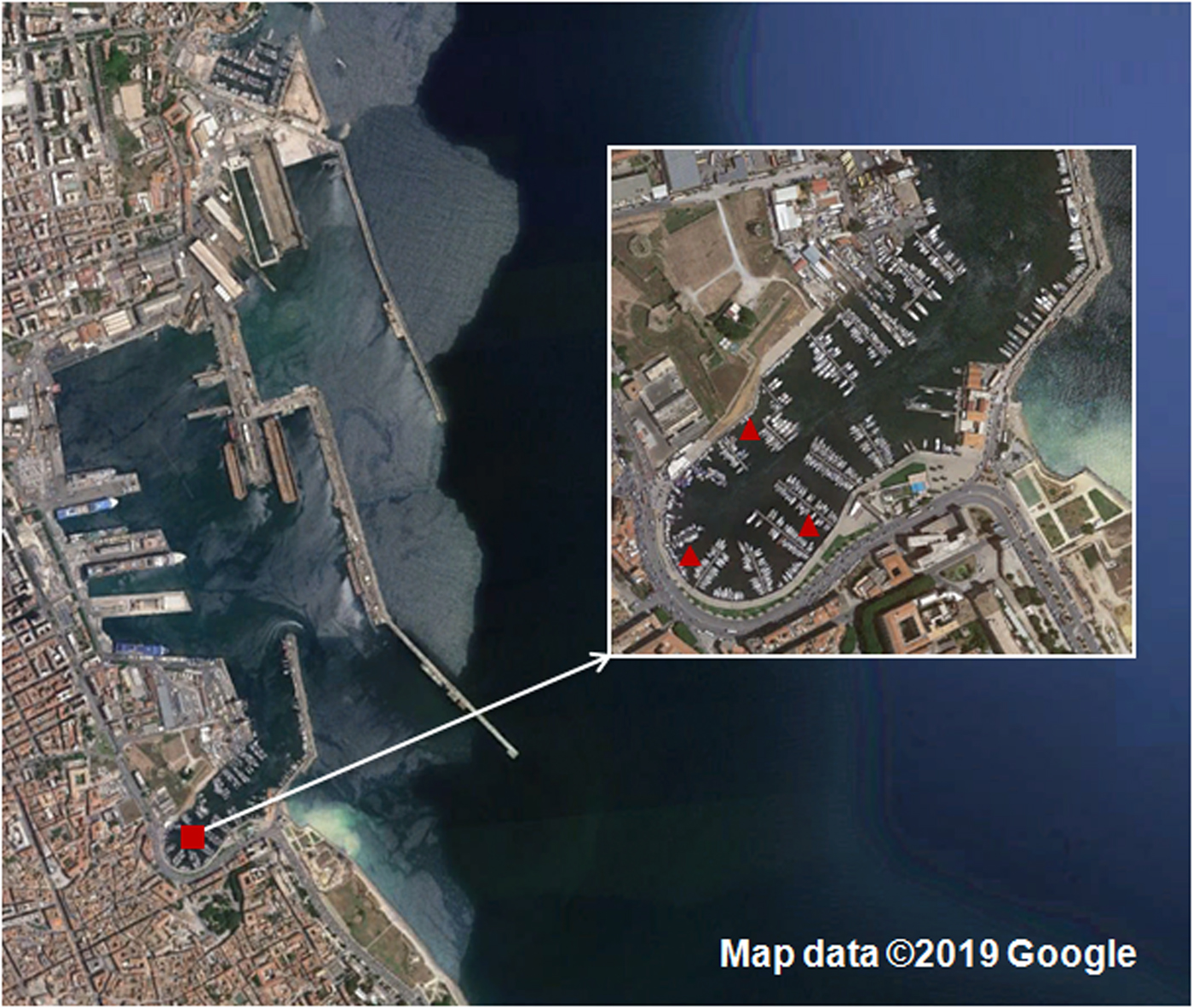
Sixteen specimens of Cassiopea sp. were collected in Palermo Cala Harbour (38°07.22′N 13°22.09′E) using a hand net on 29 November 2017 and 8 February 2018. Palermo Cala Harbour is a recently reclaimed part of the commercial harbour, which hosts small- and medium-sized pleasure craft (Figure 1). Mean water depth in this small marina is about 7 metres, ranging from 0.5 m to about 12 m. The marina hosts several artificial structures and floating wharfs which could favour the settlement of sessile organisms, including Cassiopea polyps. The first documented record of Cassiopea in this area dates back to 2014 (Cillari et al., Reference Cillari, Andaloro and Castriota2018) and has since resulted in an abundant population until winter 2018 when medusae numbers decreased until they disappeared in February 2019.
Palermo Cala Harbour. Square 38° 07.22′N 13° 22.09′E. Triangles are sampling sites.

During sampling, measurements of salinity and water temperature were recorded. Salinity varied between 35.2–35.6‰ and water temperature ranged from 14.1°C (in February) to 17.6°C (in November).
Cassiopea sp. individuals collected were transported to the laboratory where morphological analysis was immediately performed by stereo microscope observation of different characters and photographic sampling.
Molecular analyses
Specimens of Cassiopea were stored at −20°C or analysed immediately after collection. Genomic DNA was purified using PureLink Genomic DNA Kits (Invitrogen Corporation, Carlsbad, CA, USA) from the umbrella and tentacles, according to the manufacturer's instructions. The DNA concentrations were verified by spectrophotometry at 260 nm and stored at −20°C for future use.
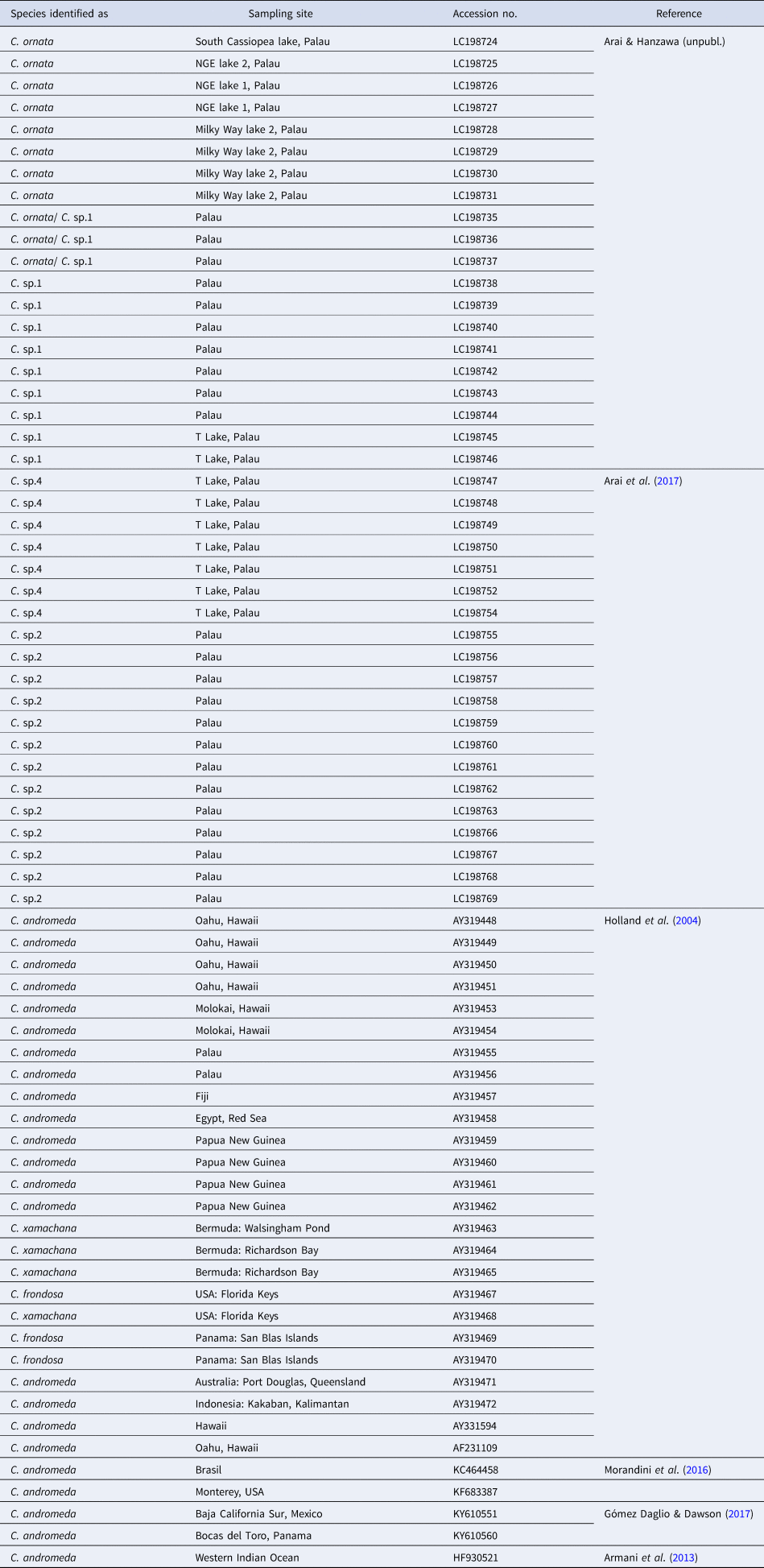
Universal PCR primers (LCO1490 and HCO2198; Folmer et al., Reference Folmer, Black, Hoeh, Lutz and Vrijenhoek1994) for the cytochrome oxidase I gene failed in the amplification of the COI barcode region. Thus, specific primers were generated aligning all Cassiopea spp. sequences from GenBank (Table 1) and searching them in the flanking COI region avoiding dimerization capability, significant hairpin formation, secondary priming sites in the template and mispriming.
List of Cassiopea spp. sequences from GenBank used for primer design, molecular and phylogenetic analysis in the present work

Sequences of the designed primers were the following: CasF 5′ GGTTCTTCTCCACCAACCACAARGAYATHGG 3′ and CasR 5′ATTTCTATCHGTTARYAACATTGTRAT 3′. 50 ng of purified DNA was used as the template for PCR amplification. Reactions were carried out in a total volume of 25 µl using Platinum Taq DNA Polymerase (Thermo Fisher Scientific Inc., Carlsbad, USA) in 1× buffer, 0.2 mM dNTPs (Euroclone), BSA (0.5 mg ml−1; New England BioLabs), 1 µM primers. PCR were performed following these conditions: hot start of 2 min at 95°C, 30 cycles of 94°C for 30 s, 48°C for 30 s and 72°C for 45 s, with a final 72°C extension for 7 min. PCR fragments were visualized on 1% (w/v) TAE agarose gel, purified and sequenced using an ABI Prism 373 automated sequencer. These primers successfully amplified the COI region for all the specimens analysed. Sequences were aligned using the MUSCLE plugin in MEGA 6 software (Tamura et al., Reference Tamura, Stecher, Peterson, Filipski and Kumar2013). Furthermore sequences were compared to those of the other Cassiopea specimens available in GenBank (Holland et al., Reference Holland, Dawson, Crow and Hofmann2004; Arai et al., Reference Arai, Gotoh, Yokoyama, Sato, Okuizumi and Hanzawa2017) (Table 1). Genetic distances were calculated using the Kimura 2-parameter model. Phylogenetic reconstructions were performed based on the Neighbour-joining and Maximum likelihood method generated in MEGA version 6. To estimate support for the nodes, 1000 bootstrap replicates were performed and we retained only the values supporting the nodes accounting for more than 50% of the bootstrap replicates.
Results
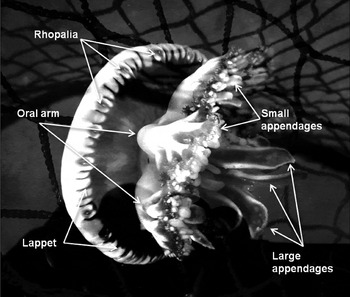
Cassiopea specimens showed an exumbrella disc-shaped, sometimes convex, concave or flat with a central dome; the marginal lappets were short, blunt, and variable in number from 4 to 6. They bore eight oral arms which were dichotomous, wide and flat, from shorter to longer than bell radius; each oral arm bore 4–6 flat, short side branches arising from each arm in a tree-like manner. The colour of the umbrella was mostly brown and varied from yellowish white to dirty blue, sometimes exhibiting a circular white band; arm colouration varied from beige to brown, and vesicles exhibited the largest array of colours being of different shades of brown, green, violet and blue. Morphological analyses revealed 16 rhopalia in the intact specimens. The number of inter rhopalia lappets ranged from 4 to 6 and the number of mouth arms branches (from 4 to 6), were variable, both within the same specimen and among different ones (Figure 2).
Adult specimen of Cassiopea sp. jellyfish from Palermo Cala Harbour.

The COI gene was successfully amplified from all Cassiopea sp. individuals. Some specimens showed identical sequences, resulting in six haplotypes that were used for the subsequent analyses. Alignment of the haplotypes built with GenBank sequences resulted in 498 base pairs; of the total 498 base pairs aligned, 274 were conserved and 224 were polymorphic with 186 informative and 38 singleton substitutions. The nucleotide frequencies were 0.287 (A), 0.349 (T), 0.173 (C) and 0.191 (G), revealing a thymine bias. The overall transition/transversion bias (R = 1.24) showed that the greater part of nucleotide variation was due to transitions, as is common in protein coding genes.
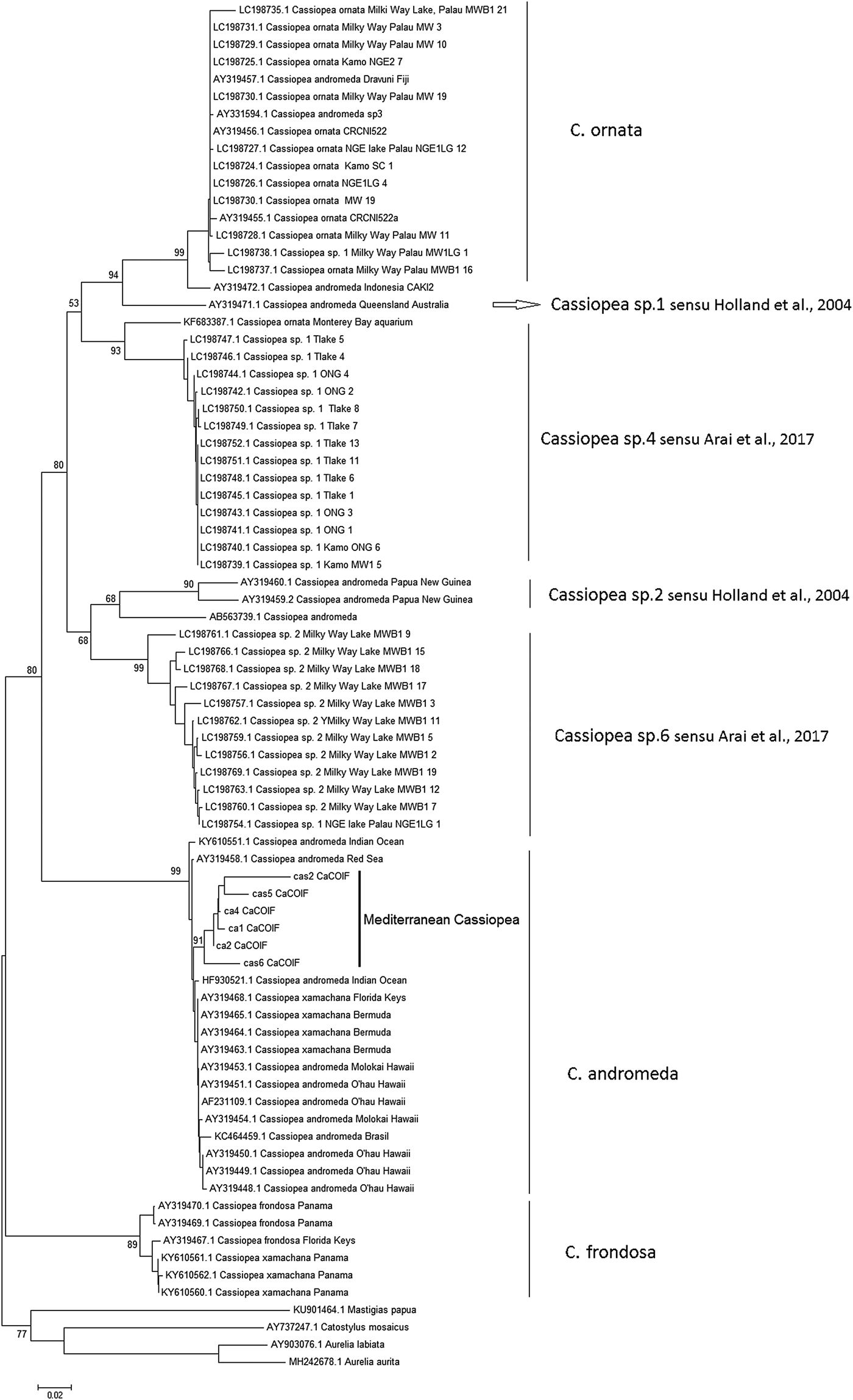
Phylogenetic analyses conducted with different approaches resulted in phylogenetic trees with similar topology, so we report the NJ in Figure 3. This tree shows the presence of seven monophyletic groups: C. ornata; Cassiopea sp.1 from Australia; Cassiopea sp.2 from Papua New Guinea, as defined by Holland et al. (Reference Holland, Dawson, Crow and Hofmann2004); Cassiopea sp.4 from Palau (Tlake, Kamo and Ongel Lakes); Cassiopea sp.6 from Palau (Milki Way Lake and NGE Lake) as defined by Arai et al. (Reference Arai, Gotoh, Yokoyama, Sato, Okuizumi and Hanzawa2017) and C. andromeda from Bermuda, Florida Keys, Hawaii, Red Sea and Indian Ocean. The last group includes the Mediterranean samples. Moreover, Cassiopea frondosa from Holland et al. (Reference Holland, Dawson, Crow and Hofmann2004) split from all the other groups.
Phylogenetic reconstruction using Neighbour-joining method among Cassiopea spp. Evolutionary distances were computed using the Kimura 2-parameter method and are in the units of the number of base substitutions per site for Cytochrome Oxidase I. Bootstrap values on 1000 replicates are next to the branches.

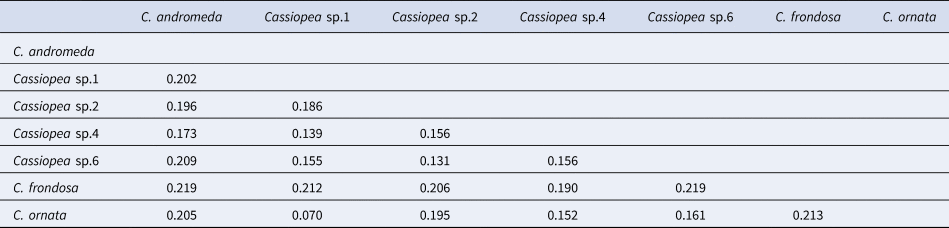
The seven units obtained in the NJ tree were compared, calculating sequence divergence as Kimura 2-parameter method. These values ranged from 7% (found in C. ornata vs Cassiopea sp.1) to 21.9% (found in C. andromeda vs C. frondosa and in C. sp.6 vs C. frondosa) (Table 2). Sequence divergence intragroups was always lower than between groups.
Pairwise genetic distance among the identified groups computed using Kimura 2-parameter substitution model

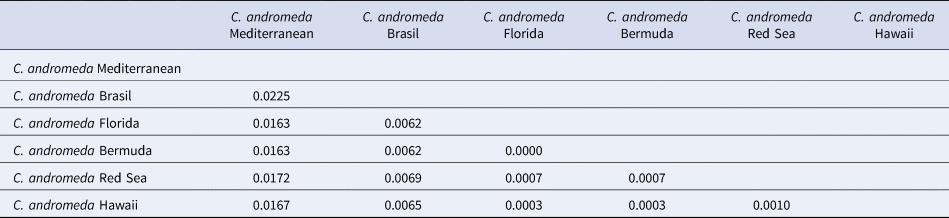
Within groups molecular divergence calculated with the Kimura 2-parameter model within C. andromeda lineage ranged from 2.2% (C. andromeda from Mediterranean vs C. andromeda from Brazil) to 0% (C. andromeda from Florida vs C. andromeda Bermuda) with an average value of 1.6% (Table 3).
Pairwise genetic distance computed using Kimura 2-parameter substitution model among C. andromeda units

Discussion
Accurate taxonomic identification of Cassiopea species other than C. frondosa, based on morphological characters is not possible due to the high plasticity of characters that are not always systematically informative. Most of the diagnostic characters considered actually vary within a species and may be shared with other species. This has generated confusion in the past, leading to the introduction of presumed new species that were subsequently disclaimed by molecular analyses (Holland et al., Reference Holland, Dawson, Crow and Hofmann2004; Ohdera et al., Reference Ohdera, Abrams, Ames, Baker, Suescún-Bolívar, Collins and Jaimes-Becerra2018). Up to now, the systematic issues of the genus Cassiopea are far from being solved and species within this genus are considered cryptic. Jellyfish species identification based only on analysis of morphological characters has always been hard and controversial. Morphological and meristic characters are often variable within the same species and in some cases they overlap between different species. In recent decades, molecular tools have helped systematics, solving species classification and sometimes identifying cryptic species complexes (Dawson et al., Reference Dawson, Sen Gupta and England2005; Scorrano et al., Reference Scorrano, Aglieri, Boero, Dawson and Piraino2017); Consequently, several authors have underlined the need to link morphological and molecular approaches to reach an integrative taxonomy and to solve patterns of marine biodiversity (Dawson, Reference Dawson2005; Dayrat, Reference Dayrat2005; Wiens, Reference Wiens2007; Scorrano et al., Reference Scorrano, Aglieri, Boero, Dawson and Piraino2017).
Therefore, in the present study molecular tools were used to identify Cassiopea specimens belonging to a dense population settled in Palermo Cala Harbour (South Tyrrhenian Sea). This harbour comprises parts with very shallow water (i.e. 0.5 m) or very transparent, which are suitable for the survival of Cassiopea, allowing photosynthetic activity of the symbiotic algae. Molecular analyses were essential to identify the Mediterranean species as Cassiopea andromeda. In particular, Mediterranean specimens grouped with C. andromeda from Red Sea–Hawaii–Florida as identified by Holland et al. (Reference Holland, Dawson, Crow and Hofmann2004).
Dawson & Jacobs (Reference Dawson and Jacobs2001) studying the Aurelia species complex, considering the taxonomic problems in jellyfish species delimitation and identification arising from their high variability, accepted a species limit of 10% for COI. Given this assumption, our results support the assignation of Mediterranean Cassiopea specimens to andromeda species. Moreover, looking at the andromeda lineage obtained with phylogenetic reconstruction, the mean sequence divergence of Mediterranean Cassiopea with the other cospecific from Hawaii–Red Sea–Florida is 1.8%. This value, although lower than inter-specific values, is much higher than intra-specific ones. To estimate the divergence time using the molecular clock hypothesis between Mediterranean Cassiopea and the other cospecific we use the formula T = d/2λ (where d is the nucleotide distance between populations and the mutation rate λ = 4.87 × 10⁻⁶) (Dawson, Reference Dawson2005). The resulting value indicates that Mediterranean Cassiopea specimens diverged from the cospecific from Hawaii–Red Sea–Florida more or less 1600 years ago; this corresponds to the period of the early Middle Ages and so does not fit with the Mediterranean first record of the species. Two different scenarios can be proposed to justify the high value of genetic divergence in the Mediterranean C. andromeda population: the first would imply that the species found a suitable ecological niche in the partially isolated Palermo Cala Harbour with good conditions to settle, grow and possibly to reproduce, with potential to become permanently established in this area. This could subsequently lead to local adaptation phenomenon although no examples of this are known. Cassiopea requires relatively clear shallow waters to allow symbionts to photosynthesize and it can find these conditions in the shallow parts of Palermo Cala Harbour; but local conditions outside of this enclosed area may not be suitable due to higher water column depth and turbidity. During recent years, in this site we have observed periods of Cassiopea blooms alternating with periods with occurrence of very few or no specimens, probably due to the interaction of the changing environmental conditions and the natural life cycle of the species. When jellyfish disappear, polyp populations probably remain active (colonizing new substrates or even performing asexual reproduction), waiting for an environmental trigger that induces the strobilation process and a new Cassiopea medusae bloom.
Another more plausible scenario would assume that genetic divergence estimated in Mediterranean C. andromeda could be inflated by multiple introduction events in the Basin. Vessels visiting different ports could collect and transport different organisms. This would imply a new introduction event and if multiple introductions come from multiple genetically differentiated geographic sources or if transported individuals come from a single genetically diverse source population, an introduction of new genotypes and increasing of genetic diversity of the species in the invaded range would occur. Dawson et al. (Reference Dawson, Sen Gupta and England2005), studying the distribution of the Aurelia spp. at global scale, concluded that the assumption of low level of genetic diversity in the introduced species is questionable, mainly because multiple human-mediated introductions can rapidly increase genetic diversity in the non-indigenous population. Cassiopea spp. jellyfish have been characterized ‘as prime candidates for accidental introduction as a non-native species in places where they do not belong’ mainly because of their biological traits (Widmer, Reference Widmer2008); further C. andromeda was considered an invasive species (Katsanevakis, Reference Katsanevakis2011) probably due to its ability to grow rapidly producing large blooms in a very short time. The high value of sequence divergence between Mediterranean specimens of C. andromeda and those from the Red Sea–Hawaii–Florida could indeed be the result of multiple introduction events mediated by human transport. Since the presence of stable populations in the eastern Mediterranean Sea has been confirmed (Özgür & Öztürk, Reference Özgür and Öztürk2008), it could be useful to analyse their genetic diversity in order to verify multiple introduction events and then reconstruct the invasion pattern.
In recent decades, jellyfish bloom events have been increasing in frequency in many coastal areas, altering ecosystem functions and consequently ecosystem services. Several factors are identified as some of the main drivers responsible for jellyfish bloom increase: overfishing activity; eutrophication and hypoxia; warming of seawater temperature; and the increase in artificial substrates expanding the potential attachment sites for polyps (Condon et al., Reference Condon, Duarte, Pitt, Robinson, Lucas, Sutherland, Mianzan, Bogeberg, Purcell, Decker, Uye, Madin, Brodeur, Haddock, Malej, Parry, Eriksen, Quiñones, Acha, Harvey, Arthur and Graham2013). All these factors occurring together act synergistically, increasing their singular effect. Undoubtedly Cassiopea, among jellyfish, is a successful invader mainly because of its life history features such as prolific asexual reproduction (Schiariti et al., Reference Schiariti, Morandini, Jarms, Von Glehn Paes, Franke and Mianzan2014) as well as high tolerance to environmental variation (Morandini et al., Reference Morandini, Stampar, Maronna and Da Silveira2016). Its presence has been empirically linked to human impacts, either by transport through maritime traffic or by eutrophication favouring blooms. Recently, Stoner et al. (Reference Stoner, Craig, Yeager and Hasset2011) demonstrated that populations of Cassiopea spp. are larger and more abundant in human-impacted coastal systems in the Bahamas, suggesting that human activity may trigger or facilitate blooms of this species, producing cascade effects on ecosystems. Further the high potential of Cassiopea to become established and then spread seems to be increased by the presence of an exogenous chemical compound acting as a natural inducer of metamorphosis (Hofmann et al., Reference Hofmann, Fitt and Fleck1996).
The C. andromeda population detected in Palermo Cala Harbour (present study) seems to be confined to this artificial habitat, with optimal environmental features for its growth and reproduction, as confirmed by rapid surveys of the surrounding coastal areas that did not reveal any occurrence of this species. It is possible that this environment could act as a rearing site from which Cassiopea could be dispersed by vessels in other more or less distant places. For this reason, monitoring and research of this species should be strengthened in order to define management strategies for limiting its invasion, impact on ecosystems and spread elsewhere.