Te lilium regem non dubito,
Nam lilium armis depingitur.
(I doubt not that thou art the Lily, the King,
For the lily is painted on thine armour.)
The ‘flower of the lily’, customarily known by the French name ‘fleur-de-lis’, represents and symbolises a wide array of ideas in the twenty-first century.Footnote 1 The stylised, three-petal flower, most often depicted as a white or gold flower against a blue background, is the heraldic flower of France, the province of Quebec in Canada, New Orleans in the United States and Florence, Italy. The ‘lily-white’ flower is also one of the saintly attributes of the Virgin Mary and a symbol of chastity and purity, as well as the Christian doctrine of the Holy Trinity.Footnote 2 Although the search for the origins of the stylised lily as a multivalent symbol extends as far back as the study of the hieroglyphics and iconography of ancient Egypt and Rome, the lily truly flourished as the now-familiar abstracted fleur-de-lis in medieval France. In poetry, music, literature and art, as well as royal documents, heraldry and theology, the lily in its many forms and manifestations infiltrated all media and echelons of French society.Footnote 3
The overarching concern that affected interpretations of the lily in thirteenth- and fourteenth-century France was its allegorical role within contemporary dichotomies of morality – good versus evil, faith versus corruption. In these cases, the lily, whether signifying the Virgin Mary, the virtues, the Holy Trinity, France or even the king himself, reveals itself as the floral foil to evil, sin and corruption. As the motetus of a thirteenth-century motet advises, ‘let your study be the lily of the valley, let it be virtue. Cleanse the dung-heap of corruption through the aid of grace’.Footnote 4 In this study, the origins and development of the fleur-de-lis as a religious and monarchical symbol in medieval France will be examined in relation to a manuscript that deals primarily with themes that contrast sharply with everything the lily stood for: Paris, Bibliothèque nationale de France, MS français 146 (hereafter fr. 146).Footnote 5
Fr. 146 is a tour-de-force manuscript that contains far more than the interpolated version of Le Roman de Fauvel for which it is rightly renowned: a Complainte d'Amour, a detailed index, Latin and French dits by Geoffroy of Paris, a selection of chansons by Jehan de Lescurel and a metrical chronicle attributed to Geoffroy of Paris fill close to one hundred folios in this deluxe manuscript.Footnote 6 The wide variety of genres has resulted in a plethora of studies by scholars in diverse areas, including musicology, literary studies, history and art history.Footnote 7 As studies on fr. 146 from as early as the nineteenth century have demonstrated, the richness and breadth of content of the manuscript easily support the weight of the abundant scholarship that has continuously emerged across disciplines.Footnote 8 One aspect of fr. 146 that remains understudied, however, is the role of religious symbolism, not only in Fauvel itself, but also in the dits and the metrical chronicle.Footnote 9 The sudden interpolation of the ‘Trinity Page’Footnote 10 at the conclusion of Fauvel, the many invocations of the Virgin Mary and the highly petitionary dits argue for a complementary, if not underlying, religious framework for a manuscript that is seen in scholarship as primarily political, satirical and admonitory.Footnote 11 Taking its diverse contents into consideration, as well as contemporaneous music and texts, I will examine fr. 146 through the interpretative lens of a symbol central to fourteenth-century religious thought and the rise of medieval French heraldry, both royal and theological, the fleur-de-lis.Footnote 12 I argue that the persistent appearance of the fleur-de-lis in fr. 146 in the dits, the Chronique metrique and Fauvel provides a necessary, yet overlooked, link between sacred and secular symbolism. Within fr. 146 and the larger cultural context of thirteenth- and fourteenth-century France, the ‘flower of the lily’ connects sacred and secular symbols by simultaneously invoking, and being invoked by, the Holy Trinity, the Virgin Mary and the Virtues, all in the interest of supporting the religious and political health of France and her monarchy.
The first section of this study provides an overview of the biblical, allegorical and historical context of the fleur-de-lis, presenting the central interpretations of the flower as they relate to the manifestation of the lily in fr. 146. An introduction to the lily itself as one of the special symbols of the Capetian monarchy follows, in addition to a brief survey of fourteenth-century texts that highlight the relationship between the sacred and royal connotations of the fleur-de-lis. Moving to fr. 146, I focus on the construction of associations between the fleur-de-lis and the Capetians in the Latin and French dits by Geoffroy of Paris and the anonymous Chronique metrique, and the invocation of the fleur-de-lis as a theological symbol and signal of France and the French monarchy in Fauvel. The sacred framework of Fauvel, the textual petitions and prayers and the musical and visual interpolations are central to this examination of the ‘lily of France’ within fr. 146 and, by association, late-medieval France. Moreover, by drawing on the extensive musico-poetic repertory and literary corpus that informs fr. 146 and its social, artistic and historical milieu, this study will place fr. 146 within the larger trajectory of religious and political exegeses of the fleur-de-lis.
The lily of the valley: theological and political contexts
The fleur-de-lis did not emerge in full bloom with the Capetian dynasty in France; rather, the development of the lily as a theological and royal sign extended over the entire Middle Ages. Its origin in the West can be traced to the Bible, where the lily functioned first and foremost as a symbol of devotion and purity in the Song of Songs 2: ‘I am the flower of the field, and the lily of the valleys. As the lily among thorns, so is my love among the daughters.… My beloved to me, and I to him who feedeth among the lilies.’Footnote 13 Throughout the Song of Songs, the lily is utilised as a symbol of pure beauty, while in both the Song and Ecclesiasticus, the sweet scent and the flowering of the lily are praised: ‘Send forth flowers, as the lily, and yield a smell, and bring forth leaves in grace, and praise with canticles, and bless the Lord in his works.’Footnote 14 Parallel references to lilies appear twice in the New Testament, in Luke and Matthew respectively: ‘Consider the lilies, how they grow: they labour not, neither do they spin. But I say to you, not even Solomon in all his glory was clothed like one of these’; and ‘for raiment why are you solicitous? Consider the lilies of the field, how they grow: they labour not, neither do they spin. But I say to you, that not even Solomon in all his glory was arrayed as one of these.’Footnote 15 These biblical passages emphasise the flower's beauty, sweetness and uniqueness, ideas that are developed further in medieval poetic and exegetical texts.
Beginning in the eleventh century, these two Song of Songs passages in particular and their echoes in Luke and Matthew became central to exegeses of the lily in mystical writings. In his sermons on the Song of Songs in the twelfth century Bernard of Clairvaux interpreted the virgin's ability to maintain a life of virtue among the wicked in the earthly life as a parallel to living ‘as the lily among thorns’.Footnote 16 Bernard also conflated the Gospel of Matthew with the Song of Songs in order to better outline his catalogue of Marian attributes, including beauty, purity and a virtuous life. The lily in Bernard's exegesis is overwhelmingly Marian in its tone, continually stressing the feminine virtues of chastity and virginity represented by the whiteness of the lily.Footnote 17 His readings of the biblical lily as a Marian symbol and attribute are reflected in medieval depictions of the Virgin Mary, which frequently included a white lily intended to symbolise chastity.Footnote 18 Moreover, poetic and musical texts associate the lily with the Virgin far more often than any other saintly figure, even explicitly troping the Song of Songs, as in the thirteenth-century Parisian conductus ‘O lily of the valley, flower of virgins, royal stem; hope of all the faithful, light of lights, O daughter’, or in the motet Salve, mater/TATEM, ‘Lily of the valley, flowering rose, fragrant as the lily, fair virgin producing a son of noble birth’.Footnote 19
While Marian interpretations of the lily proliferate throughout the Middle Ages, the anonymous author of the Vitis mystica (c. 1200) provides a botanical analysis of the lily by dividing the flower into parts and imbuing each part with a mystical, symbolic meaning.Footnote 20 While the petals (six in this author's description) have a specific earthly or heavenly meaning, it is the association he makes concerning the head of the pistil that is notable: the triangular part of the lilium mysticum is associated with the members of the Holy Trinity – the Father, Son and Holy Spirit – which establish for the first time the connection between the flower and the doctrine of the Holy Trinity.Footnote 21 In the Vitis mystica, the symbolism of the lily is thus extended beyond Marian interpretation, with its interpretation based on the physical characteristics of the flower, a tradition that continues into fourteenth-century France.
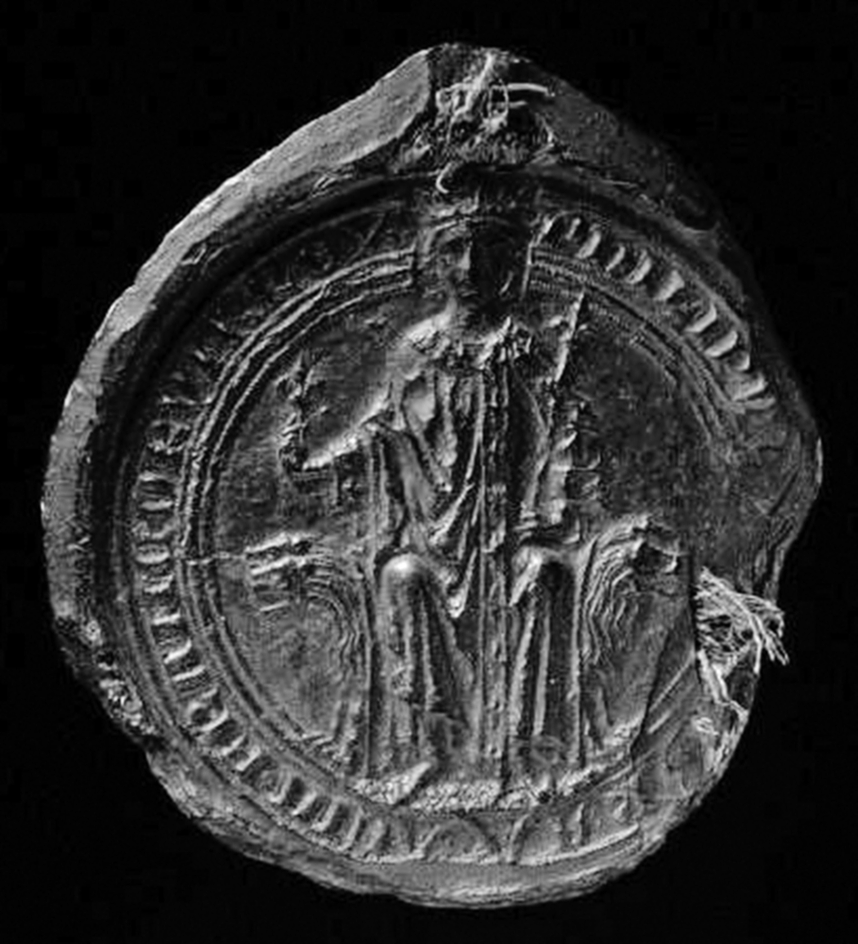
The lily, however, already had symbolic currency in France prior to the twelfth-century writings of Bernard of Clairvaux and the anonymous author of the Vitis mystica: as early as the tenth century the lily was considered an attribute of the kings of France and, as such, appeared on seals, coins and other items of material culture (see Figure 1).Footnote 22 From the beginning to the end of the Capetian line, the heraldry and iconography of the French kings included, virtually without exception, a fleur-de-lis either held in a hand, placed on top of a sceptre, or as used as a pattern on royal robes, shields and seals:Footnote 23

Seal of Philippe IV: ‘PHILIPPUS DEI GRACIA FRANCORUM REX’. (Paris, Archives nationales, coll. Douët d'Arcq, SC D47). Reproduced from <http://gallica.bnf.fr/ark:/12148/btv1b7700114z.r=fleur+de+lis.langEN> (acc. 4 May 2010). Used by permission of the Bibliothèque nationale de France
The connection of the Capetian line with the lily is significant since, apart from iconographic evidence, it is difficult to find a textual connection between the unusually direct royal line of the Capetians and the fleur-de-lis before the twelfth century. Indeed, some scholars do not necessarily see the early use of the fleur-de-lis as being connected to its later medieval Trinitarian symbolism, such as that found in the Vitis mystica, but rather with its earlier Marian attributes. Colette Beaune argues that ‘it seems likely that the kings of France adopted the emblem of the Virgin [the fleur-de-lis] in the second half of the twelfth century out of chivalric devotion and with a clear awareness of the parallels between their temporal role and the spiritual duties of the beatific mother’.Footnote 24 Although Beaune's Marian justification for the Capetian adoption of the fleur-de-lis fits with the contemporary tradition of Marian interpretations for the lily, there is also good reason to see the use of the fleur-de-lis in a heraldic fashion as a purely monarchical symbol, with the flower being identified as a gift from God in recompense for the faith of the French kings:Footnote 25
The kings of France were the inheritors of Pepin and Charlemagne, crusaders, defenders of the papacy and of orthodoxy. The exceptional quality of their faith had been rewarded by God with the fleur-de-lis, the holy ampulla, the oriflamme, and the power to touch for the King's Evil. The political theology of the Capetian dynasty stressed the virtue of the blood, not the person.Footnote 26
Thus, although the lily signalled the Virgin for theologians, it also recalled for the French populace the quasi-mythological figures of Pepin and Charlemagne, both of whom were commonly depicted in fourteenth- and fifteenth-century iconography with the attribute of the fleur-de-lis.Footnote 27
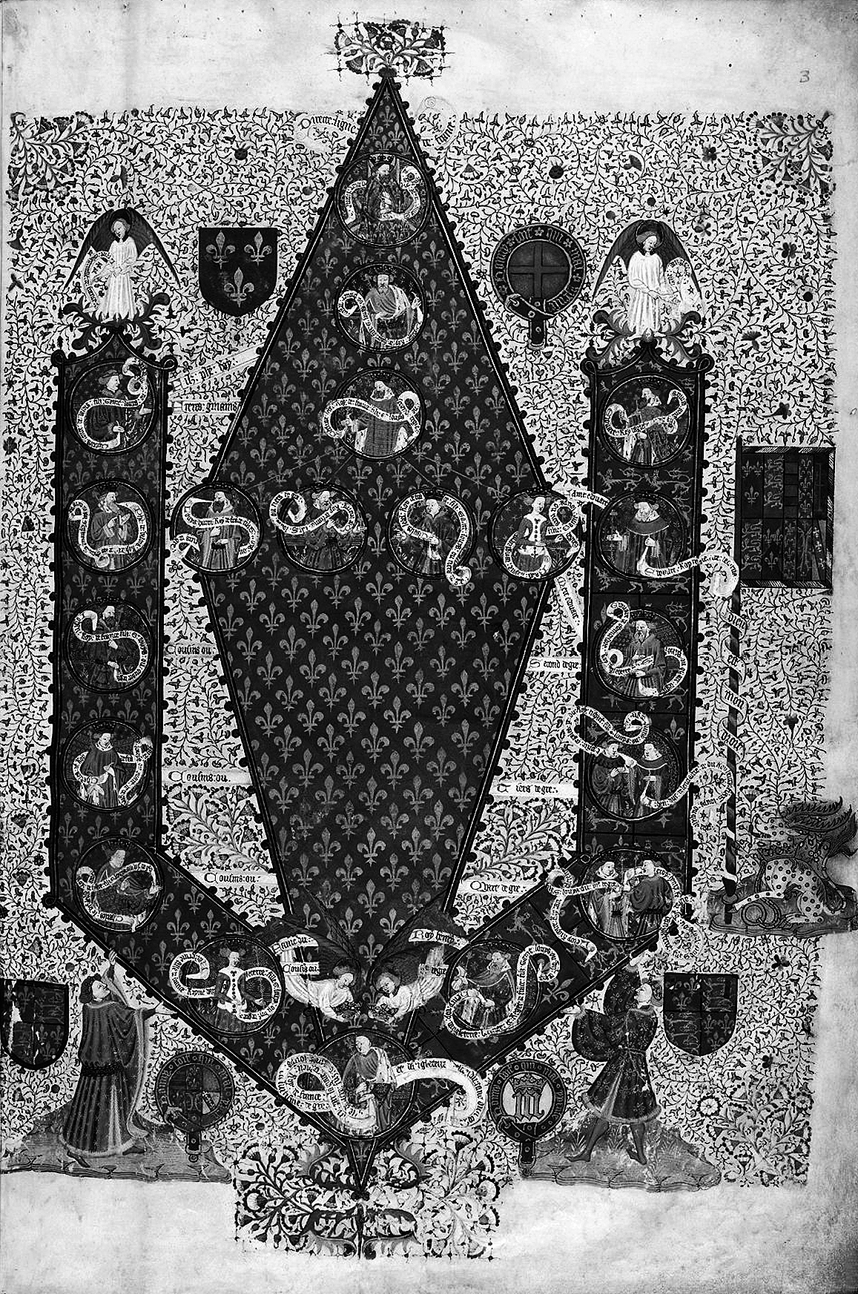
From the late thirteenth century onwards, the focus of the Capetians became fixed on one king in particular who embodied both political and religious leadership, Louis IX, later St Louis.Footnote 28 Considered a pious and just king, St Louis's economically, politically and religiously successful reign, and his subsequent canonisation by Pope Boniface VIII in 1297, made him the newest and most accessible role model for future Capetian kings and, more importantly, their advisers and critics. Louis's identity as a specifically royal saint – his sanctity being a ‘potent marker of spiritual legitimacy’Footnote 29 – lent him a kind of earthly and heavenly authority easily exploited by the Capetian line in the assertion of their divine right to rule. Besides the orthographical myth surrounding the association of the old French ‘lys’ with ‘Loys’, a spelling of Louis,Footnote 30 the reception and historiography of this thirteenth-century king in the fourteenth century firmly linked the idea of his good and pious rule with the divine symbolism of the fleur-de-lis: ‘As a symbol of the king's virtues and holiness, the fleur de lis can indeed be regarded as an image of major significance in the legacy that Saint Louis bequeathed to his descendants.’Footnote 31 The concept of a royal and divine genealogy beginning with St Louis was so tightly intertwined with the fleur-de-lis that even ‘family trees’ took on the appearance of a lily, all in an attempt to further strengthen the idea of the Capetian's divine right to rule. The floral frame is readily seen in a genealogical table of the descendants of St Louis IX contained within a fifteenth-century manuscript commissioned for the wedding of Margaret of Anjou and Henry VI (see Figure 2).Footnote 32
Genealogical table of descendants of St Louis IX. British Library, MS Royal 15 E vi, fol. 3r (image in public domain)
Although the fleur-de-lis can be linked to earlier Capetian kings through the anxiety of chroniclers to emphasise a royal blood line, in particular to Pepin and Charlemagne, by the later Middle Ages it is often St Louis to whom the fleur-de-lis most commonly refers. The transfer of interest from the more divinely royal figures of Christ and Solomon, or even the Carolingians, to a recent kin member is logical: St Louis provided a more recent – and directly related – model for subsequent Capetian kings.Footnote 33
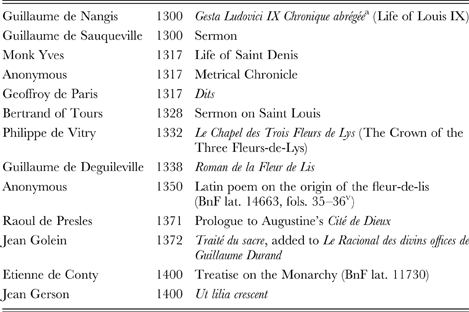
For fourteenth-century writers, theologians and historians, the lily was an especially useful symbol precisely because it could simultaneously symbolise and invoke the Virgin and the Holy Trinity, while also paying homage to the royal Capetian line, including St Louis, its most recent saintly ancestor. As a result of the symbolic power and flexibility of the lily, literary works proliferated in the 1300s that were devoted solely to the lily and its religious and political exegesis. It was in the fourteenth century, notably, that the lily even more definitively acquired a Trinitarian and heraldic meaning, one that remained central to its interpretation for the following two centuries.Footnote 34 The fourteenth-century flourishing of the flower in France can easily be seen from the list of works in Table 1. Representing a range of genres from the poetic and historical to the rhymed and the prosodic, these texts – only a selection of which will be discussed here – form the basis of any study of the political and religious iconography and symbolism of the French Royal House.Footnote 35
Writings on the fleur-de-lis c. 1300–1400
a Hindman and Spiegel point out that the Latin version of Nangis's Chronique was written in 1285, while the French translation was written after 1297. See Hindman and Spiegel, ‘Fleur-de-Lis Frontispieces’, p. 383.
In contrast to the earlier exegeses of Bernard and the anonymous author of the Vitis mystica, fourteenth-century writers began to consider more closely the religious significance of the lilies' petals in terms of numerical symbolism.Footnote 36 For Guillaume de Nangis, the threefold number of petals resulted in the following interpretation, written in reaction to the departure of students from Paris following the 1230 riots:Footnote 37
For should this most precious treasure of salutary learning that, together with faith and chivalry, had formerly followed Dionysius the Areopagite from Greece to parts of Gaul and then to Paris, be banished from the Kingdom of France, the lily, which is depicted with three floral petals and which is the sign of the King of France, would in some part or other suffer major disfigurement. But since our Lord Jesus Christ wishes above all other kingdoms to illuminate the kingdom of France with the three aforementioned attributes, that is, faith, learning, and chivalry, it has become customary for the king to bear on his coat of arms and on his banner the flower of the lily with three petals, as if the three petals said to the whole world: faith, learning, and chivalry thrive more abundantly in our kingdom than in any other kingdom, serving us through the care and grace of God. For the double petals of the lily represent learning and chivalry; having, moreover, followed Dionysius the Areopagite from Greece into Gaul, they guard and defend the third petal, which is faith and which through the grace of God he has been able to propagate. For faith is governed and ruled by knowledge and is defended by chivalry. And furthermore, as long as the aforesaid three are together in the kingdom of France and are firmly united to each other, the kingdom will also remain firm. If, however, they should be separated from each other or be torn asunder, everything will be reduced to desolation and will fall into ruin.Footnote 38
A number of important ideas emerge from even this short portion of Nangis's Life of Saint Louis: the acknowledgement of the lily as the signum regis Franciae, the sign of the king of France; the association of the lily with Dionysius the Areopagite, a figure conflated in the Middle Ages with the bishop and patron saint of Paris and founder of the Abbey of St-Denis, Saint Denis himself;Footnote 39 finally, and perhaps most importantly for fr. 146, the attribution to each of the three petals of the lily of a virtue, foremost faith, which is supported by the petals that represent learning and chivalry.
An echo of Nangis's interpretation can be found in a slighter later work of Monk Yves, the gesta of Saint Denis. In a chapter tellingly titled ‘How faith, learning and chivalry are represented by the sign of the king of France, that is, by the lily’, Monk Yves offers a reiteration of the very same virtues attributed to the petals by Nangis:
These three attributes that are mentioned above, that is, faith, learning, and chivalry, can indeed be seen to have a triple and meaningful connection, forming the cord that, according to Solomon, it is difficult to break as long as the three attributes are in mutual harmony in peace and love. If, however, they become separated or divided, the woes of dissolution can follow and this is indeed something to be feared. But the superior dignity of the above-mentioned three, that is faith, learning, and chivalry, through the merits of the blessed Areopagite has nevertheless been conferred upon the kingdom of France to the exclusion of the kingdoms of the rest of the world, by means of the lily with its triple petals; and because it has become his emblem, the lily not inappropriately also represents the most Christian king of France.Footnote 40
Important to note in this passage is the stress that Monk Yves, like Nangis before him, places on the necessity of forming a balance among the attributes of the three petals: faith, learning and chivalry. When the balance among the virtues is disrupted, ‘woes of dissolution can follow and this is indeed something to be feared’. Equally important is Monk Yves's observation that the lily, replete with a Trinitarian meaning, is an appropriate emblem with which to represent the rex christianissimus, the most Christian king of France.Footnote 41
Indeed, in addition to the Marian symbolism of the lily and the significance for the Capetian line, the flower also gained a certain Christological significance that further confirmed its suitability for use by the Capetian kings. A sermon by the Dominican Guillaume de Sauqueville composed during the reign of Philippe IV emphasises the interpretation of the fleur-de-lis as a symbol which linked the Capetian line not only to the kings of the Old Testament, but also to the two comings of Christ:Footnote 42 ‘The sign of the first coming was the lily of virginity … but at his second coming, to war on sinners, he will carry the blood-red banner [the oriflamme].’Footnote 43 Sauqueville's intention was to present the Capetian line as descended from Christ and, therefore, the Capetian kings as the ‘most Christian kings’ and rightful rulers of the most Christian country, France.Footnote 44 This was not a new conceit; even earlier Abbot Suger at St-Denis (1121–51) had made the connection between the Capetian line and the ultimate royal lineage leading back to the biblical kings via the symbol of the lily:
The use of the fleur-de-lis, from which the Christological and Marian significance of the motif derives, takes on a new meaning when seen in relation to the depiction of the kings of Israel. The use of the fleur-de-lis seems to be the result of a conscious design to establish a visual bond between the Capetian kings, as represented by their heraldic symbol, and the kings of the Old Testament, and to affirm, by means of the culminating figure of Christ, the divine character of the Capetian monarchy.Footnote 45
In the fourteenth century, belief in the divine right of the French kings was reinvigorated by the rereading of the fleur-de-lis in a royal and divine light, just in time for the difficult dynastic switch from the Capetians to the Valois and the beginning of the Hundred Years War.Footnote 46
Apart from the works contained in fr. 146 – Geoffroy's dits, the anonymous chronicle, and Fauvel, all discussed below – the next significant work on the fleur-de-lis is found in Bertrand of Tour's sermon on St Louis written between c. 1328 and 1333.Footnote 47 A glorification of the French royal house and the rex christianissimus, St Louis, Bertrand's sermon takes as its point of departure a passage from Matthew 6:28–9: ‘consider the lilies of the field, how they grow’. Bertrand plays with the idea of the ‘garden’ or field of France in which the lilies, the kings of France, are cultivated.Footnote 48 He extends his lily allegory even further by directly equating the virtues of the lily with the nine virtues of the French royal house:Footnote 49
Bertrand's allegory combines the pseudo-botanical allegorisation of the lily familiar from the Vitis mystica with the contemporary trend of labelling each petal as a virtue. A particularly notable aspect of Bertrand's nine virtues of the French royal house, however, is that the image that he utilises is not the botanical lily in the field nor the mythical lily of Pseudo-Dionysius the Areopagite or the Song of Songs, but rather the arms of France – azure with a field of gold fleurs-de-lis. It is through the works of Nangis, Monk Yves and Bertrand of Tours and other writers that a picture of the multivalent lily begins to come into focus. Emphasising both the lily's religious and heraldic symbolism – the virtues, the Holy Trinity, France, the French monarchy and the French church – these writings set the stage in this article, if not also chronologically, for more explicit and pointed writings on the fleur-de-lis, including the poetic texts of fr. 146.
Vitry, deguileville and the texts of fr. 146
The link among France, its virtues and the fleur-de-lis is strengthened in three works from 1332 to 1350 by Philippe de Vitry, Guillaume de Deguileville and the anonymous author of a Latin poem on the origin of the fleur-de-lis. Vitry's 1332 poem, Le Chapel des Trois Fleurs de Lys, a promotion of Philippe VI's aborted crusade of 1335, was, according to Hinkle, the first work in French devoted to the lilium mysticum.Footnote 50 In a similar vein as Nangis, the Monk Yves and Bertrand, Vitry labels the virtues that comprise the fleur-de-lis, although he envisages three separate flowers, as opposed to three petals:
The identification of the flowers with knowledge, chivalry and faith parallels earlier writings, as does his emphasis on the need for the virtues to be ‘well assembled’ in order for royalty and loyalty to reign. Vitry also explicitly references the Holy Trinity as being formed in and through the joining of the three fleurs-de-lis. It is not the shape of the pistil of the lily that suggests an allegorical connection to the Trinity to Vitry, however, but instead the number of the flowers that represents the affection of the three members of the Holy Trinity towards France:
The Roman de la Fleur de Lis by Guillaume de Deguileville and the anonymous Latin poem on the origin of the fleur-de-lis further Vitry's Trinitarian interpretation of the ‘Trinity flowers’ of France. The Roman de la Fleur de Lis, an allegorical poem for Philippe VI that features a dialogue led by ‘the grace of God’, Grâce Dieu, is an extended treatise on the arms or shield of the king of France, which is, appropriately, covered with heraldic lilies:
The fleur-de-lis is understood by Deguileville as a symbol of the blessing of the royal house of France; the lily therefore represents the health and strength of the kingdom. Similarly, the anonymous Latin poem in BnF lat. 14663 on the origin of the fleur-de-lis focuses on the heraldic properties of the ‘triple lily-flower’:Footnote 54
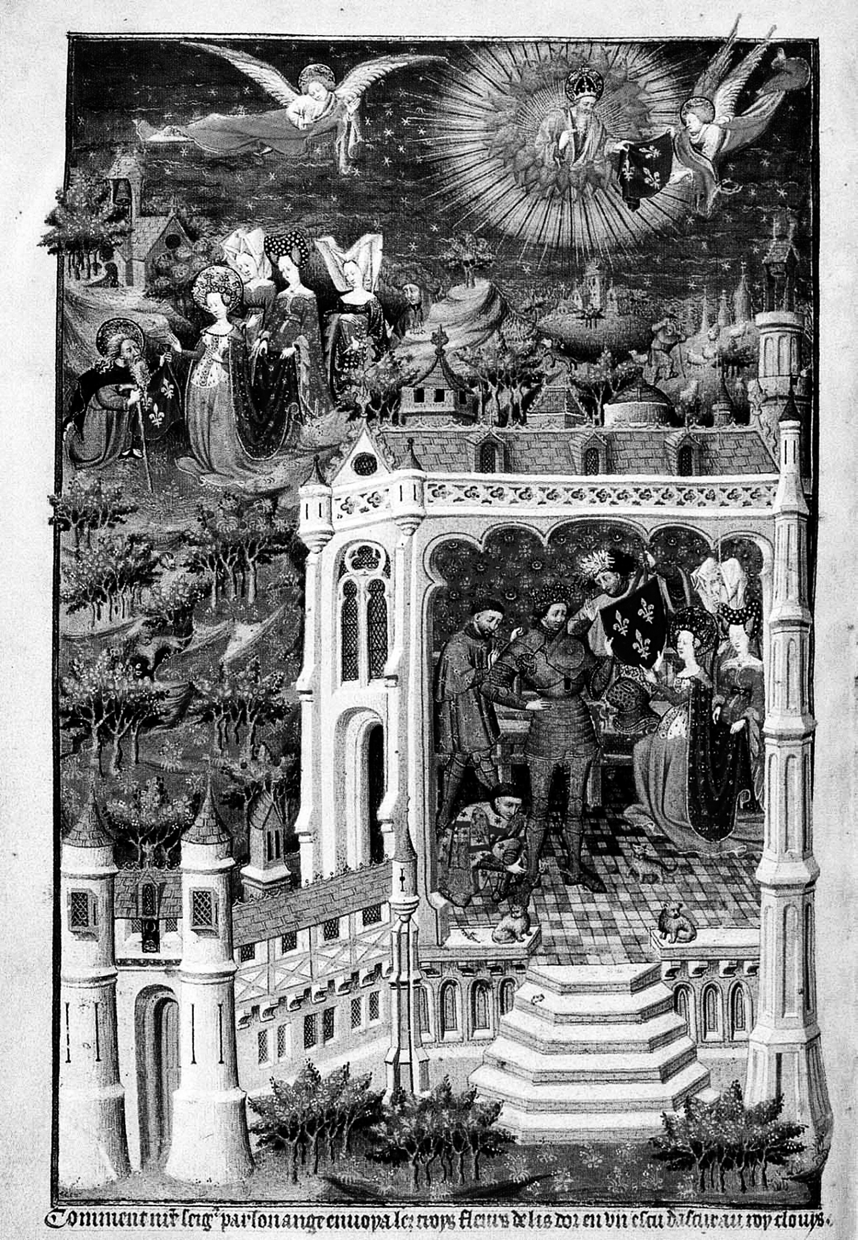
In this passage, the Holy Trinity gifts Clovis with three lilies, bestowing on the French royal line a divine origin and their revered floral symbol. Moreover, the white lilies are described as ‘gilded’, or decorated with gold, a prefiguring of the French arms of the later thirteenth and fourteenth centuries, the Azure, a semis of fleurs-de-lis or, seen in the fifteenth-century depiction of Clovis's encounter with the Holy Trinity (see Figure 3).Footnote 56
Baptism of Clovis in the Bedford Book of Hours, c. 1423. British Library, Add. MS 18850, fol. 288v. © The British Library Board. Used by permission
As a signal of divine and royal power, the fleur-de-lis continued to flourish in fourteenth-century France and beyond in the imagination of writers, theologians and artists as a symbol of the strength of France, one supported by the Marian and, even more significantly, Trinitarian associations of the lily.Footnote 57 As the dits and chronicle discussed below suggest, the increasing fourteenth-century interest in affirmations of the divine sovereignty and strength of France, as expressed in the bourgeoning lily literature, was probably a response to the ‘woes of dissolution’Footnote 58 that were multiplying in the state, woes that the authors of fr. 146 were well aware of during the compilation of their manuscript.Footnote 59
Two items contained in fr. 146 can be seen as particular reactions to the contemporary events in France, in addition to being contributions to the evolution of the fleur-de-lis as royal and religious symbol: the dits of Geoffroy of Paris on fols. 46r–55v and the metrical chronicle attributed to Geoffroy on fols. 63v–88r. The six French and two Latin dits are all concerned with historical and contemporary political events:Footnote 60
The dits most relevant to this discussion are the two Latin dits that will be referred to here by their incipits, Hora rex est and Natus ego, and two of the four French dits, Auisemenz pour le Roy Loys and Des Alliez en francois. The first French dit, Auisemenz pour le Roy Loys, contains two passages of interest, although neither explicitly references the fleur-de-lis. The first acknowledges St Louis as the model of a pious king in an admonition directed towards his descendant, King Louis X. In keeping with St Louis's idealised position in the Capetian line he is described as the guardian of peace in France and of her Church, and is invoked as a model for future kings, especially his namesake: ‘From him, King, thou art descended; wise art thou, if thou resemblest him; and from him thou bearest thy name.’Footnote 61
A passage from later in the Auisemenz pour le Roy Loys focuses on the relationship among the very same virtues governed by the allegorical fleur-de-lis and condemns those rulers who would disturb this relationship. Knowledge and Chivalry are joined together, according to this dit, to protect the Church, just as the petals of the lily are balanced between these same two virtues to support the primary virtue, Faith:
Knowledge is represented here by the clerics and chivalry by the knights; both bear arms to defend the Holy Church, which signifies, and is signified by, the virtue of faith. If the defenders of knowledge and chivalry are disassembled, the Holy Church, and thus faith, would be ‘much injured’. One of the interesting features of the passage is the nearly identical repetition of a line as a pseudo-refrain: ‘So, he does evil who separates them.’ Referring to the issue of bad rulers or bad councillors who disrupt the balance of the virtues, this line in the dit surely would have resonated for readers of the entire manuscript as a critique both of certain highly criticised French rulers and the satirical figure of Fauvel.Footnote 63 It seems possible that Vitry, in writing his Chapel des Trois Fleurs de Lys approximately fifteen years later, was aware, too, of the earlier tradition expressed in this dit of joining knowledge, chivalry and faith in defence of France – the very same trio of virtues he attaches to the three fleurs-de-lis that represent France, her rulers and her Church.Footnote 64 Even the language of the final ‘refrain’ line, in which he does evil who separates (‘dessemble’) the virtues, echoes Vitry's later statement that the lilies of France must be ‘bien assemblees’.
Geoffroy's Latin dit Hora rex est is also highly admonitory, but directed, however, towards Louis X's successor, Philippe V, and focused on the improvement of his governance. The passage quoted below presents many of the themes familiar from the later writings on the symbolic lily:Footnote 65Hora rex est recalls the botanical analogy seen in the Vitis mystica and foreshadows Bertrand's sermon;Footnote 66 it references the heraldic use of the lily on the shields of the kings of France;Footnote 67 and the image of a ‘thorn among the lilies’ also appears:Footnote 68
Hora rex est is, in many ways, a summation of lily exegeses; while nothing in the passage is definitively new, the language of association is stronger and the allegorical scenario reflects the political situation of France. Moreover, because Hora rex est was written prior to many of the later fourteenth-century fleur-de-lis works, the dit should properly be considered a precursor to the later writings, anticipating in many ways future developments in the political and religious exegesis of the lily.
The most striking moment in all of the dits for interpretations of the fleur-de-lis – and one cited surprisingly infrequently in scholarship – is found in the sixth dit, Des alliez en francois:Footnote 70
Despite the fact that most scholars place the emergence of the threefold fleur-de-lis on the French arms, the Azure aux trois fleurs de lys d'or, in 1376 with the reign of Charles V,Footnote 72 Geoffroy's dit suggests that as early as 1317 not only were three lilies emblematic of the king of France, but they were tied to the representation of the scotum fidei, the arms of the Trinity: ‘Triple with fleurs-de-lis in battle array, that is the sacrament of faith, one alone in Deity, and in persons it is tripled.’Footnote 73 As Vitry's Chapel des Trois Fleurs-de-lis, Deguileville's Roman de la Fleur de Lis and the anonymous Latin poem on the flower's origin were all written after 1332, this is probably the earliest association of the fleur-de-lis with both the arms of France and the Holy Trinity. Moreover, in contrast with many of the other texts discussed thus far, two of the virtues cited in the dit are theological virtues – faith and charity, while the third, chastity, is a virtue frequently associated with the fleur-de-lis, but is not a theological virtue.Footnote 74 As it does throughout fr. 146, faith emerges as the most important of the virtues; as the dit states, the shield arrayed with lilies is the ultimate ‘sacrament of faith’. It is this virtue in particular that is ultimately the one defended by knowledge and chivalry and that represents most ideally France and its monarchs. Also notable is the fact that it is in fr. 146 where theological virtues are highlighted – just as the lily was a gift from God to the French kings and the French arms a gift from the Trinity to Clovis, so too are the theological virtues gifts from the Holy Spirit.
Justification for the defence of virtues and therefore of France is not difficult to locate in fr. 146; the metrical chronicle on fols. 63v–88r covers historical events in Paris between 1300 and 1316 and provides ample information concerning the current state of France.Footnote 75 As Regalado has observed, the chronicle continues ‘the moral discourse of Fauvel and Geoffroy's dits’ found on earlier folios.Footnote 76 The chronicle functions as an admonition to the king(s) of France – Philippe IV, Louis X and Philippe V – and also as a historical ‘key’ to the satire presented in Fauvel.Footnote 77 The Trinity is invoked twice in the chronicle, first at the outset and again near the conclusion. The anonymous account begins with a brief prayer or doxology to the Trinity, perhaps, as Jean Dunbabin has suggested, as ‘an indication of [the author's] deep moral seriousness’:Footnote 78 ‘En l'ennor de la Trinité Qui est unë en deïté’ (‘In honour of the Trinity, which is one in (its) deity’).Footnote 79 As Elizabeth Brown observes at the second moment of Trinitarian appeals: ‘The chronicler calls on the glorious Trinity to grant Louis, “at the day of Final Judgment, reign in heaven,” but he also begs the triune God “to hold us in his power and give us after him a king who will not bring confusion … on his people” – implying … that Louis had done just this.’Footnote 80 The Holy Trinity is invoked directly as a source of divine power (without the intercession of the fleur-de-lis) in order to stress the importance of the Trinity for the Capetian line and for France. Although the fleur-de-lis is referenced twice in the course of the chronicle, only at the second mention is it acknowledged as a sign of the king of France.Footnote 81 The significance of the chronicle as a whole, therefore, is not its contribution to the symbolic development of the lily, but rather its confirmation of the Trinity as a source of divine favour and providence to the chronicle's author. The use of the fleur-de-lis as a royal symbol nevertheless suggests that the chronicler was aware of the contemporary trend towards the allegorisation of the lily. Such allegorical treatment, however, was out of place in the context of a historical record of events, despite, as Regalado has observed, the continuation of certain moral themes presented in Fauvel and the dits.Footnote 82
The invocation of a divine power and the continued use of the lily to emphasise the health of the Capetian line and France in both the dits and the chronicle in fr. 146 is a reaction to what Dunbabin sees as the central theme and concern of the chronicle itself: ‘political disarray with serious ecclesiastical disorder, the result of bad leadership’.Footnote 83 Approximately fifteen years before the compilation of fr. 146, Guillaume de Nangis foresaw the desolation and ruin of the kingdom of France if faith – and its companion virtues – was not adequately defended by Knowledge and Chivalry; the events of the years 1300–16 and their effect on the papacy and the French royal house made the desolation predicted by Nangis a real concern.Footnote 84 In the narrative of Le Roman de Fauvel and its interpolated images and music in fr. 146, the multiple meanings of the lily already developed in the dits and chronicle, not to mention the numerous texts discussed previously, are further woven into a political and religious satire, one that explores the collapse of the fleur-de-lis (France) and its possible salvation through divine invocations and intercession.
The trampling of the french lilies: le roman de fauvel and the fleur-de-lis
The story of a corrupt church, an ailing monarchy and an evil overlord, Fauvel depicts France in a state of religious and political disarray, symbolised primarily through the ravaging of the fleur-de-lis and all it symbolises by Fauvel and his ravenous companions. Although none of the texts surveyed above is more widely known than the highly interpolated Roman de Fauvel, this satire is rarely regarded as part of the historiographical trajectory of the allegorical fleur-de-lis, despite the importance of the flower to its larger narrative and underlying message.Footnote 85 With an understanding, however, of the history and theology of the lily and its relationship to the French monarchy and Church, the integral role of the lily in the theological and moral message of Fauvel is easily revealed. It is through the connection of the lily to the themes discussed earlier – the virtues girding the lily of France, the prominence of faith among these virtues, and the authorial invocations of both the Virgin Mary and the Holy Trinity – that Fauvel betrays its strong kinship to the royal and religious lily as it represents France, her kings and her church. Alongside the chronicle and dits, Fauvel is an early, multimedia contribution to the further refining and fourteenth-century cultivation of the fleur-de-lis as a simultaneously royal and religious symbol.
It is near the end of Fauvel when the narrator expresses with dismay the impact of Fauvel on France, lamenting the trampling of the ‘flowers’ of Christendom, including, among others, the now familiar virtues of faith, wisdom and chivalry:
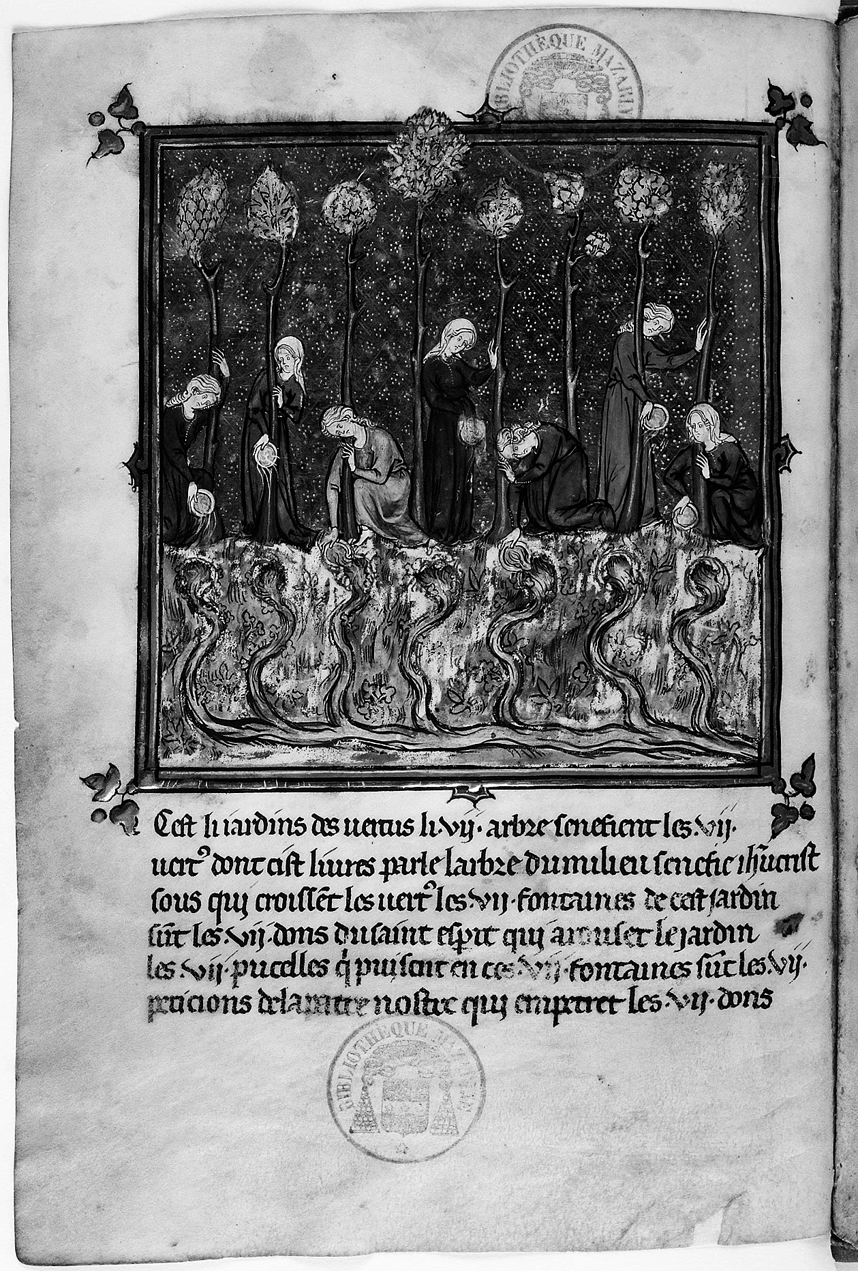
The author's exploitation of the ‘hortus’ or garden allegory of France and its ‘flowers’, the virtues, is clear. The image of a garden blooming with flowers, each representing a virtue – loyalty, justice, peace, faith, generosity, honour and chivalry – is a reflection of not only the Gospel of Matthew, but is also a prefiguration of themes explored by the Monk Yves and Vitry, namely the labelling of the lily's petals as virtues, as well as a reflection of the virtues outlined in the dits.Footnote 87 Moreover, the allegory of the ‘Garden of Virtues’ has its own history within and connection to French royal symbolism before fr. 146. The widely read thirteenth-century Somme le roi, written by the Dominican friar Lorens for King Philippe III, is a religious and didactic manual that illustrates the Garden of Virtues and the nourishment of the seven virtues by the Holy Spirit, as well as the opposing seven vices.Footnote 88 Although only one among many images depicting the virtues as growing in a garden produced in the later Middle Ages, the horticultural illustration of the virtues from the Somme le roi is particularly relevant thanks to its seminal role within the larger visual tradition and its explicit ties to the French royal line (see Figure 4). While it deals with the standard list of seven virtues (three theological and four cardinal), in Fauvel only one of the theological – faith – and one of the cardinal virtues – justice – are included.Footnote 89 In fact, although the virtues associated with the fleur-de-lis in fr. 146 are theological in character,Footnote 90 their inclusion in the Fauvel narrative corresponds to the vices critiqued in the satire, rather than conforming to the standard list of seven virtues.Footnote 91
Garden of Virtues from Somme le roi (1295), Paris, Bibliothèque Mazarine, MS 870, fol. 61v, detail. Reproduced by permission of the Bibliothèque nationale de France
The Garden of Virtues is not without its pests in fr. 146; Fauvel is, of course, the ‘thorn among the lilies’, the beast who ‘roves the garden’ of France. Although the narrator tends not to restrict the garden of France to the cultivation of specific virtues, faith is, indeed, the first virtue trod upon by Fauvel and his hordes, along with the fleur-de-lis herself:
The allegorical garden of France returns again when the author implores both Christ and God – two members of the Trinity – as well as the ‘Lily of Virginity’, the Virgin Mary, to intercede on behalf of France:
Divine figures such as the Virgin Mary and Christ are readily called upon by the author to strengthen and support the virtues responsible for the maintenance and protection of the fleur-de-lis. The delicate balance among Chivalry, Learning and Faith that upholds France in the dits, as well as in later interpretations of the fleur-de-lis, is adumbrated in Fauvel in a similar fashion, since it is the virtues who are awarded the role of sustaining and upholding the lily and therefore the entire garden of France.
It should come as no surprise that fr. 146 shows an understanding of horticultural allegories that draw upon the lily, royal and theological: similar formulations/statements can be found in the motet repertory of the thirteenth century, a textual and musical resource for the compilers of fr. 146 as evidenced by the musical works transmitted in Fauvel. An admonitory motet preserved, among other places, in the thirteenth-century Parisian manuscript of polyphony and monophony, Florence, Biblioteca Medicea Laurenziana, Pluteus 29.1 (hereafter F), Homo, quo vigeas/ET GAUDEBIT, stresses both the importance of faith and virtue generally, and utilises the lily in particular as the antidote to vice, represented in the motet by the orthographically similar alium, garlic:
Another thirteenth-century motet built on the same Marian tenor, Ypocrite, pseudopontifices/Velut stelle firmament/ET GAUDEBIT, deals with similar issues of morality. The motetus praises the faithful clergy and condemns the ‘pseudopontifices’ (false prelates), employing in doing so the allegory of the flourishing lily:
In contrast to the motetus, the triplum describes a scenario that prefigures the desolate realm of Fauvel: ‘The hypocrites, false prelates, hardened killers of the Church, clink their goblets in their boozy orgies.’Footnote 96 As Thomas Payne points out, the two motets (both almost assuredly with texts written by Philip the Chancellor) have a great deal in common, most significantly due to the lily reference.Footnote 97
Motetus and triplum texts juxtaposing the virtues of the lily and the sins of the world occur also in the motet In salvatoris nomine/In veritate/VERITATEM (LoB, fol. 50v). Here, the motetus laments the pollution of the world through the desecration of virtues, while the triplum addresses the ‘Lily’ or Virgin directly for intercession:
In a less familiar thirteenth-century Latin rondeau, the gardens of France (allegorised as Jerusalem) are filled with flowers, while those ‘seeds’ that are unworthy are driven away, in part by the virtues themselves: ‘The city's gardens display gracious lilies and roses and violets.… From these seeds may all which is not benevolent be taken up and cast away.… May the school of virtues wash away the consciences of sins of those to whom the gates lie open.’Footnote 99 Contained within a larger collection of Latin lyrics for Pentecost, saints and the Church of France, this lyric, Pange cum letitia, is an exploration of the central themes framing the story of Fauvel – a dissolute garden (whether the Church, France or Jerusalem) that requires for its health and well-being the flourishing of flowers, especially the rose and lily, and the entire ‘school of virtues’.
The array of thirteenth-century musico-poetic texts surveyed here results in a dense intertextual backdrop for Fauvel and for the utilisation of the symbolic fleur-de-lis within its satirical narrative and theological framework. With the task of defending France falling primarily to the virtues, the realm of the lily – invoking the Virgin, the virtues, the Holy Trinity and France – directly contrasts the realm of corruption and sin; in other words, Fauvel's realm. Indeed, the juxtaposition of the virtues with corruption and evil is prominent throughout Fauvel, perhaps never more so than during the Tournament of the Vices and the Virtues (fols. 37r–41r), the climactic battle between good and evil.Footnote 100 It is telling that among the arms of the virtues described here are those of France: ‘Il en y avoit d'azurees et fleurs de lis d'or ens semees’ (‘[Other shields] were blue with a pattern of golden fleur-de-lis’).Footnote 101 Throughout Fauvel, the virtues frequently appear or are invoked, often in opposition to the evils and various vices of Fauvel and his horde. One virtue in particular, faith, appears numerous times, usually outside the actual narrative of Fauvel in moments of reflection and prayer. The pitting of faith, signifying salvation and the Church of France, against Fauvel, a symbol of sacrilege and the Antichrist, throughout Fauvel is manifested physically in the Tournament of the Vices and the Virtues and musically in a number of interpolated works that emphasise the loss of faith and thus the toppling of the fleur-de-lis.
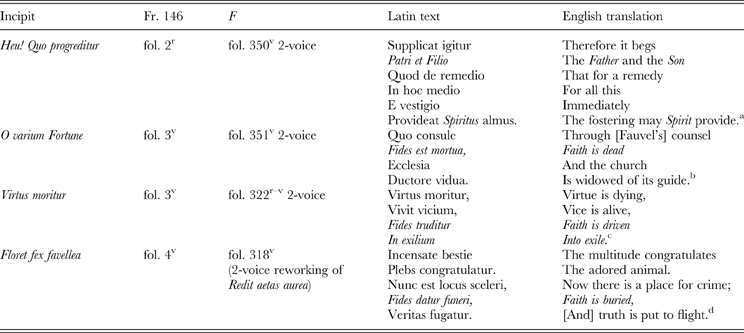
The four conductus presented on the initial folios of Fauvel (fols. 2r–4v) illustrate from the outset of the satire that the loss of faith is a central concern. Heu! Quo progreditur begins the set of conductus as a prayer to the Holy Trinity, while the subsequent three, all ‘fauvelised’, comment on the decline of faith and rise of evil in France.Footnote 102 Even in Heu! Quo progreditur before the supplication to the Trinity, the forced departure of virtue – although not specifically faith – is made clear: ‘Virtus subtrahitur / a sanctuario’ (‘virtue is torn from the sanctuary’).Footnote 103 (See Table 2.)
Excerpts from ‘Trinity’ and ‘Faith’ conductus in fr. 146 and concordances in F
a Latin edition and English translation in The Monophonic Songs in the Roman de Fauvel, ed. Rosenberg and Tischler, pp. 15–16.
b Ibid., p. 18.
c Ibid., p. 19.
d Ibid., p. 20. These are not the sole poetic works from the larger repertory of Latin texts contemporaneous with F that would have been suitable; see, for example, a refrain song from Tours, Bibliothèque municipale, MS 927, fol. 13v, Circa canit Michael, that explicitly ties together the perishing of the virtues and the return of these virtues with the birth of Christ: ‘Devitemus igitur / Vitia, / Per que virtus moritur. … Sua spargat castitas / Lilia, / Peperit virginitas’ (‘Let us, therefore, avoid the vices, through which virtue perishes. … Chastity strews her own lilies, when virginity gives birth’). Edited and translated by Anderson in Notre-Dame, viii, p. l.
In addition to the nine motets interpolated in the initial four folios of Fauvel, the texts of these monophonic adaptations of Notre-Dame conductus lay the moral groundwork for the entire satire.Footnote 104 All four – Heu! Quo progreditur, O varium Fortune, Virtus moritur and Floret fex favellea – are adapted from the great manuscript of twelfth- and thirteenth-century music for the Cathedral of Notre-Dame in Paris, F, perhaps recalling for the compilers an idealised time in Parisian history when the allegorical fleur-de-lis was both thriving due to the pious leadership of St Louis, yet still troubled through the immorality and corruption of the clergy.Footnote 105 Moreover, the comments concerning the death and burial of faith in two of the conductus – O varium fortune and Floret fex favellea – are ‘fauvelisations’, deliberate alterations, perhaps intended to foreground the loss of one of the most important virtues connected not only to the Church, but also to the allegorical lily that sprouts up throughout the satire: faith.Footnote 106
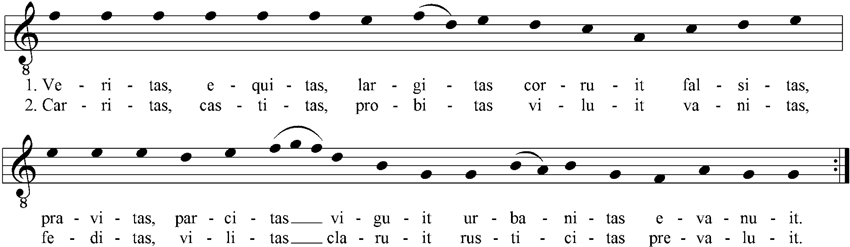
The alteration of these texts for Fauvel, however, does not imply that themes of clerical misbehaviour and bad rulership – not to mention the absence of faith and the virtues as a group – are not found throughout the conductus repertory drawn on for the musical interpolations in Fauvel. One work that again survives in both F and Fauvel, Veritas, equitas, largitas (F, fols. 440v–442v and fr. 146, fols. 22r–23r) emphasises themes that are developed in the four moralising conductus just discussed.Footnote 107 This anti-clerical work, which shares its music with two vernacular lais, lists the absence of virtues in direct comparison with the presence of sins.Footnote 108 The rise of evil and the consequent descent or falling of the virtues is especially clear in the first two stanzas:
This catalogue-like list of virtues and sins in the first two paired strophes is musically highlighted, with the three-syllable words set to declamatory repeated pitches (see Example 1). From the initial folios onwards, the results of Fauvel's ascent to power are reflected in the borrowing and adaptation of Latin conductus: the driving away, death and burial of faith – the principal virtue responsible for protecting France – which is symbolised above all in the fleur-de-lis.
Fr. 146, fol. 22r, Veritas, equitas, largitas, initial verses
These Latin conductus, adapted to their context in Fauvel, are, like the dits, yet more foreshadowings of the later writings on the lily, in which the three flowers of France, Knowledge, Faith and Chivalry, ‘[form] a Trinity’, and only through their unity is royalty and loyalty maintained.Footnote 110 When one Virtue is ‘driven away’, the Royal state, France itself, is threatened as it is in Fauvel. In the horrific context depicted in the initial four folios of Fauvel – a widowed church, absence of faith, the death of the virtues, the rise of Fauvel – aid from a power higher than the state or the church, the Holy Trinity, is necessary. It seems reasonable to suggest that the Holy Trinity – and thus the conductus Heu, Quo progreditur which refers back to the reign of St Louis – was deliberately chosen as a source of divine intercession for its resonance not only with the royal line of France, but also with the ultimate symbol of the rex christianissimus, the fleur-de-lis. While the initial prayer to the Trinity presented in the first conductus, Heu! Quo progreditur, returns only on fol. 43r, a page that represents, through its use of multimedia images of the Trinity, the ultimate salvation of France, the conductus that begin appearing in the very first introductory folios set the stage for the allegory of Fauvel's rise to power and the toppling of France, in addition to signalling to the source of divine salvation.Footnote 111
A more straightforward connection to the Holy Trinity in Fauvel lies in the threefold doxological statement, akin to the Lesser Doxology: ‘Gloria Patri, et Filio, et Spiritui Sancto, Sicut erat in principio, et nunc, et semper, et in saecula saeculorum.’ These doxologies appear, appropriately enough, at the conclusion of three interpolated chants: Filie Jherusalem nolite (fol. 37r), Facta est cum angelo (fol. 38r) and Esto nobis domine (fol. 38v):Footnote 112
Without trying to read too much into the intentions of the compilers, it is interesting to note that the threefold repetition of the doxological statements – albeit only once fully – in Fauvel reflects a kind of Trinitarian doctrine. At the very least, these chants with doxologies are a link between the performance of a proper ‘liturgy’ and the virtues in Fauvel.Footnote 114 The chants are placed at the beginning of the Tournament of the Virtues and the Vices, raising the question whether these chants were a signal for the increased presence of religiosity and faith in the narrative. As both Rankin and Robertson have observed, liturgical chants in the second book of Fauvel often function as characterisations; the three ‘liturgical’ chants with doxologies are therefore united by their ‘performance’ within the manuscript by the Virtues themselves.Footnote 115 The strong links between the Virtues and Holy Trinity through the symbolic intertext of the fleur-de-lis suggest that the placement of these chants with doxologies sung by and to the Virtues served as confirmations of the power of the Holy Trinity on the side of France, leading to the Trinitarian finale of fol. 43r.Footnote 116 Just as the virtues are responsible for maintaining and upholding the ‘lily of France’ in the numerous poetic, prosodic and theological writings on the fleur-de-lis, so too are the Virtues in Fauvel called upon to defend the French realm against the Vices in Tournament and signal through their songs the divine power of the Holy Trinity.
The figurehead of the Virtues, as well as the ‘lily among the thorns’ and the foil to Fauvel and his Vices, is, of course, the Virgin Mary. The invocation of the Virgin through text, image and music adds yet another layer to the complex of sacred associations with the fleur-de-lis in Fauvel. In addition to being closely associated with Paris and the French Royal House, the Virgin shares a close relationship to the Trinity as the mother of Christ.Footnote 117 Among the many symbols for the Virgin, two are the most striking with respect to Fauvel: the Virgin as the hortus conclusus from the Song of Songs,Footnote 118 and the Virgin's attribute of the white lily, discussed above.Footnote 119 The ‘garden of France’ is clearly the Virgin's domain in Fauvel, leading to the plea of the author that ‘Lily of Virginity’ should ‘protect the virtues, for they support truth and keep the power of the lily and the garden of France’.Footnote 120 The Virgin is both the lily itself in the garden of France, and the protector of the lily.
The Virgin's role in Fauvel is amplified during the Tournament of the Virtues and Vices as she descends to bless the Virtues accompanied by the interpolated prose Virgines egregie, fol. 37r–v.Footnote 121 A fittingly Parisian sequence, one which moreover corresponds to the exact location of the tournament, Virgines is a sacred work that celebrates the ‘excellent virgins’:Footnote 122
The sequence draws together the image of the lily of Virginity (Chastity), symbolising both France and the Virgin, the members of the Holy Trinity and the virtues generally as the ‘excellent virgins’. In so doing, the Parisian sequence unites the central theological strands of Fauvel, the Virgin, the virtues and the Trinity.Footnote 124
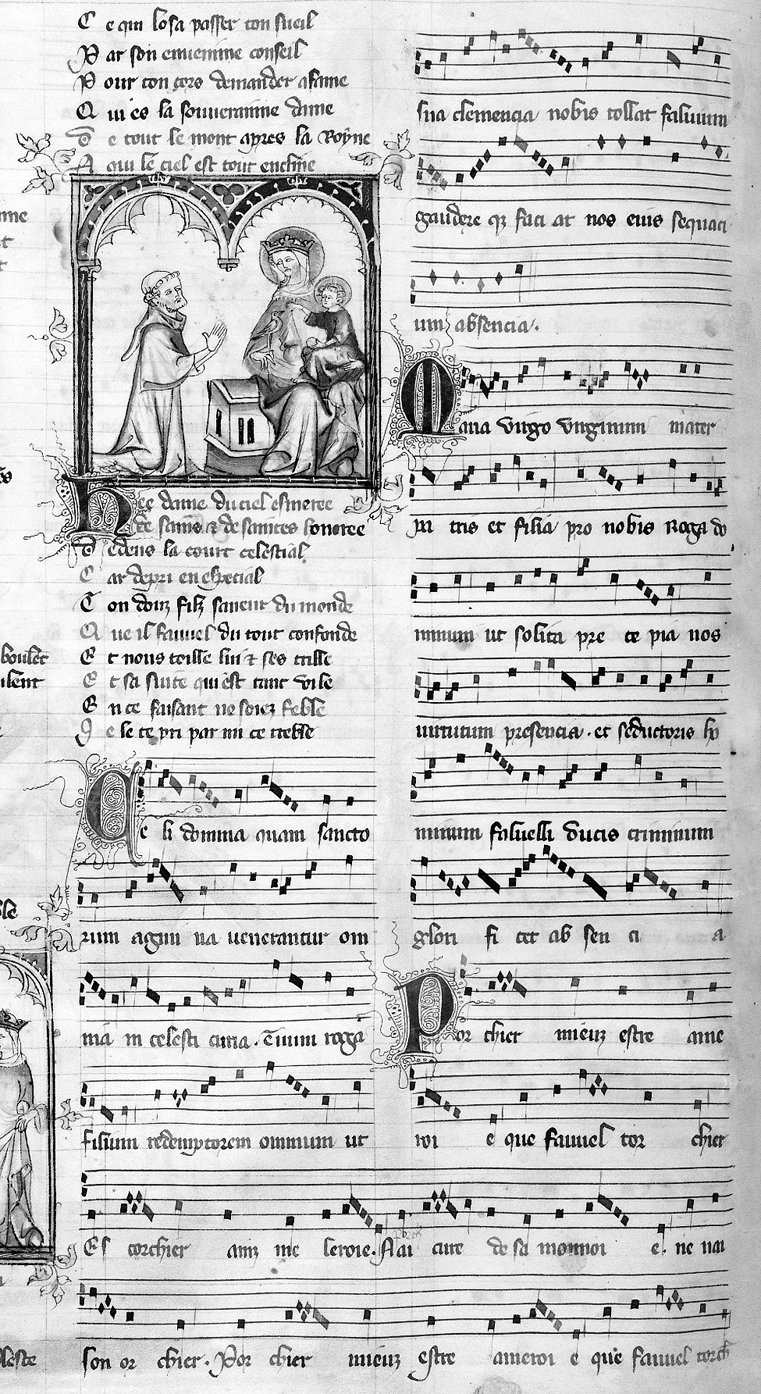
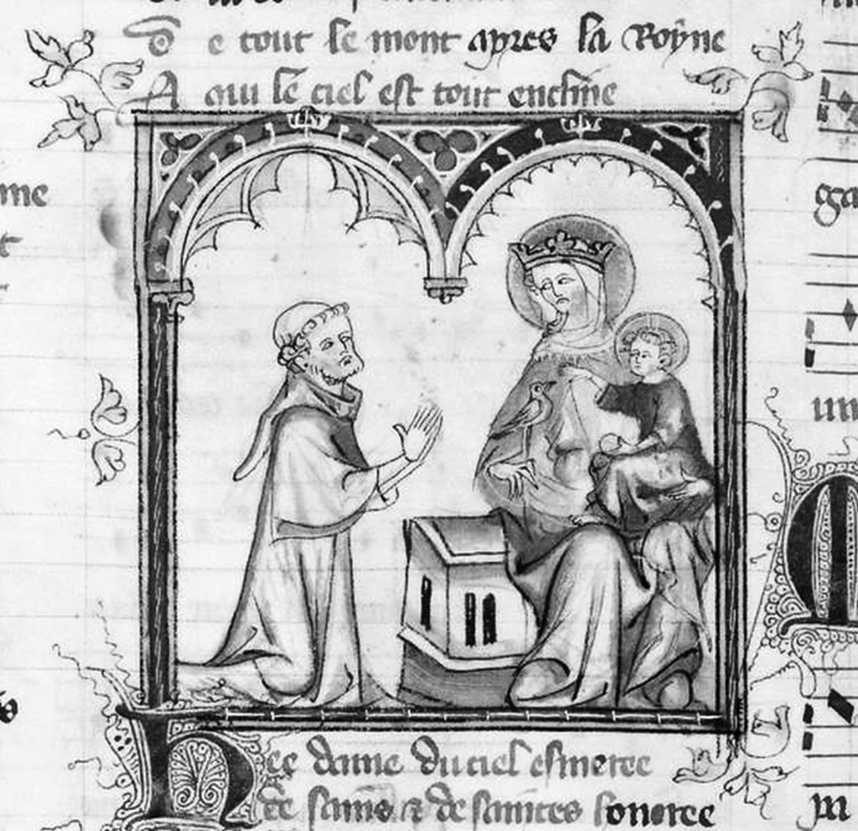
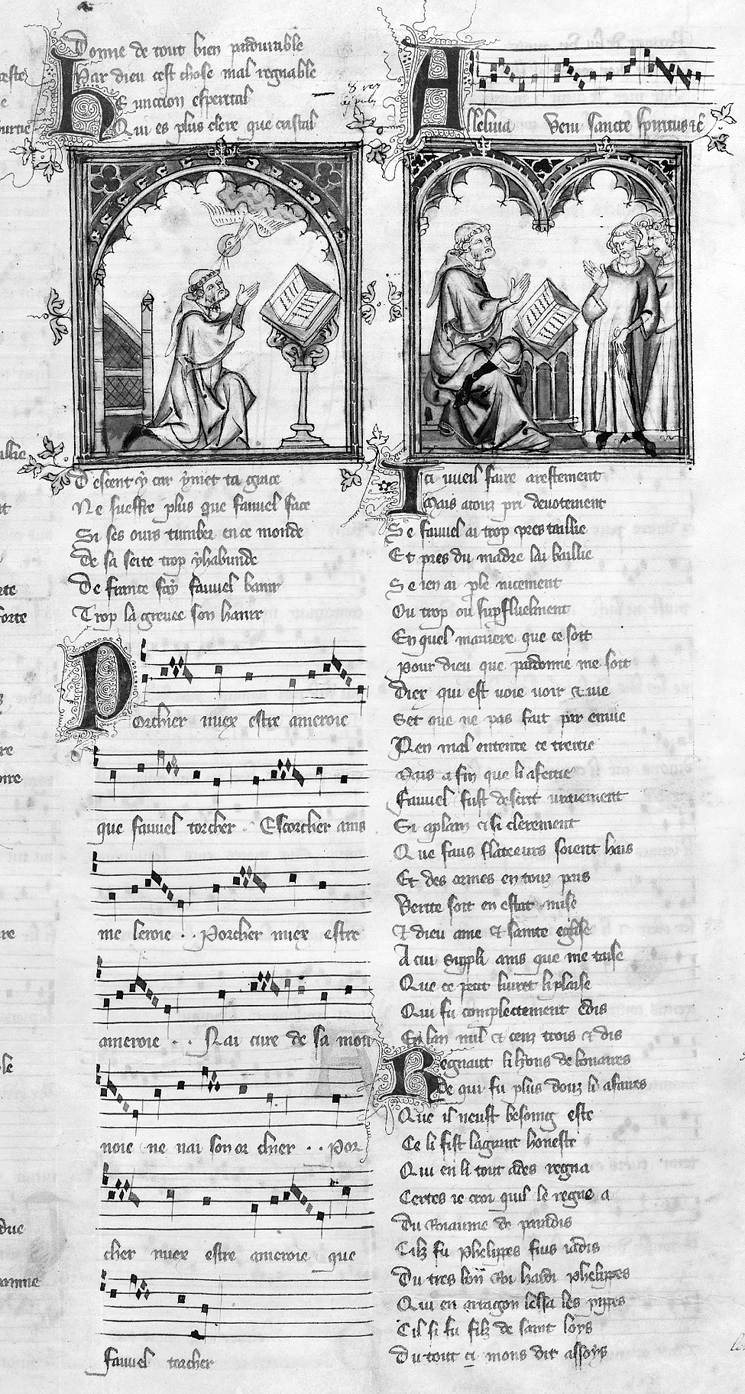
Complementing the juxtaposition of vices and virtues and the foregrounding of the Virgin in thirteenth-century musical repertories is the intercessory presence of the Virgin near the conclusion of Book 2 of Fauvel. Perhaps never more strikingly than in the motet Celi domina/Maria, virgo virginum/Porchier mieuz estre (fol. 42v), the Virgin is musically and textually contrasted with Fauvel and everything he represents. The French tenor of this three-part motet, the rondeau Porchier mieuz estre, first appears at the conclusion of Book 1 in contrast to the author's prayer to the Holy Spirit and to the Alleluia Veni sancte spiritus. Along with the Alleluia, the rondeau is, interestingly, the only musical work to appear twice in the manuscript. As Regalado observes, the rondeau and Alleluia on fol. 10r ‘[speak] to the senses as well as to the spirit: the narrator's rondeau responds to the neighing of Fauvel, while his prayerful Alleluia rises up towards Heaven’.Footnote 125 While the conflict on fol. 10r is between the Holy Spirit and Fauvel, the motet on fol. 42v, which features the French rondeau as the tenor against the Marian texts in the upper parts, depicts the dichotomy between the Virgin and Fauvel:Footnote 126
The text of the motet is further integrated into the page as a whole, as the motetus is paraphrased in French under the miniature of the Virgin.Footnote 128 (See Figure 5.)
Fr. 146, fol. 42v, detail. Reproduced by permission of the Bibliothèque nationale de France
As a musico-textual proclamation of ‘the lily among thorns’, the motet, and the page that contains it, create a multi-textual emblem for the theme of Vices versus Virtues, and the Virgin versus Fauvel, in the roman as a whole. Moreover, the rondeau is not the only swinish moment in fr. 146; in Hora rex est, one of the Latin dits, the ‘thorns’ among which the King – the lily – must take a stand are none other than swinish beasts:
Just as the king must be as the lily and protect against the thorns, so too is the Virgin Mary in Fauvel, representing the virtues, called upon as the ‘lily among the thorns’, with the thorns portrayed by Fauvel's rondeau tenor (see Example 2). In this motet, the death and absence of the virtues that began Fauvel is reversed; through the Virgin Mary and her son the virtues are made present and Fauvel, rather than the virtues, is now driven away (into ‘absencia’). Moreover, the musical confrontation of the Virgin with the swineherd in Celi domina/Maria, virgo virginum/Porchier mieuz estre is more than merely a representation of the lily among thorns: the battle of the Vices and Virtues that ends only shortly before comes to its true conclusion here. The leader of the Virtues, the Virgin/Lily, takes a final stand against the leader of the Vices, Fauvel.Footnote 130
Fr. 146, fols. 10r and 42v, Porchier mieuz estre
The confrontation musically depicted in the motet is prepared in the prayer to the Virgin herself that precedes the motet, a prayer that petitions the Flower of the Lily herself to intercede and rid France of Fauvel:
The numerical reference in the final lines not only reflects the number of voices in the motet, but also the rondeau form of the tenor (the refrain is repeated three times: ABaAabAB) and possible even the connection of this ‘three-part’ Marian prayer to the Holy Trinity itself. As Martin Kauffmann has observed in a study of the illustrations in fr. 146, the illustrator does in fact pair traditional images across the opening of the manuscript with the author petitioning the Virgin and Christ (Figure 6) and the Trinity (Figure 9 below).Footnote 132
Fr. 146, fol. 42v, detail. Reproduced by permission of the Bibliothèque nationale de France
In Fauvel, these images appear not only to contribute to the ‘impeccably orthodox’Footnote 133 nature of the manuscript, but also form a deliberate link between the Trinity and the Virgin through parallel depictions. The question whether Fauvel's authors and compilers were more interested in the divine intercession of the Virgin or the Trinity is resolved by acknowledging the symbolic link between them is, in part, provided by their shared symbol in fr. 146 and in fourteenth-century writing in general, the fleur-de-lis.
The significant presence of the members of the Trinity, the Father, Son and the Holy Spirit, in Fauvel is a feature of the narrative's theological framework that has been assigned varying degrees of importance by scholars.Footnote 134 Taking into account the culmination of religious themes on the ‘Trinity Page’ of fol. 43r, Susan Rankin has argued that the temporal framework of the satire appears to reflect the Temporale of the Catholic Church between Pentecost and Trinity Sunday.Footnote 135 The ‘Trinity Page’ at the conclusion of Book 2 signals the latter, while Pentecost is suggested by the inclusion of the Pentecost chant Alleluia Veni sancte spiritus on fol. 10r. The similarities between certain events in Fauvel, the metrical chronicle in fr. 146 and the events of the Pentecost feast in Paris in 1313 further confirm a sacred reading of the temporal framework of Fauvel beginning at Pentecost.Footnote 136
The presence of the Holy Spirit at the conclusion of the first book represents the first ‘liturgical’ moment in Fauvel: fol. 10r contains two portraits of the author, one in which he ‘sermonises’ to the readersFootnote 137 and the other in which he is visited by the Holy Spirit; it also has the Pentecost chant Alleluia Veni sancte spiritus, all of which is contrasted with Fauvel's rondeau, Porchier mieuz estre (see Figure 7).Footnote 138 These sacred images of the author offer a counterpart to the paired images at the conclusion of Book 2, and considered together, these musical, textual and visual elements also form a moment of reflection on the Holy Spirit's blessing on the kingdom of France in direct contrast to the rising power of Fauvel.
Fr. 146, fol. 10r, detail. Reproduced by permission of the Bibliothèque nationale de France
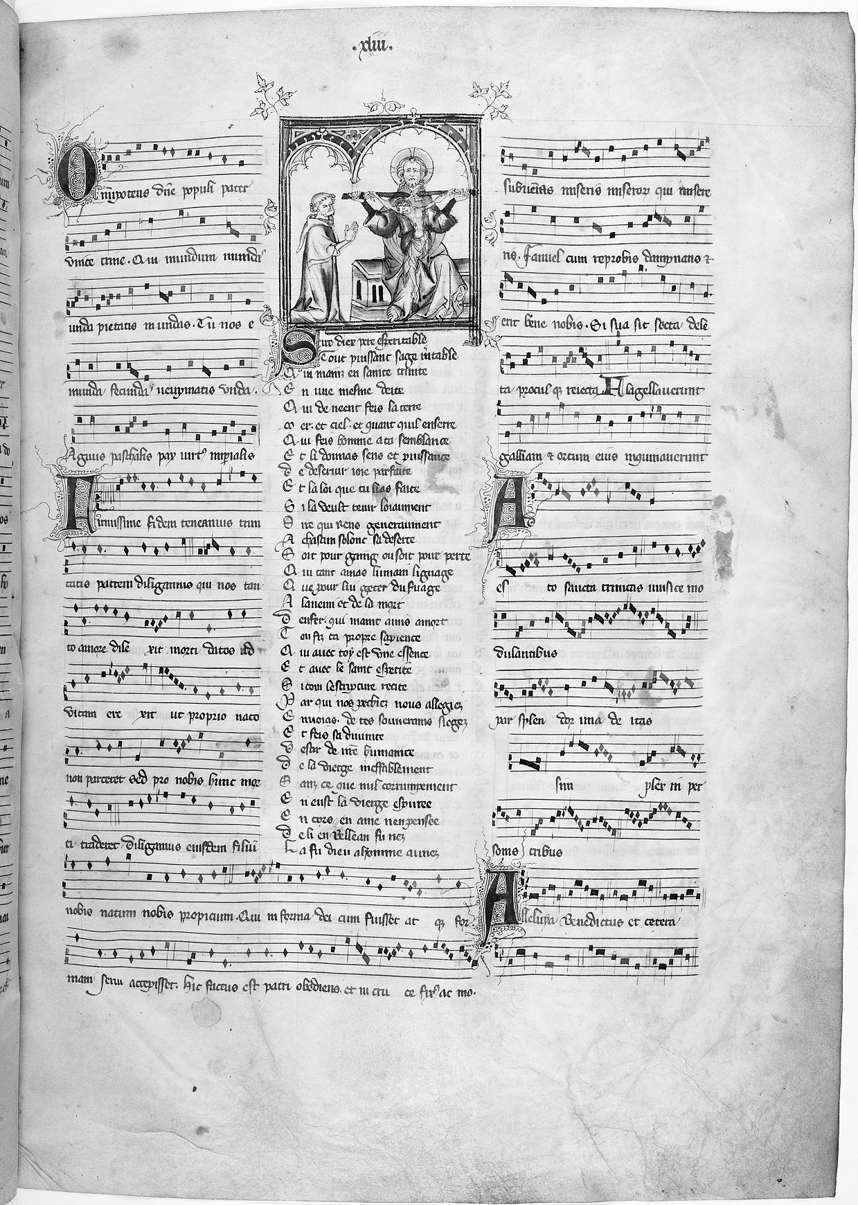
In addition to iconography, the conclusion of the second book offers another interesting parallel to that of the first book.Footnote 139 Although the two endings share the same liturgical signal, an Alleluia, the chant that ends the second book, Alleluia benedictus es,Footnote 140 appears not as a stand-alone chant, but rather as the tenor of the ‘Trinity motet’, Philippe de Vitry's Firmissime/Adesto/Alleluia benedictus es.Footnote 141 Immediately above this well-known Trinity motet, moreover, is another motet that similarly confirms the Trinitarian theme of the page, Omnipotens Domine/Flagellaverunt Galliam. Everything on the page, from the texts of the motets to the surrounding Trinitarian prayer, decoration and the formatting, are signals of the triune God (see Figure 8).Footnote 142
Fr. 146, fol. 43r, ‘Trinity Page’. Reproduced by permission of the Bibliothèque nationale de France
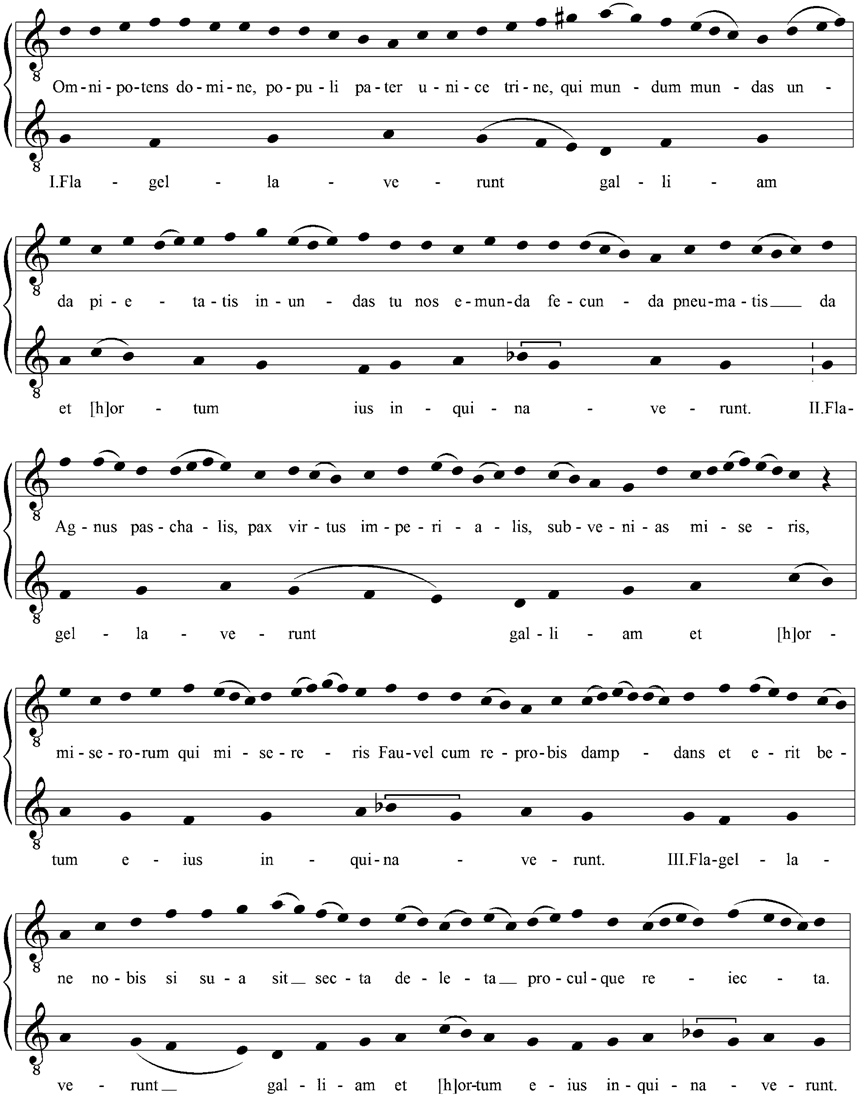
The first musical work on the page, the less frequently discussed Omnipotens Domine/Flagellaverunt Galliam, is a unicum, with texts composed explicitly for Fauvel. Moreover, this is the only other motet besides Celi domina/Maria, virgo virginum/Porchier mieuz estre to utilise a newly composed, non-liturgical text in its tenor that, like the rondeau, is specific to Fauvel:Footnote 143
The tenor is especially interesting for its return to the Garden allegory; yet again, Fauvel and his ‘fauvellettes’ are guilty of ‘scourging’ France and despoiling its Garden. However, above the tenor is a prayer for intercession directed to none other than the triune God, echoing perhaps the author's direct address to the Holy Trinity that lies in the middle column of the page and the miniature of the author praying to the Throne of Mercy. The motetus focuses primarily on the Trinity, ‘unice trine’, with references to the Holy Spirit and Christ, and concludes with a condemnation of Fauvel, whose crimes are intoned below in the tenor. Musically, the motet is unusual for its antiquated texture, appearing more like an organum trope than a fourteenth-century motet, albeit with a text declaimed in the tenor (see Example 3).Footnote 144
Fr. 146, fol. 43r, Omnipotens domine/Flagellaverunt galliam
The tenor is itself sung three times in the course of the brief work; whether this is intended as a deliberate reference to the Trinitarianism in the motetus is unclear. However, what is completely apparent is that Omnipotens Domine/Flagellaverunt Galliam is another newly created work that provides an audible reference to some kind of manufactured ‘liturgical’ orientation within Fauvel. Following the same schema between lower=Fauvel and upper=sacred as Celi domina/Maria, virgo virginum/Porchier mieuz estre, this quasi-motet, quasi-organum trope functions as the musical header of the ‘Trinity Page’ and provides a context-specific introduction to the musical climax of the manuscript, Vitry's completely sacred yet more general Trinitarian motet, Firmissime/Adesto/Alleluia benedictus es.
The texts of Vitry's motet are without a doubt entirely Trinitarian in scope; moreover, the tenor is an Alleluia for the feast or votive Mass of the Holy Trinity, as well as the parallel to the Alleluia the ends Book 1, Alleluia Veni sancte spiritus.Footnote 145 The triplum text is divided into four petitions, three for each individual member of the Holy Trinity and one for the group. The shorter motetus text is a stanza on the Trinity that emphasises the doctrine of ‘three persons in one’:
Vitry's authorship of the motet, and later the poem Le Chapel des trois Fleurs de Lis, suggests that as early as the 1310s he had begun to develop the Trinitarian symbols that he later associated with French kingship and the fleur-de-lis.Footnote 147 Robertson has speculated, moreover, that the motet was intended expressly for inclusion in Fauvel, which provides a justification not only for Vitry's use of the non-Parisian Alleluia to represent a triumph over the evil represented by Fauvel, but also the creation of an explicitly Trinitarian work for fr. 146 and its pairing with the definitely new work, Omnipotens Domine/Flagellaverunt Galliam.Footnote 148
The texts of both Trinity works, as with Celi domina/Maria, virgo virginum/Porchier mieuz estre, are further complemented by a prayer by the narrator that also references the Virgin and Christ:
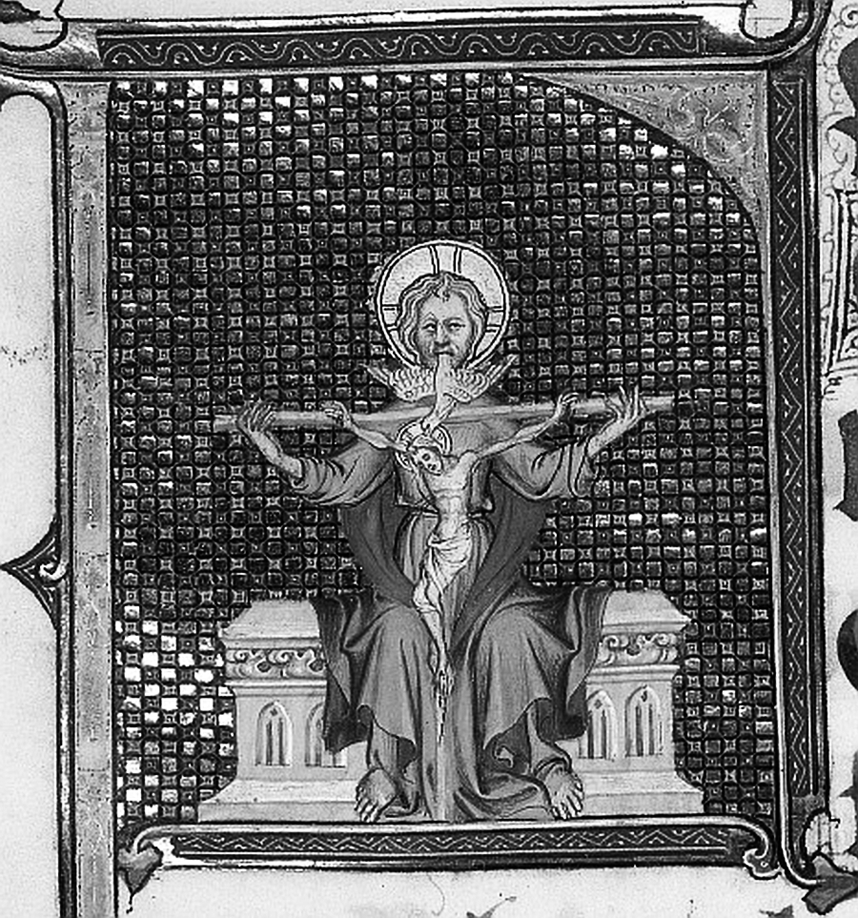
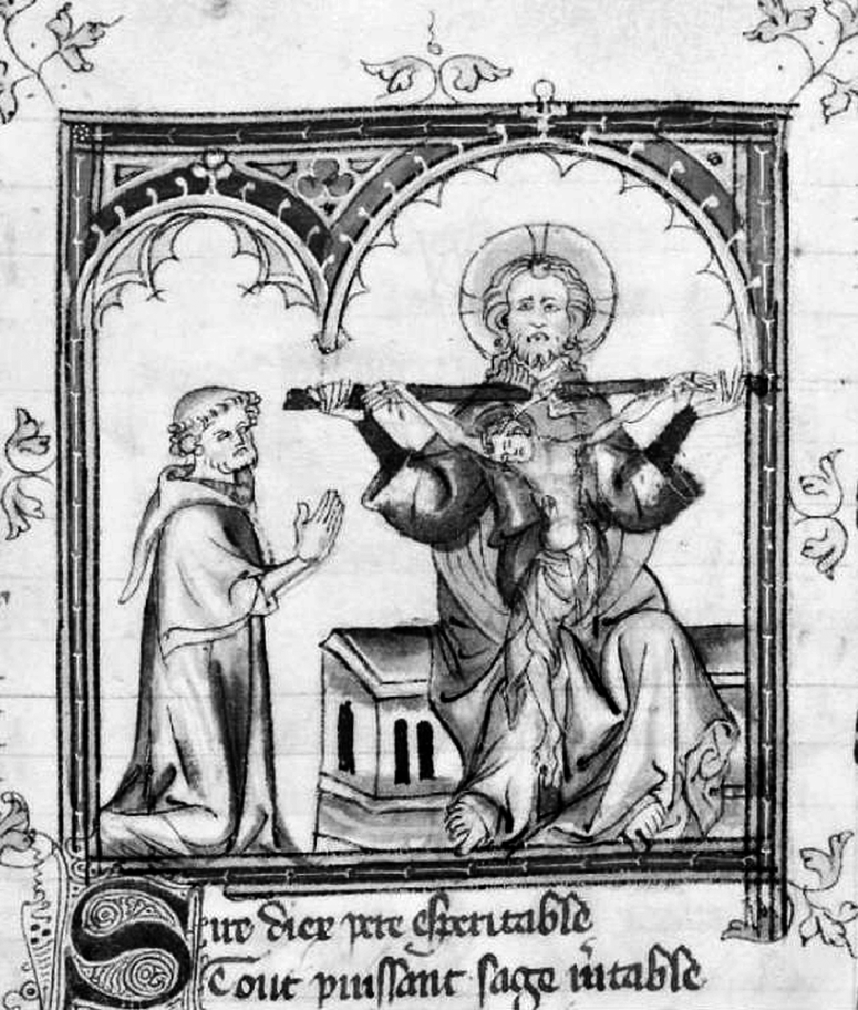
Topping the Trinitarian prayer in the centre column is a depiction of the author supplicating the traditional ‘Throne of Mercy’, which provides a suitable foil – perhaps even a dethroning – to the depiction of the enthroned Fauvel throughout the satire.Footnote 150 For comparison, alongside the image from the ‘Trinity Page’ in fr. 146 is provided another Throne of Mercy illustration from a mid-fourteenth century Parisian manuscript (see Figure 9).Footnote 151
(a) British Library, Yates Thompson MS 34, fol. 116v, detail (image in public domain); (b) fr. 146, fol. 42v, detail (reproduced by permission of the Bibliothèque nationale de France)
Continued
As a canonical manner of depicting the Trinity, the Throne of Mercy, or Gnadenstuhl, illustration is, appropriately, the third element on fol. 42v that conforms to its Trinitarian theme, in addition to text and music.Footnote 152 The parallel conclusions of the two books of Fauvel indicated through the liturgical signal of the Alleluias and the depictions of the author with the Holy Spirit and the Holy Trinity suggests that a sacred temporal overlay does in fact exist, one that moves the reader musically, textually and visually from symbols of the Pentecost to the Holy Trinity if not the actual feasts.Footnote 153 Indeed, officially, the Feast of the Holy Trinity was only authorised in 1331, after the compilation of fr. 146, when Pope John XXII set the feast day on the Sunday following Pentecost. As Craig Wright notes, before the feast was made official, the liturgy of the Holy Trinity, at least at Notre Dame in Paris, was used for sacraments and, notably for Fauvel, ‘to combat heresy’.Footnote 154 However, following the sanctioning of the Feast of the Holy Trinity, the very image depicted in Fauvel immediately following the Pentecost symbolism, the Throne of Mercy, became the customary illustration for Trinity Sunday in Parisian manuscripts.Footnote 155
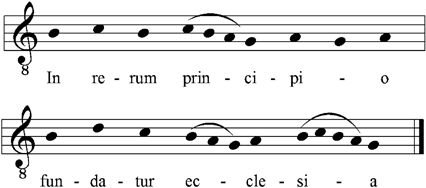
Considering the interpretation of two liturgical occasions at the end of both books, Pentecost and the Feast of the Holy Trinity, the threading of religious symbolism throughout Fauvel operates as a signal of the compiler's concern not only for France and its monarchy, but equally for the health of the Holy Church in France. The increased interest throughout Fauvel in depicting textually and musically the Virtues, the Virgin and the Holy Trinity and, of course, their communal symbol, the allegorical fleur-de-lis, reflects both the authorial invocation to resist evil in the form of Fauvel, and a more general concern with the protection of the Holy Church. Indeed, in a conductus preserved only in F, In rerum principio (fol. 469r–v) the health of the Holy Church is equated directly with the health of the lilies of France:
Surrounded by Latin rondeaux for Christmas and Easter, this conductus, comprised of only two, related musical phrases (see Example 4), has been singled out by Barbara Haggh and Michel Huglo as a work intended for the dedication of a church, possibly the Sainte-Chapelle in Paris, pointing to the fleur-de-lis in the text as proof of a relationship with this beflowered chapel.Footnote 157 Unlike the majority of chants for the dedication of churches, however, In rerum principio reads like the moral texts transmitted in both F and Fauvel, such as the introductory conductus which bemoan the banishment of the virtues: Heu! Quo progreditur, O varium Fortune, Virtus moritur and Floret fex favellea. The final lines of the first strophe of In rerum principio in particular (‘For with the weeds purged, the lilies sprung forth’) foreshadow the garden metaphors in Fauvel, stressing through the juxtaposition of the lilies with the weeds the struggle between good and evil depicted throughout fr. 146. Only with the removal and correction of bad rulers, of Fauvel and his fauvellettes – the weeds of In rerum principio? – can the fleur-de-lis that represents so much in thirteenth- and fourteenth-century France, from the Virgin, the Trinity and the virtues to France and her monarchy and Church, truly begin to flourish.
F, fol. 469r, In rerum principio
The legacy of the fleur-de-lis
In his 1372 French translation of Guillaume Durand's Rationale, Jean Golein confirms the relevance of an allegorical reading of the fleur-de-lis such as in Fauvel as a supremely spiritual and heraldic symbol in his description of one of the two arms of the French royalty:
The first [banner of the French kings], with the three fleurs-de-lis, symbolically represents the faith of the Trinity planted in the humility of the Virgin Mary, which is compared to the lily flower, according to the gloss on the Song of Songs: ‘As a lily among the thorns, etc.’; that is, as the lily flower is born among the thorns on Jesus Christ's precious crown, which is kept by the kings of France in the Sainte-Chapelle of the Palace, in Paris.Footnote 158
Interpreting one of the two banners of France, Golein ties together the flower of the lily with faith, the Trinity, the Virgin Mary, Jesus, the kings of France and their spiritual home, the Sainte-Chapelle, a building quite literally strewn with the flowers of the lily. In effect, this later fourteenth-century text provides one of the clearest statements on the theological and heraldic meaning of the fleur-de-lis for France. Produced over fifty years earlier, the very same heraldic imagery described by Golein – including, most significantly, the fleur-de-lis – appears in fr. 146, with theological and royal themes and symbols woven artfully into narrative, text and music.Footnote 159 Taking Fauvel as well as the other works that comprise fr. 146 into consideration, we discover, in fact, a significant intertextual addition to the historical trajectory of the fleur-de-lis. Interpretations of the lily central to fourteenth-century writings are prefigured in the petitionary folios that conclude the satire and in the musical repertory that forms the font of interpolations in Fauvel, while the dits and the chronicle represent an early understanding of the importance of the fleur-de-lis and its theological and monarchical associations with France.
The most important development of the lily exegesis both for and in fr. 146, however, is the linking of the flower equally with the Holy Trinity, the Virgin Mary and the virtues. The Virgin and the Trinity are easily located within the multimedia fabric of Fauvel, with parallel images, musical interpolations and prayers serving to highlight their divine relationship. The importance of the Trinity is further suggested by the temporal movement in Fauvel from Pentecost, the celebration of the Church, to Trinity Sunday, an emphasis confirmed musically, visually and textually. The association of the petals of the lily with the virtues seen throughout fourteenth-century writings also finds ample expression in Fauvel. The ‘virtuous’ petals are largely expressed through the centrality of the virtues as characters, in lyrics and as the flowers in the garden of France, not to mention as the guardians of the fleur-de-lis. Drawing on the one symbol that served both as the principal religious sign of the French Royal House and as a rich theological symbol in the fourteenth century, the compilers of fr. 146 utilised a variety of images, symbols and allegories centred around the fleur-de-lis that are fully understood only when the larger cultural and textual context of the manuscript is taken into account.
The seemingly disparate theological and monarchical themes in Fauvel, alongside the themes of good governance and the Church, can thus be united under one multivalent symbol, that of the eminently French and holy ‘flower of the lily’. Furthermore, the diversity of symbolic references to the lily in fr. 146, some borrowed from earlier interpretations and others foreshadowing later developments, leads to the firm placement of the manuscript within the historical development of the royal, religious and symbolically infused and enriched flower: from the lily of the valley to the gilded fleur-de-lis.