Introduction
Dysfunctional thoughts have been marked as a factor of predisposition in emotional disorders such as depression. These thoughts, which specify rigid and inappropriate contingencies of the person to guide and assess behavior, favor the manifestation of depressive symptoms when specific stressful events lead to behavior inconsistent with these standards (Beck et al., Reference Beck, Rush, Shaw and Emery1979; Kuiper et al., Reference Kuiper, Olinger and Air1989).
Dysfunctional thoughts act on caregivers as cognitive barriers which make it difficult for them to take appropriate care of their own mental and physical health through at least three different but interrelated pathways. In the first place, some of these dysfunctional thoughts can affect the amount of help received by caregivers. Despite the fact that seeking help from others could be beneficial, some caregivers, especially spouses, believe that they should do it all alone (Mittelman et al., Reference Mittelman, Epstein and Pierzchala2003). In the second place, dysfunctional thoughts may trigger excessive responsibility, perfectionism and over-implication in caregiving. Many caregivers, despite showing high levels of discomfort and feeling overwhelmed by the task, consider that no one can look after their relatives better than they do, thus assuming sole responsibility for the care (Mittelman et al., Reference Mittelman, Epstein and Pierzchala2003). Some authors have pointed out that this could occur because they consider that “the care has to be given exclusively by the family”, and that they are also concerned about “what people will say” if they ask for formal help (Arai et al., Reference Arai, Sugiura, Miura, Washio and Kudo2000). Cox and Monk (Reference Cox, Monk, Barresi and Stull1993) found a relationship between depressive symptomatology and adherence to the cultural norm of family help, which obliges young adults to look after their elderly parents and not make use of professional help because of the shame that the family would thereby incur. Similar results have been found by Knight et al. (Reference Knight, Robinson, Longmire, Chun, Nakao and Kim2002) and Losada et al. (Reference Losada, Montorio, Knight, Márquez and Izal2006a). Moreover, some caregivers create unreal expectations regarding care, leading to frequent feelings of anger, guilt and frustration (Gruetzner, Reference Gruetzner1992). It is not unusual for caregivers to dedicate themselves full time to care, neglecting their own needs for personal development and welfare in order to avoid guilt feelings or pain (e.g. Lindoerfer, Reference Lindoerfer, Dippel and Hutton1991). Moreover, dysfunctional thoughts can lead to excessive involvement in the care of the relative, which in turn prevents the care recipient from engaging in their own daily activities (Lindoerfer, Reference Lindoerfer, Dippel and Hutton1991). Thirdly, dysfunctional thoughts may hinder expressions of emotional distress associated with caregiving. Some caregivers consider that they should not complain or express any negative feeling (anger, shame, sadness or despair) related to caregiving (Gallagher-Thompson et al., Reference Gallagher-Thompson, Solano, Coon and Areán2003). The suppression or inhibition of the expression of feelings, attitudes, wishes, opinions or individual rights has been associated with a greater caregiver burden (Muela et al., Reference Muela, Torres and Peláez2001).
These kinds of thoughts about caregiving are not independent of culture. On the contrary, cultural beliefs and values have been found to be predictors of stress and health outcomes (Knight et al., Reference Knight, Robinson, Longmire, Chun, Nakao and Kim2002; Dilworth-Anderson et al., Reference Dilworth-Anderson, Goodwin and Williams2004). The relationship between caregiver and care recipient always occurs in a specific cultural context that influences the outcomes of this stressful situation. Although empirical evidence about this issue is scarce, some studies have shown how cultural values influence caregivers' health. From this view, familism (i.e. the salient role played by the family in the life of the individual), a key value in Hispanic culture, was found to be significantly associated with higher levels of depressive symptoms in a Spanish caregiver sample, but to present a lesser burden in an U.S. Hispanic sample (Losada et al., Reference Losada, Montorio, Knight, Márquez and Izal2006). These results indicate not only the effects of cultural values on the health and the wellbeing of the caregivers, but also the significance of the cultural context in the relationship between them. In other words, cultural values, as familism, may have different consequences for the health and wellbeing of the informal caregivers depending on the social context in which the care relationship occurs. Specifically, culture justifications for caregiving and caregiving mastery were found to explain physical and psychosocial health effects of caregiving among an African American sample (Dilworth-Anderson et al., Reference Dilworth-Anderson, Goodwin and Williams2004).
Much research on caregiving has focused on the individual caregiver, trying to identify factors which affect his/her experience of stress and burden. Fewer studies have focused on caregiving as a relationship between two individuals who affect each other. However, this scope can provide interesting knowledge in order to understand the complexity of caregiving (Dunham and Cannon, 2006). For example, the expectations of the caregiver may affect the subjective wellbeing of the care recipient. Specifically, when the informal caregiver's expectations about the capacity of the care recipient are congruent with his/her actual capacity, the subjective wellbeing of the care recipient is higher than when the expectations of the caregiver and the actual functional capacity of the care recipient are discordant (in any direction) (Izal et al., Reference Izal, Montorio, Sánchez, Márquez and Losada2005).
Few studies have analyzed the role of dysfunctional thoughts about caregiving. McNaughton et al. (Reference McNaughton, Patterson, Smith and Grant1995) studied the relationship between stress, depression, health and irrational beliefs in a sample of 89 caregivers of persons suffering from Alzheimer's disease. They found that maintaining irrational thoughts was related to depression, external locus of control and poor health in difficult circumstances. The results of six months' monitoring revealed that a lesser presence of irrational thoughts was associated with better subjective health of the caregivers. Likewise, Stebbins and Pakenham (Reference Stebbins and Pakenham2001) studied the relationship between irrational thoughts and psychological discomfort in a sample of caregivers of people with traumatic brain injuries. The dysfunctional thoughts assessed in this study referred mainly to the need for the avoidance of problems and rigidity. These authors found that a greater presence of dysfunctional thoughts was associated with higher levels of psychological discomfort in the caregiver.
Ir order to examine the caregiving from a psychological perspective, attempts have been made to analyze the problems faced by family caregivers by using the stress coping theory. The conceptual underpinnings of our study are found in the work of Lawton and colleagues (Reference Lawton, Kleban, Moss, Rovine and Glicksman1989) and Pearlin and colleagues (Reference Pearlin, Mullan, Semple and Skaff1990). Some of the most comprehensive caregiver research based on cognitive theory of stress and coping has been conducted by Lawton and colleagues (Reference Lawton, Kleban, Moss, Rovine and Glicksman1989). They developed a measure to assess the caregiving experience (Caregiver Appraisal Scale) which reflects a broader conceptualization than that underlying the term “burden.” The concept of caregiver appraisal includes all cognitive and affective appraisals and reappraisals of the potential stressor and the efficacy of one's coping efforts. They demonstrated that this construct comprised caregiver mastery, caregiver satisfaction and subjective burden. An additional domain was proposed to reflect beliefs or ideologies regarding caregiving. Finally, items representing traditional caregiver ideology were dropped from analysis. The stress-process model of distress proposed by Pearlin et al. (Reference Pearlin, Mullan, Semple and Skaff1990) poses that psychiatric outcomes are due to both objective and subjective stressors. Objective stressors include factors relating to the patient's disability and subjective stressors are factors relating to the caregiver's appraisals of the caregiving role or situations, such as feeling overwhelmed by caregiving responsibilities. Pearlin et al. investigated the role implications of life stressors. They suggest that concepts such as role captivity, which is viewed as being placed in a role involuntarily and unwillingly, and role overload, help us to understand many of the dilemmas in caregiving. Role captivity is recognized as both a consequence of the primary objective stressors and perceived overload (subjective primary stressor) and a potential contributor to increased feelings of depression. Like a sense of overload, role captivity is a subjective response to the caregiving situation. They also acknowledge the impact of caregivers' coping and social support resources on their ability to deal with caregiving demands. The concept of dysfunctional thoughts about caregiving is close to theoretical models of caregiving proposed by Lawton and Pearlin, although it stresses the importance of the values, beliefs and ideology about caregiving.
In summary, some of the caregiver's specific thoughts can affect the caregiving situation and lead to an increase in the caregiver's distress. An assessment instrument sensitive to dysfunctional thoughts about caregiving could be of great help, both to increase the mediators' knowledge about caregiver distress and to reduce it through the development and implementation of interventions. In this study, we describe the development and psychometric properties of an assessment instrument designed to identify dysfunctional thoughts specific to caregiving.
Methods
Participants
The prerequisite for taking part in this study was to be the main family caregiver of a dementia relative. Caregivers were eligible to participate if they identified themselves as the family member who was primarily responsible for the patient's care in a community setting, spent more than 3 hours a week caring for the patient and were older than 18 years. The study participants comprised 227 informal caregivers (171 females and 56 males), with an average age of 58 years (S.D = 14.1). The average number of years of formal education received was 8.7 (S.D. = 5.1). Most of them were married (81.5%); 45.8% were the son or daughter of the care recipients, 44.1%. were spouses, 4.8% were daughters-in-law, and 5.3% were other relatives. Most of the participants lived with the person they looked after (71.3%). The average age of the care recipients was 76 years (S.D. = 8.4). As regards the duration of the care, 32% had been looking after their relatives for more than four years, 39.6% between one and four years, and 28.4% had been doing it for less than a year. Finally, 45% of the caregivers did not receive any help from the people they lived with, 35% did not receive any help from any other members of the family and two out of three did not receive any kind of formal help.
Measures
Socio-demographic variables and help received
Information on age, sex and the number of hours spent daily engaged in caring was gathered. In addition, questions about the receipt of help from relatives living in the same house, as well as help from other relatives, friends and formal services were included. Based on this information, the variable “amount of help received” was developed with scores varying from 0 (no help received) to 4 (caregiver receives help from all four described sources).
Social support
Social support was assessed through the Psychosocial Support Questionnaire (PSQ; Reig et al., Reference Reig, Ribera and Miquel1991). This questionnaire consists of six items with answers on a Likert scale from 0 (never) to 3 (very often). The total score ranges from 0 to 18, a higher score indicating a higher perception of psychosocial support.
Depressive symptomatology
The Centre for Epidemiological Studies Depression Scale was used (CES-D; Radloff, Reference Radloff1977). It consists of 20 Lykert-type items with answers ranging from 0 (hardly ever or never) to 3 (all the time). The total score ranges from 0 to 60. The cut-off for clinically significant symptoms was ≥ 16.
Social support coping styles
Four items of the Carver et al. (Reference Carver, Scheier and Weintraub1989) COPE inventory of coping styles were used. In order to reduce the length of the interview, only those social support coping items with the highest weights in the two relevant COPE sub-scales were included. The two items with the highest weight in the “search for social support for instrumental questions” sub-scale were: “I ask people who have had similar experiences what they did” and “I try to get advice from someone about what to do”; and those of the “search for social support for emotional questions” sub-scale were: “I talk to someone about how I feel” and “I try to get emotional support from friends or relatives.”
General dysfunctional attitudes
Participants completed a nine-item version of the Dysfunctional Attitudes Scale (DAS; Andrews et al., Reference Andrews, Lewinsohn, Hops and Roberts1993). A high score on this scale indicates that the person tends to interpret negative events in a maladaptive manner. The items in this scale are assessed using a four-point Lykert scale. The total score ranges from 0 to 36. On the basis of the data from the NIMH Treatment of Depression Collaborative Research Project (TDCRP) (Imber et al., Reference Imber1990), DAS seems to have adequate psychometric properties in the adult population. The internal consistency of this scale in this study was 0.81.
Dysfunctional thoughts about caregiving
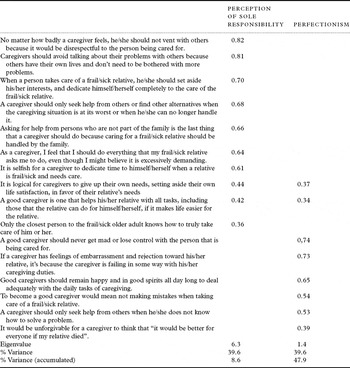
The Dysfunctional Thoughts about Caregiving Questionnaire (DTCQ) allows the identification of specific dysfunctional thoughts and provides a single summary score indicating a maladaptive approach to caregiving (Losada, Reference Losada2005; Losada et al., Reference Losada, Montorio and Márquez2006a). It consists of 16 items scored on a 5-point Likert scale (see Table 1) (range:0–64). In general terms, the summary content of this questionnaire could be defined with the following statements: “I have to do everything for the person I'm looking after and, whenever possible, I have to do it alone; I should not feel bad about it, and, if I do, I should not show my feelings.”
Factorial analysis of the DTCQ items

Only loadings higher than 0.30 are reported
The scale was administrated in Spanish. The English version contained in this table was translated and then back-translated for this paper.
Procedure
A range of health and social services centers of the Madrid Community were contacted. These centers asked caregivers to participate in the study. The average duration of each assessment was an hour and a half. All the assessments were carried out by trained psychologists. A sub-sample of participants (N = 31) completed the DTCQ twice with an interval of four weeks between the two interviews.
Results
Reliability
The DCTQ displayed an internal consistency (Cronbach's α) of 0.89. Corrected item-total correlations ranged from 0.44 to 0.76 (Table 1). The measure also displayed a moderate test-retest reliability (r = 0.60; p < 0.01).
Factorial validity
An initial principal components factor analysis method with oblique rotation was performed on the 16 items. The Kaiser criterion for the retention of factors (λ ≥ 1) was used. The oblique factor analysis resulted in a solution consisting of the 16 items loading on two factors, accounting for 47.7% of the variance. On the basis of these data, two subscales are proposed: Perception of sole responsibility, which explains 39.3% of the variance and Perfectionism, which explains an additional 8.6% of the variance. Items were assigned to the factor in which their loading was highest. The correlation between the factors was 0.65 (p < 0.001). Item loadings on the corresponding factors ranged from 0.34 to 0.82. Table 1 shows the information relative to the weight of each item in each factor.
Convergent validity and criterion-related validity
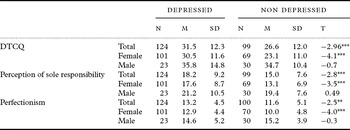
In order to assess convergent validity, the correlation coefficient was calculated between the DCTQ and general dysfunctional attitudes scale. The score on the DAS Scale has a moderate positive correlation with the total DTCQ score (r = 0. 58, p < 0.001). Criterion-related validity was assessed by comparing the DTCQ scores of caregivers with CES-D scores ≥ 16 with those of caregivers with CES-D scores < 16. As shown in Table 2, there were differences in the total score on the DTCQ and also in its two sub-factors. When these analyses were carried out with the female-only sample, those with depressive symptomatology obtained a significantly higher score than those caregivers without depressive symptoms both in the DTCQ as well as in its two sub-factors (in all the cases, p < 0.001). In the case of males, however, no significant statistical differences were found. The divergent validity of the DTCQ was analyzed by computing correlation between total scores on DTCQ and the Frequency of Behavioral Problems subscale from the Memory and Behavior Problems Checklist (MBPC) (Zarit and Zarit, Reference Zarit and Zarit1982). The correlation analysis yielded a value of −0.08.
Mean comparisons of DTCQ scores in caregivers with high versus low CES-D scores

*p < 0.05; **p < 0.01; ***p < 0.001
Additional data on construct validity
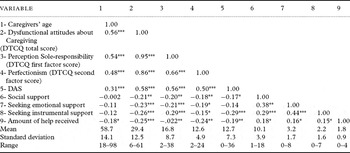
In accordance with the rationale that underlies the construction of this assessment measurement, it is assumed that dysfunctional thoughts act on social and behavioral dimensions which influence the effects of caregiving. Therefore, these thoughts will be associated with maladaptive behaviors related to caregiving such as delaying, limiting or making the request for help difficult. Given this, the DTCQ score is expected to correlate inversely with seeking instrumental and emotional social support, perceived social support and the amount of help received. The analyses revealed that DTCQ presents significant negative correlations with social support (r = −0.21 p < 0.01), search for emotional (r = −0.23, p<001) and instrumental social support (r = −0.26, p < 0.001), and the amount of help received (r = −0.25, p < 0.001) (see Table 3). Moreover, the DTCQ has proved to be sensitive to change after the application of a cognitive-behavioral program aimed at the modification of dysfunctional thoughts about caregiving (Márquez-González et al., Reference Márquez-González, Losada, Izal, Pérez-Rojo and Montorio2007). This finding is especially valid for women since men were under-represented in that study.
Bivariate correlations between variables in the global simple and mean scores, standard deviations and range of the assessed variables

*p < 0.05; **p < 0.01; ***p < 0.001
Effects of age, gender, relationship to patient and socio-educational level
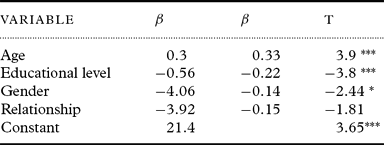
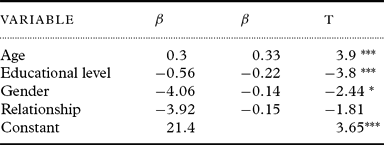
T-tests comparing female and male caregivers revealed higher scores for the male caregivers in the DTCQ total score (t = 4.0; p ≤ 0.001). Moreover, a t-test comparing spouse and adult child caregivers revealed higher scores for the spouse caregivers in the DTCQ total score (t = 9.0; p ≤ 0.001). To examine the differential association of age, gender, educational level and relationship to patient with dysfunctional thoughts a regression analyses with the DTCQ score as the dependent variable (enter method) was carried out. These results are presented in Table 4. Multicollinearity was also checked and it did not appear to be a problem according to the values of the variance inflation factors (VIFs) with a highest value of 2.47 for relationship to patient. The multiple R was 0.63 (p<0.01), and the adjusted R2 was 0.39. Age, gender and level of education made significant contributions to the prediction of the level of dysfunctional thoughts, while the relationship to patient approaches statistical significance (p<0.07).
Final regression equations: socio-demographic variable predicting dysfunctional thoughts
*p < 0.05; **p < 0.01; ***p < 0.001
Feasibility
Feasibility refers to the properties of the questionnaire that make it easy to administer in terms of language adaptation, comprehension of the item formulation, and length of time needed to complete the questionnaire (Ruiz et al., Reference Ruiz, Campillo, Monfort, Pardo, Rejas and Soto2005). The average time to administer the DTCQ is reasonably short, approximately 10 minutes. The caregivers easily identify with the item content and do not show any difficulty regarding its comprehension.
Discussion
The results of this work suggest that the Dysfunctional Thoughts about Caregiving Questionnaire has adequate psychometric qualities as a whole and constitutes a promising tool to assess specific dysfunctional thoughts about caregiving. Convergent validity is suitable; the measure was moderately correlated with a scale aimed at the assessment of general maladaptive beliefs (DAS; Andrews et al., Reference Andrews, Lewinsohn, Hops and Roberts1993). The fact that the correlation coefficient is moderate can be explained by noting that the DAS scale measures general dysfunctional attitudes, while the DTCQ assesses specific thoughts about caregiving. Moreover, the fact that the divergent validity is optimal bolsters convergent validity.
A two-factor structure was identified in the DTCQ: (i) “perception of sole responsibility,” which implies that the care recipient's needs become the priority of the caregiver who subordinates his/her own interests or wellbeing; and (ii) “perfectionism,” which represents high levels of emotional and behavioral self-requirement. The conceptual proximity and the high correlation among the factors suggest the existence of a common underlying factor, thus reflecting a general dysfunctional predisposition towards caregiving. The results of this study raise empirical evidence for the extension of the cognitive theory about emotional disorders to the area of caregiving (Losada et al., Reference Losada, Montorio, Knight, Márquez and Izal2006). The dysfunctional attitudes of the caregivers considered here can be defined as tacit beliefs and stable attitudes towards caregiving that may be unrealistic, and may lead to the establishment of inflexible and inappropriate caregiving standards.
The results of this study also show that the dysfunctional attitudes towards caregiving have a significant direct relationship to variables that have usually been considered as mediators in stress process models (Knight et al., Reference Knight, Robinson, Longmire, Chun, Nakao and Kim2002). The caregivers with the highest scores on the DTCQ spend more time looking after the care recipient, receive less social support, seek less social support for emotional and instrumental questions and receive a smaller amount of help, such as help from relatives or formal help, in caring for their relative. A relationship between the maintenance of this type of belief and suffering negative consequences has also been observed. The caregivers identified as having depression analogous to clinical depression have a significantly higher score in DTCQ, though this assertion is only valid with females. This differential between sexes and dysfunctional attitudes has precedents in non-caregiving research (Dykman and Johll, Reference Dykman and Johll1988).
Clinical implications
Several clinical implications follow from these results. First, these data suggest that dysfunctional thoughts about caregiving are not uncommon in caregivers. These findings should alert clinicians to the possibility that such thoughts could intervene in the well-being of caregivers, especially women, as an element of vulnerability towards emotional disorders. Secondly, these results suggest the need to intervene at the cognitive level of the caregivers, modifying these dysfunctional attitudes, possibly as a first step to promoting adaptive ways of coping with caregiving. Burgio et al. (Reference Burgio, Stevens, Guy, Roth and Haley2003) introduced a cognitive restructuring module aimed at favoring realistic and adaptive attitudes, in order to treat some of the beliefs which, in their experience, limit the therapeutic effectiveness of the interventions with caregivers. The DTCQ could be used to assess such attitudes and to analyze the impact of interventions on the amount or intensity of these types of thoughts. Thirdly, it must be noted, however, that intervening on a cognitive level with caregivers could result in conflict over traditional values of caregiving and so could inadvertently have negative consequences for the caregiver's wellbeing. In this sense, any intervention in beliefs about caregiving should guarantee the balance between the wishes and values of the individual, on one hand, and the demands of caregiving, on the other, in the framework of the societal context. The results of this study indicate that the significant relationship between depression and dysfunctional thoughts occurs mainly in women rather than men. This leads us to consider other factors that can affect the consequences of dysfunctional thoughts. These beliefs may be more or less harmful for the individual depending on other individual characteristics; the results indicate that it is not only gender, but also age and socio-educational level that are related to dysfunctional thoughts. Moreover, cultural values may influence the higher intensity of dysfunctional thoughts in older people in the sense that the expectations of older adults may be embodied in the thoughts described by the DTCQ; the cultural values of the older individual would be concordant with these kinds of thoughts. Fourthly, DTCQ is a brief, portable self-report instrument that can be used in conjunction with existing protocols in order to provide a more comprehensive assessment of the quality of care and develop interventions suited to the specific needs of carers. In this sense, DTCQ can be used in conjunction with other procedures and tests such as the Exemplary Caregiving Scale (Dooley et al., Reference Dooley, Shaffer, Lance and Williamson2007) and Positive Aspects of Caregiving Scale developed by the Resources for Enhancing Alzheimer's Caregiver Health cooperative group (REACH).
There are some limitations to this study that should be acknowledged. It used a convenience sample, a fact which might reflect the under-representation of men in the sample, since only one in four carers are male. This fact is of special significance because there is evidence that males are less negatively influenced than females in their caregiving roles (Vitaliano, Reference Vitaliano, Zhang and Scalan2003; Bédard et al., Reference Bédard, Kuzik, Chambers, Molloy, Dubois and Lever2005). A second limitation of the study is its cross-sectional character, which does not allow a study of the process of caregiving nor an analysis of when dysfunctional attitudes appear. Finally, there is a need to refine the wording of items 1, 2, 6 and 9 since some of these comprise a number of phrases which tend to muddle the statement. This work is a first approach to the study of the influence of specific dysfunctional attitudes about caregiving in the stress process. At present, the DTCQ seems to be a valid and reliable instrument for the assessment of specific dysfunctional attitudes towards caregiving. It would be of interest to replicate in different languages and cultures the analyses carried out in this study in order to contrast the psychometric properties of the DTCQ. It would also be of interest to explore further the clinical utility of DTCQ as well as the role of dysfunctional thoughts in the process of caregiving.
Conflict of interest
None.
Description of authors' roles
I. Montorio designed the study, analyzed the data and wrote the paper. A. Losada designed the study, collected the data and assisted with writing the paper. M. Izal designed the study, supervised the data collection and wrote the paper. M. Marquez collected the data and assisted with writing the paper.
Acknowledgments
The authors are grateful to Bob G. Knight of Andrus Gerontology Center and Gia S. Robinson-Shurgot for their valuable comments and help in the DTCQ back-translation. This study was partially funded by the Institute on Aging and Social Services (Instituto de Mayores y Servicios Sociales, IMSERSO) (Spain).