

Introduction:
Patient with mental illnesses such as schizophrenia and bipolar disorder have an increased prevalence of metabolic syndrome (MetS) and its components, risk factors for cardiovascular disease and type 2 diabetes (Ryan and Thakore, 2002; Newcomer, 2007) compared to general population in which incidence of MetS is also rising at an alarming rate (Reference NuggentNuggent, 2004). Although in the past years more attention has been devoted to the medical burden suffered by patients with schizophrenia, very recently similar concern have arisen for bipolar disorder patients. Previous studies on the prevalence of MetS in bipolar patients found 30% and 49% prevalence of MetS in US bipolar patients (Reference Fagiollini, Kupfer, Houck, Novick and FrankFagiolini et al., 2005; Reference Cardenas, Frye, Marusak, Levander, Chirichigno and LewisCardenas et al., 2008), 32% prevalence of MetS in Turkish bipolar patients (Reference Yumru, Savas, Kurt, Kaya, Selek and SavasYumru et al., 2007) and 22.4% in Spanish bipolar patients (Reference Garcia–Portilla, Saiz, Benabarre, Sierra, Perez and RodriguezGarcia-Portilla et al., 2008). The etiology associated with this increased risk of MetS in bipolar disorder is unknown. In addition to psychosocial factors such as poverty, poor diet, lack of physical activities, increasing concern has focused on the association between second generation antipsychotics, weight gain and subsequent risk of hyperlipidaemia and diabetes.
Among psychiatric disorders, bipolar disorder ranks highest in suicidality with a relative risk ratio of completed suicide of about 25 compared to the general population (Baldessarini and Tondo, 2003). During their lifetime 80% of patients with bipolar disorder exhibit suicidal behaviour and 51% attempt suicide (Reference Valtonen, Suominen, Mantere, Leppamaki, Arvilommi and IsometsaValtonen et al., 2005).
Suicidal behavior varied markedly between different phases of bipolar disorder and it is predominantly associated with depressive and mixed phases of the illness, rarely with pure manic phase. (Reference GoldbergGoldberg et al., 1999; Reference Oquendo, Waternaux, Parsons, Haas and MaloneOquendo et al., 2000; Reference Valtonen, Suominen, Mantere, Leppamaki, Arvilommi and IsometsaValtonen et al., 2007). Numerous studies showed lower cholesterol levels in patients hospitalized after suicide attempt as compared to non attempters hospitalized patients (Reference Sarchiapone, Camardese, Roy, Della Casa, Satta and GonzalesSarchiapone et al., 2001; Reference Guillem, Pelissolo, Notides and LepineGuillem et al., 2002; Reference Kim, Lee, Kim, Yoon, Choi and LeeKim et al., 2002). On the other hand, there are some other studies showing no relationship between low cholesterol levels and suicide attempt (Reference Roy, Gonzalez, Marcus and BermanRoy et al., 2001; Reference Tsai, Kuo, Chen and LeeTsai et al., 2002; Reference Deisenhammer, Kramer-Reinstadler, Liensberger, Kemmler, Hinterhuber and FleischhackerDeisenhammer et al., 2004; Fiedorowizc et al., 2007).
The current study was created to investigate if serum cholesterol level is decreased in male bipolar disorder patients with suicide attempts compared to non-attempters. Additionally, the aim ofthis study was to estimate if there were differences in the prevalence of metabolic syndrome between bipolar disorder male patients with and without lifetime suicide attempts.
Methods:
Sample Subjects were male patients (n= 40) with bipolar disorder treated at the Department of Psychiatry, University Hospital Centre Zagreb during the period of 36 months. Within patients, 20 patients were consecutively admitted men with bipolar disorder with history of suicide attempt, and 20 patients were consecutively admitted men with bipolar disorder without history of suicide attempt. Needed sample size was calculated respected the following parameters: alpha error level of 95% (P < 0.05), large effect size (Cohens d < 0.8), infinite population, t-tests for two independent samples with homogenous variances).
The diagnosis of bipolar disorder was made according to diagnostic criteria of the International Statistical Classification of Diseases and Related Health Problems, 10th Revision (ICD-10), (WHO, 1996). According to ICD-10 criteria in suicide attempter group 7 patients were in depressive, 5 in manic and 8 in mixed episode. In non attempter group 6 patients were in depressive, 12 in manic and 2 in mixed episode.
Intensity of depressive symptoms was assessed by Hamilton Depression Rating Scale, HDRS-17 (Hamilton, 1960), while manic symptoms were assessed by Young Mania Rating Scale, YMRS (Reference Young, Biggs, Ziegler and MeyerYoung et al., 1978). Brief Psychiatric Rating Scale (BPRS-18) was used to estimate a broad range of psychopathology (Overall and Gorham, 1962). Clinical Global Impression severity, CGI sev (Guy, 1976) was performed to asses the severity of illness, and Suicide Assessment Scale, SUAS for symptoms of suicidality (Reference Stanley, Traskman Bendz and StanleyStanley et al., 1986). Suicide attempt, by definition, included intent to die, self -harm did not count. The trained psychiatrist performed clinical evaluation.
All participants were free of all psychotropic medication for the previous 3 months. Two groups of patients were closely matched for age. All subjects gave written consent for participation in the study after detailed information about the procedures. This study was approved by Clinical Hospital Center Medical Ethics Committee.
Venous blood samples were collected within 24 h ofadmission. The exclusion criteria were: hypertension, diabetes mellitus, inherited disorders of lipoprotein metabolism, diagnosis of substance abuse, including alcoholism, eating disorder and organic brain syndrome.
Assessment
Venipuncture was performed for all subjects between 8 and 9 a.m. after 12 hours overnight fast. Immediately after collecting blood samples, serum concentration of total cholesterol, High density lipoprotein cholesterol (HDL-C), low density lipoprotein cholesterol (LDL-C), triglycerides and serum glucose were determined using enzyme methods and commercial kits (Olympus Diagnostic, GmbH, Hamburg, Germany) on Olympus AU 600 automated analyzer. Inter- assay laboratory coefficients of variation were 3.2% for cholesterol, 2.5 for triglycerides and 3.0% for HDL- cholesterol.
Reference intervals for the measured parameters were as follows: cholesterol < 5.0 mmol/L, LDL < 3.0 mmol/L, HDL > 1.0 mmol/L, triglycerides < 1.7 mmol/L and glucose > 6.1 mmol/L.
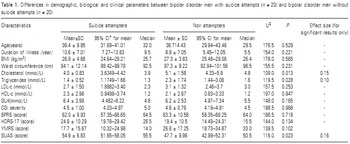
Differ ences in demo graphic, biological and clinical parameters between bip olar disorder men with suicide attempts ( n= 20) and bipolar disorde r men without suicide attempts (n= 20)

In addition to biochemical parameters, height, weight, waist circumference and blood pressure were measured. Height, weight and waist circumference of each patient were measured. Sitting blood pressure was measured in subjects after they were interviewed in the sitting position for about 5 min while discussing neutral topics.
MetS was defined according to NCEP ATP III criteria (Expert panel JAMA, 2001). The presence of 3 or more of the following criteria was required to meet criteria for MetS:
1). abdominal obesity: waist circumference > 102 cm in men and > 88 in woman
2). hypertrigliceridemia: ≥1.7 mmol/L
3). low HDL-cholesterol: < 1.04 mmol/L in men and < 1.29mmol/L in woman;
4). high blood pressure: ≥ 135/85 mm Hg;
5). high fasting glucose: ≥ 6.1 mmol/L
Data analysis
The results were expressed as mean values and standard deviations, 95% confidence intervals for means and medians. The differences in the socio-demographic variables between suicidal and non-suicidal groups were assessed using Chi square (χ2) test or Fisher's exact test for 2×2 tables. We used one-sample Kolmogorov-Smirnov test to test the normality of distributions of continuous variables. Depending on the result of the K-S test, we used parametric t-test for variables with distributions close to normal (K-S P > 0.05) and nonparametric Mann-Whitney U test for variables with non-normal distributions (K-S P > 0.05) to compare two groups of patients. Spearman correlation coefficient test was applied in searching relations between variables. In all tests, the criterion of significance was P > 0.05. Statistical processing of results was done by using commercial statistical package SPSS 11 (SPSS for Windows 11.0, SPSS, Chicago, IL, USA).
Results:
Results of the study are presented in Table 1.
There were no statistically significant differences for age (MW = 176.5; P = 0.529), BMI (M-W = 178.0; P = 0.565), waist (M-W = 155.5; P = 0.231) and duration of illness (MW = 154.0; P = 0.221) values between bipolar male patients with and without suicide attempt.
We did not find significant differences between suicide attempters and non-attempters regarding different socioeconomic measures (work status, education, marital status and number of children) as well as for nicotine consumption (P > 0.05). The BPRS scores did not differ significantly between bipolar suicide attempters and non attempters (M-W = 186.5; P = 0.718), as well as CGI severity scores (M-W = 198.5; P = 0.968).
HDRS scores were higher (M-W = 144.0; P = 0.134) and YMRS scores were lower (M-W = 139.5; P= 0.102) in suicide attemp-ters group than in non attempters group, but without statistical significance. SUAS scores were significantly higher (M-W = 116.0; P= 0.023) in attempters than in non attempters group. Average total cholesterol was statistical significantly lower (MW = 109.0, P = 0.013) among suicide attempters (4.0 ± 0.83) than among suicide non-attempters (5.1 ± 1.58). The same was true in the case of triglycerides. Suicide attempters had statistically significantly lower (M-W = 119.5, P = 0.028) triglycerides levels (1.4 ± 0.52) than non-attempters (2.3 ± 1.74). Analysis showed that there are no statistically significant differences between bipolar patients with history of lifetime suicide attempts and bipolar patients without history of suicide attempts in HDL – cholesterol, LDL – cholesterol, blood pressure parameters and blood glucose levels (P < 0.05).
The overall prevalence of MetS in our sample was 27.5%. Among attempters group only 3 patients met the criteria for MetS and in the group of non-attempters 8 patients met the criteria for MetS. Although without statistical significance, the prevalence of MetS is higher in the group of patients who never made a suicide attempt (P= 0.155).
Suicidality measured by SUAS was significantly positively correlated with HDRS score (Spearman R = 0.735, P < 0.001), and significantly negatively correlated with YMRS score (Spearman R = -0.681, P < 0.001).
Significant positive correlation was found for SUAS score and age (Spearman R = 0.358, P = 0.023), but no correlation was found for SUAS and duration of illness (P < 0.05).
We searched further for a possible correlation between SUAS score and anthropometric measures (BMI and waist) and did not find any significant correlation (P > 0.05).
Discussion: Principal findings
Results of the study showed differences between bipolar disorder male patients with and without suicide attempts both on biological and clinical level. Bipolar suicide attempters had statistically significantly lower levels of cholesterol and triglycerides compared to non attempters. LDL-C values were lower and HDL-C values were higher in attempters group, but without significance. These findings are in agreement with previous study results regarding low cholesterol and suicidal behavior in different psychiatric diagnostic categories (Reference Sarchiapone, Camardese, Roy, Della Casa, Satta and GonzalesSarchiapone et al., 2001; Reference Bocchetta, Chillotti, Carboni, Oi, Ponti and Del ZompoBocchetta et al., 2001; Reference Atmaca, Kuloglu, Tezcan, Ustundag, Gecici and FiridinAtmaca et al., 2002, 2007; Maranko et al., 2004, 2005, 2007a, 2007b, 2008). Several different mechanisms have been suggested to explain the potential effect of low cholesterol levels on suicidality. Low cholesterol and suicidality might be related to decreased 5-HT transmission (Hawton et al., 1993) and reduced lipid micro-viscosity in the brain cell membrane surface, resulting in decreased 5-HT receptor function (Engelberg, 1992), inhibited 5-HT transmission, which may lead to a poorer suppression of impulsive behavior or to a depressive state.
In accordance with previous studies investigating depressive symptoms and suicidality in mood and/or psychotic disorders (Strakovski et al., 1996; Maranko et al., 2008), our study also confirmed that suicidal patients had more pronounced depressive symptoms compared to non -suicidal patients, which was evident in higher HDRS scores in suicidal patients and positive correlation between SUAS and HDRS scores.
The overall prevalence of MetS was 27.5% which is similar to the results of the previous studies investigating MetS in bipolar patients (Reference Fagiollini, Kupfer, Houck, Novick and FrankFagiollini et al., 2005; Reference Yumru, Savas, Kurt, Kaya, Selek and SavasYumru et al., 2007; Reference Cardenas, Frye, Marusak, Levander, Chirichigno and LewisCardenas et al., 2008; Reference Garcia–Portilla, Saiz, Benabarre, Sierra, Perez and RodriguezGarcia-Portilla et al., 2008).
The relatively high prevalence of Met S (27.5%) is reason for concern because syndrome has very highly significant health implications, including a three to five fold increased risk of mortality due to coronary heart disease (Reference Alexander, Landsman, Teutsch and HaffnerAlexander and al., 2003; Reference Bonora, Targher, Fomentini, Calcaterra, Lombardi and MariniBonora et al., 2004) and sixfold risk of developing type 2 diabetes (Reference Laaksonen, Laaka, Niskanen, Kaplan, Salonen and LaakaLaaksonen et al., 2002). On the other hand, results of our study showed that the prevalence of MetS was higher(on this particular sample, that is without reaching statistical significance) in non attempters bipolar disorder group compared to attempters group. We hypothesized that the serum lipid levels were responsible for the differences in the prevalence of MetS, since there were no significant differences in other modal subcomponents of MetS between bipolar attempters and non-attempters group. Contrasting results were shown in previous study (Reference Fagiollini, Kupfer, Houck, Novick and FrankFagiollini et al., 2005) demonstrating positive correlation between the presence of MetS, and obesity in particular, and a history of suicide attempts. The possible explanation for these differences may lie in different age and gender structure of the patient's sample. The metabolic syndrome (or at least some of its components, especially obesity) can contribute to a worse prognosis of bipolar disorder through its negative impact on general physical well-being and functioning, quality of life, self esteem and psychological well-beeing (Reference Fagiollini, Kupfer, Houck, Novick and FrankFagiollini et al., 2003). However, some other components of MetS regarding hyperlipidemia may possibly have positive impact on the course and outcome of the disease since low lipid levels are associated with increased suicidality.
To our knowledge, results of this study are the first to show relationship between reduced cholesterol, metabolic syndrome and suicidality in bipolar disorder. Since suicidality is complex behavior and influenced by biological markers and different psychological factors, recognizing the patients with biological predisposition to lack of behavioral control could be of help in prevention and treatment activities in routine clinical practice. Unanswered question and future research Limitations of this study are small patient sample, patients in different phases of bipolar disorder and cross sectional design which reflects only a specific moment in time. Also, there was no information on patient's nutritive habits, lifestyle characteristics and daily physical activities, as well as genetic factors, which may all contribute to the alterations in serum cholesterol and the presence of MetS in bipolar suicidal male patients.
Conclusions:
Our results suggest that bipolar disorder male patients with suicide attempt in history have lower levels of serum cholesterol and triglyceride as compared to those patients without suicide attempt. The overall prevalence of MetS in our bipolar patient population was 27.5%. The presence of MetS was associated with lower frequency of suicide attempts in history of male patient with bipolar disorder. These results implicates that serum lipid levels may have important role in the neurobiology of suicide. Suicidality is a complex behavior influenced by many different biological and psychological parameters, so a better understanding of mutual relationship of these factors can facilitate more successful screening and treatment for suicidal patients.
Acknowledgements:
This work was supported by the Ministry of Science, Education and Sport of the Republic of Croatia, Grant No.0108106