

1. Introduction
A critical financial decision faced by most older Americans is when to claim Social Security retirement benefits, which affects the amount of monthly payment they receive for life. Optimal claiming ages can vary based on individual preferences, mortality risk, and health and economic circumstances. However, many Americans choose to claim Social Security too early relative to their optimal age (Brown et al., Reference Brown, Kapteyn and Mitchell2016; Bronshtein et al., Reference Bronshtein, Scott, Shoven and Slavov2016), which then results in a permanently reduced monthly payment and significant welfare losses that accumulate over time (Bronshtein et al., Reference Bronshtein, Scott, Shoven and Slavov2016).
For married individuals, the claiming age has wider implications for their household, as their earnings profile and level of personal benefits ultimately affect the level of benefits that their partners are entitled to. This effect operates either through spousal benefits based on the individual's earning record during their lifetime or potential survivor benefits after the individual's death. Spousal benefits allow a husband or wife to receive up to 50% of a spouse's Social Security retirement benefit, regardless of their own earnings record, while survivor benefits allow spouses over the age of 60 to receive the full monthly benefit of their deceased spouse. Shoven and Slavov (Reference Shoven and Slavov2012) found that the benefits from delayed claiming are greater for married couples relative to single individuals, and for two-earner couples relative to one-earner couples.
To make optimal claiming decisions for the combined household, individuals must be aware of and respond to the incentives for both their own and their spouse's and/or survivor's benefits. If they are not aware of spousal or survivor benefits, individuals may choose to claim earlier than is optimal for their household, which not only reduces expected lifetime benefits but also diminishes the ‘insurance’ for spouses provided by Social Security in the form of survivors' benefit (Sass et al., Reference Sass, Sun and Webb2007). This has important consequences for spouses, particularly for women who tend to earn less than men but also outlive them, and thus may be entitled to lower individual benefits and may be more likely to eventually depend on spousal/survivor benefits for income. Elderly widows are three times more likely to live in poverty than older married people, and 50% of this difference is explained by loss of spousal income (McGarry and Schoeni, Reference McGarry and Schoeni2005).
Delayed claiming of Social Security retirement benefits by men is shown to reduce the poverty risk of their spouse in widowhood (Diebold et al., Reference Diebold, Moulton and Scott2016). Yet, a series of studies show that the claiming behavior of married men tends to be responsive to the incentives built into their own benefits, but does not always take into account the spouse and survivor benefits: they choose claiming ages that do not maximize the household's and widow's expected present value of benefits (Munnell and Soto, Reference Munnell and Soto2005; Sass et al., Reference Sass, Sun and Webb2013; Henriques, Reference Henriques2018).
There are two explanations for the sub-optimal claiming decisions of married men. The first is based on self-interested preferences: individuals may not value their spouse or widow's benefits as much as they do payments for themselves. The second is based on knowledge and information: individuals may not be aware of or may not understand spouse and survivor benefits. Research has documented poor overall understanding of Social Security benefits in the general population (Yoong et al., Reference Yoong, Rabinovich and Saw2015; Carman and Hung, Reference Carman and Hung2018), which may also explain why the earlier literature has found that claiming behavior of men does not appear to take spousal benefits into account.
We evaluate these alternative hypotheses by conducting a survey experiment on the Internet-based Understanding America Study (UAS). We randomly assign respondents to one of four vignettes that present information about a character who is choosing when to claim his retirement benefits. The vignettes differ by whether the character is married or not, whether information about survivor benefits is presented, and whether the information includes an illustrative example. We then survey respondents about their knowledge and beliefs about optimal claiming decisions. We find that (1) respondents do value survivor benefits for their spouses and (2) information about survivor benefits tends to increase the suggested claiming ages only among the subgroup of respondents who are the least knowledgeable about these benefits.
Our results are compatible with the following interpretation: many Americans know enough about spousal and survivor benefits to understand that married beneficiaries may want to choose later claiming ages.Footnote 1 Therefore, the marginal value of additional information is relatively low. However, among the subset of respondents with the least overall knowledge, information about survivor benefits may indeed increase claiming ages.
2. The experiment
We conduct an online experiment on the UAS Internet panel administered by the Center for Economic and Social Research at the University of Southern California (for more information, see Alattar et al., Reference Alattar, Messel and Rogofsky2018 or visit http://uasdata.usc.edu). The panel consists of a nationally representative sample of more than 6,000 U.S. individuals who are asked to complete one to two surveys each month; data from these surveys for the same individual can be linked across different waves of data collection. Respondents in the UAS are recruited through address-based sampling. Adults willing to participate are provided with a tablet and broadband Internet if they do not have these prior to recruitment. The UAS is an ideal panel for carrying out our study because it gives us access to a representative panel of Americans and is unique in that we are also able to link the data we collect in this survey with a respondent's previously collected responses to questions on their knowledge of Social Security benefits and rules.
Questions about the value of benefits are difficult to pose directly, as asking survey respondents about the value of benefits to them would have the problem of ‘social-desirability bias (Fisher, Reference Fisher1993)’. That is, some respondents may overstate how much they care about the benefits for their surviving spouse when asked directly. Therefore, in our experiment, we provide respondents with a vignette where a male character needs to decide when to claim. We assign respondents to one of four treatments that differ by whether the character is married or not, whether information about survivor benefits is also presented, and whether the information includes an illustrative example.
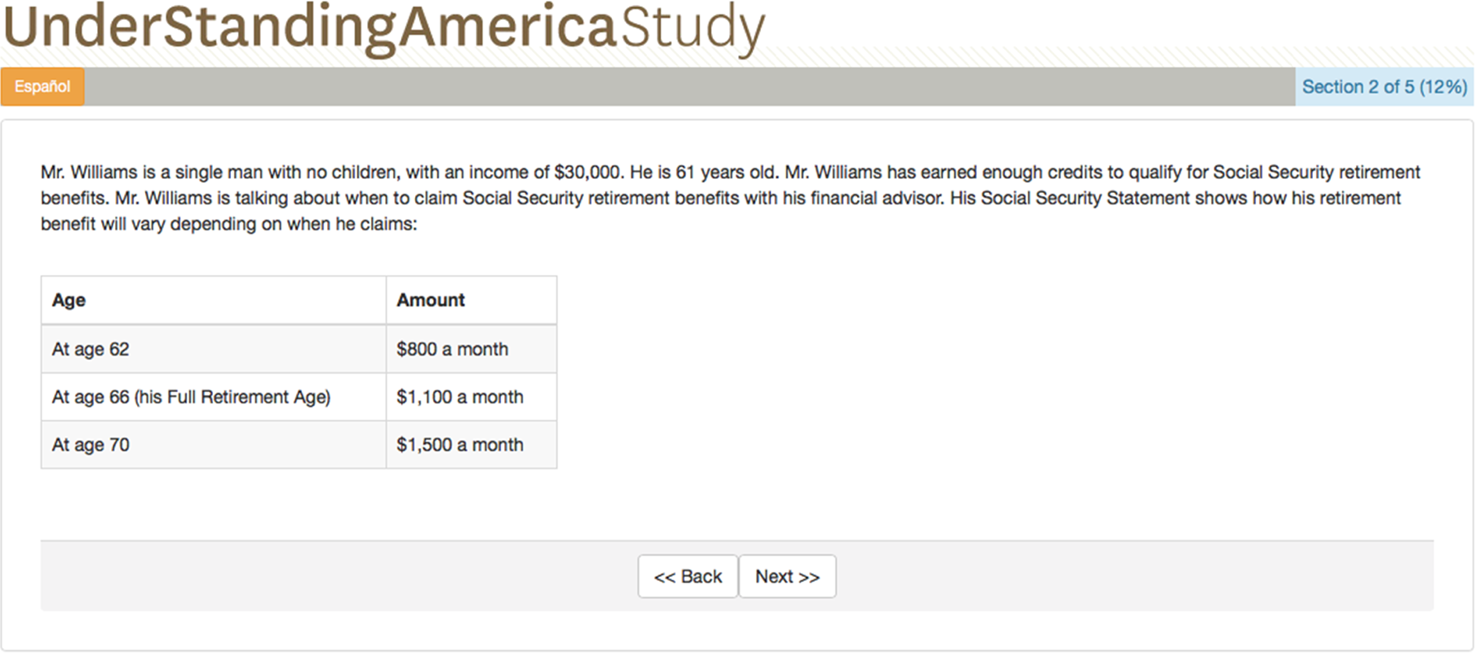
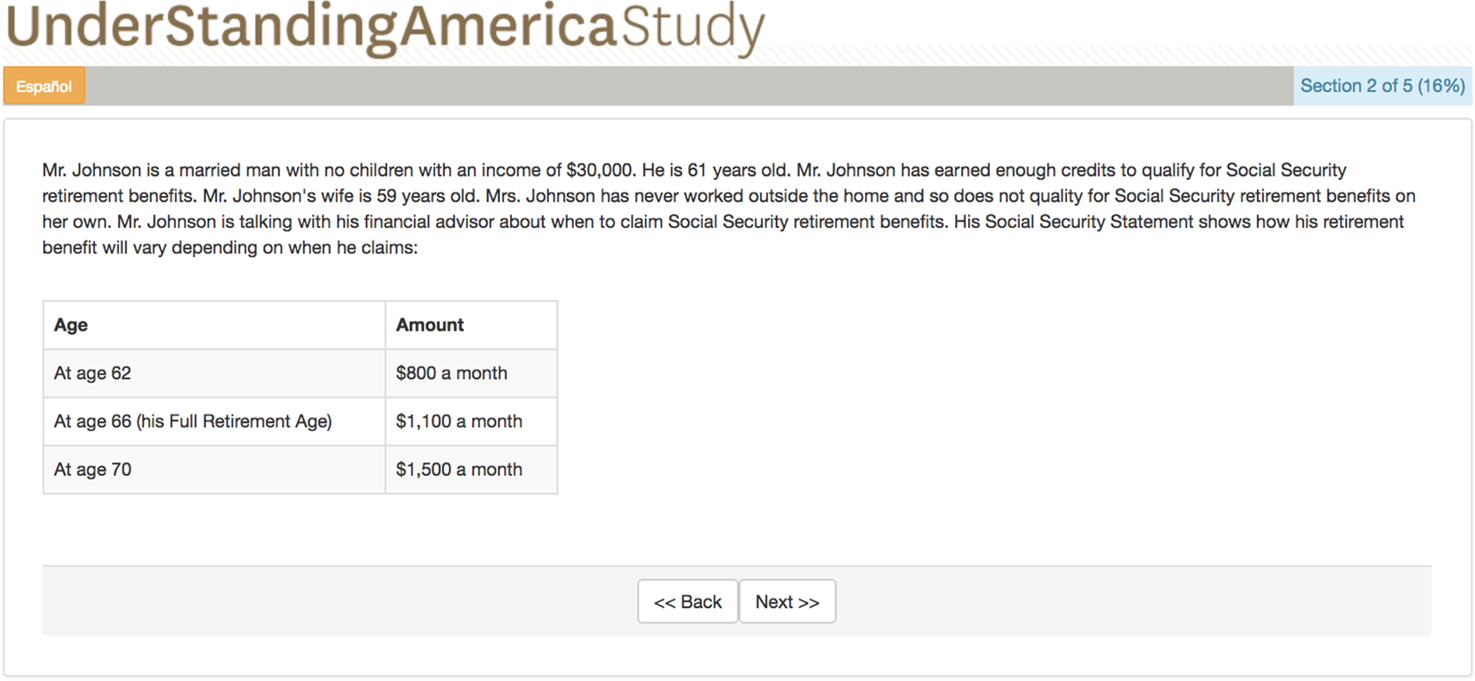
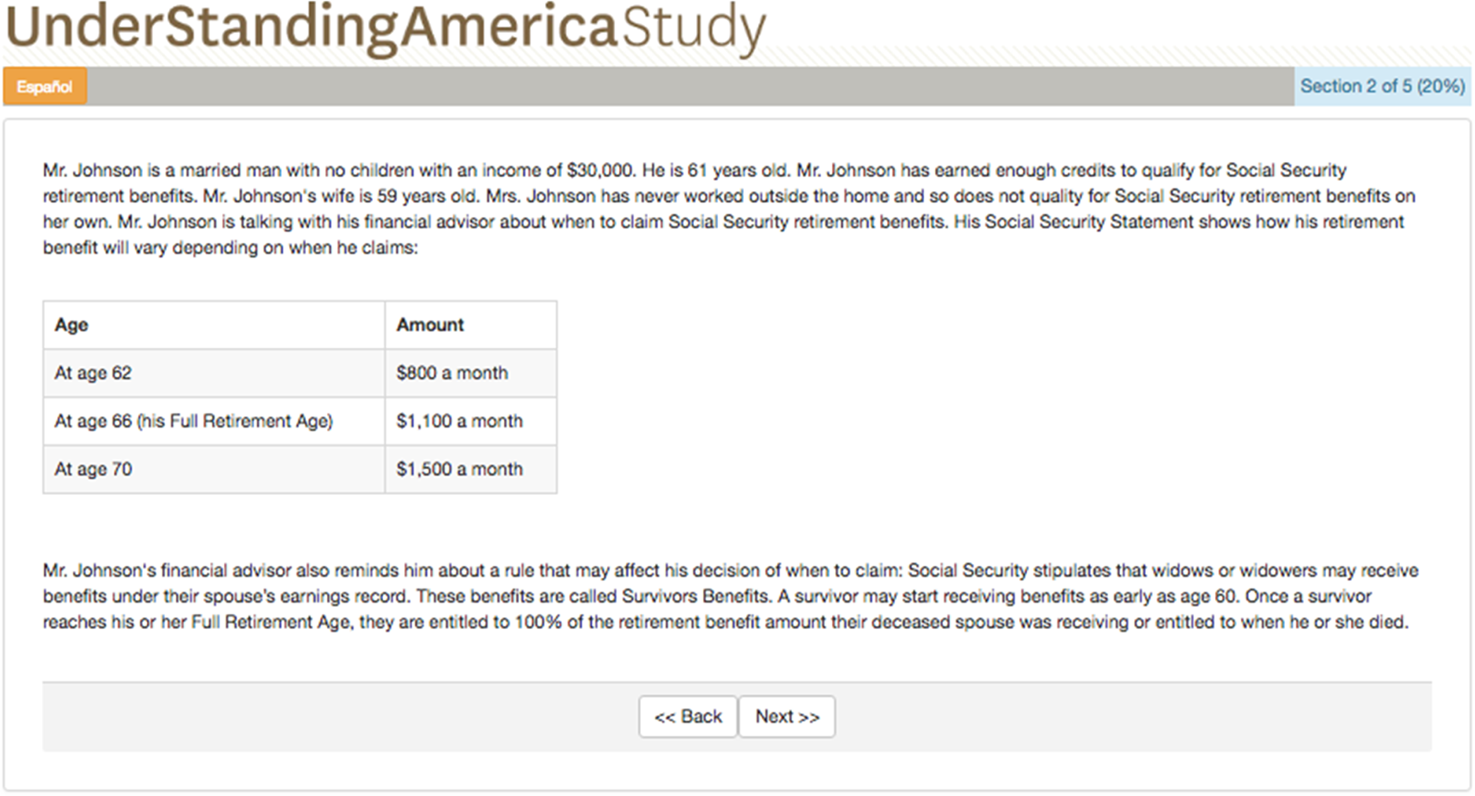
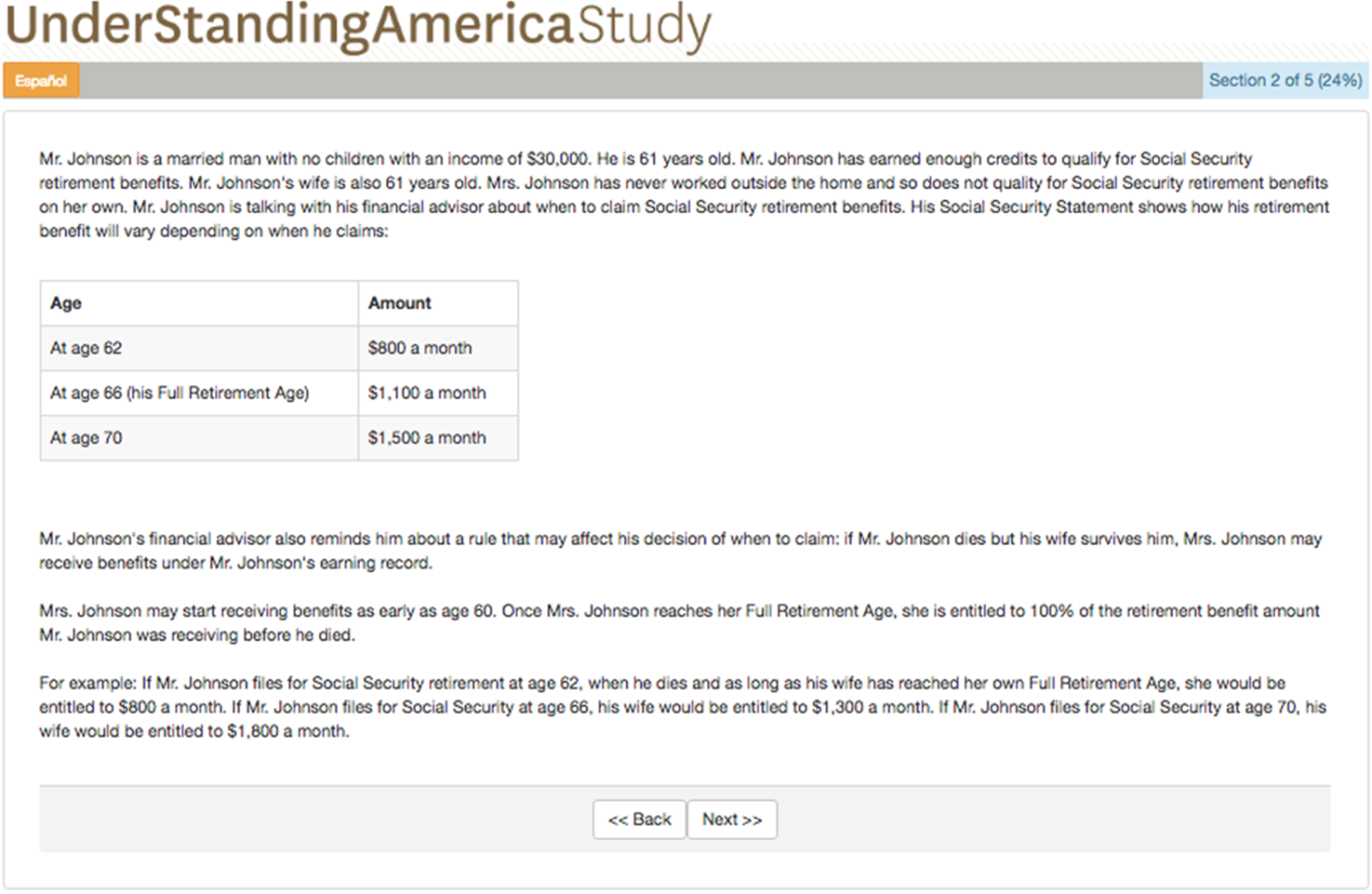
In the first treatment, respondents are told that the character is single (T1), while in the second treatment respondents are told that the character is married (T2). The vignette in T1 includes the following text: ‘Mr. Johnson is a single man with no children, with an income of $X. He is 61 years old. Mr. Johnson has earned enough credits to qualify for Social Security retirement benefits. Mr. Johnson is talking about when to claim Social Security retirement benefits with his financial advisor. His Social Security statement shows how his retirement benefits will vary depending on when he claims’, followed by a table showing the monthly benefit amount that he would be entitled to if claimed when he is 62, 66 or 70-years old, respectively. The vignette in T2 is similar but the character is said to be married: ‘Mr. Johnson is a married man with no children with an income of $X. He is 61 years of age […]’ (the rest of the vignette is identical to T1). In each vignette, we also randomly varied the name of the character (Mr. Johnson or Mr. Williams). Furthermore, the income amount shown in the vignette was selected from the following set [$30,000/$50,000/$75,000/$100,000], matched to be close to the respondent's typical income according to his responses to prior UAS surveys. The vignette screens are shown in Appendix A. A between-subject comparison of responses across these two treatments allows us to determine whether individuals value survivor benefits for spouses.
We add two treatment arms where the vignette character is married, in which we present information about Social Security survivor benefits (T3) or an additional short story (anecdote) about the character's family members' experience with survivor's benefit that highlights the increase in survivor's benefits for the character's wife that results from delayed claiming (T4). T3 includes text that reads ‘Mr. Johnson's financial advisor also reminds him about a rule that may affect his decision of when to claim: if Mr. Johnson dies but his wife survives him, Mrs. Johnson may receive benefits under Mr. Johnson's earning record. Mrs. Johnson may start receiving benefits as early as age 60. Once Mrs. Johnson reaches her Full Retirement Age, she is entitled to 100% of the retirement benefit amount Mr. Johnson was receiving before he died. T4 further adds the following text: “For example: If Mr. Johnson files for Social Security retirement at age 62, when he dies and as long as his wife has reached her own Full Retirement Age, she would be entitled to $W a month. If Mr. Johnson files for Social Security at age 66, his wife would be entitled to $Y a month. If Mr. Johnson files for Social Security at age 70, his wife would be entitled to Z a month”’ where the benefit amounts $X, $Y and $Z were chosen to be typical amounts expected for an individual with the income amounts shown in the first screen. The treatments are summarized in Table 1 and Appendix A provides the full text for each vignette.
Description of treatments

After being exposed to the vignettes, respondents are asked to give advice to the character about when to claim Social Security. They are then asked about the respondents' own expected claim age. We compare the responses across treatment arms to evaluate whether or not the suggested claiming age varies, both overall and split by the gender of the UAS respondent.
We hypothesize that if respondents have at least some prior knowledge or awareness of survivor benefits and value them, then responses to the question on the optimal claim age would be lower in the ‘single character’ vignette (T1) relative to the ‘married character’ one (T2). Alternatively, if they are either unaware of or do not value survivor benefits for spouses, then the responses in T1 and T2 will not differ. It is important to note, however, that responses could also differ across the two treatments for other reasons: for example, respondents could know that married individuals tend to live longer (e.g., Koball et al., Reference Koball, Moiduddin, Henderson, Goesling and Besculides2010) and hence would profit more from delaying claiming even if not taking into account the benefit of doing so for the surviving spouse. We discuss this further in Section 3.
Our second hypothesis is that if knowledge or information matters, individuals exposed to a vignette with information on the effect of claiming age on survivor benefits for spouses T3 (married + info) and T4 (married + info + anecdote) will prefer a later claiming age for the vignette character relative to T2 (married + no info).
3. Results
3.1 Recommended claiming age
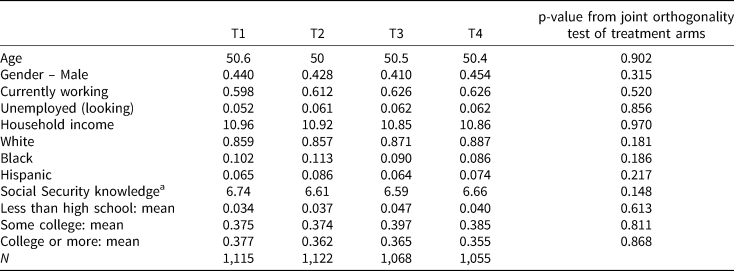
We obtained responses from 5,006 panel members from a sample size of 5,969 (83.87% response rate). We link our data with an earlier survey in the UAS that measured panelists' knowledge on Social Security (UAS16). By doing that, we end up with a sample size of 4,360. Table 2 shows demographic, labor force characteristics and baseline levels of Social Security knowledge (from the prior survey) by treatment status. The average age of the sample is 50 years old, about half are men; around 10% are Black and 9% are Hispanic; 60% were working and 6% were unemployed (not working and looking for work) at the time of the survey. There are no statistically significant differences across treatment statuses in any of the variables tested.
Orthogonality table

a Social Security knowledge score in a prior survey (UAS16).
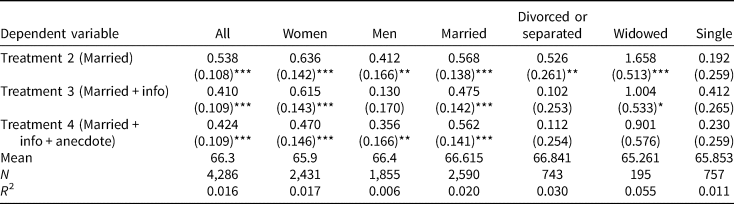
We estimate a regression where the dependent variable is the suggested claiming age for the character (in years) and the independent variables are the indicator variables for each of the treatment statuses (the excluded category is the indicator for T1, in which the character is single). Table 3 shows these results. When the character is single, respondents suggest a claim age of 66.3 years, and when the character is married, respondents suggest increasing the claim age by ~6 months. This can be seen from the coefficient of Treatment 2 (married), which equals 0.54, or about half a year. This is consistent with people having some prior knowledge about, and valuing, survivors benefit for spouses. We find an effect for both women and men. When we run the regressions separately by gender, the point estimate is somewhat higher for women (0.64 vs. 0.41). The last four columns present the results when breaking the sample by the marital status of participants (married, separated or divorced, widowed and never-married). The effect of T2 is positive and statistically significant for all but the single respondents.
Treatment effects on suggested claiming age for vignette

Note: Standard errors in parentheses, ***p < 0.01, **p < 0.05, *p < 0.1. Independent variable is age at which respondent recommends vignette character to claim Social Security retirement benefits. Control variables include age, gender (column 1 only), and average Social Security knowledge score in UAS16.
This result of a significant difference between T2 and T1 is consistent with (at least a fraction of) respondents knowing about and valuing the survivor benefits and hence recommending later claiming ages for married characters. It is important to note, however, that the same result could also arise from alternative explanations. In particular, it could be the case that some respondents knew that married individuals tend to live longer and hence would profit more from delaying claiming regardless of any spousal benefits. Likewise, it is possible that some people (erroneously) equate claiming with retiring. Hence, if they think that a married man has a responsibility to continue working longer to provide for his spouse, they may recommend claiming later irrespective of survivor benefits. Though we recognize these as possibilities, we show below that our preferred explanation is also consistent with the fact that the significant and positive coefficient for T2 only holds among the subsample of respondents who were knowledgeable about spousal and survivor benefits (a group we refer to as ‘high knowledge’ below).Footnote 2
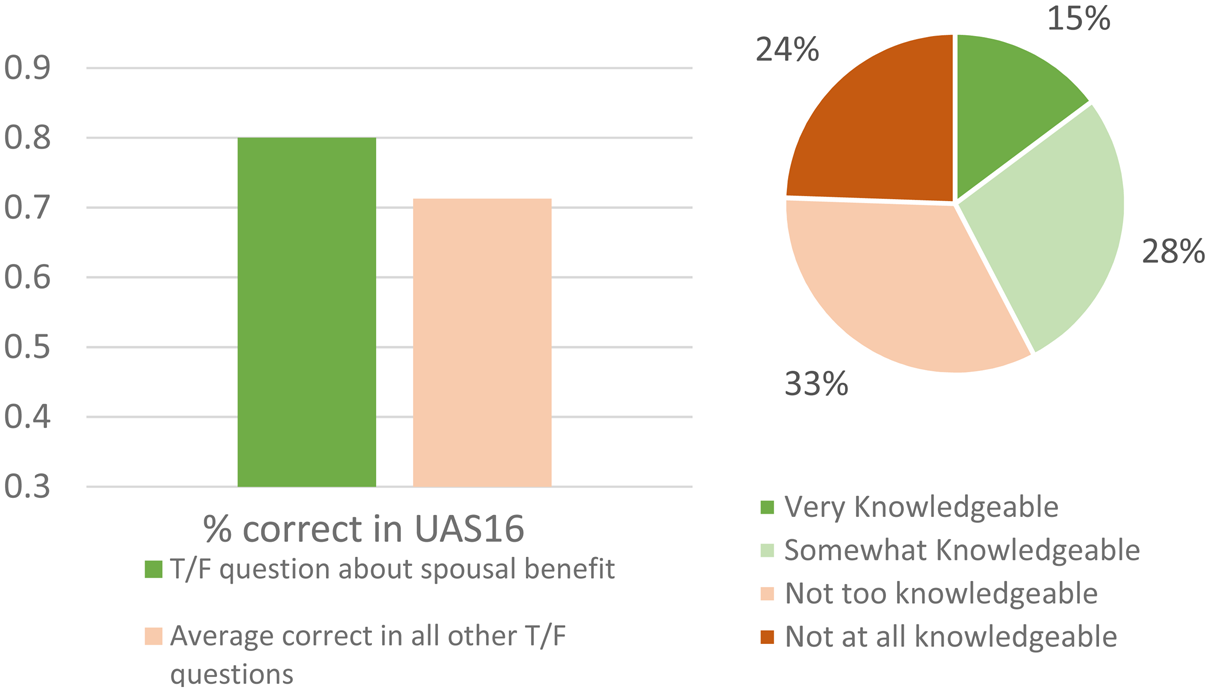
Our conclusion that respondents have some prior awareness of Social Security spousal and survivor benefits is supported by previous surveys on the UAS panel. In particular, analysis of survey data measuring respondents' knowledge of various aspects of Social Security benefits (UAS16) shows that a large percentage knows that claiming age affects spouses and survivor benefits. We find that despite low levels of Social Security literacy overall, awareness that later claiming ages affect survivor benefits is high (see Figure 1). This is consistent with the finding from Liebman and Luttmer (Reference Liebman and Luttmer2012) that while many aspects of retirement benefits are misunderstood, most Americans understand the rules regarding widow benefits.
Knowledge about spousal and survivor benefits.
Note: Left panel: The bar on the left shows the percentage of respondents correctly answering the question on spousal benefits. The bar on the right shows the average correct response on all other True or False questions about Social Security retirement benefits. Own calculations using UAS16 data. Right panel: Graph shows the percentage of respondents stating that they are ‘very’, ‘somewhat’, ‘not too’, or ‘not at all’ knowledgeable about how claiming decisions affect your spousal benefits. Own calculations using UAS16 data.

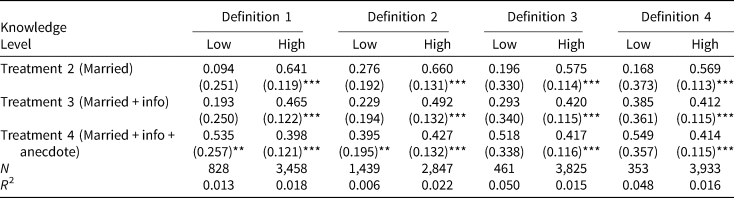
We break down the sample by baseline knowledge levels, and estimate the treatment effects for those in the ‘low’ or ‘high’ knowledge sub-samples separately. These results are presented in Table 4. For this, we use two pieces of information from the prior survey (UAS16). The first is whether the respondent correctly answered true or false test questions related to spousal and survivor benefits. The first question, Q10a, asks: ‘Someone who has never worked for pay may still be able to claim benefits if one's spouse qualifies for Social Security’ {T/F}, the second question, Q10i, asks: ‘If a worker who pays Social Security taxes dies, his/her spouse may claim Social Security survivor benefits only if they have children {T/F}’. Of course, there is substantial risk for misclassification given that someone who does not know the answer to one of these questions still has a 50% chance of getting it right. Thus, we also use the basic index of Social Security benefits knowledge variable, which also comes from the earlier survey and which captures overall knowledge of Social Security benefit rules. For robustness, we combine this information in four different ways.Footnote 3
Treatment effects on suggested claiming age by baseline knowledge

Note: Standard errors in parentheses, ***p < 0.01, **p < 0.05, *p < 0.1. Independent variable is age at which respondent recommends vignette character to claim Social Security retirement benefits. All models also include the following control variables: age, gender, and the baseline level of knowledge. Definition 1: someone has low Social Security knowledge if she answered q10a in UAS16 incorrectly. Columns 1 and 2 present the regression results when breaking the sample by low and high knowledge according to it. Definition 2: someone has low knowledge if their score is below the population median and they answered incorrectly the question used in definition 1. Columns 3 and 4 present results for low and high knowledge respondents according to this definition. Definition 3: someone has low knowledge if they classify under the previous definitions and answered incorrectly the question Q10i of survey UAS16 (‘If a worker who pays Social Security taxes dies, his/her spouse may claim Social Security survivor benefits only if they have children’, respectively). Definition 4: someone has ‘low knowledge’ if he classifies under definition 3, and has low or very low self-reported knowledge about spousal and survivor benefits (according to response to question Q4spb16) in UAS16.
Consistent with our conclusion, we see that the effect of T2 (married + no info) only arises among those classified as ‘high knowledge’. The effect of T2 is small and statistically insignificant among respondents in the low knowledge groups as can be seen in the odd-numbered columns of Table 2. That is, among those who do not know about spousal and survivor benefits there is no effect of making the character of the vignette married rather than single. This result lends support to the conclusion that most respondents already know about and value spousal and survivor benefits, vis-à-vis alternative explanations such as the aforementioned one where the difference arises from respondents considering the higher life expectancy of married men or from their preference for later retirement for them.
We now turn to the analysis of the impact of the information treatments. For the full sample, the coefficients for the treatments with information, T3 and T4, are not higher than for T2, the treatment without information (see the third and fourth rows of Table 3). The coefficients are 0.41 and 0.42 respectively, slightly smaller but statistically indistinguishable from the 0.54 coefficient of T2. This means that additional information does not lead to a higher suggested claiming age overall (and if anything, may reduce it).
However, as shown in Table 4, there is an effect of information among the ‘low knowledge’ group, at least when the information is coupled with anecdotal evidence. This can be seen from the coefficient for T4 (married + info + anecdote), which equals 0.535 (p-val < 0.05), which is more than five-fold the 0.094 coefficient for T2 (p-val > 0.1). The difference between the two coefficients is statistically significant at the 5% level. This suggests that, at least when paired with an anecdote, additional information does increase intended claiming ages for the subset of respondents who originally had low knowledge about spousal and survivor benefits. Using any of the four definitions of low and high knowledge, it remains true that, among those with low knowledge, the effect is larger among individuals provided with information and an anecdote versus not.
Overall, our results suggest that while additional information does not significantly affect choices of those with relatively high prior knowledge, it does appear to have an effect among those without poor prior knowledge (although the statistical power is low).
4. Intended claiming age
The vignettes may have affected some respondents' perspectives on when they themselves should claim Social Security retirement benefits. For an individual who is both married and did not know about spousal and survivor benefits, being exposed to our information benefits may change his perspective about when he himself should claim.
To test this hypothesis, our survey included a question about when the respondent intends to claim retirement benefits. We use this question to compare claiming intentions between those assigned to the information treatments (T3 and T4) with those not exposed to the additional information (T1 and T2).
A difficulty for this analysis is that this comparison is relevant only to respondents whose spouses are actually eligible for spousal and survivor benefits (i.e., married respondents who will likely be eligible to receive Social Security benefits and who are the prime earners). For respondents who are not likely to be affected, there is no reason why information should matter. This analysis is also relevant only for those without prior knowledge about spousal and survivor benefits. For individuals who knew about them before, there is no reason why additional information should have any effect. As a result of these restrictions, the sample on which we can make this analysis is greatly reduced. The results of this analysis, therefore, need to be seen as solely suggestive.
Table 5 shows the results of this analysis. The analysis includes only married men under age 65 who are currently working and were deemed not knowledgeable at baseline under one of our four definitions of knowledge.
Effects of spousal treatment on intended claiming age among not knowledgeable and likely affected group

Note: Dependent variable is age at which respondent expects to claim Social Security retirement benefits. Dependent variable is a dummy variable indicating whether the respondent was assigned to one of the treatments that included information (T3 or T4). Sample includes only married men below 65 year of age who are currently working and are deemed not-knowledgeable under one of four definitions. Definition 1: someone has low Social Security knowledge if she answered q10a in UAS16 incorrectly. Columns 1 and 2 present the regression results when breaking the sample by low and high knowledge according to it. Definition 2: someone has low knowledge if their score is below the population median and they answered incorrectly the question used in definition 1. Columns 3 and 4 present results for low and high knowledge respondents according to this definition. Definition 3: someone has low knowledge if they classify under the previous definitions and answered incorrectly the question Q10i of survey UAS16 (‘If a worker who pays Social Security taxes dies, his/her spouse may claim Social Security survivor benefits only if they have children’, respectively). Definition 4: someone has ‘low knowledge’ if he classifies under Definition 3, and has low or very low self-reported knowledge about spousal and survivor benefits (according to response to question Q4spb16) in UAS16. Standard errors in parentheses, ***p < 0.01, **p < 0.05, *p < 0.1.
The dependent variable in this case is intended claiming age for self. The explanatory variable is an indicator for being in one of the information treatment groups (T3 or T4). Table 5 presents the results that suggest the information treatments may have an impact on intended own claiming age. While the samples are small (N = 201 and N = 66, respectively), there are effects that are significant at 10% levels under two of the four definitions (columns 2 and 4).
5. Discussion
Given that the information treatments only had effects among those with low prior knowledge, it is important to understand who these people are. If it is the case that those individuals are those for whom the spousal and survivor benefits are not relevant, then their lack of knowledge is not a cause of concern.
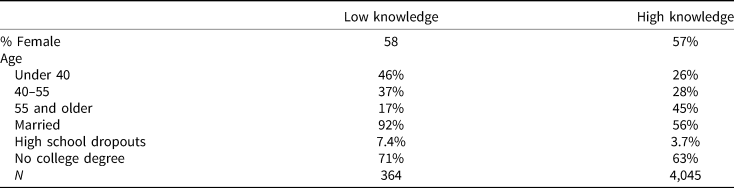
Table 6 compares the proportion of individuals with certain characteristics among the low knowledge group and how it compares to the high knowledge group (for this purpose we use the most restrictive definition of low knowledge). A larger fraction of the low knowledge group is under 40 years of age, and thus is still far from the moment when they need to make decisions about claiming. However, there is a non-negligible proportion of low knowledge respondents who are above 40 and even above 55. It is also notable that 92% of these respondents are married and hence it is quite likely that the survivor and spousal benefits will affect a number of them.
Characteristics of the low and high knowledge groups

Table shows the fraction within the group who falls within the relevant category. Knowledge groups based on the most restrictive definition (definition 4).
In summary, our results suggest that while a majority of Americans' claiming decisions would not be affected by information provision, there is a non-negligible group of individuals who lack any basic knowledge and for whom this information is relevant. A targeted information campaign for this group may affect their claiming behavior.
In the Introduction, we motivated our work by pointing out that the observed claiming behavior of married men does not take into account spousal and survivor benefits. However, in our research, we found that on average Americans did react to the fact that the character was married in T2 by suggesting a higher claiming age. One possible explanation for this is that hypothetical survey responses differ in meaningful ways from actual claiming decisions. That is, while participants in our study would advise the hypothetical character to choose a later claim age if he is married, the same participants would not necessarily change their own claiming behavior based on their marital status. Further, decisions about own claim age are influenced by a variety of factors, including advice that people receive at the Social Security office and the way information is presented in practice. For example, Brown et al. (Reference Brown, Kapteyn and Mitchell2016) suggest that framing claiming decisions in terms of ‘break-even’ analysis has a large impact on claim decisions.
6. Conclusion
In this series of experiments, we explore a general research question posed by prior literature: why do Social Security claimants fail to respond to the value of spouse and survivor benefits? In particular, we answer two questions: (1) in general, do people attach any value to spouse and survivor benefits and (2) does providing more information about the benefits affect claiming age?
We find that people do place some value on the survivor benefits for spouses that are a part of Social Security's overall retirement benefits. Recommended claiming ages respond in the appropriate direction to marital status, implying that value is attached to these benefits. We also find that providing more information about these benefits increases the recommended claiming age, but only for the minority of respondents who are less knowledgeable about these benefits. In particular, respondents in the low knowledge group do increase the age of their claiming recommendations to characters when given the information with examples. Our results are limited with respect to own intended claiming behavior in that we have a relatively small sample of married respondents in the knowledge interventions. However, we do also still find a suggestive effect of information on intended claim age for the less knowledgeable group.
Overall, these results suggest that perhaps many people already understand to a large extent that there are benefits for spouses and survivors. This is consistent with prior surveys in the UAS, which show that a majority of Americans know that their claiming age affects spousal and survivor benefits. From a policy perspective, specifically targeted information campaigns may be a more appropriate and cost-effective way to shift behaviors than relying on general education. These information campaigns should be targeted at those Americans who are least knowledgeable about Social Security.
Acknowledgements
Research reported in this publication was supported by the National Institute on Aging of the National Institutes of Health and by the Social Security Administration, under Award No. 3R01AG020717. The content is solely the responsibility of the authors and does not necessarily represent the official views of the National Institutes of Health or the Social Security Administration. We would like to thank David Rogofsky, Laith Alattar, Richard Chard, and Barbara Smith for their invaluable input. We also thank Arie Kapteyn, Tania Gutsche, and participants at the Workshop for the Special Issue of the JPEF on “New Longitudinal Data for Retirement Analysis and Policy” for their valuable comments. Programming the Internet survey was Bart Orriens; this research project would not have been possible without him.Footnote *
Appendix A
Treatment information screens
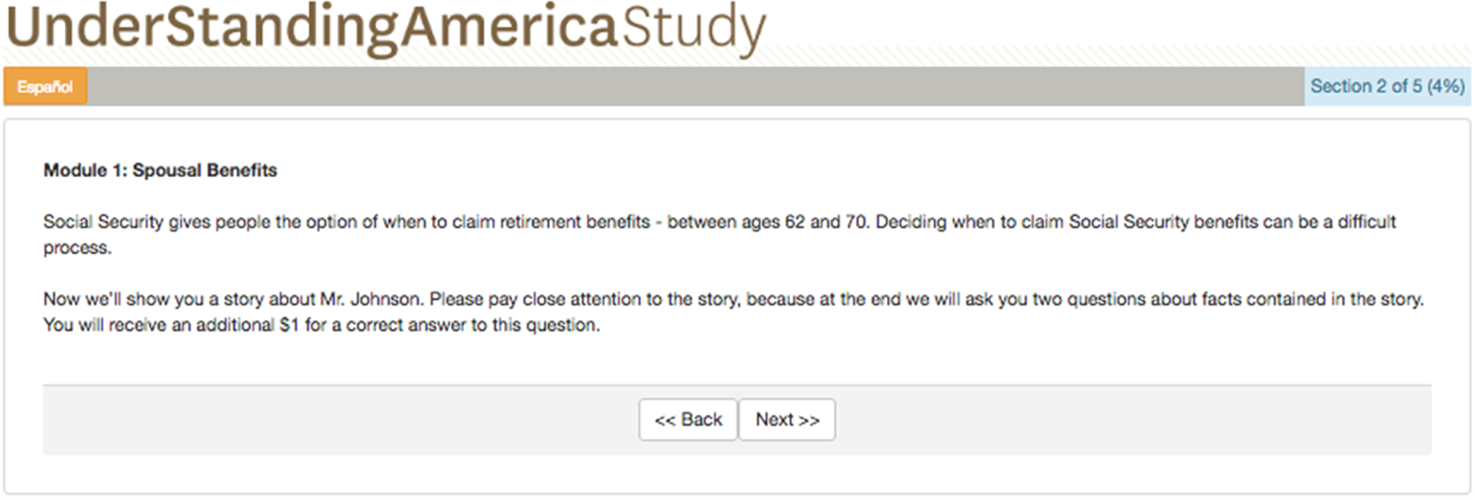
Figures A1–A5 show example treatment screens for different randomization groups. Figure A1 shows the introductory screen, while Figures A2 through A5 show the screens for information treatments 1 through 4.
Introduction screen.

Vignette screen (treatment 1).

Vignette screen (treatment 2).

Vignette screen (treatment 3).

Vignette screen (treatment 4).