Introduction
Mild cognitive impairment (MCI) is a state between normal cognition and dementia (Petersen et al., Reference Petersen, Smith, Waring, Ivnik, Tangalos and Kokmen1999). It is common, with a prevalence in general older populations of approximately 3% (Palmer et al., Reference Palmer, Backman, Winblad and Fratiglioni2008) and is being diagnosed with increasing frequency due, in part, to recent government strategies in the United Kingdom focusing on the “timely diagnosis” of dementia (Department of Health, 2009; 2012). The majority of interest in MCI has come as a result of the associated increased risk of dementia, with approximately 10–15% of patients in clinic-based research populations with MCI converting to dementia per year (Mitchell and Shiri-Feshki, Reference Mitchell and Shiri-Feshki2009). Recently, however, more attention has been paid to MCI as a condition in itself, focusing on the day-to-day experiences of people living with MCI and their “carers” (referred to in this paper as “advocates”; Frank et al., Reference Frank2006b; Lu et al., Reference Lu, Haase and Farran2007; Joosten-Weyn Banningh et al., Reference Joosten-Weyn Banningh, Vernooij-Dassen, Rikkert and Teunisse2008; Lu and Haase, Reference Lu and Haase2009; Blieszner and Roberto, Reference Blieszner and Roberto2010). However, despite the fact that increasing numbers of people with MCI (PWMCI) are coming to the attention of general practitioners (GPs) and memory services, relatively little is known about the current experiences and support needs of this group within the healthcare system.
The support needs of PWMCI are difficult to predict, in part because they are a heterogeneous group: while 10–15% per annum develop dementia, a significant proportion (in the region of 30%) will show some improvement over time and some will return to normal cognition (Wahlund et al., Reference Wahlund, Pihlstrand and Jonhagen2003; Gauthier et al., Reference Gauthier2006; Matthews et al., Reference Matthews, Stephan, McKeith, Bond and Brayne2008). In addition, it cannot be assumed that the support needs of PWMCI are the same as those of people with dementia (for whom memory services are primarily designed) since there are a number of important differences between the two conditions: First, as mentioned above, MCI is a heterogeneous condition which, unlike dementia, has an uncertain outcome – this uncertainty may result in an increased psychological burden in some PWMCI, and the heterogeneity of the condition means that support needs are likely to be much more variable than in dementia both between patients and over time. Second, while it is well recognized that impaired insight for deficits (anosognosia) is a common feature of dementia (Starkstein et al., Reference Starkstein1997), the degree to which insight is impaired in MCI is more controversial and may vary between subtypes and perhaps with the domain to which it pertains (e.g. cognitive or functional) (Roberts et al., Reference Roberts, Clare and Woods2009). This inconsistency may make it difficult to assess support needs and, potentially, to provide support where insight is impaired, particularly if there is no “informant” accompanying the patient. Indeed, the fact that the majority of the patients with dementia will have a family member or friend who has taken on a recognized “caring” role whereas many PWMCI will not have a family member or friend who has taken on this responsibility is another difference between the two groups, which is likely to influence their support needs. While it may be that the general support and information needs of PWMCI and dementia are broadly similar, it seems likely that the differences between the two groups described above will necessitate a different approach in the way in which these needs are addressed.
The experiences of family members and friends of PWMCI within healthcare services is also something about which little is known: in the context of dementia these are people who would be designated “carers,” their role would be formally recognized and appropriate support usually offered. In the context of MCI their role is often more ambiguous – not usually that of a formal “carer” but more than simply a concerned relative or friend accompanying the patient to their appointment as might be the case for a physical health condition, hence the use of the term “advocates” in this paper rather than “carers.”
In light of these uncertainties, the primary aim of this study was to explore the experiences of PWMCI and their advocates with particular reference to their contact with healthcare services.
Methods
A qualitative approach was used as there is relatively little background information on this topic, it was therefore deemed an appropriate method to explore participants’ experiences.
Sample recruitment and selection
People with MCI were recruited from research databases and memory clinics (and analogous services, e.g. home assessment by community mental health teams) affiliated with six mental health trusts in the south of England. The inclusion criteria were as follows: diagnosis of MCI (by whichever clinical criteria were used by the diagnosing clinician) by a secondary care memory service within the previous six months, being aged 50 years or older and being able to converse in English. All PWMCI included in the study, whether recruited from research databases or directly from memory clinics (or analogous services), had been referred by their GPs to a memory service for further assessment after concerns were raised about the patient's cognition by either the patient themselves, a relative, or by the GP. PWMCI recruited from research databases were sent a written invitation to take part in the study, those who returned a reply slip indicating that they were interested in participating were contacted by telephone to arrange an interview. PWMCI recruited from memory services were approached at their appointment with information about the study, those who indicated an interest in taking part were sent further information by post and subsequently contacted by telephone to arrange an interview. Relatives or friends who had been affected by the PWMCI's memory problems (henceforth referred to as “advocates”) were recruited via those PWMCI who agreed to take part in the study. Recruitment continued until data saturation was reached and no new themes emerged on the analysis of the data. Approval for the study was granted by a Research Ethics Committee and the Research and Development Departments of each hospital trust involved.
Data collection and analysis
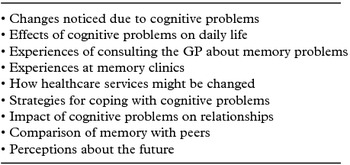
Semi-structured interviews were conducted with participants at their home (n = 34) or local hospital outpatient departments (n = 9) as per their wishes; all participants gave written, informed consent for involvement in the study. Interviews were carried out by either a geriatrician or a research nurse, both of whom had extensive experience of working with older patients with cognitive problems and of conducting interviews. Topic lists, derived from the literature review of the subject and consultation with experts in the field, were used to guide the interviews and ensure consistency between interviewers (see Table 1).
Interview topic guide

Where it was available, information about the PWMCI's Mini-Mental State Examination (MMSE) score (Folstein et al., Reference Folstein, Folstein and McHugh1975) at the time of diagnosis was collected from their clinical notes.
Interviews were audio-recorded and transcribed verbatim, the resulting transcripts were qualitatively content-analyzed using methods based on grounded theory. Coding was carried out primarily by the chief investigator of the research (Katherine Dean) and results were discussed at each stage with an expert panel consisting of a professor of geriatric medicine, a professor of health services research, and a consultant in geriatric psychiatry. At each stage the emerging codes were discussed and refined – particularly regarding whether codes represented more than one concept (and therefore should be split) or whether codes duplicated one another (and therefore should be combined). Discussions were continued until there was general consensus among the panel regarding the final coding scheme. After initial open coding was completed, the codes were refined and organized into a final framework (i.e. organizational structure for the codes) and coding was completed using this framework; the results are presented below.
Results
Twenty-three PWMCI and 20 advocates were included in the study (three PWMCI either did not have an advocate or the advocate declined taking part in the study). The PWMCI had a mean age of 77.8 years (range 63–86 years), 13 were males and 10 were females and all were of white British origin. MMSE scores (where available) ranged from 22–30 with a mean of 26.9; 70% of the PWMCI interviewed met the Petersen diagnostic criteria for MCI. The mean age of the advocates interviewed was 69 years (range 42–84 years), two were males and 18 were females and all were of white British origin. The majority (13) of the advocates were spouses of PWMCI, the remainder were offspring (two), other relatives (three), or a friend (two).
Patients’ experiences of health services
Most patients reported either positive or neutral experiences of consulting their GP about their memory problems. Those who reported positive experiences generally reported a good relationship with their GP and being pleased that they had been referred promptly to secondary care. A few participants reported negative experiences when they consulted their GP – complaints included feeling that their problem had not really been addressed, that they were not kept informed of what was going on, or, most commonly, that the GP was dismissive of their memory problem: for example, this 79-year-old female with MCI said the following:
Eventually I went to the GP and didn't get anywhere very much and one (GP) said, “Have you considered your age Mrs B. . .?” Well, and I was 73 when that was said to me. I said, “Absolute rubbish, we go to church with elderly people in their, in their mid and late nineties and they're as alert anything and they maybe wobbly on their legs but they're as alert anything.”
The reports of experiences at memory clinics (and analogous services) were more varied. Some participants had only positive views and these were usually manifested as a generally positive opinion of the memory service, particularly of how well it was run and how pleasant the staff had been. Quite a number of participants reported feeling relieved that the outcome of the assessments had not identified a more serious memory problem, for example, one 78-year-old male with MCI said: “I'm glad, I'm glad I went now, because I realize that I am like all. . . . We're all the same, and it's not dramatic.” Many participants, however, were left with negative impressions of the memory service they had attended. The most common complaints were focused on the assessment process, including cognitive testing and neuroimaging. Many participants reported finding this process unpleasant – either because it seemed too lengthy or difficult, or because they felt it did not seem appropriate to their symptoms. For example, one participant (interestingly, the same 78-year-old male quoted above) said of his experience of cognitive testing: “I felt daft, yeah. It made me. . . . Oh, I thought, don't want all this.” Another common cause for complaint was the perceived lack of feedback following the assessment: many participants reported feeling they had not been given a diagnosis or sufficient information about their condition or potential treatment options. One 63-year-old man with MCI said the following:
I'm going through a sort of ping-pong, because I've been sent here, sent to (Hospital A) for MRI scans – never seen the results of those, over, over a month ago – and I've got this other appointment in a clinic in (hospital B). So I, you know, in my head, no one's told me a single thing about this since I started, you know. And I go to the doctor, no idea. No idea where the results are going to.
Negative impressions of memory services were also caused by practical issues such as lengthy waiting times for follow-up appointments and difficulty with hospital parking. While many participants did have strong positive or negative feelings about their experiences within memory services, roughly an equal number felt ambivalent about them.
As mentioned above, the vast majority of the patients reported having received little or no information from health professionals about their diagnosis. However, aside from a small number of participants who were angry at the perceived lack of information offered, most were ambivalent about it and few had made efforts to look elsewhere for relevant information. Several participants stated that they had not looked for information from other sources (such as the Internet) as they did not wish to do so until they had received personal feedback about their diagnosis. These participants reported that they wished to be certain that any information they accessed was relevant to their specific situation, for example, the 63-year-old male quoted above also said this:
I don't want to put myself into a, what “I think” rather than what “I know.” I'm told that I've got. Because I don't wanna type into the computer and it gives me out all these anxiety lists of things “Oh, you've got this, you look that way.” I don't want any of that, you know. I just want, if you tell me that I've got X, Y, Z, then that's what I'm gonna focus on, but I don't have an open mind to what I haven't got. . . . To “think” is one thing, but to “know” is the best thing, and that's what I want.
Where participants did report receiving information about MCI roughly equal numbers reported having obtained it from healthcare professionals and the media.
The most commonly reported sources of support were participants’ spouses and friends. Participants most often described their spouses acting as a “back-up” to jog their memories when necessary. For example, one 71-year-old man with MCI said: “If I want to ask a question about recent work, I ask my wife, and she'll tell me what I want to know.” Support from formal health or social care services was rarely described.
Patients’ suggested improvements to services
Information provision
The most common suggestion for improving experiences of healthcare services was that more information should be provided on a variety of topics. Many patients reported that they would like to be given strategies to cope with their symptoms, e.g. “hints” and “tips” about how best to deal with their limitations. Many also wanted information about how to prevent further deterioration in memory, and quite a number of participants stated that they would be interested in information about what they could do to preserve their cognitive function, for example, one 63-year-old male said the following:
If that's what I've got then what is the help or, you know, how can I help myself or what is the way, the way forward with it, you know? Does it, you know, if it means sort of a, a digestion of drugs?
Some participants were particularly interested in receiving details of the results of the tests, which they had undergone at memory clinics, both cognitive tests and other investigations such as imaging. Many expressed an interest in receiving information about potential therapeutic options (both pharmacological and non-pharmacological) for their cognitive problems. Other topics that participants reported wanting information about included their likely prognosis and common causes of cognitive impairment.
Many participants did not have particularly strong preferences about how information should be provided, but there was a general consensus that face-to-face feedback of individual assessment results combined with the provision of general written information would be the most helpful option.
Changes to services
Many of the participants, when questioned, could not think of any specific changes they would like to see made to memory services – which was in keeping with the ambivalence many displayed about their experiences. The vast majority who reported not wanting any particular changes to services stated that they felt they simply did not need any additional information or support at the current time, either because they felt they had already received sufficient information or because they preferred not to know too much about their condition, for example, this 84-year-old man with MCI, who said: “A lot of stuff you don't really want to know and you don't need to wade through everything. So I tend to unburden.”
In accordance with this view, very few participants had searched for information on their condition independently, e.g. at public libraries or on the Internet.
Some participants reported that, although they felt that their experiences within memory clinics were imperfect, they were unable to suggest improvements as they felt that alternative assessment processes or the information or support they really wanted just did not exist at the current time, for example, one 85-year-old man said: “If there was any, any material that could have been given to me to improve the situation, then I would have liked to have heard about that. But I don't think there is.”
Where changes were suggested, these fell into two main categories: those relating to the process of assessment, and those relating to the interaction with memory service staff. Several participants reported that they would have liked to have been assessed using tests which appeared more appropriate for their cognitive complaints, for example, this 80-year-old male patient, when asked whether he felt that a different type of assessment would have changed matters, said: “Yeah, I think it might. . .But I mean the questions, as I explained to you, were so very simple that I didn't really think they were testing my memory at all.”
The participants who suggested possible improvements to interactions with staff reported varied concerns such as feeling they needed more time in clinic and wanting more reassurance and support, for example, this 81-year-old man said: “I think they might have left me more at ease with things, you know.”
Advocates’ experiences of health services
Many advocates had been involved to some degree in the PWMCI's assessment by their GPs and the majority of them reported that there were at least some negative aspects to the encounter. A common reason given for a negative experience was the GP not appearing to pay sufficient attention to the problems reported by the PWMCI or advocate. One (64-year-old) advocate said the following of her and her husband's experience of consulting his GP about his memory problems:
Well it was, he just sort of totally blanked me. And was talking to (my husband). And I sort of, although I don't like to, I interjected and say “Well I think you know, his specialist at the hospital said he should be checked.” “Well okay then, I'll get you an appointment.” It took that, which I'd rather, I think that with older people and the fact that they can do things now, that if somebody is going, the GP should be picking this up.
Another common concern was a perceived lack of confidentiality: several advocates reported feeling uncomfortable “reporting” on the PWMCI in their presence because they had been unable to discuss their concerns with the PWMCI's GP in confidence. One 69-year-old wife of a man with MCI said the following:
As a result of my concern, we both went to see the doctor together. And it's very difficult to talk about your husband in front of him, very difficult. Because he said, “I can only speak to you together.” So we went to see him together.
Where advocates reported positive experiences of the GP assessment, this was usually due to feeling that the GP took their (or the PWMCI's) concerns seriously or a perception that they acted quickly in making a referral to secondary care.
Most advocates had also been involved in the process of assessment at memory clinics, and again negative experiences at memory clinics were common. The most frequent cause for complaint was related to the assessments used by the clinic; in many cases advocates reported that the process of assessment was unpleasant for them and/or the PWMCI. Many felt that the assessments used were not appropriate for the PWMCI's mild degree of cognitive problems, for example, this 62-year-old described the assessments she took part in at her husband's clinic appointment as follows:
The questions I was being asked, you know “Did he get aggressive? Did he hit me? Did he do this, did he do that.” It was all proform. Yes, it might be applicable to some people but it was totally un-applicable (to me).
Another common cause for complaint was a perceived lack of information about the diagnosis and treatment or support options – including, in some cases, feeling that the PWMCI had not actually received a diagnosis following the (often quite extensive) assessments. In a similar vein, a number of advocates reported that they felt the communication from memory clinic had been poor. One 74-year-old advocate said of her experiences of the memory clinic, which her husband attended:
Yeah, the communication has been really poor, really. Which does make you feel, in my position, I don't know how he feels, but in my position, you feel a bit well they've told me that and they're just letting me get on with it, in a way.
Advocates also commonly described dissatisfaction with the setup of the memory service, for example feeling that the gap between appointments was too long, or disappointment at the PWMCI not being offered a follow-up appointment. One 42-year-old advocate said of her mother being discharged from the memory clinic: “What is quite difficult to take was that it was like ‘Yeah, there's a problem, it's not that bad. Off you go.’” Some advocates reported that they felt the service they were offered by the memory clinic was limited by financial constraints within the National Health Service (NHS). Several advocates described feeling they were in a situation where they were “falling between two stools”: neither being in the situation of caring for someone with dementia who lacks decision-making capacity and therefore feeling “entitled’ to take on that role, nor being a carer for someone with a physical disability who retains full cognitive capabilities and therefore does not require advocacy in decision-making. Rather, many advocates described feeling that they had a key role to play as an “intermediary” in the PWMCI's care without necessarily having any official recognition of this.
However, in addition to the reports of negative experiences at memory clinics, many advocates reported not feeling particularly strongly one way or the other about their involvement in the clinic assessment process, indicating that they found it straightforward and satisfactory, for example, this 74-year-old husband of a patient who said of the memory clinic appointment:
Well it was all right, but it was, I was gonna say it was nearly a multiple choice questionnaire, you know, that you filled in, you know, so it, the, the boxes, dum, dum, dum, dum, like this, and, that was it.
A not insignificant minority also reported positive experiences at the memory clinic: A number of advocates reported that they were impressed with the efficiency of the service – both in terms of the timeframe in which the patient received their assessment following their initial referral and in terms of the way the clinic appointment was structured and conducted. For example, this 75-year-old said of her husband's referral to memory clinic:
Well it's just that how quickly everything. . .I mean it was December (when we were referred) so we're now, we're just coming up to the end of our fifth month. So six months. Just things. . .I mean, normally you do have to wait a long time for different things. And it just seems that with C., things have moved a lot quicker than we would have expected, for which we're grateful.
And, this 79-year-old female said of her husband's clinic appointment: “I must say they were extremely efficient at hospital A. We got there about quarter of an hour early and we were seen on the dot. Which I thought was impressive. And very nice.” Another aspect of memory services which was commonly praised was the opportunity to have contact with specialist staff so that advocates could ask them questions; several reported finding this very useful, for example, this 70-year-old woman whose husband had MCI said of his memory clinic appointment, which she also attended:
It was, yes, it was very useful, because obviously they spoke to us separately, and at that stage, I wasn't sure whether if he said to me, “Oh where's the coffee?,” and it's always been in the same place, whether I should just say, “Ooh it's here,” and get it, or whether I should say, “Well where do you think we normally keep it?” I didn't know how much I was supposed to actually push him on that, so I found that actually very useful, as to how far I ought to make him think or whether I just would go along with it.
Several advocates also complimented the friendly and professional approach of the memory clinic staff they had encountered.
When asked about sources from which they had obtained information about MCI, many advocates said they simply had not received any. Many advocates reported feeling that there was a general lack of information provision, for example, this 69-year-old wife of a PWMCI said: “Information – there's been a dearth of it, none.” Some were more specific about the areas where they felt information had been lacking, for example, this 72-year-old whose husband had MCI reported that she did not feel they had been given a cause for her husband's symptoms, saying: “We were just told that they couldn't find anything, why his memory was bad or anything.” Another 64-year-old whose husband had MCI intimated that she would have liked more information about prognosis and treatment: “What I didn't get was any kind of idea of how this will progress, or what we can. . .is there something we can do?,” and this 79-year-old wife of a patient felt that she had not been given sufficient information about sources of support, saying: “You would have thought they would at least have given me a bit of paper or something and said, you know, if you feel you need it, you could have this or that.”
Where information had been obtained, the commonest reported source was from written material and the Internet; roughly equal numbers also reported receiving information directly from healthcare professionals (including what they had gleaned during the assessment process) and friends or family members.
The most common sources of support reported by advocates were friends and social groups (e.g. local church communities) and family members, including, in some cases, the PWMCI. One 74-year-old advocate, whose husband had cognitive problems, said:
Yeah, I've got two good friends, that when I'm feeling really, wanting a good rant, I can go and have a good rant to them. And they listen very ni’, you know. And that, it does make a great difference. ‘Cos sometimes you just got to let it out. And once I've let it out, then I can sort of calm back down and then I can carry on then.
However, quite a number of advocates (about the same number who reported receiving support from friends and family) said they did not receive any support, either because they had not sought it or because they felt they could not discuss the PWMCI's condition with others, for example, this 69-year-old wife of a PWMCI, when asked whether she received support from her friends said, “I don't. Because we haven't specifically discussed this, but I get the feeling that (my husband) wouldn't like that, because there is a certain amount of stigma attached to dementia. So no, I haven't.”
Advocates’ suggested improvements to services
The majority of the advocates felt that services could be improved. The most frequent suggestion was the provision of more information, particularly regarding likely prognosis, treatment options, and what they themselves could do for the PWMCI. When asked what additional information she would have liked to have received regarding her husband's cognitive problems, this 75-year-old said:
Well, what help can be given. And I mean, can I do more, can I sort of. . .somebody said (I) should make (him) tell me exactly what we did yesterday sort of thing. I mean, would that help? This is the sort of thing, if I know what I can do. . . .
About half of those who wanted extra information stated a preference for this being given face-to-face from a healthcare professional and half preferred a written format. Another common request was for the provision of more support for the PWMCI and/or themselves, or at least some information on the sources of such support. Areas that advocates mentioned being interested in were support groups for themselves or the PWMCI, psychological support, and practical services such as “home help.”
Several advocates suggested changes to the practical aspects of the assessment process, including the type of assessments used and whether the advocate and the PWMCI were interviewed together or separately. This 74-year-old advocate, who was asked to give a collateral history during her husband's memory assessment in his presence, was asked whether she would have preferred to talk to the doctor in confidence and said:
I think, actually it would have been quite helpful. Because I wouldn't, there were some things. . .I mean, I'm saying things to you that I wouldn't say if he was here. Because I think it would be quite sort of hurtful to say them. So I think it could have been. He did give me, I did go outside and have a sort of a questionnaire to fill in. But that wasn't all that big, and it was a very broad spectrum really. Not exactly what. . .no, it would have been easier I think if I could have put my four penn'orth in as it were, you know.
On the other hand, some of the advocates whose assessments took place separately from the PWMCI reported that they would have preferred to have remained with the PWMCI during the process, for example, this 69-year-old advocate who saw the doctor separately from her husband said: “I realised that they wouldn't know whether he was giving the right answers, so if I could have been there to just indicate whether what he was saying was correct. . . .”
In keeping with the reports of poor communication from the memory clinic, several advocates suggested that their experiences could have been greatly improved by better communication from the clinic – both in terms of sensitive discussions about diagnosis and regarding practical matters such as the timing of follow-up appointments, for example, this 79-year-old said of her husband's visit to the memory clinic: “I just think that they could realise we're human beings, and it would be nice to know what's going on.”
Some advocates felt that there was not much scope to improve services. This group generally fell into two categories: those who felt that they did not need any extra information or support at the current time, and those who, despite reporting unsatisfactory experiences, could not see how changes to services would improve matters. In the latter group many advocates reported feeling that the information they really wanted, such as how the PWMCI's cognition would change over time, just was not possible to provide, for example, this 74-year-old, when asked about additional information he would have liked to have been given at his wife's memory clinic appointment, said:
Well, I think they sort of gave all the information that. . . . Of course, one would like them to know all the answers, but that's not possible even in the ideal world. You know, if they knew all the answers, one would love to have them. But, you know, they aren't sort of absolutely superhuman, these doctors.
Discussion of experiences of health services and suggested improvements
This paper is the first to explore the experiences of PWMCI and their advocates with a particular emphasis on their contact with healthcare services and has identified several phenomena not previously described in the literature.
The MCI group tended to report that the experience of consulting the GP about their cognitive problems was either positive or neutral, whereas advocates tended to have more negative impressions of the consultation – citing as issues of particular concern a dismissive attitude on the part of the GP or disappointment at not being able to discuss the PWMCI with the GP without them being present. In a meta-analysis of studies of GPs’ ability to diagnose MCI, only about 45% of cases were recognized (Mitchell et al., Reference Mitchell, Meader and Pentzek2011) – this problem with recognition of MCI in primary care may explain the dismissive attitude encountered by some advocates. The discrepancy between PWMCI and advocate experiences within primary care has not been formally described in previous studies.
Both the PWMCI and the advocates reported varying opinions of their experiences at memory clinic. Overall, more PWMCI than advocates reported positive experiences – often related to practical aspects of the memory clinic or to feeling relieved that they had not received a diagnosis of dementia. However, a significant proportion of both groups reported negative experiences, most commonly related to practical aspects of the assessment process or memory service, or a perceived lack of information. These mixed reports are in keeping with the findings of a Dutch study of patients and carers attending memory clinic (van Hout et al., Reference van Hout, Vernooij-Dassen, Hoefnagels and Grol2001) and are likely to be due, at least in part, to the heterogeneous nature of MCI as a condition and to variations in practice between the memory services attended by the interviewees in this study. No previous studies have specifically focused on the discrepancy between patient and caregiver experiences at memory clinics; it may be that differing expectations on the part of patients and caregivers attending memory clinics go some way to explaining the discrepancies in the degree of satisfaction with the memory clinic they describe. Indeed, a study of memory clinic users in Ireland found that, while patients described general expectations of being provided with “help,” carers had more specific expectations, such as identification of the cause of patient's memory problems and provision of treatment (Cahill et al., Reference Cahill, Gibb, Bruce, Headon and Drury2008). In a similar vein, a German study of participation preferences of people with amnestic MCI found significant discrepancies between the degree of involvement in decision-making that patients stated they would like compared with the degree of involvement that caregivers wanted them to have (Hamann et al., Reference Hamann2011). This finding may reflect different expectations on the part of patients and caregivers regarding the process of assessment at memory clinic.
Many PWMCI and advocates reported receiving little information about MCI from healthcare services. Given the fact that many of the participants interviewed had difficulty recalling the details of the assessment process, it is difficult to know whether participants were genuinely given little information about their diagnosis or were simply unable to recall being given it. Indeed, many of the clinic letters for the patients interviewed recorded the fact that the diagnosis had been given in clinic and that, in many cases, a discussion about the details and implications of the diagnosis had occurred. The apparent lack of recall (by both patients and advocates) of these discussions highlights the importance of providing written information to this group, something which does not always happen in practice – for example, a survey by the American Academy of Neurologists found that only 27% clinicians gave written information to people newly diagnosed with MCI (Roberts et al., Reference Roberts, Karlawish, Uhlmann, Petersen and Green2010). Support for both PWMCI and advocates interviewed was mainly provided by friends and family members, few had received formal support (e.g. from social services). Advocates who reported receiving no support were often distressed by this, in keeping with the results of other studies where advocates have reported increased support needs (Blieszner and Roberto, Reference Blieszner and Roberto2010; Ryan et al., Reference Ryan2010) and feeling dissatisfied with the help and support offered to them by memory services (van Hout et al., Reference van Hout, Vernooij-Dassen, Hoefnagels and Grol2001).
The most common suggestion for improving services, from both PWMCI and advocates, was the provision of more information. Information provision has been mentioned by several authors of observational studies in this area when making suggestions for improvements to services for PWMCI and their carers (Adams, Reference Adams2006; Blieszner et al., Reference Blieszner, Roberto, Wilcox, Barham and Winston2007; Joosten-Weyn Banningh et al., Reference Joosten-Weyn Banningh, Vernooij-Dassen, Rikkert and Teunisse2008; Austrom and Lu, Reference Austrom and Lu2009; Kuo and Shyu, Reference Kuo and Shyu2010; Lu and Haase, Reference Lu and Haase2011). It is beyond the scope of this paper to make detailed suggestions regarding the type and format of information that should be provided. However, when considering information provision for this group, it should be borne in mind that both PWMCI and advocates interviewed expressed a preference for the opportunity to receive information face-to-face from a healthcare professional combined with the provision of additional written information. Based on the results of this study, suggested topics to cover in information aimed at PWMCI would include causes of cognitive impairment, prognosis, treatment options, results of the investigations the patient had undergone, and strategies to cope with symptoms and prevent further deterioration. Potential topics to include in information for advocates would be prognosis of MCI, treatment options, what the advocate can do to assist the PWMCI, sources of support (both psychological and practical), and possibly how to cope with the rather ambiguous role of being an advocate for someone with MCI (this is discussed in more detail below).
A number of advocates were interested in the possibility of psychological support, either for themselves and/or the PWMCI, but few of the other suggestions made in the existing literature, such as cognitive rehabilitation and physical training, were spontaneously mentioned by the PWMCI or advocates in our study.
Whereas some advocates did not feel that changes to services were needed (or, in some cases, possible), most did have suggestions for improvements. In contrast, many in the MCI group did not have any suggestions for improving services – often stating that they did not feel improvements were required.
Although the themes identified in the interviews with the PWMCI and their advocates were broadly similar, as mentioned above there were several areas where disparity was evident – between the accounts of individual PWMCI/advocate dyads, in the overall analysis of responses from the MCI and advocate groups and sometimes even within the accounts of PWMCI themselves. Possible explanations for this include difficulties with recall on the part of the PWMCI (or possibly the advocates) and impaired insight on the part of the PWMCI regarding the limitations caused by the condition, a phenomenon that has been noted by several authors previously (Vogel et al., Reference Vogel, Stokholm, Gade, Andersen, Hejl and Waldemar2004; Frank et al., Reference Frank2006a). Due to the “mild” nature of their cognitive impairment, PWMCI may well be assumed by both clinical staff and advocates to be able to participate as fully in discussions about their condition and decisions about its management as cognitively intact patients. However, the apparent lack of recall and/or insight regarding their condition and medical care, which was demonstrated by many of the PWMCI in this study, suggests that this may not always be the case. Where most patients with dementia will attend medical appointments with a carer – who will be actively involved in assessments and management discussions – this may not always occur for PWMCI. Careful assessment, whilst respecting their autonomy, of whether a patient with MCI retains sufficient insight and recall regarding their condition to participate fully and independently in managing their own healthcare should be an integral part of management for these patients. This represents another area where management differs from that of patients with dementia (where a carer would usually be involved as a matter of course).
Another likely explanation regarding the discrepancies between the accounts of the PWMCI and the advocates is that many of the advocates interviewed were beginning to take on caring roles and experiencing the psychological and practical burdens associated with this, further widening the gap between themselves and the PWMCI – especially where a lack of insight resulted in the PWMCI displaying minimal concern about their condition. The finding that, in many cases, PWMCI and their advocates have different needs, and particularly that the needs of the advocate may be just as great as those of the patient (if not greater) is important. At present it is often assumed that, due to the “mild” nature of the condition, little support is required for advocates of those with MCI and hence memory services tend not to be set up to provide them with the same level of information and support (such as “signposting”) as, for example, carers of people with dementia. Our findings, together with evidence from quantitative studies which shows that advocates of PWMCI do experience significant burden due to their caring role (Garand et al., Reference Garand, Dew, Eazor, DeKosky and Reynolds2005; Bruce et al., Reference Bruce, McQuiggan, Williams, Westervelt and Tremont2008) would suggest that memory services should make provision to address the needs of advocates as well as patients with this condition.
As mentioned in the Introduction, the role of advocates in MCI is somewhat ambiguous. This is reflected in the phenomenon described by several advocates in this study of feeling that they were “falling between two stools,” i.e. that they were neither a formally recognized carer with a responsibility to take decisions about matters for which the patient no longer retained decision-making capacity (as might be the case if the patient had dementia) nor simply a supportive friend or relative (as would be the case if the patient was fully cognitively intact). This uncertainty was described by advocates in relation to their role in a number of areas, including interaction with healthcare services, how much prompting or assistance to provide to the PWMCI, and their freedom to discuss the PWMCI's condition with other family members or friends. It may be that provision of information and guidance to advocates about the complexities of their role and how best to cope with them would also be helpful – covering, for example, topics such as how to balance efforts to maintain the independence and autonomy of the PWMCI against ensuring that they receive appropriate management and support for their condition. Provision of this type of information has the potential to relieve some of the sources of uncertainty and stress described by advocates, particularly around their interactions with healthcare services and personal relationships with the PWMCI, and may be a helpful adjunct to the simple “facts” about MCI (e.g. causes, prognosis, and treatment) which tend to be included in standard information leaflets about the condition.
Particular strengths of this study were the fact that the sample size was sufficient for data saturation to be reached, that participants’ experiences of healthcare were explored, and that linked PWMCI and advocates were interviewed allowing comparison of their reports. As this was a cross-sectional study of recently diagnosed participants, it was not possible to comment on how experiences and needs of PWMCI within healthcare services might change over time. As discussed above, it may be that recall and/or insight regarding the topics discussed were impaired in the participants with MCI and the results of the interviews should be interpreted with this in mind.
In summary, both PWMCI and their advocates described a perceived lack of provision of information and formal support by healthcare services. Although recommendations for the optimal provision of information and support for these groups are beyond the scope of this paper, these findings should be taken into account when designing services for this group – for example, provision of appropriate information about MCI (preferably in both oral and written formats) is clearly of great importance for both PWMCI and advocates. In addition, the marked discrepancies between the experiences of PWMCI and their linked advocates in some areas should be acknowledged as it is likely that certain elements of any support provided would need to be separate and specifically tailored to suit the PWMCI or advocate.
Conflicts of interest
The study was funded by Bupa Giving.
Description of authors’ Roles
K Dean assisted in designing the study and analyzing the data, she carried out the study and wrote the paper. C Jenkinson assisted in designing the study, analysing the data, and writing the paper. G Wilcock assisted in designing the study and writing the paper. Z Walker assisted in designing and carrying out the study and in writing the paper.
Acknowledgments
The authors would like to thank all the research staff who helped with the recruitment to this study, including those within Berkshire Healthcare NHS Foundation Trust, North Essex Partnership NHS Foundation Trust, Northampton Healthcare NHS Foundation Trust, Oxford Health NHS Foundation Trust, and Oxford University Hospitals NHS Trust.