INTRODUCTION
The coast of Santa Catarina, which is characterized by rocky reefs, is known to be the southernmost limit of most tropical reef fish species in the south-western Atlantic (Hostim-Silva et al., Reference Hostim-Silva, Andrade, Machado, Gerhardinger, Daros, Barreiros and Godoy2006; Floeter et al., Reference Floeter, Guimarães, Rocha, Ferreira, Rangel and Gasparini2001, Reference Floeter, Rocha, Robertson, Joyeux, Smith-Vaniz, Wirtz, Edwards, Barreiros, Ferreira, Gasparini, Brito, Falcón, Bowen and Bernardi2008). We report here a list with 10 new records of reef fish, extending their occurrence-range to the coast of Santa Catarina State, Brazil. The last few years represent a significant increase of knowledge about the biogeography and macroecology of Brazilian reef fish (Floeter et al., Reference Floeter, Guimarães, Rocha, Ferreira, Rangel and Gasparini2001, Reference Floeter, Ferreira, Dominici-Arosemena and Zalmon2004, Reference Floeter, Behrens, Ferreira, Paddack and Horn2005, Reference Floeter, Rocha, Robertson, Joyeux, Smith-Vaniz, Wirtz, Edwards, Barreiros, Ferreira, Gasparini, Brito, Falcón, Bowen and Bernardi2008; Ferreira et al., Reference Ferreira, Floeter, Gasparini, Joyeux and Ferreira2004).
The Brazilian coast extends through ~9500 km and is under the influence of a diverse set of oceanographical and ecological conditions (Campos et al., Reference Campos, Miller, Müller and Peterson1995; Floeter et al., Reference Floeter, Guimarães, Rocha, Ferreira, Rangel and Gasparini2001). From Espírito Santo to Santa Catarina States, coastal areas may be under the continuous influence of oligotrophic tropical waters from the Brazilian Current (BC), or seasonally affected by upwelling of cold, nutrient-rich waters (cf. Castro & Miranda, Reference Castro, Miranda, Robinson and Brink1998; Ekau & Knoppers, Reference Ekau and Knoppers1999; Luiz Jr et al., Reference Luiz, Carvalho-Filho, Ferreira, Floeter, Gasparini and Sazima2008).
The coast of Santa Catarina (south Brazil) represents a convergence zone between the tropical BC and the temperate Malvinas Current (MC), where the latter reaches the coast during austral winter. Such a convergence zone may vary each year, and thus winter sea surface temperature (SST) can present thermal amplitude between 21 and 12.5°C (Seeliger et al., Reference Seeliger, Odebrecht and Castello1997), allowing the occasional survival of tropical fish species in years with low influence from the MC. However, during harsh years with very low SSTs, the survival of such species may be compromised, leading to the extirpation of some populations (cf. Bohnsack, Reference Bohnsack1983; Hsieh et al., Reference Hsieh, Hsien, Jeng, Tsai, Su and Chen2008). Field observations at the Santa Catarina coast have registered a large number of goatfish (Pseudupeneus maculatus) dead on the seafloor and parrotfish paralysed by cold waters (winter SST below 15°C) (A. Dalben & S.R. Floeter, personal communication).
MATERIALS AND METHODS
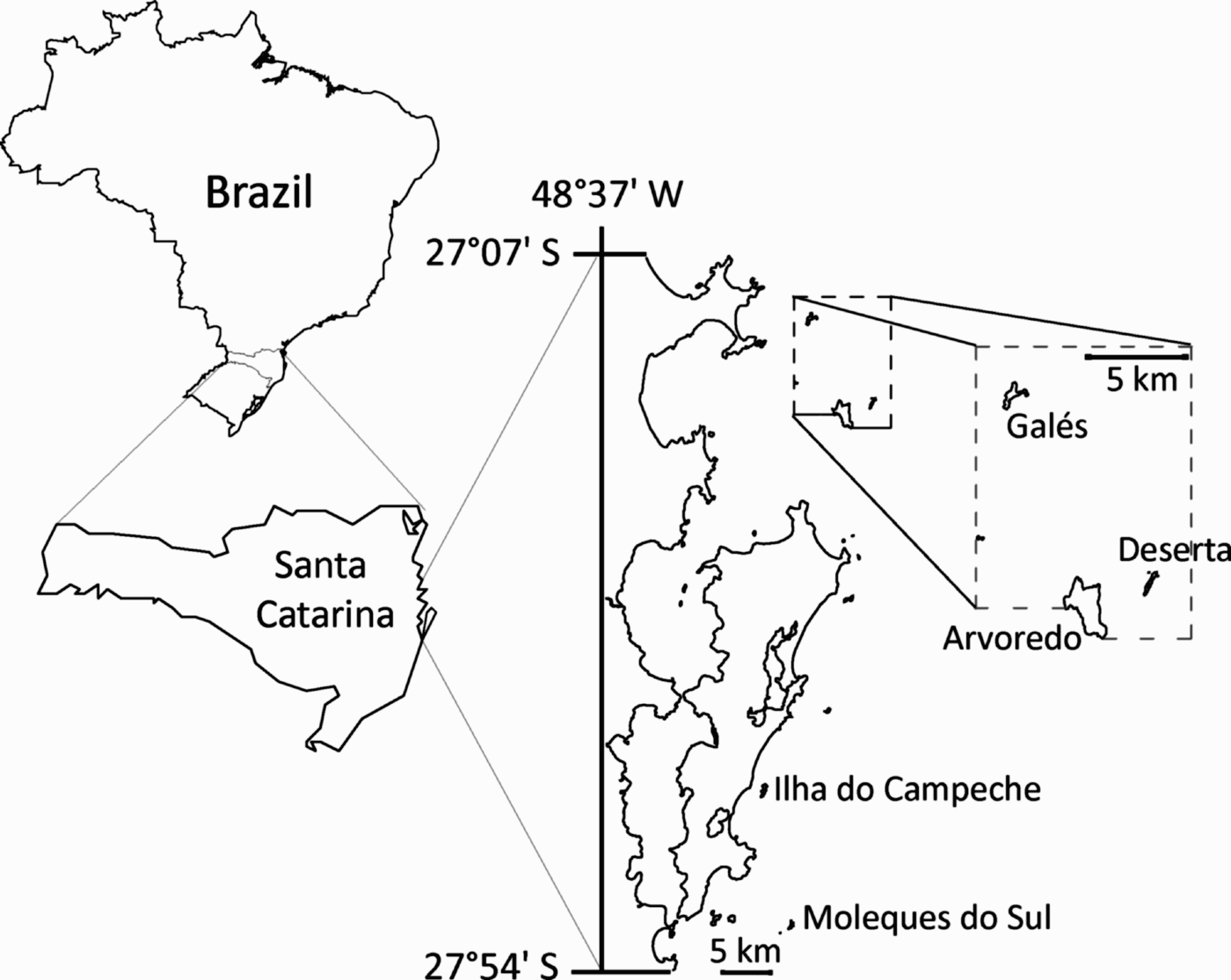
All records were made by underwater photographs taken between 2006 and 2009 at the following coastal islands (Figure 1): Arvoredo (27°17′2.93″S 48°21′56.51″W), Galés (27°10′47.21″S 48°24′26.98″W), Deserta (27°16′4.23″S 48°20′17.16″W) (all three belonging to Arvoredo Marine Biological Reserve), Ilha do Campeche (27°41′49.10″S 48°27′54.50″W) and Moleques do Sul Archipelago (27°50′45.75″S 48°25′51.89″W). Sea temperature ranged between 23.5°C–26°C. Photographic records were taken during a non-destructive diurnal visual censuses sampling campaign. Taxonomic classification follows Nelson (Reference Nelson2006).
Map of the coastal islands of Santa Catarina where the new records were observed. The dashed line indicates Arvoredo Marine Biological Reserve.

RESULTS AND DISCUSSION
During this study ten new species of reef fish were recorded for the coast of Santa Catarina: Muraena retifera Goode & Bean, 1882, Serranus baldwini (Evermann & Marsh, 1899), Calamus penna (Valenciennes, 1830), Halichoeres dimidiatus (Agassiz, 1831), Xyrichthys novacula (Linnaeus, 1758), Scarus zelindae Moura, Figueiredo & Sazima, Reference Moura, Figueiredo and Sazima2001, Ctenogobius saepepallens (Gilbert & Randall, 1968), Gnatholepis thompsoni Jordan, 1904, Ptereleotris randalli Gasparini, Rocha & Floeter, Reference Gasparini, Rocha and Floeter2001 and Cyclopsetta fimbriata (Goode & Bean, 1885). We also comment on the recently described Halichoeres sazimai Luiz Jr, Ferreira & Rocha, Reference Luiz, Ferreira and Rocha2009. With the exception of C. penna, C. fimbriata and H. sazimai, all the other listed species are typical from tropical regions and perhaps they should be ephemeral on the coast of Santa Catarina.
FAMILY MURAENIDAE
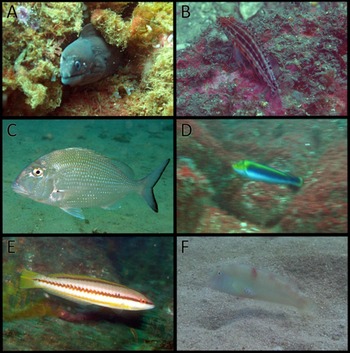
Muraena retifera—individual (Figure 2A) recorded at the approximate depth of 7 m, Moleques do Sul Archipelago, Santa Catarina, 2008.
Remarks: the individual recorded represents a south range extension. The southernmost occurrence of the reticulate eel was reported from the south-eastern coast of Brazil (Carvalho-Filho, Reference Carvalho-Filho1999).
Subdivision EUTELEOSTEI
Superorder ACANTHOPTERYGII
Series PERCOMORPHA
Order PERCIFORMES
Suborder PERCOIDEI
Five new occurrences of reef fish species recorded at Santa Catarina State coast between 2006 and 2009 and the recently described Halichoeres sazimai. (A) Muraena retifera; (B) Serranus baldwini; (C) Calamus penna; (D) Halichoeres dimidiatus; (E) H. sazimai; (F) Xyrichthys novacula. Photographs were taken by D.R. Barneche (A, B), Banco de imagens da REBIOMar Arvoredo, M. Kammers (C, E), S.R. Floeter (D) and C.E.L. Ferreira (F).

FAMILY SERRANIDAE
Serranus baldwini—individual (Figure 2B) recorded at the depth of 13 m, Moleques do Sul Archipelago, Santa Catarina, 2008.
Remarks: this report represents a south range extension. The lantern bass was recorded previously in Laje de Santos, São Paulo (Luiz Jr et al., Reference Luiz, Carvalho-Filho, Ferreira, Floeter, Gasparini and Sazima2008).
FAMILY SPARIDAE
Calamus penna—individual (Figure 2C) recorded at the approximate depth of 10–12 m, Arvoredo, Santa Catarina, 2009.
Remarks: this report represents a south range extension. The previous report of sheepshead porgy points to Tijucas Island, Rio de Janeiro, Brazil (IGFA, 2001).
Suborder LABROIDEI
FAMILY LABRIDAE
Halichoeres dimidiatus—individual (Figure 2D) recorded at the approximate depth of 7–8 m, Deserta, Santa Catarina, 2009.
Remarks: the observed individual was a terminal phase male, which indicates that it may be surviving in Santa Catarina waters for more than one year. This report represents a south range extension. The southernmost range of this species in Brazilian reefs is Laje de Santos, São Paulo (Luiz Jr et al., Reference Luiz, Carvalho-Filho, Ferreira, Floeter, Gasparini and Sazima2008).
Halichoeres sazimai—individual (Figure 2E) recorded at the depth of 21 m, Deserta, Santa Catarina, 2008 and 2009.
Remarks: this species was recently described (Luiz Jr et al., Reference Luiz, Ferreira and Rocha2009) and it is known to occur only from depths over 20 m. Our observations at Deserta, Santa Catarina, agree with Luiz Jr et al. (Reference Luiz, Ferreira and Rocha2009) that this species is always observed below the thermocline at temperatures below 17–19°C. Previously recorded at Porto Belo (27°09′29.16″S 48°33′12.96″W), Santa Catarina coast as Halichoeres bathyphilus (Moura et al., Reference Moura, Gasparini and Sazima1999). Halichoeres sazimai display both following and nuclear behaviours (Luiz Jr et al., Reference Luiz, Ferreira and Rocha2009), however, such interactions were not yet observed in Santa Catarina.
Xyrichthys novacula—individual (Figure 2F) recorded at the approximate depth of 10–12 m, Arvoredo, Santa Catarina, 2007.
Remarks: this report represents a south range extension. The southernmost range of this species in Brazilian reefs is the coast of São Paulo State (Carvalho-Filho, Reference Carvalho-Filho1999).
FAMILY SCARIDAE
Scarus zelindae —individual (Figure 3A) recorded at the approximate depth of 4–7 m, Deserta, Santa Catarina, 2009.
Five new occurrences of reef fish species recorded at Santa Catarina State coast between 2006 and 2009. (A) Scarus zelindae; (B) Ctenogobius saepepallens; (C) Gnatholepis thompsoni; (D) Ptereleotris randalli; (E) Cyclopsetta fimbriata. Photographs were taken by S.R. Floeter (A), M. Krause (B), D.R. Barneche (C) and Banco de imagens da REBIOMar Arvoredo, M. Kammers (D, E).

Remarks: the Zelinda's parrotfish is endemic to Brazil (Moura et al., Reference Moura, Figueiredo and Sazima2001). This report represents a south range extension. The southernmost range of the species in Brazilian reefs is Laje de Santos, São Paulo (Luiz Jr et al., Reference Luiz, Carvalho-Filho, Ferreira, Floeter, Gasparini and Sazima2008).
Suborder GOBIOIDEI
FAMILY GOBIIDAE
Ctenogobius saepepallens—individual (Figure 3B) recorded at the depth of 7 m, Ilha do Campeche and Arvoredo, Santa Catarina, 2008.
Remarks: this species was observed together with the bridled goby, Coryphopterus glaucofraenum Gill, 1863. This report represents a south range extension. The dash goby was recorded previously in Laje de Santos, São Paulo (Luiz Jr et al., Reference Luiz, Carvalho-Filho, Ferreira, Floeter, Gasparini and Sazima2008).
Gnatholepis thompsoni—individual (Figure 3C) recorded between the depth of 9–11 m, Galés, Santa Catarina, 2009.
Remarks: this report represents a south range extension. It was previously recorded at Laje de Santos, São Paulo (Luiz Jr et al., Reference Luiz, Carvalho-Filho, Ferreira, Floeter, Gasparini and Sazima2008). Inhabits open sand, rock, and rubble areas. It was observed together with the bridled goby, C. glaucofraenum, as described in the literature (Smith, Reference Smith1997).
FAMILY PTERELEOTRIDAE
Ptereleotris randalli —individual (Figure 3D) recorded at the approximate depth of 13–15 m, Galés and Deserta Islands, Santa Catarina, 2009.
Remarks: this report represents a south range extension. This species was known to occur from the south-eastern Caribbean to Laje de Santos (south-eastern Brazil) (Gasparini et al., Reference Gasparini, Rocha and Floeter2001; Rocha, Reference Rocha, Humann and Deloach2002; Luiz Jr et al., Reference Luiz, Carvalho-Filho, Ferreira, Floeter, Gasparini and Sazima2008).
Order PLEURONECTIFORMES
Suborder PLEURONECTOIDEI
FAMILY PARALICHTHYIDAE
Cyclopsetta fimbriata—individual (Figure 3E) recorded at the approximate depth of 10–12 m, Arvoredo, Santa Catarina, 2009.
Remarks: this report represents a south range extension of the spotfin flounder. The southernmost range of this species was recorded previously on the coast of São Paulo (Carvalho-Filho, Reference Carvalho-Filho1999; Figueiredo & Menezes, Reference Figueiredo and Menezes2000).
CONCLUSIONS
It seems that the Santa Catarina coast has a regular connectivity with the south-eastern and/or north-eastern coast of Brazil via Brazilian Current larval pools, as observations of tropical-affinity species are recurring. Long-term monitoring studies will allow a better understanding of connectivity patterns along the coast of Santa Catarina as well as the possible establishment of new populations at their southernmost limit of distribution.
ACKNOWLEDGEMENTS
We would like to thank O.J. Luiz Jr for corrections and comments on this manuscript and C.E.L. Ferreira, M. Krause and M. Kammers for permission to use their photographs. Field trips were financed by CNPq (Grant 475367/2006-5 to S.R. Floeter; Edital Universal No. 02/2006).