There is mounting evidence that bilinguals outperform monolinguals on tasks of executive function, in particular on tasks assessing inhibitory control (Bialystok, Reference Bialystok2001). Although most of the previous studies are on adults and school-aged children, there is some evidence that bilingualism may have a positive impact on inhibitory control in preschoolers (Bialystok, Barac, Blay & Poulin-Dubois, Reference Bialystok, Barac, Blaye and Poulin-Dubois2011; Carlson & Meltzoff, Reference Carlson and Meltzoff2008; Poulin-Dubois, Blaye, Coutya & Bialystok, Reference Poulin-Dubois, Blaye, Coutya and Bialystok2011), and even in infants (Kovacs & Mehler, Reference Kovács and Mehler2009). For older children, some studies have found that effects of bilingualism hold beyond inhibitory control, and extend to working memory (Blom, Küntay, Messer, Verhagen & Leseman, Reference Blom, Küntay, Messer, Verhagen and Lesemann2014; Morales, Calvo & Bialystok, Reference Morales, Calvo and Bialystok2013) and selective attention (Engel de Abreu, Cruz-Santos, Tourinho, Martin & Bialystok, Reference Engel de Abreu, Cruz-Santos, Tourinho, Martin and Bialystok2012). Results are mixed across studies, however, and previous research suggests that effects of bilingualism may, among others, be modulated by bilinguals’ language proficiency (Vega & Fernandez, Reference Vega and Fernandez2011) or language experiences, such as the frequency of switching between languages (Soveri, Rodriguez-Fornells & Laine, Reference Soveri, Rodriguez-Fornells and Laine2011). For young children, moreover, there is some tentative evidence that differences in bilingual children's language settings affect their executive functioning, such as whether children are exposed to their second language at home or in a school immersion setting (Carlson & Meltzoff, Reference Carlson and Meltzoff2008) or whether the majority or minority language is spoken at home (Gathercole, Thomas, Jones, Viñas-Guasch, Young & Hughes, Reference Gathercole, Thomas, Jones, Viñas-Guasch, Young and Hughes2010).
In this study, we compare monolingual and bilingual three-year-old children on a series of executive function tasks. We address two questions. First, we ask whether bilingual toddlers outperform their monolingual peers on inhibitory control, working memory and selective attention. Second, we ask if specific properties of bilingual children's home language environment affect executive functioning, in particular whether children are addressed in the same language or in different languages by both of their parents.
A common interpretation of the bilingual advantage in inhibitory control tasks is that bilinguals have increased inhibitory control skills because of their extensive training in the suppression of one language when using the other (Bialystok, Reference Bialystok2001). Bilingual speakers constantly need to control their attention to the relevant language in order to avoid interference from the other language, since the two languages are assumed to remain active during speech production and processing (Green, Reference Green1998; Jared & Kroll, Reference Jared and Kroll2001). This extensive training in interference suppression would explain why bilinguals often perform better than monolinguals on tasks in which attention to irrelevant or distracting information must be suppressed.
Inhibitory control is one aspect of executive functioning. Other aspects involve the ability to update information in working memory, rule shifting, and more global processes such as planning and monitoring. Attention is usually not considered a separate component of executive functioning, but implicated in other executive function components. However, for very young children, it has been argued that attention may serve as the starting point for the development of more differentiated executive functions (Cuevas & Bell, Reference Cuevas and Bell2014; Garon, Bryson & Smith, Reference Garon, Bryson and Smith2008).
While previous research shows a strong focus on inhibitory control as a locus of cognitive benefits of bilingualism, a couple of recent studies have found effects of bilingualism on visuospatial working memory (Blom et al., Reference Blom, Küntay, Messer, Verhagen and Lesemann2014; Morales et al., Reference Morales, Calvo and Bialystok2013, but see Engel de Abreu, Reference Engel de Abreu2011) and selective attention (Engel de Abreu et al., Reference Engel de Abreu, Cruz-Santos, Tourinho, Martin and Bialystok2012). For visuospatial working memory, Morales et al. (Reference Morales, Calvo and Bialystok2013) found that five- to seven-year-old bilingual children were better able to remember a sequence of locations in which a frog had appeared in a matrix than monolingual peers. Engel de Abreu et al. (Reference Engel de Abreu, Cruz-Santos, Tourinho, Martin and Bialystok2012) found an effect of bilingualism in eight-year-olds on a selective attention task in which children had to find targets among distractor pictures (i.e., Sky Search, Manly, Robertson, Anderson & Nimmo-Smith, Reference Manly, Robertson, Anderson and Nimmo-Smith1998). These findings suggest a broader effect of bilingualism, in line with accounts that assume that bilingualism enhances the central executive system that is responsible for executive processing under various task demands in both children and adults (Bialystok, Reference Bialystok2010; Costa Hernández, Costa-Faidella & Sebastián-Gallés, Reference Costa, Hernández, Costa-Faidella and Sebastián-Gallés2009; Hilchey & Klein, Reference Hilchey and Klein2011).
To date, only very few studies have investigated effects of bilingualism in children of preschool age, and without exception, these studies have looked at inhibitory control. Carlson and Meltzoff (Reference Carlson and Meltzoff2008) studied three groups of six-year-olds: English monolinguals, native English–Spanish bilinguals, and English second language learners of Spanish. They compared children's performance on two types of inhibitory control task: ‘conflict tasks’ assessing the ability to deal with conflicting attentional demands and ‘delay tasks’ assessing impulse-control such as the ability to wait for a food reward. The difference between these tasks is that conflict tasks require children to inhibit a dominant response and produce a non-dominant response, while delay tasks require them to inhibit an affective response and instead produce no response at all (i.e., by not touching or eating a reward). The authors found that the native bilingual children significantly outperformed the two other groups on the conflict tasks, but not on the delay tasks, for which no group differences were found. Importantly, moreover, superior performance on the conflict tasks was only found for the native bilinguals, and not for the second-language learners. On the basis of these results, Carlson and Meltzoff conclude that “early and intensive exposure to, and mastery of, more than one language may be necessary for a benefit in aspects of executive function to manifest itself” (p. 294).
Part of these results were replicated for two-year-old children by Poulin-Dubois et al. (Reference Poulin-Dubois, Blaye, Coutya and Bialystok2011) who compared bilingual and monolingual 24-month-olds on a test battery assessing inhibitory control that included conflict as well as delay tasks. In this study, the bilingual children outperformed the monolingual children on the conflict task (i.e., Shape Stroop, Kochanska, Murray & Harlan, Reference Kochanska, Murray and Harlan2000), but not on delay tasks in which children were asked to wait for a snack and gift reward. A study on three- and 4.5-year-olds by Bialystok, Barac, Blaye and Poulin-Dubois (Reference Bialystok, Barac, Blaye and Poulin-Dubois2011) shows that this is not due to the fact that the latter tasks require the suppression of a motor response (Martin-Rhee & Bialystok, Reference Martin-Rhee and Bialystok2008): In this study, bilingual children of a wide variety of language and cultural backgrounds significantly outperformed monolingual English children on a task requiring the inhibition of a motor response (i.e., Luria's tapping task, Diamond & Taylor, Reference Diamond and Taylor1996), already at three years of age. One possible explanation of the discrepancy in performance on conflict and delay tasks, then, might lie in the fact that they assess different skills. As described above, conflict tasks require the suppression of a dominant response, whereas delay tasks require children to inhibit an affective response. Also, unlike delay tasks, many conflict tasks involve some kind of switching, as children have to apply a new rule or even switch from one rule to another, and as such, are not pure measures of inhibitory control.
The presence of effects of bilingualism on (some aspects of) inhibitory control in children as young as two or three years suggests that cognitive differences between monolingual and bilingual children develop early in life, when children's productive vocabularies are still relatively small. Also, at this young age, children have had little training using their two languages, suggesting that bilingual language production is not the only source of the effects (cf. Bialystok et al., Reference Bialystok, Barac, Blaye and Poulin-Dubois2011). As none of the previous studies on two- and three-year-olds have included tasks measuring other aspects of executive functioning than inhibitory control, it is as yet an open question if bilingual advantages in visuospatial working memory or selective attention that have been reported for older children can be found in these early years. If such broader effects of bilingualism are found in young children this would support the idea that there is a domain-general executive control advantage (Costa et al., Reference Costa, Hernández, Costa-Faidella and Sebastián-Gallés2009; Hilchey & Klein, Reference Hilchey and Klein2011) already in young children, rather than an advantage for inhibitory control only, or an even more specific advantage limited to cognitive control and not impulse control.
Another open issue relates to the role of contextual factors. To date, only few studies have looked at this issue, but there are some indications that effects of bilingualism may be specific for certain bilingual language environments. Gathercole et al. (Reference Gathercole, Thomas, Jones, Viñas-Guasch, Young and Hughes2010) found effects of bilingualism in some groups of Welsh–English school-aged children, but not in others, depending on the language(s) spoken at home. Specifically, these authors found a complex pattern of results such that bilingual children exposed to either only English or Welsh at home outperformed monolingual English children on a tapping task assessing inhibitory control, but bilinguals exposed to both English and Welsh at home outperformed bilingual children who were exposed to Welsh at home (and to English at school) as well as monolingual children on a Stroop task. Similarly, as outlined above, in their study on six-year-old preschoolers, Carlson and Meltzoff (Reference Carlson and Meltzoff2008) found a bilingual advantage on inhibitory control for native bilingual children who received approximately equal exposure to Spanish and English at home, but not for second-language children who spoke English at home and received Spanish instruction at school. The authors explained these findings by assuming that intensive exposure to two languages and high levels of bilingual proficiency are important for the emergence of bilinguals’ advantages.
While this is a plausible explanation, an alternative interpretation comes to mind. Specifically, the native bilinguals’ advantage in Carlson and Meltzoff (Reference Carlson and Meltzoff2008) could, at least in part, be due to these children being exposed to two languages in the same context, providing them with more opportunities for switching between languages, rather than their intensive bilingual exposure or bilingual proficiency. Several studies have suggested that switching is an important factor, such that, in bilingual adults, a higher frequency of switching between languages is correlated with increased performance on cognitive tasks (Soveri et al., Reference Soveri, Rodriguez-Fornells and Laine2011; Woumans, Ceuleers & Duyck, Reference Woumans, Ceuleers and Duyck2013). Costa et al. (Reference Costa, Hernández, Costa-Faidella and Sebastián-Gallés2009) hypothesized, moreover, that bilinguals’ increased performance on executive function tasks may be related to the degree to which bilinguals use their two languages throughout the day: Bilinguals who mix languages might receive more training in the selection and monitoring processes thought to be important for executive functioning than bilinguals whose languages are kept separate. Testing this idea is not a simple task, however, as bilingual language use is likely to be correlated with a number of other factors known to influence executive functioning such as age of acquisition, bilingual proficiency, and degree of language balance. Yet, exploring how specific properties of bilinguals’ language environment relate to executive function skill is important, as it may contribute to our understanding of what it is that causes bilingual advantages in executive functioning.
In this study, we present data from monolingual and bilingual three-year old children who were all raised in the Netherlands and thus were exposed to the majority language Dutch. Children belonged to one of two groups: (i) Dutch monolinguals or (ii) bilinguals learning Dutch and one of a large number of other languages. Children were given a test battery containing tasks of selective attention, visuospatial working memory, and inhibitory control. As in previous studies on young children, inhibitory control was assessed through conflict and delay tasks (Carlson & Meltzoff, Reference Carlson and Meltzoff2008; Poulin-Dubois et al., Reference Poulin-Dubois, Blaye, Coutya and Bialystok2011).
We target two questions. First, we ask if there are effects of bilingualism on inhibitory control, visuospatial working memory, and selective attention. We hypothesize that there will be an effect on inhibitory control, in line with earlier work on toddlers (Bialystok et al., Reference Bialystok, Barac, Blaye and Poulin-Dubois2011; Poulin-Dubois et al., Reference Poulin-Dubois, Blaye, Coutya and Bialystok2011). But it is an open question if we will find advantages for visuospatial working memory and selective attention in the current sample of three-year-olds, as previous studies on older children have reported mixed findings (Blom et al., Reference Blom, Küntay, Messer, Verhagen and Lesemann2014; Engel de Abreu et al., Reference Engel de Abreu, Cruz-Santos, Tourinho, Martin and Bialystok2012; Morales et al., Reference Morales, Calvo and Bialystok2013). As for inhibitory control, we predict, moreover, that a bilingual advantage will be found in conflict tasks, but not in delay of gratification tasks, based on earlier work on young children (Carlson & Meltzoff, Reference Carlson and Meltzoff2008; Poulin-Dubois et al., Reference Poulin-Dubois, Blaye, Coutya and Bialystok2011).
Our second question is whether specific properties of bilinguals’ home language environment have an effect on bilinguals’ executive functioning. Specifically, we compare two groups of bilingual children: (i) bilingual children who are addressed in two different languages by both of their parents (i.e., one parent speaks language A, while the other parent speaks language B) and (ii) bilingual children who are addressed in only one language by their parents (i.e., both parents speak language A and the child learns language B outside the home). We hypothesize that the former group will show greater benefits in executive functioning than the latter group, as they are provided with more opportunities for switching between languages. Note that, if any differences are found depending on bilinguals’ home language environment, alternative explanations are also possible. Specifically, co-activation of two languages might be stronger in children who are presented with two languages in the same context, and the simultaneous activation of lexemes in both languages has been proposed as one of the factors explaining bilingual benefits on executive functioning (Green, Reference Green1998; Jared & Kroll, Reference Jared and Kroll2001). Also, children who are exposed to two languages at home may have more translation equivalents in their bilingual lexicons, and consequently, experience more lexical competition, than children who acquire one language at home and the other at (pre)school (Oller & Eilers, Reference Oller and Eilers2002).
To summarize, previous research on cognitive advantages of bilingualism has typically looked at adults and children of school age. A few recent studies have shown that cognitive advantages of bilingualism may manifest themselves already at preschool age. In children this young, bilingualism has an impact on inhibitory control, assessed through conflict tasks, but not delay tasks. Possible effects on working memory or attention have not yet been investigated in preschoolers. Also, examinations of bilinguals’ language environments in relation to cognitive benefits are rare or even non-existent at this young age. The general aim of this study is to fill part of this gap by (i) comparing mono- and bilingual preschoolers on various domains of executive functioning, and (ii) exploring how specific aspects of bilingual children's home language environment (or parents’ language use) may impact on bilingual children's executive functioning.
Method
Participants
The current participants were selected out of a larger sample of children participating in an ongoing, large longitudinal study on language and executive functioning in preschool children in the Netherlands (pre-COOL). In this study, over 2500 children participated. For the current study, children were selected if they had completed at least half of the items in each task reported on in this study (to avoid calculating scores on the basis of few data points for a child) and if their parents had returned a questionnaire about child and family characteristics. Children with hearing or vision problems, Down syndrome, or neurological problems were excluded. Children learning a regional language next to standard Dutch were also excluded, because these languages often differ only minimally from standard Dutch and it was therefore unclear if these children should be considered monolinguals or bilinguals. This yielded a total of 1029 children (37.6% of the full sample).
Children were classified as monolinguals or bilinguals on the basis of parental report. Specifically, if their parents had indicated in the questionnaire that no other language than Dutch was spoken at home, children were considered monolingual; if their parents had reported that another language next to or instead of Dutch was spoken at home, they were considered bilingual.
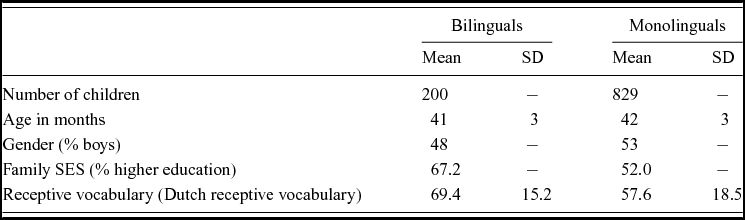
The monolingual group consisted of 829 children with a mean age of 41 months (SD = 3, range = 35 – 49). The bilingual group consisted of 200 children with a mean age of 42 months (SD = 3, range = 35 – 51). The difference in age was small but significant between groups (F(1,1028) = 4.60, p = .03, η2 p = .00). The monolingual group contained 398 boys (48%), and the bilingual group contained 106 boys (53%). This difference in gender was not significant (F(1,1028) = 1.79, p > .1, η2 p = .00). In the monolingual group, 67% of the children came from a high SES background (defined as having at least one parent with a college or university degree) versus 52% of the children in the bilingual group. This difference in SES was significant (F(1,1028) = 16.41, p < .001, η2 p = .02). Receptive vocabulary scores, obtained through an adapted version of the Dutch Peabody Picture Vocabulary Test (see below) were significantly higher in the monolinguals than in the bilinguals: 69.4% and 57.6% correct, respectively (F(1,1028) = 89.92, p < .001, η 2 p = .08). For an overview of participant characteristics, see Table 1.
Participant characteristics for the monolingual and bilinguals.

The bilingual children formed a heterogeneous group. Whereas some bilingual children were exposed to Dutch as well as another language at home, others only heard another language and no Dutch spoken by their parents and thus learnt Dutch outside their home, at daycare or preschools. Moreover, a wide variety of languages other than Dutch was reported by the bilingual children's parents. Most frequent were Turkish (18.5%), Arabic (13.5%), English (9.5%), German (5.5%), French (4%), and Spanish (3%), but many other languages were reported, including Chinese, Russian, Polish, Somali, and Japanese.
Measures
Parental questionnaire
Information about child and family characteristics was collected through a questionnaire sent to all parents. This questionnaire also contained a shortened version of the Daily Communication Questionnaire (Mayo & Leseman, Reference Mayo and Leseman2006; see also Scheele, Leseman & Mayo, Reference Scheele, Leseman and Mayo2010). This questionnaire assesses how often parents perform certain language and literacy activities with their children such as reading books, talking and singing, as well as parents’ language use during these activities. Specifically, the questionnaire contains ten items assessing how much time parents spend performing language and literacy activities with their child per week. Answers are indicated on a seven-point scale ranging from 0 (‘never’) to 6 (‘more than three hours per week’). In a next step, parents are asked which language(s) they use for each type of activity for each parent separately. Answers are given on a five-point scale ranging from 1 (‘(almost) always Dutch’) to 5 (‘(almost) always another language’). Reliability of the items assessing parents’ frequency of use of each activity was excellent (Cronbach's alpha = .90) and so was the reliability of the items assessing each parents’ language use per type of activity (Cronbach's alpha's = .91 and .95). Mean scores for each child were used in the analyses.
The parental questionnaire also contained two subscales of a shortened version of the Children's Behavior Questionnaire (CBQ, Putnam, Ahadi, Hershey & Fisher, 2001; Dutch translation by Majdandžić, cf. Majdandžić & van den Boom, Reference Majdandžić and van den Boom2007), assessing attentional focusing and inhibitory control. For both scales, parents were asked to indicate for their child how often a certain behavior occurred during the past six months. An example item of the inhibitory control scale is: “When told ‘no’, how often did your child stop an ongoing activity?” An example item of the attentional focusing scale is: “When playing alone, how often did your child move from one task or activity to another without completing any?” Answers were given on a seven-point scale that ranged from “does not apply” to “strongly applies”. Both scales contained five items and had acceptable reliability (Cronbach's alpha = .66 for each scale). Mean scores of the scales were used in the analyses.
Receptive vocabulary
The Dutch version of the Peabody Picture Vocabulary Test (PPVT-III-NL, Dunn & Dunn, Reference Dunn and Dunn2005) was used to assess receptive vocabulary. In this task, children choose one out of four picture drawings after an orally presented word. The task was adapted for the purposes of the current study in a number of ways to facilitate its administration and scoring, and contained 24 items (for more details, see Verhagen, De Bree, Boom, Mulder & Leseman, Reference Verhagen, De Bree, Boom, Mulder and Leseman2014). Scores were calculated as the percentage of correct responses out of all responses for each child. The test had good reliability (Cronbach's alpha = .73).
Selective attention
To measure selective attention, a visual search task was used (cf. Mulder, Hoofs, Verhagen, van der Veen & Leseman, Reference Mulder, Hoofs, Verhagen, Veen and Leseman2014, for a description of a slightly modified version of this task used with two-year-olds), based on earlier work by Gerhardstein and Rovee-Collier (Reference Gerhardstein and Rovee-Collier2002) and Scerif, Cornish, Wilding, Driver & Karmiloff-Smith, Reference Scerif, Cornish, Wilding, Driver and Karmiloff-Smith2004). In this task, children were presented with a structured display of 48 animals on a laptop screen. Stimuli were images of elephants, bears, and donkeys that were very similar in color and size. Children were asked to find as many targets (elephants) as possible while ignoring distractors (bears and donkeys). To minimize memory demands, the elephants that the child had located were crossed off. Following three practice trials, children were presented with three test trials which lasted 40 seconds each. Each test item contained eight targets. The first two test items contained 40 distractors presented in a 6 × 8 grid, while the third test item was more difficult and contained 64 distractors presented in a 9 × 8 grid. Scores were calculated as the mean number of correctly located targets per item. In addition, the mean number of ‘repetition hits’ was calculated, that is, children's points to targets that they had already located. Cronbach's alpha for the accuracy scores (i.e., located elephants) was acceptable (Cronbach's alpha = .65).
Inhibitory control
A Stroop task, based on the Silly Sounds Stroop task by Willoughby, Blair, Wirth, Greenberg, and Family Life Project Investigators (Reference Willoughby, Blair, Wirth and Greenberg2010), was used. In this task, children were presented with a picture of a cat and a picture of a dog on a laptop screen, and asked to make the sound of a dog when presented with a cat, and vice versa. Importantly, they were encouraged to respond as quickly as possible. In a series of practice trials, the experimenter first asked the child to make the sound of a dog and then the sound of a cat. She then introduced the idea that in this game with ‘silly animals’, cats made the sounds of dogs and vice versa. Children's understanding of this rule was assessed in two practice trials in which the experimenter provided the correct response (“This is a game with silly animals. In this game, the cat says ‘woof’. What does the cat say in this game?”), and children had to provide the correct answer. If at least one of these practice trials were incorrect, both trials were repeated. If children still made errors in the second pair of practice trials, testing stopped, as for these children, it was unclear if they understood the rules. For children passing the practice trials, there were four test (conflict) trials in which children were either shown a picture of a cat (two items) or a picture of a dog (two items). Children's responses were coded as correct or incorrect. Reliability of the task was good (Cronbach's alpha = .77).
Visuospatial working memory
The Six Boxes task (Diamond, Prevor, Callender & Druin, Reference Diamond, Prevor, Callender and Druin1997) was used to assess visuospatial working memory. This task presented children with six identical boxes in which six toys were being hidden by the assessor while children were watching. Children were then given six search attempts to find all toys. In between search attempts (trials), a screen was placed between the child and the boxes, and children were actively distracted by the assessor for six seconds. Since children had to remember during the delay time which boxes they had already emptied and which still contained a toy, and had to update this information across trials, this task is considered a working memory task. Test reliability could not be calculated as the items were not independent: The task became increasingly difficult as more boxes were emptied by the child (see Mulder et al., Reference Mulder, Hoofs, Verhagen, Veen and Leseman2014 for a detailed description of the psychometric properties of the same task used with two-year-olds). Scores were calculated as the percentage of correct trials (successful search attempts) out of all trials for each child.
Delay of gratification
Two delay of gratification tasks were used to assess self-control, that is, children's ability to inhibit a dominant impulse. First, in the Gift Delay task (Kochanska et al., Reference Kochanska, Murray and Harlan2000), a wrapped gift with a bow was placed in front of the child on a table, at a distance of 25 cm. The child was then instructed that s(he) would have the gift, but first had to try not to touch it until the research assistant had finished another task. The assistant then moved away from the child and observed the child's behavior for one minute. After the delay time, all children were given positive feedback regardless of whether they had touched the gift or not, and they were allowed to have the gift.
The second task, the Gift-in-bag task, was a slightly adapted version of a task used by Kochanska et al. (Reference Kochanska, Murray and Harlan2000). In this task, a gift that was concealed in a bag was placed in front of the child on the table. The procedure was the same as in the Gift Delay task: Children were instructed that they would have the gift, but first had to try not to touch the bag with the gift until the research assistant had finished her task. The delay time in this task was one and a half minute. After this time, children were given positive feedback, and all children were allowed to have the gift.
Pass/fail scores were used in the analyses. Specifically, for the Gift Delay task, scores reflected whether or not children had touched the gift. For the Gift-in-bag task, these scores indicated whether or not children had peeked in the bag or touched the bag during the delay time. A separate study using video recordings of 53 two- and three-year-olds showed that the live codes were reliable: For the Gift Delay task, Kappa was .89 for touching behavior, and agreement between video and live codes was 96.2% (Mulder et al., Reference Mulder, Hoofs, Verhagen, Veen and Leseman2014). No such reliability check was available for the Gift-in-bag task.
Procedure
Children were tested individually by trained assistants in a quiet room at their day care centers or at home. All tasks were administered in Dutch and presented in a fixed order to minimize fatigue and vary task demands from one task to the next. Specifically, the tasks were intermixed with other tasks not reported on in this study, and presented in the following order: Visual Search, Peabody Picture Vocabulary Test, Silly Sounds Stroop, Gift-in-bag, Six Boxes, and Gift Delay. Sessions lasted approximately 45 minutes, including short breaks that were allowed if children became fuzzy or indicated they wanted to have a break.
Analyses
We first analyzed children's amount of language exposure through parental language activities to see if there were significant differences between the groups. We also analyzed the degree to which both parents reported to speak Dutch (relative to another language) to their children, to obtain more information on bilingual children's home language environments. For our first research question concerning possible effects of bilingualism, we first checked correlations between age, gender, SES and Dutch receptive vocabulary and children's performance on the executive function tasks. Subsequently, a MANCOVA was run with children's task scores as the dependent variables, group as the between-subjects factor, and age, SES, gender and Dutch receptive vocabulary as covariates. For the dichotomous scores on the delay tasks (pass/fail), linear logistic regression analyses were performed with children's scores on the tasks as the dependent variables, and group, age, SES, gender and receptive vocabulary as the predictor variables. As for our second question about possible effects of home language environment in the bilingual group, we compared two subgroups of bilingual children: (i) bilingual children whose parents spoke the same language versus (ii) bilingual children whose parents spoke two different languages. For this analysis, a MANCOVA was again performed with children's scores on the executive function tasks as the dependent variables, group as the between-subjects factor, and age, SES, gender and vocabulary as covariates. As before, logistic regressions were run on children's scores on the delay tasks.
Results
Language exposure
The total amount of time parents spent on language activities with their children as indicated in the questionnaire was very similar for the monolingual and bilingual children. On a scale ranging from ‘0’ (never) to ‘6’ (more than three hours per week), the monolinguals’ parents had a mean score of 3.57 (SD = 1.07, range = 1 – 6), and the bilinguals’ parents had a mean score of 3.72 (SD = 1.17, range = 1.1 – 6), representing their language use in both languages together. This difference was not significant between the two groups (F(1,964) = 3.08, p > .05, η 2 p = .00)Footnote 1 .
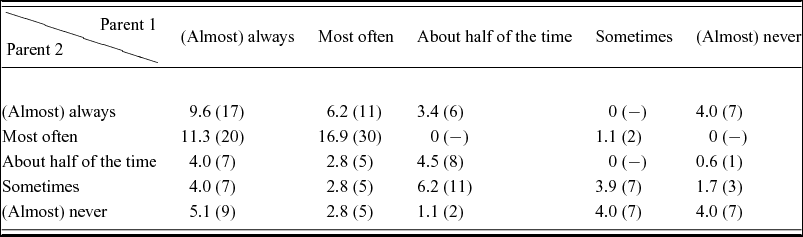
For the bilingual group, we analyzed how often parents spoke Dutch relative to the other language when talking to their child. As shown in Table 2, situations in which one of the parents (almost) always spoke Dutch and the other parent most often spoke Dutch were most frequent (11.3% + 6.2% = 17.5%). Also frequent were situations in which both parents most often spoke Dutch (and sometimes another language) (16.9%), or situations in which both parents almost always spoke Dutch (9.6%). A total of 16 families reported that one parent (almost) always spoke Dutch and the other parent (almost) never spoke Dutch (5.1% + 4.0% = 9.1%).
Parents’ use of Dutch relative to the other language in the bilingual group (in % (N)).

Note. In this table, the data of 23 single parent families were not included.
Correlations with gender, SES, and Dutch receptive vocabulary
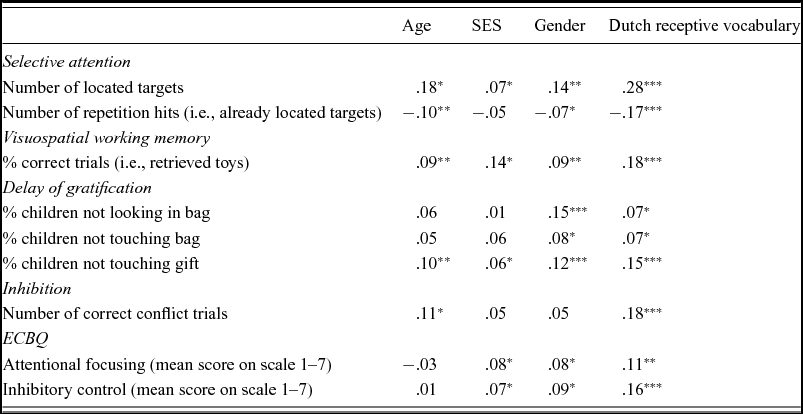
As mentioned in the participants section, the monolingual and bilingual groups differed significantly in age, SES and receptive vocabulary, such that the monolingual children were slightly younger, more often came from high SES families and had higher Dutch receptive vocabulary scores than the bilingual children. There were more boys in the monolingual than in the bilingual group, but this difference was not significant. Age, SES, linguistic ability, and gender all have been shown to influence executive functioning in earlier studies (Carlson, Moses & Breton, Reference Carlson, Moses and Breton2002; Hughes & Ensor, Reference Hughes and Ensor2005; Mezzacappa, Reference Mezzacappa2004). Therefore, we inspected correlations between these variables and executive function scores in the current sample.Footnote 2 As shown in Table 3, only weak correlations were found, with significant values being due to large sample size. The strongest (but still modest) correlation was between receptive vocabulary and selective attention (r = .28).
Correlations between background variables and executive function measures (collapsed groups, N = 1029).

Executive functioning
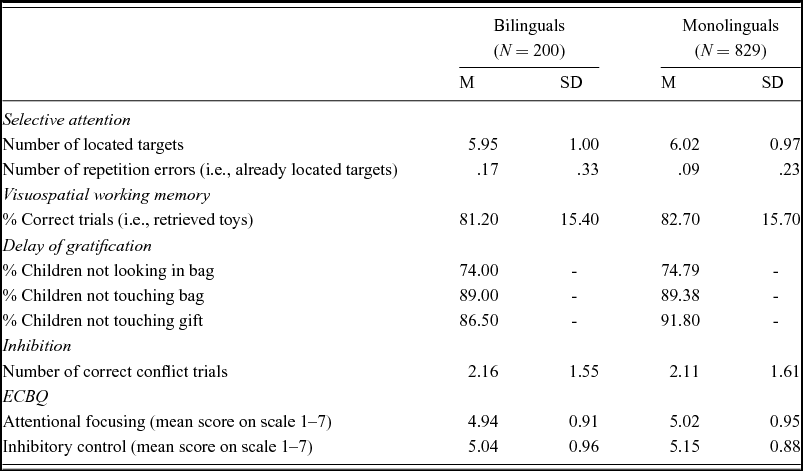
Mean scores and standard deviations on the executive function measures are presented in Table 4 for the bilingual and monolingual children separately.
Mean scores on the executive function measures for the bilinguals and monolinguals.

A MANCOVA with ‘group’ as the between-subjects factor and age, SES, gender and receptive vocabulary as covariates showed a main effect of group (F(6,1018) = 2.58, p = .02, η2 p = .02). Age, SES, receptive vocabulary and gender were all significant covariates (ps < .01). At the task level, there were no effects of group for the Six Boxes task and parents’ ratings of attentional focusing and inhibitory control (ps > .05). A small effect of group was found for the visual search task on which the bilinguals made more repetition errors than the monolinguals (F(1,1024) = 6.56, p = .011, η2 p = .01). However, on the Stroop task, the bilinguals obtained significantly higher scores than the monolinguals (F(1,1024) = 4.75, p = .029, η2 p = .01), even though the effect was again very small. Logistic regressions with age, SES, gender and vocabulary as predictor variables, entered in a first step, and group, entered in a second step, showed no effects of group for the delay tasks (ps > .1).
Bilingual home language environment
Same or different language spoken by both parents
To investigate whether bilingual home language environment influenced the bilingual children's executive functioning, two subgroups of bilingual children were selected. In the ‘Same Language’ group, both parents spoke the same language to their child. Specifically, children were placed in the ‘Same Language’ group if their parents had indicated that (i) both of them (almost) always or most often spoke Dutch to their childFootnote 3 or (ii) (almost) always or most often spoke another language to their child (i.e., eight cells in upper left-hand and lower right-hand corners in Table 2). In the latter case, children thus were solely or mainly exposed to a language other than Dutch at home and learned Dutch outside their homes, at preschools or daycare, or through television, books and possibly also through siblings. In the ‘Different Languages’ group, children's parents each spoke a different language to their child. Specifically, these children's parents had indicated that one of them (almost) always or most often spoke Dutch and the other parent (almost) always or most often the other language (i.e., eight cells in upper right-hand and lower left-hand corners in Table 2). So, the crucial difference between the two groups was whether a child's two parents always or mostly addressed the child in the same language or whether their two parents always or mostly addressed them in two different languages (and hence, applied a one-parent-one-language approach). To avoid creating a confound with language mixing within speakers, we deliberately chose to include in both groups only those children whose parents reported to always or mostly speak one language, and not include children from parents who reported to use Dutch and the other language roughly equally.
The ‘Same Language’ group contained 102 children with a mean age of 42 months (SD = 3, range = 36 – 48, 58.8% boys). The ‘Different Languages’ group contained 35 children with a mean age of 41 months (SD = 3, range = 35–47, 51.4% boys). There were significantly fewer children from high SES families in the ‘Same Language’ group (48%) than in the ‘Different Languages’ group (74.3%) (F(1,136) = 7.55, p < .01, η2 p = .05). Dutch receptive vocabulary scores were the same in both groups: 58.7% and 58.8% correct in ‘Same Language’ and ‘Different Languages’ groups, respectively.
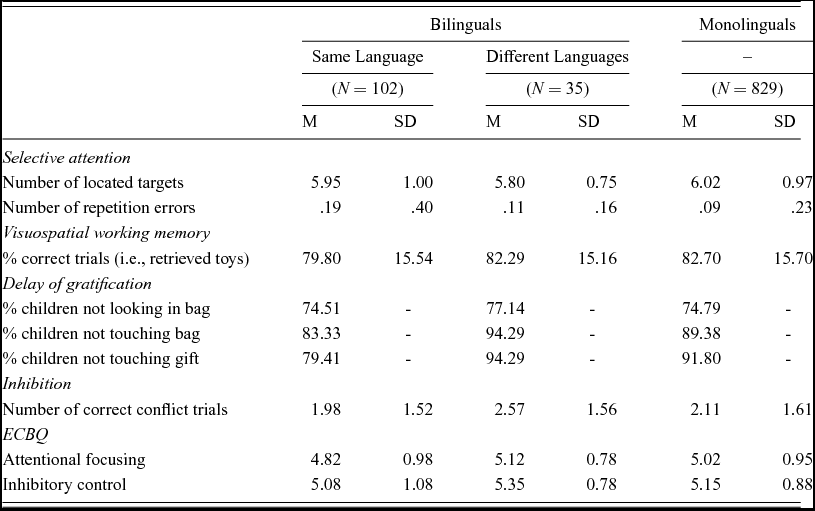
Mean scores on the executive functioning measures for the two groups are given in Table 5. This table also shows the scores of the monolingual children, repeated from Table 2 above, for the sake of comparison across the three groups.
Mean scores on the executive function measures for the ‘Same Language’ and ‘Different Languages’ bilinguals and the monolinguals.

A MANCOVA with group as the between-subjects factor and age, SES, gender and receptive vocabulary as covariates showed a very small effect of group (F(12,1910) = 1.99, p = .02, η2 p = .01). All covariates were significant at the .01-level. A series of ANCOVAs showed no effects of group for the Six Boxes tasks and parents’ ratings of attentional focusing (ps > .1). However, there was a small effect of group on the number of repetition errors made in the visual search task (F(2,965) = 4.29, p = .01, η2 p = .01) as well as on children's accuracy in the Stroop task, (F(2,965) = 2.95, p = .05, η2 p = .01). For the visual search task, post-hoc comparisons showed that the ‘Same Language’ bilinguals made significantly more errors than the monolingual children (F(1,930) = 8.14, p < .004, η2 p = .01), but the ‘Different Languages’ bilinguals did not perform worse than the monolinguals (F(1,863) = .03, p > .1, η2 p = .00). For the Stroop task, post-hoc comparisons showed that the ‘Different Languages’ bilinguals significantly outperformed the monolinguals (F(1,863) = 5.85, p = .02, η2 p = .01), but the ‘Same Language’ bilinguals did not (F(1,930) = .30, p > .1, η2 p = .00). Also, there was a trend for the ‘Different Languages’ bilinguals to perform better than the ‘Same Language’ bilinguals on this task (F(1,136) = 3.47, p = .06, η2 p = .03). A somewhat similar pattern emerged for parents’ inhibitory control ratings. Even though there was no main effect of group (F(1,965) = 1.83, p > .1), there was a trend for the ‘Different Languages’ group to obtain higher ratings than the monolingual group (F(1,863) = 3.43, p = .06, η2 p = .01), but there was no such difference between the ‘Same Language’ bilinguals and the monolinguals (F(1,965) = .19, p > .1, η2 p = .00).
Furthermore, hierarchical logistic regressions with group, age, SES, gender and receptive vocabulary as predictor variables and children's dichotomous scores on the delay tasks as the dependent variables showed that the ‘Different Languages’ bilinguals touched the gift significantly less often than the ‘Same Language’ bilinguals in the Gift Delay task (B = -1.54, Wald = 3.89, p = .049). Also, on this task, the ‘Same Language’ bilinguals performed significantly worse than the monolinguals (B = .67, Wald, 5.28, p = .02), but there was no difference in scores between the ‘Different Languages’ group and the monolinguals (B = .07, Wald = .02, p > .1). On the Gift-in-bag task, the ‘Different Languages’ bilinguals also outperformed the ‘Same Language’ bilinguals and the monolinguals, as they looked in the gift bag and touched the bag less often than the ‘Same Language’ bilinguals, but these differences were not significant (ps > .1).
Discussion
This study compared performance on measures of selective attention, visuospatial working memory, and inhibitory control between monolingual and bilingual three-year-old children. Two questions were addressed: (i) Do bilingual children show an advantage on executive functioning beyond inhibitory control? and (ii) Do specific properties of bilinguals’ home language environment impact on executive function skill?
Our results showed that the bilingual children outperformed the monolingual children on an age-appropriate Stroop task in which children had to inhibit a prepotent verbal response. This result fits well with previous studies on two-year-olds (Poulin-Dubois et al., Reference Poulin-Dubois, Blaye, Coutya and Bialystok2011) and three- and 4.5-year-olds (Bialystok et al., Reference Bialystok, Barac, Blaye and Poulin-Dubois2011) which also found effects of bilingualism on inhibitory control tasks in which a dominant response had to be suppressed. No effect for visuospatial memory was found, in contrast to studies on older children that did find such effects (Blom et al., Reference Blom, Küntay, Messer, Verhagen and Lesemann2014; Morales et al., Reference Morales, Calvo and Bialystok2013). This may indicate that advantages in this area only develop after longer exposure to two languages (and hence training in executive control), an idea that is supported by Blom et al. (Reference Blom, Küntay, Messer, Verhagen and Lesemann2014) who found that effects of bilingualism on visuospatial working memory increased with age, from five to six years. Alternatively, the differences across studies may be due to the fact that the current task was not very demanding, as indicated by children's high scores. Previous studies have shown that a certain degree of complexity is necessary for bilingual advantages to emerge (Feng, Diamond & Bialystok, 2007), leaving open the possibility that a more demanding task would have yielded different outcomes. Selective attention did not show a group difference either, unlike what has been reported for older children by Engel de Abreu et al. (Reference Engel de Abreu, Cruz-Santos, Tourinho, Martin and Bialystok2012). In fact, group differences in error scores even went in the opposite direction, with the monolinguals outperforming the bilinguals. Besides differences in age, a possible explanation of these mixed findings across studies is that Engel de Abreu et al. controlled for motor speed in their analyses (i.e., children also performed a baseline task with only targets and no distractors), whereas we did not. One alternative explanation is that, due to their lower linguistic proficiency in Dutch, the bilingual children in the present study had trouble understanding that they should try to find new targets, rather than point to the ones they had already found. However, this explanation is not very likely given our elaborate instruction that aimed at making very clear to the children that they should look for elephants only, and the fact that only very simple language was used, supported with co-speech gestures, to optimize children's understanding.
The effect on inhibitory control in our study was very small and did not extend to delay tasks or parental ratings of inhibitory control in a questionnaire. The latter finding is in line with findings by Carlson and Meltzoff (Reference Carlson and Meltzoff2008), who also used delay tasks and the same (but a longer) version of the questionnaire used here, and did not effects of bilingualism for these measures. Similarly, Poulin-Dubois et al. (Reference Poulin-Dubois, Blaye, Coutya and Bialystok2011) found in their sample of two-year-olds that the effect of bilingualism was confined to a conflict task (i.e., Shape Stroop, Kochanska et al., Reference Kochanska, Murray and Harlan2000), and did not show up in delay tasks very similar to the ones used in the current study.
Our results showed, furthermore, that when bilingual children's home language environment was taken into account, effects were found for one of the delay tasks, but crucially, involved differences within the bilingual group, rather than between the bilinguals and the monolinguals. Specifically, when we compared bilingual children who were always or mostly addressed in two different languages by each of their parents (‘Different Languages’ group) and bilingual children who were always or mostly addressed in the same language by each of their parents (‘Same Language’ group), we found that the ‘Different Languages’ group significantly outperformed the ‘Same Language’ group on the Gift Delay task, as they were better able to wait for a gift reward. The finding that specific characteristics of bilinguals’ home language environment have an effect on bilinguals’ inhibitory control supports earlier research showing effects of language learning contexts within bilingual children (Gathercole et al., Reference Gathercole, Thomas, Jones, Viñas-Guasch, Young and Hughes2010), and extends such findings from cognitive control tasks to delay tasks assessing impulse control.
Previous researchers have argued that children's performance on delay tasks reflects their (in)ability to inhibit a motor response, and thus their inhibitory control. Detailed analyses of children's behavior during these tasks, however, suggest that delay tasks do not only assess inhibitory control, but also attentional control (Peake, Hebl & Mischel, Reference Peake, Hebl and Mischel2002). Specifically, in order to succeed in waiting for a reward, children may apply various strategies such as looking away from the reward, singing a song, or walking away, the main purpose of these actions being to distract their attention from the target. In this sense, delay of gratification tasks can be argued to assess attentional control, in addition to inhibitory control (Peake et al., Reference Peake, Hebl and Mischel2002). As hypothesized in the introduction, the ‘Different Languages’ group's advantage on inhibitory (and/or attentional) control tasks might be due to their intensive experience with switching between languages. Future research could investigate further if the number of languages spoken by children's parents is indeed related to the degree of language switching at home, and if this is so, if experience with language switching is related to an advantage on tasks including an inhibitory and/or attentional control component. Further research could also explore whether any effects of switching on enhanced inhibitory and/or attentional control are related to the conditions under which such switching occurs, for example, whether it involves different speakers in the same social context or in different social contexts. The results of the current study suggest that more detailed research into contextual factors is important, and may contribute to a better understanding of mixed findings in previous studies on different bilingual populations that used the same or very similar tasks.
Taken together, the present results showed that, at three years of age, a positive effect of bilingualism was only found for a Stroop task, and did not extend to other executive functions skills such as selective attention, spatial working memory, or delay of gratification. In fact, for selective attention, a negative effect was found, as the monolingual children made fewer errors in the visual search task than the bilingual children. Our finding of an advantage for inhibitory control in bilingual children as young as three years supports other studies on young bilinguals (Bialystok et al., Reference Bialystok, Barac, Blaye and Poulin-Dubois2011; Poulin-Dubois et al., Reference Poulin-Dubois, Blaye, Coutya and Bialystok2011) and suggests that bilingual benefits may not stem from productive bilingual language use alone, but, at least in part, also from the mere exposure to and processing of two languages, given three-year-olds’ relatively brief experience with bilingual language production. This aligns with previous findings showing that bilingual advantages can already be found in infants (Brito & Barr, Reference Brito and Barr2014; Kovács & Meher, Reference Kovács and Mehler2009).
In the present study, effects were found after controlling for differences in age, SES, gender, and Dutch receptive vocabulary. Regarding SES, we found that correlations with the various executive functioning measures were significant, but low in magnitude. This could not be attributed to a lack of variance in SES in our sample. Past studies on bilingual children have yielded conflicting results regarding SES, with some studies showing clear effects of SES on executive functioning that mediated or explained effects of bilingualism (Calvo & Bialystok, Reference Calvo and Bialystok2014; Carlson & Meltzoff, Reference Carlson and Meltzoff2008; Morton & Harper, Reference Morton and Harper2007), but others finding no effects of SES on bilinguals’ executive functioning (Blom et al., Reference Blom, Küntay, Messer, Verhagen and Lesemann2014; Engel, Heloisa Dos Santos & Gathercole, Reference Engel, Heloisa Dos Santos and Gathercole2008). In fact, in a previous study on two-year-old children using data from the first wave of assessment of the current project in which executive function was modeled as a latent factor (Mulder et al., Reference Mulder, Hoofs, Verhagen, Veen and Leseman2014), effects of SES were found. This suggests that previous mixed findings for SES across studies might be due to differences in the populations studied as well as in the tasks used, and the way in which the data were analyzed (i.e., the influence of measurement error is reduced when working with latent factors compared to individual task scores (see Willoughby et al., Reference Willoughby, Blair, Wirth and Greenberg2010), possibly resulting in stronger associations with SES).
The current results contribute to a better understanding of when bilingual advantages arise. The finding that inhibitory control was developed best in children growing up in families in which each parent spoke a different language suggests that exposure to two languages at home may be important for bilingual advantages to develop in young bilinguals, possibly because it provides them with more switching opportunities. As outlined in the introduction, however, on the basis of our data, we cannot exclude alternative accounts of the effects that may even work in parallel, such as a higher level of co-activation of languages in children who acquire their two languages in the same context (Green, Reference Green1998; Jared & Kroll, Reference Jared and Kroll2001) and/or more cross-language lexical overlap (Oller & Eilers, Reference Oller and Eilers2002).
The current study suffered from a number of limitations. First, we did not collect information on bilingual children's language other than Dutch, but only had a measure of receptive vocabulary in Dutch. While, originally, we included vocabulary tasks assessing children's word knowledge of other languages than Dutch (i.e., Turkish and Moroccan Arabic), we were forced to leave out these tasks for logistic reasons after data collection had started. Measuring children's proficiency in the other language would have been a valuable addition to the study, however, as it would have enabled us to rule out that the current effects were due to the ‘Different Languages’ group having a higher bilingual proficiency than the ‘Same Language’ group. Previous work suggests that children with high bilingual proficiency outperform monolingual children on executive function tasks, but children who are ‘less bilingual’ do not (Bialystok & Majumder, 1998; Carlson & Meltzoff, Reference Carlson and Meltzoff2008). Other studies found that bilingual proficiency or bilingual balance may modulate the executive function advantage (Poarch & van Hell, Reference Poarch and van Hell2012; Vega & Hernandez, Reference Vega and Fernandez2011). While, in this study, we cannot rule out that effects of home language environment were actually due to a lower bilingual proficiency in the ‘Same Language’ group, we believe that this factor did not play a major role. Dutch receptive vocabulary scores were remarkably similar in the two bilingual subgroups (59% correct in both subgroups) and much lower than in the monolingual group (67% correct). So, at least in one of their two languages, the two bilingual groups performed at the same level, and clearly below that of monolingual peers. Assuming that, at a young age, a bilingual's two vocabularies collapsed are often the same size as that of a monolingual (Pearson, Fernández & Oller, Reference Pearson, Fernández and Oller1993), it does not seem likely that there were huge differences in bilingual proficiency between the ‘Different Languages’ and ‘Same Language’ bilingual groups.
A few further limitations of the current study relate to the inhibition task used (Silly Sounds Stroop). First, this task was a verbal task, requiring children to produce verbal responses (i.e., animal sounds) that are language-specific, and therefore probably more entrenched in monolingual than in bilingual children. However, the correlation between children's performance on the Stroop task and the Dutch receptive vocabulary task was rather weak (r = .18) and very similar to that for the spatial working memory task (Six Boxes task) which is much less dependent on children's language knowledge of Dutch. Also, separate, post-hoc analyses for the monolingual and bilingual children showed that the correlations between Dutch vocabulary and performance on the Stroop task were comparable for the two groups (r = .19, p < .001 for the monolinguals; r = .20, p < .001 for the bilinguals). A further drawback of our inhibition task was that it did not include a measurement of children's responses to congruent trials. Rather, congruent trials were only used for the practice phase, after which it was assumed that children understood the task and the test phase with incongruent trials was administered. The reason for the lack of congruent trials was that, in a study of this large scale involving many participants and many tasks, including more trials was impossible due to time constraints. Finally, the number of incongruent trials in the task was very limited. While this may seem problematic, a pilot with a sample of 61 three-year-old monolingual and bilingual children prior to our study had shown that a larger number of six trials actually yielded virtually the same mean scores and variation in scores across children as the shorter version of the task, suggesting that a longer version of the task would not have provided more informative data at this young age.
Finally, a limitation of the current study is that the task battery did not include a switching task. Such a task would have enabled us to look at relationships with bilinguals’ home language environment to see if children who are likely to experience more switching between languages at home (due to being exposed to two languages) show enhanced switching skills as compared to bilingual children exposed to only one language at home. Even though previous research has shown that children aged three years have trouble performing switching tasks such as the Dimensional Change Card Sort test (Zelazo, Frye & Rapus, Reference Zelazo, Frye and Rapus1996), others have found that they are able to perform such tasks if adaptations to the stimulus materials or procedures are made (Diamond, Carlson & Beck, Reference Diamond, Carlson and Beck2006) or if switching tasks are used in which children are asked to sort simple objects on simple dimensions, such as wooden blocks differing in size and shape (Carlson, Mandell & Williams, Reference Carlson, Mandell and Williams2004). In future studies, it would be worthwhile to include age-appropriate switching tasks to explore effects of home language environment on young bilinguals’ executive functioning.
To conclude, the present study provides a first step in exploring effects of bilingualism on domains of executive functioning other than inhibitory control in children of preschool age. Further research is needed to explore whether the current lack of effects for visuospatial working memory and selective attention is specific to the current tasks and/or sample, or extends to other samples. The present results also show that effects of bilingualism may differ between groups of young bilingual children, depending on their bilingual home language situation. We proposed that this may be due to differences in the amount of switching between languages depending on children's bilingual situation. Other explanations are of course possible, such as children's level of bilingual proficiency. Previous studies have suggested that bilingualism must be of a sufficiently high level to find detectable advantages in cognitive tasks (Carlson & Meltzoff, Reference Carlson and Meltzoff2008), but did not take into account children's bilingual home language environment. The current findings support earlier research showing effects of bilinguals’ learning contexts (Gathercole et al., Reference Gathercole, Thomas, Jones, Viñas-Guasch, Young and Hughes2010), and may be important in light of explaining null results in earlier studies. Clearly, however, more research is needed. Future studies could explore effects of contextual properties of bilinguals’ language environment on executive functioning further, thereby focusing on how such effects should be explained. In such studies, effects of bilingual proficiency and bilinguals’ language environments should be disentangled, to be able to obtain a better understanding of the origins of the bilingual advantage in young children.