Given women’s voices are historically marginalized in government decision-making, a small but growing experimental literature has examined whether politicians elected to legislative office display gender bias in their responsiveness to constituents (e.g., Dhima (Reference Dhima2020); Magni and Ponce de Leon (Reference Magni and de Leon2020)). Importantly, such studies have taken a keen interest in whether (1) male citizens are favored due to traditional stereotypes of men’s voices belonging in the public sphere, and (2) female politicians are more responsive to female citizens, consistent with the notion that descriptive representatives of a marginalized group provide greater substantive representation. Research has thus far found mixed evidence of gender bias using email correspondence studies across affluent contexts with either no affirmative action or party list candidate quotas for women.
Extending this research contextually, substantively, and methodologically, we leverage a novel survey experiment implemented in-person with politicians across a study area of 20 subnational governments in Uganda. Uganda is a low-income country where one-third of politicians are women elected to women’s reserved seats in single-member constituencies, which are overlaid on top of single-member constituencies open to any gender (however, almost always held by males). This context thus expands research on gender bias in politician responsiveness: (1) socioeconomically – to a low-income setting characterized by more traditional gender norms, and (2) institutionally – to a setting where women politicians are elected to reserved seats by citizens. Adapting our inquiry substantively and methodologically to this context, politicians are asked in an in-person survey (response rate 92%) to allocate a fixed hypothetical budget (100,000 shillings) between making service delivery improvements (staff absenteeism in health versus education) after hearing audio recordings of competing grievances and requests for improvements by constituents. The voices are randomly assigned as (a) male voice-school, female voice-health clinic or (b) female voice-school, male voice-health clinic. These design choices, discussed at length below, depart from the standard email audit method and have some notable strengths in achieving high ecological validity in this context, promoting compliance with treatment, and preserving causal validity.
Following our preregistered design, we find that politicians are no more responsive when gender is (un)shared with citizens, nor are they any more or less responsive to male or female constituents’ requests. We further find no significant differences between men and women politicians. Rather than respondent identity, we find in exploratory analysis that beliefs about the relative visibility of education versus health sector improvements to garner votes is the leading determinant of politician allocation decisions.
On the one hand, the null result is heartening. Politicians did not discriminate against the historically marginalized group, here women – a common finding in responsiveness experiments involving historically marginalized racial/ethnic groups (e.g., Costa Reference Costa2017). On the other hand, the results may be disappointing to those hoping that women’s descriptive representation yields greater responsiveness towards women (e.g., Wiener Forthcoming). In particular, some have argued that such a link may be strong among women holding office based on affirmative action institutions (a “mandate feeling”), especially in contexts where a strong women’s movement helped to usher in such institutions (Franceschet and Piscopo Reference Franceschet and Piscopo2008), such as Uganda (Johnson, Kabuchu and Kayonga Reference Johnson, Kabuchu and Kayonga2003).
This study contributes to a large experimental literature on identity-based bias in politician responsiveness to constituents, which has focused mostly on race/ethnicity, but also includes partisanship, sexuality, migrant/native status, and religiosity. Footnote 1 More specifically, we join studies examining gender bias, which have shown a mix of null or pro-woman results that are sensitive to substance (requests for mentorship, help accessing services) and context (affluent contexts with party list candidate quotas or no affirmative action). Footnote 2 Importantly, we expand this research to requests for community-level public service improvements in a low-income context with women’s reserved seats. This study joins only few others examining politician responsiveness in low-income contexts, which should be expanded given the importance of politician responsiveness in newly democratizing societies. Footnote 3
Bias in Politician Responsiveness
The responsiveness of elected officials to constituents is a core feature of democracy (Pitkin Reference Pitkin1967), and very salient to citizens, especially where politicians engage in constituency service toward geographic constituencies in newly democratizing countries (Lindberg Reference Lindberg2010). A growing body of experimental research examines, however, the potential for elected representatives to be biased in their responsiveness to certain types of constituents. This research has its roots in a seminal study by Butler and Broockman (Reference Butler and Broockman2011), where the authors email politicians in the USA with requests for personal help accessing public services and randomly vary the race of the constituent sender’s alias. This work and subsequent works have found widespread evidence that politicians tend to be less responsive (i.e., replying) to marginalized racial/ethnic group members (see Costa (Reference Costa2017)’s meta-analysis). However, descriptive representation improves politician responsiveness to marginalized groups: politicians from marginalized groups are often more responsive to ingroup members (Broockman Reference Broockman2013).
This study examines gender bias in politician responsiveness among subnational politicians in Uganda, joining a small but growing literature that has mostly been focused on affluent consolidated democracies. Such studies draw on the vast literature on gender representation, which points to several reasons for why (especially female) politicians may generally better represent same-gender constituents. Female politicians may care more about women’s welfare due to stronger other-regarding preferences for “ingroup” over “outgroup” members (Croson and Gneezy Reference Croson and Gneezy2009). They may have more informative contact with female citizens (who may feel more comfortable contacting them) and thus better understand or hold salient their policy priorities (Chattopadhyay and Duflo Reference Chattopadhyay and Duflo2004).
A second group of scholars have challenged the basic assumption that female office holders better represent female over male constituents. Female politicians may seek to promote their other identity groups – gender identity may not be the most salient of someone’s multiple identities (Hancock Reference Hancock2007). Like male politicians, they may hold internalized patriarchal norms that favor men’s priorities (Lukes Reference Lukes1974). Further, motives based on identity may be eclipsed by ordinary accountability pressures from parties and voters; politicians may better represent those groups that are more active in exerting such accountability pressures (Grose Reference Grose2011). Indeed, a cross-national analysis shows that politicians better represent policy priorities of the gender with higher voter turnout (Dingler, Kroeber and Fortin-Rittberger Reference Dingler, Kroeber and Fortin-Rittberger2019). Footnote 4
Finally, scholars have noted the role of affirmative action institutions. Women elected via affirmative action may hold a “mandate feeling,” at least informally, to work specifically on behalf of female constituents (Krook Reference Krook2014). Especially where women’s movements successfully lobbied for the introduction or reform of affirmative action institutions, women elected via such institutions may feel compelled to disproportionately focus on representing women (Franceschet and Piscopo Reference Franceschet and Piscopo2008). Such a mandate may also elicit a backlash among male politicians to represent men (Morgan and Buice Reference Morgan and Buice2013). Yet, affirmative action institutions vary and are likely to have different implications for politician behavior. A large vein of literature, for example, notes that where party elites have a heavy hand appointing such women, they may choose “loyal women” focused on supporting the party agenda rather being responsive to particular constituent (e.g., women’s) interests – a literature naturally focused by-and-large on legislative actions (Goetz Reference Goetz, Goetz and Hassim2003). In other cases (such as Uganda), male and female constituents elect women office holders to represent geographic constituencies and politicians may be more guided by constituency subpopulations (Chattopadhyay and Duflo Reference Chattopadhyay and Duflo2004). We draw hypotheses for our specific case below.
Given these competing forces and contextual diversity, the experimental literature on gender bias in politician responsiveness to constituent requests has been unsurprisingly mixed. Footnote 5 For example, politicians’ responsiveness to requests for mentorship (informal personal assistance) in New Zealand exhibits no bias (Golder, Crabtree and Dhima Reference Golder, Crabtree and Dhima2019), while US studies find no gender bias (Kalla, Rosenbluth and Teele Reference Kalla, Rosenbluth and Teele2017) or pro-woman bias (Rhinehart Reference Rhinehart2020), and a Canadian study shows a pro-woman bias, especially among female politicians (Dhima Reference Dhima2020). Responsiveness to requests for personal help accessing government services show no gender bias in Canada (Loewen and MacKenzie Reference Loewen and MacKenzie2019) or in the USA (Thomsen and Sanders Reference Thomsen and Sanders2020). In a first-of-its-kind cross-national study, no gender bias was found in responsiveness to requests for personal help to access public services in Latin American countries, while politicians in Europe were more responsive to female constituents – a finding driven by female politicians (Magni and Ponce de Leon Reference Magni and de Leon2020).
Gender bias in politician responsiveness is thus topic and context-specific. We gain critical variation on topic and context by expanding this type of study to Uganda, a low-income country with reserved women’s seats. Reserved women’s seats are extremely common in the constituency representation systems of Africa and the Middle East. Footnote 6 Further, these low-income contexts are also those in which gender biases in the public sphere tend to be more entrenched (Jayachandran Reference Jayachandran2015).
Study Context and Hypotheses
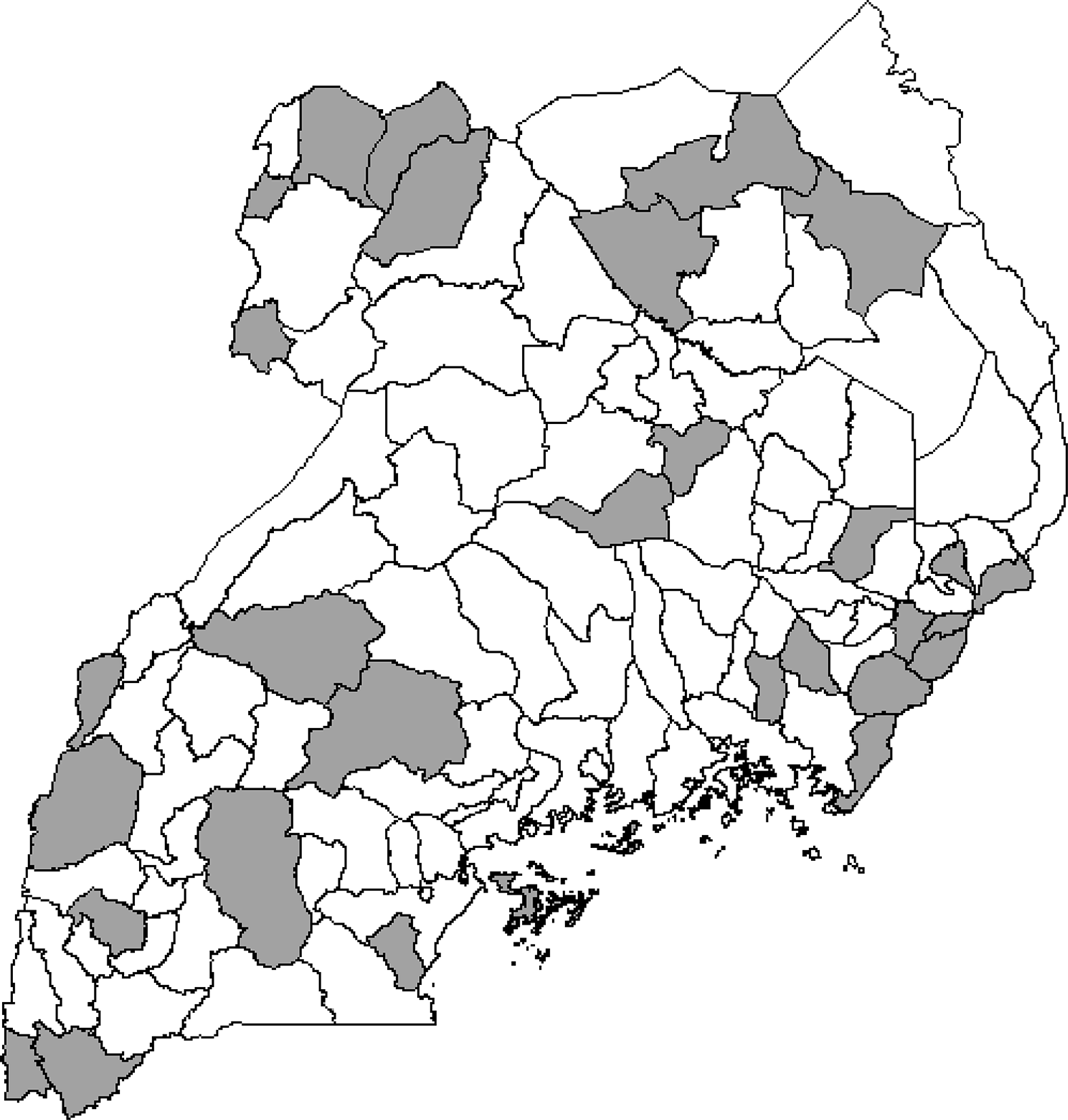
Our study context is Uganda between its second and third multiparty elections. Specifically, we study subnational Ugandan politicians across 20 subnational (LC5) legislatures (Figure 1) between October and December 2014 as part of Grossman and Michelitch (Reference Grossman and Michelitch2018)’s field experiment on politician accountability for job duty performance. Such subnational legislatures, one level below the central government, are vested with the power to make laws, regulate and monitor the delivery of public services, formulate comprehensive development plans based on local priorities, and supervise the bureaucracy. As stipulated in the Local Government Act (1997), politicians’ formal job duties include legislative services (including crafting yearly budgets), monitoring public service delivery, attending lower local government plenary sessions, and contact with the electorate.
Study area.
Notes: The study area includes the shaded districts: Agago, Amuria, Amuru, Buliisa, Gulu, Hoima, Jinja, Kabarole, Kamuli, Kanungu, Lira, Luwero, Moroto, Mpigi, Mukono, Nakapiripirit, Nebbi, Ntungamo, Rukungiri, and Soroti.

Uganda has a system of reserved seats where “special woman constituencies,” in which only female candidates can compete, are overlaid on top of “regular” subcounty constituencies (open gender, but de facto almost always candidated by men). A strong women’s movement played a key role in pushing for such affirmative action during the democratization process (Johnson, Kabuchu and Kayonga Reference Johnson, Kabuchu and Kayonga2003). Special woman constituencies encompass between one and three subcounties, depending on population size. Thus, citizens are represented by two politicians, one of each kind. Unlike the national level where women have started breaking into open seats, there are only 11 women elected to 243 open seats at the subnational level in the study area – precluding an investigation of differences across female politicians elected to open versus reserved seats. For the main analyses, we conservatively excluded open seat women. Results are robust to combining them with female politicians in reserved seats (see replication dofile).
In this context, one might expect that politicians may exhibit greater bias in favor of male constituents – traditional gender norms are fairly entrenched and men are much more participatory in holding politicians of both genders accountable (Kim and Michelitch Reference Kim and Michelitch2019). However, women politicians may favor women constituents for a few reasons. First, they are aware of overarching gender bias in politics, which may motivate them to be more attentive to women citizens. In a companion study of the same set of politicians, Garcia-Hernandez, Grossman and Michelitch (Reference Garcia-Hernandez, Grossman and Michelitch2020) show women politicians report gender-based discrimination in performing job duties. Second, this study also shows another potential driver of increased responsiveness – increased contact. Women politicians report being contacted disproportionately by female constituents on average. Third, advocacy organizations have noted (and decried) the pigeon holing of women in reserved seats to serve women, leaving men in open-gender seats to serve men as they would have traditionally (FOWODE 2020). Footnote 7 While this may not constitute a backlash effect per se, it may be that politicians view themselves as disproportionately responsible to be more responsive to same-gender citizens. This same-gender specialization may especially result from the fact that constituents are represented by two politicians – a woman in a reserved seat and an (almost always) man in an open seat.
Following previous studies and drawing on the study context, we hypothesize that
-
Politicians will be more responsive to same-gender citizens’ requests.
-
Female politicians’ same-gender responsiveness will be larger than male politicians’.
Experimental Design
To test for gender bias in politicians’ responsiveness to citizens’ requests, we embed a survey experiment in an in-person politician survey, where the target population in the aforementioned study area consists of 408 politicians (Supplemental Information (SI) A lists survey implementation details). As we report in SI B, survey enumerators achieved a 92% response rate for a total of 375 participating politicians. Due to a technical malfunction (treatment audio not playing on some device models) when the survey first launched, 42 politicians did not get the experiment in the survey. In the main analyses, the final number of observations is 333 after excluding 8 survey respondents who are women from open seats. The sample is generally representative of the target population on available covariates.
In the survey experiment, politicians were asked to divide a fixed budget to address improvements in two public service sectors – health and education, whereby the sum was programmed to always add up to 100,000 shillings. Footnote 8 These sectors were selected because they are highly salient and not stereotyped as a particular gender’s priority, allowing us to isolate the gender of the constituent from the gendered nature of a sector. Footnote 9 Before politicians made their allocation decision, survey enumerators played a prerecorded message over headphones, in which two citizens Footnote 10 report service delivery deficiencies related to worker absenteeism and express a request for improvement that would benefit themselves and their communities: Suppose you have 100,000 shillings to divide between addressing the following two problems voiced by two citizens.
-
Citizen 1 Voice: I just went to the health center to get my child tested and treated for malaria. However, there were no health workers available — they were absent. We should make sure that health center staff is present in the health center.
-
Citizen 2 Voice: I just went to the school to deliver lunch to my child. However, there was no teacher available in the classroom — they were absent. We should make sure that teachers are present in the school.
Individual politicians were randomly assigned to have Citizens 1 and 2 to be {Health Center – Male Voice, School – Female Voice} or {Health Center – Female Voice, School – Male Voice}. The enumerator subsequently asked: How much would you allocate to monitoring health center staffing versus school staffing of the 100,000? The politician then allocated tokens on the tablet between the health center and the school.
These design choices have a variety of notable strengths. First, the audio recordings are reminiscent of the typical way citizen requests are received by politicians – voice messages on their personal cell phone (email is extremely rare). Like email audit experiments, the treatment is subtle but obvious – it is easy to detect gender from the voice in the recording. Subtle but obvious treatment assignment is important to improve causal validity so that politicians receive treatment but do not engage in self-censoring behavior to minimize or maximize treatment effects. Using headphones, a common way to hear audio renders the treatment status private without drawing attention to any need for privacy, thereby reducing unintended biases emerging from enumerator or bystander presence.
Second, given that the most common types of citizen requests to politicians are either for improvements in community-level public service delivery or personal financial assistance (“handouts”), we chose allocation of a hypothetical budget between improvements in community-level service delivery as our outcome variable. Indeed, monitoring public service delivery, lobbying for targeted improvements, and budgeting for service delivery are important legally defined job duties among the politicians in this context. Thus, the request, stemming from a personal grievance about poor service delivery, would benefit the constituent and his/her community – by contrast, previous experiments have focused on requests for personal access to government services or informal favors. Although common, we did not consider using requests for handouts, since the ethics around such handouts are debated. Finally, one overarching key advantage of our study is the ability to embed the experiment in a larger in-person politician survey where Grossman and Michelitch (Reference Grossman and Michelitch2018) invested long-term fieldwork to obtain unique access to and a high response rate (92%) among these politicians – a rarity in research on politicians. Importantly, the in-person survey has an advantage in ensuring compliance – we know politicians received treatment. One major challenge in email studies is that scholars cannot know if lack of response is due to staff members’ decisions, technical glitches, or unopened email – rather than a politician’s decision to ignore or respond to certain individuals after opening and reading the email (e.g., Hughes, Gell-Redman, Crabtree, Krishnaswami, Rodenberger and Monge (Reference Hughes, Gell-Redman, Crabtree, Krishnaswami, Rodenberger and Monge2020)). Further, while analyzing differences in the type of email response (conditional on responding) often suffers from post-treatment selection bias or cruder measurement (Coppock Reference Coppock2019), we can examine the degree of discrimination cleanly.
To test H1 that politicians favor same-gender citizens, we construct the dependent variable Prioritize Schools as the difference in the allocation towards schools versus health, and for ease of visualization, divide by 1,000. We code the treatment variable
 $SameGenderSchool$
, an indicator equal to one when the same gender citizen makes a plea for school improvements, and zero otherwise (SI C shows descriptive statistics). We estimate
 $Prioritize\,Schools = \alpha + {\beta _1}\,Same\,Gender\,Schoo{l_i} + {\varepsilon _i}$
and test whether
 ${\beta _1} \gt 0$
; i.e., politicians allocate a higher share of the budget toward same-gender citizens’ requests. We report one-sided p-values.
To test H2 that female politicians favor same-gender constituents more than male politicians, we estimate
 $$PrioritizeSchools = \alpha + {\beta _1}SameGenderSchoo{l_i} + {\beta _2}FemalePoliticia{n_i} \cr + {\beta _3}SameGenderSchoo{l_i} \times FemalePoliticia{n_i} + {\varepsilon _i}.$$
We test whether
 ${\beta _3} \gt 0$
, female politicians exhibit stronger same-gender bias than male politicians, versus
 ${\beta _3} \lt 0$
, male politicians exhibit stronger same-gender bias – we thus report two-sided p-values.
The SI reports design diagnostics. First, the dependent variable is well-distributed – we are not worried about ceiling/floor effects (SI C shows descriptive statistics and survey question wording). Second, balance was achieved in covariates across treatment groups (SI D). Third, the experiment is well-powered to detect small effects (SI E).
Results
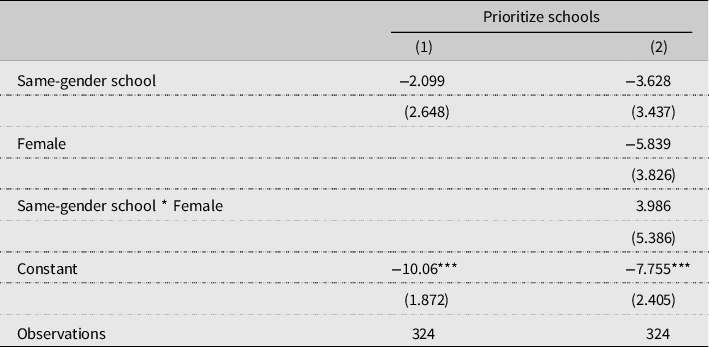
Regression results (Table 1) show that politicians do not allocate more to the sector with the same-gender constituent voice (column 1), a result consistent across male and RS-female politicians (column 2). Following our preregistered design and additional suggestions from discussants, we show the null is robust to (1) a one-way ANOVA, (2) a Kruskal–Wallis H test, (3) models with available covariates that are reasonably associated with both allocation decisions and gender (since gender is not randomly assigned) and district fixed effects, (4) difference-in-means tests, (5) collapsing the outcome into three categories, and (6) randomization inference (SI F).
(Same) Gender Bias in Responsiveness to Constituents

Notes: OLS regression results with standard errors in parentheses.
*p < 0.10, **p < 0.05, ***p < 0.01.
Given the null result, we undertake exploratory observational analysis to understand whether there are meaningful correlates of the dependent variable to lend integrity to the variable (SI G). In particular, we examine whether politicians allocate more toward a sector if they believe it is highly visible in earning constituents’ votes, following traditional theories of “ordinary” accountability pressures affecting politicians’ behavior (Harding Reference Harding2015) that may eclipse identity-based motivations (Wiener Forthcoming). Indeed, politicians believing school improvements are more visible to garner votes than health clinics (and yet other services) spend 6,057 shillings more on the school, whereas those believing health improvements are more visible to garner votes than education (and yet other sectors) spend 8,012 shillings more on the health clinic. Rather than respondent identity, beliefs about electoral rewards are associated with budget allocation.
Discussion
This study expands politician responsiveness studies, which investigate whether discrimination exists based on constituents’ identity, or (un)shared identity between politicians and constituents. Such studies have documented how many types of historically marginalized groups often receive less responsiveness from politicians (e.g., Butler and Broockman Reference Butler and Broockman2011; McClendon Reference McClendon2016; Gaikwad and Nellis Forthcoming; Carnes and Holbein Reference Carnes and Holbein2019). A growing number of studies on gender bias in politician responsiveness show contrasting results: politicians often do not exhibit gender bias on average (e.g., Loewen and MacKenzie (Reference Loewen and MacKenzie2019)) or discriminate in favor of women – a result driven by female politicians (e.g., Dhima Reference Dhima2020). Because women and men are integrated in households, while other identity groups tend to be segregated, many authors have suggested that bias against women may not be as strong. However, this statement has been made about study contexts in affluent parts of the world with more egalitarian gender norms and where female citizens often participate in politics at equal or higher rates than male counterparts (Dingler, Kroeber and Fortin-Rittberger Reference Dingler, Kroeber and Fortin-Rittberger2019).
Interestingly, in this study, we find that politicians do not discriminate in favor of a man’s request for public service delivery improvements in Uganda, despite the fact that traditional gender norms are fairly entrenched in this low-income context and reserved women’s seats are present. However, we caution against hastily interpreting the null finding as writ large support for no gender bias in Ugandan politicians’ responsiveness. First, politicians may favor same-gender citizens for other types of formal and informal constituency services. Second, constituent requests are made more frequently by men (Kim and Michelitch Reference Kim and Michelitch2019), and women may remain underrepresented.
Third, and what we find most interesting for future research, politicians may exhibit gender bias in responsiveness to citizens on gendered policy sectors (following the logic of Wiener Reference Wiener(Forthcoming)’s responsiveness study to an anti-sex trafficking organization), rather than the non-gendered sectors studied here. For example, access to clean water is a women’s issue – women walk sometimes more than 1 km to fetch water for the household, while men rarely will undertake this job because of social norms that it is emasculating. If water were voiced by a female citizen, female politicians may discriminate in favor of water (e.g., over infrastructure, the typical men’s issue). On the other hand, if a man voices a request about water, politicians may view this as indicating that the problem is especially acute and be more responsive. One could also study whether explicit gender appeals (e.g., stating “water is a women’s issue” in the request) would increase responsiveness (following Rhinehart (Reference Rhinehart2020)).
Finally, future research should continue to examine different contexts that vary socioeconomically and institutionally. We discuss some ways in which different institutions may affect gender bias in politician responsiveness in SI I. In particular, affirmative action institutions are widespread and diverse, especially in the Global South – rendering large potential cross-national differences in gender bias.
Supplementary material
To view supplementary material for this article, please visit https://doi.org/10.1017/XPS.2021.24
Data Availability
Support for this research was provided by the Carnegie Corporation of New York (Award no.), the Democratic Governance Facility as a subcontract through Advocates Coalition for Development and Environment, and an anonymous donor. The data, code, and any additional materials required to replicate all analyses in this article are available at the Journal of Experimental Political Science Dataverse within the Harvard Dataverse Network, at: doi: https://doi.org/10.7910/DVN/79T40F
Conflict of Interest
There are no conflicts of interest.