Healthcare-associated infections (HAIs) are responsible for significant morbidity and mortality in hospitalized neonates. Preterm and low-birthweight neonates have an increased susceptibility to infections owing to an immature immune system, increased duration of hospitalization, and increased need for invasive procedures.Reference Chu, Hageman, Schreiber and Alexander 1 – Reference Popoola, Budd and Wittig 4 The Centers for Disease Control and Prevention estimates that there are more than 33,000 HAIs in US neonatal intensive care units (NICUs) every year.Reference Klevens, Edwards and Richards 5 Neonates with HAIs have increased length of hospital stay and increased healthcare costs.Reference Stoll, Hansen and Fanaroff 2 , Reference Payne, Carpenter, Badger, Horbar and Rogowski 6 , Reference Sohn, Garrett and Sinkowitz-Cochran 7 Despite appropriate therapy, neonatal infections can have long-term sequelae, including adverse neurodevelopmental and growth outcomes.Reference Stoll, Hansen and Adams-Chapman 8 , Reference Schlapbach, Aebischer and Adams 9
Staphylococcus aureus is the second most common cause of HAIs and late-onset sepsis in neonates, second only to coagulase-negative Staphylococcus.Reference Hornik, Fort and Clark 10 , Reference Hocevar, Edwards, Horan, Morrell, Iwamoto and Lessa 11 In addition to the high burden of S. aureus, antibiotic-resistant S. aureus strains, especially methicillin-resistant S. aureus (MRSA), have become endemic in many NICUs.Reference Popoola, Budd and Wittig 4 , Reference Huang, Lien, Su, Chou and Lin 12 , Reference Nelson, Bizzarro, Baltimore, Dembry and Gallagher 13 Despite enhanced infection control measures and strategies, S. aureus remains a threat to neonates. Current recommendations to prevent MRSA transmission and infections in the NICU include identifying colonized neonates and placing them on contact precautions, cohorting, hand hygiene, and in some cases, decolonizing colonized neonates and/or healthcare workers.Reference Gerber, Jones and Scott 14 , Reference Popoola and Milstone 15 These strategies have focused on MRSA prevention and have overlooked potentially preventable methicillin-susceptible S. aureus (MSSA) disease. Recent data suggest that invasive MSSA infections occur 2.5 times more frequently than invasive MRSA infections in neonates, and MSSA infections have comparable morbidity and mortality in this high-risk population.Reference Shane, Hansen and Stoll 3 , Reference Carey, Duchon, Della-Latta and Saiman 16 – Reference Ericson, Popoola and Smith 19 Our objectives were to examine the impact of MSSA decolonization on the incidence of MSSA infections and to measure the prevalence of mupirocin resistance in a level IV NICU.
METHODS
Setting and Design
The Johns Hopkins Hospital (JHH) is a tertiary care academic medical center with an embedded 200-bed Children’s Center that houses a 45-bed, level IV NICU. We retrospectively identified a cohort of neonates admitted to the NICU from April 1, 2011, through September 30, 2014. We performed a quasi-experimental study to compare rates of MSSA-positive cultures and infections before and after implementation of active surveillance cultures (ASC) and decolonization of MSSA-colonized neonates. The Johns Hopkins Institutional Review Board approved this retrospective cohort study with a waiver of informed consent.
Infection Control and Prevention Program
The JHH NICU has a program of ASC and decolonization of MRSA-colonized neonates to prevent MRSA transmission and infections as previously described.Reference Popoola, Budd and Wittig 4 , Reference Milstone, Budd and Shepard 20 Nares swabs are performed weekly by nurses to identify MRSA-colonized neonates. In addition, nares swabs are performed at the time of NICU admission for neonates transferred from other hospitals or admitted from home. On April 1, 2013, the program was expanded to include ASC to identify and decolonize MSSA-colonized neonates (“the intervention”) in addition to MRSA-colonized neonates owing to occurrences of serious MSSA infections. Decolonization consisted of mupirocin applied to the nares twice a day for 5 days and 2 baths with 2% chlorhexidine gluconate–impregnated cloths administered 48 hours apart for infants greater than 36 weeks gestational age or greater than 4 weeks chronological age or daily for 5 days for infants greater than 2 months chronological age.Reference Popoola, Budd and Wittig 4 , Reference Milstone, Budd and Shepard 20
Data Collection and Outcome Ascertainment
We searched a computerized surveillance system (TheraDoc; Premier) to identify patients with surveillance cultures and cultures sent during clinical care that grew S. aureus during the study period. The primary study outcome was NICU-attributable MSSA. We compared 2 measurements to identify NICU-attributable MSSA: (1) MSSA clinical culture, defined as any clinical culture sent as part of clinical care that grew MSSA; and (2) MSSA infection, defined as any clinical culture that grew MSSA and met the National Healthcare Safety Network’s (NHSN) surveillance definition for a specific HAI. 21 We reviewed medical records of patients whose cultures sent during clinical care grew MSSA. To distinguish infection from colonization, NHSN definitions for HAIs were applied by a trained observer (V.O.P.) consistently over the study period. MRSA cultures were similarly adjudicated to assess for secular changes. Cultures were further classified into “present on admission” if they were collected less than 3 days after admission to the NICU or NICU-attributable if they were obtained 3 days or more after admission to the NICU.
Laboratory Methods
Before April 1, 2013, surveillance swabs were plated on MRSA Select (BD Diagnostics). Beginning April 1, 2013, surveillance swabs were also plated on BBL CHROMagar Staph aureus (BD Diagnostics), and beginning April 1, 2014, swabs were plated on SaSelect (Bio-Rad) in addition to MRSA Select. After 24 hours of incubation, mauve-colored colonies or pink-to-orange-colored colonies respectively were confirmed as S. aureus by Gram stain and coagulase testing. To monitor for emergence of mupirocin resistance among MSSA isolates, we tested consecutive isolates obtained from neonates after introduction of MSSA decolonization for mupirocin susceptibility using Etest (bioMérieux). We determined minimum inhibitory concentrations (MICs) using standard Clinical and Laboratory Standards Institute methodology. 22 Mupirocin susceptibility was defined as an MIC less than 4 μg/mL, low-level mupirocin resistance as an MIC from 8 to 64 μg/mL, and high-level mupirocin resistance as an MIC greater than 512 μg/mL.Reference Suwantarat, Carroll, Tekle, Ross, Popoola and Milstone 23
Statistical Analysis
We compared characteristics of neonates admitted during the preintervention and postintervention periods using χ2 tests for categorical variables and 2-sample t tests for continuous variables. The outcomes were calculated as the quarterly incidence rate of NICU-attributable MSSA clinical cultures and the quarterly incidence rate of NICU-attributable MSSA infections expressed as the number of outcomes in a quarter per 1,000 patient-days. We measured the impact of the intervention on S. aureus in the NICU by first comparing the mean quarterly incidence rates during the pre- and postintervention periods using Poisson regression and then using a quasi-experimental interrupted time-series model for the log-transformed quarterly incidence rates.Reference Linden 24 From the interrupted time-series model, the effect of the intervention is reported as (1) the “immediate” effect of the intervention as the relative change in quarterly incidence rate comparing the first quarter of the postintervention period with the last quarter of the preintervention period, and (2) the “sustained” effect of the intervention as the relative change in the quarterly incidence rate per quarter during the postintervention period. Owing to the small numbers of MRSA-positive cultures, we quantified the impact of the intervention by only comparing the mean quarterly incidence rates of MRSA before and after intervention, using Poisson regression. To determine the robustness of our findings, we performed a sensitivity analysis by varying the start time of the intervention period in the interrupted time-series model. Data were maintained in Access 2007 (Microsoft) and analyzed using StataSE, version 13.1 (StataCorp), and Excel 2007 (Microsoft). The interrupted time-series models were fit using the itsa module in Stata.
RESULTS
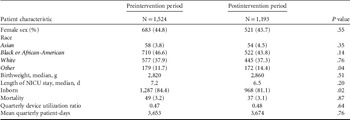
During the 24-month preintervention period, 1,524 neonates were admitted to the NICU, accounting for 29,220 patient-days. In the 18 months after the MSSA screening and decolonization program began, 1,193 neonates were admitted to the NICU, accounting for 22,045 patient-days. Of the neonates admitted in the postintervention period, 899 (75.2%) were screened for MSSA colonization and 89 had a surveillance culture grow MSSA. Of those 89 MSSA-colonized neonates, 72 (80.9%) were treated with mupirocin and chlorhexidine per protocol. Neonates admitted in the pre- and postintervention periods demonstrated minor differences in demographic and clinical characteristics that were unlikely to impact findings (Table 1).
Characteristics of Neonates Admitted in the NICU During Preintervention (April 1, 2011-March 31, 2013) and Postintervention (April 1, 2013-September 30, 2014)

NOTE. Data are no. (%) of patients unless otherwise specified. NICU, neonatal intensive care unit.
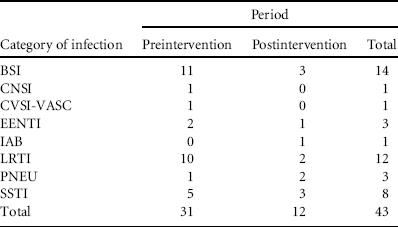
During the study period, 83 patients had 153 NICU-attributable S. aureus clinical isolates. Clinical isolates comprised 142 MSSA (92.8%) and 11 MRSA (7.2%) cultures. Forty-three (30.3%) of the 142 MSSA cultures met the NHSN’s definition for a HAI. Sites of MSSA infection were bloodstream infections (14 [32.6%]), lower respiratory tract (12 [27.9%]), skin and soft-tissue (8 [18.6%]), pneumonia (3 [7.0%]), conjunctivitis (3 [7.0%]), meningitis (1 [2.3%]), phlebitis (1 [2.3%]), and intra-abdominal infection (1 [2.3%]) (Table 2A).
Distribution of Infections

NOTE. Data are number of infections. The preintervention period was 24 months and the postintervention period was 18 months. BSI, bloodstream infection; CNS, central nervous system infection (meningitis); CVS-VASC, cardiovascular system-vascular (phlebitis); EENT, eye, ear, nose and throat infection (conjunctivitis); IAB, intra-abdominal infection; LRT, lower respiratory tract infection; PNEU, pneumonia; SSTI, skin and soft-tissue infection.
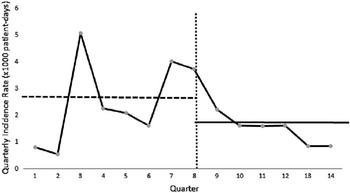
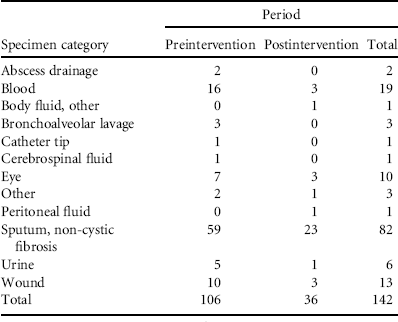
During the preintervention period there were 106 MSSA-positive clinical cultures compared with 36 during the postintervention period (Table 2B). Overall, the incidence rate of MSSA clinical cultures was 3.62 per 1,000 patient-days during the preintervention period compared with 1.62 per 1,000 patient-days during the postintervention period (incidence rate ratio [IRR], 0.45 [95% CI, 0.22–0.92]). In the quarter following introduction of an ASC and decolonization protocol, MSSA clinical culture incidence rates decreased by an estimated 64% (IRR, 0.36 [95% CI, 0.19–0.70]) (Figure 1). This reduction in MSSA clinical culture incidence rates was sustained during the postintervention period with an estimated quarterly decrease of 21% (IRR, 0.79 [95% CI, 0.74–0.84]). On performing a sensitivity analysis with varying start dates for the postintervention period (the start date was adjusted backwards into the preintervention period by 1quarter at a time for 4 quarters), a decrease in the postintervention slope of MSSA clinical culture rates was observed at each of the tested start dates; however, a statistically significant immediate drop in level of MSSA clinical culture rates occurred only at the actual start date.
Mean quarterly incidence of methicillin-susceptible Staphylococcus aureus before and after implementation of active surveillance cultures and decolonization protocol. The dashed horizontal and solid horizontal lines represent the incidence rate of methicillin-susceptible S. aureus averaged over the pre- and postintervention periods, respectively, and the dotted vertical line (beginning of the ninth study quarter) marks the start of the intervention.

Thirty-one MSSA infections (per NHSN criteria) occurred during the preintervention period compared with 12 MSSA infections during the postintervention period. Overall, the incidence rate of MSSA infections was 1.07 per 1,000 patient-days during the preintervention period compared with 0.55 per 1,000 patient-days during the postintervention period (IRR, 0.51 [95% CI, 0.14–1.82]). Immediately following the intervention, the incidence rate of MSSA infections decreased in level by an estimated 73% (IRR, 0.27 [95% CI, 0.10–0.79]). There was not a sustained reduction in incidence rates of MSSA infections during the postintervention period (IRR, 0.83 [95% CI, 0.62–1.12]).
Distribution of Clinical Culture Categories

NOTE. Data are number of clinical cultures. The preintervention period was 24 months and the postintervention period was 18 months.
Because other infection control measures in the unit would have impacted MRSA and MSSA rates over time, MRSA clinical cultures and infections were assessed to help confirm an independent effect on the addition of screening and decolonizing MSSA carriers. There was not a difference in the rate of positive MRSA cultures and MRSA infections comparing the pre- with postintervention periods. There were 8 positive MRSA clinical cultures during the preintervention period and 3 during the postintervention period. Of the 11 NICU-attributable clinical cultures that grew MRSA during the study period only 2 (18.2%), 1 each in the pre- and postintervention periods, met the NHSN’s definition for a specific HAI. The mean quarterly incidence rate of NICU-attributable MRSA positive clinical cultures was 0.27 and 0.16 per 1,000 patient-days during the pre- and postintervention periods, respectively (IRR, 0.60 [95% CI, 0.05–7.77]).
Of the first 85 neonates who had a surveillance or clinical culture grow MSSA after the intervention, 65 had an isolate available for mupirocin susceptibility testing. None of the 65 tested MSSA isolates were resistant to mupirocin. The median mupirocin MIC was 0.19 μg/mL.
DISCUSSION
S. aureus remains a major cause of HAIs and late-onset sepsis in neonates. ASC and decolonization for MSSA successfully decreased S. aureus disease in our NICU. Quarterly incidence rates of MSSA-positive clinical cultures and MSSA infections decreased more than 50% immediately following implementation of this strategy. Quarterly incidence rates of MSSA-positive cultures continued to decrease by 21% per quarter for the remainder of the study period. To our knowledge, this is the first study to evaluate the impact of active surveillance and targeted decolonization for decreasing MSSA burden in the NICU in a non-outbreak setting.
ASC coupled with decolonization has been shown to be an effective strategy in decreasing S. aureus transmission and infection.Reference Huang, Lien, Su, Chou and Lin 12 , Reference Milstone, Budd and Shepard 20 , Reference Khoury, Jones, Grim, Dunne and Fraser 25 Current guidelines suggest that decolonization may be considered in high-risk neonates during a MRSA outbreak or to combat endemic MRSA when other strategies have failed.Reference Calfee, Salgado and Milstone 26 Recommendations are less clear for MSSA and few data exist on the safety and efficacy of decolonization in this population.Reference Nelson, Bizzarro, Dembry, Baltimore and Gallagher 27 Delaney et alReference Delaney, Wang and Melish 28 found that after instituting a mupirocin prophylaxis regimen for 7 years, incidence rate of S. aureus (MSSA and MRSA) infections in their NICU decreased from 1.88 per 1,000 patient-days to 0.33 per 1,000 patient-days. They found no mupirocin-resistant S. aureus isolates.
Whereas MRSA has been the target of most NICU S. aureus prevention and control programs, MSSA may cause comparable morbidity and mortality and is likely more prevalent in most centers.Reference Carey, Duchon, Della-Latta and Saiman 16 – Reference Ericson, Popoola and Smith 19 Ericson and colleaguesReference Ericson, Popoola and Smith 19 recently reported that MSSA was responsible for 2.5 times more infections than MRSA. In a study by Shane and colleaguesReference Shane, Hansen and Stoll 3 of 8,444 very-low-birthweight neonates with S. aureus bacteremia or meningitis, MSSA was nearly thrice as prevalent as MRSA and both strains were associated with high mortality. In our study, MSSA accounted for greater than 90% of all S. aureus clinical isolates, and a third of all MSSA infections were bloodstream infections. A higher absolute burden of disease and mortality from MSSA compared with MRSA strains justifies refocusing prevention strategies to include MSSA in addition to MRSA.
Our findings are consistent with previous reports of a low prevalence of mupirocin resistance among S. aureus isolates from mupirocin-treated neonates. Hitomi et alReference Hitomi, Kubota and Mori 29 described the use of universal decolonization using mupirocin as a strategy for eradicating an outbreak of MRSA in their NICU. As discussed above, Delaney and colleaguesReference Delaney, Wang and Melish 28 reported treating all neonates in their NICU with intranasal mupirocin for 7 years. Mupirocin resistance was not observed in either study. During a recent study by our group of mupirocin resistance among MRSA isolates from hospitalized neonates, we found a low prevalence of low-level mupirocin resistance (3 [3.6%] of 84 isolates) and no isolates with high-level resistance to mupirocin.Reference Suwantarat, Carroll, Tekle, Ross, Popoola and Milstone 23 Although high-level mupirocin resistance has been associated with treatment failure, the clinical significance of low-level mupirocin resistance is unclear.Reference Walker, Vasquez, Dula, Bullock and Sarubbi 30 Similarly, in this study, we performed susceptibility testing on 65 available isolates from the first 85 neonates who had a culture grow MSSA after the intervention and found no mupirocin-resistant MSSA isolates. Acquisition of mupirocin resistance is often a concern when considering a more aggressive decolonization strategy, such as one that includes decolonizing MSSA-colonized neonates. However, although mupirocin resistance has been reported following widespread use in hospitalized adults,Reference Miller, Dascal, Portnoy and Mendelson 31 – Reference Choudhury, Krishnan and Ang 33 this has not been reported in neonates.
Data on the cost-effectiveness of ASC and decolonization for prevention of S. aureus are limited. You et al,Reference You, Chan, Wong and Ip 34 using decision analysis modeling, recently examined the potential clinical outcomes and cost of ASC for MRSA with and without decolonization in Hong Kong NICUs. Even at very low levels of decolonization efficacy for prevention of MRSA infections in colonized neonates, decolonization combined with ASC was both cost-saving and effective in decreasing incidence of MRSA infections and MRSA-associated mortality. For programs already collecting surveillance cultures for MRSA colonization, there is little additional expense to identify MSSA-colonized infants. Additional studies are needed to determine the cost-effectiveness of S. aureus surveillance and decolonization programs in the NICU.
Despite its benefits, decolonization may negatively impact the developing neonatal nasal microbiome.Reference Carey 35 Although chlorhexidine was well tolerated in our population with no skin toxicity observed, the broad antimicrobial activity of mupirocin and chlorhexidine could predispose the neonate to colonization by more harmful pathogens. When one is considering decolonization as an infection control strategy in the NICU, therefore, the risks must be carefully weighed against benefits. Neonates should be closely monitored for acquisition of mupirocin resistance and replacement of the nasal flora by fungi and other pathogens. By targeting neonates for decolonization through ASC rather than as universal treatment, the risks are restricted to those infants who may have the most benefit.
The primary outcome (positive clinical culture) has been used before as a surrogate outcome for MRSA infection and burden.Reference Huang, Septimus and Kleinman 36 This outcome likely overestimates the burden of disease, but our conclusions are supported by the similar observed reduction in MSSA infections that met the NHSN’s surveillance definition for a specific HAI. All quasi-experimental studies are at risk of influence by unobserved changes in practices over time. To account for this possibility, the burden of MRSA was evaluated during the study period and no change was observed reflecting the targeted nature of this intervention. The decrease in incidence rates of MSSA-positive clinical cultures and NHSN-defined MSSA infections may represent a return to baseline rates following an outbreak or a regression to the mean. However, during sensitivity analyses, although shifting the start of the intervention period backwards did not change the postintervention slope significantly, the immediate drop in rates of MSSA was statistically significant only at the actual intervention start time. Compliance with the intervention was only 78%, but this is partially due to the fact that some neonates were discharged from the NICU before culture results were reported. Finally, although median birthweight is comparable between the pre- and postintervention periods, it is possible that there is a difference in the number of very-low-birthweight neonates in each period, but we think this is unlikely.
Preterm and low-birthweight neonates are particularly vulnerable to S. aureus infections. ASC and decolonization may be effective in decreasing the burden of S. aureus in NICUs and preventing infections and should not be limited to MRSA-colonized neonates. Additional studies are needed to confirm the impact of decolonization on reducing MSSA infections among hospitalized neonates and to monitor for unanticipated consequences.
ACKNOWLEDGMENTS
We thank the JHH Clinical Microbiology Laboratory staff, the JHH Neonatal Intensive Care Unit nursing staff, and the JHH Department of Hospital Epidemiology and Infection Control for their support of this study.
Financial support. National Institute of Allergy and Infectious Disease, National Institutes of Health (grant R03AI117169); the Agency for Healthcare Research and Quality (grant R01HS022872); the Sherrilyn and Ken Fisher Center for Environmental Infectious Diseases, Division of Infectious Diseases of the Johns Hopkins University School of Medicine; the National Center for Research Resources, a component of the National Institutes of Health (grant UL1 RR 025005); and National Institutes of Health Roadmap for Medical Research.
Potential conflicts of interest. A.M.M. reports that he receives grant support from Sage Products. All other authors report no conflicts relevant to this article.
Disclaimer: The contents are solely the responsibility of the authors and do not necessarily represent the official view of the Fisher Center, the National Center for Research Resources, the National Institutes of Health, or the Agency for Healthcare Research and Quality.