INTRODUCTION
Supplementary fat is routinely included in the diets of young pigs although it is generally removed with increasing weight to match the (perceived) declining need for higher energy diets and concerns with increasing carcass fat content as pigs approach market weight (Campbell Reference Campbell, Cronjé and Richards2005). The use of dietary fat for grower and finisher pigs has been reviewed previously (Cera et al. Reference Cera, Mahan and Reinhart1988; Li et al. Reference Li, Thaler, Nelssen, Harmon, Allee and Weeden1990; Nichols et al. Reference Nichols, Nelssen, Hancock, Kropf, Hines, Goodband and Tokach1991; Pettigrew & Moser Reference Pettigrew, Moser, Miller, Ullrey and Lewis1991; Øverland et al. Reference Øverland, Rørvik and Skrede1999; Young et al. Reference Young, Tokach, Dritz, Goodband, Nelssen, Goodband, Tokach, Dritz and De Rouchey2003; Campbell Reference Campbell, Cronjé and Richards2005), with Campbell (Reference Campbell, Cronjé and Richards2005) estimating that for each 10 g/kg increase in added fat, there could be c. 2% improvement in feed efficiency. These data suggest that feeding the appropriate amount of supplementary fat at the appropriate stage(s) of growth can enhance overall pig performance.
Previous studies have investigated the influence of fat addition in grower-finisher diets on pig performance and carcass composition, often with conflicting results (Madsen et al. Reference Madsen, Jakobsen and Mortensen1992; Williams et al. Reference Williams, Cline, Schinkel and Jones1994; Stein et al. Reference Stein, Hahn and Easter1996; De la Llata et al. Reference De La Llata, Dritz, Tokach, Goodband, Nelssen and Loughin2001, Reference De La Llata, Dritz, Tokach, Goodband and Nelssen2007; Engel et al. Reference Engel, Smith II, Unruh, Goodband, O'Quinn, Tokach and Nelssen2001; Baudon et al. Reference Baudon, Hancock, Llanes, Goodband, Tokach, Dritz and De Rouchey2003; Dugan et al. Reference Dugan, Aalhus and Robertson2003; Young et al. Reference Young, Tokach, Dritz, Goodband, Nelssen, Goodband, Tokach, Dritz and De Rouchey2003; Apple et al. Reference Apple, Maxwell, Rakes, Hutchison, Wallis, Stephenson, Johnson, Johnson and Kellogg2005; Benz et al. Reference Benz, Tokach, Dritz, Nelssen, Derouchey, Sulabo and Goodband2011; Quiniou & Noblet Reference Quiniou and Noblet2012). Data from Campbell (Reference Campbell, Cronjé and Richards2005) suggest that early positive effects on growth may be lost if fat is removed from subsequent diets and that, for reasons yet to be established, older pigs appear more responsive to supplementary fat than younger pigs. There is also apparent concern regarding the long-term effects of adding fat to grower/finisher pig diets. Campbell (Reference Campbell, Cronjé and Richards2005) proposed that it takes some time for pigs to perceive that fat has been removed from the diet, or that there is a lag in the animals' adaptation to a change in dietary fat level, which might cause a lower energy intake and growth for a period if fat is removed.
One reason for inconsistencies between studies could be due to carry-over effects of added fat in the diet from one period of growth to another period. The current study, therefore, was designed to investigate the carry-over effects, if any, of added fat in the grower period on subsequent and overall performance and carcass characteristics in the finisher period, with the aim of developing an optimum feeding strategy for grower and finisher pigs. The hypotheses examined were that (i) supplementing grower/finisher diets with up to 80 g added fat/kg would improve performance in the grower period and overall without any effect on P2 fat thickness (i.e. thickness of fat at 65 mm down the left side from the midline, at the level of the head of the last rib), and (ii) feeding supplementary fat only in the finisher period would enhance production as no supplementary fat would be necessary in the grower period. However, eliminating fat in the finisher period, if already present in a grower diet, would be detrimental to growth performance.
MATERIALS AND METHODS
This study was conducted in compliance with the Australian Code of Practice for the Care and Use of Animals for Scientific Purposes (NHMRC 2004) and was approved by the Animal Ethics Committee of The University of Adelaide, Adelaide, South Australia.
Animals and housing
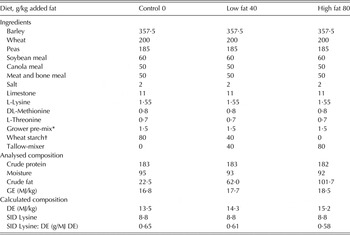
A total of 300 Landrace × Large White pigs (boars and gilts) were obtained from a high-health-status commercial piggery (Roseworthy Piggery Pty Ltd., Roseworthy, South Australia). Pigs were selected at 5 weeks of age with an average individual body weight (BW) of 10 (±0·23) kg and were group-housed in three rooms on partially slatted and partially concrete flooring with natural ventilation. Each room measured 6·5 × 6·2 m and had four feeder access points and four individual nipple water drinkers. The pigs were offered a commercial weaner diet with no added fat (Table 1) until BW was 30 (±0·33) kg. At this time 288 of the animals were randomly selected, stratified on the basis of weight and sex and then within strata randomly allocated to dietary treatments containing 0, 40 and 80 g added fat/kg (12 pigs per pen × 24 pens) on entry into the finisher sheds. These experimental buildings had curtains either side and were naturally ventilated. Each shed had partially slatted and partially concrete flooring and each pen was equipped with a self-feeder and two water nipple drinkers.
Composition and analyses of the experimental diets (g/kg of diet, as fed)

SID, standardized ileal digestible.
* Supplied per kg of diet: 75 g iron (FeSO4); 20 g copper (CuSO4); 40 g manganese (MnO); 100 g zinc (ZnO); 200 mg selenuim (Na2SeO3); 1 g iodine (KI); 250 mg cobalt (CoSO4); vitamin A, 10 MIU; vitamin D3, 2 MIU; vitamin E, 50 g; vitamin K, 1·8 g; thiamine, 1·5 g; riboflavin, 6 g; pyridoxine, 3 g; vitamin B12, 25 mg; pantothenic acid, 11 g; folic acid, 750 mg; niacin, 20 g and biotin, 100 mg.
† Starch replaced with 40 and 80 g tallow/kg to produce diets with 0, 40 and 80 g fat/kg.
Experimental design and diets
The experiment was divided into an initial 5-week period (Period 1), followed by a final 5-week period (Period 2). The experiment in both periods was factorial in design, with Period 1 designed to test for the effects of sex (gilts v. boars), added dietary fat level (as tallow; 0 v. 40 and 80 g/kg of the diet), and within added dietary fat level (40 v. 80 g fat/kg). In Period 2, the factors tested were the effects of sex (gilts v. boars), the effects of the initial diets on performance in Period 2 and overall, and possible interactions between dietary fat level in Period 1 and in Period 2 on performance in Period 2, and overall. The two fat levels tested in Period 2 were zero and 40 g/kg.
In Period 1, there were eight pens/diet (0, 40, 80 g added fat/kg), resulting in 96 pigs for each diet [48 gilts (n = 4 pens) and 48 boars (n = 4 pens) per dietary treatment]. In Period 2 there were 12 pens per diet (0 v. 40 g added fat/kg); however, Period 1 consumption was included as a factor (either 0, or 40 and 80 g fat/kg) resulting in 72 pigs for each diet [36 gilts (n = 3 pens) and 36 boars (n = 3 pens) per diet].
Experimental diets were formulated based on wheat, barley, soybean meal, canola meal and peas (Table 1) and were offered on an ad libitum basis as a meal, with water freely available. A common base mix was made including 80 g starch/kg, which was replaced with tallow to prepare the diets with 40 g/kg and 80 g/kg of added fat. The calculated digestible energy (DE) contents of the diets containing zero, 40 g/kg and 80 g/kg of added fat were 13·5, 14·3 and 15·2 MJ DE/kg, respectively. The calculated level of standardized ileal digestible (SID) lysine was kept constant at 8·8 g/kg of diet.
Animal measurements
The BW was measured at the start of the study and then at 2, 4, 5, 6, 8 and 10 weeks of the study, to cover both periods. Measurements of average daily weight gain, average daily feed intake (ADFI), feed conversion ratio (FCR) and P2 backfat thickness (65 mm down the left side from the midline, at the level of the head of the last rib) were conducted at the beginning, and at 14-day intervals throughout the experimental period. An experienced operator measured the backfat depth ultrasonically at the P2 position using a hand-held digital backfat indicator (Renco Lean-Meater®; Minneapolis, MN USA).
All experimental animals were slaughtered on the same day at a commercial abattoir at the end of the 10-week study. The pigs were transported ~1·5 h to the abattoir where they underwent CO2 anaesthesia and subsequent exsanguination. Carcass weight and backfat depth at the P2 position were measured on the slaughter line using a Hennessy Grading Probe 4 (Hennessy Grading Systems Limited, Auckland, New Zealand).
Chemical analyses
Crude protein was determined using the Dumas method by first measuring the nitrogen (N) content (Rapid N Cube Nitrogen Analyzer, Elementar Analysensysteme GmbH, Hanau, Germany) and using a conversion coefficient of N to protein of 6·25, according to the AOAC method 968·06 (AOAC 1990). Gross energy (GE) was determined by adiabatic bomb calorimetry (Parr Instrument Company, Moline, IL, USA). Dry matter was analysed by placing washed and dried, numbered crucibles in an oven for 2 h at 100 °C. Crude fat (CF) was analysed according to the AOAC method 920·39 (AOAC 1990). Acid hydrolysis preceding CF was analysed according to AOAC method 954·02 (AOAC 2006).
Statistical analyses
All statistical analyses were performed using GenStat (VSN International 2012). Data from Period 1 were analysed by ANOVA for effects of sex (gilt v. boar), dietary fat (0 v. 40 and 80 g/kg) and within dietary fat (40 v. 80 g/kg), and all interactions. The effect of level of supplementary fat inclusion was further separated into linear and quadratic contrasts using the ‘POL’ routine. Data from Period 2 and over the entire 10-week period were analysed for sex (gilt v. boar), dietary fat (0 v. 40 and 80 g/kg) and within dietary fat (40 v. 80 g/kg) during Period 1, and between dietary fat (0 v. 40 g/kg) during Period 2. In virtually all instances there were no significant within-dietary-fat effects during Period 1, so data were pooled for interpretation. Since there were no significant sex effects on initial weight, BW and carcass weight were analysed using initial live weights as a covariate. Statistical significance was accepted at P < 0·05.
RESULTS
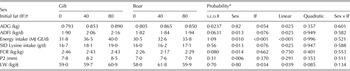
During the first 5 weeks there was no difference in the performance indices recorded between pigs consuming the diets with 40 and 80 g supplementary fat/kg, as indicated by no significant within-fat (IF) effects, except for energy intake (P < 0·05). The ADG was similar between gilts and boars (0·845 v. 0·840 kg, P = 0·821) and increased linearly with level of supplementary dietary fat (0·799 v. 0·859 and 0·870 kg, P = 0·025). The ADFI was higher in gilts than in boars (2·04 v. 1·87 kg, P = 0·013) and tended to be increased by supplementary fat (2·00 v. 1·86 kg, P = 0·076). Daily GE intake was higher in gilts than in boars (36·1 v. 33·0 MJ GE, P = 0·010) and increased with increasing level of fat (31·2 v. 34·5 and 37·9 MJ GE), as demonstrated by significant within (P < 0·001) and between (linear; P < 0·001) contrasts. The SID lysine intakes were consistent with the effects for ADFI and tended to be increased by supplementary fat (P = 0·076). Gilts had a higher FCR than boars (2·44 v. 2·24, P = 0·014) and this was not altered by supplementary fat (2·36 v. 2·33, P = 0·662). Backfat depth at the P2 site was higher after 5 weeks in gilts than in boars (8·2 v. 7·2 mm, P = 0·006) but was not altered by supplementary fat (7·4 v. 7·8 mm, P = 0·370). There was no difference in live weight (LW) at 5 weeks between the sexes (P = 0·80) but it was increased by dietary fat (60·4 v. 58·5 kg, P = 0·034). Furthermore, the effect of added fat in the diet (0 v. 40 v. 80 g/kg) was linear (P = 0·039) (Table 2).
The effects of sex and level of supplementary dietary fat during the initial phase (Period 1) on production attributes of grower pigs

ADG, average daily gain; ADFI, average daily feed intake; GE, gross energy; SID, standardized ileal digestible; FCR, feed conversion ratio; LW, live weight.
* There were no significant interactions so additional probability values have not been shown. Effect of initial fat (IF) refers to 0 v. 40 and 80 g fat/kg while linear and quadratic effects refer to linear and quadratic effects of dose of IF.
† Refers to level of supplemental fat (g/kg) during the initial 5 weeks of the study.
‡ Standard error of the difference for the effect of sex. For s.e. of the difference for IF, multiply by 1·064.
§ Analysed using initial BW as covariate.
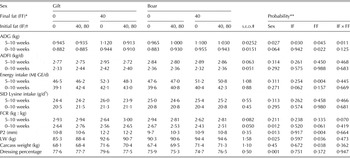
During the second 5-week period there was no difference (data not shown) in performance indices between pigs that consumed the diets containing 40 and 80 g supplementary fat/kg during Period 1, hence the data from animals consuming supplementary fat during this period have been pooled for presentation. The ADG was lower in gilts than boars (0·978 v. 1·024 kg, P = 0·027) and in pigs that received supplementary fat during Period 1 (0·970 v. 1·030 kg, P = 0·030), and was increased by supplementary fat in Period 2 (1·041 v. 0·961 kg, P = 0·045). However, there was an interaction (P = 0·011) such that dietary fat supplementation during Period 2 increased ADG in pigs that had not previously consumed dietary fat (1·110 v. 0·955 kg), but not in pigs that had previously consumed dietary fat (0·968 v. 0·972 kg). Over the entire treatment period, ADG tended to be lower in gilts than in boars (0·905 v. 0·928 kg, P = 0·064), was unchanged by dietary fat in Period 1 (0·916 v. 0·917 kg, P = 0·942) and was increased in pigs receiving supplementary fat during Period 2 (0·938 v. 0·895 kg, P = 0·022) (Table 3).
The effects of sex and level of supplementary dietary fat during the initial phase (Period 1) and during the second phase (Period 2) on production attributes of grower-finisher pigs

ADG, average daily gain; ADFI, average daily feed intake; GE, gross energy; SID, standardized ileal digestible; FCR, feed conversion ratio; LW, live weight.
* Refers to level of supplementary fat (g/kg) during the initial 5 weeks of the study. Since there were no significant within initial-supplementary-fat effects for 40 and 80 g supplementary fat/kg during the initial period, these data have been pooled.
** There were no significant within initial-supplementary-fat effects nor were there any other significant interactions, so these probability values have not been shown.
† Refers to level of supplementary fat (g/kg) during the final 5 weeks of the study.
‡ Standard error of the difference for the effect of sex and FF. For s.e. of the difference for the IF, multiply by 1·064.
There were no effects of sex (P = 0·314) or dietary fat during the first (P = 0·261) or second (P = 0·450) periods on ADFI during Period 2. Similarly, there were no effects of sex (P = 0·292) or dietary fat during the first (P = 0·575) or second (P = 0·988) periods on feed intake over the entire study (Table 3).
There was no effect of sex (P = 0·311) or supplementary fat during the first period (P = 0·254) on daily GE consumption during the second period. However, supplementary fat during Period 2 increased GE consumption during the second period (50·6 v. 46·8 MJ GE, P = 0·004). There was no effect of sex (P = 0·271) or supplementary fat during the second period (P = 0·157) on GE consumption over the entire study. However, supplementary fat during the first period tended to increase GE consumption over the entire study (42·1 v. 40·3 MJ GE, P = 0·062). There were no significant effects on SID lysine intake (Table 3).
While there were no effects of sex (P = 0·211) or dietary fat during the first (P = 0·238) or second (P = 0·335) periods on FCR, there was a trend (P = 0·070) for an interaction such that dietary fat supplementation during Period 2 decreased FCR in pigs that had not previously consumed dietary fat (2·63 v. 2·93) but not in pigs that had previously consumed dietary fat (2·88 v. 2·91). Over the entire study, FCR was higher in gilts than boars (2·65 v. 2·54, P = 0·012), was not affected by supplementary fat during the first period (2·58 v. 2·61, P = 0·520), but tended to be reduced by dietary fat supplementation during the second period (2·55 v. 2·65, P = 0·061) (Table 3).
Backfat depth at the P2 position was higher after the entire study in gilts than in boars (11·4 v. 10·4 mm, P = 0·013). It was not altered by supplementary fat during the first period (10·9 v. 10·9 mm, P = 0·917), but was increased by dietary fat during the second period (11·5 v. 10·3 mm, P = 0·004) (Table 3).
Final LW was lower in gilts than in boars (89·2 v. 92·5 kg, P = 0·025) and was not altered by supplementary fat during the first period (90·7 v. 90·1 kg, P = 0·597), but was increased by dietary fat during the second period (93·1 v. 88·6 kg, P = 0·036). Final carcass weight was not different between the sexes (69·6 v. 69·9 kg, P = 0·452) and was not altered by supplementary fat during the first period (69·6 v. 69·9 kg, P = 0·672), but was increased by dietary fat during the second period (71·2 v. 68·3 kg, P = 0·038). Carcass dressing percentage was higher in gilts than in boars (78·1 v. 75·6%, P < 0·001) but was not influenced by dietary fat during either period (Table 3).
DISCUSSION
The results showed that increasing the level of fat added to the diet in place of starch in Period 1 (0–5 weeks) increased ADG in that period but had no effect on growth rate over the entire experimental period (0–10 weeks). In contrast the addition of fat, in place of starch, to the diet in Period 2 increased ADG in that period and over the whole 10 weeks of the study, resulting in a significant increase in carcass weight. The results did not support the hypothesis that removing fat from the diet offered in one period would adversely affect performance in a subsequent period, but suggest that in terms of pig throughput the most effective strategy would be to supplement the finisher rather than the grower diet with fat. Of particular interest was the marked improvement in ADG and the tendency for the greatest improvement in FCR in Period 2 to be achieved in pigs offered the diet without added fat in Period 1 and with 40 g added fat/kg in Period 2. Female pigs on this combination grew c. 23% faster between 5 and 10 weeks than the average of those on the other three treatment combinations. For entire male pigs the corresponding improvement in growth rate was c. 10%.
The results of the current study suggest that the greatest impact on overall performance and carcass weight of including fat, in replacement of starch, in the diet is likely to be achieved in the period immediately before sale, and that commercially the best and potentially the lowest cost strategy may be to use diets without added fat in the grower period and with added fat in the finisher period. Furthermore, these data provide no evidence that adding fat, in place of starch, to the diet offered to grower pigs per se has any long-term advantage on carcass weight or feed efficiency. However in the present experiment there was no effect of increasing dietary fat or energy content on FCR in Period 1 and a tendency for FCR to only be improved in Period 2 for pigs offered a diet supplemented with fat in Period 2 only. These data concur with the findings by Perez et al. (Reference Perez, Soltwedel, Radke and Holzgraefe2014), who observed a linear improvement in FCR as more fat (from 0 to 20 to 40 g/kg) was added to the diets of finisher pigs. In contrast, Stein et al. (Reference Stein, Hahn and Easter1996) and Beaulieu et al. (Reference Beaulieu, Williams and Patience2009) noted improvements in ADG and FCR when the DE content of the diets was increased (from 11·29 to 14·64 and from 12·93 to 14·94 MJ/kg, respectively), but in both the studies pigs were fed these diets throughout the entire grower-finisher phase (51–112 and 31–113 kg, respectively). In the above studies the increase in energy intake also increased growth rate, and because maintenance is relatively constant for a given weight, increasing growth rate dilutes the proportion of energy being used for maintenance and contributes to improved efficiency of energy use.
In this regard, the lack of an effect of the higher energy diets on overall FCR in the current study was unexpected and may have been associated with the fact that dietary amino acid levels were held constant, and consequently the amino acid : DE ratio declined with the addition of fat. The diets may therefore have become marginally and increasingly deficient as the level of fat and the diet DE was increased, potentially ameliorating the expected improvement in FCR with increasing dietary energy level. This possibility is further suggested by the increase in ADFI observed with increasing fat addition in Period 1 but not in Period 2 when the pigs were heavier, and any amino acid deficiency would have been less severe than in Period 1. Nevertheless the amino acid : DE ratio was obviously adequate enough to enable boars to express their higher protein deposition capacity that was reflected in better feed efficiency (c. 9%) in Period 1 than gilts.
Baudon et al. (Reference Baudon, Hancock, Llanes, Goodband, Tokach, Dritz and De Rouchey2003) and Benz et al. (Reference Benz, Tokach, Dritz, Nelssen, Derouchey, Sulabo and Goodband2011) also reported that adding fat to the diets of finisher pigs only affected growth rate while Apple et al. (Reference Apple, Maxwell, Rakes, Hutchison, Wallis, Stephenson, Johnson, Johnson and Kellogg2005) reported no changes in the performance of pigs in response to supplementation of the diet with fat. Azain et al. (Reference Azain, Bullock, Kasser and Veenhuizen1992) similarly reported that in grower pigs, increasing the energy density of the diet by adding fat did not increase the energy intake of ad libitum-fed pigs. In contrast, Collins et al. (Reference Collins, Philpotts and Henman2009) reported a positive effect of added fat on the growth rate and feed efficiency of pigs between 60 and 100 kg with improvements being more pronounced during the initial 14-day feeding period. The inconsistency in results across published studies probably reflects the fact that the effects of dietary energy content on feed and energy intake and subsequent utilization are influenced by many factors including LW, stocking density, competition for feeder space, the physiological and (or) immunological status of the pigs and possibly even genetic and behavioural factors (Campbell Reference Campbell, Cronjé and Richards2005), all of which are yet to be fully elucidated.
The improvement in carcass weight associated with supplementing the diet offered in Period 2 with 40 g fat/kg, in replacement of starch, was associated with an increase in carcass P2 fat thickness, particularly in females. When carcass weight was used as a covariate in the analysis of the results the effect of the diet fat/energy level on P2 was statistically significant. In deciding any commercial implications of the current results, the change in P2 would need to be taken into consideration and balanced against improvements in carcass weight and FCR associated with the use of the higher energy diet between 5 and 10 weeks. The higher P2 exhibited by females at the end of Periods 1 and 2 is consistent with expected and reported differences in protein and fat deposition capacity between the sexes (Campbell Reference Campbell, Cronjé and Richards2005).
In conclusion, the data presented herein question current nutritional strategies for grower/finisher pigs where the dietary fat and dietary energy levels are generally reduced over time. These data confirm that increasing the dietary energy level in grower pigs by the addition of fat, in place of starch, improves ADG and has no immediate or longer-term effects on carcass fatness. However, the effects of added fat, in place of starch, on growth performance are not sustained. Indeed the present results suggest that finisher pigs, due possibly to physical and other constraints on feed intake, are more responsive to added fat under commercial situations than grower pigs.
The results suggest that the magnitude of the response appears to be blunted if fat has been incorporated in the diet offered in the previous period or during earlier development. Equally importantly, the results show that the strategy is more likely to result in improvement in final carcass weight and overall feed efficiency than the use of diets supplemented with fat during the grower phase only.
The authors wish to express their gratitude to staff at the Roseworthy Piggery and SARDI Pig and Poultry Production Institute for care of animals, help with collection of data and laboratory analyses. The Australian Cooperative Research Centre for an Internationally Competitive Pork Industry (Pork CRC) financially supported this research.