

Introduction
The Innovative Medicines Initiative recently funded DRIVE-AB,1 a 3-year project that published its final report in early 2018.2 The project brought together pharmaceutical companies, academics, and other groups to help develop a new business model to spur new antibiotic development, disentangle perverse incentives that drive antibiotic resistance (and thus help preserve long-term efficacy, referred to as “sustainable use” in DRIVE-AB),3 and make antibiotics equitably available globally. Drawing from basic economic theory and the incentives that derive from it, this paper examines the extent to which the incentive models selected by DRIVE-AB do or do not support the long-term sustainable use (or long-term effectiveness) of the novel antibiotics they seek to produce.
While the sustainable use of antibiotics depends to a large extent on stewardship and local guidelines, the upstream incentives produced by the antibiotic business model also have a major impact on product availability, take-up within the system, prescriber reference, and ultimately prescriber selection and frequency of use.4 As the DRIVE-AB proposed incentives represent new business models, they can be expected to affect sustainable use in these ways. The degree to which the incentive models support the sustainable use of antibiotics depends on their design, particularly on the three features outlined below.
1. Reliance on the unit sales to recoup research and development (R&D) costs and accrue profits
The most important design feature affecting sustainable use is the de-linking of the innovation reward (the reward given for research and development that bring a new antibiotic to market). The concept of “delinkage” has received much attention in recent years,Reference Outterson, Gopinathan, Clift, So, Morel and Røttingen5 particularly regarding antibiotics due to the competing dual needs to encourage development through appropriate rewards and minimize inappropriate consumption. Delinking of unit sales and end prices from the reward paid to the developer for bringing the product to market can be achieved with many different models. However, recently, the dialogue surrounding innovation incentives has started to include a perceived middle-ground option between the traditional unit sale based business model and the new, less familiar, delinked options. This middle-ground, “partially” delinked approach entails granting a large-scale reward for bringing the product to market (the “market entry reward” or MER) and leaving intact the rest of the traditional business model, including the selling of the product on the open market on a unit sale basis, but adding recommendations on steward-ship and appropriate use.
2. The extent to which marketing of the product is used to enhance unit sales
This is an independent yet closely related issue to feature 1. The ability to promote an antibiotic for commercial ends has the potential to increase its sales (and therefore its consumption) to levels that may not be justified by clinical need. Indeed beyond basic information necessary to communicate the issues regarding the product's safety and efficacy, the marketing of antibiotics, like that of other drugs, is designed for maximizing sales.Reference Norris, Herxheimer, Lexchin and Mansfield6
3. End price considerations
The way in which the incentive affects end prices (prices paid by the healthcare provider) can have important ramifications for how and when the product is used. Where health system safeguards are weak, low prices can contribute to inappropriate use. In contrast, excessively high prices in any part of the world can contribute to a lack of access to what are often life-saving products.Reference Wirtz, Hogerzeil, Gray, Bigdeli, de Joncheere, Ewn, Gyansa-Lutterodt, Jing, Luiza, Mbindyo, Möller, Moucheraud, Pécoul, Rägo, Rashidian, Ross-Degnan, Stephens, Teerawattananon, ‘t Hoen, Wagner, Yadav and Reich7
Methods
The work presented below examines the innovation-geared incentive models shortlisted by DRIVE-AB8 with respect to each of these sustainable use related characteristics and discusses the impact on longer-term sustainable use that is likely to result, drawing on economic theory and the incentives that derive from it. The two lists of sustainable use obligations (one for antibiotic developers accepting a large scale reward presented in Table 1 and the other for countries wanting access to a novel antibiotic, presented in Table 2) draw from extensive expert interviews across a range of disciplines. There is some divergence with the lists of obligations included in the DRIVE-AB report. The authors of this paper believe the ones included here to be optimal. This is discussed in detail elsewhere.
Sustainable Use Related Obligations That Could Be Placed on Countries Wanting Supply of a Product Approved Under Any New Scheme

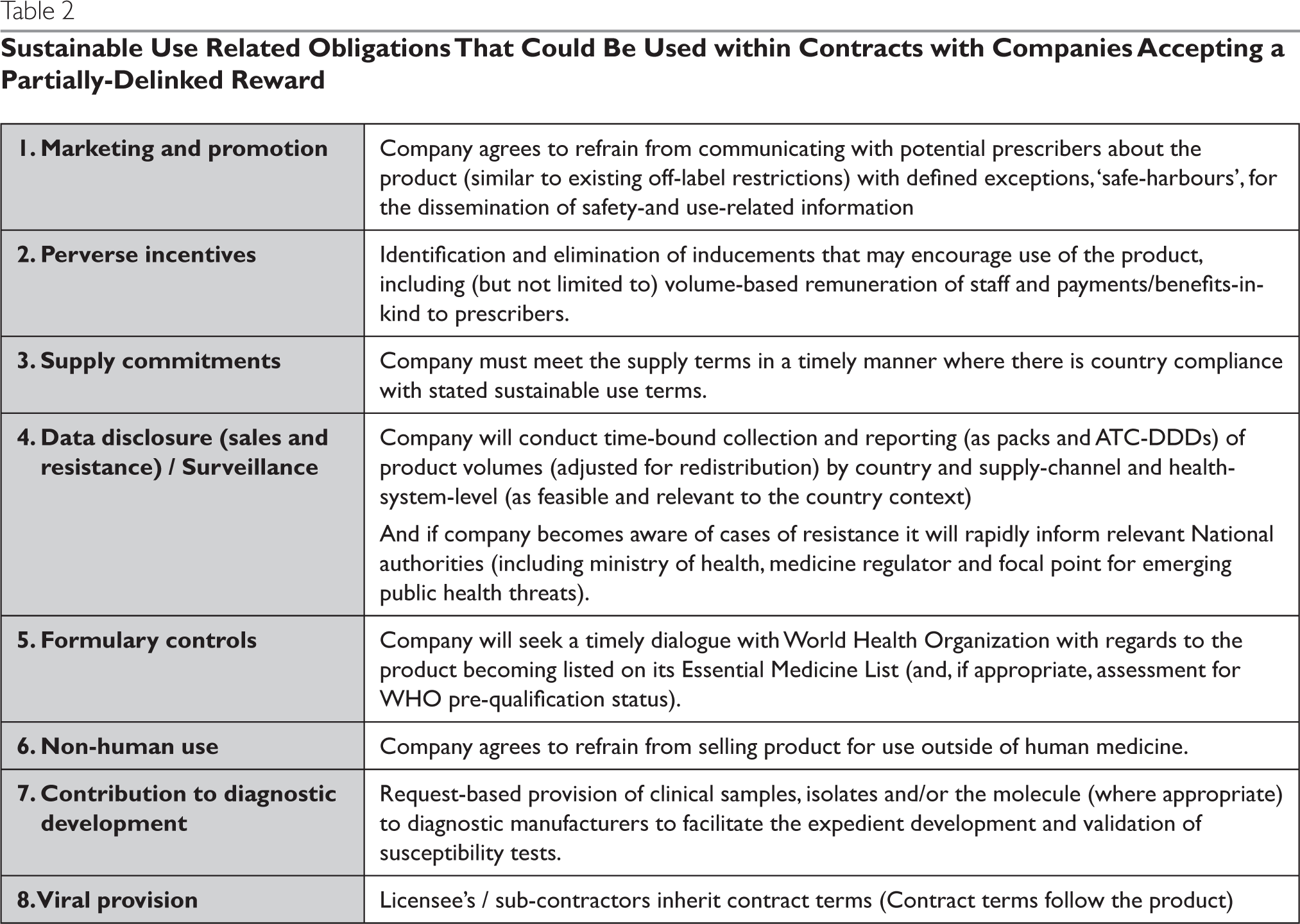
Sustainable Use Related Obligations That Could Be Used within Contracts with Companies Accepting a Partially-Delinked Reward

Sustainable use is examined in the case of each of the models shortlisted by DRIVE-AB: fully delinked MER, partially (with or without sales adjustment), grants, pipeline coordinators and long-term continuity model, which are defined in the respective sections. The work does not suggest that these models are themselves optimal for addressing sustainable use but rather how sustainable use can best be supported within such approaches.
Market Entry Reward: Fully Delinked
While fully delinked MER schemes can be designed in numerous ways, such delinking of the unit sales from revenues means that decisions surrounding post-approval activities (those coming after the product is approved by regulatory agencies) are made by a third-party, independently of the originator (or late-stage) developer. Such activities include, for example, country market registrations, manufacturing (single or multisource), distribution conditions (where and when), and follow-on R&D (if and when) and post-market surveillance. Decision-making on these issues can be handled by the MER awarding entity or a designated institution with a public health mandate. Manufacturing can be licensed out to other manufacturers or the originator company can be asked to maintain this role with compensation. Other operations such as product registration, supply, and pharmacovigilance may also stay with the originator company; indeed any operations can stay with the developer if they are thought to be comparative advantages. In adequately compensating the developer for agreeing to the optimal mix of roles, fully delinked models have substantial advantages for longer-term sustainable use of the product in that there is no longer the incentive to maximize sales — and therefore no direct or indirect pressures from product marketing — while supporting necessary innovation and supply. If basic product information can be ensured through health systems in which there is real need for the product (e.g., where there is relevant multidrug resistant infection justifying use of the specific product), then demand for the product can be considered legitimate demand. Sharing critical information — such as information pertaining to safety and proven efficacy of the product — may, of course, need to be enhanced with the help of public health bodies to ensure that potential prescribers know of the existence of the product and understand the cases in which it can be useful.
In managing distribution free of the commercial objective, the decision to sell into national markets can be based on true need for the product and on ability of the health system to appropriately manage it. For example, countries can be asked to fulfil certain criteria such as those listed in Table 1. Ensuring that the appropriate structures, procedures and steward-ship personnel are in place is absolutely essential to maintaining product efficacy over the longer-term.Reference Pulcini, Morel, Tacconelli, Beovic, de With, Goossens, Harbarth, Holmes, Howard, Morris, Nathwani, Sharland, Schouten, Thursky, Laxminarayan and Mendelson9
Making pricing decisions free of the commercial objective leaves room for local affordability and the relative price of other available products to be the main determinant of end price. This is essential for ensuring that the product is accessible where it is needed and that sensitivity to prices does not lead to its overuse or under-use. Indeed fully delinked approaches allow for local considerations to influence end price and avoid unhelpful pricing distortions that can contribute to inappropriate use of the product or prohibit access where the product is needed.
Fully delinked arrangements may also present overall cost advantages in that they can help encourage full product development by smaller companies who traditionally lack post-market capacities to sell in global markets. They also remove the major expense associated with product marketing — thereby potentially decreasing the magnitude of the reward necessary for developers to be profitable. Ultimately, such a scheme allows for a greater number of MERs to be offered and for a greater number of products to be brought to market and protected for the longer-term.
Market Entry Reward: Partially Delinked
This version of the MER is the one recommended by DRIVE-AB. In the partially delinked MER, the developer receives a large-scale reward and then sells the product on a unit basis into the market. While such arrangements may in theory reduce the pressure to sell the product if the MER is sufficiently high that the developer can recoup R&D costs, it still leaves in place the incentive to increase unit sales to maximize profits. Since end price considerations remain with the developer, prices will reflect what the market will bear. In the case of a new antibiotic, one can expect prices to be very high — much higher than most antibiotics on the market today. Wide-scale product marketing is then likely to increase because each additional sale will be worth so much more.
As sustainable use is not directly supported by the structure of the partially-delinked model (sustainable use is not supported in partially-delinked models as it is in fully delinked models), it has to be addressed in other ways. For example, sustainable use could be partly supported by structural elements such as a sales exclusivity provision in which the developer sells only to a large-scale purchaser acting in the public interest (e.g., Global Fund, UNICEF, GAVI etc.) for all or some markets, such as the Global Drug Facility for TB treatment.10 Responsibility for sustainable use in these markets therefore is transferred to the purchaser and any down-stream actors. Of course such arrangements would not affect the markets in which the developer directly sells the product.
Another option would be to have part of the MER offered later in time, and granted on the basis of enduring susceptibility to the drug. This would directly discourage extensive product marketing and any unjustified sales. (For further discussion on this topic, see publications on Antibiotic Susceptibility Bonus).
DRIVE-AB has also proposed a version of the MER in which the magnitude of the five yearly payments is adjusted by revenues in the previous year (revenues above a stated level would reduce the reward payment of the following year). While this may be intended to keep a cap on sales in this time frame, in practice it is unlikely to significantly impact normal firm behaviour. The greater the number of sales in the early years post-market, the greater the chances of physicians being accustomed to using the product and using it in the latter half of the patent life when constraints of the reward scheme no longer hold (see below for more on sustainable use related contractual obligations) and prices can be highest. A sales-adjusted version of the MER, as proposed, would not support sustainable use goals any better than the version using standard payments without sales-adjustment.
Tackling sustainable use in markets into which the developer directly sells the products requires weaving sustainable use related obligations into the MER contract. These obligations are intended to restrict marketing activities and limit sales to country markets with the necessary infrastructure, regulation, and stewardship personnel to ensure appropriate use. Ideally demands emanating from such measures would remain minimal at the level of MER granting body and the developer, utilize fairly straightforward approval procedures, and be stated as early as possible such that developers can adapt.
A list of potential obligations that could be used is provided in Table 2. The design of these obligations must match the specific market context and product characteristics. Where this is not possible upfront (e.g., where resistance-related risks related to the market or product context reveal themselves only late in the production process), more specific measures may need to be introduced closer to product launch. For example, this could include obligations surrounding oversight by third-parties, distribution controls, or named-patient supply. Together the obligations must cover all situations that might lead to clinically inappropriate sales and must have strong oversight and enforcement mechanisms in place, including large penalties for confirmed breaches. Most importantly perhaps, the parameters of the MER must fully align with the reward conditions. If the company or country is not bound by the obligations for sales of the product outside of the contract specifications for new indications, etc., then sustainable use measures will not result in the desired effect. Ideally, the MER and contract provisions should be applied globally such that minimum standards relating to use of that product are not gamed or undermined by variations in different jurisdictions.
Addressing sustainable use through contractual obligations creates a legal ‘zone of control’ as do the product patents and label. It also maximizes developer control, thereby potentially retaining commercial attractiveness. On a practical level, this approach is closest to the current business model, and most relevant parties are already accustomed to dealing with contract law. However, this is a time bound approach that can only be enforced for the duration of the contract. Contractual obligations may also be particularly ineffective in addressing perverse incentives (e.g., sales representative remuneration linked to sales targets). In order for sustainable use related contractual obligations to be effective, they must be inherited by any third-parties involved in the manufacturing and/or distribution of the product and possibly further development in the case of follow-on products.
Enforcement of such contractual obligations themselves would be challenging. Meaningful punitive measures, stated upfront, would be necessary to ensure compliance. Claw-back of the MER (full or partial) would be required in the case of confirmed breaches.
Finally, while use of contracts may be more familiar to most stakeholders and seem less burdensome than using a new business model, in reality the necessary measures to ensure compliance may prove administratively and financially burdensome and ultimately require a larger and more empowered MER secretariat. Allowing industry and public health interests to diverge would give such a secretariat an eternal uphill battle.
In the models proposed by DRIVE-AB that leave in place the link to sales (e.g., the partially delinked MER in all its forms, the long-term supply continuity model), there are no inherent pressures to improve sustainable use. Even if well designed and financed, the use of contractual obligations to impose sustainable use measures would be extremely difficult given the strong remaining incentive to maximize antibiotic sales. A fully delinked model would be a more efficient way to reward developers for their innovation and protect antibiotic efficacy over the longer term.
Grants and Pipeline Coordinator
Basic sustainable use provisions can also be included in push incentive arrangements such as grants (nonrepayable funding for R&D),Reference Savic and Årdal11 including those to support a pipeline coordinator (governmental or nonprofit organization that closely tracks the antibiotic pipeline and targets both financial and technical support to fill any identified gaps).Reference Baraldi, Lindahl, Savic, Findlay and Årdal12 Indeed defining general obligation provisions (or principles) early on in the discovery/R&D process has advantages in that expectations are clear to the developer when critical investment decisions are being made and, more generally, the developer retains autonomy over how to achieve the broad goals according to internal capacities and preferences. This approach is widely used within existing product development partnerships for products needed in the developing world13 and can be illustrated through a long history in the US of embedding public interest provisions in both government grants and public-private partnerships.Reference Sagal, Slowinski, Freese and Ferguson14 In this case, sustainable use could be embedded through broad public health principles by which recipients must abide. The design of the measures could be refined and made more specific as product characteristics become clearer and adapted to the changing external context. Indeed, such measures could be adapted incrementally until a developer-led plan is in place.
Long-Term Supply Continuity Model
The Long-Term Supply Continuity model proposes payments for maintaining supply of needed but rarely used antibiotics after patent expiry of the originator product. Crucially, as the tender recipients go on to sell independently into the open market, the model leaves the link between rewards and unit sales remains intact. As such, activities related to product promotion can be expected or to increase if they had previously been suppressed by MER arrangements. In order to hedge against this risk, sustainable use related contractual obligations would need to be included, similar to those included in the MER scheme, as mentioned in the report.15 Indeed, the obligations could be amended in light of experience with the product during the patent/MER period. This would represent a loss of commercial attractiveness for potential, traditional, generic bidders, which would have to be compensated for in the magnitude of the payment. Obligations could also be used to encourage that end price decisions are made in accordance with public health authorities, in line with the overall prescribing strategy (such that the price of the product is appropriate relative to other therapeutic options, and ends up encouraging an optimal prescribing strategy). The caveats surrounding the use of contractual obligations as the sole means of supporting antibiotic sustainable use hold again here.
However, if the long-term supply chain payments were instead intended to serve rather as a lump-sum payment covering manufacture and supply of the product upon demand — thus functioning like an insurance mechanism or service contract — then sustainable use goals would be much easier to achieve. Arguably there would little remaining motivation to promote the product, unless potential gains to general company reputation (which could support sales of other products within the portfolio) were seen to outweigh the marginal cost of production. The remaining risk of promotion, as with any fully delinked model, could be removed as part of the supply contract. Finally, if this model functions as an insurance scheme or service contract, then end price can be determined according to health needs and supportive of steward-ship and locally optimal prescribing strategies.
Conclusion
Fully delinked approaches to incentivizing antibiotic R&D make preserving long-term efficacy much easier to achieve because they remove the motivation to maximize unit sales — thereby allowing provision of these drugs to be determined exclusively by local health priorities, including the need for effective antibiotics in future. In the models proposed by DRIVE-AB that leave in place the link to sales (e.g., the partially delinked MER in all its forms, grants and pipeline coordinator if used on their own, and the long-term supply continuity model), there are no inherent pressures to improve sustainable use. While any subsidization of R&D may theoretically dampen the rush towards rapid return on investment post-approval, the incentive to maximize sales will remain and product promotion can be expected to continue. This necessitates the use and monitoring of carefully-designed contractual obligations to create minimal safeguards against sales, marketing, and pricing strategies that run counter to the interests of public health. Even if well designed and financed, the use of contractual obligations to impose sustainable use measures on the recipient of a “partially” delinked R&D reward would be extremely difficult given the strong remaining incentive to maximize antibiotic sales. A fully delinked model would be a more efficient way to reward developers for their innovation and protect antibiotic efficacy over the longer term.
Acknowledgments
The research leading to these results has received support from the Innovative Medicines Initiative Joint Undertaking under grant agreement n°115618 [Driving re-investment in R&D and responsible antibiotic use — DRIVE-AB — www.drive-ab.eu], resources of which are composed of financial contribution from the European Union's Seventh Framework Programme (FP7/2007-2013) and EFPIA companies' in kind contribution. This work does not represent the view of all DRIVE-AB partners.