


Introduction
While many individuals with congenital heart disease (CHD) are now able to lead lives that are functionally normal or near normal, the effects of their CHD and the consequences of their care on well-being are considerable. In the past four years, three independent patient-informed research priority settings have reiterated the need to learn about and address holistic and psychosocial health in individuals with CHD. Reference Burns, Basken and Acosta1–Reference Keir, Tarr and McFadden3 A key component of this is quality of life, which reflects physical, emotional, social, and school-related well-being in children, Reference Varni, Burwinkle and Seid4 and is generally reported as poorer in children with CHD compared to typically developing children. Reference Ladak, Hasan and Gullick5 Previous investigations into the quality of life of children with CHD highlight the need to identify modifiable correlates to guide future education and interventions.
Physical activity represents one such potentially modifiable factor of quality of life and is essential for supporting multiple dimensions of children’s health. Reference Luca, Țarcă and Tănase6 Historical recommendations advising caution with vigorous physical activity for children with CHD have largely been attenuated in favour of encouraging physical activity with limited to no restrictions following appropriate screening. Reference Luca, Țarcă and Tănase6 Most children with CHD are now encouraged to adhere to public health recommendations of at least 60 minutes of moderate-to-vigorous physical activity per day. Reference Tremblay, Carson and Chaput7
A small positive association has been observed between physical activity and quality of life in children with and without chronic disease. Reference Marker, Steele and Noser8 Previous studies in children and adolescents with CHD by Kim et al. Reference Kim, Jae and Choo9 and Brudy et al. Reference Brudy, Meyer and Oberhoffer10 noted two limitations to be addressed: the need to strengthen analyses by adjusting for theoretical confounding variables, such as age and socio-economic status, and the inclusion of a reference, non-CHD cohort to determine whether the association is modified by, or attributable to, CHD. Both studies also reported gender differences in physical activity, Reference Kim, Jae and Choo9,Reference Brudy, Meyer and Oberhoffer10 and Kim et al. observed gender differences in quality of life; Reference Kim, Jae and Choo9 however, neither examined whether gender modified the association between physical activity and quality of life.
Accordingly, the aims of this study were first to measure and compare the quality of life and physical activity between children with and without CHD aged 5 to 10 years; and second, to explore the association between physical activity and quality of life in this population, and how it might be modified by CHD or gender.
Materials and methods
Sample
This cross-sectional analysis draws on baseline data from a prospective cohort study. Children aged 5 to 10 years, residing in British Columbia, Canada, with a CHD diagnosis or no known CHD, were eligible to participate. Children were not eligible if instructed by a physician not to participate in aerobic activities. Physical activity modifications (e.g., avoid intense isometric activity) were permitted.
Protocol
Recruitment and data collection occurred between June 2024 and November 2025. Eligible children with CHD were invited during outpatient appointments at the BC Children’s Hospital Heart Centre and partnership travel clinics across British Columbia, and through the Children’s Heart Network of BC Society. Children without CHD were recruited via snowball sampling, social networks, and the online provincial recruitment platform REACH BC. Written informed parental/guardian consent, child assent (children aged ≥7 years), and surveys were completed electronically using the Research Electronic Data Capture data management platform. Reference Harris, Robert and Robert11,Reference Harris, Robert and Brenda12 Waist-worn accelerometers were mailed to children to record physical activity for 7 consecutive days. Data collection was limited to the spring and autumn seasons to account for seasonality effects on physical activity. Reference Kuan, Voss and Lopez13
Measures
Clinical and Demographic Characteristics
Parents/guardians completed a demographic questionnaire reporting household income in Canadian dollars, their and their child’s gender (boy, girl, non-binary, or prefer not to answer), and their child’s height and weight. Body mass index percentiles were calculated using World Health Organization reference curves and corresponding cut points for underweight, normal weight, overweight, and obesity. Reference Rodd, Metzger and Sharma14 Residence was classified using the Government of British Columbia Community Health Service urban–rural typology, which is based on population density and functional role as regional service centres, and collapsed into three analytical categories: rural or remote (population < 10,000), small-to-medium urban (population 10,000–99,999), and large urban to metropolitan (population > 100,000). 15
Medical history and physical activity restrictions were obtained from parent/guardian surveys and electronic medical records. CHD diagnoses were used to classify children with CHD into “simple,” “moderate,” and “complex” according to the Bethesda (American College of Cardiology/American Heart Association 2008) classifications. Reference Warnes, Williams and Bashore16
Quality of life
The Parent Proxy-Report PedsQL 4.0 Generic Core Scales were used to measure health-related quality of life, as its validity and reliability have been well-demonstrated and are acceptable for comparative and associative analyses. Reference Varni, Burwinkle and Seid4,Reference Uzark, Jones and Burwinkle17 Due to the remote nature of the larger longitudinal study, standardised administration of child self-report PedsQL questionnaires was not feasible. Furthermore, Uzark and colleagues (2003) suggest low reliability for child self-reported PedsQL scores among this age group of children with CHD. Reference Uzark, Jones and Burwinkle17 Parents/guardians responded to 23 items on a five-point Likert scale to assess physical (8 items), emotional (5 items), social (5 items), and school functioning (5 items). Reference Uzark, Jones and Burwinkle17 Responses to each item are reversed and linearly transformed to a score of 0 to 100, where higher scores indicate better health-related quality of life. Reference Uzark, Jones and Burwinkle17 The mean of the Physical Functioning items yields a Physical Health Summary Score, and the mean of the Emotional, Social, and School Functioning items yields the Psychosocial Health Summary Score. Reference Uzark, Jones and Burwinkle17 The mean of all 23 items yields the PedsQL Total Score, an indicator of overall health-related quality of life. Reference Uzark, Jones and Burwinkle17
Physical activity
Physical activity was measured using the GT3X (Ametris LLC, Pensacola FL; formerly ActiGraph LLC) accelerometer for seven consecutive days. Children wore the accelerometer over the right hip during waking hours, and the device was removed only during water-based activities. Actilife v7.3.0 (Ametris LLC, Pensacola, FL) was used for accelerometer initialisation (sampling rate set to 30 Hz), file download, and processing. Fifteen-second epoch .agd files were generated from the raw .gt3x files. Liberal accelerometry wear time criteria of at least 2 valid weekdays and 1 valid weekend day of ≥600 min wear time per day were applied to maximise participant inclusion, Reference Voss, Duncombe and Dean18 permitting 60 min of ≤2 min of zeros to avoid discarding reasonable sedentary bouts as non-wear time. Reference Troiano, Berrigan and Dodd19 The mean moderate-to-vigorous physical activity (min/day) of each participant was calculated using established cut points for children, defined by Evenson et al. Reference Evenson, Catellier and Gill20 Meeting physical activity guidelines was defined as an average of ≥60 minutes of daily moderate-to-vigorous physical activity. Reference Tremblay, Carson and Chaput7
Statistical analysis
Unadjusted generalised linear regression models were used to compare continuous measures, and ordinal logistic regression models were used to compare categorical measures between genders and between children with and without CHD. A generalised linear regression model, adjusted for theoretically relevant confounders of age and household income, was used to explore the association between moderate-to-vigorous physical activity (min/day) and PedsQL Total Score, as modified by CHD and gender. Analyses were conducted in R (version 4.2.0; R Foundation for Statistical Computing, Vienna, Austria), and statistical significance was set at p < 0.05.
Results
Sample characteristics
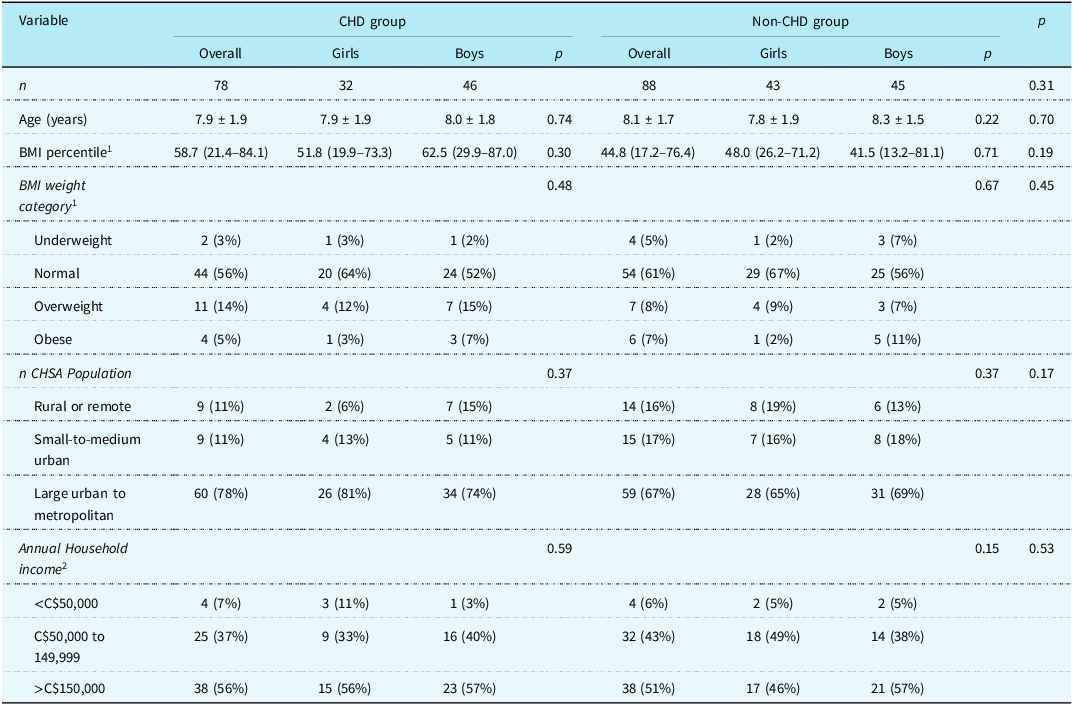
One hundred and seventy-nine children, n = 85 with CHD and n = 94 without CHD, enrolled in the study. Seven individuals with CHD and 6 without CHD were excluded due to insufficient physical activity data. The final analytical sample of 166 children included 78 (41% girls) children with CHD and 88 (49% girls) children without CHD (Table 1). Most parents/guardians (85%) identified as women; the remainder identified as men. None reported their or their child’s gender as non-binary or preferred not to answer.
Participant characteristics by group and gender

Table 1. Long description
The table compares participant characteristics by group and gender, focusing on children with CHD and non-CHD. It has 12 rows and 10 columns. The columns are labeled as follows: Variable, CHD group Overall, CHD group Girls, CHD group Boys, p, Non-CHD group Overall, Non-CHD group Girls, Non-CHD group Boys, and p. The rows include variables such as n, Age (years), BMI percentile, BMI weight category (Underweight, Normal, Overweight, Obese), CHSA Population (Rural or remote, Small-to-medium urban, Large urban to metropolitan), and Annual Household income (<$50,000, $50,000 to $149,999, >$150,000). Each row provides specific data points for these variables across the different groups and genders. Notable trends include the distribution of BMI weight categories and household income levels among the groups.
Results reported as n (%), mean ± standard deviation, or median (interquartile range). p determined by generalised linear models for continuous variables and ordinal logistic regression models for categorical variables.
CHD, congenital heart disease; BMI, body mass index (kg/m 2); CHSA, community health service area.
1 Not available for n = 17 CHD and n = 17 non-CHD participants (didn’t know or preferred not to answer).
2 Not available for n = 11 CHD and n = 14 non-CHD participants (didn’t know or preferred not to answer).
Of the children with CHD, 29 (34% girls) had simple, 23 (43% girls) had moderate, and 26 (46% girls) had complex heart defects. Reference Warnes, Williams and Bashore16 Three CHD participants (4%; n = 1 girl and n = 2 boys) had documentation of restrictions to avoid intense isometric exercise or contact sports. Seven CHD participants (9%; n = 3 girls and n = 4 boys) had documentation recommending increased physical activity to promote chest-wall strengthening, increase exercise tolerance, or improve body composition.
Quality of life
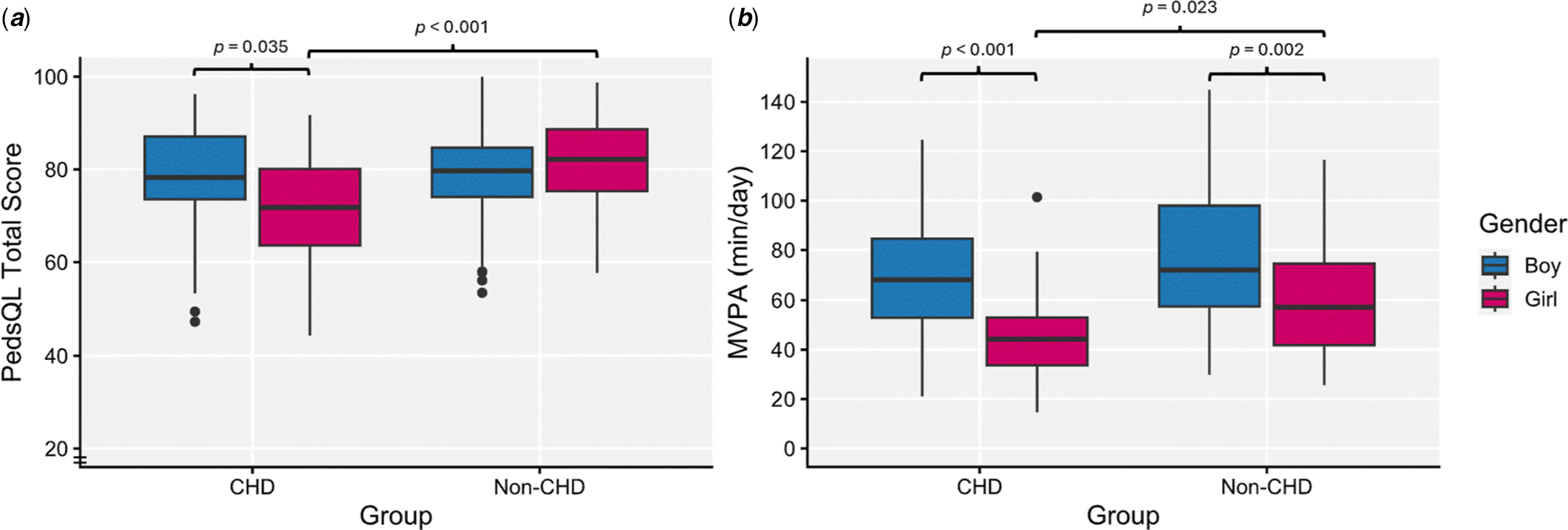
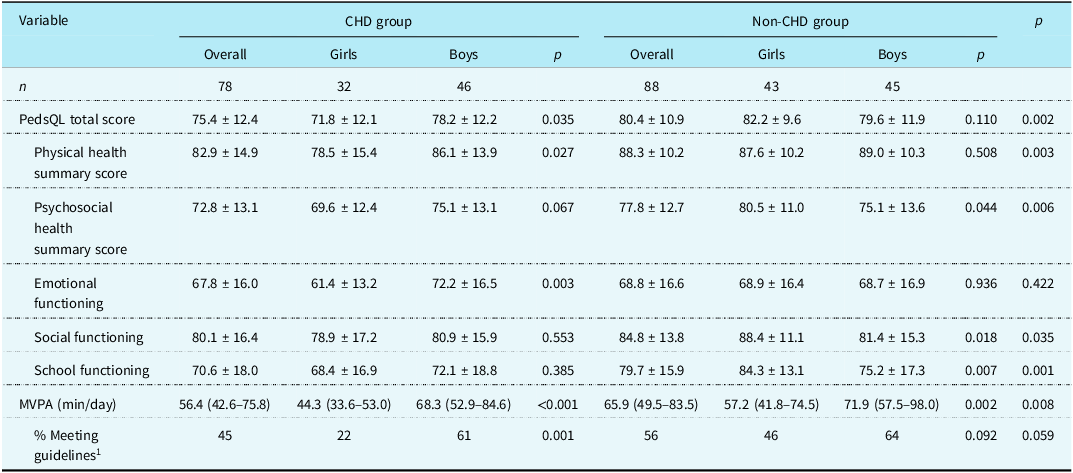
Table 2 presents detailed descriptive statistics for health-related quality of life and physical activity measures. PedsQL scores were lower among children with CHD than children without CHD for PedsQL Total Scores (p = 0.002), Physical Health Summary Scores (p = 0.003), and Psychosocial Health Summary Scores (p = 0.006). Children with CHD had lower reported scores than children without CHD in the domains of Social Functioning (p = 0.035) and School Functioning (p = 0.001), with no difference in Emotional Functioning (p = 0.422). Among children with CHD, girls generally had poorer reported PedsQL scores than boys; however, the opposite trend was emerging in children without CHD (Table 2; Figure 1A). There was no significant difference in PedsQL Total Scores across CHD complexity levels (Supplementary Table S1).
Quality of life (a) and physical activity (b) between CHD and non-CHD groups by gender.
p determined by linear regression models and pairwise contrasts.
PedsQL scores on a 0 to 100 scale, with higher scores indicating better health-related quality of life.
CHD = congenital heart disease; PedsQL = Paediatric Quality of Life Inventory; MVPA = moderate-to-vigorous-intensity physical activity.

Descriptive results of study outcomes by group and gender

Table 2. Long description
The table presents a comparison of health-related quality of life and physical activity measures between children with CHD and those without CHD, further categorized by gender. It includes data for 78 children in the CHD group and 88 children in the Non-CHD group. The table is divided into several rows and columns, with column headers including Variable, CHD group (Overall, Girls, Boys, p), Non-CHD group (Overall, Girls, Boys, p), and p. Row labels include PedsQL total score, Physical health summary score, Psychosocial health summary score, Emotional functioning, Social functioning, School functioning, MVPA (min/day), and % Meeting guidelines. Each row provides specific values for the different groups and genders. Notable trends include lower PedsQL scores among children with CHD compared to those without CHD, with significant differences in Physical Health Summary Scores and Psychosocial Health Summary Scores. Among children with CHD, girls generally had poorer reported PedsQL scores than boys, while the opposite trend was observed in children without CHD.
Results reported as mean ± standard deviation, median (interquartile range), or percentage. p determined by linear regression models for continuous variables, logistic regression models for binary variables (% meeting guideline).
PedsQL scores on a 0 to 100 scale, with higher scores indicating better health-related quality of life.
CHD, congenital heart disease; PedsQL, Paediatric Quality of Life Inventory; MVPA, moderate-to-vigorous-intensity physical activity.
1 MVPA guidelines = an average of 60 min of MVPA/day. Reference Marker, Steele and Noser8
Physical activity
Children with CHD accumulated significantly less moderate-to-vigorous physical activity (min/day) than children without CHD (p = 0.008; Table 2). Girls accumulated fewer minutes of daily moderate-to-vigorous physical activity than boys, both among those with CHD (p < 0.001) and without CHD (p = 0.002; Figure 1B). Moderate-to-vigorous physical activity (min/day) did not significantly differ by CHD complexity (Supplementary Table S1). Forty-five percent of children with CHD and 56% of children without CHD met or exceeded 60 minutes of daily moderate-to-vigorous physical activity (p = 0.059).
Association between physical activity and quality of life
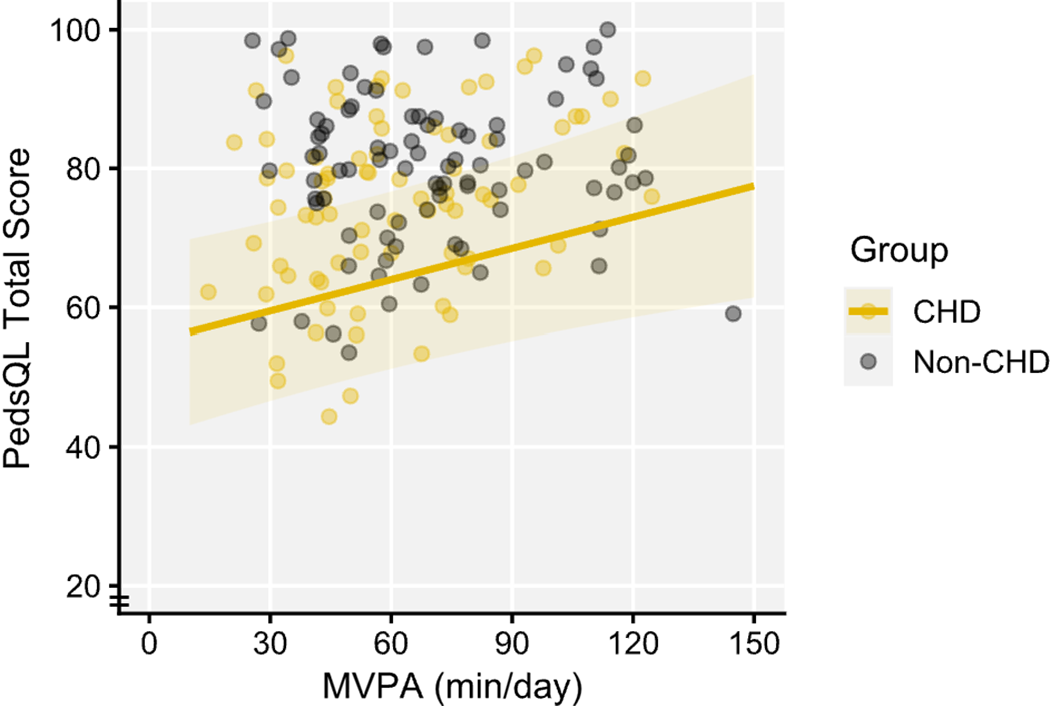
The association between moderate-to-vigorous physical activity and PedsQL Total Score was significantly modified by CHD (p = 0.001), in which a significant positive association was observed between these outcomes for children with CHD (β = 0.17 [95% confidence interval: 0.04, 0.29], p = 0.011) but not for children without CHD (β = 0.01 [95% CI: −0.09, 0.12], p = 0.783; Figure 2). Gender did not significantly modify the association (p = 0.241), and theoretical confounders of age and household income did not significantly contribute to the model (p > 0.05).
The association between physical activity and quality of life, as modified by group.
Association determined by linear regression adjusted for theoretical confounders of age, gender, and household income.
PedsQL = Pediatric Quality of Life Inventory; CHD = congenital heart disease; MVPA = moderate-to-vigorous-intensity physical activity.

Discussion
This analysis examined the quality of life and physical activity and their relationship among children with and without CHD. Consistent with previous research, children with CHD had lower quality of life scores and physical activity levels compared to their peers. This analysis extends the literature by demonstrating that the small positive association between quality of life and physical activity among children with CHD is consistent across gender and income groups but is not observed in children without CHD.
Quality of life in children with CHD
The PedsQL Total Score observed for the CHD group in this analysis, 75.4 points (out of 100), aligns with the midrange of prior findings from studies of children with CHD, which have shown variability from 60.4 to 79.8 points. Reference Uzark, Jones and Burwinkle17,Reference Eagleson, Justo and Ware21 In the present analysis, children with CHD had lower PedsQL Total Scores than children without CHD by ∼5 points, consistent with prior reports of a 2-point Reference Berkes, Varni and Pataki22 to 18-point Reference Abassi, Huguet and Picot23 difference in PedsQL Total Scores between children with and without CHD.
Among children with CHD in our analysis, girls had significantly lower PedsQL Total Scores than boys. Gendered analyses of quality of life have been underreported in children with CHD, with many studies foregoing reporting of results by gender (e.g., Uzark et al., 2003 Reference Uzark, Jones and Burwinkle17). The few studies that analysed results by gender have reported lower quality of life among girls compared to boys Reference Kim, Jae and Choo9,Reference Amedro, Huguet and Macioce24 or found no difference in quality of life by gender. Reference Abassi, Huguet and Picot23,Reference Uzark, Jones and Slusher25 Studies of younger children (ages 1–3 years) Reference Lee, Cinanni and Di Cristofaro26 and adults with CHD Reference Freilinger, Andonian and Beckmann27 have also found that girls and women generally experience poorer quality of life than boys and men.
Poorer quality of life among children with CHD may reflect many underlying factors. For example, lower exercise capacity among some children with CHD compared to children without CHD, Reference Banks, Rosenthal and Manlhiot28 and among girls compared to boys with CHD, Reference Kim, Jae and Choo9 likely has implications for the physical dimension of quality of life Reference Kim, Jae and Choo9 and aligns with the trends observed in the present analysis. The diagnosis of CHD and subsequent treatment can also lead to significant psychological distress in parents of children with CHD, Reference Biber, Andonian and Beckmann29 which has been associated with a lower perceived quality of life of their child. Reference Ernst, Marino and Cassedy30 While child self-report and parent-proxy quality of life scores are well-correlated, parent-proxy ratings tend to be lower than child self-reports. Reference Varni, Burwinkle and Seid4 This pattern is generally observed in both CHD Reference Abassi, Huguet and Picot23 and typically developing children, Reference Varni, Burwinkle and Seid4 suggesting parent psychological distress does not fully explain the difference observed between children with and without CHD in our analysis.
Despite no difference in PedsQL Total Scores across CHD complexity levels in the present analysis, the literature generally reports poorer quality of life scores among children with more complex CHDs. Reference Eagleson, Justo and Ware21,Reference Abassi, Huguet and Picot23,Reference Amedro, Huguet and Macioce24 The Bethesda (American College of Cardiology/American Heart Association 2008) classification, Reference Warnes, Williams and Bashore16 used in the present analysis to classify CHD by anatomical complexity, may not be as discriminating as functional classifications, such as the Ross Infant Heart Failure Classification. Reference Abassi, Huguet and Picot23,Reference Ross, Bollinger and Pinsky31 However, given our inclusion of mostly children with repaired CHDs, few participants—if any—would be expected to exhibit symptoms relevant to functional classifications.
Physical activity in children with CHD
Median moderate-to-vigorous physical activity (56.4 min/day) was ∼ 10 min/day higher than in comparable studies of children with CHD, including recent studies from our team, Reference Kuan, Voss and Lopez13,Reference Voss, Duncombe and Dean18,Reference Lopez, Voss and Kuan32 and previous studies following similar methodologies: Zaqout et al. (38.9–55.3 min/day) Reference Zaqout, Vandekerckhove and Michels33 and Chapelski et al. (41.7 min/day). Reference Chapelski, Houser and Libke34 Previous studies have generally included older children and adolescents beyond our 5–10 year age range, and differences between findings may reflect age-related declines in physical activity that occur across the school-aged years. 35
Our finding of lower physical activity levels among children with CHD than children without CHD aligns with prior prospective case–control studies, Reference Voss, Duncombe and Dean18,Reference Elmesmari, Reilly and Paton36,Reference Kişin, Savci and Kahraman37 but contrasts with the conclusion of a recent scoping review by Chapelski and colleagues (2025) that suggests children with CHD accumulate physical activity levels comparable to children without CHD. Reference Chapelski, Tomyn and Sobolewski38 Previous studies have varied widely in their settings, sample characteristics, and, especially, methods for data collection and analysis (questionnaires vs. commercial activity trackers vs. accelerometers; epochs and intensity cut points), and these methods must be considered when interpreting results.
In adolescent samples with CHD, prior research has observed that girls generally accumulate less physical activity than boys. Reference Brudy, Meyer and Oberhoffer10,Reference Voss, Duncombe and Dean18,Reference Jackson, Fox and Swenski39 Our results build on this finding, adding that this gender difference is already present in children with CHD aged 5 to 10 years. This result may be considered unsurprising, given that gender differences in physical activity were also observed in our sample of children without CHD and in normative data for this age group. 35
The association between physical activity and quality of life
Our finding of a small positive association (β = 0.17) between physical activity and quality of life among children with CHD is consistent with previous studies. Reference Kim, Jae and Choo9,Reference Brudy, Meyer and Oberhoffer10 The present analysis extends prior research by demonstrating that this association is consistent across gender and socio-economic status and is evident even among younger children (ages 5 to 10 years).
Despite this analysis and prior studies providing valuable insight, the cross-sectional design limits conclusions about causality or directionality. Although physical activity might be encouraged to improve quality of life, impairments or enhancements to quality of life might influence a child’s ability to participate in physical activity. Evidence from interventional studies is necessary to understand causal mechanisms. To that end, existing interventions aimed at increasing physical activity to improve quality of life in children with CHD are limited and have generally not yielded improvements in quality of life. Reference Klausen, Andersen and Søndergaard40,Reference Meyer, Brudy and Fuertes-Moure41 However, previous intervention results may have been influenced by a lack of sustained increases in physical activity. Reference Klausen, Andersen and Søndergaard40,Reference Meyer, Brudy and Fuertes-Moure41 Few studies have examined structured exercise interventions in children with CHD and generally report post-intervention improvements in quality of life. Reference Amedro, Gavotto and Huguet42–Reference Kroll, Kovach and Ginde44 As both Jacobson et al. (2016) and Kroll et al. (2021) included parent supervision in exercise sessions, Reference Jacobsen, Ginde and Mussatto43,Reference Kroll, Kovach and Ginde44 improved parent proxy-reported quality of life may reflect alleviated parental concerns regarding physical activity participation. Amedro et al. (2024) also reported improved parent- and child-reported quality of life among children with CHD who initially had impaired cardiopulmonary fitness and subsequently improved following a structured exercise program. Reference Amedro, Gavotto and Huguet42 The mechanisms underlying the relationship between physical activity and quality of life are likely multifactorial, including physiological and psychosocial factors.
The absence of a significant association between physical activity and quality of life among children without CHD was unexpected, given previous literature. Reference Marker, Steele and Noser8 Children without CHD may be less likely to experience parental restrictions or deficits in physical fitness and self-efficacy, factors that may moderate the relationship between physical activity and quality of life. Consequently, the relationship between physical activity and quality of life may be less pronounced in children without CHD.
While the association between physical activity and quality of life is evident among children with CHD, uncertainty regarding underlying mechanisms, directionality, and strategies to increase physical activity hinders the development of effective physical activity interventions in this population.
Clinical implications
Healthcare practitioners should recognise that children with CHD are at increased risk of having suboptimal physical activity and lower quality of life. Routine screening of quality of life may help identify previously unrecognised concerns and facilitate the direction of support. Although education-based interventions have shown limited effectiveness, no adverse effects have been reported from physical activity education Reference Klausen, Andersen and Søndergaard40,Reference Meyer, Brudy and Fuertes-Moure41 or structured exercise programs. Reference Amedro, Gavotto and Huguet42–Reference Kroll, Kovach and Ginde44 Given its well-established physical, psychological, and social benefits—extending far beyond the quality of life domains captured in this analysis—physical activity should remain a core component of care for children with CHD. Reference Luca, Țarcă and Tănase6
Limitations and future research
Our methods mobilised the most widely used and validated measures to assess physical activity and health-related quality of life in children with CHD. Nevertheless, survey data are subject to potential recall and social desirability biases. Accelerometry provides a more objective measure of physical activity than self-report; however, estimates of physical activity vary with data-processing decisions. Results should be interpreted in the context of the selected parameters: 15-second epochs and Evenson 2008 cut-points. Reference Evenson, Catellier and Gill20 Additionally, accelerometry does not capture the context or type of physical activity, and measures may be underestimated if devices are removed during activity.
Our recruitment approach was successful in drawing participants from across British Columbia; however, it may have introduced selection bias. Many participants were from relatively affluent households, with 45% reporting household incomes ≥C$150,000 annually, exceeding the British Columbia median of C$76,000. 45 Although most (72%) participants also resided in metropolitan or urban areas, this is broadly consistent with the provincial population (89.5%). 46 While there were no significant differences in characteristics between children with and without CHD, differences in recruitment avenues (direct invitation versus snowball sampling) may have preferentially enrolled more clinically aware families among participants without CHD. This could have led parents to perceive their child’s quality of life more favourably and partially explain the lack of association between physical activity and quality of life among the children without CHD in the present analysis. However, the physical activity and quality of life among children without CHD in the present analysis align well with normative data. Reference Varni, Burwinkle and Seid4,35 Future research would benefit from purposeful recruitment of lower-income families and those residing in rural or remote regions to enable comprehensive comparisons of physical activity and quality of life across socio-economic and geographic contexts.
Conclusion
The disparity in quality of life and physical activity between children with and without CHD, and across genders, warrants greater attention. The association between physical activity and quality of life highlights the need for future research in this population, as well as the continued promotion of physical activity (≥60 minutes per day, on average) by healthcare providers.
Supplementary material
The supplementary material for this article can be found at https://doi.org/10.1017/S104795112612410X
Acknowledgements
We extend our sincere gratitude to the families who participated in this research. Special thanks to the Children’s Heart Network of BC Society and the clinical teams at the Children’s Heart Centre and outreach clinics who facilitated recruitment.
Financial support
This work was funded by the SickKids-CIHR-IHDCYH New Investigator Grant (grant number 191255). T.C.S. was funded by a BC Children’s Hospital Child Health Award and the Canadian Institutes of Health Research Canada Graduate Scholarship—Master’s program. C.V. was funded by a Michael Smith Health Research BC Scholar Award (SCH-2021-1574). The funders had no role in the design, conduct, or reporting of this study.
Competing interests
None.
Ethical standard
The authors assert that all procedures contributing to this work comply with the ethical standards of the relevant national guidelines on human experimentation and with the Helsinki Declaration of 1975, as revised in 2008, and have been approved by the UBC Okanagan Behavioural Research Ethics Board (Harmonized Board of Record; # H24-00018) and Interior Health (ID # 2024-25-003-H).


 Open access

