

1. Introduction
Canada has begun a national conversation regarding the relationship it has with the Indigenous peoples. It is driven by the Calls to Action of the Truth and Reconciliation Commission (TRC)Footnote 1 as well as the recent decisions regarding child welfare from the Canadian Human Rights Tribunal.Footnote 2 As a result, there is a rapidly shifting landscape in the area of child intervention. British Columbia has recently announced efforts to allow Metis communities to take responsibility for their own children;Footnote 3 Treaty 8 Nations in northern Alberta opened up an urban office to be responsible for their children, whether on or off reserve,Footnote 4 and Quebec has entered into discussions with Atimakew First NationFootnote 5 to shift management of child intervention to the nation. Canada and several provinces have indicated that the underfunding of on-reserve child intervention will stop. This will address the significant challenges First Nations have offering a full range of services, particularly prevention services. In November 2018, Canada announced an intention to introduce legislation, co-developed with Aboriginal peoples, with the stated goal of enacting “the right to self-determination of Indigenous peoples to freely determine their laws, policies and practices in relation to Indigenous child and family services.”Footnote 6
The TRCFootnote 7 has called for child intervention to be done differently. Analyzing how change might occur also requires consideration of the role of the courts. In this paper, we will argue that precedential decisions need to be challenged, as the courts need to see issues from the position of reconciliation and decolonization. Perhaps one of the most significant precedents comes from the Supreme Court of Canada in Racine v Woods.Footnote 8
Discussions about child protection decisions must be considered in contexts of other events post-Racine. Footnote 9 In 2008, then Prime Minister Stephen Harper issued an apologyFootnote 10 on behalf of Canada for the destructive impact of Indian Residential Schools on Indigenous culture, families, and communities. Prime Minister Justin Trudeau has extended that apology to former students in Newfoundland and Labrador.Footnote 11 More recently, Canada has entered into a compensation scheme for Sixties ScoopFootnote 12 Survivors as a result of Brown v Canada (Brown), which will be reviewed later in this paper.Footnote 13 In Alberta, Premier Rachel Notley made a formal apology for the provincial role in this period, while in 2015, Manitoba premier Selinger apologized on behalf of that government.Footnote 14
Canada continues to have significant over-representation of Indigenous children in its child protection systems.Footnote 15 While there are many complicated historical reasons related to assimilation and colonization efforts, we argue that the application of social and psychological theories in the court systems sustains a discriminatory, colonial-based view of Indigenous children, family, and caregiving systems, which can be seen in the continuing application of Racine.
1.1 Orienting the Authors
Peter Choate is a white settler who is an Associate Professor of social work at Mount Royal University. He grew up on the traditional lands of the Musqueum, Tsel’ Waututh, and Squamish peoples. Brandy CrazyBull is an Indigenous woman who is a member of the Kainai First Nation and also has Cree origins. Brandy offers lived experience related to the child intervention system. Felicia Cloete is a settler/guest raised in Treaty 7 territory born to parents of European ancestry. Taylor Kohler is a Métis woman, raised on Treaty 8 lands, and is of Cree descent. Desi Lindstrom is an Indigenous man who is a member of the Anishnabe nation and a ’60s scoop survivor. Parker Tatoulis is of Greek origin and grew up in Treaty 7 territory.
2. Racine v Woods
2.1 Overview of Racine v Woods
Leticia Grace Woods was born on September 4, 1976, in Manitoba to her mother Linda Woods who is Aboriginal. The biological father of Leticia is unknown. Leticia has two half siblings who, at the time, resided with their father. Linda Woods was described as unable to care for Leticia due to a “serious alcohol problem.” Leticia stayed with her uncle and then her aunt before she was apprehended. She was six weeks old when she became a ward of the child welfare authorities for a one-year term, which was extended by an additional six months. Leticia was placed in the foster home of Sandra and Lorne Ransom. Later that year, Sandra and Lorne divorced, and Sandra entered into a new relationship with Allan Racine. Sandra and Allan got married, during which time Leticia remained in their care until the wardship expired a year later. Leticia was returned to her mother; at that time, her half-siblings also resided with her mother. Once the transition was complete, the Racines paid a couple of visits to see how Leticia was doing in her new living environment. On the second visit, the Racines were permitted to take Leticia home with them on the premise that it would be temporary. The Racines understood this was to be a permanent placement and began the process of adoption. Five weeks later Mrs. Woods arrived at the Racines’ home stating she was moving and wished to place Leticia in the care of her sister. The Racines refused to relinquish Leticia to her mother. Three years later, Mrs. Woods issued an application to have Leticia returned to her under habeas corpus. The Racines stated prior to this order they did not receive any contact from Mrs. Woods over that three-year period. Shortly after Mrs. Woods applied for habeas corpus, the Racines applied for a de facto adoption. The adoption was approved by the courts, as the Racines had cared for Leticia for three consecutive years. It was also stated that Mrs. Woods’ lack of contact over the course of three years suggested abandonment of the child, and thus she relinquished the rights to her child to the Racines. The courts acknowledged the fact that the Racines illegally withheld the child from her mother but sided with the Racines as their actions were “prompted by concern for the child.” The claims of kidnapping were dismissed due to the de facto adoption order. Mrs. Woods was not seen as being assertive or prompt enough in the process of regaining her rights to her child, and thus the court sided with the Racines on the claim of abandonment. Mrs. Woods appealed the decision, which eventually made its way to the Supreme Court.
Over the course of five years, Mrs. Woods overcame her addiction, left an abusive relationship and upgraded her education. However, it was stated that over those five years, Leticia became “an established part of the Racine family.” Leticia was described as a well-adjusted child who was positively involved in her school and church. Leticia was aware the Racines were not her birth parents and that Mrs. Woods was. Leticia was also aware of her Aboriginal descent. Expert witnesses considered the Racines to be Leticia’s “psychological parents.” The argument arose that keeping Leticia within the Racine home cut her off from her culture and heritage.
Madam Justice Wilson concluded that “the significance of cultural background and heritage as opposed to bonding abates over time. The closer the bond that develops with the prospective adoptive parents the less important the racial element becomes.”Footnote 16 The Court believed that the Racines were well equipped to deal with any identity crises the child might face in adolescence and believed that the bond between Mrs. Racine and Leticia was more important than that of cultural preservation. Attachment and bonding were used to determine the best interests of the child, and thus the Supreme Court granted the Racine’s adoption.
The adoption did not work out, and Leticia found herself in group care through most of her teenage years. She recently noted, “I had no identity, nobody to connect with. I always felt shame, I asked myself, ‘why did I have to be this colour?’ I’d look in the mirror and say, ‘I hate you.’”Footnote 17
2.2 Ongoing Impact of Racine v Woods
When the question of the primacy of attachment is at issue, this case has been cited as the basis upon which to determine placement of children from Indigenous communities permanently into non-Indigenous care. While there are over 580 citations noted through the CANLII database, three recent cases in Alberta help to illustrate how Racine continues to be applied. We will argue that continued application is an error of present understandings of the inter-cultural application of attachment theory. While attachment theory is not the only consideration in these cases, it is relied upon heavily. This runs contrary, in our view, to the notion of the best interests of the child. The United Nations Convention on the Rights of the Child (CRC), states that in “all actions concerning children, whether undertaken by public or private social welfare institutions, courts of law, administrative authorities or legislative bodies, the best interests of the child shall be a primary consideration.”Footnote 18 The Canadian Bar Association notes, “best Interests of the child” is a substantive right and guiding principle that covers all CRC rights, is aimed at the child’s holistic development, and requires a rights-based approach that promotes the child’s human dignity: adult judgment cannot override the child’s rights.Footnote 19 The best interests of the child test is a legally based argument as opposed to one that has been validated through social science research.Footnote 20
URM Footnote 21 is an Alberta Provincial Court decision regarding two Aboriginal girls who were placed under a permanent guardianship order (PGO) immediately after birth and placed within a non-Indigenous foster home. Both girls resided within that home for about three years. In 2015, the foster parents applied for private guardianship of both girls; shortly thereafter, the maternal great-aunt of the girls also filed for guardianship. Up to twice monthly, the aunt would bring various family members to visit the children, starting in 2016 and until the trial date. Both the aunt and the foster parents were assessed as suitable placement options; however, the Court followed Racine,Footnote 22 seeing culture as less important than attachment. In URM,Footnote 23 the trial judge quoted Justice Wilson to the effect that as attachment and bonding strengthen, the importance of culture and race abates. The foster parents were labelled the psychological parents, which is defined as the person or persons who provide the child continuous emotional and physical care and whom the child considers to be its parents. The Court felt that the disruption of attachment the two girls had to their foster parents would be detrimental to their development. The Court concluded, “To be absolutely clear, I reject as unsustainable or insupportable that the factor of maintaining Indigenous heritage is sufficient reason to ignore attachment theory. This position amounts to prioritizing the preservation of Indigenous heritage at the expense of all other factors, including the established attachment relationship between the children and the Foster Parents.”Footnote 24
DP v Alberta Footnote 25 was a 2016 provincial court case regarding two Aboriginal boys who had become permanent guardians of Alberta. Both children were placed in the care of their foster home as infants. The biological parents remained in contact with the boys throughout, visits increasing in frequency and duration as time went on. The biological parents, who had seven children in total, overcame their addictions in hopes of regaining their children. Since the removal of their four eldest children, they had managed to successfully raise three others with minimal intervention from child services. All had been returned to the biological parents apart from the two boys in question. The two boys had been in continuous care of their foster parents for about ten years. The foster parents were believed to be the psychological parents in this case, and though the children showed interest in wanting to be involved in their biological parents’ lives, their preference was to remain living with their foster parents. The courts deemed both sets of parents to be appropriate placements; however, when the test of best interests was applied, the courts relied on the belief that the maintaining of a consistent home and the emotional attachments formed in care took priority over cultural preservation. A psychologist testified it would be in the best interests to return the children to their biological parents; however, the judge disagreed. The trial judge quoted Justice Wilson in stating that as attachment and bonding strengthen, the importance of culture and race abates. The Court in DP determined that there was no reasonable cause to remove the children from their stable living environment unless there were dire circumstances. Guardianship and custody were granted to the foster family, and the biological family’s application was denied.
KG (Re) Footnote 26 was a 2013 Alberta Provincial Court case regarding a girl, almost six years old, who was placed in foster care and became a permanent guardian of Alberta in 2011. The foster parents who gave respite care for the girl applied for guardianship alongside a paternal cousin. It was understood at that time that the Director of Child Welfare intended to place the girl within her community and thus was in support of the guardianship order presented by the cousin. The process of transitioning and exposing the child to overnight stays with her aunt commenced with overall success; however, it was noted by the foster parents as well as the child’s school that she began to act out upon returning from her visits with her aunt. Through an assessment, it was deemed the psychological parents of the child were her foster parents. The foster parents believed they had built a level of trust with the child and that the child had become attached. The Court in KG (Re) called upon Racine, quoting Justice Wilson in stating that as attachment and bonding strengthen, the importance of culture and race abates. Another quote relied on from Racine focused on race dropping in priority as time moves forward and that the true issue at hand is the mother-child relationship and the level of connection the child has with the parties involved. The trial judge concluded that the transition was causing unnecessary trauma to the child, who had already experienced enough adversity in her life. The guardianship was granted to the foster parents, and the application of the cousin was denied.
3. Connecting Racine v Woods to Child Protection Issues
3.1 Over-Representation in Care
The colonization and assimilation of Aboriginal peoples in Canada is linked to the over-representation of Aboriginal children in care.Footnote 27 Canada sought to fully assimilate Indigenous peoples into European society but determined that allowing children to continue to live with family was a barrier to that goal. Indian residential schools were developed to “get rid of the Indian problem.”Footnote 28 Boarding schools for Aboriginal children have been recorded as early as 1620 in New France.Footnote 29 They became more prominent in the 1860s and expanded into government-funded facilities in 1883. By 1930, eighty residential schools existed across Canada. The government was encouraged by the churches to remove the children from their families as early as six years old to ensure they were “caught young to be saved from what is on the whole the degenerating influence of their home environment.”Footnote 30 Aboriginal children were removed from their homes and placed in a Christian, white, colonial environment and were stripped of their language, culture, and community. Approximately 150,000 children were removed from their homes and placed in one of the 132 Indian Residential Schools (IRS) in Canada that were government funded. By 1980, most residential schools were closed, although the last one would not be closed until 1996. In the 2008 apology by Prime Minister Harper, he described substantial wrongdoing on the government’s behalf, including the “emotional, physical and sexual abuse and neglect of helpless children, and their separation from powerless families and communities.”Footnote 31 The government acknowledged the continued effects the residential schools have on the survivors and their family members, for whom a settlement agreement was implemented and a promise of reconciliation given.
Despite the closures of IRS, between the 1950s and 1980s roughly 20,000 children were taken from their homes and placed in white foster homes or adopted out to white families throughout Canada, the United States, and other countries.Footnote 32 This movement was referred to as the ’60s Scoop. Blackstock argues that the ongoing over-representation of Indigenous children in the care of child welfare across Canada is a different version of assimilation and colonization efforts.Footnote 33 She sees this as a continuation of the IRS, as the children were removed from their families on the same premise but with less potential of them ever being returned to their families.
Henry, Lévesque, and Lévesque demonstrated the continuing relocation and removal of Aboriginal children,Footnote 34 referring to a quote from 1985 by Judge Kimelman stating:
With the closing of the residential schools, rather than providing the resources on reserves to build economic security and providing services to support responsible parenting, society found it easier and cheaper to remove the children from their homes and apparently fill the market demand for children in Eastern Canada and the U.S.Footnote 35
This leads us to today’s over-representation of Aboriginal children in the foster care system. Aboriginal people make up 6% of the population in Alberta while Aboriginal children represent 69% of children in care. According to the Canadian incidence study in 2008,Footnote 36 46% of Indigenous children coming into care were for reasons of neglect related to poverty and lack of supportive resources. A further 9% were related to emotional maltreatment and 33% to intimate partner violence. Physical and sexual abuse represented 11%. The report indicates a strong connection between intergenerational trauma and involvement in child protection. Henry, Lévesque, and Lévesque noted the majority of staff working within child welfare consisted of “white middle-class people who assumed that low-income Native parents could only provide a less than adequate home for their children.”Footnote 37 The lack of proper training regarding colonialism’s financial effects on Aboriginal communities, together with the “strengths, needs, culture resiliencies, and unique spaces of Indigenous families and communities” results in racial and economic biases.Footnote 38
Economic insecurities date back 200 years, to the beginning of colonialism, when Aboriginal people lost the rights to their natural resources.Footnote 39 Issues of insufficient and over-crowded housing plagues reserves, which only further entrenches the involvement of Child and Family Services.Footnote 40 Continued systemic racism provides major road blocks to gaining employment for Aboriginal people, with those on reserve having an overwhelmingly high unemployment rate.Footnote 41 Economic considerations have become a major element in the decisions to remove First Nations children from their homes as stated above. Another major factor, outlined in the CHRT 2016 decision,Footnote 42 is access to more comprehensive funding for children in care than for those remaining at home. This case outlined the imbedded racism within child protection when intervening with First Nations and funding that encourages the removal of Aboriginal children, promoting a more reactive, rather than preventive, form of intervention. The Tribunal sided with the First Nations Child and Family Caring Society of Canada (FNCFS), which resulted in recommendations made by the FNCFS for changes within the child welfare system as well as a settlement. Wrongdoing in regard to the removal of children due to race, underfunding of programs, and implementation of IRS were acknowledged within the final Tribunal decision.Footnote 43 The case of Brown v Canada Footnote 44 (Brown) shows that there is a common-law duty to properly care for Indigenous children, and long-term harm arises when that is not done.
4. Brown v Canada Footnote 45—Damage and Reparation
As noted above, this case set a pathway for financial compensation for those who were part of the Sixties Scoop. The decision considered the impact of loss of culture and identity and the related trauma. Reflecting on Racine,Footnote 46 Brown showed that culture and connection do matter and that the state bears responsibility for the consequences of its decisions. Given the harms that flow from the Racine decision,Footnote 47 the issue arising is whether the state should be using criteria to determine the best interests of the child that social science has not validated with Indigenous cultures.
The Court in the Brown decision was focused on Canada creating long-term harm that violated the duty of care. The Court’s words serve as a clear statement that details how the harm was imbedded:
[6] There is also no dispute about the fact that great harm was done. The “scooped” children lost contact with their families. They lost their Aboriginal language, culture and identity. Neither the children nor their foster or adoptive parents were given information about the children’s Aboriginal heritage or about the various educational and other benefits that they were entitled to receive. The removed children vanished “with scarcely a trace.” As a former Chief of the Chippewas Nawash put it: “[i]t was a tragedy. They just disappeared.”
[7] The impact on the removed Aboriginal children has been described as “horrendous, destructive, devastating and tragic.” The uncontroverted evidence of the plaintiff’s experts is that the loss of their Aboriginal identity left the children fundamentally disoriented, with a reduced ability to lead healthy and fulfilling lives. The loss of Aboriginal identity resulted in psychiatric disorders, substance abuse, unemployment, violence and numerous suicides. Some researchers argue that the Sixties Scoop was even “more harmful than the residential schools”:
Residential schools incarcerated children for 10 months of the year, but at least the children stayed in an Aboriginal peer group; they always knew their First Nation of origin and who their parents were and they knew that eventually they would be going home. In the foster and adoptive system, Aboriginal children vanished with scarcely a trace, the vast majority of them placed until they were adults in non-Aboriginal homes where their cultural identity and legal Indian status, their knowledge of their own First Nation and even their birth names were erased, often forever.Footnote 48
When children lack an orientation that links to a solidified sense of self identity, then the child struggles to know place, connection, roots and the worth of self. This sets the child up for mental health and substance abuse issues. The memories of the Sixties Scoop have lifelong impacts not only in the generation in which they occur but also in succeeding generations until the inter-generational trauma can heal.Footnote 49 One of the authors (DL), a Sixties Scoop survivor, describes significant grief and loss for not only what occurred (trauma) but what could otherwise have been:
So if none of this would have happened, if instead you would have just given my mom and my dad the help that they were asking for rather than this whole ‘Sixties Scoop’ business, my life would have been entirely different. I would have grown up knowing who I was. I had my dad’s side who was all traditional; I could have been exposed right away to culture. I could have known right away who I was. I would have been put in ceremonies. I would have grown up knowing the pipe, the sweat lodge, powwows. (Personal communication)
Simard and Blight noted the importance of cultural identity and how attachment “to the cultural variables and process within their families, communities, and Nation” aid in the overall success of Aboriginal youth.”Footnote 50 When we consider the IRS, the Sixties Scoop, and the continued over-representation of Indigenous children in care, there is little doubt that trauma has been imposed upon Indigenous families for several generations. Both Blackstock and the TRC make this point.Footnote 51 This has resulted in the fracturing of many Indigenous care systems as a result of the intergenerational transmission of trauma (IGT).Footnote 52 O’Neill, Fraser, Kitchenham, and McDonald report that having a family member who has survived trauma, such as the residential schools, may “secondarily traumatize” the entire family due to “the disruption on connection and communication patterns of the family as a whole.”Footnote 53 This harm is seen in ongoing expressions of trauma. Boyce reported upward of one-third of Aboriginal people not having faith in the effectiveness of the judicial system.Footnote 54 Boyce identified significant experiences of substance abuse, mental and physical illness, homelessness, childhood abuse, and children at elevated risks for victimization. In essence, a judicial decision that does not take into account the matters outlined in the Brown decision, as well as the CHRT decisions outlining the combined impact of IRS, inter-generational trauma, and ongoing resource deprivation connected to government underfunding, has denied the contextual reality of the life of the Indigenous person. This can be seen in the vibrant literature showing IGT and its effects upon Indigenous peoples subject to assimilation and colonization, child welfare involvement being one of the factors.Footnote 55 However, there were many other factors creating IGT, such as loss of lands, segregation on reserves, failure to honour treaties, and loss of traditional culture and activities, such as hunting, which sustained communities. The TRC named it “cultural genocide.”Footnote 56
In the Nistewatsiman project,Footnote 57 six Blackfoot Elders were consulted about family, tradition, and parenting. They acknowledged IGT but spoke firmly about the ways in which Indigenous communities are regaining connection, culture, ceremony, leadership, community caring of children, and connection to land. At the same time, communities are increasing their educational success in secondary and post-secondary completions. Their point was that the debilitating story is not the story of Indigenous nations. Given the supports, resources, and opportunities, along with rediscovering culture, reclaiming their identity, and caring for their own, is not only possible but is happening. It is the “whitestreaming”Footnote 58 of services that acts as a barrier.
5. Attachment Theory—Challenging the Applicability to Indigenous Peoples and the Ongoing Relevance of Racine v Woods
5.1 Contextualizing Attachment Theory and Indigenous Peoples
As seen in the above-noted cases, including Racine,Footnote 59 attachment is a major consideration, particularly when a child is not to be returned to a parent and some sort of permanency is sought for the child. This can create a contest between possible caregivers. As seen above, there are several cases where attachment theory has been used to determine that existing, non-familial, often foster carers, are preferred placements rather than kinship placements. Decisions have rested heavily upon the notion that the child has formed a secure attachment with the foster carers which would cause significant harm if the child were removed and placed in kinship care or some other form of familial care.
There is no doubt that attachment theory has a place in our understanding of human relationships. This theory found its roots in the work of English psychoanalyst John Bowlby.Footnote 60 He argued that early childhood attachments played a crucial role in the development of the child, influencing mental and relational functioning.
His work was reinforced by psychologist Mary Ainsworth.Footnote 61 Looked at together, their work formed an understanding that a child would seek proximity to attachment figures that they would remain close to throughout development. Their research also led to an understanding of the transferability of attachment behavior in other intimate and familial relationships along with a contribution to intergenerational parenting patterns.
Bowlby’s early work included a report to the World Health Organization in 1951,Footnote 62 in which he argued for an intimate, warm and continuous caregiving relationship with the mother or a permanent mother substitute. Bowlby was aligned with the work and thinking of Sigmund Freud, in the sense that they both believed that early life experiences were crucial to the life course of a person.Footnote 63 Like Konrad Lorenz, Bowlby also linked attachment to survival.Footnote 64 This is often used as the argument for sustaining the foster care position, as it is deemed the place from which the child is capable of developing healthy relationships with others.
Bowlby’s work was built on the English and European understanding of family, which tends towards a nuclear construction with a primary dyadic relationship with the primary caregiver, typically the mother. The attachment theory that evolved is hierarchical in nature. That is, there is the primary attachment (typically the mother) at the top. The secondary caregiver, often the father, is next, and then would come siblings and so on along the hierarchy to other figures.Footnote 65
While influential, Bowlby’s work is not the seminal understanding of maternal-child relationships. Some of his early work has been heavily criticized, particularly his influential 1944 study known as the 44 Thieves Study. Footnote 66 This study tested the hypothesis that disrupted attachment led to future socially maladaptive behaviours. Rutter has shown the experiment was methodologically flawed, confusing cause and effect with correlation.Footnote 67 Rutter suggested the distress reported in the study could also be seen with the departure of other attachment figures such as a father, siblings, friends, and peers and even inanimate objects. Others have noted the conclusions around attachment in the 44 Thieves experiment are likely more connected to the deprivation arising from severe maltreatment and the complex interplay between genetic and environmental triggers.Footnote 68
Rutter went on to distinguish, in attachment theory, a difference between deprivation and privation.Footnote 69 The former is the loss of or damage to an attachment relationship, while the latter is the failure to develop an attachment relationship. Deprivation is often mistaken as the impact of moving a child from a home where they have developed a secure attachment to a home where a secure attachment might also be developed. Deprivation, as outlined by Rutter, is loss without a recovery attachment. It is that which distinguishes attachment from privation. His work essentially contributes to an understanding that children have the capacity to transfer attachment.
Later work showed that a child can transfer attachment patterns. In fact, there is little sense in attachment theory in the absence of this ability. Otherwise, we would need to stay attached to the primary figure all of our lives and would be unable to attend to the needs of new relationships. Indeed, as Allen points out, the capacity to build new attachments is quite possible when we transfer a child to different caregivers.Footnote 70 In fact, this is exactly what we do when we move children into foster care and later return them to family.
Weisner and Gallimore showed that only a minority of children in human societies are cared for by a primary individual as opposed to a system of caregivers.Footnote 71 This was reaffirmed in the work of Tavecchio and van IJzendoorn and of van IJzendoorn, Sagi, and Lambermon showing that, not only can a network of carers provide a stable system for a child, but it may indeed have significant advantages, as the mother is then not solely or primarily responsible for all of the needs of the child.Footnote 72 It is also vital to note that by 1977, Bowlby was thinking of various attachment figures, although still starting with a dyadic understanding.Footnote 73 Zeanah, Shaiffer, and Dozier report that transfers, such as back to biological family, are stressful but can be successful if appropriately managed.Footnote 74
5.2 The Issue of Culture and Attachment Theory
Racine decided culture fades and attachment is the lingering connection.Footnote 75 In essence, this gives attachment a priority position while virtually disempowering the role that culture has in the development of a child. The Brown decision suggests otherwise.Footnote 76 It is estimated that 20,000 children were affected and that the compensation could see as many as 15,000 survivors come forward. Loss of culture and identity was a significant factor in determining compensation was needed. It also was foundational in the apology by Premier Notley.
A significant question is whether attachment theory can be seen as culturally universal given its roots in white, ethnocentric cultures. This has certainly been argued.Footnote 77 Van IJzendoorn and Sagi argue for balancing factors between universal trends and contextual determinants. They state, “attachment theory without contextual components is as difficult to conceive as attachment theory without a universalistic perspective.”Footnote 78 They add, while supporting the notion of a universal sense of attachment, “cross cultural studies on attachment have made us sensitive to the importance of wider social networks in which children grow and develop…We need a radical change from a dyadic perspective to an attachment network.”Footnote 79 Yeo adds there is a need for not only culture-specific research but also consideration of the interactions of Indigenous attitudes, values, and behaviours.Footnote 80 Weisner came to a similar conclusion, noting “dyadic attachment does not represent such complex, changing social worlds of relationships well, even in the USA and Europe, and much less in the rest of the world.Footnote 81”
Kline, Shamsudheen, and Broesch show that attachment theory and other family-related constructs are rooted in Western understandings, with “belief that Western populations represent a normal and/or healthy standard against which developments in all societies can and should be compared.” These authors add that this builds upon the ethnocentric assumption that divides populations into “the west” and “the rest.”Footnote 82 Keller supports this view by noting that attachment theory is “based on the Western middle-class conception of development with the primary goal of individual psychological autonomy.”Footnote 83 Thus, assessment of parenting becomes premised upon the notion of “whiteness” parenting as the foundation against which all other parenting is compared.Footnote 84 There is white and then there is the “other.”Footnote 85
Levine and Norman show that any sense of agreed upon universality of attachment theory as a concept is blind to cultural variations, perhaps due to the ways in which it was developed:
The study of attachment theoretically formulated by John Bowlby and translated into research by Mary Ainsworth is a perfect if somewhat perverse example: perfect in illustrating the jump from human universals to individual differences without considering cultural variations between populations; perverse because, though the first developmental study of attachment was carried out by Ainsworth (1967, 1977) in Africa (among the Ganda in Uganda), it gave rise to an approach as blind to culture as any other in psychology.Footnote 86
Other researchers have shown that attachment theory does not transfer as either pure nor universal but has specific manifestations. Rothbaum et al. showed that understanding the culturally specific expression is vital.Footnote 87 Morelli stated that we cannot just sidestep the contextual realities even though that may go against a “research tradition that spans decades and extends to communities worldwide.”Footnote 88. Children’s lives and relationships exist in their particular cultural expression and parenting practices that reflect the specific needs for successful maturation in that context.Footnote 89
Research now shows that attachment must be considered within the context of culture,Footnote 90 dismissing a whiteness lens of how the relationship between children and their caregiving system might be described. Even the language of attachment must shift from the whiteness lens and into the formative descriptions rooted in cultural language and knowledge. Pearson and Child concluded that the dyadic tenets of attachment theory are not culturally universal.Footnote 91 Wotherspoon et al. recommend that “judges not rely solely on ‘bonding assessments’ but take a more comprehensive look at the quality of the relationship between parents and infants in the context of overall risk.”Footnote 92 This is a call for an ecological view that steps outside of attachment as a singular or primary view, although it still relies more upon a dyadic than a systemic view.
Lindstrom and Choate, working with Blackfoot elders, have shown that, in their culture, attachment is not to a person but rather to a communal collection of people.Footnote 93 Parenting is done by a system of people not tied by blood bonds but by communal, cultural ones. Thus, the argument is not that attachment fails to occur in culturally diverse contexts, but that it occurs quite differently and can be in collective rather than dyadic or hierarchical expressions. Courts are being asked to use non-culturally based frameworks of attachment that discriminate against Indigenous caregiving systems, and likely those of other collectivistic or communal cultures. This differentiates culture in Indigenous communities from the hierarchical structure described above to one of multiple, communal-based attachments. The whiteness lens seeks to flatten attachment to a singular rather than complex, multi-varying series of relationships that differ but are equally valid.Footnote 94
Mercer is pointed in stating that attachment research has been based in Western European and North American habits and beliefs, adding to the question of validity when applied to Indigenous peoples and other populations that do not fit the “whiteness” frame.Footnote 95 Yet the discussion about the influence of factors such as culture and socioeconomic status is not new; it began in the mid-1990s, if not earlier. However, there remains resistance to accepting this notion, as seen in the recent cases noted above.Footnote 96
From the same perspective as many leading researchers, Granqvist et al. describe the improper use of attachment assessments and theory in child protection matters, stating:
Misapplications of attachment theory in general, and disorganized attachment in particular, have accrued in recent years, as reflected for example in some child removal decisions. These misapplications can result from erroneous assumptions that (1) attachment measures can be used as definitive assessments of the individual in forensic/child-protection settings and that (2) disorganized attachment reliably indicates child maltreatment, (3) is a strong predictor of pathology, and (4) cannot be changed through interventions in the child’s original home. Such misapplications may selectively harm already underprivileged families, such as those facing multiple socioeconomic risk factors or including a parent with functional impairments. These misapplications not only violate children’s and parents’ human rights but, in many cases, they may also represent discriminatory practice against minorities in need of our social and material support.Footnote 97
When an assessment acts as the basis of judicial decision making, it is vital that the method, theory and tools used to draw conclusions not serve to discriminate against a population. This becomes the essential point, in that attachment assessment draws from a dyadic relational theory and is being applied to a communal family system. This is contrary to the best interests of the child when such decisions result in Indigenous children being removed from their culture. It also brings into question whether assessments based upon a predominant theory that is not culturally appropriate would meet the Mohan test for expert evidence in Indigenous or communal parenting systems.Footnote 98
The need for culturally appropriate assessment methodology has been considered by the Supreme Court of Canada in Ewart v Canada (Ewart).Footnote 99 While that case arose from the criminal justice system, there are parallels to child intervention. Culturally biased tools may result in structural bias which is averse to an Indigenous person. This is particularly so when the system is aware that the tools are biased with respect to Indigenous peoples. A careful review of the attachment literature makes clear that there is no evidence that attachment theory has been determined to have validity within the Indigenous cultures of Canada. Following the Court’s line of thinking in Ewart,Footnote 100 the lack of cultural appropriateness of assessments reliant on attachment theory and other assessment methodology should be discontinued until reliability and validity can be determined.
This is consistent with the position taken recently by the Task Force of the Canadian Psychological Association and the Psychology Foundation of Canada,Footnote 101 which cautioned that assessments are “highly templated” and not normed on populations that diverge from Western theories. They accept that quantitative assessment tools have not been normed on Indigenous populations and yield results that do not “resonate with Indigenous world views.”
6. Whiteness and the Other
Whiteness is the notion that the discourse, in this case around Indigenous child welfare, is dominated by the white, predominantly middle-class populations of social workers, academics and jurists, who impose their definitions of what constitutes good enough parenting.Footnote 102 The structures that deliver services come to reflect those beliefs and are set up to reinforce the dominant position of white understandings relative to those of other populations.Footnote 103 This sets up structural racism.Footnote 104
6.1 The Issues of Structural Racism
When applying definitions of family, parenting, and child care that are invalid for the population being assessed, a form of structural racism results. While this might be deemed a controversial nomenclature, we argue that it accurately represents the impact. Gee and Ford identify that, when a negative outcome occurs at a group level, then the discrimination, even though also felt at the individual level, is aimed at the group.Footnote 105 This resonates with the historical and ongoing over-representation of Indigenous children in Canada’s child welfare populations. The whiteness frame has been seen in other non-white populations, such as black populations in CanadaFootnote 106 and the United States.Footnote 107 Barn affirms that social workers are agents of the state. They enact the policy, legislation, and direction proposed by the state.Footnote 108 Thus, in Canada, they have been the agents of assimilation and over-representation. Equally, the courts act in similar roles. We argue this is seen when white culturally-based definitions continue to be applied, such as through attachment theory.
When the Racine decision is applied, there is a necessary implication that severance of the child from the Indigenous culture is also in the best interests of the child. This removes from the child rights associated with being Indigenous. Some cases, such as URM,Footnote 109 indicate that it is possible to sustain culture through the use of “cultural plans,” whereby the adopting parent agrees to keep the child exposed to culture. This might include attending pow wows, ceremony, or visiting family. However, such plans are entirely at the goodwill of the adopting parent, as there is no way to enforce such orders in adoption. Furthermore, knowing culture comes from living “in,” as opposed to periodic exposure to, that culture. Kline describes Racine as justifying separation from community and culture.Footnote 110 In particular, it silences the mothers who no longer believe the court will hear their voices.Footnote 111
Whiteness also occurs when the approach to answering assessment, case planning, and permanency questions for children and families is rooted in theories that have not been developed, normed, or validated in Indigenous populations.Footnote 112 This starts with the assumption of what is the desired outcome for the child and the pathways for achieving it. Like attachment theory, it assumes a universal definition of what is good enough. From there, the questions posed and their interpretations act as meaning making of the parenting and needs of Indigenous children by the Eurocentric culture.
There are assumptions that theories, such as attachment, are applicable because they have been found to be so in other cultures. Cowan and Cowan show such an assumption should not be made.Footnote 113 What might be most important in ending structural racism is to not assume applicability but rather to work with Indigenous peoples to understand how such issues are expressed within their culture, if at all.Footnote 114 If a theory or practice has not been determined to be valid, it must be so treated. Otherwise, colonialism and structural racism are extended.
However, it must also be noted that the apologies, though stepping in the right direction, do not address how our societal structures are still based on racial biases [structural racism]. Henry, Lévesque, and Lévesque addressed this issue in their article, stating, “It does not appear that apologies and money are going to restore the trust that has been broken between the two races. Apologies and money do not constitute a relationship.”Footnote 115
6.2 The Acceptance of Inherent Bias
Ewart illustrates how bias operates and can be accepted as applicable over time.Footnote 116 The methods used become accepted as valid simply because they have been used previously. The decision can be extended to the role of another set of government agencies, child protection. In the same way, the question can be asked whether the tools used to assess parents and the needs of children are biased. This work shows that there is a high probability of inherent bias. Choate and LindstromFootnote 117 and Lindstrom and ChoateFootnote 118 have shown that assessment of parenting capacity is built upon Western definitions of family, parenting, and child rearing, which is equally concerning and corroborates the case of Ewart. Footnote 119 Indeed, there is a significant concern that much research is heavily weighted to Western, Educated, Industrialized, Rich, and Democratic (WEIRD) populations,Footnote 120 raising issues of generalizability. These same authors note that most people do not fit into the WEIRD category.Footnote 121
6.3 Validity Exists Within the Indigenous View
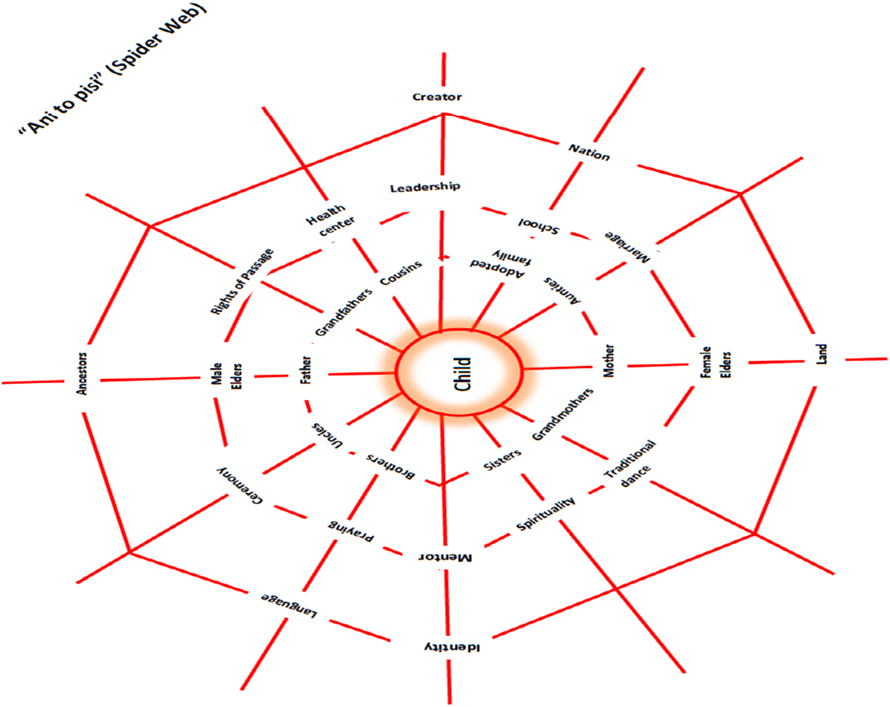
As can be seen in Figure 1, the raising of a child in an Indigenous culture can be seen from a communal perspective. There is not the notion of a particular person or set of parent figures who are solely accountable for raising the child. Rather, it is a multi-directional caring system with multiple intersections that weave together developmental pathways for the child. The child, in this system, draws knowledge, capacity, and skill building through relationships with land, culture, spirit, and community. Attachment, according to this view, constitutes too narrow an interpretation of the systems that support the development of a child within their culture.
“Ani to pisi” Spider Web gifted to the authors by Elder Roy Bear Chief as told to him by his brother Clement Bear Chief. As shared by Roy Bear Chief from the Siksika Nation, the story of Ani to pisi (Spider web) can explain the intricate connections involved in the care of people. Creator asked the spider to make a web and surround the people with this protective web. If there was a disturbance in the thread (which Roy referred to as a vibration), Creator would be there to help calm the vibration and restore balance. The spider web can be used to map out support systems and resources. Vibrations (disturbances) can be quelled by the assistance of the supports that make up the web. This adaptation is being used to show the relational connections involved in the raising and care of an Indigenous child. This diagram might not represent all Indigenous views but is being used as a mechanism to demonstrate the complexities of the relationships built within one’s culture.
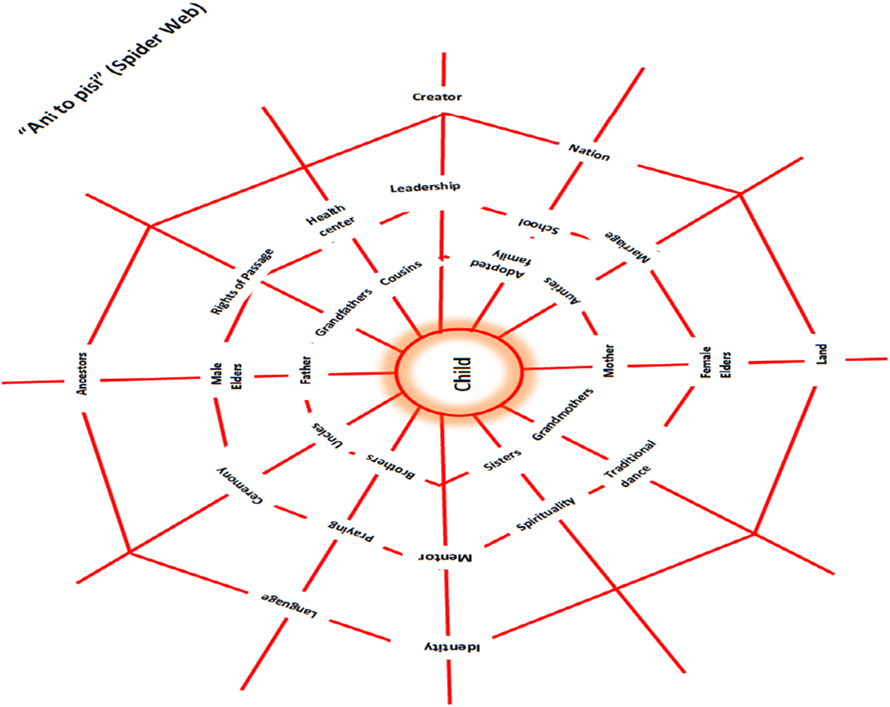
When assessing the needs of an Indigenous child, these forces go far beyond the narrow view of attachment. In fact, this is closer to the transactional model,Footnote 122 in which attachment is part of a series of influencing factors. This model has a larger, ecological view that considers vulnerability and protective factors that move well beyond dyadic views. This brings into consideration the child as an individual with impacts from familial, social, community, and economic forces. The dyadic view is too narrow to encompass these processes.
The Indigenous world view reflected in Figure 1 outlines more than just human relationships. Knowledge of the land and the way of nature, for example, allows the child to understand place in the universe not so much as unique but interconnected. Assessment that does not reflect this interactional understanding serves as a source of bias and will misjudge the child’s capacity and ability to develop in culture.
This leads to a need for a decolonizing view of assessment and the presentation of evidence to the court. Courts should be wary of expert evidence that lacks an Indigenous lens of caring for and raising a child. Figure 1 is an example of this Indigenous knowledge, but there is not a pan-Indigenous view, as cultures vary. Discomfort should arise when evidence not informed by the Indigenous view is presented, as the evidence may not meet the tests laid out in Mohan,Footnote 123 in that it would not be given by a properly qualified expert. Courts, social workers, psychologists, and others involved with families need to work with Indigenous peoples to revise their approach to be valid with Indigenous peoples, which is consistent with the TRC Calls to Action,Footnote 124 particularly Calls 1 to 5.
Indigenous authors have noted that Racine Footnote 125 fails to understand the identity that comes from connection to culture and its longitudinal impact. This leaves the child with identity confusion over time.
7. Conclusion
As can be seen from the cases and literature cited, the impact of Racine Footnote 126 continues. Attachment theory was powerful and, at the time, was useful in trying to understand how the best interests of the child could be considered over time. What we now understand is very different. We now know that attachment should not be placed in primacy when considering the best interests of the child, and that a multitude of variables need to be considered. Canada’s understanding of families, framed within the dominant society, was drawn upon a Eurocentric understanding of family. As a result of the Royal Commission on Aboriginal Peoples,Footnote 127 the TRC,Footnote 128 and recent decisions by the CHRT,Footnote 129 there are multiple calls for change to the relationships between Canada, the provinces and territories, and Indigenous peoples. We are called upon to change the relationship between the dominant society and Indigenous peoples. We are also called upon to no longer use invalid tools that continue to operationalize colonialization.
The Government of Alberta has announced its intent to tackle the priority of cultural preservation via legislative change, through “Identifying safety and connection to family as the primary considerations in deciding what is in the best interests of a child or youth.”Footnote 130 Such a change will direct the courts in Alberta to re-examine the weight and priorities to be considered in deciding permanency of Indigenous children.
This means we must reflect on how child intervention is put into practice and the decisions of the courts. If attachment theory, as we have argued, was built upon a Eurocentric understanding of family, then its application in decisions about Indigenous families is prejudicial. Attachment theory is not the only way in which non-Indigenous theories and practices are being imposed on Indigenous families. Parenting capacity assessments, definitions of family, understanding good enough parenting, and the caregiving system of children are further examples.Footnote 131 Indigenous understandings matter and remain valid.
Despite Canada’s deliberate efforts to eliminate Aboriginal ways of life, Elders were able to hold onto traditional teachings, knowledge, and practices. They continue to share them in a way that creates healing and restores community. The teaching of traditional parenting, language, and cultural practices is highly valued within these communities, and these traditions are slowly being reintegrated.Footnote 132 Healing is linked to cultural connection.Footnote 133
In our view, change comes from accepting that current methodologies, relying on Eurocentric theories such as attachment, do not apply to Indigenous cultures and may require examination for validity with various non-European cultures.Footnote 134 We also raise the need to challenge other methods rooted in Eurocentric beliefs, such as what it means to be a good enough parent.Footnote 135 Joining with Indigenous partners to conduct an inquiry into which assessment methods might be appropriate, could be modified, or need to be discontinues is consistent with the thinking in Ewart. Footnote 136 Choate and McKenzie raise concerns about validity in many methods, but it is not clear that all are inappropriate or that there are not some that can become valid and reliable through appropriate research.Footnote 137
Child intervention requires careful examination and a dramatic rethink to let go of the structural racism that inherently has been built into it. Challenging Racine is one step in that direction.Footnote 138 The historical goals of assimilation included adopting children out of Indigenous cultures so as to reduce the obligations of Canada. Transracial adoption “became the vanguard in socializing [Indigenous children] for democratic citizenship.”Footnote 139 Child intervention was used so that Indigenous children would be new members of the dominant Canadian society by having been reared away from their culture. They would be proper citizens of Canada.Footnote 140 Continuing to apply Racine Footnote 141 carries on colonization and should make Canada quite uncomfortable.