1. Introduction
Modern seafloor hydrothermal circulation involves permeable media, elemental dissolution and fluid migration, as well as exchange of material and thermal energy between the lithosphere and the ocean (Tivey, Reference Tivey1995; Wohlgemuth-Ueberwasser et al. Reference Wohlgemuth-Ueberwasser, Viljoen, Petersen and Vorster2015; Keith et al. Reference Keith, Haase, Klemd, Krumm and Strauss2016a, b). The sources of S in the hydrothermal fluids include the reduction of seawater sulphate, igneous rocks, magma and bacterial sulphate reduction (Bluth & Ohmoto, Reference Bluth and Ohmoto1988; Bowers, Reference Bowers1989; Herzig, Hannington & Arribas, Reference Herzig, Hannington and Arribas1998; Ono et al. Reference Ono, Shanks, Rouxel and Rumble2007; Rouxel et al. Reference Rouxel, Ono, Alt, Rumble and Ludden2008b; Alt & Shanks, Reference Alt and Shanks2011; Lever et al. Reference Lever, Rouxel, Alt, Shimizu, Ono, Coggon, Rd, Lapham, Elvert and Prietomollar2013). In modern hydrothermal systems, sulphur isotopic variations are mainly controlled by tectonic geological background conditions (e.g. spreading rates and depositional environments), a variety of S sources and multi-stage hydrothermal fluid evolution (Bluth & Ohmoto, Reference Bluth and Ohmoto1988; Zeng et al. Reference Zeng, Jiang, Qin and Qu2001, Reference Zeng, Ma, Chen, Selby, Wang and Yin2016). Additionally, changes in physicochemical conditions (e.g. pH, redox potential and temperature) can also affect δ34S values during sulphide precipitation (Ohmoto & Rye, Reference Ohmoto, Rye and Barnes1979). Thus S isotopes can effectively trace the sources of S within the hydrothermal fluid, providing robust evidence for clarifying the formation of sulphide chimneys (Woodruff & Shanks, Reference Woodruff and Shanks1988; Herzig, Hannington & Arribas, Reference Herzig, Hannington and Arribas1998; Ono et al. Reference Ono, Shanks, Rouxel and Rumble2007; McDermott et al. Reference McDermott, Ono, Tivey, Seewald, Shanks and Solow2015; Zeng et al. Reference Zeng, Ma, Chen, Selby, Wang and Yin2016). At sediment-starved mid-oceanic ridges, sulphur in the sulphides is mainly from basalts and seawater (Zierenberg & Shanks, Reference Zierenberg and Shanks1988; Shanks, Reference Shanks2001). At sediment-rich mid-oceanic ridges, biological activity can cause significant S isotopic fractionation among the sulphides; under such conditions, sulphate-reducing bacteria can deplete 34S by up to 66 ‰ (Sim, Bosak & Ono, Reference Sim, Bosak and Ono2011), leading to negative δ34S values (Alt & Shanks, Reference Alt and Shanks2011; Shao et al. Reference Shao, Yang, Xin, Jun, Shi and Geology2014; Lode et al. Reference Lode, Piercey, Layne, Piercey and Cloutier2017). At present, multiple S isotopes (32S, 33S, 34S, and 36S) are used as effective tools to constrain biological S fractionation (McDermott et al. Reference McDermott, Ono, Tivey, Seewald, Shanks and Solow2015; Lode et al. Reference Lode, Piercey, Layne, Piercey and Cloutier2017). Moreover, the contributions of magmatic volatile phases to hydrothermal fluids lead to the precipitation of sulphides with light S isotopes (δ34S = −5 ‰) at the Hine Hina hydrothermal vent in the Lau Basin (Herzig, Hannington & Arribas, Reference Herzig, Hannington and Arribas1998). A laser microscopic study of S isotopes in a seafloor hydrothermal spire preliminarily showed micro-scale S isotopic variations produced by seawater / hydrothermal-fluid mixing, deep-seated convection and redox processes (Crowe & Valley, Reference Crowe and Valley1992). Previous S isotopic studies have described the sources of S and the controlling factors of S isotopic compositions in detail; however, the δ34S values of chimney sulphides at the micro-scale still remain poorly documented. With recent advances in micro-analytical techniques (Ireland et al. Reference Ireland, Schram, Holden, Lanc, Ávila, Armstrong, Amelin, Latimore, Corrigan and Clement2014), the in situ analysis method permits us to investigate the micro-scale S isotopic compositions of sulphides and then ascertain fluid evolution during the formation of the chimney.
The abundant pores (10−15–10−11 m2, Tivey, Zhu and Kelley, Reference Tivey, Zhu and Kelley2001) found throughout the chimney walls promote seawater infiltration and fluid flow (Rona et al. Reference Rona, Hannington, Raman, Thompson, Tivey, Humphris, Lalou and Petersen1993), causing changes in geochemical gradients and fluid compositions (Tivey & McDuff, Reference Tivey and McDuff1990; Tivey et al. Reference Tivey1995; Kristall et al. Reference Kristall, Nielsen, Hannington, Kelley and Delaney2011). The porosity and permeability depend on progressive mineral precipitation and dissolution processes, varying mineral morphology and mineralization conditions across the chimney wall (Tivey & McDuff, Reference Tivey and McDuff1990; Tivey et al. Reference Tivey, Humphris, Thompson, Hannington and Rona1995; Zhu et al. Reference Zhu, Tivey, Gittings and Craddock2007). Studies of elemental distributions have been used to deduce patterns of fluid flow and seawater / hydrothermal-fluid interactions and to reveal the variations in geochemical conditions within chimney walls (Tivey & McDuff, Reference Tivey and McDuff1990; Tivey, Reference Tivey1995). Sulphur isotopes are also sensitive to changes in the composition of fluid, fluid–seawater mixing and physicochemical conditions across the hydrothermal chimney wall (Crowe & Valley, Reference Crowe and Valley1992). Conversely, in situ S isotopic variations at the micro-scale in sulphide mineral paragenetic sequences of chimneys can be used to track fluid evolution and hydrothermal-fluid / seawater mixing (Woodruff & Shanks, Reference Woodruff and Shanks1988; Crowe & Valley, Reference Crowe and Valley1992). However, conventional bulk and single-mineral analyses homogenize fine-scale geochemical differences and cannot provide precise information regarding mineral distributions.
In this study, we perform in situ analyses of two S isotopes (32S and 34S) using a sensitive high-mass-resolution ion micro-probe for stable isotopes (SHRIMP SI) to investigate the complex growth of a chimney in the East Pacific Rise 1–2° S hydrothermal field. The main objectives of this paper are (1) to characterize the mineral zones seen within the chimney; (2) to investigate the characteristics of the in situ S isotopic compositions in the sulphide mineral paragenetic sequence; (3) to highlight the correlation between S isotopic variations and fluid–seawater mixing across the chimney walls; and (4) to establish a model for the formation of chimneys.
2. Geological background
The East Pacific Rise (EPR) is a typical fast-spreading ridge with a full spreading rate that ranges from 80 to 200 mm a−1 (Holler & Marchig, Reference Holler and Marchig1990; Dick, Lin & Schouten, Reference Dick, Lin and Schouten2003). The ridge features an axial magma chamber that produces frequent volcanic eruptions (Holler, Reference Holler1999). Abundant disconnected volcanoes are formed with a wide variety of geometric structures (MacDonald & Fox, Reference MacDonald and Fox1983). Numerous high-temperature hydrothermal vents are distributed along the EPR, and the temporal evolution of these hydrothermal systems is related to the magmatic activity.
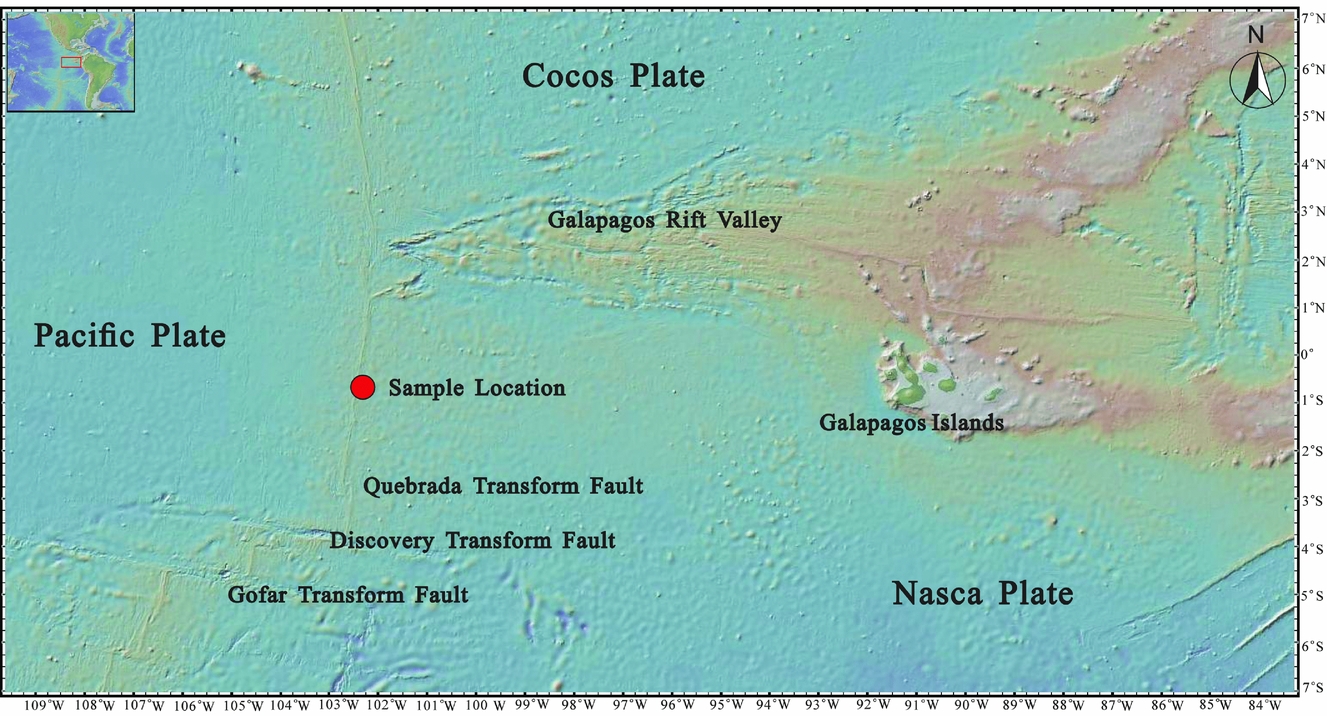
Our study area is located in the EPR 1–2° S hydrothermal field between the Galapagos triple junction and the Quebrada transform fault (Fig. 1). Multiple geophysical and geological surveys were conducted in this area in 2005, 2008 and 2009 during the Chinese expeditions DY115-20, DY115-21 and DY115-22 (Tao et al. Reference Tao, Lin, Wu, German, Yoerger, Chen, Guo, Zeng, Han and Zhou2008, Reference Tao, Li, Wu, Su and Zhang2011). The seafloor topography of the study area exhibits an ‘M’ shape, and the topography along the axis of the ridge is flat. The oceanic lithosphere features are characteristic of intense magmatic activity, and the basement rock consists of fresh basalt (Holler & Marchig, Reference Holler and Marchig1990; Sours-Page, Nielsen & Batiza, Reference Sours-Page, Nielsen and Batiza2002; Ding et al. Reference Ding, Li, Zheng, Huang, Cui, Dou and Sun2014). The basement basalt of this region can be divided into pyroxene basalt, vesicular basalt and vitrobasalt (Ding et al. Reference Ding, Li, Zheng, Huang, Cui, Dou and Sun2014). During the Chinese DY 20th cruise in 2008, the investigations of multi-metal sulphide resources near the EPR 1–2° S hydrothermal field were conducted by a series of submarine sensors, including CTD, ADCP, MAPR and METS (Tao et al. Reference Tao, Lin, Wu, German, Yoerger, Chen, Guo, Zeng, Han and Zhou2008). Subsequently, a high-temperature hydrothermal field named the ‘Bird's Nest’ was first discovered on an off-axis volcano near the southern EPR at a water depth of 2700 m (Tao et al. Reference Tao, Li, Wu, Su and Zhang2011). Zeng et al. focused on the hydrothermal sulphides in this hydrothermal field using multiple geochemical proxies, including S and Re–Os isotopes, rare earth elements and noble gases, which showed the geochemical composition characteristics of hydrothermal sulphides (Zeng et al. Reference Zeng, Chen, Selby, Yin and Wang2014, Reference Zeng, Niedermann, Chen, Wang and Li2015a, b, Reference Zeng, Ma, Chen, Selby, Wang and Yin2016). The above studies suggested that there may be abundant potential mineral resources in this region (Zeng et al. Reference Zeng, Zhang, Rong, Wang, Chen, Cui, Jiang and Qi2015c).
Location of the sulphide samples from the EPR 1–2° S hydrothermal field analyzed for in situ S isotopes (modified after Zeng et al. Reference Zeng, Zhang, Rong, Wang, Chen, Cui, Jiang and Qi2015c).

3. Sampling and analytical methods
Submarine hydrothermal sulphide samples were collected with a TV grab sampler near the EPR 1–2° S hydrothermal field during the Chinese DY 20th cruise in 2008 (Fig. 1).
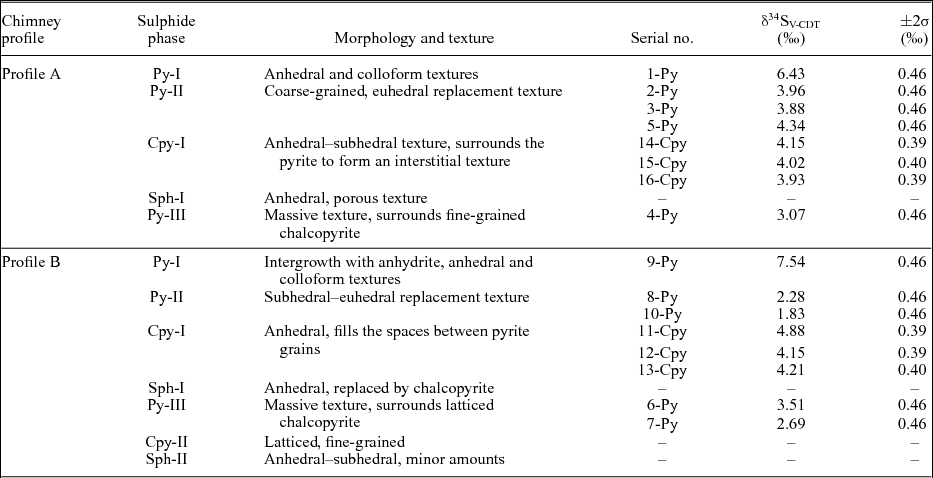
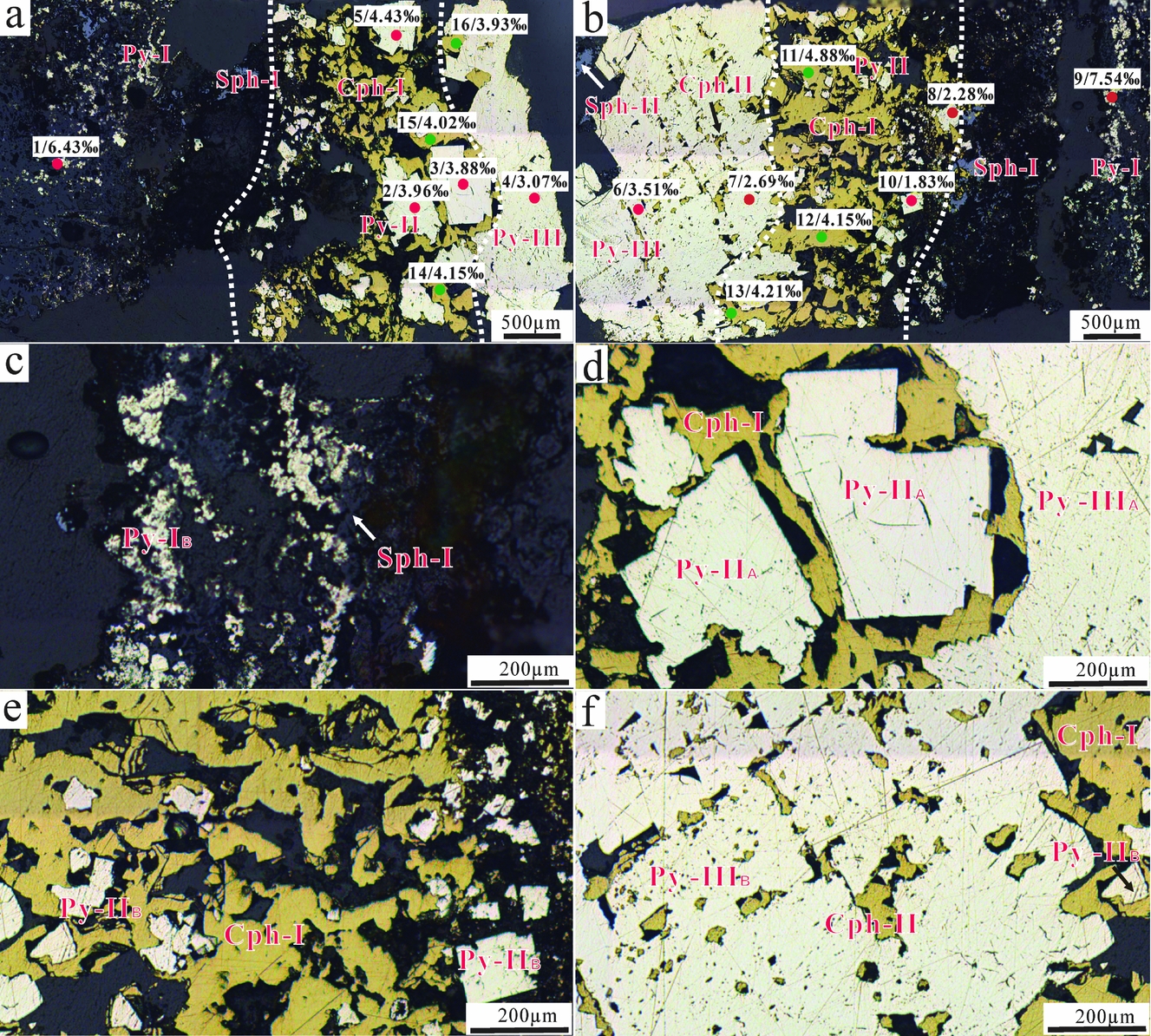
The sulphide chimney samples were cut into two thin sections, and photomicrographs were taken under a microscope using reflected light to identify potential locations for analysis. The δ34S values of pyrite and chalcopyrite in the hydrothermal chimney were measured in situ using the SHRIMP SI at the Research School of Earth Sciences, Australian National University (RSES, ANU) (Ireland et al. Reference Ireland, Clement, Compston, Foster, Holden, Jenkins, Lanc, Schram and Williams2008). A beam of primary Cs+ ions was focused to 6 nA with an acceleration voltage of 15 kV and a spot size of 20 μm. The detailed analytical procedures and methods are thoroughly described by Ireland et al. (Reference Ireland, Schram, Holden, Lanc, Ávila, Armstrong, Amelin, Latimore, Corrigan and Clement2014). All analyses for the unknowns were normalized to two primary standards, Ruttan pyrite and Norilsk chalcopyrite, assuming δ34SV-CDT values of +1.2 ‰ and +8.0 ‰, respectively (Crowe & Vaughan, Reference Crowe and Vaughan1996). The error for each sulphur isotope ratio is reported at the 2σ confidence level (Table 1). The spot-to-spot analytical errors (2σ) of Ruttan pyrite and Norilsk chalcopyrite were ±0.35 ‰ (n = 12) and ±0.37 ‰ (n = 7), respectively, whereas the internal precisions for the unknowns are better than ±0.08 ‰. The analytical locations and δ34SV-CDT values of the sulphides are shown in Figure 2 and Table 1.
Petrography and δ34S values of chimney sulphides from the EPR 1–2° S hydrothermal field

Abbreviations: Py=pyrite; Cpy=chalcopyrite; Sph=sphalerite; ‘–’=not detected.
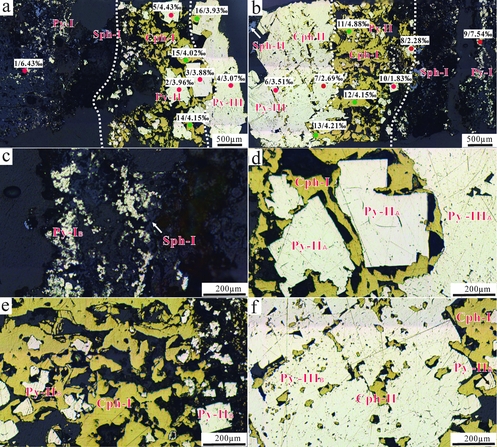
Analytical spot locations and in situ S isotopic values determined using SHRIMP SI for the sulphide chimney from the EPR 1–2° S hydrothermal field. (a) Mineral zones in profile A in the sulphide chimney; (b) Mineral zones in profile B in the sulphide chimney; (c) Fine-grained colloform and anhedral pyrite (Py-I); (d) Coarse-grained euhedral pyrite (Py-IIA) corroded by later chalcopyrite (Cpy-I); (e) Fine-grained sub-euhedral pyrite (Py-IIB) surrounded by massive chalcopyrite (Cpy-I); (f) The ‘chalcopyrite disease’ texture. Abbreviations: Py=pyrite (red circle); Cpy=chalcopyrite (green circle); Sph=sphalerite (analysis spot / δ34SV-CDT).
4. Results
4.a. Ore minerals and petrography
Petrographic observations made along two profiles of the chimney sampled from the EPR 1–2° S hydrothermal field show three obvious mineral zones: an inner pyrite-dominated zone is surrounded by a pyrite/chalcopyrite mixing zone, which is in turn mantled by an external zone of porous anhydrite and colloform pyrite (Fig. 2a, b). The typical mineral zones of the chimney are caused by multiple phases of dissolution, replacement and recrystallization, revealing the multi-stage geochemical evolution in the hydrothermal fluids (Kristall et al. Reference Kristall, Kelley, Hannington and Delaney2006, Reference Kristall, Nielsen, Hannington, Kelley and Delaney2011). The sulphide samples composed of well-crystallized pyrite and massive chalcopyrite reflect precipitation at high temperatures (>300°C) (Kim et al. Reference Kim, Lee, Halbach, Lee, Ko and Kim2006; Chen-Long et al. Reference Chen-Long, Fan, Sun and Yang2014).
In the external chimney wall, porous anhydrite intergrows with colloform/anhedral pyrite (Py-I), a minor amount of which is replaced by late sphalerite (Sph-I) (Fig. 2c). The internal middle zone of the chimney features abundant euhedral pyrite (Py-II) which is surrounded by later massive chalcopyrite (Cpy-I). Fine-grained sub-euhedral pyrite (Py-II) precipitates near the outer edge of the chimney in both profiles. Coarse-grained euhedral pyrite (Py-IIA) is observed only near the boundary with the core in profile A (Fig. 2d) and represents a higher mineralization temperature. However, the pyrite (Py-IIB) in profile B exhibits a disseminated fine-grained subhedral morphology (Fig. 2e), reflecting a lower mineralization temperature caused by mixing with cold seawater or conductive cooling (Kristall et al. Reference Kristall, Kelley, Hannington and Delaney2006). The sub- to euhedral pyrite (Py-II) and early sphalerite (Sph-I) at the edge are dissolved by subsequent ore-bearing fluids and cemented by sulphide veins composed of chalcopyrite (Cpy-I). The inner mineral zone of the chimney wall is composed of pyrite (Py-III) with a massive texture. In profile B, fine-grained chalcopyrite (Cpy-II) surrounded by massive pyrite (Py-III) displays the ‘chalcopyrite disease’ texture (Fig. 2f), which may be the result of the dissolution of chalcopyrite (Cpy-I) by ore-bearing fluids saturated with pyrite (Py-III) (Brett et al. Reference Brett, Evans, Gibson, Hedenquist, Wandless and Sommer1987; Graham, Bluth & Ohmoto, Reference Graham, Bluth and Ohmoto1988). A small amount of sphalerite (Sph-II) in the core may represent residual crystals after wurtzite recrystallized to pyrite (Fig. 2b). According to the ideal model of Graham et al. (Graham, Bluth & Ohmoto, Reference Graham, Bluth and Ohmoto1988), this chimney is in the mature period or waning stage (Graham, Bluth & Ohmoto, Reference Graham, Bluth and Ohmoto1988; Peng & Zhou, Reference Peng and Zhou2005).
4.b. In situ S isotopic compositions across the chimney wall
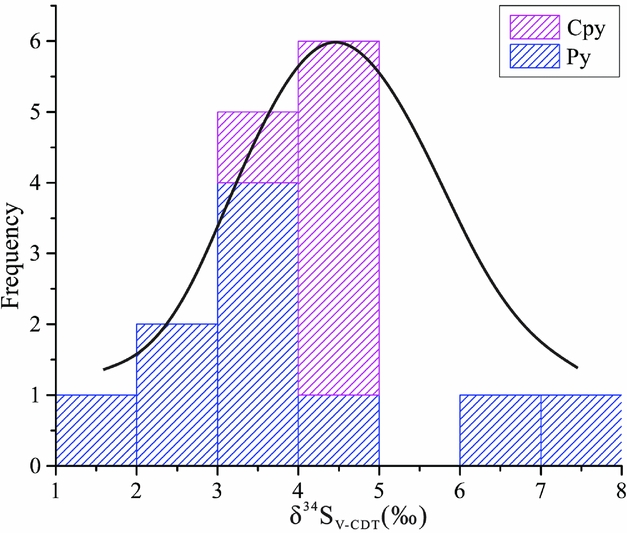
The δ34S values of sulphides from the EPR 1–2° S hydrothermal field range from 1.83 to 7.51 ‰ (avg. 4.05 ‰, n = 16) and exhibit a unimodal distribution on a frequency histogram (Fig. 3). The δ34S values of the pyrite vary between 1.83 and 7.51 ‰ (avg. 3.95 ‰, n = 10), whereas the δ34S values of the chalcopyrite range from 3.93 to 4.88 ‰ (avg. 4.22 ‰, n = 6). Hence, the δ34S values of the pyrite and chalcopyrite in this study are lower and higher, respectively, than previously reported average δ34S values for pyrite (4.43 ‰, n = 9) and chalcopyrite (3.85 ‰, n = 2) (Zeng et al. Reference Zeng, Ma, Chen, Selby, Wang and Yin2016).
Frequency histogram of in situ δ34S values in pyrite (n = 10) and chalcopyrite (n = 6) obtained from the EPR 1–2° S hydrothermal field.

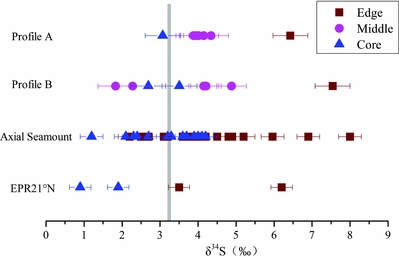
From the core to the edge in profile A, the average δ34S values of the sulphides are as follows: δ34SPy-I, 6.43 ‰ (n = 1); δ34SPy-II, 4.06 ‰ (n = 3); δ34SCpy, 4.03 ‰ (n = 3); and δ34SPy-III, 3.07 ‰ (n = 1). On the other hand, the average δ34S values of the sulphides in profile B are as follows: δ34SPy-I, 7.54 ‰ (n = 1); δ34SPy-II, 2.06 ‰ (n = 2); δ34SCpy-I, 4.41 ‰ (n = 3); and δ34SPy-III, 3.10 ‰ (n = 2). The variations in S isotopes differ between the two profiles, especially the anomalously low δ34S values of Py-IIB in profile B (Fig. 4). Overall, the δ34S values of the sulphides increase from the core (3.09 ‰, n = 3) through the mantle (3.78 ‰, n = 11), and to the edge (6.99 ‰, n = 2), which is consistent with in situ S isotopic analyses of other chimneys from the Axial Seamount and EPR 21° N hydrothermal fields (Fig. 4) (Woodruff & Shanks, Reference Woodruff and Shanks1988; Crowe & Valley, Reference Crowe and Valley1992). This pattern may be the result of a gradual increase in the proportion of seawater-derived S in the hydrothermal fluid across the chimney wall (Woodruff & Shanks, Reference Woodruff and Shanks1988).
In situ δ34S values of chimney sulphides from the EPR 1–2° S, Axial Seamount and 21° N hydrothermal fields. Data are derived from Table 1, Crowe & Valley (Reference Crowe and Valley1992) and Woodruff & Shanks (Reference Woodruff and Shanks1988), respectively; the grey solid line represents the average in situ δ34S value (3.2 ‰, n = 108, Data is derived from the Table 2).

5. Discussion
5.a. In situ S isotopic analyses of submarine hydrothermal sulphides
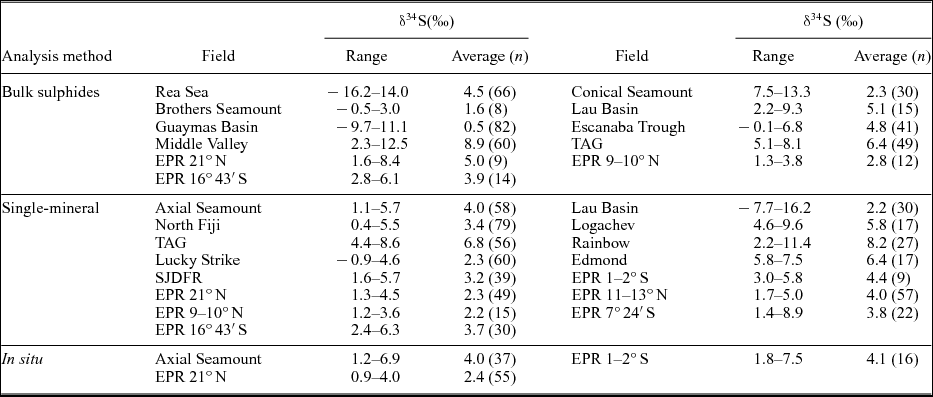
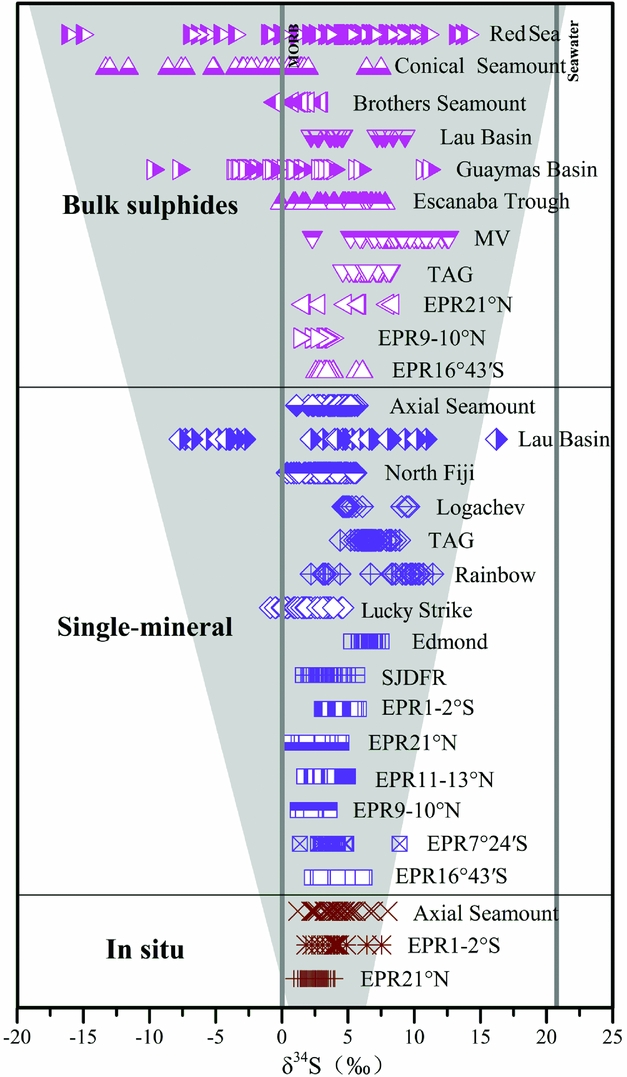
The S isotopic analysis methods for hydrothermal sulphides include bulk, single-mineral and in situ analyses (Table 2). Figure 5 shows that the δ34S values of the bulk sulphide samples range from −16.2 to 12.6 ‰ (avg. 3.8 ‰, n = 386); the δ34S values of the single-mineral samples range from −7.7 to 16.2 ‰ (avg. 4.0 ‰, n = 565); and the in situ δ34S values of the sulphide samples range from 0.9 to 7.5 ‰ (avg. 3.2 ‰, n = 108). Approximately 91 % of the δ34S values determined by previous studies fall between the δ34S values for basalt (0 ± 0.5 ‰, Sakai et al. Reference Sakai, Marais, Ueda and Moore1984) and seawater (20.9 ‰, Rees, Jenkins & Monster, Reference Rees, Jenkins and Monster1978), suggesting that S in hydrothermal fluids is mainly derived from basalt and seawater (Bluth & Ohmoto, Reference Bluth and Ohmoto1988; Shanks, Reference Shanks2001). Although the average δ34S values of the sulphides obtained through analyses of bulk samples and single minerals are similar, their variability differs (Fig. 5). This phenomenon may occur because the bulk samples include multiple S-bearing materials (sulphates, sediments and sulphides) and thus represent a mixture of S from the entire source region. In contrast, the variability of S isotopic measurements obtained from single-mineral analyses is relatively narrow because of pure sulphide minerals. On the basis of the δ34S values obtained from the single-mineral analyses, we can identify the anomalous data covered by mixtures. For example, the S isotopes display significant fractionation in the Hine Hina hydrothermal vent due to the contribution of light S derived from the magmatic volatile phase (Herzig, Hannington & Arribas, Reference Herzig, Hannington and Arribas1998). Similarly, biological reduction is also an important mechanism for producing 32S-enriched sulphides in the Lucky Strike hydrothermal field (Rouxel, Fouquet & Ludden, Reference Rouxel, Fouquet and Ludden2004a). Nevertheless, due to the fineness and intergrowths of the sulphide particles, obtaining pure single-mineral samples is difficult (Zeng et al. Reference Zeng, Qin, Zhao and Zhai2000). Unlike conventional analyses of bulk and single-mineral sulphide samples, in situ analyses do not include mineral grains that are smaller than the size of the beam, leading to a narrow range of δ34S values and a smaller degree of sampling bias.
The δ34S values of hydrothermal sulphides from various global hydrothermal fields based on bulk, single-mineral and in situ analyses

Data sources: Bulk sulphides: Red Sea (Zierenberg & Shanks, Reference Zierenberg and Shanks1988; Blum & Puchelt, Reference Blum and Puchelt1991), Conical seamount (Petersen et al., Reference Petersen, Herzig, Hannington, Jonasson and Arribas2002), Brothers Seamount (Ronde et al. Reference Ronde, Faure, Bray, Chappell and Wright2003), Lau Basin (Herzig & Hannington, Reference Herzig, Hannington and Arribas1998; Zeng et al. Reference Zeng, Niedermann, Chen, Wang and Li2015a), Guaymas Basin (Shanks & Niemitz, Reference Shanks and Niemitz1982; Peter & Shanks, Reference Peter and Iii1992), Escanaba Trough (Böhlke & Shanks, Reference Böhlke and Shanks1994; Zierenberg & Shanks, Reference Zierenberg and Shanks1994), Middle Valley (MV) (Goodfellow & Franklin, Reference Goodfellow and Franklin1993), TAG (Herzig, Petersen & Hannington, Reference Herzig, Petersen and Hannington1998), EPR21° N (Stuart et al. Reference Stuart, Duckworth, Turner and Schofield1994), EPR 9–10° N (Ono et al. Reference Ono, Shanks, Rouxel and Rumble2007; McDermott et al. Reference McDermott, Ono, Tivey, Seewald, Shanks and Solow2015), EPR 16° 43′ S (Marchig, Blum & Roonwal, Reference Marchig, Blum and Roonwal1997). Single-mineral analyses: Axial Seamount (Hannington & Scott, Reference Hannington and Scott1988), Lau Basin (Herzig & Hannington, Reference Herzig, Hannington and Arribas1998), North Fiji (Kim et al. Reference Kim, Lee, Halbach, Lee, Ko and Kim2006), Logatchev (Rouxel, Fouquet & Ludden, Reference Rouxel, Fouquet and Ludden2004b), TAG (Knott et al. Reference Knott, Fouquet, Honnorez, Petersen and Bohn1998), Rainbow (Lein et al. Reference Lein, Ulyanova, Ulyanov, Cherkashev and Stepanova2001; Rouxel, Fouquet & Ludden, Reference Rouxel, Fouquet and Ludden2004b), Lucky Strike (Rouxel, Fouquet & Ludden, Reference Rouxel, Fouquet and Ludden2004a, b; Ono et al. Reference Ono, Shanks, Rouxel and Rumble2007), Edmond (Zeng et al. Reference Zeng, Ma, Chen, Selby, Wang and Yin2016), Southern Juan de Fuca Ridge (SJDFR) (Shanks & Seyfried, Reference Shanks and Seyfried1987), EPR 1–2° S (Zeng et al. Reference Zeng, Ma, Chen, Selby, Wang and Yin2016), EPR 21° N (Hekinian et al. Reference Hekinian, Fevrier, Bischoff, Picot and Shanks1980; Kerridge, Haymon & Kastner, Reference Kerridge, Haymon and Kastner1983; Zierenberg, Shanks & Bischoff, Reference Zierenberg, Shanks and Bischoff1984), EPR 11–13° N (Bluth & Ohmoto, Reference Bluth and Ohmoto1988; Ono et al. Reference Ono, Shanks, Rouxel and Rumble2007; Zeng et al. Reference Zeng, Ma, Chen, Selby, Wang and Yin2016), EPR 9–10° N (Rouxel et al. Reference Rouxel, Shanks, Bach and Edwards2008a), EPR 7° 24′ S, 16° 43′ S (Marchig, Blum & Roonwal, Reference Marchig, Blum and Roonwal1997). In situ analyses: Axial Seamount (Crowe & Valley, Reference Crowe and Valley1992), EPR 21° N (Woodruff & Shanks, Reference Woodruff and Shanks1988), EPR 1–2° S (see Table 1).
The δ34S values of sulphides from global modern seafloor hydrothermal fields, including the Red Sea, the Conical Seamount, the Brothers Seamount, the Lau Basin, the Guaymas Basin, the Escanaba Trough, the Middle Valley (MV), the Trans-Atlantic Geotraverse (TAG), the Edmond, the Rainbow, the Logachev, the Lucky Strike, the Southern Juan de Fuca Ridge (SJDFR), the EPR (at 16° 43′ S, 7° 24′ S, 9–10° N, 11–13° N, 21° N, and 1–2° S), the North Fiji Basin, and the Axial Seamount hydrothermal fields. Mid-ocean ridge basalt (MORB) and seawater data are from Sakai et al. (Reference Sakai, Marais, Ueda and Moore1984) and Rees et al. (Reference Rees, Jenkins and Monster1978), respectively. The S isotopic data of global sulphides follow Table 2.

The δ34S values of the sulphide minerals from the EPR 1–2° S hydrothermal field generally fall within the narrow range of 3–5 ‰, and the in situ δ34S values of the sulphides increase from the core (3.09 ‰) to the edge (6.99 ‰) of the chimney. The average δ34S value (3.09 ‰, n = 2) of the sulphides in the core of this chimney is similar to the average δ34S value (3.2 ‰, n = 17) of sulphides from the core of a chimney in the Axial Seamount hydrothermal field (Crowe & Valley, Reference Crowe and Valley1992). However, the pyrite at the edge contains remarkably high δ34S values (6.99 ‰, n = 2). According to experiments and theoretical calculations performed using a model (Janecky & Shanks, Reference Janecky and Shanks1988), the δ34S values of the associated fluids increased from 1–1.5 ‰ to 1.5–4.5 ‰, due to the addition of seawater-derived S in the mixing of hydrothermal fluids (350 °C) with cold seawater (2 °C). These values suggest that the pyrite (6.99 ‰) in the exterior wall is significantly affected by ambient seawater. Using the two end-member model (δ34Smixing = ƒ × δ34Sseawater + (1 − ƒ) × δ34Sbasalt, where ƒ is the percentage content of seawater, and δ34Smixing, δ34Sseawater (δ34S ≈ 20.9 ‰) and δ34Sbasalt (δ34S ≈ 0.1 ‰ ± 0.5 ‰) are the δ34S values in sulphide, seawater and basalt, respectively, Ono et al. Reference Ono, Shanks, Rouxel and Rumble2007), we can estimate the varying proportions of S in the sulphides of the core, the middle and the edge of the chimney wall derived from seawater (12–17 %, 8–23 % and 30–36 %, respectively) and basalt (83–88 %, 77–92 % and 64–70 %, respectively). These differences may result from a gradual decrease in seawater infiltration as sulphides precipitate from the core to the edge during chimney growth (Bluth & Ohmoto, Reference Bluth and Ohmoto1988; Zeng et al. Reference Zeng, Ma, Chen, Selby, Wang and Yin2016). Therefore, the sulphides in the interior chimney wall reflect little mixing between the ascending hydrothermal fluid and the seawater, and their δ34S values may represent the primary S isotopic compositions of the hydrothermal fluid (Woodruff & Shanks, Reference Woodruff and Shanks1988).
5.b. The correlation between S isotopic variations and fluid–seawater mixing across the chimney
During the growth of a chimney, the changes in the temperature and chemical compositions caused by hydrothermal-fluid/seawater mixing, conductive cooling of the fluid or multi-stage fluid evolution promote the formation of mineral zones within the chimney wall (Koski et al. Reference Koski, Jonasson, Kadko, Smith and Wong1994; Kristall et al. Reference Kristall, Nielsen, Hannington, Kelley and Delaney2011; Keith et al. Reference Keith, Häckel, Haase, Schwarz-Schampera and Klemd2016b). Sulphur isotopes can be exchanged and redistributed among S-bearing species due to dynamic and thermodynamic fractionation of S isotopes (Gavelin, Parwel & Ryhage, Reference Gavelin, Parwel and Ryhage1960; Ohmoto & Lasaga, Reference Ohmoto and Lasaga1982).
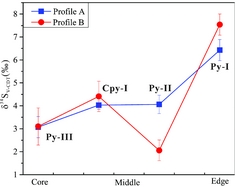
The in situ S isotopic variations in the mineral paragenetic sequence of the chimney indicate that the δ34S values of the sulphides in profiles A and B are different (Fig. 6). In the outer mineral zone, the average δ34S value of Py-IB in profile B is 1.1 ‰ higher than that of Py-IA in profile A. In the middle part of the chimney, the differences in the δ34S values of Py-II and Cpy-I in the two profiles are highly variable. The difference in δ34S between Py-IIA and Cpy-IA in profile A is approximately 0 ‰, whereas the difference in δ34S between Py-IIB and Cpy-IB in profile B reaches −2.3 ‰. However, the differences in δ34S between Py-II and Cpy-I in both profiles are opposite to the S isotopic equilibrium fractionation factor (∆34Spyrite-chalcopyrite ≈ 1.1 ‰; Ohmoto, Reference Ohmoto and Barnes1997). This phenomenon has been widely observed in other hydrothermal fields (Rouxel, Fouquet & Ludden, Reference Rouxel, Fouquet and Ludden2004a; Ono et al. Reference Ono, Shanks, Rouxel and Rumble2007; Rouxel et al. Reference Rouxel, Shanks, Bach and Edwards2008a; McDermott et al. Reference McDermott, Ono, Tivey, Seewald, Shanks and Solow2015). The significant differences in δ34S values of the pyrite and chalcopyrite indicate that the pyrite and chalcopyrite that coexist in this chimney are not paragenetic or cogenetic, which may reflect multi-stage precipitation or replacement of sulphides under a wide range of geochemical conditions (Rouxel, Fouquet & Ludden, Reference Rouxel, Fouquet and Ludden2004a). In contrast to the marked differences in δ34S values of Py-II, the δ34S values of Py-III in the core of both profiles are nearly identical.
The average δ34S values of sulphide minerals across the sulphide chimney from the core to the edge.

During the initial stage of chimney growth, the early deposited anhydrite wall is porous and promotes seawater infiltration and fluid flow (Tivey & McDuff, Reference Tivey and McDuff1990; Zhu et al. Reference Zhu, Tivey, Gittings and Craddock2007). The elevated δ34S values of the sulphides at the edge of the chimney wall may be interpreted as evidence of reactions with the ambient seawater or early deposited anhydrite in the near-surface zone, indicating a substantial contribution of reduced S derived from sulphate to the hydrothermal fluids (Janecky & Shanks, Reference Janecky and Shanks1988; Woodruff & Shanks, Reference Woodruff and Shanks1988; Ono et al. Reference Ono, Shanks, Rouxel and Rumble2007).
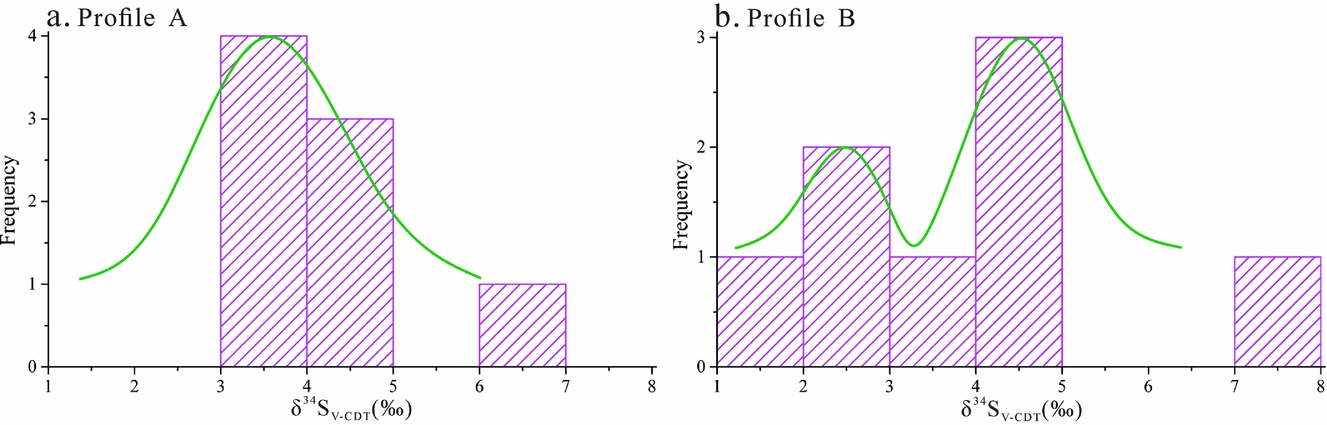
In the internal middle zone of the chimney, the δ34S values of Py-II in profiles A and B are markedly different (Fig. 6). The δ34S values of Py-IIB are dramatically lower in profile B than in profile A, which may be the result of an external factor that causes substantial S isotopic differences among the S-bearing species during the precipitation of Py-IIB. This phenomenon has several potential causes. (1) Bacterially reduced sulphate contributions: it is generally agreed that at temperatures of 15–25 °C, the reduction of biological sulphate can generate a large fractionation effect of 30–40 ‰ (Canfield, Reference Canfield2001). However, precipitation temperatures that exceed 150 °C do not favour the survival of thermophilic bacteria (Deming & Baross, Reference Deming and Baross1993). The mineral association in the chimney studied here reflects a high-temperature (>300°C) environment (Chen-Long et al. Reference Chen-Long, Fan, Sun and Yang2014). Additionally, the formation temperatures of hydrothermal chimneys on the EPR typically exceed 250 °C (Shanks, Reference Shanks2001; Rouxel et al. Reference Rouxel, Shanks, Bach and Edwards2008a, b). Therefore, it is relatively improbable that the reduction of biological S occurred during the growth of this chimney. (2) Kinetic fractionation of S isotopes between fluid H2S and sulphide: at temperatures of 200–350 °C and under low-pH conditions, the difference in fractionation coefficients is within 1 ‰ (Kerridge, Haymon & Kastner, Reference Kerridge, Haymon and Kastner1983; Ohmoto, Reference Ohmoto and Barnes1997). Therefore, the S isotopic fractionation between fluid H2S and sulphide is not significant at a high-temperature condition during this chimney growth. (3) The exchange of S isotopes between seawater 32SO42− and fluid H234S: the frequency histogram of δ34S values for the chimney sulphides in profile A shows that the distribution of δ34S values is unimodal (Fig. 7a), indicating a simple origin or a well-mixed source with two end members (basalt and seawater) for the hydrothermal fluid originating from the oceanic crust (Duckworth, Fallick & Rickard, Reference Duckworth, Fallick and Rickard1994). In contrast, the distribution of sulphide δ34S values in profile B is bimodal (Fig. 7b), reflecting the presence of a turbulent mineralization environment. Hydrothermal fluids are usually influenced by the ambient seawater after erupting from the seabed (Tivey, Reference Tivey1998). Previous studies have shown that sulphide mounds allow seawater sulphate to enter and to mix with the hydrothermal fluid, which promotes the exchange of S isotopes during the precipitation of sulphides (Ono et al. Reference Ono, Shanks, Rouxel and Rumble2007; Rouxel et al. Reference Rouxel, Shanks, Bach and Edwards2008a, b). Laboratory investigations indicate that only 4–15 hours is required for the degree of S isotopic exchange between seawater sulphate and fluid H2S to reach 90 % in hydrothermal fluids (∑S = 0.01 mol/kg·H2O, pH = 2–3 and T = 350 °C) (Ohmoto & Lasaga, Reference Ohmoto and Lasaga1982). Therefore, we infer that the exchange between seawater SO42− and fluid H2S can explain the abnormally low δ34S values of Py-IIB in profile B. The porous chimney wall in profile B promotes seawater infiltration and the exchange of S between seawater 32SO42− and fluid H234S, leading to the precipitation of 32S-enriched pyrite (Py-IIB). By contrast, the higher and stable δ34S values of Py-IIA in the same mineral phase in profile A may reflect little S isotopic fractionation and lack a distinct seawater influence.
Frequency histogram of δ34S values in profiles A and B within the chimney wall.

In contrast to the differences in the δ34S values of Py-I and Py-II seen in profiles A and B, the δ34S values of Cpy-I and Py-III are similar in the two profiles, reflecting a single sulphur source or a stable mineralization environment (Rouxel, Fouquet & Ludden, Reference Rouxel, Fouquet and Ludden2004a). In the late stage of chimney growth, the presence of a thick chimney wall produced by sulphide mineral precipitation isolates the hydrothermal fluid from the ambient seawater (Haymon, Reference Haymon1983; Kristall et al. Reference Kristall, Kelley, Hannington and Delaney2006). Meanwhile, as the pathways of seawater migration along fractures and faults become clogged by early deposited S species (Tivey, Reference Tivey2007), the amount of seawater-derived S in the hydrothermal fluid decreases with the waning hydrothermal circulation beneath the seafloor. Therefore, Cpy-I and Py-III precipitated from the hydrothermal fluid with little influence from seawater. The temporal evolution of the H2S in the hydrothermal fluid may be the main reason for the lower δ34S values in Py-III at the core (Duckworth et al. Reference Duckworth, Knott, Fallick, Rickard, Murton, Van Dover, Parson, Walker and Dixon1995).
Based on the variations in S isotopes between the two profiles in the three mineral zones, we find that the differences in the influence of seawater during the precipitation of sulphide are the dominant cause of S isotopic variations across chimney walls. Systematic laboratory measurements of chimney walls show that the different mineral precipitation processes with the evolution of the pore space result in the changes in permeability and porosity (Zhu et al. Reference Zhu, Tivey, Gittings and Craddock2007). Variations in permeability (10−15–10−11 m2, Tivey, Zhu & Kelley, Reference Tivey, Zhu and Kelley2001) across the chimney control the migration of fluids and the mixing of seawater and hydrothermal fluids, and these processes are responsible for the changes in the fluid compositions and physicochemical conditions (Tivey & McDuff, Reference Tivey and McDuff1990; Tivey, Reference Tivey1995; Kristall et al. Reference Kristall, Kelley, Hannington and Delaney2006). Petrographic observations of the sulphide minerals in the chimney studied here indicate that the differences in mineral association, mineralogy and crystal morphology between the two profiles lead to distinct pore structures across the chimney wall (Fig. 2d, e). Therefore, we may infer that differences in seawater penetration in response to changes in permeability or porosity across the chimney wall explain the S isotopic variations in the different profiles of the chimney.
5.c. Establishing a chimney growth model based on the variations in δ34S values and pyrite morphology
In the hydrothermal systems, pyrite is a ubiquitous sulphide present in every stage of black smoker growth. The crystal morphology of pyrite records the information on replacement or alteration, as well as the mineralization environment (Syverson, Borrok, & Seyfried, Reference Syverson, Borrok and Seyfried2013; Keith et al. Reference Keith, Haase, Klemd, Krumm and Strauss2016a, b). The δ34S values of pyrite can reflect changes in physicochemical conditions, the sources of fluids and fluid evolution (Tanner et al. Reference Tanner, Henley, Mavrogenes and Holden2016).
The zones from the edge to the core of the chimney are characterized by crystal morphologies of colloform/anhedral pyrite to euhedral pyrite and massive pyrite (Fig. 2c–f), and these morphologies show progressive depletion in S isotopic values of 6.99 ‰ (n = 2), 3.26 ‰ (n = 5) and 3.09 ‰ (n = 3), respectively (Fig. 6). The crystal morphologies of the pyrite display distinguishable S isotopic compositions, suggesting multiple stages of fluid evolution and chimney growth. The early sulphides, which were deposited at low temperatures, display colloform/anhedral morphologies, whereas the later sulphides exhibit coarse-grained euhedral and massive textures produced by precipitation at high temperatures in the core of the chimney. Hydrothermal fluids are gradually isolated from ambient seawater with the precipitation of sulphides, which promotes a rise in temperature of the hydrothermal fluid (Peng & Zhou, Reference Peng and Zhou2005). Furthermore, S isotopic variations in pyrite from the core to the edge of the chimney are caused by a decrease in the amount of seawater-derived S and the degree of S isotopic fractionation caused by different fluid–seawater mixing (Crowe & Valley, Reference Crowe and Valley1992; Ono et al. Reference Ono, Shanks, Rouxel and Rumble2007). Therefore, parallel variations in the crystal morphologies of pyrite and S isotopic compositions across the chimney result from different hydrothermal-fluid / seawater mixing possibly controlled by the changes in permeability and porosity within the chimney. These findings enhance our in-depth understanding of the multi-stage evolution of hydrothermal fluids and ore-forming processes (Wang & Zhu, Reference Wang and Zhu2015; Zhang et al. Reference Zhang, Shao, Chen, Liu and Li2016).
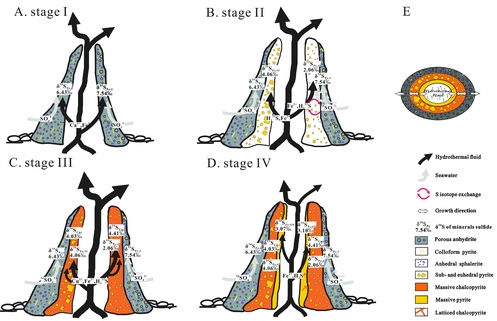
Based on the variations in S isotopes, mineral morphologies and the metasomatic replacement of pyrite across the chimney wall, the formation of this chimney can be divided into four mineralization stages (Fig. 8). Compared to previously published growth histories of chimneys (Goldfarb et al. Reference Goldfarb, Converse, Holland and Edmond1983; Haymon, Reference Haymon1983; Peng & Zhou, Reference Peng and Zhou2005; Kristall et al. Reference Kristall, Kelley, Hannington and Delaney2006), the profiles of this chimney reflect different hydrothermal-fluid / seawater mixing during the growth of the chimney.
The ideal chimney growth model (modified after Wohlgemuth-Ueberwasser et al. Reference Wohlgemuth-Ueberwasser, Viljoen, Petersen and Vorster2015). A. Formation of anhedral pyrite. B. Crystallization of euhedral pyrite. C. Chalcopyrite filling stage. D. Precipitation of massive pyrite. E. Top view of the chimney. Abbreviations: Py=pyrite; Cpy=chalcopyrite.

In the initial stage of chimney growth, high-temperature hydrothermal fluids are ejected into the cold seawater (Fig. 8A). When the temperature of the mixed fluid exceeds 150 °C, a porous anhydrite wall precipitates and intergrows with later colloform pyrite (Kristall et al. Reference Kristall, Kelley, Hannington and Delaney2006). Quenching of H2S-rich fluids caused by rapid fluid–seawater mixing precipitates colloform/anhedral Py-I, which reflects a disequilibrium condition. The pyrite deposited by this process is enriched in 34S due to the reduction of seawater or early deposited anhydrite sulphate by Fe2+ (Woodruff & Shanks, Reference Woodruff and Shanks1988; Crowe & Valley, Reference Crowe and Valley1992). In stage II, as the pores in the exterior chimney wall become clogged with the precipitation of sulphides, the hydrothermal fluid gradually becomes isolated from ambient seawater (Styrt et al. Reference Styrt, Brackmann, Holland, Clark, Pisutha-Arnond, Eldridge and Ohmoto1981; Tivey, Reference Tivey1998). The enclosed system promotes temperature rise of the fluid, which provides a high-temperature condition for the precipitation of coarse-grained euhedral Py-IIA near the inner conduit of the chimney in profile A (Fig. 8B). However, small amounts of seawater can still permeate through unclogged mineral pores and undergo rapid S isotopic exchange with the hydrothermal fluid (Rouxel et al. Reference Rouxel, Shanks, Bach and Edwards2008a), precipitating fine-grained subhedral Py-IIB that displays relatively low δ34S values in profile B. Subsequently, as the hydrothermal chimney matures, the hydrothermal fluids become completely isolated from the seawater because of decreases in permeability of the inner zone with the precipitation of sulphides. The high-temperature fluids replace Py-II, dissolve the early sphalerite, and ultimately form Cpy-I in stage III (Fig. 8C). Cpy-I is present as a massive texture and surrounds Py-II in the middle part of the chimney. The higher porosity of profile B favours the advection of fluids and pyrometasomatic reactions (Tivey & McDuff, Reference Tivey and McDuff1990; Zhu et al. Reference Zhu, Tivey, Gittings and Craddock2007). Additionally, the chalcopyrite zone rapidly becomes impermeable and limits the effects of seawater on the minerals (Berkenbosch et al. Reference Berkenbosch, Ronde, Gemmell, Mcneill and Goemann2012). As the hydrothermal circulation begins to wane in the last stage of chimney growth, the fluids precipitate massive Py-III in the core of the chimney (Fig. 8D). Furthermore, the S isotopic compositions of Cpy-I and Py-III also decrease as the hydrothermal fluid (H2S) evolves, because of the decrease in the supply of seawater-derived S (Woodruff & Shanks, Reference Woodruff and Shanks1988).
6. Conclusions
(1) The hydrothermal sulphide chimney collected from the EPR 1–2° hydrothermal field can be subdivided into three mineral zones based on mineral compositions and mineral textures: an outer mineral zone of porous anhydrite and colloform pyrite, a middle zone of euhedral pyrite and missive chalcopyrite, and an innermost zone of massive pyrite.
(2) The δ34SV-CDT values of the sulphides range from 1.83 to 7.51 ‰ (avg. 4.05 ‰, n = 16). Moreover, the δ34S values of the sulphides gradually increase across the chimney wall; specifically, these values are 3.09 ‰ (n = 3), 3.78 ‰ (n = 11) and 6.99 ‰ (n = 2) in the core, the middle and the edge, respectively. The changes in the δ34S values occurred due to the increasing amount of seawater-derived S in the hydrothermal fluids. Compared with conventional bulk and single-mineral analyses, the in situ S isotopic analyses are more precise and also yield information on the fine-scale distribution of geochemical parameters and minerals.
(3) In contrast to the gradual decrease in δ34S values in one profile (profile A), abnormally low δ34S values (2.06 ‰, n = 2) are observed in the fine-grained pyrite that precipitated in another profile (profile B) in the internal middle zone of the chimney. These results suggest different distributions of S-isotopes in the variable profiles of chimney due to S isotopic exchange between seawater SO42− and fluid H2S, which is possibly caused by different degrees of hydrothermal fluid–seawater mixing in response to variations in permeability or porosity within the chimney wall.
(4) The systematic variations in S isotopic compositions and morphologies of the pyrite across the chimney wall reflect multiple stages of mineralization and fluid evolution. Based on in situ S isotopic compositions, we propose a chimney growth model that focuses on different degrees of fluid–seawater mixing in the various profiles of the chimney.
Acknowledgements
This work was financially supported by the National Natural Science Foundation of China (No. 41276055 & 41406066, the Fundamental Research Funds for the Central Public-Interest Scientific Institution (No. JT1701) and the China Ocean Mineral R&D Association (COMRA) project (No. DY135-G2-1-01, 03 & DY135-S2-2-05). The authors thank senior engineer Mr Xuewen Wu in the Marine Operation of Xiamen University for technical support.
Declaration of interest
The authors declare no conflict of interest related to this article.