Introduction
Phragmolites Conrad, Reference Conrad1838 is a familiar and diverse bellerophontoid gastropod genus known primarily from Upper Ordovician strata of the Laurentian platform and marginal areas, but also from Baltica, Siberia, Chingiz (Kazakhstan), and Himalaya (India). An Early Ordovician (Tremadocian) occurrence from North China was reported in the literature, whereas previous reports of Silurian occurrences of the genus were shown to be incorrect (Peel, Reference Peel1991; Ebbestad, Reference Ebbestad1999a). Species of the genus are often small, < 2 cm in length, but easily identifiable by the relatively narrow planispiral conch, the comarginal and corrugated lamellose shell ornamentation, and the lack of a median apertural sinus. Instead, the median apertural margin turns abruptly into the open carinated slit. In North America, Phragmolites is for the most part found in shallow-water subtidal carbonate facies but ranges to the deeper shelve areas (Wahlman, Reference Wahlman1992; Novack-Gottshall and Miller, Reference Novack-Gottshall and Miller2003; Ebbestad et al., Reference Ebbestad, Frýda, Wagner, Horný, Isakar, Stewart, Percival, Bertero, Rohr, Peel, Blodgett, Högström, Harper and Servais2013). Phragmolites, being easily identifiable, is potentially important in understanding faunal relationships across biofacies, provinces, and latitudes.
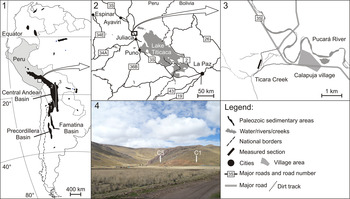
In this paper, an occurrence of Phragmolites from the Late Ordovician (Sandbian) Calapuja Formation of southwestern Peru is reported. Deposits in the high plains (Altiplano) of Peru belong to the northern part of the Central Andean Paleozoic Basin, which broadly extends southward along the western margin of South America through the Altiplano of Bolivia and Puna of northwestern Argentina and its border with Chile (Fig. 1). During the Ordovician, the Central Andean Basin was part of the Proto-Andean margin of Gondwana, and was situated in a mid-latitude position facing the Rheic Ocean with increasing distance to Avalonia and Laurentia toward the end of the period (Astini, Reference Astini and Benedetto2003; Cocks and Fortey, Reference Cocks and Fortey2009; Torsvik and Cocks, Reference Torsvik, Cocks, Harper and Servais2013). Lower Ordovician brachiopod associations from Peru share key genera with Avalonia and the so-called Celtic fauna (Gutiérrez-Marco and Villas, Reference Gutiérrez-Marco and Villas2007). This represents shelly assemblages from a number of smaller paleoareas centered around Avalonia, fragments in the Iapetus Ocean, and parts of South America, which reflect a common Celtic province stretching along high- to mid-latitude geographical positions (Harper et al., Reference Harper, Rasmussen, Liljeroth, Blodgett, Candela, Jin, Percival, Rong, Villas, Zhan, Harper and Servais2013). Although Ordovician brachiopods from Peru typically comprise taxa in common with the Mediterranean margin of Gondwana, the Avalonia signature prevails and these areas share genera and species at least until the early Late Ordovician (Gutiérrez-Marco and Villas, Reference Gutiérrez-Marco and Villas2007; Villas et al., Reference Villas, Colmenar and Gutiérrez-Marco2015).
The study area: (1) generalized map of South America and Peru, showing Paleozoic basins; (2) position of the Calapuja area in relation to Lake Titicaca; (3) detailed map of the Ticara Creek section; (4) photograph of the locality viewed toward west-northwest (photo by the junior author).

Specimens of Phragmolites lissoni n. sp. presented here are well preserved and allow a broader discussion on morphological variation within the genus, especially concerning the spatial distribution of the typical lamellar ornamentation. Regular spatial ornamentation requires a complex morphological mechanism, which suggests that these features are taxonomically important. Furthermore, an updated inventory of known species of Phragmolites and their distribution is given, which is fundamental for understanding the biogeographic significance of the new discovery. The Calapuja species represents the hitherto only systematically described Ordovician gastropod from Peru. Hughes et al. (Reference Hughes, Rickards and Williams1980) figured a specimen of Sinuites sp. from the Darriwilian Contaya Formation of east-central Peru, but otherwise Ordovician gastropods are known mainly from several taxa in Argentina and three records in Bolivia. The study follows up on previous reports of Peruvian brachiopods and cornulitids from the same section as the present material (Villas et al., Reference Villas, Colmenar and Gutiérrez-Marco2015; Vinn and Gutiérrez-Marco, Reference Vinn and Gutiérrez-Marco2016).
Geological setting and previous work
The specimens described here come from a section exposed northwest of Ticara Creek, ~ 2 km west of the town of Calapuja, situated ~ 50 km northwest of Lake Titicaca in the Altiplano (high plains) of the Region of Puno in southwestern Peru (Fig. 1). The section was described in detail by Villas et al. (Reference Villas, Colmenar and Gutiérrez-Marco2015) and encompasses the lower part of the Sandbian (Sa2) Calapuja Formation. This is a 2200–2500 m thick siliciclastic succession consisting of a series of approximately a dozen 100 m thick quartzite packages separated by shaly siltstone and sandstone (Villas et al., Reference Villas, Colmenar and Gutiérrez-Marco2015). The ~ 200 m thick section from where Phragmolites comes represents a regressive sequence, capped by quartzite unit Q3 (Villas et al., Reference Villas, Colmenar and Gutiérrez-Marco2015, fig. 2).
Ordovician rocks in the area form the northern part of the large autochthonous Central Andean Basin, extending south into Bolivia and Argentina (Fig. 1). The Central Andean Basin and the proto-Andean Paleozoic margin in general have three geological provinces from west to east: (1) the Altiplano (named Puna in Argentina), (2) the Cordillera Oriental, and (3) the SubAndean Ranges (Fig. 1). The Ordovician succession is ~ 5000 m thick, with excellent distribution and continuous exposures, and broadly represent a large foreland area with a complex depositional development along the western Gondwana margin (Astini, Reference Astini and Benedetto2003). Further to the south in Argentina, Ordovician sediments are also found in the Precordillera and Famatina basins. Whereas the Famatina Basin reflects a magmatic arc developed at the western margin of Gondwana, the Precordillera Basin represents a distinct terrane (the Cuyania Terrane) (Astini, Reference Astini and Benedetto2003; Mángano et al., Reference Mángano, Astini, Buatois and Dávila2003; Finney, Reference Finney2007; Benedetto et al., Reference Benedetto, Vaccari, Waisfeld, Sánchez, Foglia and Bassett2009).
Materials and methods
The specimens from the Ticara Creek section were collected by the junior author during two different campaigns of fieldwork. Of the 11 available specimens, 10 are preserved as external molds in siliceous mudstones, and latex casts were prepared from these. Only one specimen retains some of the original shell (Fig. 4.3), although it is imperfectly preserved. All illustrated specimens were coated with ammonium chloride prior to photography. Taxonomy follows Ebbestad (Reference Ebbestad1999a). The abbreviations C1 through C5 correspond to the fossiliferous beds indicated by Villas et al. (Reference Villas, Colmenar and Gutiérrez-Marco2015).
Terminology of the shell lamination
The characteristic ornamentation of Phragmolites has been described by a number of broad terms. Ulrich and Scofield (Reference Ulrich and Scofield1897) described it as consisting of imbricated lamellae that are serrated or plicate. Knight (Reference Knight1941) called them flared frills with regular spaced flutes and noted that the transverse lines simulate ammonite sutures. Harper (Reference Harper1947), using an analogy with ammonites, described the folds as forming saddles and lobes. Wahlman (Reference Wahlman1992) described it as lamellose and corrugated or scalloped, whereas Ebbestad (Reference Ebbestad1999a) used crenulated flarings. For descriptive methodological purposes, it is suggested that standardized terms are applied. The periodically flared and transverse ornamentation should be referred to as ‘lamellae.’ The general plicate/serrated/folded/crenulated structure is ‘corrugated,’ and the individual folds should be called ‘flutes.’ This allows the general ornamentation to be referred to as ‘corrugated lamellae,’ whereas the detailed and specific nature of the flutes can be characterized separately. Broadly speaking, each flute is shaped as a low bell curve, the apex of which can be rounded or slightly flattened, although the shape can vary even within a specimen. The flutes can be ‘close’ along the lamella or ‘spaced’, meaning that they have a nearly horizontal stretch or ‘interspace’ of variable length between them (Fig. 2.1).
Terminology and measurements used in the descriptive section: (1) a lamella with ‘close’ flutes (above) and one with ‘spaced’ flutes (below), with a = flute with pointed bell shape, b = flute with flattened bell shape; (2) section of a whorl showing the arbitrary measurements of spacing between lamellae as explained in the text.

Besides the shape and distribution of the flutes, the spatial distribution of the lamellae constitutes specific characters that lack simple descriptive terminology. Due to the spiral shape, the space between the lamella on the inner, adumbilical portion of the shell is compacted, whereas the outer part is farther apart. The lamellae therefore seem to fan out radially from the umbilical area albeit they do not have the same starting point. From a purely descriptive perspective, a simple approach to estimate distance between two consecutive lamellae in lateral view is to extend a ray along the approximate center line of a lamella (ray 1), and from the same adumbilical starting point as ray 1, extend a second ray (ray 2) to the top of the consecutive lamella at its center line, then measure the angle (θ) between them (Fig. 2.2). This is an entirely arbitrary measurement but allows a semiquantified way of describing the spacing between lamellae regardless of the size of the shell. This should be done on the last whorl of mature specimens and on several pairs to catch variation. When the angle is 12° or less within a species, the spacing is considered ‘close,’ when the angle is between 10 and 16°, the spacing is ‘moderate,’ and when the spacing is 18° or more, it is considered ‘wide’ (see discussion below).
Repositories and institutional abbreviations
All Peruvian specimens in this study are deposited in the Instituto Geológico, Minero y Metalúrgico, Código Paleontológico INGEMMET (CPI), in Lima, Peru. Additional species of Phragmolites are from the collections of the Natural History Museum, London, England (NHMUK); the Natural History Museum, University of Copenhagen, Denmark (MGUH); the Royal Ontario Museum, Ottawa, Canada (ROM); and the Smithsonian Institution, National Museum of Natural History (United States National Museum), Washington DC, USA (USNM).
Systematic paleontology
Class Gastropoda Cuvier, Reference Cuvier1797
Superfamily Bellerophontoidea McCoy, Reference McCoy1852
Family Bucaniidae Ulrich and Scofield, Reference Ulrich and Scofield1897
Subfamily Bucaniinae Ulrich and Scofield, Reference Ulrich and Scofield1897
Genus Phragmolites Conrad, Reference Conrad1838
Type species
Phragmolites compressus Conrad, Reference Conrad1838, p. 119, from the Late Ordovician Black River Group (Turinian Stage) at Burgin, Mercer County, Kentucky, USA; by monotypy.
Remarks
Ebbestad (Reference Ebbestad1999a) revised and discussed Phragmolites in some detail, but the new species from Peru and advances in Ordovician research since then prompts a revision and update of the records. Table 1 lists all 28 currently known species of the genus, all of which are from the Late Ordovician. Species previously reported from the Silurian need to be revised, but clearly fall outside the genus (Peel, Reference Peel1991; Ebbestad, Reference Ebbestad1999a). Likewise, the Chinese records most likely represent other genera. Phragmolites changjiangensis Yü, Reference Yü1974 from the Sandbian of China was transferred to Rotadiscoides Yü, Reference Yü1976. Two other North China species, Phragmolites sp. sensu Endo (Reference Endo1932) from the Dapingian and Phragmolites huoliensis Endo, Reference Endo1935 from the Tremadocian (both refigured by Yü et al., Reference Yü, Wang and Li1963) clearly do not belong in Phragmolites. The former shell is very small (5.5 mm in length) with a rounded whorl profile and seemingly collabral ribs. The latter species has an even more rounded outline of the whorls and collabral ribs lacking plications according to Endo (Reference Endo1935). Both shell form and ornamentation deviate markedly from those seen in Phragmolites. A few species described by Reed (Reference Reed1920) are also excluded from Phragmolites. Ebbestad (Reference Ebbestad2008) placed Phragmolites multilineata (Reed, Reference Reed1920) from the Katian of Scotland in Carcassonnella. The Katian Phragmolites sladensis (Reed, Reference Reed1920) from Wales has a small shell with reticulate ornamentation consisting of spiral threads interrupted by strong commarginal ribs. In size, general shape, development of the carina, and ornamentation, it resembles species of Cyrtodiscus Perner, Reference Perner1903 described by Horný (Reference Horný1997), and the Reed species is tentatively transferred to that genus. From the Katian of Himalaya, Reed (Reference Reed.1912, pl. 11, fig. 15) described Phragmolites aff. Phragmolites obliquus (Ulrich and Scofield, Reference Ulrich and Scofield1897) (as Conradella). Although Reed (Reference Reed.1912) remarked that the serrated lamellae do not swing back at the median, the figure of the partial specimen seems to indicate a median sinus. This is not compatible with placement in Phragmolites, but until the material can be reinvestigated, it is tentatively kept with Phragmolites. Phragmolites sp. sensu Rohr and Johns (Reference Rohr and Johns1990), reported from the Bromide Formation in the western USA, is not a planispiral shell (personal communication, D.M. Rohr, 2019).
Known species of Phragmolites Conrad, Reference Conrad1838, arranged alphabetically, and with information on localities, regional stages, and global ’stage slices’ (Bergström et al., Reference Bergström, Chen, Gutiérrez-Marco and Dronov2009). An asterisk following the taxon name marks a lanceolate species; those without an asterisk have whorls that are wider than long. The letters C, M, or W in parentheses behind a taxon name indicates closely, moderately, or widely spaced lamellae, respectively; a question mark in parentheses indicates that data are unavailable.

Phragmolites lissoni new species
Figures 3, 4, 5.6
- Reference Chacaltana, Gutiérrez-Marco, Rábano and García-Bellido2010
Phragmolites sp., Chacaltana et al., p. 215, fig. 1.8.
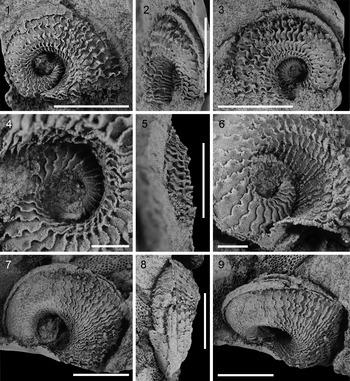
Phragmolites lissoni n. sp. from the Late Ordovician (Sandbian) Calapuja Formation, level C2 at the Ticara Creek section near Calapuja, Peru: (1–6) latex cast showing right lateral, posterior oblique, left lateral, detail of umbilicus, anterior, and detail of umbilical wall, respectively, of holotype (CPI-7908); (7–9) latex cast of specimen CPI-7909 in right lateral, dorsal, and dorsal oblique views. Scale bars = 5 mm.

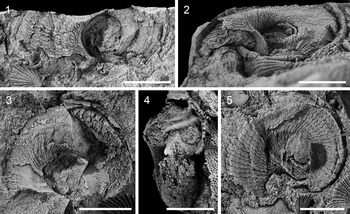
Phragmolites lissoni n. sp. from the Late Ordovician (Sandbian) Calapuja Formation, level C2 at the Ticara Creek section near Calapuja, Peru: (1, 2) latex cast of a large specimen, CPI-7911, in left lateral and ventral views; (3) left lateral view of specimen CPI-7912 with original shell partially preserved; (4) latex cast of specimen CPI-7910, in ventral view showing outline of aperture; (5) specimen CPI-7913, external mold of right lateral side. Scale bars = 5 mm.

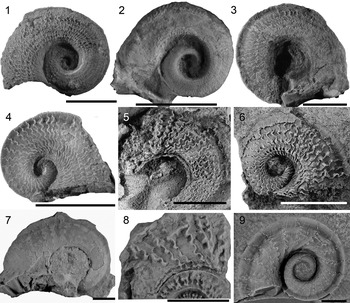
Comparison of lamellar spacing in species of Phragmolites, showing specimens with closely spaced lamellae (first row), those with moderately spaced lamellae (second row), and species with widely spaced lamellae (third row). See Table 1 for details on stratigraphy. Note that all specimens in a type series of a species named by Ulrich and Scofield (Reference Ulrich and Scofield1897) carry the same lot number. Specimens illustrated here and by Wahlman (Reference Wahlman1992) are reassigned new individual numbers: (1) Phragmolites bellulus (Ulrich in Ulrich and Scofield, Reference Ulrich and Scofield1897), holotype, USNM PAL 45751, Covington, Kentucky, USA (original of Ulrich and Scofield, Reference Ulrich and Scofield1897, pl. 67, figs. 23–26); (2) Phragmolites cellulosus (Ulrich and Scofield, Reference Ulrich and Scofield1897), USNM PAL 706471 (out of lots USNM PAL 311305 and 45753), near Cannon Falls, Minnesota, USA; (3) Phragmolites girvanensis (Reed, Reference Reed1920), NHMUK G44502, Shalloch Mill, Girvan, Scotland (original of Reed, Reference Reed1921, pl. 9, fig. 1); (4) Phragmolites elegans (Miller, Reference Miller1874), USNM PAL 706472 (out of lot USNM PAL 45754), Cincinnati, Ohio, USA; (5) Phragmolites aff. Phragmolites fimbriatus (Ulrich and Scofield, Reference Ulrich and Scofield1897), NHMUK G44759, Thraive Glen, Girvan, Scotland (original of Reed, Reference Reed1921, pl. 9, fig. 5); (6) Phragmolites lissoni n. sp., latex cast of CPI-7908, Ticara Creek near Calapuja, Puno, Peru; (7) Phragmolites fimbriatus, USNM PAL 706473 (out of lot USNM PAL 45755), Minneapolis, Minnesota, USA (original of Ulrich and Scofield, Reference Ulrich and Scofield1897, pl. 67, possibly figs. 7, 8); (8) Phragmolites hyberboreus Troedsson, Reference Troedsson1928, holotype, MGUH 2736, Kap Calhoun, Washington Land, Greenland (original of Troedsson, Reference Troedsson1928, pl. 1, figs. 1–10); (9) Phragmolites compressus Conrad, Reference Conrad1838, ROM 24131, Paquette rapids, Ontario, Canada. Scale bars = 5 mm.

Holotype
Specimen CPI-7908, an external mold (Fig. 3.1–3.6), preserved as two halves, from the Late Ordovician (Sandbian) Calapuja Formation, level C2 at the Ticara Creek section near Calapuja, Region of Puno, Peru.
Diagnosis
A relatively large species of Phragmolites with a broad shell, periphery very low on the whorl, moderately spaced corrugated lamellae carrying 4–6 spaced flutes with interspaces equal to the width of the flutes.
Occurrence
Found in levels C2, C3, and C5 in the section described by Villas et al. (Reference Villas, Colmenar and Gutiérrez-Marco2015) at Ticara Creek near Calapuja, encompassing the lower part of the Late Ordovician (Sandbian) Calapuja Formation.
Description
Shell ~ 16 mm wide, with at least four rapidly expanding whorls with very little overlap. Whorl profile heart-shaped with maximum median length of aperture (excluding carina) ~ 80% of its maximum width (Fig. 4.4). Rounded periphery very low on whorl, with upper whorl surface gently convex toward dorsum. Umbilical wall convex but angled only slightly addorsally as it extends toward the median. Umbilical angle moderate, estimated to be ~ 80°. Dorsal median carina sharply delineated from whorl and raised above it. It is low, with height ~ 15% of whorl height. Its width is similar to its height. The course of the carina is seen as a keel on the interior of the shell because it is overlapped by subsequent whorls (Fig. 4.4). The median band of the carina is slightly sunken between sharp margins (Fig. 3.8) but lunulae are not preserved. The slit extends approximately a half whorl back framed by raised margins (Fig. 3.9). The corrugated lamellae are flared, nearly normal to the shell surface in early ontogeny but seemingly becoming more inclined adaperturally during ontogeny. On the upper whorl surface, the flaring is similar or nearly similar to the height of the carina. The lamellae are moderately spaced in early ontogeny (11–16°) but become more tightly spaced near the aperture in large specimens (Figs. 3.7, 4.1). In the earliest whorl, the lamellae are nearly straight at the umbilical wall with low amplitude of the flutes on the upper whorl surface (Fig. 3.4, 3.6). The marked corrugation starts to develop in the last ~ 1.5 whorls but then only on the umbilical wall close to the periphery and on the upper whorl surface. During ontogeny, the number of flutes on the corrugated lamella changes from four (Fig. 3.1, 3.3) to as many as six (Figs. 3.7, 4.1). They have a rounded bell shape, height smaller than their width, and are spaced. The interspaces are approximately the same width as the flutes. Near the periphery, the lamellae are more crowded so that the flutes line up to form a nearly continuous spiral component. Flutes are of nearly similar size along a lamella, with the ones closer to the carina being slightly smaller in width and amplitude. This is less distinct when the lamellae are denudated (Fig. 4.3).
Etymology
In honor of Carlos I. Lisson Beingolea (1868–1947), who introduced the study of fossil mollusks in Peru and is considered as the ‘father’ of Peruvian geology and paleontology.
Materials
Altogether, 11 specimens are known, CPI-7908–7918, in which 7909 and 7910 are associated on the same slab, from the same locality as the holotype. Two specimens are from level C2 in the section (the holotype CPI-7908, and 7915), seven from level C3 (CPI-7909–7914 and 7916), and two from level C5 (CPI-7917 and 7918). The last two are very poorly preserved.
Remarks
At 16.5 mm maximum length, Phragmolites lissoni n. sp. from Peru is a bit larger than most species of the genus (see Table 1 for a list of recognized species); the median length from published maximum measurements on 23 of the 28 known species is 13 mm. Only Phragmolites grandis (Ulrich in Ulrich and Scofield, Reference Ulrich and Scofield1897 and Phragmolites lindstroemi (Koken in Koken and Perner, Reference Koken and Perner1925) reach sizes of 30 mm (see Wahlman, Reference Wahlman1992; Ebbestad, Reference Ebbestad1999b). Approximately half of the species have a narrow lanceolate shell (marked with an asterisk in Table 1), unlike the broader shell of Phragmolites lissoni n. sp. The latter is not as broad as in Phragmolites fimbriatus (Ulrich and Scofield, Reference Ulrich and Scofield1897), but is more similar to that of Phragmolites obliquus. Compared to both of these species, the periphery is much lower in Phragmolites lissoni n. sp. Shell shape and placement of the periphery are comparable to those of Phragmolites pannosus (Billings, Reference Billings1866), but in the latter species, the whorl expansion is slower. Another comparable species is Phragmolites girvanensis (Reed, Reference Reed1920), which appears very similar in shell form and rate of whorl expansion, although the holotype is slightly deformed (Fig. 5.3).
The intermediate spacing of the corrugated lamella in Phragmolites lissoni n. sp. is only seen in Phragmolites elegans (Miller, Reference Miller1874), Phragmolites triangularis (Ulrich and Scofield, Reference Ulrich and Scofield1897), and Phragmolites aff. Phragmolites fimbriatus (marked M in Table 1). All other species have either closely spaced lamella (marked with C in Table 1) or widely spaced lamella (marked with W in Table 1). Data are unavailable for Phragmolites aff. Phragmolites obliquus and Phragmolites? sp. sensu Yochelson (Reference Yochelson1977), and uncertain for Phragmolites dyeri (Hall, Reference Hall1872) sensu Mironova (Reference Mironova1979). In the larger specimens of Phragmolites lissoni n. sp., the spacing becomes closer near the aperture (Figs. 3.7, 4.1), which is interpreted as a gerontic feature. However, it is evident in the holotype and specimen CPI-7913 (Figs. 3.1, 3.3, 4.5) that the spacing of the lamellae is closer also on the last third of the whorl. This is probably due to a period where growth was halted or slowed down for short time, possibly related to stress, illness, lowered nutritional intake, or other physical factors that could affect the physiology of the animal.
The morphology of the spaced flutes in Phragmolites lissoni n. sp. resembles those of Phragmolites hyperboreus Troedsson, Reference Troedsson1928, Phragmolites elegans, Phragmolites girvanensis, Phragmolites imbricatus (Meek and Worthen, Reference Meek and Worthen1868), and Phragmolites pannosus, but with individual variations in the length of the interspace, the width of the flutes, and size variation along the lamellae. In Phragmolites pannosus, for instance, the interspace is wide on the lower part of the whorl near the umbilicus, whereas the flutes near the median carina are much smaller and close. In Phragmolites elegans (Fig. 6.4) and Phragmolites girvanensis (Fig. 6.3), the flutes are very narrow and separated by large interspaces, but with variation during ontogeny (compare for instance the early and late parts of the last whorl in Phragmolites elegans).
The flutes near the umbilicus in Phragmolites lissoni n. sp. line up closely to form a spiral component, which is a purely geometrical feature due to the spiral shape. This feature is best developed in Phragmolites dyeri, where the lamellae are closely spaced, subparallel, and nearly all of the flutes along the lamellae line up to create several spiral ornamental components (see Wahlman, Reference Wahlman1992, pl. 44, fig. 8). This is also prominent in Phragmolites bellulus (Ulrich in Ulrich and Scofield, Reference Ulrich and Scofield1897) (Fig. 6.1), Phragmolites cellulosus (Ulrich and Scofield, Reference Ulrich and Scofield1897) (Fig. 6.2), and other small species with closely spaced lamellae.
The lamellae in Phragmolites lissoni n. sp. stand out a small distance from the whorl surface, initially nearly normal to the conch but becoming more inclined adaperturally in later ontogeny. Generally, the extent of the lamellae corresponds to the height of the carina and is not very extensive. Prominent and extensive flaring is seen in Phragmolites fimbriatus and Phragmolites lindstroemi in particular, but even Phragmolites hyperboreus and Phragmolites obliquus have prominently flared lamellae. Growth lamellae rarely show the full extent of flaring preserved but stand out as an undulating line of some distinction on the shell. The lamellae might have been broken off during taphonomy or when extracted from the rock but might even have been worn during life. Secondary resorption of the shell could also be possible, but seemingly this is a derived ability among gastropods and uncommon or absent in ‘archaeogastropods’ (Vermeij, Reference Vermeij1977). Because the corrugation often becomes more prominent toward the free edge of the lamella, the outline of the flutes can appear different if the lamellae are broken close to the whorl.
Phragmolites lissoni n. sp. occurs with brachiopods and bryozoans in particular (Chacaltana et al., Reference Chacaltana, Gutiérrez-Marco, Rábano and García-Bellido2010; Villas et al., Reference Villas, Colmenar and Gutiérrez-Marco2015). Wahlman (Reference Wahlman1992, p. 41) observed that Phragmolites typically would be found in a bryozoan/brachiopod-dominated facies and not in a mollusk-dominated facies. Wahlman (Reference Wahlman1992) suggested that Phragmolites might have been grazing on the bryozoans or could have been an algal foliage dweller in quiet waters.
Discussion
Classification and the taxonomic history of Phragmolites were discussed by Peel (Reference Peel1991), Wahlman (Reference Wahlman1992), Ebbestad (Reference Ebbestad1999a), and Frederick and Rohr (Reference Frederick and Rohr2015) and nothing new can be added to this. But the unexpected occurrence of well-preserved Phragmolites lissoni n. sp. in Peru allows appreciation of the corrugated lamellar ornamentation of the genus in general and its biogeographic significance relative to the Proto-Andean areas in the Late Ordovician in particular.
Development of the lamellae
Three fairly consistent groups of spacing appear when the arbitrary, simplistic method described earlier is employed (Fig. 2.2, Table 1). Exact measurements could not be performed on all specimens owing to poor illustrations. Eleven species have closely spaced lamellae, in which the angle is a maximum of 12° or less (e.g., Fig. 5.1–5.3), only four have moderately spaced lamellae in which the angle is between 10° and 16° on the last whorl (e.g., Fig. 5.4–5.6), and 11 species have widely spaced lamellae with the angle being 18° or more (e.g., Fig. 5.7–5.9). Intraspecific variation in the spacing of the lamellae can occur, but not enough specimens of each species have been available to evaluate this. There is no obvious connection between the shape of the whorl (lanceolate or broad) and the spacing of the lamellae, nor any trend through time or between paleoareas. Specimens with closely spaced lamellae are in general smaller than those with widely spaced lamellae (median length 15 mm vs 20 mm, respectively). Rate of expansion plays a role during ontogeny of a species, because the spacing generally is closer in early ontogeny and wider in the last whorl of larger specimens. In Phragmolites triangularis, the spacing changes from close in juvenile specimens to moderate in larger specimens, and differences in spacing during ontogeny are also evident in Phragmolites lissoni n. sp., Phragmolites compressus Conrad, Reference Conrad1838, Phragmolites lindstroemi, and others. Although there can be minor irregularities in the spacing of the lamellae on a whorl and tighter spacing in mature specimens when the growth rate is slower, as observed in Phragmolites lissoni n. sp., their spatial distribution and development across the shell is fairly regular.
During ontogeny, the number and expression of the flutes along a lamella increases and changes, so it is not simply a matter of isometric growth. No halts in the growth of the shell following formation of a lamella is apparent, and they display a periodic development in the sense of Savazzi and Sasaki (Reference Savazzi and Sasaki2004). It seems that the formation of the periodic sculpture in Phragmolites is unaffected by the lamellae on previous whorls, because they do not overlap or align from one whorl to the next and there is very slight overlap of the whorls. On the other hand, the extent of the lamellae is intimately linked with the height of the median dorsal carina, which suggests that the morphogenesis of these two is linked. During the formation of a corrugated lamella, the mantle edge must have been extended and expanded, possibly becoming thinner, and subsequently retracted (Chirat et al., Reference Chirat, Moulton and Goriely2013); this is a developmental component specific to the morphology of the lamellae. The second component in lamellar formation is the alternation between regular incremental growth and formation of a lamella. Whether the development (morphogenesis) of such structures can be viewed as a biomechanical or a biochemical response is an ongoing debate (Erlich et al., Reference Erlich, Moulton, Goriely and Chirat2016, and references therein).
Paleobiogeographical significance
Ebbestad et al. (Reference Ebbestad, Frýda, Wagner, Horný, Isakar, Stewart, Percival, Bertero, Rohr, Peel, Blodgett, Högström, Harper and Servais2013) analyzed the biogeography of Ordovician and Silurian gastropods. Lack of data from many areas and time intervals as well as over-representation of records from certain areas, like eastern North America and Baltoscandia, severely hampers our understanding of their distribution. So far only ~ 35 gastropod and tergomyan species are known from the Proto-Andean margin of Gondwana through the entire Ordovician. Five species are known from the Central Andean Basin: Sinuites sp. from the Darriwilian Contaya Formation in the lowlands of east-central Peru; the new record of Phragmolites (Sandbian) described herein; as well as three species from Bolivia, including the widespread Tremadocian tergomyan Peelerophon Yochelson, Reference Yochelson1982 and the gastropods Lecanospira Butts, Reference Butts1926 (Floian) and the endemic Gyrospira Boucot, Reference Boucot1956 (Katian) (Branisa, Reference Branisa1965; Hughes et al., Reference Hughes, Rickards and Williams1980; Jell et al., Reference Jell, Burret, Stait and Yochelson1984; Babin and Branisa, Reference Babin and Branisa1987). From the Famatina basin of Argentina Gutiérrez-Marco et al. (Reference Gutiérrez-Marco, Aceñolaza and Aceñolaza2000) tentatively identified Lesueurilla Koken, Reference Koken1898 in the Dapingian Suri Formation. Other gastropods have been reported from this formation but never described. Most Ordovician gastropods from South America come from the Precordillera Basin, found in the Empozada Formation (Katian; four species) of Western Precordillera, the San Juan Formation (Floian–Darriwilian; ~ 20 species) from Central and Eastern Precordillera and redeposited Sandbian material (~ 10 species) from the Hirnantian Don Braulio Formation of Eastern Precordillera (Rusconi, Reference Rusconi1955; Rohr et al., Reference Rohr, Beresi and Yochelson2001; Benedetto, Reference Benedetto and Benedetto2003; Bertero, Reference Bertero2009, Reference Bertero2010; Ebbestad et al., Reference Ebbestad, Frýda, Wagner, Horný, Isakar, Stewart, Percival, Bertero, Rohr, Peel, Blodgett, Högström, Harper and Servais2013; Dzik, Reference Dzik2019 and references therein). Typically, these faunas are from carbonate facies.
Many of the Ordovician gastropod specimens from the Precordillera are poorly preserved and largely identified only to genus, which in most cases only allow a broad comparison with other faunas (Rohr et al., Reference Rohr, Beresi and Yochelson2001; Bertero, Reference Bertero2010). Several of the more identifiable taxa in the Middle Ordovician San Juan Formation are typically placed with Laurentia genera in particular, including widespread taxa like Maclurites Le Sueur, Reference Le Sueur1818, Malayaspira Kobayashi, Reference Kobayashi1958, Mimospira Koken in Koken and Perner, Reference Koken and Perner1925, and Teiichispira Yochelson and Jones, Reference Yochelson and Jones1968. Bertero (Reference Bertero2009) showed that the distribution of Malayaspira was controlled by latitude and dispersed by ocean currents, indicating that Malayaspira had a planktotrophic larval stage capable of wide dispersal. Another genus from the Argentine Precordillera at that time is Ceratopea Ulrich, Reference Ulrich1911, which was widespread in eastern North America and Greenland, but also occurred in Svalbard, North China and the Farewell terrane of Alaska. During the Late Ordovician, genera like Tetranota Ulrich and Scofield, Reference Ulrich and Scofield1897 and Bucania Hall, Reference Hall1847 in the Don Braulio Formation (Bertero, Reference Bertero2010) are shared with Laurentia and Baltica. Except for Tetranota, which is shared between the Don Braulio and the San Juan formations, and Bucania, shared between the Don Braulio and the Empozada Formation, no taxa are shared within the Precordillera occurrences. Separation in time might influence this.
During the Sandbian, Phragmolites was quite diverse, but was hitherto only found in eastern North America (Table 1). Diversity increased in the Katian, and the genus is present in Wales (Avalonia) in the early Katian and much later in Scotland, India, and Baltica. Most species in eastern North America are from shallow-water carbonate facies developed in an equatorial epicontinental sea (Wahlman, Reference Wahlman1992), but studies of biofacies in the Cincinnati Arch region, eastern USA, show that Phragmolites also occurred abundantly in deeper settings (Patzkowsky and Holland, Reference Patzkowsky and Holland1999; Novack-Gottshall and Miller, Reference Novack-Gottshall and Miller2003), suggesting wider tolerances in temperature and facies. The genus is often associated with a brachiopod and bryozoan assemblage rather than a molluscan assemblage (Wahlman, Reference Wahlman1992), which is also the case for the Calapuja occurrence. However, the main distribution of Phragmolites in shallow-water carbonate facies from tropical latitudes in the Sandbian is seemingly at odds with the mid-latitude presence in Peru. Brachiopods from the same section in Calapuja show affinities with faunas of the Mediterranean margin of Gondwana but also weak links with Avalonia, indicating the arrival of eurythermal species probably dispersed by the existence of intermediate islands in the Rheic Ocean (Villas et al., Reference Villas, Colmenar and Gutiérrez-Marco2015). Cornulitids from level C3 in the Calapuja section shows affinities with Laurentian taxa (Vinn and Gutiérrez-Marco, Reference Vinn and Gutiérrez-Marco2016).
Dzik (Reference Dzik2019) reported an abundance of bellerophontoid and/or tergomyan protoconchs in the San Juan Formation in the Precordillera, and tentatively assigned the smooth conchs to various genera. Phragmolites was not among these, but Dzik (Reference Dzik2019) showed that bellerophontoids in the assemblage have small protoconchs. In more advanced members of the group, this suggests planktotrophic larvae development (Frýda, Reference Frýda1999), which would allow them to stay a long time in the water column and facilitate wider dispersal (Nützel, Reference Nützel2014).
Phragmolites is an abundant taxon, but the restricted geographic occurrence in the Sandbian, and even to some extent in the Katian (Table 1), does not characterize it as a typically widespread genus. However, possible planktotrophy and its occurrence in the deeper facies of the Cincinnati Arch could suggest both potential wide dispersal and tolerance of different water and substrate conditions. Furthermore, widespread faunas in deep-water facies could have great geographical ranges unhindered by distance (Fortey and Cocks, Reference Fortey and Cocks2003). It has also been shown that early Sandbian transgressions allowed deep-water brachiopods to move onto the platforms as well as the opposite tendency where platform faunas moved into deeper facies (Harper et al., Reference Harper, Rasmussen, Liljeroth, Blodgett, Candela, Jin, Percival, Rong, Villas, Zhan, Harper and Servais2013, and references therein), which would also apply to other fauna.
The scant record of Ordovician gastropods in the Central Andean Basin precludes comparison with the disparate record of Ordovician gastropod taxa from the Precordillera. Most records from here represent widespread taxa, and many identifications can be considered uncertain. It is suggested that the Precordillera Basin derived from the Laurentian margin sometime in the Cambrian, amalgamating with Gondwana in the Middle to Late Ordovician (Benedetto et al., Reference Benedetto, Vaccari, Waisfeld, Sánchez, Foglia and Bassett2009; Torsvik and Cocks, Reference Torsvik, Cocks, Harper and Servais2013; Benedetto, Reference Benedetto2018, and references therein), which could explain the general Laurentian signal. An alternative hypothesis suggests a parautochthonous Gondwanan origin with placement in the paleotropical part of Gondwana before rifting and migration along a transform fault to its present position outboard of the Famatina magmatic belt, adjacent to the central Andean Basin (Aceñolaza et al., Reference Aceñolaza, Miller and Toselli2002; Finney, Reference Finney2007). In this scenario, the Laurentian aspects of many faunas could be explained by a similar paleolatitudinal context.
The presence of Phragmolites in Peru unfortunately cannot contribute directly to solve this puzzle. It is also difficult to assess whether the distribution of Phragmolites at the Proto-Andean margin is due to a pre-Sandbian dispersal or is more or less contemporary with its occurrence. The clue to decipher this is to find pre-Sandbian representatives or relatives of Phragmolites.
Acknowledgments
Specimens of Phragmolites have through many years been studied by the senior author in various museum collections. Study of material in collections at the USNM in 2004 was facilitated by E. Valiulis and E.L. Yochelson, at the NHMUK in 2005 by C. Hensley and J. Todd, and at the Natural History Museum of Oslo, Norway, on several occasions by F.-J. Lindemann and H.A. Nakrem. These visits were financed by the Swedish Research council, project 16160700, during 2003–2008. M. Florence at the Smithsonian kindly helped with the renumbering of specimens. D.M. Rohr, J. Frýda, and an anonymous reviewer are thanked for valuable comments. Study of Peruvian material was made possible through SYNTHESYS project ES-TAF-5274 awarded to the senior author. This is also a contribution to project CGL2017-87631-P of the Spanish Ministry of Science, Innovation, and Universities (to the junior author), and to IGCP 653, ‘The onset of the Great Ordovician Biodiversification Event.’