Introduction
Arbuscular mycorrhizal (AM) fungi are soil fungi that form a mutualistic symbiosis with the majority of crop plantsReference Smith and Read1. Although the symbiosis has been shown to enhance water relations and disease resistance of the host plant, the most commonly measured benefit the plant receives from the symbiosis is enhanced mineral nutrient, notably P, uptake. The extra-radical phase of the fungus (ERM) acts in effect as an extension of the root system for the uptake of nutrients that are immobile in the soil solution. These nutrients are available to non-mycorrhizal roots only from the volume of soil explored by root hairs, approximately a 1–2 mm distance from the root. The ERM may extend up to 14 cm from the root, thereby exploring a greater soil volume for PReference Mozafar, Jansa, Ruh, Anken, Sanders and Frossard2. This is reflected in the soil P levels required for optimal growth of non-mycorrhizal Allium porrum being much higher than that of mycorrhizal A. porrum, i.e., 80–100 versus 15–25 μg P g−1 soil, respectivelyReference Jakobsen, Varma and Hock3.
Utilization of the AM symbiosis is most attractive and perhaps essential in organic farming, where application of synthetic chemicals for fertilization and pest control are prohibited. Two options are available to farmers: (1) better utilize the AM fungi indigenous to their soils through management techniques that bolster the size and functioning of these populations; or (2) utilize inocula of AM fungiReference Bagyaraj4. Management options that enhance mycorrhizal functioning include reduced tillageReference Miller, McGonigle and Addy5, overwintering cover cropsReference Galvez, Douds, Wagoner, Longnecker, Drinkwater and Janke6, Reference Sorensen, Larsen and Jakobsen7 and crop rotationReference Johnson, Copeland, Crookston and Pfleger8. Two options for the use of inoculum are to use commercially available inocula or for the farmer to produce it on-farmReference Sieverding9–Reference Douds, Nagahashi, Pfeffer, Kayser and Reider11.
One significant challenge that all farmers face is weed control. This is particularly challenging for organic farmers due to the constraints against the use of synthetic chemicals. An alternative to labor-intensive methods for such farmers is mechanical cultivation prior to planting to produce a ‘stale seedbed’Reference Johnson and Mullinix12, Reference Boyd, Brennan and Fennimore13. This is a cycle of cultivation, germination and early growth of weed seedlings, re-cultivation to uproot and desiccate those seedlings, and germination of yet more weed seeds. The cycle is repeated until the weed seed population in the upper layer of soil has been depleted.
Tillage operations by farmers are known to impact on the AM fungus communityReference Antunes, Koch, Dunfield, Hart, Downing, Rillig and Klironomos14. The ERM has dual functions as both the nutrient-absorbing organ of the symbiosis and as infective propagules. Soil disturbance has been shown to decrease the AM fungus colonization of seedlings germinating in the disturbed/tilled soil and decrease the uptake of P into the shoots of the seedlingsReference Evans and Miller15, Reference Fairchild and Miller16. Therefore, soils in which the stale seedbed method has been used for weed control may be strong candidates for utilization of AM fungus inoculum. We conducted an experiment to test the utilization of AM fungus inoculum produced on-farm in a mixture of compost and vermiculite to grow A. porrum L. seedlings in a field that had been repetitively cultivated prior to planting to control weeds.
Materials and Methods
Inoculum production
Inoculum of AM fungi was produced on-farm at the Rodale Institute, Kutztown, PA, USA during the 2008 growing seasonReference Douds, Nagahashi, Pfeffer, Reider and Keyser17. Briefly, a 1:4 [v/v] mixture of yard clippings compost and vermiculite, respectively, was prepared and placed into 7 gallon black plastic bags (‘Grow Bags’, Worm's Way, Bloomington, IN 47404, USA). Paspalum notatum Flugge seedlings, colonized by one of the following AM fungi: Glomus intraradices Schenck & Smith (DAOM 181602); Glomus geosporum (Nicolson & Gerdemann) Walker, Glomus etunicatum Becker & Gerdemann, Glomus claroideum Schenck & Smith and Glomus mosseae (Nicol. & Gerd.) Gerdemann & Trappe, originally isolated from the Rodale Institute Experimental Farm, Kutztown, PA, USA; and Glomus sp., isolated from the Stoneleigh Estate, Villanova, PA, USA were transplanted into the bags on June 18, 2008. Bags were weeded and watered as needed throughout the growing season. The P. notatum host plants were killed by cold winter temperatures, and the AM fungi overwintered outdoors in the growth medium.
Compost and vermiculite mixture from bags containing the above-listed AM fungi was collected on March 17, 2009. A most probable number bioassay conducted on the mixed inoculum, utilizing three replicate pots per dilution and tenfold dilutions ranging from 10−1 to 10−5, indicated a propagule density of 120 cm−3.Reference Alexander, Black, Evans, Ensminger, White and Clark18
Production of A. porrum seedlings
Seeds of A. porrum L. cv. Lancelot (Seedway LLC, 99 Industrial Pike, Elizabethtown, PA 17022, USA) were sown into 98-cell plastic flats (25 cm3 cell−1) on March 20, 2008. The flats contained either a 1:4 (v/v) mixture of the mixed species AM fungus inoculum and horticultural peat-based potting media (Berger BM6, Saint-Modeste, Quebec G0L 3W0), respectively, or straight potting media for the uninoculated treatment. Flats were placed in a growth chamber under controlled conditions (16 h/8 h, 25 °C/18 °C day/night) for 1 month, after which they were moved to a greenhouse. After seedling emergence, flats of mycorrhizal plants received a weekly watering with Hoagland's nutrient solution without P while the uninoculated flats received Hoagland's solution modified to contain 0.01 mM KH2PO4Reference Hoagland and Arnon19. These fertilization regimes were designed to promote AM fungus colonization of inoculated plants and provide sufficient P to the uninoculated plants.
Site preparation and outplanting
Field aspects of the experiment were conducted at a farm in Lititz, PA, USA. The soil was a Berks silt loam (loamy-skeletal, mixed, active, mesic Typic Dystrudepts) with pH = 7.0 and available P = 169 μg g−1 soil (Mehlich 3). The field plot had been used to grow cantaloupes (Cucumis melo) in 2008, and there was no overwintering cover crop utilized prior to the 2009 growing season. Grass clippings and leaf compost was added at the rate of 22.4 × 10³ kg ha−1. The site was roto-tilled three times to control weeds prior to outplanting the seedlings on July 17, 2009. Soil collected to a depth of 20 cm from five locations within the plot on the day of planting was pooled (approximately 1.5 liter total) and utilized for a most probable number bioassay to measure the status of the indigenous population of AM fungi. The assay indicated that the soil contained 2.2 propagules of AM fungi cm−3.
The seedlings were outplanted in two rows 90 cm apart with 23 cm between plants within the row. The two treatments were represented in alternating runs of 15 plants; i.e., 15 inoculated plants, followed by 15 uninoculated plants, etc., with ten such 15 plant units per inoculation treatment.
Data collection and analysis
Six plants of each treatment were withheld from outplanting for characterization of plant growth and mycorrhizal status at time zero. Shoot length and dry weight were recorded. Shoot P concentration was determined colorimetrically after H2SO4 plus H2O2 digestionReference Murphy and Riley20. Percentage root length colonized by AM fungi was determined at 20 × magnification under a dissecting microscope via the gridline intersect method after clearing and staining the rootsReference Newman21, Reference Phillips and Hayman22.
Ten plants per treatment were harvested from the field on September 24, 2009. In addition to the data collected at outplanting, the diameters of the freshly harvested stems were measured at their widest point.
Data were analyzed using analysis of variance. Measurements for which significant treatment effects were found were characterized further using Tukey's method of multiple comparisons (α = 0.05).
Results
An important consideration in work with AM fungi is that inoculated and uninoculated plants be of the same size and P status at the time of outplanting or imposition of experimental treatments. There were no significant differences between treatments at the time of outplanting (Table 1). Inoculated seedlings were well colonized by AM fungi. No colonization was found in the uninoculated plants.
Status of A. porrum cv. Lancelot at time of outplanting1.

1 Means of six observations ± SEM. Non-myc, non-mycorrhizal.
2 Minimum significant difference from Tukey's test (α = 0.05).
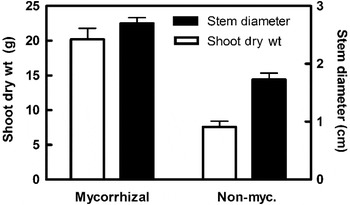
Aboveground growth differences were striking at harvest. Shoot biomass of inoculated plants was 266% and stem diameter 159% that of uninoculated plants (Fig. 1). Uninoculated plants had become colonized by indigenous AM fungi to the point that percentage root length colonized was not significantly different from that of the inoculated plants (Pr > F=0.2222) after 10 weeks in the field (Table 2). Phosphorus content of shoots of inoculated plants was 280% of that of uninoculated plants.
Stem diameter and shoot dry weight of A. porrum cv. Lancelot at harvest. Means of ten observations ± SEM. Both measurements were significantly different between treatments (Pr > F⩽0.0001). Non-myc, non-mycorrhizal.

Status of A. porrum cv. Lancelot at harvest1.

1 Means of ten observations ± SEM. Non-myc, non-mycorrhizal.
2 Minimum significant difference from Tukey's test (α = 0.05).
Discussion
Inoculation of A. porrum seedlings with AM fungi during the greenhouse growth phase significantly increased their growth in the field despite an available P level of 169 μg P g−1 soil.
Two soil characteristics are primary determinants of the potential for a response to inoculation with AM fungi. The first is the level of available P in the soil. High levels of available P increase root P concentrations, which result in lower colonization of roots by AM fungiReference Menge, Steirle, Bagyaraj, Johnson and Leonard23. The level of available P above which there may not be a response to mycorrhization varies with the soil type and host plant, and has been shown to range from 50 to 140 μg P g−1 soilReference Amijee, Tinker and Stribley24, Reference Thingstrup, Rubaek, Sibbeson and Jakobsen25. No growth response at final harvest was seen by Sorensen et al.Reference Sorensen, Larsen and Jakobsen7 for A. porrum in soil with moderate available P levels, ranging from 26 to 50 μg P g−1 soil in the presence of the healthy AM fungus community in the soils of their experiment.
The second soil factor exerting control over the potential for a response to inoculation with AM fungi is biological: the abundance of the indigenous population with which the inoculated AM fungi must competeReference Sieverding9, Reference Hamel, Dalpé, Furlan and Parent26. No data are available to form a soil inoculum potential versus growth response curve specifically for A. porrum. SieverdingReference Sieverding9 found that Manihot esculenta was unlikely to respond to inoculation when the indigenous AM fungus population exceeded 12 propagules g−1 soil. Here, we had a lower population of AM fungi (2 propagules cm−3) than that, and saw a significant growth response. Even at low levels, the indigenous AM fungus population produced colonization in the uninoculated plants that was statistically equivalent to that of the inoculated seedlings by the end of the experiment (Table 2). The growth benefit from inoculation came from the advantage to seedling growth conferred by outplanting with an already-established symbiosis.
In addition to repeated tillage/cultivation, other agricultural practices negatively impact on the indigenous AM fungus community and therefore create opportunities for the use of AM fungus inoculum. Bare fallows deprive AM fungi of host roots to colonize, resulting in a decline in vigor and infectivityReference Thompson27. Non-host overwintering cover crops such as Brassica sp. not only likewise deprive AM fungi of fixed carbon but also produce compounds inhibitory to the growth of AM fungus hyphaeReference Schreiner and Koide28. Continuous monocultures of commercially attractive crops select for those members of the AM fungus community best at reproducing with those host plants, not necessarily the most effective symbiontsReference Johnson, Copeland, Crookston and Pfleger8. Lastly, fertilization may select for ineffective AM fungiReference Johnson29. These situations produce opportunities for inoculation with effective isolates of AM fungiReference Bagyaraj4.
On-farm production of AM fungi is a viable technology for both temperate and tropical agricultural systemsReference Sieverding9, Reference Gaur, Adholeya and Mukerji10, Reference Douds, Nagahashi, Pfeffer, Reider and Keyser17. Mixing the inoculum into horticultural potting media for the production of seedlings for later outplanting to the field is practical and cost effectiveReference Koide, Landherr, Besmer, Detweiler and Holcomb30–Reference Sorensen, Larsen and Jakobsen32. Targeting agricultural situations in which the native population of AM fungi has been negatively impacted due to agronomic practices conducted for purposes such as weed control increases the potential for significant positive growth responses to inoculation, even when high available P levels would indicate otherwise.
Acknowledgement
We thank Joe Lee for technical assistance.