


1. Introduction
The new generation of wide-field radio surveys, such as the Evolutionary Map of the Universe (Norris et al. Reference Norris, Hopkins and Afonso2011, Reference Norris, Marvil and Collier2021b; Hopkins et al. Reference Hopkins, Kapinska and Marvil2025, EMU), is transforming our ability to study active galactic nuclei (AGN), galaxy evolution, cosmic large-scale structure and rare astrophysical phenomena. Conducted with the Australian Square Kilometre Array Pathfinder (ASKAP), EMU will map the entire southern sky up to +30° declination. The survey is expected to detect tens of millions of radio sources, providing a legacy dataset of unprecedented scope.
Although automatic algorithms efficiently classify compact and unresolved objects, extended and morphologically complex sources remain a challenge (Mohan and Rafferty Reference Mohan and Rafferty2015; Boyce et al. Reference Boyce, Hopkins and Riggi2023a,b). To address this, the Radio Galaxy Zoo EMU (RGZ EMU) project was officially launched in August 2024, after internal testing for more than two years, as a live citizen science initiative that integrates human pattern recognition with artificial intelligence (AI). The goal of RGZ EMU is to integrate its results into the open science ready catalogue for EMU, namely EMUCAT (Marvil et al., in prep.).
In the era of big data and all-sky surveys, citizen science offers a powerful means to support research by providing robust training samples for machine and deep learning algorithms. However, even with the efforts of tens of thousands of volunteers, the task of classifying millions of radio sources would require centuries to complete if carried out manually. To overcome this challenge, RGZ EMU adopts a quasi-automated framework (see Fig. 1) that integrates the strengths of both citizen science and machine learning, enabling the efficient identification and classification of radio sources at the scale demanded by modern surveys (Tang et al. Reference Tang and Vardoulaki2025).
The RGZ EMU project framework: integrating citizen science with machine learning to classify extended radio sources in the EMU survey. Adopted from Tang et al. (Reference Tang and Vardoulaki2025).

2. Sample
The EMU survey, conducted with ASKAP, is designed to produce the benchmark radio atlas of the southern hemisphere. ASKAP comprises 36 12-metre antennas equipped with phased-array feeds, providing a 30 deg2 instantaneous field of view. This wide coverage enables rapid surveys of the sky at ∼GHz, detecting not only AGN and star-forming galaxies but also unexpected sources such as Odd Radio Circles (Norris et al. Reference Norris, Crawford and Macgregor2021a, ORCs), relics, and cluster bridges.
Phase I of RGZ EMU uses data from the EMU Pilot Survey(Norris et al. Reference Norris, Marvil and Collier2021b, EMU-PS), which achieved an rms sensitivity of 25-30 Jy beam-1 at a spatial resolution of ∼11-18 arcsec, and contains 287,555 radio components identified with the Selavy source finder (Whiting and Humphreys Reference Whiting and Humphreys2012). The radio data are complemented by optical observations from the Dark Energy Survey (Dark Energy Survey Collaboration 2016, DES) and mid-infrared data from the AllWISE catalogue at 3.4µm (Cutri et al. Reference Cutri, Wright and Conrow2013). To maximise scientific diversity, subjects were selected according to both morphological complexity (Segal et al. Reference Segal, Parkinson and Norris2023) and angular size, the latter measured by the Selavy catalogue. The resulting Phase I dataset of 6,230 extended sources, spanning simpler to highly irregular morphologies, forms the input to the Zooniverse platform for citizen science classification.
3. Methodology
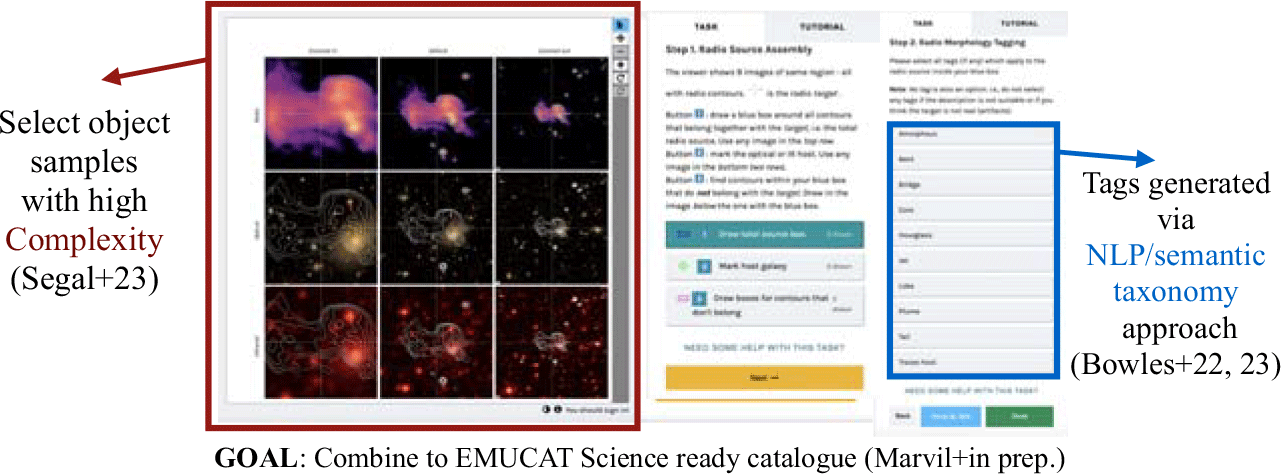
RGZ EMU employs a hybrid workflow (see Fig. 2) in which citizen science annotations will enhance AI pipelines. Sources with high image complexity are prioritised for classification. Following Segal et al. (Reference Segal, Parkinson and Norris2023), complexity is quantified using a coarse-grained Kolmogorov measure: sources with rich substructure compress less efficiently and preserve more information across scales. In practice, 6ʹ×6ʹ cutouts with higher complexity values are selected, ensuring that volunteers see the most challenging morphologies. To refine this selection, projected angular size (from Selavy) is combined with complexity, thereby targeting the most interesting sources for citizen scientists while leaving simple, compact sources to automated pipelines. Volunteers mark related radio components, identify host galaxies, and assign simple descriptive morphological tags (Rudnick Reference Rudnick2021). The tags were derived using a semantic taxonomy (Bowles et al. Reference Bowles, Tang and Vardoulaki2022, Reference Bowles, Tang and Vardoulaki2023), which bridges descriptive language and machine-readable classification. An ontology of 22 morphological descriptors was refined into a set of ∼10 tags for RGZ EMU. These tags (e.g. “hourglass”, “bent”, “traces host galaxy”) allow citizen scientists to classify complex structures intuitively, while creating a shared language that can be ingested by machine learning and linked to scientific categories such as active or star-forming galaxies.
The RGZ EMU workflow asks citizen scientists to identify radio sources and their host galaxies, and to classify them using simple descriptive tags. These results will be feed into active learning pipelines, improving automated cataloguing of complex radio sources.

As the project evolves, active learning loops will integrate citizen science results into training sets, allowing iterative improvement of AI pipelines. The outputs will feed into EMUCAT (Marvil et al. in prep.), producing a more complete and reliable science-ready catalogue.
4. Discussion
Early results from over 2,500 volunteers and 97,000 classifications show that combining citizen science with AI improves the identification of complex morphologies compared to automated pipelines alone (Tang and Vardoulaki in prep.). Citizen scientists are particularly effective at recognising rare or ambiguous sources, and the project’s multilingual deployment (Greek, Chinese, Urdu, Japanese, with further languages in prep.) highlights its open and inclusive character. Scaling to millions of sources remains a challenge, especially in terms of server and storage access, but feasibility has already been demonstrated.
Beyond catalogue building, citizen science provides an open channel for discovery and ensures diversity in training data, reducing potential biases from a limited classifier pool. Preliminary Phase I results (Tang and Vardoulaki in prep.), consistent with earlier findings (Willett Reference Willett2016), indicate that once a sufficient number of independent classifications is obtained, the collective accuracy of volunteers approaches that of expert consensus. This supports the use of “golden samples” as benchmarks and feedback loops for machine learning, enabling the creation of high-quality catalogues and contributing to the development of trustworthy, interpretable AI methods.
5. Outlook
Over the next five years, RGZ EMU will expand to the full EMU survey, classifying around four million extended sources. The project provides a testbed for trustworthy AI in preparation for the SKA era and strengthens education and outreach through the RADIIO program (PI: Vardoulaki, OAD-IAU funded), positioning RGZ EMU at the frontier of open science. Its combination of citizen science and machine learning exemplifies “hybrid intelligence”, where algorithms manage large-scale tasks while human expertise guides rare or complex cases. Links with surveys such as POSSUM, WALLABY, PEGASUS and Euclid, will enable multi-wavelength studies, offering deeper insight into galaxy evolution and feedback.
Through its training, education, and outreach initiatives, RGZ EMU lowers barriers to public participation and creates opportunities for students and early-career researchers, serving not only as a scientific tool but also as a model for inclusive, global science and education in the 21st century.