Bipolar disorder (BD) is a severe mental illness associated with a chronic course and recurring periods of mania and depression, ranked by the World Health Organization as the fifth leading cause of disease burden among mental disorders (Ferrari et al. Reference Ferrari, Stockings, Khoo, Erskine, Degenhardt and Vos2016). Research attention in BD has broadened to include quality of life (QoL) as an important outcome of care alongside symptom management (Murray & Michalak, Reference Murray and Michalak2012; Morton et al. Reference Morton, Michalak and Murray2017), and indeed both patients with BD and clinicians have rated improvements in QoL as the most important outcome in the treatment of BD (Maczka et al. Reference Maczka, Siwek, Skalski and Dudek2009). As a person-centred, recovery-oriented construct, QoL has powerful potential to represent consumer interests in research and clinical practice (Murray et al. Reference Murray, Leitan, Thomas, Michalak, Johnson and Jones2017). Naturalistic, prospective investigations offer the opportunity to investigate trajectories of QoL under real-world treatment regimes and inform our understanding of its relationship to symptoms of BD.
While it is sometimes assumed that absence of mental illness equates to mental wellbeing, the two concepts share only a small portion of variance (Keyes, Reference Keyes2005). Consequently, constructs such as QoL have emerged as treatment goals in their own right in the care of mental illnesses generally (Basu, Reference Basu2004) and in BD specifically (Murray & Michalak, Reference Murray and Michalak2012; Morton et al. Reference Morton, Michalak and Murray2017). QoL is prioritised by consumers and thus the personal recovery movement views QoL improvement as an outcome of equal importance to symptom remission (Murray et al. Reference Murray, Leitan, Thomas, Michalak, Johnson and Jones2017). Popular interest in QoL is paralleled in the scientific BD literature, with publications referencing QoL increasing exponentially over recent years (Murray & Michalak, Reference Murray and Michalak2012). These studies show that QoL is impaired in individuals with BD relative to the general population, even during euthymic periods (Brissos et al. Reference Brissos, Dias, Carita and Martinez-Arán2008; Gutiérrez-Rojas et al. Reference Gutiérrez-Rojas, Gurpegui, Ayuso-Mateos, Gutiérrez-Ariza, Ruiz-Veguilla and Jurado2008), suggesting that attention needs to be paid to improving this patient-valued outcome. We propose that a critical step towards this goal is to develop understanding of (a) the impact of current guideline-driven treatment on QoL in BD, and (b) the dynamic relationship between symptoms of BD and QoL: existing relevant literature is briefly reviewed before introducing the present study.
Attention to the impact of treatment regimens on QoL is needed to validate the assumption that current best practice improves QoL from the consumer perspective. Pharmacological interventions form the bedrock of current treatment guidelines, with psychosocial interventions and self-management strategies increasingly recognised and encouraged (Yatham et al. Reference Yatham, Kennedy, Parikh, Schaffer, Beaulieu and Alda2013), While QoL is increasingly used as a primary outcome variable to judge the efficacy of pharmacological and psychosocial interventions through randomised controlled trials (RCTs; Namjoshi et al. Reference Namjoshi, Rajamannar, Jacobs, Sanger, Risser and Tohen2002, Reference Namjoshi, Risser, Shi, Tohen and Breier2004, Shi et al. Reference Shi, Namjoshi, Zhang, Gandhi, Edgell and Tohen2002, Reference Shi, Namjoshi, Swindle, Yu, Risser and Baker2004, Endicott et al. Reference Endicott, Rajagopalan, Minkwitz and Macfadden2007, Reference Endicott, Paulsson, Gustafsson, Schiöler and Hassan2008, Michalak et al. Reference Michalak, Guiraud-Diawara and Sapin2014), it is important to note that RCTs do not represent the reality of clinical practice in which polypharmacy, medication changes, and combined pharmacological and psychosocial strategies are common, and patient characteristics are heterogeneous (Post, Reference Post2009). The effectiveness of current best practice BD treatment at improving subjective QoL is unknown: naturalistic, longitudinal studies are therefore required to accurately gauge the impact of real world BD treatment strategies on QoL.
A second assumption in need of further investigation relates to the impact of mood symptoms on QoL in BD. Data from cross-sectional studies generally suggest that depressive symptoms are associated with poorer QoL (Vojta et al. Reference Vojta, Kinosian, Glick, Altshuler and Bauer2001; Yatham et al. Reference Yatham, Lecrubier, Fieve, Davis, Harris and Krishnan2004; Gazalle et al. Reference Gazalle, Andreazza, Hallal, Kauer-Sant'Anna, Ceresér and Soares2006, Reference Gazalle, Frey, Hallal, Andreazza, Cunha and Santin2007a; Hayhurst et al. Reference Hayhurst, Palmer, Abbott, Johnson and Scott2006; Zhang et al. Reference Zhang, Wisniewski, Bauer, Sachs and Thase2006; Simon et al. Reference Simon, Bauer, Ludman, Operskalski and Unutzer2007). The cross-sectional influence of manic symptoms on QoL is less well understood, with some articles finding mania to be associated with poorer QoL, (Vojta et al. Reference Vojta, Kinosian, Glick, Altshuler and Bauer2001; Simon et al. Reference Simon, Bauer, Ludman, Operskalski and Unutzer2007; Gazalle et al. Reference Gazalle, Hallal, Andreazza, Frey, Kauer-Sant'Anna and Weyne2007b) and others finding no negative impact of mania (Hayhurst et al. Reference Hayhurst, Palmer, Abbott, Johnson and Scott2006; Gazalle et al. Reference Gazalle, Frey, Hallal, Andreazza, Cunha and Santin2007a). However, cross-sectional studies cannot illuminate directionality of effects. Limited investigation of the trajectory of QoL following first episode psychotic mania did not reveal an effect of symptoms at baseline with QoL at 18 months (Oldis et al. Reference Oldis, Murray, Macneil, Hasty, Daglas and Berk2016): more sensitive analyses of time-varying relationships in the general BD population is needed to illuminate possible relationships. Additionally, although QoL change is typically assumed to be a downstream consequence of symptom changes in BD, it is not known whether changes in QoL may have reciprocal impacts on BD symptoms: potentially, improvements in wellbeing and functioning could moderate symptoms of the disorder (Murray & Michalak, Reference Murray and Michalak2012). Longitudinal studies are therefore required to inform understanding of the relationship between BD symptoms and QoL over time.
The present study
The present prospective observational study analysed data from the Health Outcome and Patient Evaluation-Bipolar Disorder (HOPE-BD) project, a multisite prospective naturalistic investigation of patients receiving guideline-driven treatment for BD in Canada. The primary aim of the HOPE-BD project was to prospectively examine treatment patterns, clinical outcomes, QoL, and resource utilisation of a Canadian BD sample receiving guideline-driven treatment.
As we have recently reviewed, it is important to recognise different emphases across existing measures of QoL in BD (Morton et al. Reference Morton, Michalak and Murray2017). Here, we chose the 36-item Short-Form Survey (SF-36; Ware et al. Reference Ware, Snow, Kosinski and Gandek1993) as a commonly used measure of QoL qua psychosocial and physical functioning. A further advantage of the SF-36 for the present purposes was its generation of two well-understood subscale scores (physical and mental functioning) for exploration.
The aim of the present analyses was to investigate: (i) the trajectory of QoL under guideline-driven treatment and (ii) the relationship between objective symptom measures and subjective QoL ratings over time. It was hypothesised that QoL would increase over time with guideline-driven treatment. Additionally, it was hypothesised that lower levels of depression would predict a positive change in QoL. Analyses of the impact of mania on trajectories of QoL and QoL as a predictor of change in symptom ratings were exploratory.
To the authors’ knowledge, this is the first study to use multilevel modelling (MLM) to examine the naturalistic trajectory of QoL in a population receiving guideline-driven treatment. Additionally, it is the first study to report on the time-varying relationship between symptoms of BD and QoL.
Materials and method
Study design
Participants were recruited from 12 sites across Canada, including university and community hospitals and outpatient clinics, and prospectively followed every 3 months for a period of up to 5 years. Treating psychiatrists retained responsibility for delivering pharmacotherapies and other treatments according to Canadian Network for Mood & Anxiety Treatments (CANMAT) guidelines (1997). Patients or legally accepted delegates gave informed written consent for data to be collected. The study was approved by the University of British Columbia Research Ethics Board and the Ethics Boards at all sites that collected data.
Participants
Psychiatrists at participating sites referred eligible patients for participation. Inclusion criteria were: (i) diagnosed with BD-I, BD-II or BD not otherwise specified (NOS); diagnoses were confirmed at intake using the Mini-International Neuropsychiatric Interview (MINI; Sheehan et al. Reference Sheehan, Lecrubier, Sheehan, Amorim, Janavs and Weiller1998), (ii) currently meeting or recently (within the past 3 months) met criteria for a (hypo)manic or depressive episode, or recently (within the past 3 months) changed treatment, (iii) under the care of a participating psychiatrist, (iv) aged 15 years or older, (v) competent and willing to provide informed consent (or consent given by a legally accepted delegate), and (vi) fluent in either English or French. Exclusion criteria for the study were: (i) diagnosed with either a (a) non-affective psychotic disorder, (b) substance-induced mood disorder, (c) mood disorder secondary to a medical condition, or (d) personality disorder with only subthreshold hypo/manic or depressive symptoms; (ii) unwilling or unable to participate in follow-up assessments (e.g. moving out of area); (iii) currently participating in a clinical treatment trial; or (iv) hospitalised longer than 6 months.
Measures
Symptoms
Both symptom measures were validated, widely used clinician-rated scales. Mania was assessed using the Young Mania Rating Scale (YMRS; Young et al. Reference Young, Biggs, Ziegler and Meyer1978), an 11-item scale with scores ranging from 0 to 60. Depression was measured on the Montgomery-Asberg Depression Rating Scale (MADRS; Montgomery & Asberg, Reference Montgomery and Asberg1979), a 10-item instrument with scores ranging from 0 to 60. All investigators were members of the Canadian Network for Mood and Anxiety Treatments, had received training on inter-rater reliability and had demonstrated excellent inter-rater reliability on previous clinical trials.
Quality of life
QoL was measured with the SF-36 (Ware et al. Reference Ware, Snow, Kosinski and Gandek1993), a 36-item self-report questionnaire. The SF-36 has eight subscales assessing: Physical Function, Role Limitations due to Physical Health, Bodily Pain, General Health, Vitality, Social Function, Role Limitations due to Emotional Problems, and Mental Health. Two component scores may be derived (Ware et al. Reference Ware, Kosinski and Keller1994): one summarising physical QoL (Physical Component Score – PCS), and the other summarising mental QoL (Mental Component Score – MCS). The eight subscales and two component scores are scored 0–100, with higher scores representing better QoL. Scores were standardised according to Canadian norms (Hopman et al. Reference Hopman, Towheed, Anastassiades, Tenenhouse, Poliquin and Berger2000).
Assessment schedule
Confirmation of BD diagnosis via the MINI occurred at baseline. Symptom measures (YMRS and MADRS) and QoL (SF-36) were assessed at baseline and at follow-up assessments, which were conducted at 3-month intervals (within a 2-week window).
Trajectory analyses
MLM was used due to the hierarchical structure of the data (i.e. longitudinal observations are nested within individuals). This data structure, which would violate the assumption of independence of residuals required for linear regression models, is accounted for in MLM (Hox, Reference Hox2010). In addition, MLM methods were chosen as they support estimation in situations where observations are missing. Data were analysed using the MIXED procedure of SPSS using full maximum likelihood estimation (IBM SPSS statistics for Windows, Version 22.0; 2013). Predictors where zero is a non-interpretable value (e.g. age) were centred around the sample mean. Given the exploratory nature of the study, the α level was set at 0.05.
Fixed and random effects were specified for the intercept and slope parameters in models unless otherwise stated. Random effects were removed in cases where models failed to converge due to lack of random variance (Heck et al. Reference Heck, Thomas and Tabata2014). Residual terms at level 1 were specified as having an autoregressive covariance matrix: unobserved variance was assumed to differ between the time points, and it was assumed that correlation between occasions of measurement would decrease with greater duration between occasions of measurements (Heck et al. Reference Heck, Thomas and Tabata2014). Level 2 residuals were specified as having a diagonal covariance matrix: it was assumed that the random effects for the intercepts and the slope did not correlate. The level 2 covariance structure was chosen as it permitted the estimation of intercept and slope variances. Models without random effects for slope must be estimated using a scaled identity covariance matrix.
MLM was employed as follows:
1. Unconditional QoL growth models. To examine the trajectories of QoL over time, growth models with linear and quadratic terms were fitted individually for MCS and PCS. Significant terms were retained for following analyses.
Exploratory subscale analyses. Additional growth models were created to compare the trajectories of the SF-36 subscales [General Health, Role Limitations (Emotional), Social Functioning, Physical Functioning, Role Limitations (Physical), Pain, Vitality, and Mental Health].
2. Level 2 predictors of QoL. Age, sex, and BD diagnosis were entered as level 2 predictors in the growth models for PCS and MCS. Significant predictors were retained for following analyses.
3. Models with time-lagged covariates. Possible temporal relationships between symptoms and QoL were investigated as follows.
a. Firstly, significant growth models for QoL were analysed controlling for earlier symptom covariates (MADRS and YMRS). That is, a model was created where QoL variables at the present visit (time) were predicted by symptom data from the previous visit (time – 3 months). The 3-month time lag was chosen due to the data structure.
b. Secondly, to test the directionality of any relationship between QoL and symptoms of BD, models where symptom ratings (MADRS and YMRS) were predicted by earlier QoL (PCS and MCS) were calculated. Unconditional growth models for symptom measures and models evaluating level 2 predictors were created to permit identification of significant parameters to retain in models where lagged MCS and PCS acted as predictors. However, they are not the focus of the present analysis and are presented in online Supplementary Tables S1 and S2, respectively.
Results
Participant characteristics
A total of 362 participants aged 18–72 (M = 42.75, s.d. = 12.18) were recruited. The majority of participants (n = 207) were female, and approximately equal numbers were of Caucasian (n = 158) and non-Caucasian (n = 164) ethnicity. The majority of participants were recruited through teaching hospitals in (i) Vancouver, British Columbia (n = 56), (ii) London, Ontario (n = 64), and (iii) Montreal, Quebec (n = 82); and a private practice in Montreal (n = 53). Participants completed between one and 13 assessments (M = 4.90, s.d. = 3.30).
BD-I was the most common diagnosis (n = 185), followed by BD-II (n = 120) and BD-NOS (n = 21). Mood episodes at baseline were predominantly depressive (n = 121) with fewer manic (n = 44), hypomanic (n = 20), or mixed recorded (n = 15). At baseline, 106 (29%) were prescribed lithium, 84 (23%) sodium valproate, 14 (4%) carbamazepine, 36 (10%) risperidone, 40 (11%) olanzapine, 41 (11%) quetiapine, 41 (11%) lamotrigine, and 95 (26%) an antidepressant.
Mean MCS at baseline was lower than the Canadian norm (31.13 v. 51.7), as was PCS (48.16 v. 50.5; Hopman et al. Reference Hopman, Towheed, Anastassiades, Tenenhouse, Poliquin and Berger2000).
Trajectory analyses
1. Unconditional QoL growth models
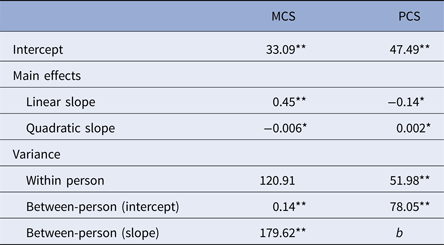
The results of the unconditional growth models for MCS and PCS are displayed in Table 1. The linear slope parameter for MCS was positive and significant (estimate = 0.45, p < 0.001), with a significant negative quadratic (estimate = −0.006, p < 0.05) indicating the rate of growth slowed over time. The linear slope parameter for PCS was negative and significant (estimate = −0.14, p < 0.05), with a significant positive quadratic (estimate = 0.003, p < 0.05) indicating the decrement in PCS slowed over time. No random effect for slope was specified in the growth model for PCS.
Unconditional growth model results for MCS and PCS

Note: *p < 0.05, **p < 0.001, b parameter was not calculated.
Exploratory subscale analyses
Growth models were created for each of the eight SF-36 subscales (see online Supplementary Table S3). Paralleling the trends seen in MCS (above), a significant positive linear effect and significant negative quadratic effect were found for the SF-36 subscales Role Limitations due to Emotional Problems (linear estimate = 1.01, p < 0.001; quadratic estimate = −0.01, p < 0.05)), Social Functioning (linear estimate = 0.68, p < 0.001; quadratic estimate = −0.008, p < 0.05) and Mental Health (linear estimate = 0.48, p < 0.001; quadratic estimate = −0.007, p < 0.05). A significant positive linear effect was found for the subscales General Health (estimate = 0.11, p < 0.05) and Vitality (estimate = 0.26, p < 0.05); no significant quadratic effects were observed for either of these subscales. No random effects for slope were retained in the models for Physical Functioning, Role Limitations due to Physical Problems, or Pain; in addition, no significant change over time was observed in these subscales.
2. Level 2 predictors of QoL
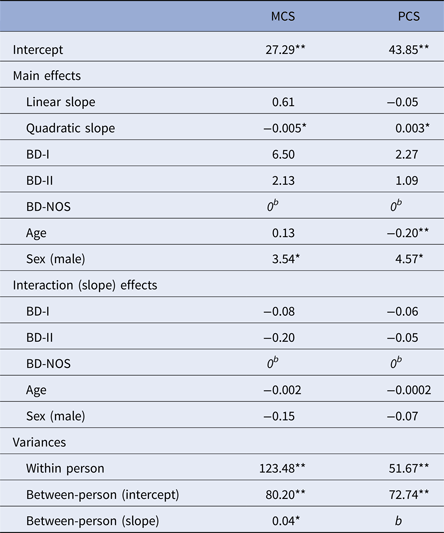
Age, sex, and BD diagnosis were entered as predictors for the growth models for MCS and PCS (Table 2). The only predictor to reach significance and be retained in future models of MCS was the main effect for sex (estimate = 3.54, p < 0.05): males had higher baseline mental QoL than females. There was a significant negative main effect of age on PCS (estimate = −0.20, p < 0.001): individuals older than the sample mean (42.75) had poorer baseline physical QoL. There was a positive main effect of sex on PCS (estimate = 4.57, p < 0.05): males had higher baseline physical QoL than females. Sex and age were retained as predictors in future PCS models. No significant interaction (slope) effects were observed for either MCS or PCS.
Growth model results for MCS and PCS with level 2 predictors (mean-centred age, sex, and BD diagnosis)

Note: *p < 0.05, **p < 0.001, b parameter was not calculated, 0b redundant parameter set to zero.
3. Models with time-lagged covariates
3.a Symptoms as time-lagged covariates
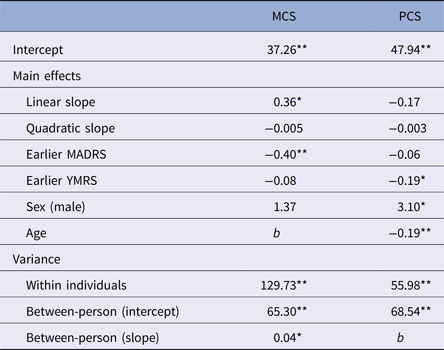
The growth models for MCS and PCS controlling for the effects of both MADRS and YMRS ratings from the previous visit (3 months) are displayed in Table 3. There was a significant negative main effect of earlier depression (MADRS) on MCS (estimate = −0.40, p < 0.001): lower depression ratings were associated with higher MCS ratings at the following visit. There was no significant main effect for earlier mania (YMRS) on MCS (estimate = −0.08, p = 0.58).
Growth models for MCS and PCS with effects of earlier (time – 3 months) MADRS and YMRS

Note: *p < 0.05, **p < 0.001, b parameter was not calculated.
There was a significant negative main effect of earlier YMRS on PCS (estimate = −0.19, p < 0.05): higher YMRS ratings were associated with lower PCS at the following visit. There was no significant main effect for earlier MADRS ratings on PCS (estimate = −0.06, p = 0.15).
3.b QoL as time-lagged covariates
Unconditional growth models and investigation of level 2 predictors (age, sex, BD diagnosis) for MADRS and YMRS are displayed in online Supplementary Tables S1 and S2, respectively. Random effects for slope were not specified for MADRS and YMRS growth models. Of the level 2 predictors, only the main effect and interaction (slope) effect for sex were retained for future MADRS models. No level 2 predictors were retained for future PCS models.
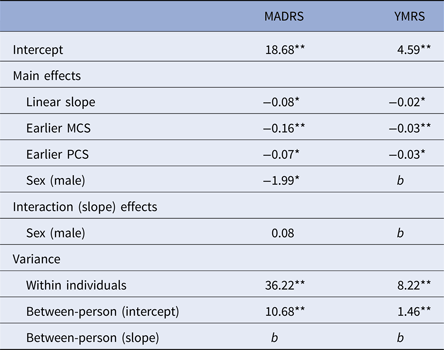
MCS and PCS were added as time-lagged covariates to growth models for symptom measures (MADRS and YMRS; see Table 4). There was a significant negative main effect of earlier MCS on both MADRS (estimate = −0.16, p < 0.001) and YMRS (estimate = −0.03, p < 0.001): higher levels of MCS were associated with lower symptom ratings at the following visit. Similarly, there was a significant negative main effect of earlier PCS on both MADRS (estimate = −0.07, p < 0.05) and YMRS (estimate = −0.03, p < 0.05): higher levels of PCS were associated with lower symptom ratings at the following visit.
Growth models for MADRS and YMRS with effects of earlier (time – 3 months) MCS and PCS

Note: *p < 0.05, **p < 0.001, b parameter was not calculated.
Discussion
The HOPE-BD study naturalistically followed 362 patients with BD receiving guideline-driven treatment over a period of up to 5 years. Here, we analysed both symptoms and QoL at 3-month intervals. Mental QoL (measured on the MCS) was found to increase over time, and the rate of improvement in mental QoL slowed over time. Physical QoL (PCS) was found to worsen over time, with a gradually slowing rate of decrement. Novel analyses of the dynamic relationship between symptoms of BD and mental QoL found: (a) reduction in depressive symptoms was associated with later improvements in mental QoL, (b) reduction in manic symptoms was associated with later improvements in physical QoL, and (c) improvements in both physical and mental QoL were associated with subsequent reduction in symptoms of BD.
MLM analyses led to the hopeful finding that, with guideline driven treatment, mental QoL improves over time among people with BD, albeit with a gradual reduction in rate of improvement. Improvement in the subscales Social Functioning, Role Limitations due to Emotional Problems, and Mental Health paralleled the MCS growth curve. Positive impacts on role and social functioning as a consequence of guideline-driven treatment may be expected given the known negative impact of manic and particularly depressive symptoms on social and occupational functioning in BD (Rosa et al. Reference Rosa, Reinares, Michalak, Bonnin, Sole and Franco2010). If replicated, these novel findings have significant implications for prognostic discussions with patients.
In contrast to mental QoL, PCS ratings in this population were observed to decrease over time in a non-linear fashion. In addition, PCS ratings were poor in this BD population as compared with Canadian norms. The finding that physical QoL is poor in individuals with BD is not unexpected: individuals with BD not only suffer from higher rates of physical health comorbidities than the general population (Kilbourne et al. Reference Kilbourne, Cornelius, Han, Pincus, Shad and Salloum2004; Krishnan, Reference Krishnan2005), but may also face added burden from adverse physical effects of psychotropic medication on their QoL (Yen et al. Reference Yen, Cheng, Huang, Yen, Ko and Chen2008). However, the finding that physical QoL worsened in this sample demands further attention to methods to improve physical health and functioning in BD (for a review of the emerging evidence for lifestyle interventions for physical health in BD, see Bauer et al. Reference Bauer, Gálvez, Hamilton, Balanzá-Martínez, Zunta-Soares and Soares2016). Lack of significant change on the role limitations due to Physical Problems, Physical Functioning, Vitality, and Pain subscales, along with positive change in the General Health and Vitality subscales may seem counterintuitive given the growth curve results observed for PCS (above). However, this is due to the nature of the MCS/PCS scoring algorithms: these are norm-based scores, such that MCS and PCS here reflect the QoL of this population relative to Canadian averages (Hopman et al. Reference Hopman, Towheed, Anastassiades, Tenenhouse, Poliquin and Berger2000). Additionally, summary scores are produced from positively and negatively weighted physical and mental subscales in order to remove shared variance (Ware et al. Reference Ware, Kosinski and Keller1994).
The study's novel investigation of dynamic relationships between symptoms of BD and mental QoL supported common assumptions, but also identified new associations warranting further study. Improvements in mental QoL were found to be predicted by improvements in the preceding visit's depression ratings, while depression did not significantly impact subsequent physical QoL ratings. This is consistent with (but permits stronger causal inference than) the numerous cross-sectional analyses suggesting a negative influence of depressed mood on QoL (Vojta et al. Reference Vojta, Kinosian, Glick, Altshuler and Bauer2001; Yatham et al. Reference Yatham, Lecrubier, Fieve, Davis, Harris and Krishnan2004; Hayhurst et al. Reference Hayhurst, Palmer, Abbott, Johnson and Scott2006; Simon et al. Reference Simon, Bauer, Ludman, Operskalski and Unutzer2007; Gazalle et al. Reference Gazalle, Frey, Hallal, Andreazza, Cunha and Santin2007a). The present study contributes to ongoing clarification of the role of mania in QoL in BD: earlier mania did not impact on mental QoL at the following visit; however, improvements in physical QoL were predicted by improvements in the preceding visit's mania ratings. It may be expected that higher levels of mania would be associated with subsequent decrements in physical QoL, given the intense physical effects of this highly dysregulated state and the side effect profile of anti-manic medications required to address it (de Hert et al. Reference de Hert, Correll, Bobes, Cetkovich-Bakmas, Cohen and Asai2011); further research is required to elucidate mechanisms through which mania may impact QoL.
Most strikingly, modelling analyses also found that improvements in mental and physical QoL were associated with subsequent benefits for the symptoms of BD: improvements in both mental and physical QoL were associated with later reduction in mania and depression. To our knowledge, this is the first empirical study supporting the longstanding humanistic assumption that improvements in subjective QoL may predict clinical improvements in BD (Murray & Michalak, Reference Murray and Michalak2012). QoL may play a uniquely predictive role in mental health (IsHak et al. Reference IsHak, Greenberg, Balayan, Kapitanski, Jeffrey and Fathy2011): improved subjective perception of life circumstances and positive impacts in valued life areas such as leisure and social relationships would intuitively be expected to stabilise mood. In fact, evidence-based and emerging treatments for BD such as cognitive behaviour therapy, interpersonal and social rhythm therapy, and mindfulness training target aspects of QoL such as perceptions of self, others and the future, engagement in positive activities, and management of stressful life circumstances (Frank et al. Reference Frank, Swartz and Kupfer2000; Lam et al. Reference Lam, Jones and Hayward2010; Murray et al. Reference Murray, Leitan, Thomas, Michalak, Johnson and Jones2017). The impact of subjective QoL on later symptoms may also relate to changes to objective circumstances (e.g. functioning): scores on functioning measures and employment status have been shown to predict treatment response (Deckersbach et al. Reference Deckersbach, Nierenberg, McInnis, Salcedo, Bernstein and Kemp2016). Finally, the potential role of physical QoL as a predictor of future manic symptoms suggests attention to the developing field of interventions for physical health in BD (Bauer et al. Reference Bauer, Gálvez, Hamilton, Balanzá-Martínez, Zunta-Soares and Soares2016): for example, exercise has been associated with improved sleep quality in BD (Nusslock et al. Reference Nusslock, Abramson, Harmon-Jones, Alloy and Hogan2007), which would be expected to have downstream impacts on manic symptoms (Frank et al. Reference Frank, Swartz and Kupfer2000). The subjective nature of the QoL assessment used in this study directs particular attention to interventions which target evaluations of physical health [e.g. yoga, mindfulness, relaxation training (Bernstein et al. Reference Bernstein, Rabideau, Gigler, Nierenberg, Deckersbach and Sylvia2016)]. Investigation of possible mechanisms through which QoL may impact later symptoms will illuminate this relationship further and identify additional therapeutic targets.
Through the use of large-scale, longitudinal data, the present study is able to illustrate for the first time the common-sense prediction that QoL improvements are associated with downstream impacts on both depressive and manic BD symptoms (Malhi et al. Reference Malhi, Bassett, Boyce, Bryant, Fitzgerald and Fritz2015). If this finding proves robust in future research, it will encourage renewed therapeutic effort on interventions for BD specifically targeting consumers’ QoL goals (Leitan et al. Reference Leitan, Michalak, Berk, Berk and Murray2015; Murray et al. Reference Murray, Leitan, Thomas, Michalak, Johnson and Jones2017). A focus on QoL as a treatment outcome is consistent with calls to attend to broader psychological, physical, and functional outcomes in mental health (Slade, Reference Slade2010). The novel analyses of the present study add weight to this call by suggesting that interventions directly targeting QoL have the potential for downstream benefits for the symptoms of BD. Future research could specifically test mechanisms by which subjective QoL may have impacts on mood symptoms, including the impacts of cognitive strategies (as in cognitive therapy, mindfulness) and behavioural interventions (such as lifestyle changes and interpersonal and social rhythm therapy).
Limitations
A number of limitations should be noted. While the long-term prospective design has marked advantages over cross-sectional methods, temporal precedence alone is insufficient to establish causality. Additionally, the naturalistic design precludes specific statements about the variety of treatments received by participants beyond the broad criterion of ‘guideline-driven treatment’. A comprehensive investigation of all relevant time-varying covariates (e.g. medication use, psychosocial treatments) is beyond the current scope. This study represents an initial attempt to track QoL and symptoms across time, and generates hypotheses for future investigation. Future studies should account for other possible determinants of QoL, (e.g. treatment changes, life events, disease progression, etc.). The present study was not designed to evaluate the relative predictive power of QoL compared with other determinants of symptoms in BD (e.g. physical health, unemployment, etc.), and indeed there is no agreed upon method to calculate effect sizes as they are commonly understood in other statistical analyses (Roberts & Monaco, Reference Roberts and Monaco2006; Peugh, Reference Peugh2010). However, the exploratory findings here suggest that QoL is an important predictor, which should be taken into account in future studies which evaluate multiple competing variables. The use of the SF-36 to measure QoL situates the present study within a body of work characterising QoL as related to functioning (Morton et al. Reference Morton, Michalak and Murray2017) – results may not generalise to measures associated with conceptualisations of QoL as wellbeing or satisfaction.
Missing data were a limitation of the present dataset. As with any long-term, prospective, multisite study, data were lost due to participant dropout, erratic attendance, or site-related issues in data collection. The issue of missing data does raise some questions that the present analysis is unable to clarify, for example, mechanisms explaining the interaction between age and physical QoL. An advantage of the analysis used is that MLM supports estimation in situations where observations are missing (Heck et al. Reference Heck, Thomas and Tabata2014). As number of completed assessments correlated only weakly with MCS (r s = 0.19), PCS (r s = −0.04), and symptom ratings (MADRS: r s = −0.12; YMRS: r s = −0.08), we inferred that missing data from participant dropout were unlikely to systematically bias findings.
Conclusion
Within its limitations, the present study demonstrates for the first time that individuals receiving consensus treatment for BD show linear improvements in their mental QoL. Investigation of temporal relationships between QoL and symptoms of BD suggested bidirectional effects, and generates novel hypotheses for future research. Guideline-driven treatment was found to positively impact symptoms and subsequent QoL. Evidence for positive impacts of QoL on downstream symptoms encourages further research into optimising QoL in BD.
Supplementary material
The supplementary material for this article can be found at https://doi.org/10.1017/S0033291717002495.
Acknowledgements
The HOPE-BD study was funded by Astrazeneca with an unrestricted grant to Dr Lakshmi Yatham.
Declaration of Interest
Ms Emma Morton reports no financial relationships with commercial interests. Professor Greg Murray reports no financial relationships with commercial interests. Dr Erin Michalak reports no financial relationships with commercial interests. Dr Raymond Lam has received speaker honoraria from AstraZeneca, Canadian Network for Mood and Anxiety Treatments, Canadian Psychiatric Association, Lundbeck, Lundbeck Institute, and Otsuka; is on the consultant/advisory board at Allergan, Asia-Pacific Economic Cooperation, Bristol Myers Squibb, Canadian Depression Research and Intervention Network, Canadian Network for Mood and Anxiety Treatments, Janssen, Lundbeck, Medscape, Pfizer, and Takeda; has received research funds from Brain Canada, Bristol Myers Squibb, Canadian Institutes of Health Research, Canadian Depression Research and Intervention Network, Canadian Network for Mood and Anxiety Treatments, Janssen, Lundbeck, Movember Foundation, Pfizer, St. Jude Medical, University Health Network Foundation, and Vancouver Coastal Health Research Institute; has the following patent: Lam Employment Absence and Productivity Scale (LEAPS); and has book royalties through Cambridge University Press, Informa Press, Oxford University Press. Dr Serge Beaulieu is on the speaker bureau at Astra Zeneca, Eli Lilly, Otsuka, Sunovion, Bristol Myers Squibb (BMS), Lundbeck, and Pfizer; is on the consultant/advisory board at Astra Zeneca, Forest Laboratories, Merck, Pfizer, Bristol Myers Squibb (BMS), Lundbeck, Otsuka, and Sunovion; has received peer-reviewed research funding from CIHR, RSMQ, FRSQ, NARSAD, Stanley Foundation, and Pfizer Research Award; has received research support from Astra Zeneca, Lundbeck, Sunovion, Bristol Myers Squibb (BMS), and Otsuka. Dr Verinder Sharma has received grant support from, participated on scientific advisory boards for, or served on the speakers’ bureaus of Kinect, Stanley Medical Research Institute, Assurex, Genome Canada and Sunovian Pharmaceuticals. Dr Pablo Cervantes reports no financial relationships with commercial interests. Dr Sagar Parikh has received a research grant from Assurex, has consulted for Bristol Myers Squibb, Takeda, and Sunovion, and has shares in Mensante. He has received non-commercial research funding from CIHR, Ontario Brain Institute, UHN Foundation, Flinn Foundation, and University of Michigan. Dr Lakshmi Yatham has been on speaker/advisory boards for, or has received research grants from: Alkermes, Allergan, AstraZeneca, Bristol Myers Squibb, CIHR, CANMAT, Dainippon Sumitomo Pharma, Eli Lilly, GlaxoSmithKline, Janssen, Teva, the Michael Smith Foundation for Health Research, Pfizer, Servier and the Stanley Foundation.
Ethical Standard
The authors assert that all procedures contributing to this work comply with the ethical standards of the relevant national and institutional committees on human experimentation and with the Helsinki Declaration of 1975, as revised in 2000.