INTRODUCTION
Edges of utterances, beginnings and ends, are salient for children acquiring language (Slobin, Reference Slobin, Ferguson and Slobin1973, Reference Slobin and Slobin1985). Several influential theories, particularly Newport's ‘less is more’ hypothesis (Reference Newport1990; Elman, Reference Elman1993), propose that processing limitations privilege edges of utterances and might confer advantages to the beginning language learner. In this paper we investigate the roots of these processing limitations.
The processing advantage for speech material adjacent to edges of utterances is observed very early in life. Neonates (Ferry et al., Reference Ferry, Fló, Brusini, Cattarossi, Macagno, Nespor and Mehler2016) as well as 7-month-olds (Benavides-Varela & Mehler, Reference Benavides-Varela and Mehler2015) detect switched syllables at edges but not in the middle of multisyllabic sequences. Infants also segment words earlier in development when they are presented at the edges of utterances than in the middle (Seidl & Johnson, Reference Seidl and Johnson2006, Reference Seidl and Johnson2008) and associate such words with visual referents (Shukla, White & Aslin, Reference Shukla, White and Aslin2011).
In fact, across languages, mothers typically place novel words at the ends of multiword utterances, even when the resulting sentences are ungrammatical (Aslin, Woodward, LaMendola & Bever, Reference Aslin, Woodward, LaMendola, Bever, Morgan and Demuth1996). This early processing advantage for speech material aligned with utterance edges continues into adulthood. Adults learn novel words in a non-native language more easily when the words are utterance-final than when they are utterance-medial (Golinkoff & Alioto, Reference Golinkoff and Alioto1995). Enhanced encoding of material located at the edges of sequences has also been demonstrated in artificial language experiments (Endress, Nespor & Mehler, Reference Endress, Nespor and Mehler2009).
Some researchers have suggested that the different rates at which various inflectional morphemes are acquired could relate to their distribution at the edges of sentences (Hsieh, Leonard & Swanson, Reference Hsieh, Leonard and Swanson1999). Hsieh et al., examined conversation and stories addressed to children. They report that 52% of nouns with plural -s occur in sentence-final position, whereas only 16% of verbs with third person singular -s occur sentence-finally. This results in the average duration of the third person singular -s being about 25% shorter than that of the plural -s, due to the fact that utterance-final syllables are lengthened in English. Hsieh et al., suggest that this difference in distribution at edges, resulting in a difference in duration, might account for English-learning children's earlier acquisition of plural -s compared to the third person singular -s.
Although it is difficult to compare acquisition rates across different inflectional morphemes due to confounding differences in grammatical complexity, a comparison of children's production of the same morpheme across different sentence positions also shows earlier acquisition of the morpheme at the ends of sentences. Longitudinal data from one- to three-year-olds and cross-sectional data from two-year-olds (Song, Sundara & Demuth, Reference Song, Sundara and Demuth2009; Sundara, Demuth & Kuhl, Reference Sundara, Demuth and Kuhl2011) show that children produce third person singular -s more accurately sentence-finally compared to sentence-medially, even when mean length of utterance (MLU), utterance length, and final consonant (coda) complexity of the inflected verb is controlled. A similar pattern of results is also seen in production data on finite verb morphology – tense and agreement – in typically developing children as well as children with language impairment (Dalal & Loeb, Reference Dalal and Loeb2005; cf. Leonard, Miller & Owen, Reference Leonard, Miller and Owen2000).
The present study
What makes speech material at the edges of sentences or utterances salient? Speech material at the edges of utterances may be salient due to acoustic enhancement. Languages use prosodic and segmental modifications to mark the edges of utterances. The edges of utterances in speech to children and adults are typically marked prosodically with intonation contours and pause duration (Beckman & Pierrehumbert, Reference Beckman and Pierrehumbert1986; Fernald & Mazzie, Reference Fernald and Mazzie1991; Fisher & Tokura, Reference Fisher and Tokura1996). They also involve segmental modifications such as initial strengthening or final lengthening (Bernstein Ratner, Reference Bernstein Ratner1986; Fisher & Tokura, Reference Fisher and Tokura1996; Fougeron & Keating, Reference Fougeron and Keating1997; Horne, Strangert & Heldner, Reference Horne, Strangert and Heldner1995; Keating, Cho, Fougeron & Hsu, Reference Keating, Cho, Fougeron, Hsu, Local, Ogden and Temple2003; Wightman, Shattuck-Hufnagel, Osterdorf & Price, Reference Wightman, Shattuck-Hufnagel, Osterdorf and Price1992).
Alternatively, speech material at the edges of sentences may also be salient because of sensory or recall advantages relating to its position. Here, we are interested primarily in the salience of ends, so that is what we discuss. First, material that follows can significantly reduce the audibility of auditory stimuli in utterance-medial positions (Moore, Reference Moore1997). Whether due to the immaturity of the sensory or neural systems, or due to non-sensory factors like attention and memory, these effects of backward masking are more detrimental to the performance of children than adults (Hartley, Wright, Hogan & Moore, Reference Hartley, Wright, Hogan and Moore2000; Saffran, Werker & Werner, Reference Saffran, Werker, Werner, Siegler and Kuhn2006). Because the ends of utterances are not followed closely by other speech material, the audibility of segments at the ends of utterances are less likely to affected by backward masking. This tends to make speech material at the ends of sentences more salient compared to speech material in sentence-medial position. Second, in recall studies, the first (primacy) and last items (recency) are routinely remembered more accurately and more often (Deese & Kaufman, Reference Deese and Kaufman1957); enhanced memory for the first and last items is observed for linguistic, visual, and spatial stimuli (Gupta, Lipinski, Abbs & Lin, Reference Gupta, Lipinski, Abbs and Lin2005; Hurlstone, Hitch & Baddeley, Reference Hurlstone, Hitch and Baddeley2014).
In this study, we investigated whether the acoustic enhancement at the edges of utterances is necessary for the salience of speech material at edges. We tested the ability of 22-month-olds to detect the presence vs. absence of the third person singular -s when the verb was embedded in a 3-word sequence, sentence-medially vs. sentence-finally. Previously, in Sundara et al. (Reference Sundara, Demuth and Kuhl2011), we have shown that 22-month-olds listen significantly longer to grammatical compared to ungrammatical sentences when the third person singular -s is in sentence-final position. Older children, that is, 27-month-olds, also detect the presence vs. absence of the third person singular -s in sentence-final position, but by listening significantly longer to the ungrammatical sentences. In contrast, children at 22 and 27 months listen comparably to the presence vs. absence of third person singular -s in sentence-medial position. Thus, children successfully detect the presence versus absence of third person singular -s only in sentence-final position.
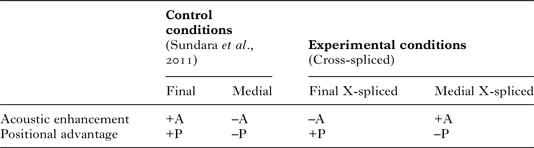
The children in Sundara et al. (Reference Sundara, Demuth and Kuhl2011) were tested on naturally produced sentences. That is, all sentence-final verbs were also acoustically enhanced, as is typical given final lengthening in English. Conversely, the sentence-medial verbs were not enhanced. Here we compare the performance of 22-month-olds on naturally occurring (a) final-enhanced, and (b) medial conditions previously presented in Sundara et al. (control conditions), to two new experimental conditions. In the experimental conditions, all stimuli were cross-spliced. Specifically, we cross-spliced the acoustic instantiation of the inflected verb from one sentence position to the other (Table 1). That is, in the medial cross-spliced condition, the verb from a sentence such as “There he cries” was excised, and replaced the verb in the sentence “He cries now”. Similarly, in the final cross-spliced condition, the sentence-medial verb from “He cries now” replaced the verb in “There he cries”. This cross-splicing was also applied to ungrammatical counterparts (e.g. “There he cry”). With this stimulus manipulation, verbs in the medial cross-spliced condition were acoustically enhanced, but did not have sensory or recall benefits. In contrast, in the final cross-spliced condition no acoustic enhancement was available; however, the sensory and recall benefits were still available due to the placement of the verb sentence-finally.
The experimental design fully crossed Acoustic Enhancement (yes: +A; no: –A) with sentence position (Final: +P; Medial: –P) in the Control and Experimental conditions

If acoustic enhancement is necessary and sufficient to make grammatical inflections salient, in the current experiment children were expected to succeed only in the medial cross-spliced condition. Alternately, if sensory and recall advantages alone are necessary and sufficient to make grammatical inflections salient, children were expected to succeed only in the final cross-spliced condition.
METHODS
Participants
All participants were full-term, monolingual English-learning children. According to parental report, the children had normal hearing, vision, and good health; none of the children had a cold or an ear infection on the day of testing. The final sample included thirty-four 22-month-olds (20 girls, 14 boys, Range: 647–693 days) in the control group, tested using natural sentences (previously reported in Sundara et al., Reference Sundara, Demuth and Kuhl2011), and thirty-four 22-month-olds (16 girls, 18 boys, Range: 654–695 days) in the experimental group, tested using the cross-spliced stimuli. An additional nine children were tested but excluded from analysis either because they never looked away from the screen (2) or did not complete testing (3), or due to experimenter error (4).
Stimuli
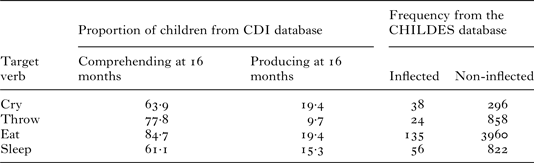
The stimuli were the same as the ones used in the perception experiment in Sundara et al. (Reference Sundara, Demuth and Kuhl2011). Highly frequent, familiar and pictureable verbs (Table 2) were embedded in 3-syllable, 3-word sentences with a third person singular subject (e.g. He cries now, There he cries). The sentences are listed in Table 3. Each sentence was paired with an animated cartoon depicting the action (Figure 1; for details on the validation of the cartoon–sentence pair, see Sundara et al., Reference Sundara, Demuth and Kuhl2011).
Animated cartoons paired with the verbs – cry, throw, eat, and sleep.

Characteristics of the target verbs: MacArthur CDI comprehension and production scores for each target verb at 16 months (Dale & Fenson, Reference Dale and Fenson1996), as well as information from the CHILDES database regarding inflected with third person singular -s and non-inflected verb frequency in child-directed speech (Li & Shirai, Reference Li and Shirai2000; MacWhinney, Reference MacWhinney2000) are presented.

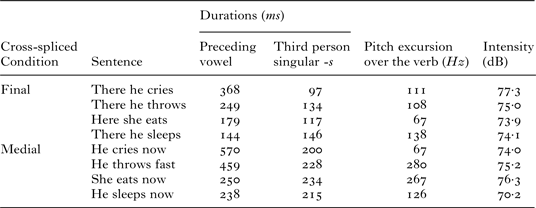
The duration of third person singular -s and the preceding vowel as well as the pitch excursion on the verb in each target sentence in cross-spliced stimuli is presented. The sentence-medial verbs from natural utterances were cross-spliced into sentence-final position, and vice versa. Thus, contrary to the acoustics of spoken English, the duration of the third person singular -s morpheme as well as the vowel preceding it are longer in the medial cross-spliced condition. Note that for children tested on the control group with natural stimuli, the durations and pitch excursions for the final and medial condition are reversed.

In an animated voice, a 36-year-old, female native speaker of American English who is also a trained musician read sixteen grammatical and ungrammatical sentences, four pairs where the verb was in sentence-final position and four pairs where the verb was in sentence-medial position. Sentences were recorded in a soundproof booth using a Shure SM81 table-top microphone. In the ungrammatical sentences, the third person singular -s was omitted (e.g. He sleeps now vs. He sleep now). All sentences were digitized at a sampling frequency of 44·1 KHz and 16-bit quantization, and were excised using PRAAT (Boersma & Weenink, Reference Boersma and Weenink2005).
To confirm that the grammatical and ungrammatical sentences did not differ systematically on extraneous prosody, the stimuli were low-pass filtered and presented to five native English-speaking adults (Mean age = 19·4; Range = 19:20). Low-pass filtering eliminates most segmental information, particularly the presence or absence of the third person singular -s, while retaining rhythm, intonation, and phrasing differences. Listeners were at chance when asked to determine whether the sentences were grammatical or ungrammatical (Mean percent correct = 52·5%; SD = 1·9). Thus, grammatical and ungrammatical sentences could not be distinguished based on their prosody alone.
Crucially, for the experimental group, the verbs in final and medial position were cross-spliced. Specifically, the verbs recorded in sentence-medial position were excised and replaced the verbs in sentence-final position and vice versa. Stimuli were cross-spliced to preserve all acoustic enhancements associated with utterance edges. These formed the stimuli for the final and the medial cross-spliced condition, respectively. Thus, between the control and the experimental group, acoustic enhancement and sentence position effects were fully crossed (Table 1). In the control group, the sentence-final condition also naturally had acoustically enhanced verbs, whereas the medial condition did not. In the experimental group, the acoustically enhanced verbs were in the sentence-medial position and not in the sentence-final position.
Next, to ensure that final and medial cross-spliced stimuli did not differ in naturalness, ratings from five native English-speaking, To-BI trained adults were obtained. Listeners were asked to rate the naturalness of cross-spliced sentences on a scale from 1–7 (where 1 = completely unnatural, and 7 = completely natural). The ratings for final cross-spliced sentences (Mean = 5·6; Median = 6; Range = 2:8) and medial cross-spliced sentences (Mean = 6·15; Median = 6; Range = 3:9) were entirely overlapping.
The duration of the third person singular -s and the vowel preceding it are presented in Table 3. Recall that, due to cross-splicing, both duration measures are expected to be longer in the medial cross-spliced condition compared to the final cross-spliced condition. As expected, third person singular -s was significantly longer in the medial cross-spliced condition (M = 219 ms; SD = 15) compared to the final cross-spliced condition (M = 124 ms; SD = 21) (t(3) = 9·49, p = ·002). Similarly, the preceding vowel duration was also significantly longer in the medial cross-spliced condition (M = 379 ms; SD = 162) compared to the final cross-spliced condition (M = 235 ms; SD = 99) (t(3) = 4·0, p = ·03).
Besides signaling utterance edges, longer segmental durations in English may also signal new information, particularly when accompanied by increased intensity and greater pitch excursions (Breen, Fedorenko, Wagner & Gibson, Reference Breen, Fedorenko, Wagner and Gibson2010; Pierrehumbert & Hirschberg, Reference Pierrehumbert, Hirschberg, Cohen, Morgan and Pollack1990). The extent of pitch excursion in the medial (M = 185 Hz; SD = 105) and final (M = 106 Hz; SD = 29) cross-spliced condition in our stimuli was comparable (t(3) = 1·27, p = ·29), ad so was the intensity [medial (M = 75 dB; SD = 1·6); final (M = 74 dB; SD = 2·7); t(3) = 1·27, p = ·5]. Thus, the cross-splicing did not inadvertently signal a focus condition in one or other sentence position, although the longer duration in the medial, enhanced condition is certainly consistent with an interpretation of focused, new information.
Procedure
During testing, children sat on their parent's lap in a dark room facing a TV monitor. Audio stimuli were played at a comfortable 77 dB SPL over Bose loudspeakers placed next to the TV monitor, behind a dark curtain. The parent as well as the tester listened to music over sound attenuating JTC Clearwater headphones so as not to influence the child's behavior. A Sony SuperExWave camera lens was placed below the monitor. A tester outside the room was able to record the infant's gaze by watching the infant over a second TV monitor connected to the camera.
Children were tested using a modified version of the central fixation auditory preference procedure (Pinto, Fernald, McRoberts & Cole, Reference Pinto, Fernald, McRoberts, Cole, Rovee-Collier, Lipsitt and Hayne1999) as in Sundara et al. (Reference Sundara, Demuth and Kuhl2011). The procedure was infant-controlled and implemented using Habit X (Cohen, Atkinson & Chaput, Reference Cohen, Atkinson and Chaput2004). At the beginning of each trial, a red flashing light accompanied by a baby giggle drew the child's attention to the screen. Once the child's gaze was on the screen, an animated cartoon was presented for the duration of the trial or until the child looked away from the TV screen for more than 2 seconds.
Testing was done in three phases. In the familiarization phase, children were presented with the four animated cartoons, each representing one verb, one-by-one, with no audio signal (Maximum trial duration = 10 seconds). The order of presentation of the four cartoons was randomized across children. A video-only, familiarization phase was necessary because children found the cartoons very interesting and would otherwise never look away from the screen during the test phase. In the test phase, children were presented with two blocks of eight trials each (16 trials). On each trial, children saw one cartoon accompanied by a grammatical or ungrammatical sentence presented repeatedly (Maximum trial duration = 18·5 seconds). The order of presentation of the four grammatical and four ungrammatical sentences was randomized in each block. An experimenter, who was blind to the condition, coded how long the child looked at the monitor to obtain a measure of listening time to grammatical and ungrammatical sentences. Finally, to ensure that children tested in the experimental group were paying attention, one final post-test trial was presented. In the post-test trials infants saw the cartoon of a boy throwing a baseball, while listening to “He sleeps now”. The listening time to the post-trial for all children was close to ceiling (17–18·5 seconds), confirming that they were surprised by the incongruence between the cartoon and the sentence presented auditorily. Thus, children were paying attention to the congruence of the audio and video stimuli; data from the post-test trial are not analyzed further. Children took about 10 minutes to complete the task.
RESULTS
Listening time was analyzed in a 4-way ANOVA with Block (2 levels, 1~2) and Trial-type (2 levels, grammatical~ungrammatical) as within-subjects variables, and Sentence Position (2 levels: medial~final) and Acoustic Enhancement (yes~no) as between-subjects variables (SPSS version 24). Unsurprisingly, the main effect of block was significant [F(1,64) = 52.6, p < ·00], indicating that children's attention to the stimuli reduced over the blocks. A decline in listening times over successive blocks is a hallmark of infant listening time paradigms. In fact, listening times in Block 1 were nearly at ceiling – listening times to 75% of grammatical and ungrammatical were over 15 s (where maximum trial duration is 18.5 s). This was the case for both Experimental and Control conditions.
There was also a marginally significant effect of Acoustic Enhancement [F(1,64) = 4·1, p = ·05], and a significant interaction between Trial-type and Sentence Position [F(1,64) = 8·1, p = ·006]. Crucially, there was a significant 3-way interaction between Trial-type, Sentence Position, and Acoustic Enhancement [F(1,64) = 6·7, p = ·01]. Thus, 22-month-olds’ listening time to grammatical and ungrammatical sentences varied as a function of Sentence Position and Acoustic Enhancement.
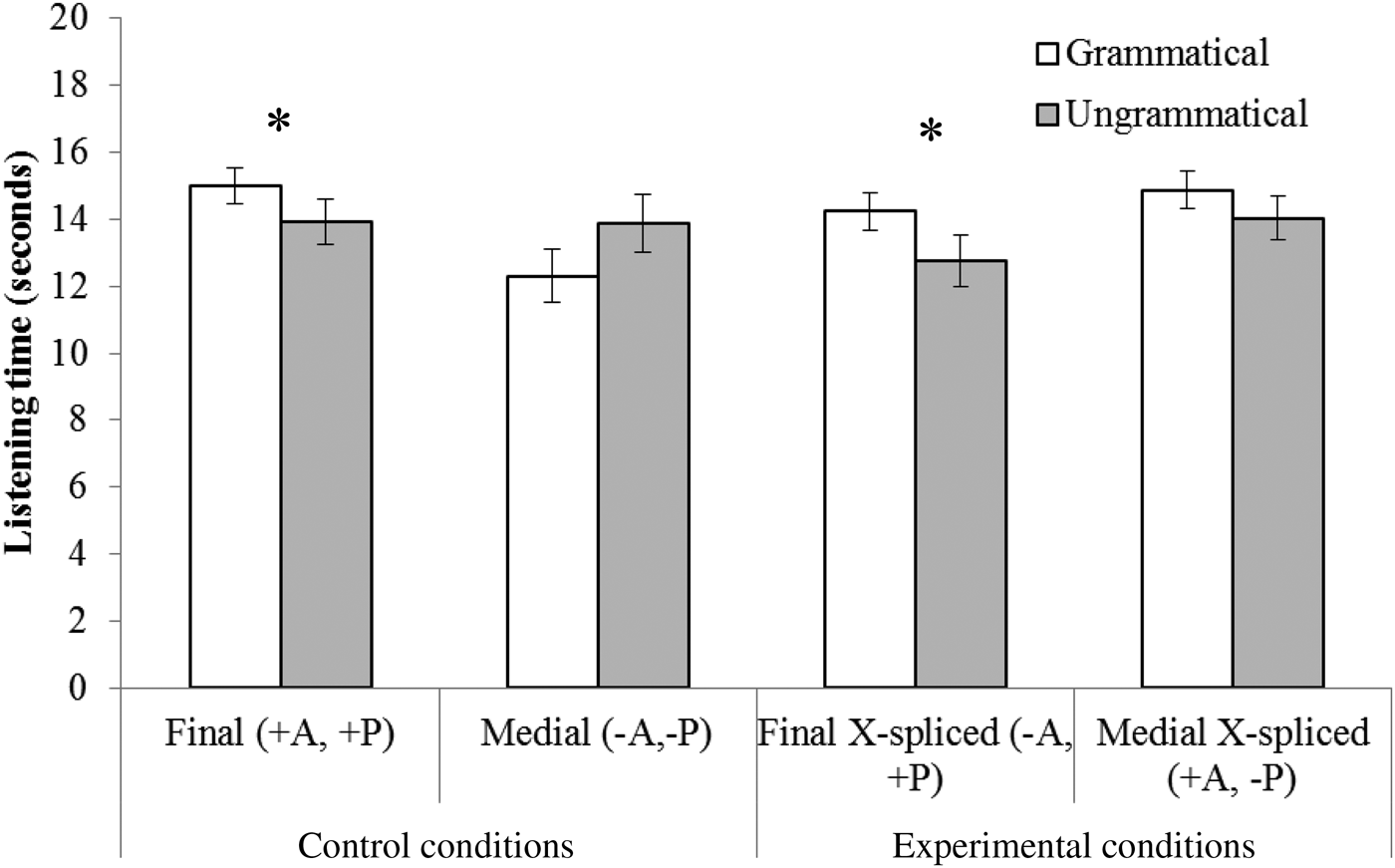
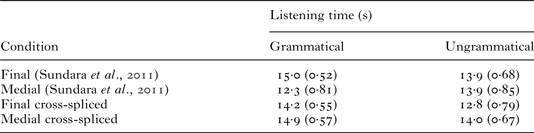
Next, we analyzed the results for the two sentence positions separately in a 3-way ANOVA. We first did this by comparing the two experiments where the verbs were presented in final position – Final vs. Final cross-spliced condition, using a 3-way ANOVA. Again, Block (1~2) and Trial-type (grammatical~ungrammatical) were within-subjects factors, and Acoustic Enhancement (yes~no) was a between-subjects factor. As seen previously, the main effect of Block was significant [F(1,32) = 18·2, p < ·001, η p2 = 0·36]. Crucially, the main effect of Trial-type was also significant [F(1,32) = 12·6, p = ·001, η p2 = 0·28]. A follow-up paired comparison between listening time to grammatical and ungrammatical trials showed no significant differences in Block 1 in final position because looks were mostly at ceiling. In Block 2 (first and third set of bars in Figure 2), listening time differences for grammatical vs. ungrammatical sentences were significant for both the acoustically enhanced [t(16) = 2·5, p = ·02] and not-enhanced condition [t(16) = 2·4, p = ·03]. Thus, 22-month-olds listened significantly longer to grammatical compared to ungrammatical sentences when verbs were in sentence-final position, regardless of acoustic enhancement.
Average listening time (± SE) in Block 2 to grammatical and ungrammatical sentences in the control and experimental groups is presented. The (+A/–A) in parentheses indicates whether or not morphemes in that condition were acoustically enhanced; whereas (+P/–P) indicates whether or not morphemes were in final position. The asterisks mark the conditions where the listening times to the grammatical and ungrammatical sentences were significantly different in a paired t-test.

Then, using another 3-way ANOVA, we compared the two experiments where verbs were presented in medial position – Medial vs. Medial cross-spliced condition. Block (1~2) and Trial-type (grammatical~ungrammatical) were within-subjects factors, and Acoustic Enhancement (yes~no) was a between-subjects factor. Only the main effect of Block [F(1,32) = 36·2, p < ·001, η p2 = 0·53] was significant. There was only one other marginally significant interaction of Trial-type and Acoustic Enhancement [F(1,32) = 4·1, p = ·05, η p2 = 0·11]; all other effects were non-significant [ps > 0·2].
We probed the marginal interaction of Trial-type and Acoustic Enhancement with paired comparisons between listening time to grammatical and ungrammatical trials. Unsurprisingly, there were no significant differences in Block 1 because looks were mostly at ceiling. In Block 2, the listening time differences between grammatical and ungrammatical sentences were in opposite directions for the enhanced and un-enhanced condition (second and fourth set of bars in Figure 2), though neither was significantly different from the other [enhanced: t(16) = 1·2, p = ·24; not-enhanced: t(16) = –1·7, p = ·12]. Thus, 22-month-olds listened comparably to the grammatical and ungrammatical sentences when verbs were in sentence-medial position, regardless of acoustic enhancement.
In sum, 22-month-olds were able to detect the presence vs. absence of third person singular -s regardless of acoustic enhancement only in sentence-final position. Average listening times in Block 2 are presented in Figure 2, and summarized in Table 4.
Average listening times in seconds in Block 2 (SE) to grammatical and ungrammatical sentences

DISCUSSION
We tested whether acoustic enhancement of morphological inflections occurring at the ends of sentences was necessary and sufficient to account for the salience of speech material at the ends of sentences. For this, we compared 22-month-olds’ ability to detect the presence or absence of third person singular -s in four conditions. In the control conditions, natural sentences with medial, non-enhanced morphemes were contrasted with final, enhanced morphemes (previously reported in Sundara et al., Reference Sundara, Demuth and Kuhl2011). In the experimental conditions, the sentence stimuli were cross-spliced. In the medial cross-spliced condition, acoustic enhancement was preserved. In the final cross-spliced condition, only the sensory and recall advantages were preserved.
Our results show that 22-month-olds successfully detected the presence vs. absence of third person singular -s in sentence-final position, regardless of acoustic enhancement. Note that these results cannot be explained by a simple preference for -s alone; otherwise 22-month-olds would have succeeded when the morphemes were presented in sentence-medial position as well. Thus, the sensory and recall advantages conferred by placement at the end of a sentence alone are necessary and sufficient for the salience of edge-aligned grammatical inflections.
That acoustic enhancement alone is not sufficient to make inflections placed sentence-medially salient is consistent with the results of an on online perception study by typically developing children and children with SLI (Montgomery & Leonard, Reference Montgomery and Leonard2006). Acoustic manipulation of the duration of third person singular and possessive -s in this study was primarily restricted to target words in non-final position, and thus did not successfully enhance the performance of either group of children. Based on our findings, placing grammatical morphemes in sentence-final position is more likely to enhance their perception by children.
There are cross-linguistic implications of our finding that sensory and recall advantages make grammatical inflections at the ends of sentences salient. Sensory and recall advantages being domain general likely confer advantages for learners of any language. Specifically, facilitative effects of edge-alignment are likely to be observed in morphological acquisition cross-linguistically, with children acquiring inflections earlier at the edges of utterances.
In conclusion, we show that infants’ detection of inflectional morphemes – third person singular -s in this case – is facilitated when the verbs are placed at the edge of an utterance. Additionally, acoustic enhancement resulting from segmental and prosodic manipulations alone was not necessary or sufficient to make grammatical inflections salient. However, it is possible that these acoustic enhancements add to the salience of speech material at utterance edges. Future investigations are needed to test the additive effects of acoustic enhancements, if any, on the salience of edge-aligned grammatical morphemes. Such an investigation could also serve to disentangle the relative contribution of segmental and prosodic enhancements.