Building Sensibility: Technology and the Character of Modern London
In June 1891, the Incorporated Association of Municipal and County Engineers visited Deptford.Footnote 1 There, members inspected the spacious public abattoirs at the Foreign Cattle Market, built in 1871, where over 100,000 imported cows were slaughtered annually. They then toured Sebastian Ferranti's electric power station. Functional from October 1890, this vast plant transmitted current at 10,000 volts to 30,000 electric lamps in central London.Footnote 2 Here, on the Thames's slimy south bank, respectfully distant from the fashionable, wealthy West End and City, were two institutions demonstrating how modern technology was being utilized to accommodate the growth and changing tastes of the metropolitan population. Public abattoirs and power stations were bold responses to the need for large-scale, organized feeding and illumination of London. Moreover, the bloody, dirty, and dangerous processes through which meat and electricity were produced had no place within a civilized metropolis. Deptford, a peripheral space devoted to the industrialized production of beef and light, was a sign of London's future.
Deptford's technological salience, however, was ephemeral. Following several fires and blackouts, Ferranti's visionary power station was abandoned later in 1891. The abattoirs closed with the market itself in 1913; the area was requisitioned as a war store a year later. Small-scale, localized slaughter and power production remained predominant well into the twentieth century. These examples, of slaughterhouses and electrification, remind historians that technological reform of London and the habits of its population were patchy, fragile, and “mangled.”Footnote 3
There can be little doubt that technologies such as electrification, drainage, and telephony have decisively “patterned” modern experience, particularly in cities, where they have been concentrated.Footnote 4 Nineteenth-century London was typified by ceaseless demolition and reconstruction of streets, buildings, and infrastructures.Footnote 5 There were many specific reasons for such restless reconstruction, but here I will emphasize a political desire to generate a civilized, clean, respectable, productive, and healthy city that was driven by an environmentalism that persisted across the century, despite changing political, social, and medical attitudes.Footnote 6 The urban environment and the physico-moral condition of London's population were inseparable. The Metropolitan Board of Works, founded in 1856, had as its explicit aim “the better management of the metropolis in respect of the sewerage and drainage, and the paving, cleansing, lighting and improvement thereof.”Footnote 7
The physical and moral characteristics of London's population, therefore, were perceived as being institutionally amenable to technical adjustment, a basic premise uniting projects as diverse as those of Edwin Chadwick and Ebenezer Howard. The relationships forged between technology and the individual were, of course, particular to specific projects. Chadwick's “sanitary idea” embodied the belief that delivering fresh water and removing waste would enable individuals to clean themselves and their surroundings, thus precluding the possibility of disease. Fifty years later, Howard's garden-city movement advocated free circulation of air and sunlight as a solution to physical ills. The provision of facilities enabling people to wash themselves, breathe freely, and cultivate health could be secured by the creation and maintenance of durable infrastructures designed to deliver basic resources on demand without direct governmental interference. Such bodily practices were invariably connected to ideas of moral selfhood, which themselves had broader social ramifications: “a healthy and agreeable home, whilst tending to elevate the tastes and improve the morals of those who lodge within its walls, results in an amount of self-respect being created that almost precludes a man from becoming a pauper, and certainly saves him from becoming a criminal.”Footnote 8 The imbrication of particular subjective capacities and technical systems, as Patrick Joyce argues, formed part of a wider liberal rationality of government, designed to instill self-government and self-discipline in individuals, institutions, and municipalities.Footnote 9
Perceptual aptitudes were integral to the technical realization of this self-governing individual. “Modernity,” writes Jonathan Crary, “is inseparable from on the one hand a remaking of the observer, and on the other a proliferation of circulating signs and objects whose effects coincide with their visuality.”Footnote 10 Our historical formation as sentient beings cannot be considered without addressing the technical and discursive configuration within which such development occurs. Here, I want to suggest that technology was used in two fundamental ways to modify subjective perception within urban space. First, it was deployed essentially negatively, to delimit sensory experience. This technical negation was apparent in the building of private, self-enclosed domestic facilities, bedrooms and toilets, where one's body could be experienced intimately and in its depths in physical, visual isolation from family and society.Footnote 11 It also operated through countless little techniques to curb noise and smell, from soundproof paving and dog muzzling to deodorization. Technology was also used positively, to stimulate and seduce the senses, to maximize human ocular or aural capacities. Public leisure spaces, and transportation networks, for example, used light and sound in order to induce subjective states of fascination or attention.Footnote 12 Devices like spectacles, hearing aids, and telescopes were also being used more routinely to rectify and normalize perception, and to escape the organic boundaries of sensibility.
This technologically mediated set of perceptual restraints and enhancements implied two closely related, yet distinct, modes of subjectivity. “Negative” technologies could embed increased levels of decency, creating the kind of subjectivity associated with Elias's “civilizing process”: the modern individual's disgust at blood and stench, and intolerance of bodily habits like defecation and spitting.Footnote 13 James Kay and Charles Booth were among many depicting what has become a familiar catalog of bodily horrors.Footnote 14 Victorian disgust, however, required the material as well as discursive production of obscenity and embarrassment. There is also more to modern subject-formation than repression and reaction. The subject was not simply freed from physical and moral corruption by calculated use of technology. “Positive” technologies freed the subject to enter into specific, productive relations with the city and its spaces, to improve body and mind through physical exercise and education.Footnote 15 The distinction I am making between negative and positive technologies should not imply their mutual exclusivity. Technical systems invariably combined both aspects: sanitation, for example, freed individuals from disease matter and dirt while freeing them to breathe, work and behave decently. Technology and subjectivity, in other words, interact in multiple and perhaps even conflicting ways.
This article explores these complicated relations between technology and subjective agency, especially perception, by examining two very different projects. The first, modernized slaughterhouses and abattoirs, functioned largely, but not exclusively, as a negative technology, preventing ocular, olfactory, and sonic nuisances (blood, stench, cries) in addition to physical contamination. The second project, electric lighting, operated more positively, facilitating discernment and lucidity. Both, however, aimed to contribute to a material environment within which a healthy, decent, and dynamic set of individuals could be secured. These technologies, however “governmental,” were sometimes untried and unpredictable, often complicated and cumbersome. They were, moreover, contested: private butchers certainly resented the idea of centralized abattoirs, and gas manufacturers feared competition from electricity. The constitution of new technical networks, in other words, involved cajoling matter, minds, and bodies to enter into delicate new configurations. However impatient reformers were, smooth and rapid progress was hardly to be expected.
The Blood of London: Slaughterhouse Reform, 1840–1900
“It cannot, we think, be denied that London, in spite of its boast of being the most populous and richest city in the world, is but very imperfectly supplied with markets,” declared the Builder in 1883, directing envious eyes toward Paris, where reconstruction of the central markets had begun in 1852. These capacious, clean spaces contrasted with London's: “a great capital like ours has no just cause for pride at its vastness, if it does not supply its inhabitants with every possible facility for existence… and foremost among the facilities for existence in a great capital stands the adequate supply of markets.”Footnote 16 The Halles Centrales stood in the center of the French capital, with which it communicated via broad boulevards. Additionally, Haussmann oversaw the building of abattoirs of unprecedented size at La Villette, on the city's periphery. Bisected by one channel of the Canal Saint Denis, and girdled by railways and roads, they epitomized Parisian modernization. “This vast establishment,” recalled Haussmann, “is one of the most considerable works accomplished by my administration, paralleling the great sewer constructions.”Footnote 17
London, of course, had no Haussmann, no Halles Centrales, and no La Villette. In 1850, Smithfield remained London's primary livestock market. In its 900-year history, it had hosted jousting, bearbaiting, and executions: William “Braveheart” Wallace was hanged and disemboweled there in 1305. By 1851, nearly two million live animals were sold annually at Smithfield, and most were killed nearby.Footnote 18 This slaughter had been regulated, albeit haphazardly, since medieval times: Edward III banned slaying in the streets, and Henry VII tried to drive it beyond the City walls. But such efforts proved largely futile. In London and Westminster Improved (1766), John Gwynn condemned “the intolerable practice of holding a market for the sale of live cattle in the center of the metropolis.”Footnote 19 Slaughtering, as George Dodd observed in 1856, had “been carried on for many ages in the neighborhoods of Smithfield and Leadenhall,” in numerous cellars, rooms, and sheds, generating congestion and increasingly offending civility.Footnote 20 Schemes for rebuilding came and went: in 1836, a new cattle market opened in Islington, but the City of London Corporation, supported by traders, butchers, and bankers, successfully boycotted it, and the space was later sold for housing.Footnote 21 There were 138 slaughterhouses in the City alone in 1848, and they were still not legally regulated. It is consequently unsurprising that, like slums and sewers, slaughterhouses were attracting sanitary and moral anxiety by 1850.
Humanitarian concern for suffering animals, which gathered pace throughout the eighteenth century, was an important aspect of liberal improvement.Footnote 22 One could hardly govern oneself or others if one treated brute creation with callous disregard. The formation of the Society for the Prevention of Cruelty to Animals (SPCA; 1824) was arguably as much about the morality of humans as the care of beasts.Footnote 23 The society lobbied for legal protection of animals, and the 1835 Cruelty to Animals Act, which banned cockfighting and bullbaiting, was the first of several parliamentary interventions for which it claimed credit. Such acts, however, did nothing to control how and where animals were slaughtered. As London's human population swelled, increasing numbers of animals were forced through streets and buildings en route to slaughter. “Few things can be more objectionable than the driving of terrified animals through shops or dwellings,” observed Thomas Dudfield, Medical Officer of Health for Kensington, in 1876.Footnote 24
While Smithfield remained the epicenter of the live meat trade, Londoners regularly confronted “lame and bruised (animals)… as they struggle in stupor or in terror through our bewildering streets.”Footnote 25 Public executions ceased in 1868; displays of pain and punishment were seen as being incompatible with civil urban spectatorship. Like executioners, slaughter men were routinely accused of being drunken, unskilled, and cruel. The prominent vegetarian Josiah Oldfield observed in 1895 that “habitual contact with animals for the purpose of injuring them instead of helping them; for the purpose of bringing pain and suffering upon them instead of comfort and healing, must absolutely and necessarily brutalise, degrade, and demoralise the men whom we doom to this trade, and entail suffering of a nature impossible to prevent upon the victims entrusted to their power.”Footnote 26 Methods of slaughter progressed little. In 1913, “time-hallowed and uncertain pole-axes” were still largely used to kill beasts after stunning, despite sporadic efforts to replace them with gas, bullets, electricity, guillotines, or dynamite.Footnote 27
In addition to the sight of exhausted animals lumbering to their doom were more tangible reminders of their death. The sounds of dying animals were particularly emotive. The public health chemist Alexander Wynter Blyth reported that “the squeals, or almost human shrieks, of (pigs) are peculiarly distressing, and, from the high pitch of the sounds, are heard a long distance.”Footnote 28 Furthermore, slaughterhouses were sometimes simply back rooms or old wooden sheds; they mingled with houses and thoroughfares, precluding discreet concealment of killing within a civilizing cloak of brick. An 1874 inspection of City slaughterhouses found some where death was “screened from public view by canvas only, or not at all.”Footnote 29 Over thirty years later, the architect R. Stephen Ayling described a Westminster slaughterhouse where “the doors were frequently open or ajar, and it was quite customary to find a number of children watching the slaughtering operations, fascinated by the sight of blood and the struggles of the animals.”Footnote 30
These semipublic spaces of horror were the material antitheses of the “improving” institutions desired by those concerned about the physical and moral condition of the poor. How could one witness such grotesque scenes without being corrupted and desensitized? Ayling cited a recent Liverpool Courier article, which argued that civilized man “must forget the intervening stages of the sirloin's evolutionary progress from the country meadow to the dining table.”Footnote 31 Such forgetting required technical obfuscation of the bloody, pitiless process through which animal became meat. This separation of nature and society has been seen by anthropologists and philosophers as a key marker of the modern order.Footnote 32 Civilized society, in this view, was measured by its distance from nature, a distance as much material as moral or spiritual. J. S. Mill, for example, argued that “the English are farther from a state of nature than any other people, a product of civilization and discipline.”Footnote 33 The mélange of animals and humans at Smithfield undercut both.Footnote 34 Moreover, the private slaughterhouse system technologically precluded the seamless, invisible transformation of cow into beef. Viscid, raw nature tumbled into the streets: “situated behind the shops in Whitechapel, and under the shops in Newgate Market, and in various obscure localities about Smithfield, [slaughterhouses]… bring scenes of blood into the midst of scenes of commerce, death into the midst of life.”Footnote 35
Private slaughterhouses were invariably very small. In 1874, a Shoreditch butcher was operating from one only six feet by nine feet in size.Footnote 36 In such cramped spaces, there was insufficient room to keep animals in separate lairs before slaughter. Likewise, Smithfield only had room for 4,000 cattle, but 7,000 beasts were sometimes forced into this space. Cows, dogs, carts, butchers, and traders inevitably spread into surrounding streets, and on market days the neighborhoods of Newgate and Smithfield became notoriously congested. In 1861, The Times described Newgate thus: “the whole business has to be done within the limited space of which Paternoster Row, Ivy Lane, Newgate Street, and the Old Bailey are the boundaries…. Wagons and vans… and the butchers' carts, completely block up Giltspur Street, Newgate Street, and the Old Bailey on several days in the week, Mondays and Fridays especially.”Footnote 37 This process also damaged animals' bodies: “excessive fatigue, terror, panic, or rage, deranges their functions and the nutrition of their tissues, not only diminishing the quantity but affecting the quality of their flesh.”Footnote 38 Cows, it was estimated, shed sixteen pounds of weight the night before sale at Smithfield.
Slaughterhouses themselves were frequently condemned by sanitarians and public health officials as filthy and antiquated. Those in Aldgate were described in 1876 as “in a general state of disrepair; the roofs dilapidated, the flooring uneven and broken, and side walls filthy and bloodstained, the drainage defective and sluggish, the water-supply inadequate and badly-placed. Accumulations of dung, offal and blood were general… nothing short of entire reconstruction of these premises will satisfy the requirements of sanitary science.”Footnote 39 Rarely were they purpose-built, and they lacked adequate ventilation, light, and water. Blood and offal trickled into public sewers, or accumulated in pits that, unless disinfected, stank and generated septic diseases and puerperal fever. These spaces were disconnected from expanding drainage and irrigation networks, a situation that only demolition or extensive rebuilding could rectify. The surrounding atmosphere was heavy with animal emanations. In the 1840s, William Farr, statistician and registrar general, listed these odors and exhalations, along with those disgorged from cesspools, sewers, and graveyards, as the causes of the protean “disease mist,” which, “like an angel of death… has hovered for centuries over London.”Footnote 40
Associated with slaughtering itself were numerous other trades processing animal matter for human consumption: soap works, fat melting, bone boiling, manure production, gut scraping (the production of sausage skins), blood drying, knackery (the slaughter of old horses), glue making, and fellmongering (the preparation of skins for tanning). Edward Ballard, reporting on noxious effluvia as Medical Officer of Health for the Local Government Board in 1876–77, produced the following vivid description:
gut scraping and gut spinning establishments are the most intolerable of nuisances wherever they may perchance be located. Within the workshops the stench is inconceivably horrible: few persons unaccustomed to it could bear to remain for a single minute in some scraping rooms that I have visited. I myself have had sometimes difficulty to restrain vomiting and to carry on the inquiries I was bent upon. The stench, after I have been in some of them for twenty minutes or half an hour, has so pertinaciously attached itself to my clothing and hair, that only repeated ablutions have removed the odour from my hair; my clothing has retained the stench for days. It spreads from the workshop and yard all around the neighbourhood, and often gives rise to such loud complaints that local authorities in some towns have insisted upon the entire removal of them.Footnote 41
Seldom has civilized disgust been more clearly expressed. This overwhelming sense of corruption and defilement could only be eradicated by “repeated ablutions.”Footnote 42 Such self-cleansing was, obviously, impossible without a reliable urban hydraulic system.
Animal products, sanitarians argued, could also communicate diseases to humans if not properly monitored. The greatest threat came from tuberculosis, which, as was shown in 1882, was caused by a specific germ that was identical in both cattle and humans.Footnote 43 Experiments showed that the germ survived both undercooking and the chemical action of gastric juice. The unmistakable signs of its presence were tubercles coating the organs, particularly the lungs. The only solution, public health officials urged, was scrupulous, widespread inspection of carcasses for abscesses, swellings, unusual coloring and speckles, as well as tubercles. “Bad meat,” reported the chemist Henry Letheby, “is wet, flabby, and sodden, with the fat looking like jelly or wet parchment.”Footnote 44 Private slaughterhouses, however, were not easily open to systematic inspection. They were private property, and even RSPCA officers had difficulty entering them. Some butchers preferred to slaughter animals “in their own back parlours,” resenting intrusion into what they regarded as private activity.Footnote 45 It was argued that “nothing less than the most open public inspection at any hour of the day can ever keep the (slaughterer's) will in condition for permanent sanitary action.”Footnote 46 Making slaughter public, therefore, entailed opening it to municipal vision while concealing it from the eyes of polite society. A specific play of openings and constraints would be mobilized to encourage public health and private morality.
From midcentury, the public abattoir was promoted as the solution to the problem of insanitary, uncivilized private slaughterhouses. Dating from 1806, the term “abattoir“ came to refer to a large, centralized, municipal space devoted to slaughter and its attendant industries. In 1873, the Lancet declared that “it cannot be doubted for a moment that the use of public abattoirs, as compared with private slaughterhouses, is advantageous in many respects, notably as regards cleanliness, space and supervision.”Footnote 47 Benjamin Ward Richardson, president of the London Model Abattoir Society, founded in 1882, described the requirements of a public abattoir:
it must be thoroughly lighted, and there must be no dark corners; drainage must be properly provided for, and there must be means of promptly removing offal; there must be abundant and easily accessibly [sic] of pure water for cleansing the carcases, and convenient lavatories for the men; well-constructed and clean sheds, in which the animals could be kept apart, according to their kind, and away from the slaughter-room; and, lastly, a preserving-room, where, either by refrigeration or the use of antiseptics, meat might be safely stored in hot weather. The killing should only go on during stated hours, and by daylight.Footnote 48
It would be constructed from impervious, resilient materials: glazed bricks, concrete, iron, and cement. Permanent supervision was secured from an elevated office, while diseased animals were examined in a pathological laboratory. Physical vitality would be protected. As Ayling concluded, “public abattoirs are essential for the bodily health of the nation.”Footnote 49 The whole site should be located on the city's periphery, away from houses and close to railways, canals, and docks.Footnote 50
This was a machine for silent, salubrious killing, where noxious industries were concentrated and technology enlisted to deodorize and cleanse. Calculated architectural arrangement of lairs, pens, and slaughterhouses made animals oblivious to their fate. Death was delivered swiftly by trained butchers, while carcasses were rapidly skinned and disemboweled: “the cooling and dressing rooms should be in close proximity to the slaughter-halls, and be so arranged that the meat can be carted away without having to pass through any portion of the abattoir buildings.”Footnote 51 Carcasses were suspended from mechanized rails and chilled to precise temperatures, ready for urban delivery: “the rooms are shut up at the close of the day's killing and opened next day shortly after noon, when the carcases are found reduced to 33 degrees Fahrenheit and conditioned ready for safe transit by rail to their destination.”Footnote 52 Richardson's model design comprised “eight radiating slaughter bays… from which the veterinary inspector would have a full view.”Footnote 53 A lethal chamber running on tramlines rotated into position when an animal was ready to be gassed. Slaughter would be rendered clean and scientific.
The first British public abattoir opened in Edinburgh in 1851. Located in the city center, it was simply an agglomeration of several small slaughterhouses on one site. In 1895, there were fifty-four public abattoirs in Britain; by 1908, this number had grown to 135. Many, like those at Deptford and Birkenhead, were located at ports, especially after the 1869 Contagious Diseases (Animals) Act, which followed the cattle plague epidemic of 1865 and insisted on animals from certain countries being slaughtered upon landing.Footnote 54 Surveying new abattoirs at South Shields in 1876, Spear and Hall observed that “the contrast between a properly constructed abattoir and the existing slaughter-houses cannot fail to impress.”Footnote 55 By 1900, all Carlisle's butchers were using their city's public abattoir, and municipal engineers now toured abattoirs as well as pumping stations and gasworks. But they remained local in scope and scale: “no attempt has been made to institute an ‘Abattoir System’ such as that started nearly a century ago on the Continent, and which has since rapidly grown and approached perfection.”Footnote 56
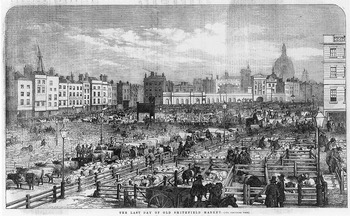
In London, meanwhile, the market system was being modernized. In 1855 Smithfield finally closed. It was replaced by a new Metropolitan Cattle Market at Copenhagen Fields, Islington. Covering seventy-five acres, it was considerably larger than its forebear, connected to railways and canals, and equipped with public and private slaughterhouses. The contrast between this orderly site, divided according to type of animal, with specific sites for slaughter and provision for future expansion, and the cramped, chaotic old market was made explicit in the Illustrated London News (plates 5 and 6). Through such graphic techniques, the material modernization of London was displayed. Smithfield itself reopened as a dead-meat market in 1868. Billingsgate Fish Market, the oldest such establishment in the metropolis, was rebuilt and reopened in 1852, while Newgate market lingered until being condemned in 1861.
—“The Last Day of Old Smithfield Market,” Illustrated London News (16 June 1855), p. 600. Reproduced with the permission of the Library of the University of California, Berkeley.

—“The New Metropolitan Cattle-Market, Copenhagen-Fields,” Illustrated London News (16 June 1855), p. 601. Reproduced with the permission of the Library of the University of California, Berkeley.

Parallel with this reconstructed market network were moves to regulate slaughterhouse structures. The first notable piece of legislation was the 1844 Metropolitan Buildings Act, which included clauses regulating the location of noxious trades. London's butchers rebelled, arguing that their businesses would be ruined, and received a thirty-year grace period in which to rebuild slaughterhouses within specified distances of houses and public ways. Rather timorous moves requiring registration and licensing did little to curtail the growth of unwholesome premises. In 1874, it was reported that hundreds of new slaughterhouses had appeared since 1844. Many of these, despite butchers' arguing otherwise, were neither detached nor well ventilated. People sometimes lived above them, “and, in certain cases, light was obtained by opening the doors, so that the business was carried on in public.”Footnote 57 Butchers argued the connection between private slaughterhouses and physico-moral decline was unprovable, making their case before the 1873 Select Committee on Noxious Businesses with sufficient force that the 1874 Slaughterhouses, &c. (Metropolis) Act indefinitely postponed their abolition. The act was, however, the first substantial attempt to regulate their construction. Buildings were to be independent of housing or shops, at least 100 square feet in size, and “substantially constructed of brick, stone, iron or concrete.”Footnote 58 Partitions would divide lairs from slaughter halls, and sloping granite floors would convey blood into public sewers via gullies and glazed pipes. Water and ventilation should be plentiful. Slaughter itself should not entail “unnecessary suffering”; animals were to be killed swiftly and accurately. Finally, inspectors would be allowed free access during working hours.Footnote 59
Municipal authorities acted quickly, condemning the worst institutions: 284 London slaughterhouses were closed between 1875 and 1876.Footnote 60 Medical and sanitary reformers hoped that this legislation would spur metropolitan authorities to undertake more radical reforms. Dudfield argued “now that they have fulfilled their task of making by-laws for regulating for the present the existing private slaughter-houses, let us hope that they will proceed to the consideration of the far more important question of providing a sufficient number of large commodious and accessible public abattoirs that may, in due course, take the place of the multitudinous private establishments of which we have heard so much of late, and so little that is satisfactory from a sanitary point of view.”Footnote 61 The Deptford abattoirs, which included England's biggest chill room and provided most of the animal fat for London's embryonic margarine industry, remained very much the exception. Metropolitan abattoirs for domestic slaughter failed to materialize. Richardson bemoaned the inability to find an appropriate location, spacious and distant from population: “how hard it is to meet these conditions is shown by the fact that the Council of our (London Model Abattoir) Society, ever on the look-out in London for a site on which to erect a small and modest model, has waited patiently and impatiently for five years in search of a site, and all in vain.”Footnote 62 London County Council plans to construct six giant abattoirs around London in 1898 were blocked by butchers who, appealing to liberal principles, evoked the language of the small independent trader fighting against the threat of monopoly. These protests were organized through the National Federation of Meat Traders and its mouthpiece, the Meat Trades' Journal, both founded in 1888.Footnote 63
Reformers, therefore, concluded that the project to regulate metropolitan slaughterhouses was heavily compromised. Despite reconstruction, Smithfield appeared small and quaint, as Engineering observed in 1894: “it will be noticed that this area is smaller than that of the Halles Centrales in Paris, designed for a much smaller population.”Footnote 64 Worse, it was still surrounded by slaughterhouses, with their persistently harmful effects on health and morality. There were 728 licensed slaughterhouses in London in 1889, and many more operating illegally. In 1878, inspectors of a Bethnal Green slaughterhouse “found the premises in a shocking state, with all the appearance of being used as a knackers' yard, beside the machinery for slaughtering and hanging the carcass, blood and bones and hides of horses all over the place.”Footnote 65 Inspectors often lacked training, worked part-time, and combined surveying duties with other trades like carpentry or floristry. The inner surface of the carcass often remained illegible to men lacking training in sanitary science, which led, by 1890, to the insistence that inspectors hold basic diplomas. Their task was, of course, hardly helped by the diffuse nature of the existing metropolitan slaughterhouse system.
New architectural forms and raised levels of knowledge were only two of the factors necessary for creating reliable networks of metropolitan meat inspection. As Richardson suggested, abattoirs should also be flooded with light and devoid of shadowy nooks in which dirt could fester. New systems of artificial illumination, therefore, were promoted as a positive technology capable of making cleanliness clearly visible. The second part of this article explores the progress of electric light in the metropolis.
Glare, Shadow, and Smoke: Illuminating London, 1850–1900
In 1807, London's first public gaslights flickered into existence in Pall Mall.Footnote 66 By 1875, over five thousand miles of mains extended beneath the capital's streets. It was the first industrially lit metropolis.Footnote 67 This increase in nocturnal illumination formed a tangible index of London's modernity. As the Builder observed in 1873, “the dim oil-lamp way of lighting a street… takes us into the last century fairly.”Footnote 68 Organized, permanent, and reliable illumination became indispensable to London's transportation, commerce, and policing. Numerous metropolitan gasworks, with giant telescopic holders, were built to satiate this thirst for light. In 1865, the Hackney Road gasholder was 201 feet in diameter, considerably larger than the dome of Saint Paul's.Footnote 69 Other industries (dyeing, tar, coke) clustered around gasworks and devoured their waste.
Gaslight, however, fell victim to shifting environmental and sanitary sensibilities. The smoke, soot, and heat accompanying the flame, it was argued, produced an atmosphere damaging to the human organism. Gaslight robbed the air of oxygen and, in return, released soot. Moreover, as the engineer J. Angelo Fahie observed, “in the process of combustion the air is contaminated with certain poisonous compounds, such as carbonic acid, carbonic oxide, and sulphur, which, when breathed even in a limited quantity, are injurious to the human frame. Another effect of the combustion is the production of vapor, formed by the oxygen of the air combining with the hydrogen, which constitutes a portion of the material consumed.”Footnote 70 This was evident in nocturnal trades like printing. “Those who work habitually in gas-lighted rooms,” noted one doctor, “become blanched and sickly.”Footnote 71 Soot and sulfurous vapors blackened clothing and stunted plants' growth. The Public Record Office's search room had no artificial light until 1882 because of fears that documents would be irretrievably damaged. Gas, which once epitomized urban modernity, was now derided for producing a dirty light for a dirty city.
Gaslight and gasworks, like slaughterhouses, and cellar dwellings, were seen as inimical to the sanitary and sensory conditions consonant with civilized existence. “Sanitary science,” argued Thomas Bartlett Simpson, owner of Cremorne Gardens, was “unheard of” when early gasworks were built, but by the 1860s, “nuisances which would have formerly passed unnoticed are now properly treated as intolerable.”Footnote 72 Bow Common gasworks was now routinely “avoided by persons of sensitive organs.”Footnote 73 Such structures had no place in a civilized city, he continued, citing the removal of Parisian gasworks to the city's outskirts as evidence of London's sanitary backwardness. The gas industry replied by arguing that purification techniques and better chimneys had substantially reduced stench and smoke, citing London gasworks that were “surrounded by luxuriant vegetation, which is not in the slightest degree affected by their presence.”Footnote 74 New works, however, tended to be planned at increasing distances from central London. Those at Beckton, near the Barking Creek outfall sewer, conveyed gas over eight miles to a smaller station in Brick Lane.
Effluvia, however, caused less apprehension than explosions. Gasholders had shown tendencies toward self-destruction well before the 1860s, but the 1865 explosion at the Nine Elms Station, which killed nine people, demonstrated the risks accompanying industrialized illumination. Argued Simpson, “we now find ourselves encircled by about twenty of these dreadful magazines of discomfort, sickness and peril; converting thousands of tons of coal into coke and gas every day, necessarily accompanied by poisonous emanations, and an ‘unavoidable accident,’ at any one of which may in the busy hours of day, or in the stillness of night, lay a neighbourhood in ruins, and bury its inhabitants beneath them.”Footnote 75 Rumored Fenian attacks on the gas network in 1867 intensified disquiet. More endemic, if less dramatic, were leaks. In the 1850s, the “average unaccounted-for gas throughout the country amounted to certainly not much less than 20% of all that was manufactured.”Footnote 76 Corroding joints and fractures caused by traffic, steamrollers, or roadworks were mainly responsible. Gas, it seemed, easily escaped from pipes and wormed its way into other subsurface networks, blackening the earth as it went. One metropolitan electricity company reported rather smugly in 1895 on the volume of gas hemorrhaging from aging pipes: “the basements of several houses are seriously charged with gas, and servants living in them have been made sick… if an iron bar be driven into the roadway in this district, and then withdrawn, a match applied to the hole will light a gas flame.”Footnote 77
Aside from sanitary concerns, there was a growing chorus of complaint about the quality of gaslight itself. In 1872, London consumers held various meetings to try to secure improved gas at a better rate.Footnote 78 Gas companies were accused of consistently failing to provide light at the legal minimum of sixteen candles set by the 1860 Metropolitan Gas Act. The prevalent impression seems to have been one of dinginess rather than radiance: “little or no effort has as yet been made to improve the lighting up of London streets by night.”Footnote 79 For some romantics, like Robert Louis Stevenson, gas produced “a warm domestic radiance,” but its softness and yellowness made it less appropriate for lighting large public areas.Footnote 80 The visual field produced by the average London streetlamp remained mottled and grainy. In 1891, the Electrician argued that the illumination, “for the purpose of reading a newspaper or finding a fallen sixpence, is of the feeblest kind.”Footnote 81 Sherlock Holmes would struggle to discern detail in such circumstances.
This environmental and visual critique of gaslight coincided with the development of functional electric lighting systems. “The progress of electrical science,” declared the architect John Slater in 1882, “is the most striking feature of the latter part of the nineteenth century.”Footnote 82 Electrical engineers promoting the clean, smokeless nature of arc lights and glow lamps were joined by doctors and sanitarians. Richardson, for example, saw electric light as intrinsically healthy, arguing in 1877 that “the great disideratum in respect to artificial lighting (is)… the practical development and application of the electric light.”Footnote 83 William Preece, electrophilic postmaster general, asserted, “that the electric light is a powerful element of health is evidenced by the fact that those who use it not only feel all the better for its introduction, but their appetite increases, and their sleep improves, and the visits of the doctor are reduced in frequency.”Footnote 84 “The chief duties of municipal engineers,” he argued elsewhere, “have been to improve sanitary matters, to remove vegetable and decaying matter from water, and by a proper system of drainage to remove all dangers from health. But the duties of a municipal engineer will not be complete until he takes in hand the electric light.”Footnote 85 Electric light, like water, could free the individual from pathogenic environmental influences, while augmenting visual perception. Human agency, therefore, could be subtly and plurally modified by new technological networks.
Electric light has been described by Reyner Banham as heralding “the greatest environmental revolution in human history since the domestication of fire.”Footnote 86 The process of environmental reform was, I think, considerably more hesitant and contingent than Banham implies. But the relationship between light, environment, and bodily practice was central to contemporary debates about electricity. “When several electric lights are placed in a hall illuminated by gas,” argued the electrical engineer Paget Higgs, “the eye experiences a sort of relief, both by the redoubled brilliancy and by the perception of colours which were not before suspected, and, on the contrary, if the electric lights be suddenly extinguished, the spectators are thrown into the comparative night of the old illumination.”Footnote 87 The eye, he implied, was freed from the constraints of gas: electricity allowed sight to function naturally. Spectroscopic and photometric analysis provided graphical evidence of these chromatic advantages, while the steadiness of incandescent light provided comforting, stable visual conditions. These analyses strove to prove electric light's equivalence to daylight. It could help, experiments suggested, to maximize the eye's basic capacities to distinguish color and discern detail. These aptitudes, in turn, were connected to specific ocular agencies regarded as necessary for the functioning of liberal society: surveillance, inspection, and attention.Footnote 88 The engineering press regaled readers with examples of the technological improvements to urban vision generated by electricity: reading without eyestrain, facial recognition, discernment of signals and warning lights, detection of objects at distance. In short, a whole set of nocturnal practices became feasible under brighter light. Argued one electrical enthusiast, “this improvement [is] essential, indispensable, for the advance of civilisation, of culture, and of material comfort.”Footnote 89
The first electric light in London, an arc lamp patented by William Staite, was exhibited at the Royal Polytechnic Institute in 1846. Several semipermanent installations of this light followed, between 1848 and 1849, at the National Gallery, Hungerford Bridge, and the Haymarket Theatre.Footnote 90 But technical problems, notably the generation of cheap, reliable power and the regulation of arc apparatus, delayed development until the later 1870s, when improvements to batteries, generators, filaments, and carbons enabled various public institutions to adopt electric lighting. In 1879, for example, the British Museum and King's Cross Station installed arc light systems. By the mid-1880s, parts of Buckingham Palace and the Houses of Parliament were electrically lit, along with numerous theaters, banks, courts, and churches. Building central stations supplying electricity permanently for streets and houses, however, proved considerably more difficult. The Holborn Viaduct Station, which opened in April 1882, and lit the area along Holborn Circus, the Viaduct, and Newgate Street, was the first project to supply a metropolitan area from a generating plant but was abandoned in 1886 following heavy financial losses. The example of the City of London schemes in the final two decades of the century illustrate the rather piecemeal, compromised development of large-scale electric lighting systems.
The City of London, 673 acres in size and the financial hub of Britain and its empire, had retained control over its paving, lighting, and sewering despite the establishment of the Metropolitan Board of Works. Its narrow, zigzagged streets and tall buildings made “the task of lighting with a medium giving intense and sharply-defined shadows one of considerable difficulty.”Footnote 91 The area's declining population meant that the demand was largely for street and business lighting, frequently to combat fogs. From the late 1870s, there were numerous electrical experiments. In 1881, one project involved suspending six giant lamps, at a height of eighty feet, to illuminate public spaces such as that outside the Royal Exchange. Usually sober publications like Engineering fantasized about the possibility of a radiant, electrified metropolis:
there is something exceptionally fascinating and attractive in the thought of lighting a great city by a number of powerful lights suspended in mid air far above its roofs, shedding a purely white light, softened by distance and robbed of its glare by height; and strangers arriving in London by the night trains or boats—for the river would be rendered navigable by night as well as by day—could not fail to be deeply impressed by the beauties of science and the perfection with which in skilful hands those beauties may be turned to useful ends.Footnote 92
“From the southern side of Blackfriars to the eastern end of Cheapside,” enthused one observer, “the thoroughfare is brilliantly illuminated by means of thirty-two lamps on the Brush system maintained by a single generator fixed at the company's works in Lambeth.”Footnote 93
“We venture to predict,” intoned Engineering, “that the 31st of March, 1881, will… long be remembered as the beginning of a characteristic epoch in the history of electricity, and of the application of science to the requirements of the public.”Footnote 94 Within two years, however, the Brush Company's were the only public electric lights still running in the City. In 1885, while electric lights were being dismantled on the Victoria Embankment, private capital was proving hard to attract. City councillors were still vacillating over how to light their streets in 1889, when trials of new gas and oil lamps were held. “For reasons which are not very apparent the City authorities have certainly adopted an obstructive attitude towards electric lighting,” moaned the Electrician. Footnote 95 The City Corporation's Streets Committee produced thirty-nine separate reports on the subject until, in 1890, it was decided to split the City into two zones and invite tenders. The two companies chosen amalgamated into the City of London Electric Light Company shortly after.
In January 1891, the second systematic attempt to electrically light the City began with the laying of a commemorative junction box at the Mansion House. Echoes of 1881 were heard: “the time has now come when a genuine and complete attempt may be made to light up every part of the City by the electric current.”Footnote 96 By 1892, two electric generating stations were illuminating Queen Victoria Street, Gracechurch Street, King William Street, and Cornhill. Main laying continued slowly: “the present rate of progress is about a mile a week.”Footnote 97 Nonetheless, in 1894, the company declared itself able to provide electricity “for all purposes in every street and lane within the City of London, and in the district of St. Saviour's, Southwark”; a total of 55 1/2 miles of streets were electrified.Footnote 98 An inspector was appointed to coordinate the network's maintenance.
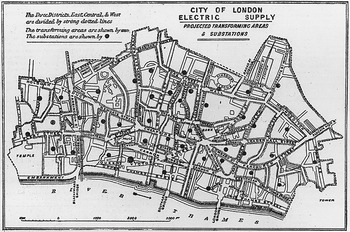
In 1894, Webber, the chief engineer, recalled this tedious, tortuous process. High-tension current was supplied from two generating plants to twenty-two transformer stations in the City itself, where the current was reduced and distributed via bitumen-coated secondary wires. These stations were squeezed into any available space, including two graveyards. Bones were relocated, and the lighting company agreed to pay an annual fee toward church services. Meanwhile, laying street conduits was a convoluted process. In early 1892, with a dearth of skilled foremen and a shortage of tubing for wires, the City streets were in a shambolic condition, with only a quarter of the distributing mains built. Webber spoke of the “inconvenience caused to the public by having 100 yards of footway ‘up’ in nearly thirty different places at one time.”Footnote 99 Beneath the pavements, he grappled with the logistics of threading mains between water pipes, cellars, gas mains, sewers, and telegraph wires. His manholes defied description: “owing to the obstruction underground, they are of every conceivable size and shape.”Footnote 100 Even fixing lampposts into the ground was compromised by uncertainty about what might be discovered there. Diagrams of subways, street boxes, and cross sections of roads (plate 7), and the overall map of the scheme (plate 8), functioned rhetorically rather than reflectively to connote a rational plan that in reality barely existed.
—Top, “Subway, Charterhouse Square, with Street Box,” Electrical Review (23 February 1894), p. 224. Reproduced with the permission of the Library of the University of California, Berkeley. Bottom, “Section of Road,” Electrical Review (23 February 1894), p. 224. Reproduced with the permission of the Library of the University of California, Berkeley.

—“Map of Whole City, Showing Transformer Points,” Electrical Review (23 February 1894), p. 226. Reproduced with the permission of the Library of the University of California, Berkeley.

The City authorities, and bankers, lawyers, and stockbrokers, forced to negotiate ripped-up streets, became exasperated. Gas leaked through abandoned pillars and standards; nocturnal revelers sometimes lit it from omnibuses. The light itself was described as “intermittent and unreliable.”Footnote 101 The lord mayor complained of its irregularities. In November 1894, faulty substation fuses caused a violent explosion that blew up part of the footway in Cannon Street, killing a horse. Incandescent lamps dimmed at peak times, owing to limited current. This was a fragile and delicate modernity, of gossamer threads rather than steel girders: “it does not require any great stretch of imagination to conjure up in one's mind such little affairs as possible bank robberies, &c., when these establishments have suddenly to fall back upon candles and ginger-beer bottles to contain the composite dips.”Footnote 102
Electric lighting networks, however local and limited, generated novel municipal safety issues. Early public installations were powered by overhead cables, frequently flimsy and criticized for being unsightly and hazardous, as wind and snow easily prompted their collapse. Following storms in 1887, the Electrician reported, “both in the City and at the West End great has been the destruction. Broken and bent telegraph posts on the roofs, wires rolled up and put away in corners, with ends hanging or tied round railings, are visible in all directions.”Footnote 103 The development of the electric chair in New York fueled anxieties about the clandestine circulation of deadly, imperceptible currents. The proliferation of airborne cables was legally tamed by the London Overhead Wires Act (1891), and almost all wires for electrical distribution were, by this time, being buried beneath the streets. Problems did not vanish, however. In 1895, it was reported that mysterious subterranean explosions “have occurred so frequently of late in London that the matter has been brought up in Parliament.”Footnote 104 The City of London Company appointed twelve men to inspect mains for corrosion, gas, or moisture. Even scientific reporters concurred that “there is at least some ground for the uneasiness with which one of its critics has expressed at the idea of ‘2500 volts grumbling in the cellar.’”Footnote 105
The visual conditions provided by electric light were often unsatisfactory. While incandescent lamps often dimmed, arc lighting could produce a stark, bluish glare. “Those who have experimented much with it and have used no means to protect their eyes,” noted the photographer T. C. Hepworth, “have reason to repent their negligence.”Footnote 106 Overlighting, therefore, was as problematic as faintness: floods of light were painful and unwelcome. Giant lanterns hanging above the City produced an unpleasant light and were obscured when fog descended. “To light a whole city with a huge electrical sun is a great scientific achievement,” commented the Electrician, “but it is not the sort of lighting that anybody wants, and if what is really needed can be had in another way, it is not to be supposed the public will patronise the more pretentious scheme out of compliment to science.”Footnote 107 The elongated shadows and visual disorientation associated with arc lights contrasted with the familiar glow of gas lamps, which produced a “great volume of light comparatively free from those highly refrangible and rapidly moving rays which irritate the visual organs, and render them to a certain degree insensitive.”Footnote 108 The invention of the brighter, cleaner gas mantle by Welsbach in 1886 stimulated a revival in the gas industry. Between 1875 and 1895, many gasworks doubled in capacity. In 1887, the Gas Light and Coke Company sold 16,788,208,000 cubic feet of gas. By 1896, this had risen to 20,116,000,000 cubic feet, partly because of increasing use of gas stoves and water heaters.Footnote 109 Neither did older light sources become extinct. In 1921, one electrical engineer admitted that “for domestic lighting, nothing can compare for comfort, beauty and efficiency with good candles.”Footnote 110 Multiple light forms were the metropolitan norm, therefore, for decades.
Conclusion: A Mangled Modernity
In 1895, the Engineer mocked the state of London's illumination: “The principal streets are lighted in a manner which astonishes the foreigner and incites the American to contemptuous scorn.”Footnote 111 Following the abandonment of Ferranti's plant in 1891, the metropolis had no central electricity stations, and lacked coordination of voltages and frequencies between its multitude of private and municipal systems. London would remain largely gaslit until the third and fourth decades of the twentieth century.Footnote 112 Similarly, the persistence of private slaughterhouses incensed reformers. In 1908, Ayling claimed that there were still 318: “in the twentieth century the private slaughterhouse still flourishes throughout the kingdom, with its attendant evils of danger to health… its haphazard method of inspection, and its enormous waste of valuable by-products. Not only are live animals driven or carted through the streets to the slaughter-houses, but carcases are conveyed in open vans, and blood and refuse pass through the sewers of the greatest city of the world.”Footnote 113
Reforming architects, sanitarians, and engineers, therefore, found much about which to complain. London, they argued, remained immune to system, pointing to the jumble of old and new, and the juxtaposition of dirty and clean. It had no central abattoirs or power stations to match those of Paris, New York, or Berlin, or, for that matter, Birkenhead, Carlisle, or Newcastle. Reformers blamed, among other things, administrative fragmentation, corporate inertia, vested interests, “bumbledom,” institutionalized parsimony, and obdurate landowners, for selfishly blocking technical progress. The dominant narrative of London's history invariably repeats this story of visionary modernizers thwarted by backwardness and antiquated structures.Footnote 114 This is surely too Whiggish. Simply because today's London is sanitized and electrified, all those for whom private slaughterhouses, cesspools, and candles appeared satisfactory in 1850 should not be dismissed as fools or monsters.
Revising this narrative involves nuancing our understanding of the operation of power, technology, and the body. In Britain, the dominant liberal practice of government was coy about direct intervention: society worked more “naturally” and “economically” that way. Hence, butchers defending their privacy or bus companies complaining about ceaseless main laying can hardly be castigated as “illiberal”; rather, their perspective illustrates how liberalism was a protean, plural arena for contestation, a restless space of debate about where government should stop and simply let things be. As more and more aspects of city life (water, air, nutrition, bodily proximity, animal keeping) became identified by doctors and social investigators as potentially problematic, the parameters of the debate expanded. The emergence of this pullulating domain of problems, existing outside the state but transcending the lives of individuals, which has been termed the “social,” is the broader epistemological and material context within which this concern about meat, blood, germs, smoke, and light crystallized.Footnote 115 This development was common to London, Paris, and Berlin. The form it took, of course, was shaped by the political, social, and physical structure of each city.Footnote 116
Technology was, and remains, a fundamental way of liberally governing the social. Tentacular networks of electric wires and water mains could subtly shape and normalize conduct, without any direct human interference, save for the occasional repairman or meter reader. They have, historically, sunk below the threshold of public consciousness, becoming part of the background of collective life. This essay has examined a time when they were not. Inhabitants of Victorian London were often acutely aware of how animals were slaughtered and frequently plunged into darkness when candles or oil burned out or fog descended. For those concerned with the social consequences of this, technology offered the possibility of eradicating blood from the streets and delivering illumination on demand. Closing slaughterhouses could promote more delicate sensibilities by freeing individuals from public displays of cruelty and secure more wholesome meat through better inspection. Electric light could allow detailed work to continue into the night and liberate lungs and eyes from noxious gases.
When historians accuse metropolitan politics of preventing the production of a clean, clear city, they overlook both the production of the social and the materiality of technical systems. They see negativity where there is a positive operation of power. The air, earth, and streets of London had to be persuaded to work with, rather than against, new technological systems, just like professional and political interests. The ensuing play of resistances and accommodations, to again borrow Pickering's language, produced enormous changes to the very substance of London that elude generalization. Modern technologies, to conclude, were neither purely resisted nor effortlessly installed: they were mangled.
This leaves, finally, the question of perception itself. What of the moral vision associated with the clean city, and the lucid vision associated with the electric city? The historical drift was toward deodorized space and hidden horror, sootless light and detailed vision. But the cleansing and clarifying of London took place in a piecemeal fashion: slaughterhouse by slaughterhouse, street by street. The ensuing environment, therefore, was peculiarly fractured and churned by the restless, grinding struggle between competing conceptions of how London should look and feel. Cleanliness sat alongside dirt, radiance fought murk. This fissured and bifurcated perceptual field characterized London's modernity.