INTRODUCTION
Inhibition is an important construct in current models of psychopathology (Barkley, Reference Barkley1997), neuropathology (Aron, Fletcher, Bullmore, Sahakian, & Robbins, Reference Aron, Fletcher, Bullmore, Sahakian and Robbins2003), and development (Harnishfeger & Pope, Reference Harnishfeger and Pope1996). Several forms and measures of inhibition have been studied (Schachar, Logan, Robaey, Chen, Ickowicz, & Barr, Reference Schachar, Logan, Robaey, Chen, Ickowicz and Barr2007), but response inhibition (hereafter referred to as inhibition) has been studied the most often, commonly using the Stop Signal Task (SST). Theoretical models have suggested that inhibition is a primary deficit in attention-deficit hyperactivity disorder (ADHD) (Barkley, Reference Barkley1997; Quay, Reference Quay1997). Accordingly, most attention in the literature on inhibition has been paid to ADHD. Recently, it has become apparent that other psychiatric disorders may share this deficit (Penades, Catalan, Rubia, Andres, Salamero, & Gasto, Reference Penades, Catalan, Rubia, Andres, Salamero and Gasto2007). However, previous SST meta-analyses have tended to focus either exclusively or predominantly on ADHD (e.g., Lijffijt, Kenemans, Verbaten, & van Engeland, Reference Lijffijt, Kenemans, Verbaten and van Engeland2005). As a result, the generality of deficient inhibition as measured by the SST has yet to be fully established.
Few meta-analyses dedicated to the SST have been published (Alderson, Rapport, & Kofler, Reference Alderson, Rapport and Kofler2007; Lijffijt et al., Reference Lijffijt, Kenemans, Verbaten and van Engeland2005; Oosterlaan, Logan, & Sergeant, Reference Oosterlaan, Logan and Sergeant1998). Oosterlaan et al. (Reference Oosterlaan, Logan and Sergeant1998) reviewed 8 studies published between 1990 and 1997. Four groups of patients were examined: children with ADHD, children with oppositional defiant disorder/conduct disorder (ODD/CD), children with anxiety disorder (ANX), and children with comorbid ADHD + ODD/CD. Children in all of the groups, with the exception of ANX, showed impaired inhibition. Lijffijt et al. (Reference Lijffijt, Kenemans, Verbaten and van Engeland2005) performed a meta-analysis of 29 studies from 1998 to 2004. They studied children and adults with ADHD and found both to have deficient inhibition. Finally, Alderson et al. (Reference Alderson, Rapport and Kofler2007) looked at 24 studies published between 1990 and 2004. Children with ADHD were assessed and their inhibition was reported to be impaired. Some limitations of these meta-analyses are that they: (a) were limited predominantly to ADHD; (b) did not take methodological quality of studies into account; and (c) failed to thoroughly check for publication bias, a phenomenon in which studies with significant results are more likely to be published than studies with non-significant results.
Since the most recent SST meta-analysis by Alderson et al. (Reference Alderson, Rapport and Kofler2007), the literature on psychopathology and inhibition has grown dramatically. A considerable number of studies are now available on ADHD and 10 other psychiatric disorders, including ANX, autism, major depressive disorder (MDD), ODD/CD, obsessive compulsive disorder (OCD), pathological gambling, reading disability (RD), schizophrenia (SCZ), substance dependence (cocaine and alcohol), and Tourette syndrome. We calculated effect sizes (ESs) to examine the magnitude of difference in SST performance between patients with each psychiatric disorder and healthy controls, which allowed us to determine the generality of deficient inhibition. In view of the high rate of comorbidity between ADHD and other psychiatric disorders (Biederman, Newcorn, & Sprich, Reference Biederman, Newcorn and Sprich1991), we also investigated inhibition in three comorbid ADHD groups: ANX + ADHD, ODD/CD + ADHD, and RD + ADHD. In addition, we considered the quality of studies and conducted a comprehensive assessment for publication bias.
The SST measures the ability to cancel an ongoing speeded motor response. This measure contrasts with the Go/No-Go Task, which measures response restraint (Schachar, Logan, et al., Reference Schachar, Logan, Robaey, Chen, Ickowicz and Barr2007). Inhibition has been found to activate the right inferior frontal gyrus (IFG) and related subcortical structures (Chevrier, Noseworthy, & Schachar, Reference Chevrier, Noseworthy and Schachar2007). Deficient inhibition is associated with decreased activation in these regions (Rubia, Smith, Brammer, Toone, & Taylor, Reference Rubia, Smith, Brammer, Toone and Taylor2005). In the SST, participants are required to respond as quickly and accurately as possible to a primary task stimulus, also referred to as the go stimulus. On a subset of trials, the go stimulus is followed by a stop signal, at which point, participants are required to inhibit their response to the go stimulus. The SST is based on the race-model, which purports that whether or not a particular response will be inhibited depends on the outcome of a race between two independent processes: the go process and the stop process (Schachar & Logan, Reference Schachar and Logan1990). If the stop process finishes first, the response will be inhibited, whereas if the go process finishes first, the response will be executed. The outcome of the race could be affected also by response variability. This meta-analysis considers three SST outcome variables: stop signal reaction time (SSRT), mean reaction time (MRT), and the within-subject standard deviation of reaction time (SDRT). SSRT provides an estimate of the latency of the inhibitory process, whereas MRT and SDRT reflect the latency and the variability in the latency of the go process, respectively. Lijffijt et al. (Reference Lijffijt, Kenemans, Verbaten and van Engeland2005) noted that SSRT was not disproportionately longer than MRT in children with ADHD, which suggested to them the absence of an inhibition deficit. We subjected this argument to closer scrutiny by examining the influence of MRT and SDRT on SSRT across the ADHD studies using meta-analytic methods.
Based on the results of the previously mentioned SST meta-analyses (Alderson et al., Reference Alderson, Rapport and Kofler2007; Lijffijt et al., Reference Lijffijt, Kenemans, Verbaten and van Engeland2005; Oosterlaan et al., Reference Oosterlaan, Logan and Sergeant1998), it is unclear whether deficient inhibition is unique to ADHD. The meta-analysis by Oosterlaan et al. (Reference Oosterlaan, Logan and Sergeant1998) suggested that children with ODD/CD also have an inhibition deficit. However, this result was variable and based on a small number of studies. A growing body of literature suggests that inhibition is not impaired in children with ODD/CD (Schachar, Mota, Logan, Tannock, & Klim, Reference Schachar, Mota, Logan, Tannock and Klim2000). Rubia et al. (Reference Rubia, Halari, Smith, Mohammed, Scott and Giampietro2008) found no significant differences in brain activation between children with ODD/CD and controls during successful inhibition. At the same time, recent studies have shown that impaired inhibition is present in other psychiatric disorders, especially in OCD (Penades et al., Reference Penades, Catalan, Rubia, Andres, Salamero and Gasto2007) and SCZ (Huddy, Aron, Harrison, Barnes, Robbins, & Joyce, Reference Huddy, Aron, Harrison, Barnes, Robbins and Joyce2008). Structural neuroimaging studies have reported that OCD and SCZ patients have abnormalities in brain regions implicated in inhibition (Suzuki et al., Reference Suzuki, Zhou, Takahashi, Hagino, Kawasaki and Niu2005; Yoo et al., Reference Yoo, Roh, Choi, Kang, Ha and Lee2008, respectively). Therefore, it is predicted that deficient inhibition will not be unique to ADHD. However, we do not expect that the deficit will be present in all of the disorders reviewed.
Taken together, this meta-analysis updates the literature on inhibition as measured by the SST, expands the systematic review to all disorders for which sufficient evidence is available, assesses the influence of comorbid ADHD on inhibition in patients with other psychiatric disorders, looks at the influence of response speed and variability on inhibition across the ADHD studies, estimates the impact of publication bias, and models study quality to determine whether published results are affected by the methodological rigor of studies.
METHOD
A literature search from 1966 to August 2009 was conducted using PubMed and PsycINFO electronic databases. The search terms used were “stop task”, “stop signal”, “response inhibition”, and “executive function” in combination with the terms “attention deficit hyperactivity disorder”, “ADHD”, “addiction”, “anxiety”, “autism”, “conduct disorder”, “dependence”, “depression”, “obsessive compulsive disorder”, “OCD”, “oppositional defiant disorder”, “reading disability”, “schizophrenia”, and “Tourette syndrome”. The titles, abstracts, and texts of the retrieved articles were scanned to determine eligibility. Studies included in previous meta-analyses of the SST were considered for inclusion in the present meta-analysis. We reviewed articles that met our inclusion criteria for further relevant references. Studies were identified by the first author and then confirmed by the second author.
Inclusion and Exclusion Criteria
Included studies were required to: (a) use the SST to measure inhibition; (b) have a healthy control group; (c) provide sufficient information for ES calculation (i.e., means and standards deviations or F/t values); (d) be written in English; and (e) be published in a peer-reviewed journal. Where studies had overlapping samples, only the study with the larger sample size was included (Rosenthal, Reference Rosenthal1991). The present meta-analysis included studies that used the Change Task, which is a modified version of the SST where participants shift to a secondary response once they have inhibited an ongoing response. The Change Task may yield longer SSRTs than simple stopping (Logan & Burkell, Reference Logan and Burkell1986), but this is unlikely to influence the magnitude of group differences (Bekker et al., Reference Bekker, Overtoom, Kenemans, Kooij, De Noord and Buitelaar2005).
We excluded studies for various reasons. Studies that provided feedback to participants were excluded because of the suspected effect of reward on inhibition (Slusarek, Velling, Bunk, & Eggers, Reference Slusarek, Velling, Bunk and Eggers2001). We did not include studies if they explicitly stated that participants were on stimulant medication at the time of testing. Also excluded were studies using atypical SST paradigms, such as the Selective SST because of the added stage of response selection. A list of excluded studies can be obtained from the authors.
ES Calculation and Data Extraction
Hedge’s g ES measure was used because it corrects for small sample sizes (Lipsey & Wilson, Reference Lipsey and Wilson2001). A positive ES indicates that the experimental group performed worse than the control group, whereas a negative ES indicates that the experimental group performed better. Cohen (Reference Cohen1992) classified ESs as small (0.2), medium (0.5), or large (0.8). To put these categories into perspective, a medium effect is one that can be seen by the naked eye of an attentive observer (Cohen, Reference Cohen1992). We also described ESs in terms of the percentage overlap between the experimental and control groups (Zakzanis, Reference Zakzanis2001). ESs of 0.2, 0.5, and 0.8 correspond to overlap percentages of 85.3, 66.6, and 52.6, respectively. A random-effects model was used to calculate weighted mean ESs (WMESs). Studies with standardized residuals greater than 2.5 were considered outliers and removed from the analysis (Lipsey & Wilson, Reference Lipsey and Wilson2001).
Heterogeneity was investigated using the Q-statistic (Lipsey & Wilson, Reference Lipsey and Wilson2001). A significant Q (p < .05) suggests that variability among ESs is not due to chance, and that moderator variables may be contributing to ES variability. However, a search for moderator variables was conducted irrespective of the result obtained from the Q-test, as recommended by Rosenthal (Reference Rosenthal1995). Potential sources of heterogeneity were first investigated using univariate weighted mixed-effects meta-regression analyses. Univariate analysis was also used to investigate the influence of MRT and SDRT on SSRT. We required a minimum of 10 studies to perform a meta-regression (Higgins & Green, Reference Higgins and Green2009). Variables found to be significant by univariate analysis were entered into a multivariate weighted mixed-effects meta-regression model. Analyses were performed with Comprehensive Meta Analysis software (Borenstein, Hedges, Higgins, & Rothstein, Reference Borenstein, Hedges, Higgins and Rothstein2005) and macros designed for SPSS (Lipsey & Wilson, Reference Lipsey and Wilson2001).
All studies were coded twice by the first author. As suggested by Lipsey and Wilson (Reference Lipsey and Wilson2001), the second coding was conducted on a separate occasion than, and without reference to, the first. Any discrepancies were resolved by consensus with the second author.
Moderators
Study characteristics
For all studies, the following variables were extracted: age (coded as 0 for studies where the mean age of patients was younger than 18 years and 1 for studies where the mean age was equal to or greater than 18 years), mean IQ of patients, and gender (coded as the percentage of male patients). With respect to the ADHD studies only, subtype was examined (coded as 0 for studies including combined subtype patients only and 1 for studies that included patients with both the combined and inattentive subtypes). We did not code for the hyperactive-impulsive subtype because few studies included patients with this form of ADHD.
Methodological study quality
Study quality was assessed using the approach of Rosenthal (Reference Rosenthal1995). The quality scale, which was designed for and applied to the ADHD studies only, consisted of five items. The first two items covered the pervasiveness of ADHD symptoms and the rigor of diagnostic procedures. For studies of children, item one determined whether symptom information was provided by a parent or caregiver, while item two determined whether the information was obtained from the classroom teacher. With respect to studies of adults, items one and two addressed whether symptom information was obtained from the patient and an informant (such as a spouse), respectively. We assigned 0.5 points to studies that used rating scales or questionnaires to gather symptom information and 1 point to studies using an interview either with or without rating scales or questionnaires. Item 3 evaluated the criteria used in making a diagnosis of ADHD. One point was allocated to studies that explicitly used Diagnostic and Statistical Manual of Mental Disorders (DSM)-III-R or -IV (American Psychiatric Association, 1987, 1994) criteria. Item 4 addressed the medication status of participants. Studies stating that participants were free of stimulant medication at the time of testing received one point. Item 5 covered the validity of task performance. We applied one point to studies that reported a mean go accuracy of at least 66% for both the ADHD and control groups, which indicates that participants understood the task requirements. Overall quality scores could range from 0 (low) to 5 (high).
Publication Bias
Funnel plots of ES against standard error were generated to visually check for publication bias (Light, Singer, & Willett, Reference Light, Singer, Willett, Cooper and Hedges1994). Asymmetry in the funnel plot is an indication of publication bias. The trim-and-fill method (Duval & Tweedie, Reference Duval and Tweedie2000) was applied to adjust for any bias.
RESULTS
The studies identified using our inclusion and exclusion criteria included a total of 5593 patients and 3654 controls.
Supplementary Material
To view the individual study characteristics and outcomes, please access an online-only supplementary appendix and refer to the first three tables. Visit journals.cambridge.org/INS, and then click on the link “Supplementary Material” for this article.
ES Analysis
SSRT
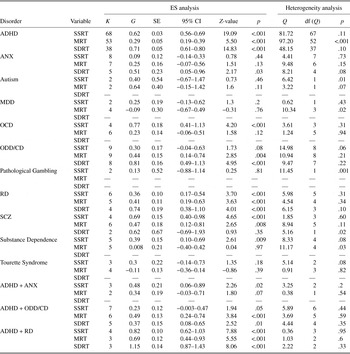
Table 1 presents the WMESs and homogeneity analysis by group and SST outcome variable. Before analysis, two outliers were omitted from ADHD (Gupta & Kar, Reference Gupta and Kar2009; Johnstone, Barry, & Clarke, Reference Johnstone, Barry and Clarke2007) and one from substance dependence (Fillmore & Rush, Reference Fillmore and Rush2002). Medium WMESs were found for ADHD (g = 0.62; p < .001), OCD (g = 0.77; p < .001), and SCZ (g = 0.69; p < .001), which correspond to overlap percentages of approximately 61.8, 52.6, and 57, respectively. This suggests that few disorders share an inhibition deficit of similar magnitude with ADHD. WMESs were small-to-medium or small for the other comparisons. Significant heterogeneity was observed for autism (p = .01) and pathological gambling (p = .001). We found a large WMES for ADHD + RD (g = 0.82; p < .001). WMESs were small-to-medium for the other two comorbid ADHD groups.
Weighted mean ESs and homogeneity analysis by group and SST outcome variable

Note
Dashes indicate that data were not reported. p < .05 was considered statistically significant. k = number of studies; g = Hedge’s ES; SE = standard error. See text for abbreviations.
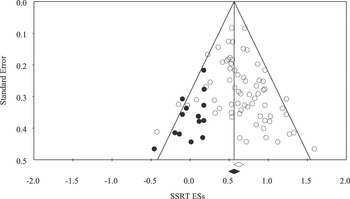
Visual inspection of funnel plots indicated possible publication bias for ADHD (see Figure 1), ANX, OCD, and ODD/CD. Applying the trim and fill method reduced WMESs from 0.62 to 0.56 (95% confidence interval [CI] = 0.49–0.63) for ADHD (see Figure 1), from 0.09 to 0.01 (95% CI = −0.20–0.22) for ANX, from 0.77 to 0.63 (95% CI = 0.27–1.00) for OCD, and from 0.30 to 0.12 (95% CI = −0.26–0.49) for ODD/CD. It is of interest that the WMES for ODD/CD was reduced from small-to-medium to small. Data were insufficient to assess publication bias for autism, MDD, or pathological gambling. There was also possible publication bias for ADHD + ODD/CD. The trim and fill method reduced the WMES from 0.23 to 0.12 (95% CI = −0.16–0.40). This is a notable reduction in WMES from small-to-medium to small.
Funnel plot of stop signal reaction time (SSRT) effect sizes (ESs) for the difference between attention-deficit hyperactivity disorder (ADHD) patients and controls. Open circles are original studies, whereas filled circles are imputed studies. Diamonds reflect ES estimates before (open) and after (filled) adjustment for publication bias.

SDRT
Before analysis, three outliers were removed from ADHD (Oosterlaan, & Sergeant, Reference Oosterlaan and Sergeant1998; Rubia, Taylor, Smith, Oksanen, Overmeyer, & Newman, Reference Rubia, Taylor, Smith, Oksanen, Overmeyer and Newman2001; Turner, Clark, Dowson, Robbins, & Sahakian, Reference Turner, Clark, Dowson, Robbins and Sahakian2004). WMESs were medium or large for ADHD (g = 0.71; p < .001), ANX (g = 0.51; p = .03), ODD/CD (g = 0.81; p < .001), RD (g = 0.74; p < .001), and SCZ (g = 0.62; p = .35), suggesting that a moderate or greater increase in response variability was present across disorders. There was significant heterogeneity only for SCZ (p = .02). Data were insufficient to calculate WMESs for autism, MDD, OCD, pathological gambling, substance dependence, and Tourette syndrome. ADHD + RD and ADHD + ODD/CD yielded large (g = 1.15; p < .001) and small-to-medium (g = 0.37; p = .01) WMESs, respectively. Insufficient data were available to calculate a WMES for ADHD + ANX.
Funnel plots suggested the possibility of some publication bias for ADHD. The trim and fill method reduced the WMES from 0.71 to 0.67 (95% CI = 0.57–0.77). Due to insufficient data, publication bias was not assessed for SCZ. There was also possible publication bias for ADHD + RD. The trim and fill method reduced the WMES from 1.15 to 1.00 (95% CI = 0.70–1.31).
MRT
Three outliers were omitted from ADHD before analysis (de Zeeuw et al., Reference de Zeeuw, Aarnoudse-Moens, Bijlhout, Konig, Post Uiterweer and Papanikolau2008; Liotti, Pliszka, Perez, Luus, Glahn, & Semrud-Clikeman, Reference Liotti, Pliszka, Perez, Luus, Glahn and Semrud-Clikeman2007; Oosterlaan & Sergeant, Reference Oosterlaan and Sergeant1998). A medium WMES was found for autism (g = 0.64; p = .11). All other comparisons produced small-to-medium or small WMESs. Heterogeneity was significant for ADHD (p < .001), substance dependence (p = .03), and MDD (p = .02). Data were inadequate to calculate a WMES for pathological gambling. WMESs were medium for ADHD + RD (g = 0.69; p < .001) and small-to-medium for the other two comorbid ADHD groups.
Funnel plots could not rule out the presence of some publication bias for ADHD and Tourette syndrome. After applying the trim and fill method, WMESs decreased from 0.29 to 0.25 (95% CI = 0.14–0.36) for ADHD and from −0.11 to −0.13 (95% CI = −0.37–0.11) for Tourette syndrome. Due to insufficient data, publication bias was not assessed for autism. There was also evidence of possible publication bias for ADHD + RD. The trim and fill method reduced the WMES from 0.69 to 0.60 (95% CI = 0.39–0.81). Data were insufficient to assess publication bias for ADHD + ANX.
Moderators
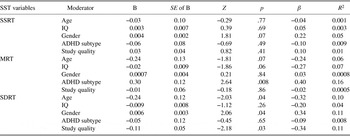
ADHD was the only group that had sufficient studies to conduct a meta-regression analysis. We investigated moderators of SSRT, SDRT, and MRT. Table 2 presents the results of the univariate meta-regression analyses. Gender was a borderline significant moderator of SSRT (β = 0.22; p = .07). Studies with a higher percentage of male ADHD patients had larger ESs. A significant moderator of SDRT was study quality (β = −0.34; p = .03). ESs decreased as the quality of ADHD studies increased. Age was also a significant moderator of SDRT (β = −0.32; p = .04). Adult ADHD studies produced smaller ESs than child ADHD studies. Another significant moderator of SDRT was gender (β = 0.34; p = .04). Studies with a greater proportion of male ADHD patients had larger ESs. We entered these three significant moderators of SDRT into a multivariate meta-regression analysis.
Supplementary Material
To view the multivariate meta-regression analysis for SDRT, please access an online-only supplementary appendix. Visit journals.cambridge.org/INS, and then click on the link “Supplementary Material” for this article.
Study quality remained a significant moderator of SDRT (β = −0.38; p = .01), whereas age and gender were no longer significant (for both, p > .10). A significant moderator of MRT was ADHD subtype (β = 0.40; p = .008). ADHD studies including patients with the combined and inattentive subtypes had larger ESs than studies consisting of patients with the combined subtype only. Age was a borderline significant moderator of MRT (β = −0.24; p = .07). Studies of adults with ADHD had smaller ESs than studies of children with ADHD. Another borderline significant moderator of MRT was IQ (β = −0.27; p = .06). Studies including ADHD patients with higher IQ scores yielded smaller ESs.
Univariate meta-regression analyses across the ADHD studies

Note
p < .05 was considered statistically significant. IQ = intelligence quotient; B = unstandardized regression coefficient; SE = standard error of unstandardized regression coefficient; β = standardized regression coefficient; R 2 = proportion of explained variance; ADHD = attention-deficit hyperactivity disorder; SST = Stop Signal Task; SSRT = stop signal reaction time; MRT = mean reaction time; SDRT = standard deviation of reaction time.
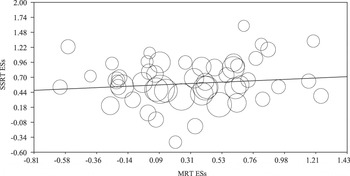
We also examined the influence of SDRT and MRT on SSRT ESs across the ADHD studies. No significant relationship was found between ESs for SSRT and those for SDRT (β = 0.22; p = .17) or MRT (β = 0.13; p = .35; Figure 2), which indicates that a deficit in SSRT is not readily attributable to a deficit in SDRT or MRT.
Weighted mixed-effects meta-regression of stop signal reaction time (SSRT) on mean reaction time (MRT) effect sizes (ESs) across the attention-deficit hyperactivity disorder (ADHD) studies.

DISCUSSION
We examined inhibition, response variability, and processing speed in ADHD and ten other psychiatric conditions, as well as three comorbid ADHD groups. We will first consider the results for inhibition. Consistent with previous SST meta-analyses (Alderson et al., Reference Alderson, Rapport and Kofler2007; Lijffijt et al., Reference Lijffijt, Kenemans, Verbaten and van Engeland2005; Oosterlaan et al., Reference Oosterlaan, Logan and Sergeant1998), we confirmed that ADHD patients showed a medium SSRT deficit, supporting prior research indicating that inhibition is impaired in ADHD (Barkley, Reference Barkley1997; Quay, Reference Quay1997). An SSRT deficit of comparable magnitude was also found in OCD and SCZ, suggesting that deficient inhibition is not unique to ADHD. It is possible that ADHD, OCD, and SCZ may share a dysfunction in the neural mechanism of inhibition. Adjusting for publication bias did not substantially affect the inhibition results for ADHD, OCD, or SCZ. ADHD was the only group that included sufficient studies to conduct a search for moderator variables. Although no significant moderators emerged, results showed that male ADHD patients had borderline significantly longer SSRTs than female patients, which agrees with previous research indicating that males with ADHD are more symptomatic than females with ADHD (Gershon, Reference Gershon2002). The presence of comorbid ADHD differentially affected inhibition in patients with ANX, ODD/CD, and RD, as will be discussed in more detail later.
Patients in the autism, MDD, RD, substance dependence, and Tourette syndrome groups had small-to-medium SSRT deficits, suggesting that deficient inhibition is less likely to be at the core of these disorders. Inspection of individual study ESs suggested that adults in the MDD and Tourette syndrome groups had greater SSRT deficits than children. Individual study ESs further indicated that patients with cocaine dependence had more impaired SSRTs than patients with alcohol dependence. The autism result was found to be heterogeneous. Of the two studies in the autism group, one excluded patients with ADHD and yielded a small negative SSRT ES (Ozonoff & Strayer, Reference Ozonoff and Strayer1997), whereas the other included some patients with comorbid ADHD and yielded a large positive SSRT ES (Verte, Geurts, Roeyers, Oosterlaan, & Sergeant, Reference Verte, Geurts, Roeyers, Oosterlaan and Sergeant2005). This suggests that the autism result was influenced by the presence of comorbid ADHD.
Patients in the ANX, ODD/CD, and pathological gambling groups showed small SSRT deficits. Adjusting for publication bias reduced the SSRT WMES for ODD/CD from small-to-medium to small. This result differs from that of Oosterlaan et al. (Reference Oosterlaan, Logan and Sergeant1998), who reported a medium difference in SSRT between ODD/CD children and controls. However, the result by Oosterlaan et al. was based on a small number of studies. The two studies in the pathological gambling group showed heterogeneity. One study provided data on a group of patients without comorbid ADHD and yielded a small-to-medium negative SSRT ES (Rodriguez-Jimenez et al., Reference Rodriguez-Jimenez, Avila, Jimenez-Arriero, Ponce, Monasor and Jimenez2006). The other study included some patients with comorbid ADHD and yielded a medium positive SSRT ES (Goudriaan, Oosterlaan, de Beurs, & van den Brink, Reference Goudriaan, Oosterlaan, de Beurs and van den Brink2006). This suggests that ADHD comorbidity influenced the pathological gambling result. Our ANX result was comparable to that of the Oosterlaan et al. meta-analysis.
This meta-analysis also investigated response variability and processing speed. Slower and more variable responding has been commonly reported in studies of ADHD (Alderson et al., Reference Alderson, Rapport and Kofler2007; Lijffijt et al., Reference Lijffijt, Kenemans, Verbaten and van Engeland2005). Several explanations have been proposed to account for this style of responding, such as inattention (Lijffijt et al., Reference Lijffijt, Kenemans, Verbaten and van Engeland2005), a non-optimal activation state (Kuntsi, Oosterlaan, & Stevenson, Reference Kuntsi, Oosterlaan and Stevenson2001), and/or a time perception deficit (Paule et al., Reference Paule, Rowland, Ferguson, Chelonis, Tannock and Swanson2000). Abnormalities in white matter tracts connecting the prefrontal cortex, parietal lobe, and cerebellum are thought to underlie the deficit (Ghajar & Ivry, Reference Ghajar and Ivry2008).
Patients in all groups with sufficient studies for meta-analysis had at least moderately increased response variability, which suggests that high response variability is a non-specific marker of psychopathology, rather than a deficit that is unique to a single disorder or group of disorders. The medium SDRT deficit in ADHD agrees with the meta-analyses of Alderson et al. (Reference Alderson, Rapport and Kofler2007) and Lijffijt et al. (Reference Lijffijt, Kenemans, Verbaten and van Engeland2005). Yet, results indicated that ADHD studies of lower quality significantly overestimated the difference in SDRT between ADHD patients and controls, suggesting that response times may not actually be as variable as reported in the literature. Results further suggested that males with ADHD had significantly more variable response times than females with ADHD, supporting previous research showing that ADHD females have less impaired attention than ADHD males (Gershon, Reference Gershon2002). We also noted that adults with ADHD had significantly less variable response times relative to children with ADHD, which complements research by Johnstone, Dimoska, et al. (Reference Johnstone, Dimoska, Smith, Barry, Pleffer and Chiswick2007) that response variability decreases with increasing age in children. However, age and gender did not reach significance as moderators of SDRT in the multivariate analysis.
MRT tended to be less impaired than SDRT across groups. Autism had a medium MRT deficit, but this result was borderline heterogeneous. Patients in most other groups, including ADHD, had small-to-medium deficits in MRT. The ADHD result is consistent with the meta-analyses of Alderson et al. (Reference Alderson, Rapport and Kofler2007), Lijffijt et al. (Reference Lijffijt, Kenemans, Verbaten and van Engeland2005), and Oosterlaan et al. (Reference Oosterlaan, Logan and Sergeant1998). MDD, substance dependence, and Tourette syndrome showed no deficits in MRT. However, the MDD and substance dependence results showed heterogeneity. Results revealed that ADHD studies including patients with both the combined and inattentive subtypes had significantly larger MRT ESs than studies of patients with the combined subtype only, which is in accordance with previous research suggesting that ADHD children with the inattentive subtype have slower processing speed than ADHD children with the combined subtype (Solanto et al., Reference Solanto, Gilbert, Raj, Zhu, Pope-Boyd and Stepak2007). We also found that adults with ADHD had borderline significantly less impairment in MRT than children with ADHD, which is in line with Williams, Ponesse, Schachar, Logan, and Tannock (Reference Williams, Ponesse, Schachar, Logan and Tannock1999), who reported that response times become faster with increasing age in children. We further observed that ADHD patients with higher IQs had borderline significantly faster MRTs, supporting research showing a relationship between choice reaction time and IQ (Luciano et al., Reference Luciano, Wright, Smith, Geffen, Geffen and Martin2001).
Previous meta-analyses concluded that ADHD patients did not have an inhibition deficit on the grounds that SSRT was not found to be disproportionately longer than MRT (Alderson et al., Reference Alderson, Rapport and Kofler2007; Lijffijt et al., Reference Lijffijt, Kenemans, Verbaten and van Engeland2005). However, this reasoning does not consider the possibility that ADHD may be associated with both slower responding and deficient inhibition without the former explaining the latter. We addressed this issue by examining the influence of MRT and SDRT on SSRT across the ADHD studies. Results showed no significant relationship between ADHD studies with prolonged SSRTs and those with longer or more variable MRTs. Consequently, an SSRT deficit in patients with ADHD cannot be readily explained by a deficit in either MRT or SDRT. Most studies indicate that going and stopping are independent (Verbruggen & Logan, Reference Verbruggen and Logan2009), have distinct developmental courses (Williams et al., Reference Williams, Ponesse, Schachar, Logan and Tannock1999) and exhibit unique patterns of neural activity as measured by single cell recordings (Verbruggen & Logan, Reference Verbruggen and Logan2009).
Results suggest that ADHD comorbidity introduces a potential confound into studies of other psychiatric disorders using the SST. Relative to the ADHD and RD groups, ADHD + RD had greater deficits in the three SST variables, raising the possibility that ADHD + RD may be associated with more severe ADHD symptomatology than ADHD alone. ADHD + ODD/CD had an SSRT deficit that was similar to that of ODD/CD after taking publication bias into account, but smaller than that of ADHD alone. The SDRT deficit in ADHD + ODD/CD was smaller than that of both the ADHD and ODD/CD groups. It may be that, in some cases, ODD/CD produces a symptomatic phenocopy of ADHD without the underlying cognitive deficits that are typical of ADHD (Schachar et al., Reference Schachar, Mota, Logan, Tannock and Klim2000). A complementary explanation relates to the finding by Schachar, Sandberg, & Rutter (Reference Schachar, Sandberg and Rutter1986) that children behaving in an oppositional, defiant and aggressive manner may sometimes be incorrectly judged as restless, inattentive and impulsive. ADHD + ANX had an SSRT deficit that was greater than that of ANX, but slightly less than that of ADHD, suggesting that a phenocopy of ADHD may arise in the presence of ANX. These findings confirm the importance of controlling for comorbid ADHD in studies of other psychiatric disorders, but do not establish the mechanism of comorbidity between ADHD and any other disorder.
Some limitations of this meta-analysis should be noted. Several of the studies investigating psychiatric disorders other than ADHD included patients on non-stimulant medications at the time of testing, possibly confounding the difference in SSRT between patients and controls. However, the impact of many medications on inhibition is unclear. Another limitation is the relatively small number of studies in the non-ADHD groups. There is also the issue that most of the studies in the OCD and SCZ groups, and all studies in the pathological gambling and substance abuse groups, included adult participants only, thereby limiting the generalizability of our results with regard to these particular disorders.
Some recommendations for future research can be made. Considering that a relatively small number of studies have been published on patients with psychiatric disorders other than ADHD using the SST, inhibition should be examined more extensively in these patient groups to increase the robustness of the results. Moreover, studies on non-ADHD patient groups should control for the use of medication, given its possible impact on inhibition. It would also be useful for future meta-analyses of the SST to expand the content of the quality assessment instrument, which may increase our understanding of the relationship between study quality and the results.
This meta-analysis provided critical insight into inhibition as measured by the SST and psychopathology. First, we showed that an inhibition deficit is not unique to ADHD, but is also found in OCD and SCZ. On the other hand, deficient inhibition is not a general characteristic of psychopathology because we did not observe such a deficit in most of the disorders reviewed. The fact that approximately 50 to 60% of patients with ADHD, OCD, and SCZ had SSRTs that overlapped with those of controls suggests that the SST does not meet the sensitivity criteria of a diagnostic measure (Zakzanis, Reference Zakzanis2001). At the same time, ADHD and other neuropsychiatric disorders are thought to be heterogeneous conditions. A better understanding of deficient inhibition may aid in dissecting this etiological heterogeneity. Second, results pointed to the need of taking into account the influence of comorbid ADHD on inhibition. In many cases, comorbid ADHD worsened inhibition in patients with other psychiatric disorders. Finally, we established the importance of testing and adjusting for publication bias. Although this meta-analysis suggests that deficient inhibition plays a role in OCD and SCZ, more studies are needed to confirm the presence of a deficit. If a common cognitive deficit can be firmly established across these disorders, it would be informative to compare the physiological basis of the deficit using functional neuroimaging.
ACKNOWLEDGMENTS
This work was part of the first author’s Master’s thesis in the Institute of Medical Science at the University of Toronto. The first author was funded by a Restracomp Studentship from The Hospital for Sick Children and a Frederick Banting and Charles Best Canada Graduate Scholarship from the Canadian Institutes of Health Research (CIHR). The second author was funded by CIHR grants MOP-64277, MOP-44070, and MOP-74699.