Child maltreatment represents a serious dysfunction in parenting, as well as a substantial disturbance in parent–child relationships that may eventuate in aberrant biological and psychological development and child maladaptation across the life span (Belsky & Jaffee, Reference Belsky, Jaffee, Cicchetti and Cohen2006; Cicchetti & Toth, in press; DeBellis, Reference DeBellis2001, Reference DeBellis2005). In addition, experiences of child abuse and neglect may present serious challenges to the species-typical organism–environment “coactions” that play important roles in the emergence and timing of normal developmental processes (Cicchetti & Lynch, Reference Cicchetti, Lynch, Cicchetti and Cohen1995; Cicchetti & Valentino, Reference Cicchetti, Valentino, Cicchetti and Cohen2006).
Through scientific investigations of the effects of severe environmental disturbances, such as child maltreatment, researchers may be able to gain insight into processes that normally are so subtle and gradual that they are not observed (Chomsky, Reference Chomsky1968). For example, by examining the development of children who have not experienced a benign rearing environment, such as is the case with children who have been abused and/or neglected, researchers may be able to elucidate the impact that caregiving quality can exert on neurobiological structure and function (Belsky & de Haan, Reference Belsky and de Haan2011; Cicchetti, Reference Cicchetti1996, Reference Cicchetti, Hartup and Weinberg2002a, Reference Cicchetti2002b; Cowell, Cicchetti, Rogosch, & Toth, in press; McCrory, De Brito, & Viding, Reference McCrory, De Brito and Viding2010).
Child maltreatment ushers in motion a probabilistic cascade of epigenesis for abused and neglected children that often eventuates in a profile of relatively enduring vulnerability factors that increase the probability of the emergence of maladaptation and psychopathology (Cicchetti & Lynch, Reference Cicchetti, Lynch, Cicchetti and Cohen1995; Cicchetti & Toth, in press; Manly, Kim, Rogosch, & Cicchetti, Reference Manly, Kim, Rogosch and Cicchetti2001; Rogosch, Cicchetti, & Aber, Reference Rogosch, Cicchetti and Aber1995; Toth, Cicchetti, Macfie, & Emde, Reference Toth, Cicchetti, Macfie and Emde1997; Widom, Dumont, & Cjaza, Reference Widom, DuMont and Czaja2007). Among the personality disorders, borderline personality disorder (BPD) has been examined extensively with regard to the role that adverse childhood experiences play in its etiology, course, and pathogenesis (Fonagy & Luyten, in press; Lenzenweger & Cicchetti, Reference Lenzenweger and Cicchetti2005). Given that personality disorders do not emerge de novo at 18 years of age, the cutoff criterion established in the psychiatric nomenclature, some researchers have adapted a developmental psychopathology approach by seeking to identify early precursors, prodromal signs, and processes that confer vulnerability to later personality pathology (Cicchetti, Reference Cicchetti2014; Cicchetti & Crick, Reference Cicchetti and Crick2009a, Reference Cicchetti and Crick2009b; Tackett, Balsis, Otlmanns, & Krueger, Reference Tackett, Balsis, Oltmanns and Krueger2009). The discovery of precursors and prodromes that could later coalesce into BPD would contribute to its identification and pave the way for the implementation of early interventions that are developmentally appropriate as well as timed and guided (Fonagy & Luyten, in press; Lenzenweger & Cicchetti, Reference Lenzenweger and Cicchetti2005; Toth, Gravener-Davis, Guild, & Cicchetti, Reference Toth, Gravener-Davis, Guild and Cicchetti2013).
BPD is characterized by features of affective instability and dysregulation, impulsivity, dysfunctional interpersonal relationships with parents and peers, identity problems, and anomalies in self-system processes. (American Psychiatric Association, 2000; Fonagy & Luyten, in press). In general, research conducted with patients with BPD indicates that they report higher rates of maltreatment during their childhoods than is the case with patients who have other personality disorders or Axis I psychiatric disorders (Johnson, Cohen, Brown, Smailes, & Bernstein, Reference Johnson, Cohen, Brown, Smailes and Bernstein1999; Zanarini et al., Reference Zanarini, Williams, Lewis, Reich, Vera and Marino1997). A major limitation of the research implicating child abuse and neglect in the etiology, course, and sequelae of BPD (as well as in other personality disorders) is that the majority of the work has been retrospective in nature and hence must be interpreted with caution (Lenzenweger & Cicchetti, Reference Lenzenweger and Cicchetti2005).
The investigation of maltreated children provides an invaluable opportunity to examine the precursors and pathways to BPD. Abused and/or neglected children manifest functioning deficits in a number of areas that reveal problems associated with BPD. These include maladaptive personality and temperament profiles, relationship disturbances, self-pathology, emotion dysregulation, and increased self-harm and suicidality (Bradley et al., Reference Bradley, Westen, Mercer, Binder, Jovanovic and Crain2011; Cicchetti & Toth, in press; Dube et al., Reference Dube, Anda, Felitti, Chapman, Williamson and Giles2001; Evans, Hawton, & Rodham, Reference Evans, Hawton and Rodham2005; Johnson et al., Reference Johnson, Cohen, Gould, Kasen, Brown and Brook2002; Rogosch & Cicchetti, Reference Rogosch and Cicchetti2004).
In efforts to overcome the limitation of extant research on the role that the adverse early experiences of child maltreatment play in the etiology, precursors, and pathways to BPD, prospective research with school-age maltreated and nonmaltreated children has begun to be conducted in our laboratory. Rogosch and Cicchetti (Reference Rogosch and Cicchetti2005) investigated potential precursors to BPD in a sample comprising 185 maltreated and 175 nonmaltreated children of school age who had attended a weeklong research summer day camp. Self-report, peer-report, and counselor-report measures were utilized to assess developmental constructs conceptualized to constitute vulnerability for later emerging BPD. Personality features; representational models of self, parent, and peers; interpersonal relationship difficulties with peers and adults; suicidal/self-harm behavior; and lability/negativity were among the areas included to develop a BPD precursors composite. In addition, the efficiency of three independent attentional networks (alerting, orienting, and conflict) was assessed using a computerized task (Fan, McCandliss, Sommer, Raz, & Posner, Reference Fan, McCandliss, Sommer, Raz and Posner2002; Rueda et al., Reference Rueda, Fan, McCandliss, Halparin, Gruber and Lercari2004). Maltreated children had higher scores on the BPD precursors composite than did the nonmaltreated comparison children; moreover, children identified as having higher levels of these precursors were more prevalent in the maltreatment group. No differences were found between maltreated and nonmaltreated children for the efficiency of the three attention networks; however, children with high levels of BPD precursors, regardless of group status, evinced less efficient processing of the conflict attention network, comparable to findings observed among adult psychiatric patients with BPD. Child maltreatment and efficiency of the conflict attention network independently predicted scores on the BPD precursors composite.
Crick, Murray-Close, and Woods (Reference Crick, Murray-Close and Woods2005) developed the Borderline Personality Features Scale for Children (BPFS-C), a youth self-report questionnaire that was adapted and modified from the Personality Assessment Inventory (PAI; Morey, Reference Morey1991). The PAI is used to assess borderline pathology among adults. Hecht, Cicchetti, Rogosch, & Crick (Reference Hecht, Cicchetti, Rogosch and Crick2014) administered the BPFS-C to a large sample of maltreated (N = 314) and nonmaltreated (N = 285) children. Hecht et al. (Reference Hecht, Cicchetti, Rogosch and Crick2014) found that maltreated children reported higher overall borderline feature scores, higher scores on each of the four subscales of the BPFS-C (i.e., affective instability, identity problems, negative relationship, and self-harm), and were more likely to be identified as at high risk for the development of BPD through exhibiting raised scores on each of the four BPFS-C subscales. In addition, maltreatment parameters were examined from coding of Department of Human Services (DHS) records (Manly, Reference Manly2005). Chronicity, defined as the number of developmental periods during which a child experienced maltreatment, predicted higher overall borderline feature scores on the BPFS-C. In addition, children who experienced early onset and also recent maltreatment were significantly more likely to be included in the high-risk for BPD group.
In this study, we strove to demonstrate how the self-report measure of borderline personality disorder features for children developed by Crick et al. (Reference Crick, Murray-Close and Woods2005) corresponds to a theoretically and developmentally informed borderline features composite comprising self-report, parent-report, and counselor-report measures. If it is found that the BPFS-C (Crick et al., Reference Crick, Murray-Close and Woods2005) and the composite of borderline features are significantly related, then this would provide further validation of the BPFS-C as a potential self-report measure of childhood borderline pathology.
In addition to the multi-informant composite of borderline personality features and the self-report BPFS-C, we included two candidate genes, the oxytocin receptor gene (OXTR) and the FK506 binding protein 5 gene (FKBP5), in order to facilitate the understanding of any of the variation in BPD features observed among maltreated children.
The human genotype has a single OXTR gene that is located on chromosome 3p 25, spans17 kb, and contains three introns and four exons (Inoue et al., Reference Inoue, Kimura, Azuma, Inazawa, Takemura and Kikuchi1994). The gene encodes a 391-amino acid protein that belongs to the class I G-protein-coupled receptor family. Among their presence in other systems of the body, oxytocin receptors also are present in the central nervous system (Gimpl & Fahrenholz, Reference Gimpl and Fahrenholz2001). These receptors modulate a diversity of behaviors, including stress and anxiety, attachment, affiliation, and aggression.
Variation in OXTR function also is related to social behavior. For example, the distribution of oxytocin receptors across the rodent brain is related to the social organization of a species (Insel & Shapiro, Reference Insel and Shapiro1992), as well as to natural variations in maternal care behavior that are eliminated by oxytocin receptor antagonists (Champagne, Diorio, Sharma, & Meaney, Reference Champagne, Diorio, Sharma and Meaney2001). In addition to its relation to variation in social behavior, attachment, affiliation, and aggression, the OXTR genotype appears to play differential roles under high and low distress conditions. (Hostinar, Cicchetti, & Rogosch, Reference Hostinar, Cicchetti and Rogosch2014). Given the relation of these diverse behaviors to borderline personality features, we chose OXTR as one of the candidate genes examined to explain variation in borderline symptoms.
Genes that are implicated in the stress-response system have been targets for research examining the impact of child maltreatment on psychiatric functioning (Dackis, Rogosch, Oshri, & Cicchetti, Reference Dackis, Rogosch, Oshri and Cicchetti2012; Koenen, Armstadter, & Nugent, Reference Koenen, Amstadter and Nugent2009; Koenen et al., Reference Koenen, Saxe, Purcell, Smoller, Bartholomew and Miller2005). The FKBP5 gene is involved in regulating the sensitivity and binding affinity of the glucocorticoid receptor and therefore has significant implications within the limbic system. FKBP5 is induced by cortisol and acts within a negative feedback loop to promote the transcription of stress-response target genes, leading to downstream release of adrenocorticotropic hormone and plasma cortisol. Environmental stress is strongly related to differential functioning and regulation of FKBP5 at the glucocorticoid receptor level (Dackis et al., Reference Dackis, Rogosch, Oshri and Cicchetti2012). Given that FKBP5 plays a critical role in the pathogenesis of stress-related psychopathology, we included FKBP5 as another candidate gene with the potential of expanding understanding of variation in borderline features.
Finally, gender considerations also were thought to be important determinants of variation in borderline symptoms in BPFS-C. Crick et al. (Reference Crick, Murray-Close and Woods2005) have found borderline features to be more common in girls. Among 11-year-olds meeting criteria for BPD, girls have been found more likely than boys to have mood reactivity, profound abandonment concerns, and unstable relationships, whereas boys were more likely than girls to engage in physically destructive acts and other forms of impulsivity (Zanarini et al., Reference Zanarini, Horwood, Wolke, Waylen, Fitzmaurice and Grant2011). It is important to examine both male and female children in interaction with maltreatment status and the candidate genes chosen for inclusion in this study because these genes may contribute differentially to variation in BPFS-C scores for males and females.
Hypotheses
This study is guided by the following hypotheses:
-
1. Children who exhibit higher mean scores on the BPFS-C will have high levels on adult-, peer-, and self-report indicators of the BPD precursors composite.
-
2. OXTR genotype variants will interact with child maltreatment status and gender in relation to BPFS-C scores. Females will exhibit a different pattern of Gene × Environment interaction (G × E) than will males.
-
3. FKBP5 haplotype will interact with child maltreatment status and gender in relation to BPFS-C scores. Males and females will exhibit different patterns of G × E.
-
4. Separate interactions of OXTR, child maltreatment status, and gender and FKBP5 haplotype, maltreatment status, and gender will contribute independently to BPFS-C scores.
Method
Participants
The participants in this investigation included 1,051 children aged 8 to 12 (M age = 10.37, SD = 1.30) who attended a summer camp research program designed for school-aged low-income children. Assessments were conducted during the summers of 2004–2007 and 2009–2012. The sample included both maltreated children (n = 562) and nonmaltreated children (n = 489). Among the participants, 50.2% were girls. The maltreated and nonmaltreated samples were comparable in terms of gender and age. The Add Health system for coding race and ethnicity was used (http://www.cpc.unc.edu/projects/addhealth/data/code/race; cf. DeYoung et al., Reference DeYoung, Cicchetti, Rogosch, Gray, Eastman and Grigorenko2011). We determined that 61.2% of the sample was African American, 10.4% was European American, 19.7% was Hispanic, and 8.7% was from other or multiracial/multiethnic groups. The families of the children were low income, with 98.3% of the families having a history of receiving welfare benefits. Single mothers headed 75.5% of the families.
Recruitment and classification procedures
Parents of all maltreated and nonmaltreated children provided informed consent for their child's participation, as well as consent for examination of any DHS records pertaining to the family. Children in the maltreated group had been identified by the county DHS as having experienced child abuse and/or neglect, and the sample was representative of the children in families receiving services from DHS. A recruitment liaison from DHS contacted eligible maltreating families, explained the study, and if parents were interested, then their names were released to the project team for recruitment. Families were free to choose whether or not to participate. Comprehensive searches of DHS records were completed, and maltreatment information was coded utilizing operational criteria from maltreatment nosology specified in the Maltreatment Classification System (MCS; Barnett, Manly, & Cicchetti, Reference Barnett, Manly, Cicchetti, Cicchetti and Toth1993), as discussed below.
Consistent with national demographic characteristics of maltreating families (National Incidence Study; Sedlak et al., Reference Sedlak, Mettenburg, Basena, Petta, McPherson and Greene2010), the maltreated children were predominantly from low socioeconomic status families. Consequently, demographically comparable nonmaltreated children were recruited from families receiving Temporary Assistance for Needy Families. A DHS recruitment liaison contacted eligible nonmaltreating families, described the project, and if interested, parents signed a release for their names to be given to the project for recruitment. DHS record searches were completed for these families to verify the absence of any record of child maltreatment. Trained research assistants also interviewed mothers of children recruited for the nonmaltreatment group to confirm a lack of DHS involvement and prior maltreatment experiences utilizing the Maternal Maltreatment Classification Interview (Cicchetti, Toth, & Manly, Reference Cicchetti, Toth and Manly2003). Record searches were conducted in the year following camp attendance to verify that all available information had been accessed. Only children from families without any history of documented abuse or neglect were retained in the nonmaltreatment group. In addition, families who had received preventive services through DHS owing to concerns over risk for maltreatment were excluded from the sample to reduce the potential for unidentified maltreatment existing within this group.
The MCS is a reliable and valid method for classifying maltreatment (Bolger, Patterson, & Kupersmidt, Reference Bolger, Patterson and Kupersmidt1998; English et al., Reference English, Upadhyaya, Litrownik, Marshall, Runyan and Graham2005; Manly, Reference Manly2005) that utilizes DHS records detailing investigations and findings involving maltreatment in identified families over time. Rather than relying on official designations and case dispositions, the MCS codes all available information from DHS records, making independent determinations of maltreatment experiences. Based on operational criteria, the MCS designates all the subtypes of maltreatment children have experienced (i.e., neglect, emotional maltreatment, physical abuse, and sexual abuse). Coding of DHS records was conducted by trained research assistants, doctoral students, and clinical psychologists. Coders were required to meet acceptable reliability with criterion standards before coding actual records for the study. Coders demonstrated acceptable reliability with the criterion (weighted κs with the criterion ranging from .86 to .98. Reliabilities (κs) for the presence versus absence of maltreatment subtypes ranged from .90 to 1.00.
In terms of the subtypes of maltreatment, neglect involves failure to provide for the child's basic physical needs for adequate food, clothing, shelter, and medical treatment. In addition to inadequate attention to physical needs, forms of this subtype include lack of supervision, moral–legal neglect, and education neglect. Emotional maltreatment involves extreme thwarting of children's basic emotional needs for psychological safety and security, acceptance and self-esteem, and age-appropriate autonomy. Examples of emotional maltreatment of increasing severity include belittling and ridiculing the child, extreme negativity and hostility, exposure to severe marital violence, abandoning the child, and suicidal or homicidal threats. Physical abuse involves the nonaccidental infliction of physical injury on the child (e.g., bruises, welts, burns, choking, or broken bones). Injuries range from minor and temporary to permanently disfiguring. Finally, sexual abuse involves attempted or actual sexual contact between the child and caregiver for purposes of the caregiver's sexual satisfaction or financial benefit. Events range from exposure to pornography or adult sexual activity, to sexual touching and fondling, to forced intercourse with the child.
Children in the maltreatment group all had documented histories of abuse and/or neglect. Among the maltreated children, 79.7% had experienced neglect, 58.9% had experienced emotional maltreatment, 29.2% had experienced physical abuse, and 8.7% had experienced sexual abuse. As is typical in maltreated populations (Bolger et al., Reference Bolger, Patterson and Kupersmidt1998; Manly, Cicchetti, & Barnett, Reference Manly, Cicchetti and Barnett1994; Manly et al., Reference Manly, Kim, Rogosch and Cicchetti2001), the majority of children had experienced multiple subtypes of maltreatment. Specifically, 58.7% of the maltreated children had experienced two or more maltreatment subtypes. Among maltreated children, we derived a variable to characterize maltreatment subtype experiences. Given the overlap among subtypes and the relatively lower rates of physical and sexual abuse as compared to neglect and emotional maltreatment, we identified children who had experienced emotional maltreatment and/or neglect (EMPN; 63.1%) without physical or sexual abuse versus children who had experienced physical and/or sexual abuse (PASA; 36.9%). The PASA group also may have experienced neglect or emotional maltreatment.
The MCS also determines when in the course of development maltreatment events occurred, providing indices of developmental timing. Events were coded as occurring during five developmental periods, including infancy (0–18 months), toddlerhood (19–36 months), preschool (36–59 months), early school age (ages 5 to 7), and later school age (age 8 to 12). The timing information allows for the determination of whether maltreatment occurred within each of the developmental periods. The developmental periods of onset of maltreatment and the recency of maltreatment are determined. In the current investigation, we classified maltreated children in terms of onset during infancy (23.3%) versus postinfancy onset (76.7%), and in terms of recency during school age (60.7%) versus recency prior to school age (39.3%).
Procedure
Children attended a weeklong day camp program and participated in research assessments. At the camp, children were assigned to groups of 8 to 10 same-age and same-sex peers; half of the children assigned to each group were maltreated. Each group was conducted by three trained camp counselors, who were unaware of the maltreatment status of children and the hypotheses of the study. Camp lasted 7 hr/day for 5 days, providing 35 hr of interaction between children and counselors. In addition to the recreational activities, after providing assent, children participated in various research assessments (see Cicchetti & Manly, Reference Cicchetti, Manly, Brody and Sigel1990, for detailed descriptions of camp procedures) and provided DNA samples. Trained research assistants, who also were unaware of research hypotheses and maltreatment status, conducted individual research sessions with children, in which questionnaires and other research measures were administered. Clinical consultation and intervention occurred if any concerns over danger to self or others emerged during research sessions. At the end of the week, children in each group completed sociometric ratings of their peers. The counselors, who had been trained extensively for 2 weeks prior to the camp, also completed assessment measures on individual children, based on their observations and interactions with children in their respective groups.
Measures
The measures described below constitute a subset of assessments conducted during the research camp. The camp context and associated measurement battery provide a multi-informant, multiperspective view of child adaptive functioning. Measures include child self-report, peer evaluations, and counselor-report assessments of individual children, as well as DNA sample collection. The measures of interest in the current investigation were selected to identify varied aspects of child functioning and relationships that were conceptualized as related to risk for BPD.
Child self-report measures
BPFS-C
The BPFS-C (Crick, Murray-Close, & Woods, Reference Crick, Murray-Close and Woods2005) is a self-report questionnaire used to measure borderline personality features in youth. The scale was developed based on consultation with the author of the PAI (Morey, Reference Morey1991), a measure used to assess borderline personality pathology among adults. The BPFS-C has demonstrated reliability and validity (Crick et al., Reference Crick, Murray-Close and Woods2005). The BPFS-C includes four subscales, including affective instability, identity problems, negative relationships, and self-harm (six items each), with content comparable to the PAI. Crick et al. (Reference Crick, Murray-Close and Woods2005) adapted the items in order to reflect age-appropriate indicators (e.g., middle childhood and beyond) of borderline personality pathology. Affective instability is measured with questions such as “My feelings are very strong. For instance, when I get mad, I get really really mad. When I get happy, I get really really happy” and “I go back and forth between different feelings, like being mad or sad or happy.” Identity problems are assessed by items such as “I feel that something important is missing about me, but I don't know what it is” and “I change my mind almost every day about what I should do when I grow up.” Negative relationship subscale items include “I want to let some people know how much they've hurt me” and “I've picked friends who have treated me badly.” Finally, self-harm questions include “When I get upset, I do things that aren't good for me” and “I get into trouble because I do things without thinking.” Children rate each statement on a Likert scale based on how true the statement is of themselves, from 1 (not at all true) to 5 (always true). The Likert scores for these items are averaged (some items are reverse scored) to generate a composite borderline personality features score, with higher scores indicative of higher levels of borderline traits. For the current sample, internal consistency α was 0.88.
Perceptions of Peers and Self
The Perceptions of Peers and Self (Rudolph, Hammen, & Burge, Reference Rudolph, Hammen and Burge1995) is a self-report questionnaire composed of two subscales. The first subscale measures children's perceptions of their peers and friendships, with feelings of problematic relationships resulting in higher scores. Sample items include “Other kids will try to put you down or tease you if they have a chance,” “Friends often leave you out when there are other kids to play with,” and “Friends may gossip about you when you're not around.” The second subscale measures children's perception of self in the context of relationships. Sample items include “It's a waste of other kids' time to be friends with me,” “When other kids do not want to be around me, it's probably because there is something wrong with me,” and “I am not very good at getting other kids to let me join their games.” In the current sample, the internal consistencies were as follows: peer scale α = 0.71 and self-scale α = 0.73. Rudolph et al. (Reference Rudolph, Hammen and Burge1995) reported 1- and 5-month test–retest reliabilities ranging from 0.55 to 0.69. Negative representations of peers and self have been shown to relate to dysfunctional social behavior and less positive status in the peer group (Rudolph et al., Reference Rudolph, Hammen and Burge1995).
Relationship Stance Questionnaire
The Relationship Stance Questionnaire (Finnegan, Hodges, & Perry, Reference Finnegan, Hodges and Perry1996) is a 30-item questionnaire designed to measure features of avoidance and preoccupation in relation to attachment figures. In the current study, the preoccupied scale was of particular interest. Brief vignettes are presented to the child, involving stressful situations, and two response options are provided, one suggesting a preoccupied response and the other a nonpreoccupied response. Children then rate whether their choice is sort of true or really true for them. The response options describe children who experience a strong need for their mothers in stressful or novel situations, distress over separation, excessive concern over abandonment, emotional distress following reunion, and difficulty functioning adaptively owing to strong needs for mother. The internal consistency for the scale in the current study was 0.75. The preoccupied scale, as an attachment construct, has been found to relate negatively to social functioning in the peer group (Finnegan et al., Reference Finnegan, Hodges and Perry1996; Hodges, Finnegan, & Perry, Reference Hodges, Finnegan and Perry1999).
Children's Depression Inventory
The Children's Depression Inventory (Kovacs, Reference Kovacs1982, Reference Kovacs1992) is a widely used self-report questionnaire to assess depressive symptomatology in school-age children. For each item, children chose from among three option statements, depicting increasing levels of depressive symptoms, in order to characterize their experiences in the past 2 weeks. Kovacs (Reference Kovacs1992) reports that internal consistency for the total scale has ranged from 0.71 to 0.89, and validity has been well established. In addition to total scores, one critical item involving suicidal ideation was of particular interest in this study.
Counselor measures
Teacher Report Form (TRF)
Behavioral symptomatology was evaluated at the end of each week by counselors' completion of the TRF (Achenbach, Reference Achenbach1991). The TRF is a widely used and validated instrument to assess behavioral disturbance from the perspective of teachers, and the measure was used in the present study because camp counselors are able to observe similar behaviors to that of teachers. The TRF, containing 118 items rated for frequency, assesses two broadband dimensions of child symptomatology, externalizing and internalizing, as well as total behavior problems. Subscales scores are also computed for the following factors: withdrawn, somatic problems, anxiety/depression, social problems, thought problems, attention problems, delinquent behavior, and aggressive behavior. In the present study, interrater reliability for the internalizing and externalizing scales based on average intraclass correlations among pairs of raters were 0.73 and 0.82, respectively. The counselors' scores for each child were averaged to obtain individual child scores for the broadband dimensions, as well as for the youth self-report subscales. We also were interested in one critical item, “Deliberately harms self or commits suicide,” in order to assess suicidality and self-harm behavior in children.
California Child Q-Set (CCQ)
At the end of each week of camp after extensive observation and interaction, two counselors independently completed the CCQ (Block & Block, Reference Block and Block1969) on children in their group. The CCQ consists of 100 diverse items about children's personality, and cognitive and social characteristics. Raters sort the individual items printed on cards into a fixed distribution of piles depicting nine categories, ranging from most to least characteristic of the individual child. Thus, individual profiles of the 100 items are generated for each child. Interrater agreement assessed by average intraclass correlations among pairs of raters was 0.82.
John, Caspi, Robins, Moffitt, and Stouthamer-Loeber (Reference John, Caspi, Robins, Moffitt and Stouthamer-Loeber1994) utilized the CCQ to develop scales corresponding to the personality dimensions of the Five-Factor Model: extraversion, agreeableness, conscientiousness, neuroticism, and openness to experience, based on the placement of specific CCQ items in the overall Q-sort for individual children. In the current study, we were particularly interested in the conscientiousness dimension, which has been linked to effortful control (Posner et al., Reference Posner, Rothbart, Vizueta, Thomas, Levy and Fossella2003), and low effortful control has been associated with BPD. Our previous work with similar samples has demonstrated acceptable internal consistency for the conscientiousness dimension, αs ranging from 0.73 to 0.78 (Rogosch & Cicchetti, Reference Rogosch and Cicchetti2004).
Emotion Regulation Checklist (ERC)
The ERC (Shields & Cicchetti, Reference Shields and Cicchetti1997) is a 24-item rating scale measure completed by adult observers. In this study, camp counselors completed the ERC on children in their group. The ERC contains two factor analytically derived subscales, including lability/negativity and emotion regulation. We were particularly interested in the lability/negativity scale as an indicator of intense and impulsive negative affect. This subscale is composed of items representing a lack of flexibility, mood lability, and dysregulated negative affect. Sample items include “Exhibits wide mood swings” and “Is prone to angry outbursts.” Interrater agreement in terms of the average intraclass correlation among pairs of raters was 0.82, and counselors' ratings were averaged to obtain scores for individual children. Lability/negativity has been shown to mediate relations between child maltreatment and aggressive behavior (Shields & Cicchetti, Reference Shields and Cicchetti1998).
Student–Teacher Relationship Scale (STRS)
The STRS (Pianta & Steinberg, Reference Pianta and Steinberg1992) is a 30-item measure assessing the quality of the relationship between a child and a teacher, as perceived from the teacher's perspective. Given similarity between the camp and school context, counselors used the STRS to report on the relationship quality they experienced with individual children. Items are rated on a 5-point Likert scale. We were particularly interested in the conflicted subscale as an indication of interpersonal antagonism the counselor experienced in trying to relate to the child. Sample items include “This child and I always seem to be struggling with each other,” “This child easily becomes angry with me,” “This child feels that I treat her/him unfairly,” and “This child's feelings toward me can be unpredictable or can change suddenly.” Although individual counselors may have unique relationships with specific children, the ratings of each of the counselors were averaged to derive scores for each child. The internal consistency of the conflicted scale in this study was α = 0.96. The STRS scales have been shown to predict subsequent adjustment (Pianta & Nimetz, Reference Pianta and Nimetz1991) and resilience in low-income children (Flores, Cicchetti, & Rogosch, Reference Flores, Cicchetti and Rogosch2005).
Peer-report measure: Peer sociometric ratings
After children had interacted with each other during the week of summer camp, children evaluated the characteristics of their peers in their respective camp groups using a peer rating method on the last day of camp (cf., Coie & Dodge, Reference Coie and Dodge1983). The peer rating method, as compared to peer nominations, is particularly valuable for assessing peer relations in small groups, and given the combined contributions of multiple raters, peer rating measures provide reliable and valid indicators of children's peer relations (Asher & Dodge, Reference Asher and Dodge1986; Bukowski, Sippola, & Newcomb, Reference Bukowski, Sippola and Newcomb2000). Counselors conducted the peer rating assessment with individual children. For each peer in the camp group, children were given six brief behavioral descriptors characterizing different types of social behavior and asked to rate each peer on a 3-point scale (not true, sort of true, or very true). Children also rated how well they liked and disliked each child, using the same scale. Two behavioral descriptors were targeted for this study. These items captured disruptive/upsetting/demanding behavior (“Child name upsets everyone, wants everyone to do things his/her way”), and relational aggression (“Child name, when s/he is mad at someone, refuses to play or talk to the person, will try to get others not to like the person, will spread rumors or talk behind the person's back”). The disliked rating also was used. For each item, all peers' ratings for a specific child were averaged in order to obtain a mean peer rating for each individual child for each respective item.
Derivation of a BPD precursors composite
Measures derived from self-, peer, and counselor report were used to derive a composite of features indicative of high vulnerability for later BPD. In terms of personality features, the ERC lability/negativity scale was chosen as an indicator of intense negative affect and emotional volatility. Similarly, the Five-Factor Model conscientiousness scale has been linked to the temperamental construct of effortful control, and diminished effortful control has been linked to BPD. Interpersonal relationship difficulties with adults and peers also were included. We selected the conflict subscale from the STRS to reflect interpersonal difficulties as experienced by adults in trying to relate to the child. In terms of difficulties in interpersonal relations with age mates, peer ratings of disruptiveness, relational aggression, and dislike were incorporated. Representations of self and other were based on the self and peer scales for the Perceptions of Peers and Self, as well as the preoccupied scale from the Relationship Stance Questionnaire answered in regard to the child's mother. Finally, any endorsement by the child on the Children's Depression Inventory item assessing suicidal thoughts and behaviors was targeted. Similarly, the TRF item evaluating self-harming behaviors and suicidal behavior as observed by counselors also was specifically examined. These 11 scales were transformed to Z scores and averaged; the means were again restandardized to derive the BPD precursors composite. The Cronbach α for the composite was 0.76.
DNA collection, extraction, and genotyping
Trained research assistants obtained DNA samples from participants by collecting buccal cells using the Epicentre Catch-All Collection Swabs or by collecting saliva using the Oragene DNA Self-Collection kits. DNA was extracted and prepared for polymerase chain reaction amplification using the Epicentre BuccalAmp DNA Extraction Kit (Epicentre, Cat. No. BQ090155C). Genotyping was then performed using established protocols. Single nucleotide polymorphism (SNP) genotyping was conducted using Applied Biosystems Custom Taqman SNP Genotyping Assays. The products of these analyses were then analyzed using endpoint allelic discrimination. Genotypes were identified and sequenced with the Beckman–Coulter CEQ8000 semiautomated florescent sequencing system, which utilizes fragment analysis application and associated software. All samples were genotyped twice for quality control. Human DNA from cell lines was purchased from Coriell Cell Repositories for each genotype and used as control samples using DTCS chemistry on an ABI 3130xl. These cell lines and a no-template control were run with study samples representing 9% of the total data output. Samples that were not able to be genotyped to a 95% or greater confidence level were repeated under the same procedures up to four times.
OXTR
The OXTR rs53576 SNP was genotyped. The call rate was 99.8%. Genotype frequencies were as follows: A/A, 7.9% (n = 79); A/G, 37.2% (n = 390), and G/G, 54.9% (n = 576). The genotype distribution was in Hardy–Weinberg equilibrium (HWE). For subsequent analyses, minor A allele carrier were combined into an A/G–A/A group and compared to major allele homozygotes (G/G).
FKBP5 CATT haplotype
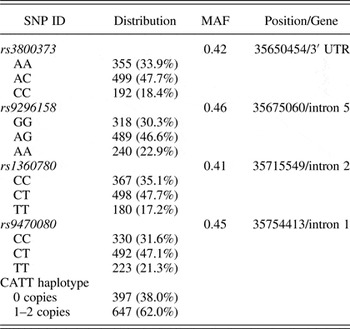
Four FKBP5 SNPs were genotyped: rs3800373, rs9296158, rs1360780, and rs9470080. Table 1 presents the location of each SNP within chromosome 6 and the distribution of genotypes for each SNP within the sample. Haploview software version 4.2 (Barrett, Fry, Maller, & Daly, Reference Barrett, Fry, Maller and Daly2005) was used to determine linkage disequilibrium, HWE, and minor allele frequencies within the sample. All four SNPs were in HWE. The call rates for the four SNPs were as follows: rs3800373 = 99.5%, rs9296158 = 99.6%, rs1360780 = 99.4%, and rs9470080 = 99.4%.
Description of FK506 binding protein 5 single nucleotide polymorphisms (SNPs)

Note: MAF, minor allele frequency.
Arlequin v3.5.1.3 was used to form haplotypes using a pseudo-Bayesian approach to estimate phase (Escoffier & Lischer, Reference Escoffier and Lischer2011). All samples were haplotyped with greater than 98% confidence, with the exception of four samples, which were subsequently excluded from analyses. Over 88% of the sample was represented by either the AGCC or the CATT haplotype. Following haplotype assignment, individuals with one or more copies of the CATT haplotype were grouped together and compared to individuals with zero copies of this haplotype. This dichotomous variable was utilized in subsequent analyses.
Ancestral proportion determinations
DNA from the study participants was submitted to the BioMedical Genomics Center at the University of Minnesota for quantity and quality testing and subsequent SNP genotyping. Acceptable samples (99.0%, 10 cases were excluded) were subjected to SNP genotyping of the Burchard et al. panel of 106 SNPs (Lai et al., Reference Lai, Tucker, Choudhry, Parnell, Mattei and Garcia-Bailo2009; Yaeger et al., Reference Yaeger, Alvial-Bront, Abdul, Nolan, Grann and Birchette2008), known to be informative for ancestry from Africa, Europe, and Native America. The SNPs were genotyped using the iPLEX platform from Sequenom Bioscience, Inc., which uses the Sequenom MassArray. The SNP genotyping results were then recoded and uploaded into STRUCTURE v2.3.4, which uses algorithms developed by Pritchard et al. (Falush, Stephens, & Pritchard, Reference Falush, Stephens and Pritchard2003, Reference Falush, Stephens and Pritchard2007; Hubisz, Falush, Stephens, & Pritchard, Reference Hubisz, Falush, Stephens and Pritchard2009). Three SNP tests were excluded based on high allele call rates of the non-DNA containing wells. The data from the remaining 103 loci were uploaded into the software and set to analyze with an Admixture model of ancestry and initialization of the simulation on the GALA cohort. The simulation was set to run with a burn-in of 10,000, MCMC Reps of 1,000 and assuming three populations within the group. The results of the simulations were subsequently identified as percent association to each ancestry group, African, Native American, and European, based on the known ancestry of the GALA cohort.
Results
BPFS-C: Associations with child indicators of potential borderline risk
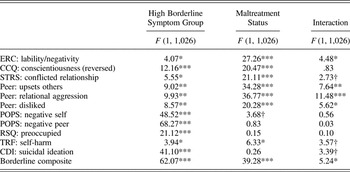
We examined each of the 11 component indicators of our previously developed borderline precursors composite (Rogosch & Cicchetti, Reference Rogosch and Cicchetti2005), as detailed above. Based on children's self-report on the BPFS-C, children scoring more than one standard deviation above the mean were included in a high borderline symptoms group; the remaining children were included in a low borderline symptoms group. More maltreated children (21.7%) than nonmaltreated children (13.7%) were represented in the high borderline symptoms group, χ2 (1) = 11.37, p < .001. A multivariate analysis of covariance was conducted with main effects of high borderline symptom group and maltreatment status and the 11 indicator variables of borderline precursors composite as dependent variables. Age and gender were included as covariates. For comparability with subsequent analyses involving genetic effects, ancestral proportion scores also were included as covariates. The multivariate analysis of covariance resulted in significant multivariate main effects for the high BPFS-C symptoms group (Wilks λ = 0.87), F (11, 994) = 12.96, p < .001, and maltreatment status (Wilks λ = 0.95), F (11, 994) = 4.86, p < .001, and the interaction of these main effects (Wilks λ = 0.98), F (11, 994) = 2.05, p = .022. Given these significant multivariate effects, individual univariate effects were examined. The high BPFS-C symptom group obtained significantly higher scores than the low symptom group on all of the 11 borderline indicator component variables (ps .04 to <.001). See Table 2. Specifically, compared to the low symptom group, the high BPFS-C group was reported by counselors to have higher lability/negativity, lower conscientiousness, more conflicted relationships with adults, and greater self-harm. Peers rated the high BPFS-C group as higher in disruptive interpersonal behavior, relational aggression, and being disliked. Finally, children in the high BPFS-C group, relative to the low group, self-reported more negative peer experiences, more negative feelings about the self, more preoccupied attachment relationships with mothers, and higher suicidal ideation. In terms of maltreatment status, maltreated children scored significantly higher than nonmaltreated children on all of the adult counselor- and peer-rated borderline indicators (ps = .012 to <.001). However, significant maltreatment status group differences were not found for the four child self-report variables (i.e., negative peers, negative self, preoccupied attachment, and suicidal ideation). In terms of interaction effects, four significant interactions between the high borderline symptom group and child maltreatment status were observed (ps = .04 to < .001). In these interactions, maltreated children with high BPFS-C symptoms evinced more extreme scores on lability/negativity, and the peer-rated variables of disruptiveness, relational aggression, and disliked than their nonmaltreated counterparts. Finally, an analysis of covariance (ANCOVA) examining the borderline composite of the 11 component variables indicated strong main effects for the high BPFS-C symptom group, maltreatment status, and their interaction. Children in the high BPFS-C group had substantially higher borderline composite total scores than children in the low group, and maltreated children had higher borderline composite scores than did nonmaltreated children. Maltreated children in the high BPFS-C group had higher borderline composite scores than any other group.
Main effects and interaction of high BPFS-C borderline symptoms group and maltreatment status on adult-, peer-, and self-rated borderline precursor indicators

Note: BPFS-C, Borderline Personality Features Scale for Children; ERC, Emotion Regulation Checklist; CCQ, California Child Q-Set; STRS, Student–Teacher Relationship Scale; POPS, Perceptions of Peers and Self; RSQ, Relationship Stance Questionnaire; TRF, Teacher Report Form; CDI, Children's Depression Inventory.
†p < .10. *p < .05. **p < .01. ***p < .001.
OXTR
A series of ANCOVAs was conducted to evaluate the influence of child maltreatment, variation in the OXTR rs53576 SNP, and gender on individual differences in the BPFS-C total scores. Age was included as a covariate. Our initial analyses indicated significant effects of maltreatment status (p < .001) and gender (p = .044) on BPFS-C scores, as well as a significant three-way interaction of maltreatment, OXTR genotype, and gender (p = .009). Because the sample was racially and ethnically diverse, potentially introducing population stratification into the results, we addressed the effects of race/ethnicity with two strategies in order to evaluate whether hypothesized G × E × Gender effects were affected by racial/ethnic variation. In the first approach, we included the child's parent-reported race/ethnic group (Black, White, Hispanic, or other/multiracial) as a main effect to the ANCOVA model, as well as interactions of Maltreatment × Race Group, Gender × Race Group, and OXTR Genotype × Race Group (cf., Keller, Reference Keller2014). These main and interactive effects involving race were all nonsignificant (ps > .05), and the main effect of maltreatment status and the three-way interaction of maltreatment status, OXTR genotype, and gender retained significance (p = .007).
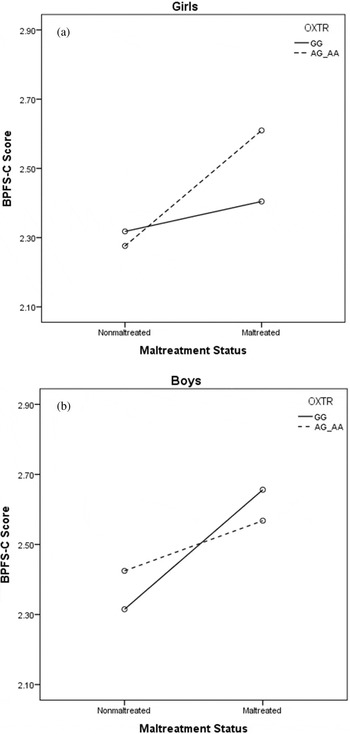
The second strategy to evaluate race/ethnic effects involved including the ancestral proportion scores for African, Native American, and European groups as covariates in the ANCOVA model. The covariates were not significantly related to the BPFS-C total scores, and the initial main and interactive effects were maintained. Specifically, the main effects of maltreatment status, F (1, 1,027) = 29.01, p < .001, and gender, F (1, 1,027) = 4.53, p = .034, were significant, whereas the effect of OXTR genotype group was not F (1, 1,027) = 1.22, p = .27. No two-way interactions were significant. However, the three-way interaction was significant, F (1, 1,027) = 7.14, p = .008. To examine the three-way interaction, we considered the effects of maltreatment status and OXTR genotype separately for girls and for boys, as depicted in Figure 1. Among girls, Bonferroni contrasts indicated that among nonmaltreated girls, there was no effect of genotype. In contrast, among maltreated girls, the effect of OXTR genotype was significant (p = .016), with girls in the AG–AA group having higher BPFS-C scores than girls in the GG group. In addition, among girls with the AG–AA genotypes, maltreated girls had significantly higher BPFS-C scores than did nonmaltreated girls (p < .001), whereas significant maltreatment status group differences were not observed among girls with the GG genotype. For boys (Figure 1b) in contrast to girls, among those with a GG genotype, maltreated boys had significantly higher BPFS-C scores than did nonmaltreated boys (p < .000), whereas maltreatment group differences were not significant for boys in the AG–AA genotype group. No other contrasts were significant.
Interaction of maltreatment status, oxytocin receptor (OXTR) genotype, and gender in predicting Borderline Personality Features Scale for Children (BPFS-C) borderline symptoms.

OXTR genotype and maltreatment subtype groups
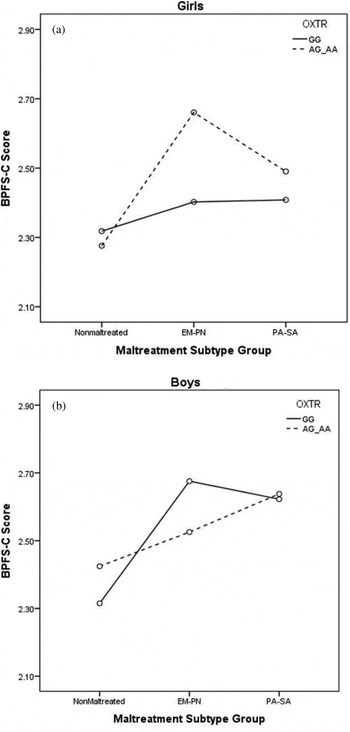
The effects of variation in maltreatment experiences were examined by inclusion of a maltreatment subtype variable (physical and/or sexual abuse, neglect and/or emotional maltreatment without abuse, and nonmaltreated) in place of maltreatment status in the ANCOVA model. Given the comparable results when controlling for race/ethnicity effects using parent-reported group versus ancestral proportion scores, we present results using ancestral proportion scores as covariates, given the greater genetic specificity of the proportion scores. The ANCOVA, controlling for age and ancestral scores, indicated significant main effects for maltreatment subtype, F (2, 1,023) = 14.24, p < .001, and gender, F (1, 1,023) = 5.77, p = .02, as well as the three-way interaction of subtype, OXTR genotype, and gender, F (2, 1,023) = 4.53, p = .01. The results for girls and for boys are shown in Figure 2. For girls, Bonferroni contrasts for genotype group were not significant in the nonmaltreated and PASA groups, whereas among girls in the EMPN group, those with AG–AA OXTR genotypes had significantly higher BPFS-C scores than those in the GG OXTR group (p = .016). In addition, among those with AG–AA genotypes, girls in the EMPN group had significantly higher BPFS-C scores than did nonmaltreated girls (p < .001). No subtype group differences were found among girls with GG genotypes. Among boys (Figure 2b), no significant subtype group differences were observed among boys with AG–AA genotypes. However, among boys in the GG OXTR genotype group, those in both the EMPN group (p < .001) and the PASA group (p = .018) had significantly higher scores than did nonmaltreated boys.
Interaction of maltreatment subtype group, oxytocin receptor (OXTR) genotype, and gender in predicting Borderline Personality Features Scale for Children (BPFS-C) borderline symptoms.

OXTR genotype and maltreatment onset in infancy
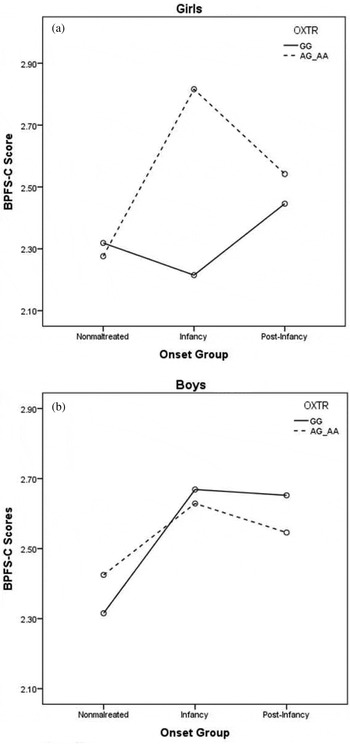
The next analyses examined variation in the developmental timing of maltreatment, considering the onset period of maltreatment, with groups comprising those experiencing onset in infancy, later (postinfancy) onset, and nonmaltreated children. In this ANCOVA, all three main effects were significant, including maltreatment onset group, F (2, 1,023) = 13.98, p < .001, OXTR genotype, F (1, 1,023) = 4.34, p = .037, and gender, F (1, 1,023) = 4.41, p = .036, as well as a Gender × Genotype interaction, F (1, 1,023) = 5.46, p = .02. The effects were further clarified by a three-way interaction of onset, genotype, and gender, F (2, 1,023) = 5.063, p = .008. The three-way interaction was again examined by evaluating Bonferroni contrasts within gender groups (see Figure 3a and b). Among girls, those with infancy onset differed significantly based on OXTR genotype (p = .001), with girls in the AG–GG genotype group having significantly higher BPFS-C scores than those in the GG genotype group. For girls in the AG–AA genotype group, those with infant onset had significantly higher scores than did nonmaltreated girls (p < .001) and marginally higher scores than girls with postinfancy onset (p = .065). No significant onset group differences were found in the GG genotype group. In contrast, for boys, no significant differences in BPFS-C scores were found among boys with the AG–AA genotypes, whereas for boys with GG genotypes, boys in both the infancy onset group (p < .001) and the postinfancy group (p = .02) had significantly higher scores than did nonmaltreated boys.
Interaction of maltreatment onset group, oxytocin receptor (OXTR) genotype, and gender in predicting Borderline Personality Features Scale for Children (BPFS-C) borderline symptoms

OXTR genotype and maltreatment recency in the school-age period
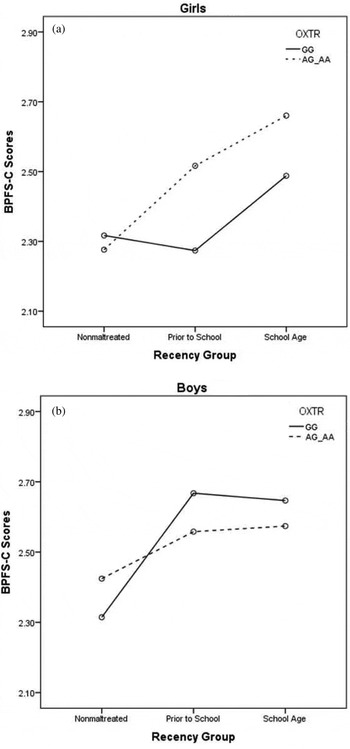
Next, we examined the recency of maltreatment experiences, differentiating children whose most recent maltreatment experiences occurred during the school-age years versus those whose most recent maltreatment occurred prior to school age, and maltreated children. In this ANCOVA, significant main effects were found for recency group, F (2, 1,023) = 15.31, p < .001, and gender, F (1, 1,023) = 6.15, p = .016, as well as the three-way interaction of recency group, OXTR genotype, and gender, F (1, 1,023) = 3.54, p = .029. Examination of interaction effects among girls (see Figure 4a) indicated that for those with AG–GG genotypes, girls with school-age recency had significantly higher BPFS-C scores than did nonmaltreated girls. No significant group differences were found among girls with GG genotypes. In contrast, among boys (Figure 4b), no significant recency group differences were found for boys with AG–GG genotypes, whereas among those boys with GG genotypes, both the school-age recency group (p = .002), and the prior to school-age recency group (p = .002) had higher scores than did nonmaltreated children.
Interaction of maltreatment recency group, oxytocin receptor (OXTR) genotype, and gender in predicting Borderline Personality Features Scale for Children (BPFS-C) borderline symptoms.

FKBP5 CATT haplotype
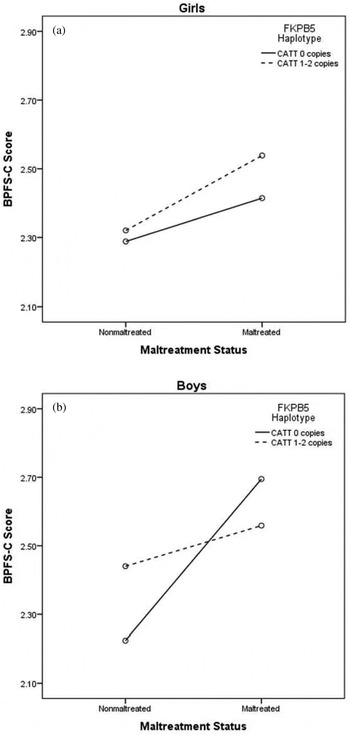
To evaluate the influence of the FKBP5 CATT haplotype in conjunction with maltreatment parameters and gender on BPFS-S scores, the same approach as used for OXTR was followed. Initially, an ANCOVA controlling for age resulted in significant main effects for maltreatment status (p < .001) and gender (p = .047), as well as a significant three-way interaction of maltreatment, CATT haplotype group, and gender, p = .008. We also applied the two strategies for examining race/ethnicity contributions. In the first analysis, inclusion of race/ethnicity group and its interactions with maltreatment, gender, and haplotype group did not result in significant effects, and the three-way interaction remained significant. Similarly, in using the second strategy to control for race/ethnicity effects, inclusion of the ancestral proportion scores did not alter the three-way interaction effect, and these covariates were not significant in the model. In this ANCOVA, the main effects for maltreatment status, F (1, 1,023) = 29.09, p < .001, and gender, F (1, 1,023) = 4.30, p = .01, were significant, as was the three-way interaction, F (1, 1,023) = 6.66, p = .038. We examined this interaction by investigating effects of maltreatment status and haplotype groups separately among girls and boys (see Figure 5a and b). For girls with one to two copies of the CATT haplotype, Bonferroni contrasts indicated that maltreated girls had significantly higher BPFS-C scores than did nonmaltreated girls (p = .003). No significant differences between maltreated and nonmaltreated girls were observed for those in the zero copy CATT haplotype group. No other comparisons were significant. In contrast, for boys, significant maltreatment status group differences were found for the zero CATT copies group, with maltreated boys having significantly higher BPFS-C scores than did nonmaltreated boys (p < .001), whereas for boys with one to two copies of the CATT haplotype, maltreatment status groups did not differ significantly. In addition, among nonmaltreated boys, those with one to two CATT copies had significantly higher scores than did those with zero copies (p = .04). Among maltreated boys, the haplotype groups did not significantly differ.
Interaction of maltreatment status, FK506 binding protein 5 gene (FKBP5) haplotype, and gender in predicting Borderline Personality Features Scale for Children (BPFS-C) borderline symptoms.

FKBP5 CATT haplotype and maltreatment subtype groups
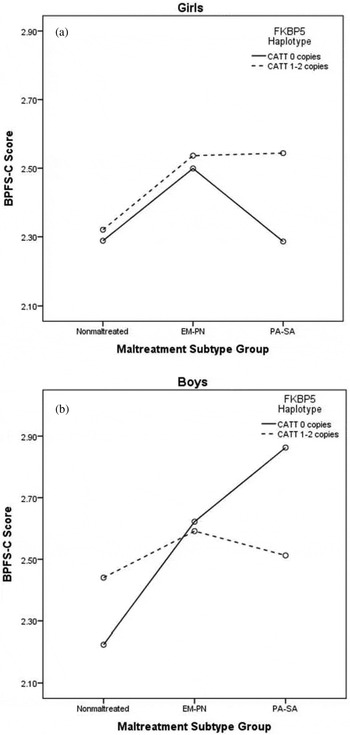
The influence of variation in children's maltreatment subtype experiences was examined next in the ANCOVA model, with age and ancestral proportion scores as covariates. Significant main effects emerged for subtype group, F (2, 1,023) = 15.36, p < .001, and for gender, F (1, 1,023) = 7.92, p = .005, as well as the three-way interaction of subtype, haplotype, and gender, F (2, 1,023) = 5.70, p = .003. Figure 6 illustrates the interaction effects for girls and boys. Among girls, no significant differences were found based on haplotype group for maltreated girls or for girls in the EMPN group; however, in the PASA group, girls with one to two copies of the CATT haplotype had significantly higher BPFS-C scores than did girls with zero copies (p = .05). In addition, among girls with one to two copies, those in the EMPN group had significantly higher BPFS-C scores than did nonmaltreated girls. No additional contrasts were significant. Among boys, although the haplotype group difference in BPFS-C scores was not significant in the EMPN group, contrasts indicated that in the PASA group, boys with zero copies of the CATT haplotype had significantly higher scores than did boys with one to two copies (p = .02), whereas among nonmaltreated boys, those with one to two copies had significantly higher scores than did nonmaltreated boys with zero copies (p = .04). In addition, although no subtype group differences were significant among boys with one to two CATT haplotype copies, among boys with zero copies, those in the EMPN group (p = .002), and in the PASA group (p < .001) had significantly higher BPFS-C scores than did nonmaltreated boys.
Interaction of maltreatment subtype group, FK506 binding protein 5 gene (FKBP5) haplotype, and gender in predicting Borderline Personality Features Scale for Children (BPFS-C) borderline symptoms.

FKBP5 CATT haplotype and maltreatment onset in infancy
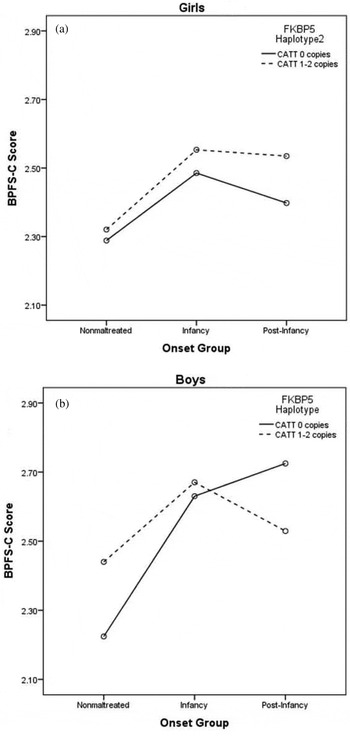
When the effects of developmental timing of maltreatment were considered, a similar pattern of results was found based on infancy onset. Specifically, in an ANCOVA examining infancy onset groups (onset in infancy; onset later, postinfancy; and nonmaltreated children), controlling for age and ancestral proportion scores, significant main effects were observed for onset group, F (2, 1,019) = 15.03, p < .001, and gender, F (2, 1,019) = 4.28, p = .039, as well as the onset group by haplotype group by gender three-way interaction, F (2, 1,019) = 3.94, p = .02. Investigation of the three-way interaction proceeded by investigation of the gender groups (see Figure 7a and b). Among girls with one to two copies of the CATT haplotype, those with postinfancy onset had significantly higher BPFS-C scores than did nonmaltreated girls (p = .023); girls with infancy onset had marginally higher scores than did nonmaltreated girls (p = .095). No significant onset group differences were found among girls with zero copies of the CATT haplotype. When boys were examined, for those with 0 copies of the CATT haplotype, both boys with infancy onset (p = .02), and boys with postinfancy onset (p < .001) had significantly higher BPFS-C scores than did nonmaltreated boys. Significant onset group differences were not found among boys with one to two CATT haplotype copies. In addition, among boys with postinfancy onset, higher scores were observed among those with zero copies compared to those with one to two copies of the CATT haplotype (p = .04), whereas among nonmaltreated boys, the converse was true. Boys with one to two CATT copies had higher scores than those with zero copies (p = .037).
Interaction of maltreatment onset group, FK506 binding protein 5 gene (FKBP5) haplotype, and gender in predicting Borderline Personality Features Scale for Children (BPFS-C) borderline symptoms.

FKBP5 CATT haplotype and maltreatment recency in the school-age period
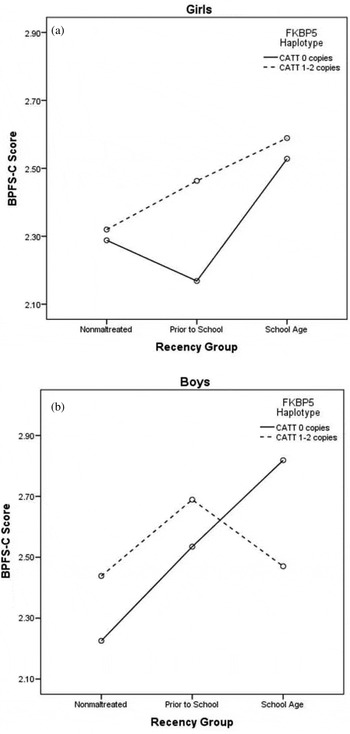
We further examined the recency of maltreatment experiences (school-age, prior to school age, and nonmaltreated children). As in prior analyses, in this ANCOVA, main effects were found for recency group, F (2, 1,019) = 16.80, p < .001, and gender, F (1, 1,019) = 9.08, p = .003. In addition, a two-way interaction of recency and haplotype group was observed, F (2, 1,019) = 5.75, p = .003. However, these effects were clarified by a significant three-way interaction of recency group, haplotype group, and gender, F (2, 1,019) = 4.70, p = .009. Investigation of the three-way interaction proceeded by examination of effects within gender groups, as shown in Figure 8a and b. Among girls, the nonmaltreated and the school-age recency groups did not differ significantly based on haplotype group; however, a marginal difference was observed for recency occurring prior to school age (p = .056), with higher scores among girls with one to two copies of the CATT haplotype, compared to those with zero copies. Among girls with zero copies of the CATT haplotype, those with school-age recency had significantly higher BPFS-C scores than did those with recency prior to school age (p = .05) and nonmaltreated girls (p = .05). Among girls with one to two copies of the CATT haplotype, girls with school-age recency had higher scores than did nonmaltreated girls (p = .007). When boys were considered, among those with zero copies of the CATT haplotype, boys with school-age recency had higher scores than did those with recency prior to school age (p = .044) and nonmaltreated boys (p < .000). Among boys with one to two CATT copies, those with recency prior to school age had higher scores than did nonmaltreated boys (p = .03); other contrasts among those with one to two CATT copies were not significant. Finally, among boys with school-age recency, those with zero copies of the CATT haplotype had significant higher BPFS-C scores than did those with one to two copies (p = .002), whereas among nonmaltreated boys, the converse was true, with those with one to two CATT copies having higher scores than those with zero copies (p = .037).
Interaction of maltreatment recency group, FK506 binding protein 5 gene (FKBP5) haplotype, and gender in predicting Borderline Personality Features Scale for Children (BPFS-C) borderline symptoms.

Independent contributions of OXTR and FKBP5 CATT haplotype
In the final analysis, both OXTR and FKBP5 were examined together to determine the extent to which their effects in interaction with maltreatment status and gender were overlapping. Accordingly, an ANCOVA was conducted with main effects of maltreatment status, gender, and both OXTR genotype and FKBP5 haplotype groups. As previously, age and the ancestral proportion scores were used as covariates. In this analysis both of the previously reported three-way interactions conducted separately by gene (maltreatment status, gender, and OXTR; maltreatment status, gender, and FKBP5) remained significant, F (1, 1,014) = 5.75, p = .017 and F (1, 1,014) = 5.75, p = .008, respectively, for the three-way interactions involving OXTR and FKBP5. The pattern of these three-way interactions was consistent with those obtained when the genes were examined separately. Thus, these three-way interaction effects appeared to independently contribute to BPFS-C scores. Further consideration of maltreatment parameter effects was precluded owing to cell size restrictions.
Discussion
Consistent with our first hypothesis, children in the high BPFS-C group had significantly higher scores on each of the 11 borderline indicator component variables than did the children in the low BPFS-C group. Camp counselors rated the high BPFS-C group as manifesting higher lability/negativity, lower conscientiousness, more conflicted relationships with adults, and greater self-harm than children in the low BPFS-C group. Moreover, the peers in their camp group rated children in the high BPFS-C symptoms group as higher in disruptive interpersonal behavior, relational aggression, and less liked than children in the low symptoms group. Furthermore, children in the high BPFS-C group, relative to the children in the low symptoms group, self-reported more negative experiences with peers, more negative self-feelings, more preoccupied attachment relationships with their mothers, and higher suicidal ideation.
Maltreated children scored significantly higher than did nonmaltreated children on each of the adult- and peer-related borderline indicators; however, maltreatment group differences were not obtained for the child self-report borderline indicators. In addition, the high BPFS-C symptoms maltreatment group evinced significantly higher scores, relative to nonmaltreated children in the high BPFS-C group on lability/negativity, and the peer-related variables of disruptiveness, relational aggression, and disliked. When the overall borderline composite total scores were considered, the high borderline BPFS-C group was substantially higher than the low group on total borderline precursor scores. Maltreated children also were higher than nonmaltreated children on the composite score index. Furthermore, maltreated children with high BPFS-C symptoms evinced more extreme scores on the borderline features composite than did nonmaltreated children with high BPFS-C symptoms.
Taken together, these results demonstrating a significant relationship between high scores on the BPFS-C measure and the borderline features composite, and its associated indicators provide further validation of the Crick et al. (Reference Crick, Murray-Close and Woods2005) self-report measure. Moreover, the similarities in the dysfunctional developmental processes displayed by maltreated children and adult patients with BPD provide suggestive evidence for a potential prospective pathway from childhood maltreatment to BPD. Likewise, the striking multiple relations found between maltreatment and higher scores of the BPFS-C and between maltreatment and the borderline composite indicators, conceived as a precursor to borderline personality features, also may portend an earlier emergence of BPD than depicted in the psychiatric literature. (Cicchetti, Reference Cicchetti2014; Cicchetti & Crick, Reference Cicchetti and Crick2009a, Reference Cicchetti and Crick2009b; Crick et al., Reference Crick, Murray-Close and Woods2005; Fonagy & Luyten, in press; Rogosch & Cicchetti, Reference Rogosch and Cicchetti2005).
Two candidate genes were chosen to elucidate individual variation obtained among maltreated children. The inclusion of the molecular genetic level also is consistent with one of the principles of developmental psychopathology, namely, that a multiple levels of analysis perspective provides a more comprehensive understanding of normal and abnormal developmental processes than does a single level of analysis (Cicchetti & Dawson, Reference Cicchetti and Dawson2002; Cicchetti & Toth, Reference Cicchetti and Toth2009).
Across all of the analyses conducted, the genotype groups for both OXTR and FKBP5 did not demonstrate main effects in predicting BPFS-C scores. In contrast, maltreatment and maltreatment parameters exhibited strong main effects on BPFS-C scores.
Moderation of maltreatment effects by genotypes was discovered for both OXTR and FKBP5; however, these moderation effects occurred differentially for girls and for boys. Consequently, consistent G × E × Gender three-way interactions were observed. In particular, the genotype group typically associated with greater risk for high BPFS-C scores was the opposite in girls and boys.
Specifically, for the Maltreatment × OXTR × Gender interaction, the highest BPFS-C borderline feature symptoms were found for maltreated girls in the AG–AA group (minor allele A present). These maltreated girls also had significantly higher scores than did the nonmaltreated comparison girls who possessed the GG (G is the major, more common allele) genotype.
In contrast, boys exhibited the opposite pattern. The maltreated boys who had the GG genotype had significantly higher BPFS-C scores than did the nonmaltreated boys. However, maltreated and nonmaltreated boys did not differ in symptoms if they had the AG–AA genotypes.
The pattern of results for the Maltreatment × FKBP5 Haplotype Group × Gender three-way interaction was similar to that found for OXTR. Specifically, the highest BPFS-C symptoms were found for maltreated girls in the one to two copies of the FKBP5 haplotype group (indicating that minor alleles are present). These maltreated girls had significantly higher scores than did the nonmaltreated girls. However, if the maltreated and nonmaltreated girls had zero copies of the FKBP5 CATT haplotype, then no differences in BPFS-C symptoms were obtained. As was the case for OXTR, the pattern of findings for the Maltreatment × FKBP Haplotype Group × Gender is opposite for boys to that of the results for three-way interaction involving girls. The maltreated boys who possessed zero copies of the CATT haplotype (and thus primarily major alleles) had significantly higher BPFS-C scores than did nonmaltreated boys. However, maltreated and nonmaltreated boys did not differ in symptoms if they possessed one to two copies of the CATT haplotype (indicating minor alleles present).
Thus, for both genes maltreated girls appeared to be more at risk for high BPFS-C symptoms when they had minor alleles (i.e., AG or AA of OXTR and one to two copies of the FKBP5 CATT haplotype), but not when they possessed major alleles (i.e., GG for OXTR and zero copies of the FKBP5 CATT haplotype). In contrast, maltreated boys appeared to be at increased risk for higher BPFS-C symptoms when they had major alleles (i.e., GG for OXTR and zero copies of the FKBP5 haplotype). These effects were not obtained for maltreated boys who possessed the minor alleles (i.e., AG or AA for OXTR and one to two copies of the FKBP5 CATT haplotype).
What is striking is that the three-way interaction for maltreated girls appears to reflect a “diathesis-stress” model (Falconer, Reference Falconer1965; Gottesman & Shields, Reference Gottesman and Shields1972), where genotypes of the minor alleles are associated with increased risk for BPFS-C symptoms in the presence of stress. An inspection of the figures illustrating the three-way-interaction findings for girls reveals that the classic crossover interaction necessary to conform to a differential susceptibility to environmental influences model (Belsky, Bakermans-Kranenburg, & van IJzendoorn, Reference Belsky, Bakermans-Kranenburg and van IJzendoorn2007) is not present. For boys, in contrast, a different picture emerged. Crossover interactions occur frequently, and these appear to be quite consistent with a differential susceptibility to environmental influences model. (Belsky et al., Reference Belsky, Bakermans-Kranenburg and van IJzendoorn2007; Ellis, Boyce, Belsky, Bakersman-Kranenburg, & van IJzendoorn, Reference Ellis, Boyce, Belsky, Bakermans-Kranenburg and van IJzendoorn2011). Further, the “plasticity” genotype (Belsky & Pluess, Reference Belsky and Pluess2009, Reference Belsky and Pluess2013) for boys is the opposite of girls as it comprises genotypes of the major alleles.
The consideration of child maltreatment parameters, including subtype, onset, and recency, contributed to further understanding of variation among maltreated children. An examination of maltreatment subtype groups (nonmaltreated, EMPN, and PASA) for OXTR revealed that maltreated girls in the EMPN subtype group who possessed the AG–AA genotype had higher scores on the BPFS-C. Boys with the GG genotype who were in either the EMPN or the PASA maltreatment subtype groups had higher BPFS-C scores.
Girls in the EMPN maltreatment subtype group and who possessed one to two copies of the FKBP5 CATT haplotype had higher scores than did nonmaltreated girls, and for girls in the PASA maltreatment subtype group, those who had one to two copies of the FKBP5 CATT haplotype had higher scores on the BPFS-C than did girls with zero copies.
Among boys with zero copies of the CATT haplotype, both the EMPN and the PASA groups had significantly higher BPFS-C symptoms than did nonmaltreated boys; among boys with the one to two copies of the haplotype, no subtype group differences were found. In addition, evidence for a crossover interactive effect was observed, with boys in the PASA group and zero copies of the haplotype having higher scores than those with one to two copies, whereas among nonmaltreated boys, those with one to two copies of the CATT haplotype had higher scores than did those with zero copies.
Analyses of additional maltreatment parameters obtained from MCS coding of DHS records (Barnett et al., Reference Barnett, Manly, Cicchetti, Cicchetti and Toth1993) revealed that girls in the infancy onset group with the AG–AA OXTR genotype had higher BPFS-C scores than did the nonmaltreated girls. Moreover, the infant onset maltreatment group of girls who possessed the AA–AG genotype had higher symptoms than did girls in the GG genotype group. In addition, maltreated girls in the infant onset group with the AA–AG genotype had marginally higher BPFS-C scores than girls with the same genotype who experiences maltreatment postinfancy.
In contrast, boys with the GG genotype in the infant maltreated and postinfant onset maltreated groups had higher BPFS-C scores than did nonmaltreated boys. No differences were found between the two aforementioned onset groups with AG–AA genotypes and the nonmaltreated boys.
Further, examination of the maltreatment infancy and postinfancy onset groups and borderline features was undertaken with FKBP5. The girls who had one to two CATT copies of the FKBP5 haplotype and who were maltreated postinfancy reported higher BPFS-C scores in comparison to nonmaltreated girls, whereas those girls with infancy onset had marginally higher borderline feature scores than did the nonmaltreated girls.
Boys in the infancy and postinfancy onset groups who possessed zero copies of the FKBP5 CATT haplotype had higher BPFS-C scores than did nonmaltreated boys. Furthermore, among boys who were maltreated postinfancy, those who had zero copies of the FKBP5 CATT haplotype had higher borderline feature symptoms than did maltreated boys with one to two copies of the CATT haplotype. Crossover interaction effects also were found, with postinfancy onset boys with zero copies of the CATT haplotype having higher BPFS-C scores than those with one to two copies of the haplotype, whereas among nonmaltreated boys, the reverse was observed.
An additional inspection of maltreatment parameters was conducted, focusing on maltreatment recency groups (nonmaltreated, prior to school, school age). Maltreated girls in the school-age recency group who had the AG–AA OXTR genotypes scored higher on the BPFS-C. No differences were found in the GG group. In contrast, maltreated boys in both the prior to school and the school-age recency groups with the GG genotype had greater scores on the BPFS-C than did nonmaltreated boys. In contrast, no differences were obtained when maltreated boys possessed the AG–AA genotypes.
Maltreated girls in the school-age recency group who had one to two copies of the FKBP5 CATT haplotype had higher borderline feature symptoms on the BPFS-C than did nonmaltreated comparison girls. However, for maltreated girls who had zero copies of the CATT haplotype, school-age recency is associated with higher BPFS-C symptoms than for maltreated girls in the early onset group and nonmaltreated comparison girls.
Maltreated boys who had zero copies of the FKBP5 CATT haplotype and whose onset of maltreatment was during school age had higher BPFS-C scores than did maltreated boys with early onset and nonmaltreated comparison boys. Moreover, borderline feature symptoms were higher in maltreated boys with school-age recency who had zero copies of the CATT haplotype of FKBP5 than for maltreated boys who had early onset and nonmaltreated boys. Again, indicative of crossover interaction effects, among boys with school-age recency, those with zero copies of the haplotype had higher scores than those with one to two copies, whereas nonmaltreated boys with one to two copies and higher scores than those with zero copies.
In summary, consistent with the second hypothesis, OXTR genotype variants interacted with gender and child maltreatment status and associated parameters in relation to BPFS-C scores. The prediction that females would exhibit a different pattern of G × E interaction than males was confirmed. Likewise, congruent with the third hypothesis, the number of copies of the FKBP5 CATT haplotype interacted with child maltreatment status/maltreatment parameters and gender in relation to BPFS-C scores. In addition, the prediction that males and females would exhibit different patterns of G × E was borne out. The fourth hypothesis that there would be separate interactions of OXTR, child maltreatment status, and gender, and FKBP5 CATT haplotype, maltreatment status, and gender that would contribute independently to BPFS-C scores also was confirmed.
The results highlight the need to consider gender in G × E studies. Three-way interactions involving candidate molecular genetic and environmental pathogens and gender are rare in gene–environment research. The large sample size included in the present investigation enables the conduct of such three-way interactions because there was sufficient statistical power to consider gender interactive effects.
As was shown with respect to the OXTR genotype and the FKBP5 CATT haplotype copies, girls had different risk and plasticity genotypes than did boys. The finding regarding Genotype × Maltreatment upon BPFS-C scores was completely opposite for girls and boys. This suggests that the use of vulnerability/risk and plasticity genes that has become common in the literature (Belsky & Pluess, Reference Belsky and Pluess2009) must realize that a number of factors, including development, race, and gender, in addition to environmental context must be examined before concluding that particular genotypes are considered to be the “risk” or “plasticity” gene.
The inclusion of ancestry-informative markers (AIMs), also known as ancestral proportion scores, in the present investigation enables us to estimate the geographical origins of an individual's ancestors and to discern the proportion of ancestry that is derived from each geographical region. Because our sample is genetically heterogeneous, unlike many sample utilized in the G × E literature, we were able to obtain a more accurate portrayal of race and racial admixture than self-report of race. The utilization of these AIMs represents an increase in methodological sophistication and addresses concerns raised by Duncan and Keller (Reference Duncan and Keller2011) regarding the absence of these AIMs markers in G × E research with genetically heterogeneous samples.
In addition, we controlled for all potential confounders in each of our maltreatment status models. Keller (Reference Keller2014) commented on the fact that few G × E investigators had entered all relevant interaction terms in the same model that tests the G × E term. We computed all interactions as Keller (Reference Keller2014) suggested, thus eliminating alternative explanations for our G × E findings. Because this study is the first demonstration of a three-way interaction involving genes, maltreatment, and gender, it will be important to replicate these findings in future research. Nonetheless, the current findings have important implications for understanding the differential precursors and pathways to borderline pathology. In order to design efficacious, developmentally appropriate interventions, it will be important to consider the interactions of gene and environment in the context of gender.