In ductus-dependent congenital heart disease, ductal occlusion leads to disorders of end-organ perfusion and tissue oxygenation through inadequacy of pulmonary flow and intracardiac mixing. Keeping the patency of ductal communication is of vital importance for providing the time necessary to establish an anatomic diagnosis until the surgical or non-surgical intervention can be performed.Reference Shivananda, Kirsh, Whyte, Muthalally and McNamara 1 , Reference Stone, Frattarelli, Karthikeyan, Johnson and Chintala 2 Owing to the fact that it is well known that prostaglandin E1 treatment effectively keeps the ductal patency, it is widely used before either open surgery or transcatheter procedure is carried out.Reference Condò, Evans, Bellù and Kluckow 3 – Reference Silove, Roberts and de Giovanni 7 Patients with a suspected or established diagnosis of ductus-dependent congenital heart disease are exposed to the risks of transportation to a tertiary health-care centre and the side effects of prostaglandin E1 treatment, until they can be given definitive treatment. Prostaglandin E1 treatment entails certain difficulties in managing these patients. Apnoea, hypoventilation, hypotension, vasodilatation, flushing, diarrhoea, seizures, and hyperpyrexia have been reported among the frequent side effects of short-term, standard dose prostaglandin E1 treatment.Reference Freed, Heymann, Lewis, Roehl and Kensey 8 , Reference Hallidie-Smith 9 Given the need for mechanically assisted ventilation and neonatal intensive care that arose with prostaglandin E1 treatment, different studies explored prostaglandin E1 treatment at a dose lower than the proposed standard, to reduce adverse effects without loss of efficacy.Reference Barker, Yates and Kelsall 10 – Reference Ito, Harada, Tamura and Takada 13 It is yet unclear, however, how low the dose can be while continuing to keep the patency of the ductus arteriosus, or how low it should be to be devoid of side effects. The objective of the present study was to determine the lowest effective prostaglandin E1 dose that can be given without adverse effects while ensuring ductus arteriosus patency. Prostaglandin E1 treatment at very low doses may ensure both protection from possible side effects and safe transportation to a tertiary care centre.
Materials and methods
Study design
The present study retrospectively reviews the records of patients who received prostaglandin E1 infusion after being referred to the study centre between January, 2011 and July, 2012 for interventional heart catheterisation or open surgery because of a diagnosis of ductus-dependent congenital heart disease. Neonates who were younger than 14 days and who had duct-dependent congenital heart disease were included, whereas the remaining were excluded neonates older than 14 days. The recruited patients were allocated into two groups: those with insufficiency of pulmonary blood flow and/or blood mixing (Group 1) and those with insufficient systemic blood flow (Group 2). Records of patients referred to our centre between January, 2011 and July, 2012 for interventional heart catheterisation or open surgery with a diagnosis of ductus-dependent congenital heart disease, who had received prostaglandin E1 infusion, were reviewed for the study. Neonates with duct-dependent congenital heart disease were part of the study if younger than 14 days. The following patients were excluded: neonates older than 14 days; patients necessitating mechanical ventilation or assisted breathing; those with a defect ensuring sufficient intracardiac mixing; patients whose duct-dependent congenital heart disease diagnosis could not be confirmed by echocardiography; neonates who received treatment, intra venously or inhaled, other than prostaglandin E1 – inotropic treatment, oxygen, intravenous fluid for treatment – during transportation; and patients who had undergone balloon atrioseptostomy. Patients were retrospectively evaluated after being allocated to one of two main groups: those with insufficiency of pulmonary blood flow and/or blood mixing (Group 1) and those with insufficient systemic blood flow (Group 2). Patients were later distributed in three groups for evaluation of specific subgroups: Group A: Complete transposition of the great arteries; Group B: Pulmonary flow insufficiency; Group C: Systemic flow insufficiency. Local Ethics Committee approval was obtained before the study.
Echocardiographic examinations
The paediatric cardiology team at the neonatal intensive care unit of the study centre performed transthoracic echocardiography examination for all of the recruited neonates. In addition to ductal morphology, the degree of support by the ductus arteriosus to pulmonary and systemic circulation was determined to evaluate the patients in distinct groups of ductus-dependent congenital heart disease. Echocardiographic examination was performed with Vivid 3 Pro Echo devices (General Electric Medical Systems, Horten, Norway) using 3 and 7 MHz probes. Images were obtained through a high parasternal imaging window, using a direct inferior or slightly superior position by effecting a counterclockwise rotation in the left second to third intercostal space. Images were acquired by effecting a clockwise or counterclockwise rotation while visualising the aortic arch along its long axis – left or right, according to the direction of the aortic arch – alternatively over the right or left clavicle, over the bifurcation of the main and left pulmonary arteries.Reference Hiraishi, Fujino and Saito 14 Ductal morphology was defined by minimal and maximal intraluminal diameter measurements by two-dimensional echocardiography. The smallest measurement obtained at the pulmonary end of the ductus arteriosus by colour-Doppler mapping was defined as ductal diameter.Reference Joshi, Berdon and Brudnicki 15 The lowest effective prostaglandin E1 dose was defined by periodic serial measurements obtained during prostaglandin E1 treatment, after basal measurements. A narrowing to <2 mm of the inner ductal diameter, as defined above, was accepted as the first sign of ductal constriction.Reference Graham, Atwood and Boucek 16 , Reference Lewis, Freed, Heymann, Roehl and Kensey 17
Treatment protocol
All patients considered to be at risk for a worsening of their clinical course after ductus arteriosus closure, owing to their major cardiac defect, were given prostaglandin E1 (alprostadil, 20 mcg/ml) at a dose schedule of 0.5–0.1 mcg/kg/minute. After their first evaluation on reaching study centre, the intra-venous starting dose (initial dose), maintenance dose during transportation (maintenance dose), dose reached by titration in our centre (titrated dose), and the lowest required dose (lowest dose) of prostaglandin E1 were recorded. Records were evaluated for side effects attributed to prostaglandin E1 – apnoea, diarrhoea, hyperpyrexia, hypotension, flushing.
Clinical parameters
Every 4 hours, the patients’ respiratory rate, heart rate, systemic arterial blood pressure measured by oscillometry, body temperature, pulse oxymetry oxygen saturation, and the number of apnoea episodes, if any, were recorded. During prostaglandin E1 treatment, the following were also recorded, as indicators of prostaglandin E1 efficacy: (1) diuresis, (2) systemic arterial blood pressure, and (3) peripheral capillary oxygen saturation. When more than one value had been obtained after the onset of the infusion, the measurement at the time closest to 1 hour after the start of infusion was used.
Statistical analysis
All continuous variables were reported as their mean±1 standard deviation, median (minimum–maximum). For categorical variables, frequency and percentage calculations were provided as descriptive statistics. The Shapiro–Wilk test was used to test the normality of continuous variable distribution. Parametric or non-parametric comparative tests were applied according to the distribution. Student’s t-test or the Mann–Whitney U-test were used for comparisons between two independent groups. Comparisons among three independent groups were performed by one-way analysis of variance or the Kruskal–Wallis variance analysis. The Tukey honestly significant difference post hoc test was used to investigate pairwise comparisons. For pairwise comparisons following the Kruskal–Wallis test, the Mann–Whitney U-test with Bonferroni correction was applied. The Pearson χ2 or the Fisher exact test was used to test differences among categorical variables. Potential correlations among continuous variables were explored by Spearman’s correlation analysis. All above tests and correlation tests were performed using Statistical Package for Social Sciences 19.0 (SPSS, Chicago, Illinois, United States of America). The graphical presentations were prepared using Microsoft Excel 2010 (Microsoft Corporation, Bellevue, Washington, United States of America). The level of significance for α was accepted as being 0.05 throughout the study.
Results
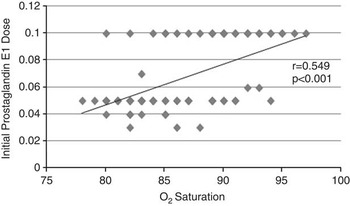
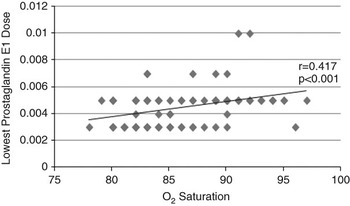
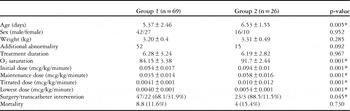
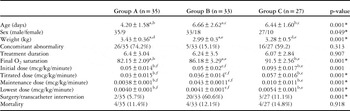
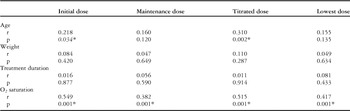
The study cohort consisted of 37 female patients (38.9%) and 58 male patients (61.1%). The average age, body weight, and treatment duration were, respectively, 5.7±2.3 days (range: 1–12 days), 3.23±0.42 kg (range: 2.40–4.25 kg), 6.26±3.12 days (range: 1–13 days). Moreover, the starting dose and the lowest efficient dose for prostaglandin E1 were 0.065±0.024 mcg/kg/minute (range: 0.03–0.1 mcg/kg/minute) and 0.0044±0.0013 mcg/kg/minute (range: 0.003–0.01 mcg/kg/minute), respectively. Surgery was performed in 70 patients (73.7%), whereas 25 patients (26.3%) underwent transcatheter intervention. A total of 12 patients (12.6%) were lost to follow-up during the post-operative period. Of 95 patients included in the study, 69 patients (72.6%) were allocated in Group 1 and 26 patients (27.3%) were allocated in Group 2. Both groups were statistically similar with respect to sex, body weight, the presence of concomitant abnormality, and the duration of prostaglandin E1 treatment (p>0.05 for all) (Table 1). What is more, there was no statistically significant difference between the two groups with regard to the number of patients lost to follow-up (p=0.730). When compared with Group 2, the initial, maintenance and lowest efficient doses of prostaglandin E1 treatment were significantly lower and the titrated dose of prostaglandin E1 was significantly higher in Group 1 (p=0.001 for each) (Table 1). Subgroup analysis was done to assess 35 patients (36.8%) with complete transposition of the great arteries, 33 patients (34.7%) with pulmonary flow insufficiency, and 27 patients (28.5%) with systemic flow insufficiency. The average age was significantly higher, whereas the average body weight was significantly lower in Group B patients (p=0.001 for both). However, there were no differences among the subgroups with respect to treatment duration, presence of concomitant abnormalities, or mortality (p>0.05 for all) (Table 2). The initial dose and the lowest efficient dose of prostaglandin E1 was significantly higher in Group C, whereas the maintenance dose was significantly higher in Group B (p=0.001 for each). The ratio of open surgery was significantly higher in Group 2 patients (p=0.045) and Group B patients (p=0.001). All of the recruited patients underwent an arterial switch procedure and four patients were lost because of intra-operative and post-operative complications. In the subgroup with pulmonary flow insufficiency, a central shunt was performed in 12 patients, a ductal stent was implanted in eight patients, seven patients had a modified Blalock–Taussig shunt, and five patients had pulmonary balloon valvuloplasty. With regard to the subgroup with systemic flow insufficiency, five patients underwent Norwood’s procedure and one patient had a Damus–Kaye–Stansel operation. The remaining patients were subjected to aortic coarctation repair. A correlation between body weight or treatment duration on the one hand and prostaglandin E1 doses on the other could not be evidenced, although patient age and oxygen saturation positively correlated with prostaglandin E1 dose (Table 3, Figs 1 and 2).
Correlation plot of initial prostaglandin E1 dose and O2 saturation.

Correlation plot of lowest prostaglandin E1 dose and O2 saturation.

Demographic and clinical characteristics of patients in Group 1 and Group 2.

* p-values <0.05 were accepted to be statistically significant
Demographic and clinical characteristics of patients according to their diagnostic subgroups.

* p-values <0.05 were accepted to be statistically significant
a Group A versus Group B statistically significant (p<0.05)
b Group A versus Group C statistically significant (p<0.05)
c Group B versus Group C not statistically significant (p>0.05)
d Group A versus Group C not statistically significant (p>0.05)
e Group B versus Group C statistically significant (p<0.001)
f Group A versus Group B not statistically significant (p>0.05)
Correlations between prostaglandin E1 doses and other variables.

* p-values <0.05 were accepted to be statistically significant
Discussion
This study determined that prostaglandin E1 therapy in duct-dependent congenital heart disease may maintain ductal patency without causing side effects at doses much lower than those proposed in the published literature. It additionally reports for the first time the results of very low-dose prostaglandin E1 treatment in different subgroups of duct-dependent congenital heart disease patients. Prostaglandin E1 for maintaining ductal patency in duct-dependent congenital heart disease has been widely in use for several years and it is the subject of many studies.Reference Shivananda, Kirsh, Whyte, Muthalally and McNamara 1 , Reference Stone, Frattarelli, Karthikeyan, Johnson and Chintala 2 , Reference Takeda, Hiraishi and Misawa 12 – Reference Graham, Atwood and Boucek 16 Freed et al have published the report of a 56-centre study of prostaglandin E1 administration to 492 neonates with either cyanotic or acyanotic congenital heart disease.Reference Freed, Heymann, Lewis, Roehl and Kensey 8 Prostaglandin E1 was administered intra-arterially or intravenously, at a dose schedule for cyanotic congenital heart disease starting at 0.1 mcg/kg/minute, which could be lowered to 0.002 mcg/kg/minute in 27% of the patients, while the dose was increased again to the starting level in 3% and 11% of patients received various doses. The same study had a prostaglandin E1 starting dose of 0.05 mcg/kg/minute for cyanotic heart disease patients. Although a reduction of side effects at such doses was shown in the study, the lowest effective dose could not be established because of the difficulties in monitoring prostaglandin E1 efficiency in acyanotic heart disease. A total of 95 patients were included in the present study. They were primarily evaluated in two groups, patients with insufficiency of pulmonary blood flow and/or of pulmonary–systemic blood mixing, and those with insufficient systemic blood flow. The patient population was then evaluated in the following three subgroups: pulmonary flow insufficiency, pulmonary–systemic mixing insufficiency, and systemic flow insufficiency. The patients in the study were started on the standard recommended prostaglandin E1 doses, as treatment was started before referring patients with a tentative or definite diagnosis to our paediatric cardiology tertiary care centre for final diagnosis and treatment. The prostaglandin E1 dose was then reduced during transportation, to reach the maintenance dose.
Upon the arrival at the study centre and the initial evaluation of the patients, prostaglandin E1 dose was modified as a part of dose titration and the following two dose modifications resulted in the lowest efficient dose.
The starting dose for prostaglandin E1 was 0.065±0.024 mcg/kg/minute (range: 0.03–0.1 mcg/kg/minute), whereas the lowest efficient dose during treatment was 0.0044±0.0013 mcg/kg/minute (range: 0.003–0.01 mcg/kg/minute), which were considerably lower than the standard recommended doses, and nonetheless maintained ductal patency.
A study by Lewis et alReference Lewis, Freed, Heymann, Roehl and Kensey 17 in 492 neonates with duct-dependent congenital heart disease characterised the adverse effects of intra-venous and intra-arterial prostaglandin E1. Cardiovascular events were observed in 18% of cases, respiratory depression in 12%, and central nervous system events in 16%. Of note, a correlation was found between these events and intra-arterial administration or birth weights lower than 2000 g. No such relationship of prostaglandin E1 treatment with haematologic, infectious, or renal events was detected in this study. The need to reduce the prostaglandin E1 infusion rate in the presence of respiratory depression, hypotension, high fever, or jitteriness has been signalled. During the treatment period, no side effects attributed to prostaglandin E1 were observed in the cohort of the present study. Serious difficulties in patient management are created by both prostaglandin E1 treatment and the monitoring of its possible adverse effects, during the transportation of neonates with documented duct-dependent congenital heart disease to tertiary care centres with neonatal intensive care units. This is equally true of critical neonates with suspected disease. Therefore, the efficiency of prostaglandin E1 doses lower than the recommended standard was also studied in a study including patients with suspected duct-dependent congenital heart disease.Reference Browning Carmo, Barr, West, Hopper, White and Badawi 4 Prostaglandin E1 was administered at doses of 0.005–0.01 mcg/kg/minute to 52 neonatal patients, in whom no significant side effects were recorded and the dose dependency of side effects was indicated. Therefore, the authors proposed an initial prostaglandin E1 dose of 0.001–0.01, indicating that it may be increased in case of insufficient response. As for the present study, all of the recruited patients received the initial recommended standard dose, between 0.05 and 0.1 mcg/kg/minute, with the intention of making a reduction during transportation.
A study analysing the efficacy and side effects of low-dose prostaglandin E1 in 91 duct-dependent neonates was published by Kramer et al.Reference Kramer, Sommer, Rammos and Krogmann 18 These patients were evaluated in three distinct groups: those with pulmonary flow insufficiency, those with systemic flow insufficiency, and those with a complete transposition of the great arteries. The prostaglandin E1 dose needed for patients with systemic flow insufficiency was found to be higher than those that needed for the other groups, complying with results of the present study. In the mentioned study, although the prostaglandin E1 dose administered to patients with transposition of the great arteries and those with pulmonary flow insufficiency was 0.016±0.007 and 0.017±0.006 mcg/kg/minute, respectively, and similar to each other, the figure for patients with systemic flow insufficiency was 0.02±0.01 mcg/kg/minute. As for maintenance doses, they amounted to 0.013±0.008 mcg/kg/minute in transposition of the great arteries, 0.013±0.006 in pulmonary flow insufficiency, and 0.02±0.01 in systemic flow insufficiency patients. This report also recommends an initial dose of 0.015 mcg/kg/minute, to be increased in the absence of improvement. The highest dose required during the mentioned study was 0.04 mcg/kg/minute. The initial and lowest doses were 0.05±0.014 and 0.0040±0.001 mcg/kg/minute in the patient group with transposition of the great arteries, 0.05±0.02 and 0.0041±0.001 mcg/kg/minute in the patients with pulmonary flow insufficiency, and in the group with systemic flow insufficiency they were 0.093±0.017 and 0.0054±0.001 mcg/kg/minute; ductal patency could thus be maintained with very low prostaglandin E1 doses. Although no correlation between prostaglandin E1 dose and body weight or treatment duration could be evidenced, the dose was strongly correlated with oxygen saturation. These findings indicate that intra-venous infusion rate, rather than patient weight, is an important factor determining the effective dose of prostaglandin E1, and that oxygen saturation as determined by pulse oxymetry may be used for monitoring treatment efficacy in all patient groups.
Limitations of the study
Oxygen saturation is an important monitoring parameter in patients with “pulmonary flow insufficiency” or “insufficient intracardiac mixing” in assessing the efficiency of prostaglandin E1. However, there are difficulties in quantitative analysis and monitorization of the effectiveness of prostaglandin E1 in the follow-up of patients with a predominant systemic flow insufficiency. The transportation time needed to bring the patients to the study centre while titrating their dose represents another limitation. In addition, maintenance of ductal patency in the presence of restricted interatrial communication in the case of complete transposition of the great arteries may be inadequate for ensuring haemodynamic stability in such patients.
In conclusion, these findings indicate that very low-dose prostaglandin E1 treatment (0.003–0.005 mcg/kg/minute) is sufficient to maintain ductal patency in patients with duct-dependent congenital heart disease. It may be necessary to administer higher doses to patients with systemic flow insufficiency as compared with those with insufficiency of pulmonary flow or intracardiac mixing.
Acknowledgement
None.
Financial Support
This research received no specific grant from any funding agency, commercial or not-for-profit sectors.
Conflicts of Interest
None.