Introduction
An image stays with me from David France's Reference France2012 documentary How to Survive a Plague, about the AIDS Coalition to Unleash Power (ACT UP), which agitated for medical justice during the 1980s–1990s peak of the HIV/AIDS epidemic among the queer community in the United States. An activist sports Star of David earrings as he clutches a box of his lover's ashes at a 1992 AIDS Quilt memorial demonstration on the National Mall in Washington, DC, sartorially claiming his Jewishness amidst queer action. The earrings made his Jewishness visible within a queer space. Intersectional enactments like this charted queer Jewish political solidarity.
Like this activist, LGBTQ+ choreographers Meredith Monk (b. 1942), David Dorfman (b. 1955), and Arnie Zane (1948–1988) mobilized their Jewish queerness as activism within their work during the AIDS crisis.Footnote 1 These Jewish artists grew up in the shadow of the Holocaust. When they experienced an epidemic that appeared to target them and their loved ones, they employed the Holocaust as an allegory through which to make sense of the gravity of the AIDS crisis. Monk and Dorfman lost company members and loved ones to AIDS, and Zane died of complications from AIDS. Following the practices of many Jewish people in the United States to act on a collective responsibility to work for justice (Shneer and Aviv Reference Shneer, Aviv, Shneer and Aviv2002, 5), Monk, Dorfman, and Zane deployed their art as social action.
In this article, I argue that choreographers who drew upon Holocaust memory to address the AIDS crisis engendered a queer Jewish imaginary by engaging Jewishness from ethnic Ashkenazi (European-descended) Jewish American lineages of modernist dance as social justice, Jewish cyclical temporal logics, and Ashkenazi histories of being scapegoated for societal ills. I contend that Monk's film Book of Days (Reference Monk1988), Dorfman's stage duet Sleep Story (Reference Dorfman1987), and Zane's quartet dance The Gift/No God Logic (Reference Zane1987) fostered Jewish queerness in modernist artistic practices during a time that, from the 1970s to 1980s, LGBTQ+ American Jews developed a queer Jewish consciousness (Drinkwater 2021).
In the 1980s, Jewish peoplehood, an early to mid-twentieth-century phenomenon wherein Jewish people felt connected to other Jews across national, cultural, and ideological lines (Pianko Reference Pianko2015), re-formed through queer Jewish coalitions and between queer Jews and Jewish allies. Peoplehood occurs in modernist dance through what dance theorist Lucia Ruprecht calls a “gestural imaginary,” which “uses the archives of cultural memory to reproduce signature expressive moments, combine them with new ones, or modify them by misquotation” (Reference Ruprecht2019, 25). Bodily expression generates shared conceptions, Ruprecht contends, which discursively collect people together. In this way, Monk, Dorfman, and Zane corporeally mobilized queer Jewish consciousness.
Monk, Dorfman, and Zane neither upheld nor denied religious practices. Most American Jews, particularly those affiliated with the Reform and Reconstructionist movements, are “lightly religious” (Tracy Reference Tracy2021): they identify as culturally Jewish, observe Jewish holidays, form Jewish communities, and interpret the Jewish tenet tikkun olam (healing the world) as social justice, but they do not observe all Jewish laws. To analyze Monk's, Dorfman's, and Zane's work in this context, I mention clergy's influence on cultural movements, and end-of-life practices that are part of the artists’ experiences of being Jewish in the United States that inform their work.Footnote 2
Reading Monk's, Dorfman's, and Zane's works through a queer Jewish lens reveals a long modernist period in American concert dance often undercut by binary narratives of modernism and postmodernism. These choreographers employed tenets of modernism, generally defined on American stages between the early 1900s and 1960s, into the late twentieth century, in the genre of postmodern dance that engaged rules of modernism and postmodernism (see Manning Reference Manning1988; Banes and Manning Reference Banes and Manning1989). They inherited revolutionary modernism, a predominantly Jewish proletarian modernism from New York's 1930s dance movements for social change (Kosstrin Reference Kosstrin2017, 13–22). Like Ashkenazi Jewish choreographers—including Anna Sokolow, who led the 1930s workers’ movement in political dance protest against European fascism and American complicity (Graff Reference Graff1997; Kosstrin Reference Kosstrin2017)—Monk, Dorfman, and Zane established dances for AIDS justice against the homophobic workings of 1980s capitalism. Following interwar modernism's blending of human and machine (Calinescu [1977] Reference Calinescu1987, 125–132; Foster Reference Foster1997), Monk's, Dorfman's, and Zane's works embody residue of the Holocaust's dehumanizing mechanization within the American context of AIDS, which alienated people from their bodies even as corporeality defined their experiences. These artists’ use of allegory upholds modernist composition (see Melaney Reference Melaney2012), and the memorialization-as-activism in their dances about AIDS resonates with the modernist practices of American Jewish choreographers’ dances about the Holocaust during and after World War II (Jackson Reference Jackson2000; Rossen Reference Rossen2014; Morris Reference Morris2006, 87–113; Kosstrin Reference Kosstrin2017). I overread their works (Martin Reference Martin1998) to show how their cultural embedment makes them products of their time.
I show how compositional practices, less epoch, determine modernism. In Book of Days and Sleep Story, Monk and Dorfman used the specific to suggest the universal—wherein themes about the human condition purportedly relate across time periods and audiences—following Jewish choreographers’ midcentury modernist dances about biblical heroines or self-representation (Rossen Reference Rossen2014, 62–93; Ross Reference Ross2007, 108–115; Morris Reference Morris2006, 87–113). In The Gift, Zane disassociated formalist movement from “pathos”—what dance theorists Susan Leigh Foster (Reference Foster1986) terms “objectivism,” and Gay Morris (Reference Morris2006) terms “vanguard modernism.” Modernist and postmodernist compositional techniques do not widely vary; what differs is postmodernism's tone (Chesney Reference Chesney2012, 650). Postmodernism has a sense of play and indeterminacy. In contrast, Monk's, Dorfman's, and Zane's dances are earnest. Modernism shows in their works through formalism, alienation, metaphor, and Jewish-referential narrative as ethnic self-representation (see Manning Reference Manning2004, 119–120). Taken together, their works exemplify why it is important to engage modernism and its problematics as a compositional approach that supersedes its epoch. These artists’ queer Jewish compositional lineages and logics determine their works’ modernism. My angle here shows how conceiving a long modernist midcentury through compositional practices introduces a way for the present to hold continuity with the past by reconsidering genre boundaries.
AIDS, the Holocaust, and Queer Jewish Communitas
Holocaust memorialization drove AIDS activism within 1980s–1990s queer Jewish practices. When gay Jewish playwright and ACT UP founder Larry Kramer (1935–2020), for example, learned that the Dachau death camp opened in 1933, years before the United States entered World War II in 1941, he was infuriated that killing occurred so long without response. He felt similar abandonment from 1980s public inattention to the numbers of people dying from AIDS (Shilts [1987] Reference Shilts2000, 358). Kramer linked antisemitism and homophobia in a call to action, stating, “We are witnessing—or not witnessing—the systematic, planned annihilation of some by others with the avowed purpose of eradicating an undesirable portion of the population” (Reference Kramer1989, 263). Gay Jewish playwright Tony Kushner noted of Kramer's generation, “The Holocaust is a defining historical moment, and what happened in the early 1980s with AIDS felt, and was in fact, holocaustal [sic] to Larry” (quoted in Oster Reference Oster2020). Jewish clergy also made these connections, particularly in cities like New York and San Francisco, which had large LGBTQ+ Jewish populations, where AIDS ravaged Jewish communities.Footnote 3 Gay Rabbi Yoel Kahn of San Francisco's gay synagogue Congregation Sha'ar Zahav, located in the historically LGBTQ+ Castro District, told the Los Angeles Times that the gay community's resolve against AIDS recalled that of the Holocaust, and they would prevail in spite of suffering (Zonana and Morain Reference Zonana and Morain1988, B18).
Connections like Kramer's and Kahn's occurred in the moment, when they grappled with unknown scale of disease, frightening deaths, and government antipathy. Monk's, Dorfman's, and Zane's works were born of this crucible. Literary theorist David Caron has noted, “The political success of these comparisons, however, depended on their ability to respect, not dilute, the power of the Holocaust to evoke exceptionality” in the wake of accusations that such connections trivialize the Holocaust (Reference Caron2010, 157).Footnote 4 Far from trivializing, I examine how these second- and third-generation LGBTQ+ American Jews drew on Ashkenazi Jewish cultural memory to bear witness to and make sense of the AIDS catastrophe through Jewish understanding because it was their closest comparison to what they saw happening to their community (cf. Caron Reference Caron2010, 158, 172). In hindsight, we understand the difference in scale between the Holocaust and the AIDS crisis (see Sontag [1988] Reference Sontag1989). The virus itself did not discriminate, whereas President Ronald Regan and his administration refused to act on AIDS research until years into the epidemic (see also Goshert Reference Goshert2005).
Yoking Jewishness and queerness through AIDS reveals historical scapegoating that treated Jewish and gay people as vectors of disease.Footnote 5 European antisemitic tropes imported to the United States are predicated on Jews and Jewish ghettos as vectors of disease, and the LGBTQ+ community, particularly gay men, were pinned as the main circulators of HIV/AIDS. For queer Ashkenazi Jews, this alienation was acute; antigay violence recalled antisemitic pogroms targeting people for societal ills like disease and misfortune.Footnote 6 In the next section, I show how Monk's Book of Days mobilizes this discourse by employing tropes around scapegoating Jewish people during the bubonic plague and the Third Reich to indict blaming gay men during the AIDS crisis.
Plagues, Discrimination, and Jewish Temporality
Book of Days (1988) deploys alienation and allegory to connect cyclic European antisemitism to contemporary American homophobia through stigmatizing the Other. In this ninety-minute film that revolves around present-day (1980s) New York and medieval (1349) Europe, Monk applied stage-based choreographic practices, from moving people through space to moving the camera through scenes, in addition to characters’ movement sequences. The film tells a story of the ways the bubonic plague ravaged people's bodies and decency toward one another, in one historically fictional village, as a reflection of societal reaction to AIDS patients in the 1980s. It is doubly suffused with Jewish peoplehood: through Holocaust memory and a diasporic yearning for Jerusalem. Monk considered pogroms against Jewish communities during the medieval plague in chronological relation to Nazi extermination of Jews in the Holocaust and the scapegoating of gay people during the AIDS crisis (Monk [c. Reference Monk1985b], 1; Harvey Reference Harvey1990; Monk and Sciscioli Reference Monk and Sciscioli2021). Monk's body of work engaged what dance historian Sally Banes called “formal explorations of specific places” ([1979] Reference Banes1987, 160). Minor-toned Ashkenazi melodies mark Book of Days’ Jewish spaces (see Gottlieb Reference Gottlieb2004). Monk's formalism enhanced a sense of ostranenie (making strange) that engendered social action (see Banes Reference Banes, Banes and Harris2003).
Holocaust symbolism determined Book of Days’ visual treatment. Monk drew on her experiences meeting Holocaust survivors and visiting a French war museum, and then she “imagine[d] what it would have been like to live through that [medieval] period as a Jew” (Samuel Reference Samuel2007, 18). Medieval Jewish historian Ivan Marcus suggested that if Monk shot the film in France and Germany she would render a general medieval flavor (Monk [c. Reference Monk1988], 7–8). Monk chose Cordes-sur-Ciel, France, because it “was a center of heretic activity during the Inquisition and you could feel the suffering in the very stones” (Monk [c. Reference Monk1988], 3). A pinnacle scene with the protagonist and her grandfather occurs in a medieval Jewish cemetery in Worms, Germany, that a local historian's quick thinking saved from Nazi destruction (Monk [c. Reference Monk1988], 17). Badges marking the Jews in Book of Days as “Other” ties Nazi practices to medieval ostracizing strategies. The Jewish villagers must wear a circle on their garments, recalling the Nazi rule that German Jews sew a yellow Star of David onto their clothing. Jews and Christians live in segregated quarters and mix in the marketplace, where posted edicts prescribe what Jews may and may not do.
Monk's angle aligned with calls for AIDS justice from Jewish clergy. At the Union for Reform Judaism's 1985 Biennial Convention, Rabbi Alexander Schindler connected the AIDS-era scapegoating of gay men to the bubonic plague–era scapegoating of Jewish people (Drinkwater Reference Drinkwater2020, 131). During the bubonic plague in Germany's imperial cities, roughly 1348 to 1351, patrician-class, Christian city council members spread anti-Jewish propaganda that Jews poisoned wells, rivers, and food supplies and caused the plague; this discourse resulted in mass burnings of Jewish people (Cohn Reference Cohn2007, 17–22). Monk began developing Book of Days in 1984, when people she knew were dying of AIDS; she wanted to address scapegoating a minority group for fear of the Other (Monk Reference Monk2006).
In Book of Days, the yearning for Jerusalem that underlies the Jewish community's utopian desires during a time of discriminatory strife (Monk [c. Reference Monk1985a], 1) maps onto liberatory yearning during the Holocaust and its reverberations during the AIDS crisis. Monk intended to film part of Book of Days in Jerusalem (Dufty Reference Dufty1985; Stitt Reference Stitt1986, 2–4) but cut the Israel shoot (Stitt and Lasseur Reference Stitt and Lasseur1987).Footnote 7 The film's treatment includes six visions of the walls surrounding Jerusalem's Old City from antiquity to the present. All but the last end with an Arab woman walking through a city gate. In the last, she is absent. The Israeli-Palestinian conflict complicates Jewish yearning entwined with Holocaust memory, Monk seems to suggest, at a time in the 1980s when Israelis destroyed Arab villages (Monk Reference Monk1985, 20–39; Monk and Sciscioli Reference Monk and Sciscioli2021). Monk entwines the Holocaust with the Nakba as a haunting presence invisible in the final work.Footnote 8 Cordes's medieval ramparts, winding cobblestone streets, and tightly packed stone buildings read as much like the Jewish Quarter in Jerusalem's Old City, built within one hundred years of when Monk set this film, as they do medieval Europe (Contact sheet [c. 1986]).Footnote 9 Finding Jerusalem in Cordes translates homeland into a feeling that fuels a sense of Jewish peoplehood to fight injustices.
Book of Days’ nonchronological narrative and defamiliarization tactics amplify the ways past persecutions inform current crises. This cross temporality resonates with temporally circular Talmudic reasoning, wherein events inform one another from various chronological points in a narrative (Samuel Reference Samuel2007, 23; Kaye Reference Kaye2018). Jewish temporal logic governs the film's transhistoricity. The film opens when construction workers in 1980s New York blast through a brick wall to reveal the medieval European village. Long horizontal pans that begin in the medieval village and end in Tribeca reframe what is familiar by suggesting no difference between then and now (Arnold Reference Arnold1989). Monk asserted, “There's a sense for how close these two periods are” (quoted in Everett-Green Reference Everett-Green1986, C4). Monk entwines temporal prophesy through Eva, her adolescent Jewish protagonist, and the ostracized Madwoman to whom Eva apprentices, whose futurist visions engender queerness by existing outside time. Their clairvoyance resonates with what historian Carolyn Dinshaw identifies as a cross temporality of queer relations, wherein the interpenetration of time periods vis-à-vis queer actors generates affective communities across time (Reference Dinshaw1999, 50–51). The film's formalism intertwines modernist composition alongside more post-structuralist temporal logics. Taken together, Monk's tactics generate a queer Jewish temporality that determines how the present and the past inform each other.
In her youth, Monk gravitated toward nonnormative roles, noting that in local theater productions, she “specializ[ed] in princes and witches” (Paul Reference Paul1988, 25). As queer Jewish outsiders, Eva and the Madwoman become voices of warning. Through their clairvoyance, everything occurs simultaneously. This “out-of-timeness” suggests divine time, wherein past, present, and future exist at once, as opposed to human time, which relies on what philosopher T. M. Rudavsky calls “a flow of events” (Reference Rudavsky2000, xiii). According to Rudavsky, divine time was “a dominant motif” in the medieval period, conceived as being out of succession (Reference Rudavsky2000, xiii–xiv). The embodied properties of temporality distinguish “the relation between the human and God,” between temporality and eternity (Rudavsky Reference Rudavsky2000, 187). These women's visions invite viewers to identify with this medieval logic. Defining the present and the past on each other's terms presents what philosopher Mikhail Bakhtin called “historical inversions,” wherein events associated with the future are placed in the past and become “a purpose, an obligation” ([1937–1938] Reference Bakhtin, Holquist, Emerson and Holquist1981, 147). Eva's prescient visions of airplanes, suitcases, cars, eyeglasses, and war are these very historical inversions. When, in the film, her grandfather dismisses her premonitions as insignificant, they become more obligatory for the power they introduce to shake normativity.
Eva's and the Madwoman's queer temporality (see Freeman Reference Freeman2010) enables prophetic warning when the Madwoman initiates Eva, prompting temporal reshuffling. After sharing postural patterns back and forth, the Madwoman instructs Eva to drink a liquid, teaches her to read sand drawings, grasps Eva's shoulders, and looks deep into her eyes. Eva has these visions: “It's a place I've never seen before. They walk on gray ground. I hear a dead noise. Many people are falling. They can't breathe. There is no air. Everyone is sick. It is hot. I'm afraid.” Eva's description of people not being able to breathe in a hot place with no air echoes stories relating to people's experiences of gas chambers in concentration camps. This description, along with the image of people falling where they walk on gray ground (concrete), recalls the Triangle Shirtwaist Factory fire in New York in 1911, where many Jewish immigrant workers leapt to their deaths. When the Madwoman sings the future into being with a nigun, a wordless Jewish melody, a series of clips representing historical events places the viewer in the position of the temporally queer by showing how destruction and creation coexist.
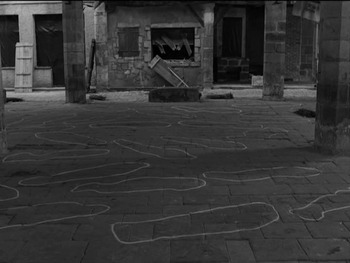
Monk's scapegoating allusions indict AIDS disenfranchisement. The Angel of Death's fiery appearance through a cloud of smoke and his scythe-slicing gestures announce the plague's arrival. The Christians blame the Jews for the destruction. A nonpartisan monk intervenes with an angry Christian mob, claiming that no one is at fault. They trample him. The monk's voice of reason stands out like so many AIDS activists pleading for help with no reply. Blood soaking the village map represents the plague's spread. A storyboard sequence cuts to a “contemporary hospital room” featuring a lone man hooked up to IVs, suggesting an AIDS patient, and then a closeup “of a well with a red X on it,” recalling medieval German accusations that Jews caused the plague by poisoning well water (Monk, Reference Monkn.d.b, 92). These abandoned shots echo Jewish leaders connecting the act of scapegoating during the medieval plague to AIDS. In the film, Jews are in a cage set aflame, recalling pogroms (see also Blanch Reference Blanch2007, 403). One by one, everyone dies. Monk's comment crystallizes when the shrouded bodies in the marketplace fade, leaving behind chalk outlines like ACT UP Die-Ins calling attention to the US government's failure to help people dying of AIDS. (Photo 1) To Monk's audiences, the blended scapegoating of Jewish and gay people for disease was timely. Critic Jack Anderson reported, “When the medieval villagers blame the spread of the Plague on the Jews, a pogrom ensues, and, suddenly, there are imagistic references to today's AIDS epidemic and to persecutions through the centuries” (Reference Anderson1989, 14). A San Francisco critic noted that the film “makes deeper commentary on the nature of society, humankind's enduring ills—the plague then and AIDS now, pogroms then and anti-Semitism [sic] now” (San Francisco Chronicle 32). By incorporating recurrent tropes of ostracizing through fear, the film's allegory, formalism, and cyclic temporality prophesize the present.
Film still from Meredith Monk's Book of Days (Reference Monk1988). Cinematography: Jerry Pantzer. Courtesy Meredith Monk/The House Foundation for the Arts.

Book of Days’ modern-day construction workers excavating Eva's dwelling and finding her visionary drawings on the wall prompt viewers to remember her struggles. Jewish tradition centralizes the imperative to remember. The act of remembrance fights off the pain of exile (Hansen-Glucklich Reference Hansen-Glucklich2014, 9), resonates with yearning for homeland, and grounds Jewish people in a stable relationship to one another amidst diasporic mobility. In her study of Holocaust museums, historian Jennifer Hansen-Glucklich argues that “memorialization practice tells us as much about the present as about the past” (Hansen-Glucklich Reference Hansen-Glucklich2014, 10).Footnote 10 The Holocaust was an attempt to erase, and then forget, Jewish people and cultural production. Remembrance is also central to AIDS memorialization, manifesting most clearly in gay rights activist Cleve Jones's NAMES Project AIDS Memorial Quilt. In both contexts, acts of memorialization fought discrimination to restore people their dignity. Like Book of Days, David Dorfman's Sleep Story manifests this tenet.
Toggling Past and/as Present for Queer Jewish Truths
Sleep Story (1987) mobilizes Holocaust memory for AIDS justice by grappling with representations of death. It is a six-minute duet during which an onstage partner continually fells Dorfman as he tells a dual story of facing experiences of loss from the Holocaust and AIDS. Speaking while jogging in place with the gentle ongoing rhythm of treading water, as if trying to conserve energy to survive, Dorfman recounts visiting George Segal's Holocaust Memorial (1984) sculpture at the California Palace of the Legion of Honor in San Francisco (S. Smith Reference Smith1990).Footnote 11 Dance historian Rebecca Rossen notes that, in Sleep Story, “there is something particularly brave, weighty, and moving about making and witnessing performance created for, about, and at an historically potent site” (Reference Rossen, Jackson, Pappas and Shapiro-Phim2021, 551). As part of Dorfman's allegory, his experience at the sculpture stands in for his experience as AIDS witness.
Jewish temporality determines Sleep Story's structure. Dorfman tells a cross temporal story while Ginger Gillespie, crouched in a long lunge as if a sprinter awaiting the starting gun, intermittently cannons Dorfman backward with the horizontal thrust of a football tackle. Dorfman narrates that, behind a standing plaster figure peering through barbed wire strung between two poles in the sculpture, were “white plaster bodies, some of them piled on top of one another. It almost looked as if they were sleeping, as if they were in another world. Their bodies were full, not the emaciated types one is used to seeing in documentaries or …”—Gillespie knocks him down—“… or photos. But they weren't sleeping.” Dorfman recounts a passerby's insensitive comment about Jewish people dying naked in gas chambers, which the sculpture represents. Dorfman's insistence that “they weren't sleeping” refuses to ignore their deaths.
Dorfman's muscular physique, highlighted by his sleeveless shirt, refutes antisemitic tropes of Ashkenazi Jewish men as effeminate and weak. This embodiment, and his reputation as an “athletic” dancer (MacAdam Reference MacAdam1994, 3C), recall the early twentieth-century “muscular Judaism” movement for Jewish men to bulk up and play sports to fight stereotypes of physical weakness (Foulkes Reference Foulkes2000, 236–237; Jackson Reference Jackson, Roginsky and Rottenberg2020, 150–151). In the 1980s, gay male physical culture responded to images of languishing AIDS patients by projecting muscular strength. The duets Dorfman made concurrently with Dan Froot subverted American Jewish men's anxieties by showing interplay between virility and submissiveness, competition and collaboration, in dances like Bull (1987) and Horn (1987) (see also Rossen Reference Rossen2014, 123–135). Dorfman's choice for a woman to knock him down in Sleep Story similarly upends these perceptions. This layering reflects the ways Jewish and queer discourses construct each other through shared discriminations from Christian heterosexist societal norms (see Jakobsen Reference Jakobsen, Boyarin, Itzkovitz and Pellegrini2003), particularly as they are marked through representations of effeminate corporealities applied to Ashkenazi Jewish men and gay men, and thus links them within what Judith Butler (Reference Butler1993) has termed the “discursively queer.”
Gillespie's body slams become transhistorical cyclic violence. Critic Helen C. Smith's comment that “over and over he [Dorfman] is downed; over and over he struggles back up—and struggles on” describes a resolve to keep fighting (Reference Smith1992, 6). The attacks represent two sets of violence: the toll of the Holocaust's legacy on Dorfman, survivors, and their families, for whom the memory can be emotionally debilitating; and the toll of living through the AIDS crisis, for those infected and those affected by relentless loss of loved ones. To surface AIDS in Sleep Story, Dorfman names people in his community, such as his ballet teacher Ernie Pagnano and the New York fashion designer Willi Smith, who both died of AIDS in 1987 (Albright Reference Albright1997, 137; Carman Reference Carman2008, 60; New York Times 1987, A29; Los Angeles Times 1987). He lists these professional connections alongside his family members who perished in or escaped the Holocaust, and his elder relatives who, he said, were “the only two left” connecting him to his extinguished lineage. According to dance theorist Ann Cooper Albright, “His text consciously recognizes the shared history of Jewish persecution, and through that memory, through the connections to his own bodily history, he remembers (and recounts) the contemporary loss of life as the result of AIDS” (Albright Reference Albright1997, 138). Many critics, even Jewish ones, left Sleep Story's themes untouched (Dunning Reference Dunning1990; Survant Reference Survant1990; Rosen Reference Rosen1989; Rosen Reference Rosen1990; Carbonneau Levy Reference Carbonneau Levy1991; MacAdam Reference MacAdam1994; Zimmer Reference Zimmer1988), but critic Sid Smith noted the intertwinement of Dorfman naming Holocaust and AIDS deaths (1990, E5), and Regina Popper called the dance “a haunting monologue on remembering dead family members, the Holocaust and lost lovers” (Reference Popper1988). Dorfman draws upon his family's Holocaust history in order to grapple with his perception of the scale of AIDS deaths.
Abstracted movement sequences juxtaposed against text provide Sleep Story's emotional content and show modernist-Jewish compositional moves. Dorfman's tactics align with those of Holocaust museums, which enact remembrance in abstract visual terms undergirded by people's stories. Abstracted visuals avoid reducing the magnitude of the Holocaust to a set of images and breaking taboos representing death camp horrors like gas chambers, which undercut the sanctity of life and the terror of dying that way (Hansen-Glucklich Reference Hansen-Glucklich2014, 11–18). Dorfman's sleep metaphor does this. While he repeats, “And then I remembered that they aren't sleeping … and then I remembered that they weren't sleeping,” Gillespie slams her shoulder into his hip at quicker intervals. Dorfman's tiny jogging and Gillespie's horizontally forced tackles have sent Dorfman across the stage, until Gillespie finally does not get up and Dorfman prevails, exhausted. He frenetically chants “aren't sleeping/weren't sleeping” until the words become desperate gasps for air, his shoulders perceptively twisting against his still-jogging feet as if to keep his balance as a shield against death. By juxtaposing present with past tense—“aren't sleeping/weren't sleeping”—Dorfman connects the Jews who perished in the Holocaust to those dying of AIDS. Dorfman never utters the words “Holocaust” or “AIDS.” These events live in the rhythm of “aren't sleeping/weren't sleeping” that stands in for a Jewish-informed acknowledgment of death so that people will not have died in vain.
The words combine with Dorfman's corporeality to generate a queer Jewish imaginary. American Jews who came of age in the mid-twentieth or late twentieth century recognize the Holocaust in Dorfman's description of the plaster bodies as “not the emaciated types one is used to seeing in documentaries.” Similarly, people who lived through AIDS and lost important queer people in their lives in the 1980s and 1990s recognized the rising death toll of friends as the ravages of AIDS. Enacting memory as monument thus activates spectators’ empathy within a shared imaginary. Zane's The Gift/No God Logic did so in a formalist manner.
Questioning the Loyalty of a Jewish God/Living Past Death
The Gift/No God Logic (1987) foregrounds Jewish approaches to life, death, temporality, and questioning God's loyalty amidst Zane's own battle with AIDS. Set to two arias from Verdi's La Forza del Destino (The Power of Destiny) performed by Zane's favorite soprano Montserrat Caballe (Gere Reference Gere2004, 235–236), the dance is a requiem about painful departure that locates the future in the present. Zane premiered The Gift the year before he died and, through it, grappled with AIDS draining his life. The idea of “the gift” is literal and figurative. Zane considered The Gift an offering as the last dance he made (Zane Reference Zane1987b, 23). Within the dance's energetic pattern of gently sailing then landing, the dancers rise, turn, and sink into their weight, ebbing and flowing, joining, separating, like predictable tides, as life will go on without Zane. Reinforcing the imperative to remember, in Jewish practice people say about people who have died, “May their memory be a blessing.” In this sense, this dance's “gift”/blessing is Zane's company continuing his legacy. Yoking melancholy and pain, the dance blends intimacy with public spaces for memorialization.
The Holocaust haunts The Gift in two ways. First, Zane's angry grief recalls the existential Jewish question of how can God exist if tragedies like the Holocaust (and, arguably, AIDS) occur (see Ross Reference Ross, Banes and Harris2003, 37). Second, Zane compared the US government's stigmatizing gay men to the Nazis’ actions, echoing Kramer's Holocaust comparisons: “They took all the millions of gypsies [sic], Jews, gay people, a variety of Catholics, et cetera, and put them on one-way trains, nobody knew how many countries, nobody knew where anybody was going. We know. We know that people are dying” (Zane Reference Zane1987a). One of the first public dance figures to come out as living with AIDS, Zane wanted to fight the hysteria surrounding HIV and ensure public support services for people with HIV/AIDS. The Gift echoes this sentiment.
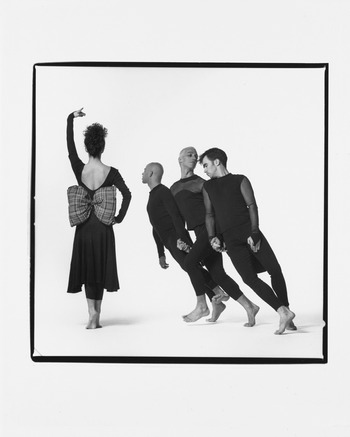
The Gift centers Zane's wrangling with God over his death sentence. When journalist Joanna Simon asked Zane about his future plans, he responded, “I do think broad range still, I do, I do [Zane giggles and gestures upward, as if toward God], I'm into the future. I haven't given it up” (Zane quoted in Jones and Zane Reference Jones and Zane1987). This sentiment materializes in the divinity of a shaft of light from an upstage corner, suggesting the heavens opening, which stands as testament and accusation throughout the work. A smoky haze highlights this conical light beam, illuminating what the company called the “god path” within the mise-en-scène (Bill T. Jones/Arnie Zane Dance Company 1987a, 1–2, 1987b, 1). This “god light” bathes the dancers, as if a divine presence, or Zane's projection of himself visiting loved ones after he is gone, illuminates them (RMW 1987). Dance theorist David Gere noted that Zane “created it at a fraught moment when he could not fathom the possibility of a just or loving God” and that in the 1990s, the phrase “the gift” happened to become slang for giving or receiving AIDS through anal sex (Gere Reference Gere2004, 235, 307n10). Demian Acquavella costumed the dancers—himself plus Arthur Avilés, Seán Curran, and Heidi Latsky—in black long sleeves, billowing elongated shirts, and leggings. Latsky wears a pillowy red plaid bow on her back, as if she is the gift, the vector of transmission.Footnote 12 Zane, too, asserted, “I don't believe in God. There is no God Logic. I mean, 30,000 people dead from this disease, all from my subcultural group. If there is a god in any form, I don't understand it and I don't accept he or she or this being or spirit” (Zane Reference Zane1987b, 23). Zane's claim that he does not believe in God does not foreclose his relationship to Judaism. On the MacNeil/Lehrer NewsHour in July 1987, Zane wore a gold necklace with a Star of David and a cha'i amulet, which consists of two Hebrew letters that spell out “life” and represents the value of being alive. Like the activist in How to Survive a Plague, Zane's jewelry claims his Jewishness with his queerness, and suggests he feels that Jewish culture is part of him, including challenging divine existence.
The formalist aesthetic structures of Zane's composition continued histories of queer modernism. Zane built The Gift from five designs he drew on a piece of paper, to which the dancers return over the course of the dance in a minimalist fashion (Zane Reference Zane1987b, 24). Bill T. Jones recalled, “He made this piece in the way in which he usually does, starting with a very severe series of patterns which are repeated. Then there are the variations on them—he never does anything purely mathematical” (quoted in Wallach Reference Wallach1988, 14). This is what Gere calls Zane's “stringent postmodernism” (2004, 235), which is a kind of neo-modernism through its minimalist formalism. Zane's choreography focused on structures and patterns; journalist Marcia Pally noted that Zane was “intrigued by the possibilities evoked by crossing a square space for 55 minutes” (Pally, Reference Pallyn.d., n.p.), an exercise that recalls those of queer choreographers such as Merce Cunningham and Paul Taylor, who straddled the compositional divides of modernism and postmodernism (cf. Kowal Reference Kowal2010, 151–193). The Gift's tightly choreographed formalist intertwining of compositional structure recalls queer-deflecting modernist quartets like José Limón's The Moor's Pavane (1949) (Manning Reference Manning2004, 193–201). However, The Gift's formalism proliferates, instead of elides, queerness. Zane yearned for, even demanded, a “sense of sexual freedom” on stage. He told Lesley Farlow in 1987, “I'm so put off by the dance world that I come from, the passing, the way people are constantly trying to pass in a heterosexualized way, the way we continue to act out the dreams of a lifestyle which we ourselves don't live, and I'm saying that as a gay man. This has always left a bad taste in my mouth” (Zane Reference Zane1987b, 27; emphasis in original). Queerness challenges hierarchies because it defies heteronormativity, and in this way, queer dance “disrupts” (Croft Reference Croft2017, 2). Lawrence Goldhuber, a gay Jewish member of Bill T. Jones/Arnie Zane & Company in the 1980s and 1990s, identified the company's out-gayness and queer choreographic logics in the 1980s as part of its postmodern mark (Goldhuber Reference Goldhuber1997, 16). The publicity around Jones and Zane in mainstream dance periodicals like Dance Magazine and Ballet News also suggested that the company's queerness buttressed its pop appeal (Zimmer Reference Zimmer1984; Laine Reference Laine1985).
Importantly, The Gift generated queer communitas. The dancers often gently dip into one another and finish upside down or supported aloft by one or more of their compatriots. At the time, Avilés said, “For us the piece was about helping each other out. We were always lifting one another, reaching out hands” (quoted in Miller Reference Miller1987, 5). This support was clear to audiences. Critic Tobi Tobias wrote, “This quartet might be Zane's vision of the closely knit company just after his leaving them,” (Reference Tobias1989, 82) and Deborah Jowitt noted, “Each seems vigilant to maintain the group's harmony and equilibrium, to lift the fallen, [… as they] move gravely from one position to another” (Jowitt Reference Jowitt1988, 93). Even with lingering death, as Jowitt's “gravely” suggests, queer communitas remains. The Gift is a gay man's world, alongside 1980s collaborations on which Jones and Zane embarked, such as Secret Pastures (1985), aesthetically defined by gay artists Keith Haring and Willi Smith, who both died of AIDS, and reflecting Zane's work that he premiered concurrent to The Gift, such as Like in Egypt (Reference Zane1988), a gold-clad, archaically queer, and somewhat orientalist wonderland of angular hieroglyphic gestures and vogue-like poses for Acquavella, Avilés, and Curran. Photo 2 shows a sense of queer camaraderie among The Gift's men, as they grasp hands to support their weighted fall, with Curran leaning into the tilt of Acquavella's downcast gaze. Throughout the dance, Latsky opposes the men in space but sometimes they partner her, delicately thread her upward, or relocate her to another spot. A catalyst, she alternates between being a life force and an angel of death by spreading her arms like wings or leading the men's arms into wings. It seems unfair that Latsky, the sole woman and only Jewish dancer onstage, is marked as the god-illogical vector of disease, resonating with stigmatization like that in Monk's Book of Days. Latsky may also be a stand-in for Zane, supported by his community. The dancers’ geometric kaleidoscoping comes into focus when petite, purposeful foot slides draw them into a tight but uneven final square made by the angles of their feet and outlines of their bodies facing different directions, settling in a memorial resolution.
Dancers, left to right: Heidi Latsky, Arthur Avilés, Demian Acquavella, and Seán Curran in The Gift/No God Logic (1987) by Arnie Zane. Photo of The Gift/No God Logic (1987), © Lois Greenfield. Jerome Robbins Dance Division, The New York Public Library for the Performing Arts.

A memorialization adjacent to The Gift is Goldhuber saying Kaddish for Zane in the moments after he died, at Zane's mother's request (Jones Reference Jones1995, 183). Reciting the Jewish Mourner's Kaddish is intimate; this Aramaic prayer about peace has a mumbling, comforting rhythm. The Mourner's Kaddish shepherds the soul of the person who died and keeps that person's memory alive when people say it in remembrance. Many Jews in the American Reform movement feel that standing together during this Kaddish since the Holocaust serves as communal support and commemoration for all victims. Bedside Kaddishes for AIDS patients were powerful. Two San Francisco-area Reform rabbis, one straight and one gay, were so affected by saying Kaddish for AIDS hospice patients that they focused 1985 sermons for Kol Nidre (the night before Yom Kippur, the holiest time in the Jewish calendar) on AIDS (Drinkwater Reference Drinkwater2020, 124–129). Gay Jewish playwright Tony Kushner's Angels in America (1993) also pivots on an AIDS bedside Kaddish, which gender theorist Jyl Lynn Felman calls “a restructuring of the post-immigrant experience” (2002, 195). Goldhuber's Kaddish for Zane was a Jewish AIDS memorialization. This final moment with Zane became The Gift's opening light beam, as if subsequent performances were like yahrzeit (memorial) candles keeping Zane's memory alive. After Zane died, Jones saw himself and Zane in The Gift at a moment when two dancers reach for each other (Jones Reference Jones1995, 186). The Gift's beaming light in performances after Zane died surfaced queer Jewish AIDS activism within a queer Jewish imaginary by fulfilling Zane's prophesy that his memory would endure, one shared by many gay men dying of AIDS.
Conclusion
When LGBTQ+ Jewish choreographers mobilized Holocaust memory to agitate for AIDS justice, their dances generated a queer Jewish imaginary by engaging LGBTQ+ Jewish positionalities through modernist compositional tactics to act in spite of transhistorical pain. Their works identified alienating similarities between gay people's and Jewish people's experiences of scapegoating, death, and defiance during AIDS and the Holocaust. The long modernist midcentury is predicated on how modernist compositional strategies collected artists and audience members into an imaginary of embodied peoplehood. Monk, Dorfman, and Zane composed queer aesthetics reliant on Jewish histories that interrupted the assimilationist benefits of postwar modernism (see Kosstrin Reference Kosstrin2017). Their works implored the public to fight AIDS without re-stigmatizing gay people in the ways Jewish people experienced for generations. Understanding these choreographers’ works within a long modernist midcentury connects queer Jewish modernisms to the varied temporalities of global modernity.