Implications
Previous fasting heat production (FHP) values of broilers have been considered to be proportional to BW0.75 and most literature values were obtained in fatter and slower growing broilers. The present compilation of measurements obtained in modern lines of broilers indicates that the new FHP values should be expressed per kg of BW0.70. They provide a basis for the estimation of maintenance requirements and the development of new energy systems for poultry, especially in connection with more appropriate systems that are based on the net energy concept.
Introduction
The fasting heat production (FHP) of animals is indicative of their basal metabolic rate and is used to estimate their maintenance energy requirements. It is also used for calculating the net energy (NE) value of feeds in growing animals (Noblet et al., Reference Noblet, Shi and Dubois1994; Carré et al., Reference Carré, Lessire and Juin2014). Between and within animal species, the FHP is related to the so-called metabolic body weight (MBW) based on the concept of a constant FHP per unit of MBW for an animal (or for a group of animals) over a large BW range and in standardized climatic conditions and animals behavior. For comparing FHP in adult animals of different species, MBW is frequently expressed as BW0.75 (Kleiber, Reference Kleiber1947). But the validity of the 0.75 exponent has been questioned in growing farm animals, and values of 0.60, 0.85 and 0.70 have been suggested for growing pigs (Noblet et al., Reference Noblet, Karege, Dubois and van Milgen1999), growing calves (Labussière et al., Reference Labussière, Dubois, van Milgen, Bertrand and Noblet2008) and growing turkeys (Rivera-Torres et al., Reference Rivera-Torres, Noblet, Dubois and van Milgen2010), respectively. In addition, estimates of FHP vary with animal characteristics (e.g., genotype in pigs; van Milgen et al., Reference van Milgen, Bernier, Lecozler, Dubois and Noblet1998) and previous feeding conditions with a lower FHP at lower feeding levels in pigs, lambs or calves (Koong et al., Reference Koong, Nienaber, Pekas and Yen1982; de Lange et al., Reference De Lange, van Milgen, Noblet, Dubois and Birkett2006; Labussière et al., Reference Labussière, van Milgen, de Lange and Noblet2011). Estimates of FHP also depend on the methods used for its measurement or calculation. For instance, the method of extrapolating the heat production (HP) measured at different levels of energy intakes to zero energy intake has been criticized (Labussière et al., Reference Labussière, van Milgen, de Lange and Noblet2011) and may provide biologically unrealistic results such as FHP values not different from zero (Renaudeau et al., 2006). The adjustments of FHP for variation in physical activity of the animals or the duration of fasting are also of importance (e.g., Close and Mount, Reference Close and Mount1975).
In the case of broilers, FHP measurements are available from studies conducted between 1960 and 1990 with concomitant recommendations about the most appropriate exponent for MBW ranging from 0.5 to 1.0 (Berman and Snapir, Reference Berman and Snapir1965; Kuenzel and Kuenzel, Reference Kuenzel and Kuenzel1977; Siregar and Farrell, Reference Siregar and Farrell1980; Meltzer, Reference Meltzer1983; Johnson and Farrell, Reference Johnson and Farrell1985; Rogers et al., Reference Rogers, Pest and Johnson1991). These different exponents result from measurements conducted according to different methodologies, environmental conditions and types (genotype, sex, age, etc.) of birds. The objective of the present work is to reassess FHP in modern broilers and especially the exponent for expressing the metabolic BW. To achieve that objective, 73 FHP measurements obtained between 2000 and 2012 in our laboratory on fast-growing male broilers over a wide BW range, under comparable environment conditions, and according to a common methodology validated in other growing farm animals (i.e., turkeys, pigs and calves) (Labussière et al., Reference Labussière, van Milgen, de Lange and Noblet2011) were combined.
Material and methods
The experiments complied with the French law on animal experimentation and ethics and were conducted under the direction of J. Noblet, authorized by the French Ministry of Agriculture and Fisheries (authorization number: 04739).
Experimental designs and diets
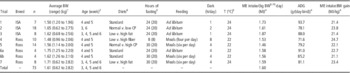
The FHP data originate from seven studies designed to determine the effect of diet characteristics on components of HP in growing male broilers and to evaluate the interest of a NE system for growing broilers and, more generally, for poultry (Table 1). In each study, groups of broilers were kept in a respiration chamber for 5 or 6 days for measuring the HP and the metabolizable energy (ME) content of the diet as well as calculating the protein, fat and energy balances in a fed state. Broilers then spent an additional day in the respiration chamber without receiving feed to estimate the FHP; water remained available. This methodology used in our laboratory has been described in detail by Barea et al. (Reference Barea, Dubois, Gilbert, Sellier, van Milgen and Noblet2010), Labussière et al. (Reference Labussière, Maxin, Dubois, van Milgen, Bertrand and Noblet2009) and Rivera-Torres et al. (Reference Rivera-Torres, Noblet, Dubois and van Milgen2010) for pigs, veal calves and turkeys, respectively. In each broiler study, either a single standard diet (trials 1 or 6) or a control and experimental diets (trials 2, 3, 4, 5 and 7) were offered to the broilers. A single 1.5 m3 respiration chamber, in which a metabolic cage (1.10×0.70 m floor space) was introduced, was used for the studies. Each study was conducted on successive batches of 40 to 50 broilers with successive measurements on sub-samples of birds within each batch during either 2 (i.e., at 3 or 6 weeks of age or at 4 and 5 weeks of age) or 4 (i.e., at 3, 4, 5 or 6 weeks of age) 1-week periods; each broiler in a given batch was measured only once. The number of broilers in the respiration chamber was adjusted to their age or BW, varying from 15 (3 weeks old) to 5 (6 weeks old) broilers. In the studies with two dietary treatments, each diet was measured on the 1st and 3rd week in one batch of broilers and on the 2nd and 4th week in the second batch of broilers to obtain results at similar ages and BW for the two diets. This design was repeated to obtain four to eight measurements per diet (Table 1).
Main characteristics of trials used for fasting heat production (FHP) measurements in group-housed broilers

ME=metabolizable energy.
1 Average BW of 5 to 14 broilers per group.
2 Age in weeks during the balance period; FHP measurement was carried out on the last day of the week.
3 In brackets, number of hours used for estimating FHP (see text).
4 Performance during the previous 5 to 6 days balance period.
5 Temperature on the fasting day; this was either equal or 1°C higher than during the preceding fed period.
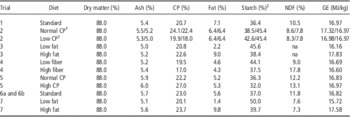
6 Detailed characteristics of diets are given in Table 2.
Trial 1 was conducted for FHP measurements in 4 and 5-weeks-old broilers for calculating the NE value of diets according the comparative slaughter technique (Carré et al., Reference Carré, Lessire and Juin2014). In trials 2 and 3, two diets with reduced levels of protein (trial 2) or fat (trial 3) were compared with control diets and measurements were conducted in birds that varied between 3 and 6 weeks of age. In trial 2, the CP content of diets fed on weeks 5 and 6 was lower than on weeks 3 and 4, but the difference in CP content between the low and the control CP diets was the same at both periods (i.e., 4 percentage units). In both trials, the changes in CP or in fat level were associated with opposite changes in starch content (Table 2) and were obtained by substitution of corn starch by soybean isolate or rapeseed oil. In these first three trials, birds were from the ISA breed and were offered feed ad libitum. Ross birds were used in trials 4 to 7. In trials 4, 5 and 7, two diets differing in dietary fiber (trial 4), CP (trial 5) and fat (trial 7) were compared at weeks 4 and 5 of age (trials 4 and 5) or weeks 3 to 6 (trial 7). In these three trials, birds were meal fed, each meal feeding consisting of 30 min ad libitum access to the feed. Access to the feeder was regulated by a cover that was opened or closed according to a time schedule. This meal methodology was implemented to differentiate the short-term and long-term components of the thermic effect of ingested feed (van Milgen et al., Reference van Milgen, Noblet, Dubois and Bernier1997). Compared with trial 2 that tested a control and a low CP diet, trial 5 evaluated a control and an excess protein diet (Table 2); trial 7 was equivalent to trial 3, except for the feed distribution (meals v. ad libitum). Finally, trial 6 was a methodological trial conducted with a standard diet and designed to compare the energy balance and HP of broilers offered feed ad libitum or in six meals per day. In all trials, the ratio between calculated digestible Lys content and calculated ME content and the ratios between essential amino acids and Lys (calculated values) met or exceeded the standard recommendations provided by the breeding company that supplied the broilers. The complete characteristics of diets (i.e., ingredients and nutritional values) will be presented in forthcoming papers and only the analyzed nutrient composition of the experimental diets is presented in Table 2. The most important aspects in each protocol of the different studies are summarized in Table 1. A dark period was imposed either for 1 or 2 h starting at midnight or for 4 h starting at 0200 h. The windows of the chamber were obscured to avoid an effect of outside natural or artificial lighting. In trial 4, the fasting period lasted only 8 h (0900 to 1700 h) with darkness throughout the period in an attempt to shorten the fasting period and also being able to start a new series of measurements on the next morning with cleaned equipment.
Diet characteristics (values standardized for 88% dry matter) in trials used for measuring heat production in broilers

GE=gross energy.
1 Dietary CP content was adjusted to BW: the first value corresponds to the diet fed at 3 weeks of age and the second value to the diet fed at 6 weeks of age.
2 Polarimetric method.
Measurements
The dietary ME values, HP and energy balance measurements were carried out according to routine techniques used in our laboratory and described in publications of Noblet et al. (Reference Noblet, Henry and Dubois1987), van Milgen et al. (Reference van Milgen, Bernier, Lecozler, Dubois and Noblet1998) or Labussière et al. (Reference Labussière, Maxin, Dubois, van Milgen, Bertrand and Noblet2009). In brief, birds were weighed on the morning of the 1st day in the respiration chamber and on the morning of the fasting day. Dry matter (DM) feed intake of the group was measured daily and for the total period by a load cell located below the feeder. Excreta were cumulated over the total fed period and collected on morning of the fasting day. Possible feed spillage was also collected and weighed on morning of the fasting day. The respiration chamber was an open-circuit system from which gases were extracted and analyzed for O2 and CO2 concentration. Variations in gas concentration between ingoing and outgoing gas were measured continuously by a paramagnetic differential O2 analyzer (Oxymat 6; Siemens AG, Munich, Germany) and an IR CO2 analyzer (Unor 600; Maihak AG, Hamburg, Germany or Ultramat 6; Siemens AG). A mass gas flow meter (Teledyne Brown Engineering, Hampton, VA, USA) measured the gas extraction rate. The cage was mounted on four force sensors (9104 A; Kistler, Winterthur, Switzerland), which measured an electrical signal proportional to the force exerted on the cage. This measurement allowed quantifying the physical activity of the birds. Measurements of gas concentrations and force were performed 60 times per second, averaged over successive 10-s periods, and stored on a computer. Each day, the continuous measurements were interrupted in the morning (between 0800 and 0900 h) for 20 to 30 min for calibrations, storage of data and interventions on the birds if needed. The same measurements, except feed intake, were carried out on the fasting day.
Chemical analyses
Samples of feed were analyzed for the different criteria considered in Table 2. Excreta were measured for DM, ash, N and gross energy contents in all trials and for additional criteria such as fat in trials 3 and 7 and dietary fiber in trial 4. Routine methods were used (Noblet et al., Reference Noblet, Shi and Dubois1994).
Calculations and statistical analyses
The ME values of the feeds were calculated for each balance period as the difference between energy intake and loss of energy in excreta, divided by feed intake. HP calculations during the fed days will not be detailed here, but reported in forthcoming papers. During the fasting day, the dynamics of HP can be attributed to physical activity and to a gradually declining HP when the broilers transition from an anabolic fed state to a catabolic fasting state (Labussière et al., Reference Labussière, van Milgen, de Lange and Noblet2011). As described by van Milgen et al. (Reference van Milgen, Noblet, Dubois and Bernier1997), it is assumed that this transition is asymptotic and the asymptote or minimal HP corresponds to the FHP at zero physical activity. In the statistical estimation procedure, time and the measured physical activity (i.e., the signal from the force sensors) were used as independent variables and the measured O2 and CO2 concentrations of the outgoing air from the chamber during the fasting day as dependent variables. The respiration chamber was opened on the morning of the fasting day for broiler weighing, excreta collection, feed withdrawal and calibrations of gas analyzers. These operations took 30 to 45 min. In addition, after the door of the chamber was closed, it also took some time for the birds to overcome the eventual stress of the previous operations and the gas concentrations in the chamber to increase and become more stable. The measurements over the first 4 h of the fasting day were therefore excluded from the modeling procedure for estimating FHP (Table 1). The only exception again was trial 4 with modeling of data immediately after closing the door of the respiration chamber. Finally, it should be pointed out that the fasting state was more pronounced in the meal-fed studies (last meal at 0100 h before the dark period) than in the ad libitum fed studies (last meal shortly but variably before the interruption of measurements of the last fed day). Calculations were carried out on the group of broilers and further expressed per broiler according to the number of broilers in the respiration chamber.
The FHP values are usually considered as a power function of the BW of the individual animal. However, several studies have shown that the exponent may differ among animal species, stage of production or calculation methods. We therefore consider that the exponent may be specific for growing modern broilers and that FHP is related to BW according to the following formula:
 $${\rm FHP (kJ}/{\rm day)}=a{\times}{\rm BW}^{b} $$
where b is the scalar of BW, BW the BW measured on the morning of the fasting day in kg (i.e., total BW divided by the number of broilers in the respiration chamber) and a the FHP per unit of scaled BW. However, the residuals (i.e., observed minus predicted) of such a model vary with the magnitude of the dependent variable. A logarithmic transformation of the equation was therefore used:
 $${\rm log(FHP)}={\rm log(}a{\rm )}{\plus}b{\times}{\rm log(BW)}$$
In this model, it was assumed that log (a) was dependent on trial and diet (within trial) while the b coefficient was dependent on trial only. In trial 6, two modes of feed distribution were applied (ad libitum v. meals) and each mode was considered as a separate trial identified as 6a (ad libitum) and 6b (meals) (Table 1). In this model, the diet effect was not significant (P>0.05) and the b coefficient was not affected by the trial (P>0.05). The model indicated in equation (1) was therefore simplified with only a trial effect (log(a)) and a constant b value. Unlike the studies of Labussière et al. (Reference Labussière, van Milgen, de Lange and Noblet2011) indicating an effect of the previous feeding level on FHP values, this effect could not be tested in the present studies since all animals were fed close to their ad libitum intake and feed intakes were little variable. The b value of that analysis was used to express the FHP values per unit of metabolic BW (BW b ). The latter values were tested for the effects of trial and diet (within trial) on one hand and the effect of breed (ISA v. Ross) and trial (within breed) on the other hand. Daily FHP values were also analyzed according to a covariance model with BW b as covariate, the coefficient of the covariate being dependent on trial and diet (within trial). All statistical analyses were carried out with the GLM procedures of SAS (SAS Institute Inc., Cary, NC, USA).
Results and discussion
As indicated in Table 1, the broilers used in our studies had satisfactory performance during the fed period in the respiration chamber with daily BW gains ranging between 80 and 90 g/day between 3 and 6 weeks of age. The lowest value (72 g/day) observed in trial 4 for one diet was probably related to the limited number of meals (four per day) and the high percentage of dietary fiber. Overall, the broilers used in these studies can be considered as representative of modern fast-growing broilers under commercial conditions.
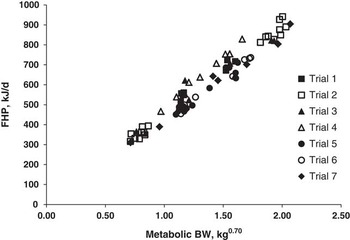
The application of the logarithmic model on FHP data (n=73) indicated a value of 0.694 (±0.012) for the b exponent, both effects of the log (BW) covariate and trial being highly significant (P<0.001; R 2=0.98). For simplicity, the most appropriate coefficient from our set of data was considered to be 0.70 (Figure 1). In addition, our result is quite precise (low s.d.) and the b value differs (P<0.05) from the conventional value of 0.75 proposed for interspecies comparisons in adults (Kleiber, Reference Kleiber1947). Studies conducted in the 1970s and 1980s on FHP in broilers that grew much slower than those in our trial suggested that the most appropriate coefficient for metabolic BW was about 0.60 (Meltzer, Reference Meltzer1983; Johnson and Farrell, Reference Johnson and Farrell1985). Other studies also suggested that the most appropriate coefficient was higher in younger than in older or mature birds (Hoffmann et al., Reference Hoffmann, Klein and Schiemann1982; Meltzer, Reference Meltzer1983), being close to 1.0 for birds below 0.5 kg (Kuenzel and Kuenzel, Reference Kuenzel and Kuenzel1977). In fact, the most appropriate exponent depends on the characteristics of the data set (e.g., BW range, growth potential) used for its calculation. It should also be pointed out that the basal metabolic rate of animals depends on the feed intake before fasting (Labussière et al., Reference Labussière, van Milgen, de Lange and Noblet2011). Our result (0.70) obtained on a large BW range (0.6 to 2.8 kg) of fast-growing broilers and also in fast-growing turkeys (Rivera-Torres et al., Reference Rivera-Torres, Noblet, Dubois and van Milgen2010; Noblet et al., Reference Noblet, Labussière, Dubois, de Lange, Barea, Lasnier, Rivera, Warpechowski and van Milgen2013) can be considered as a reliable basis for expressing the MBW of present and near future broilers and also turkeys. As for growing pigs (0.60; Noblet et al., Reference Noblet, Karege, Dubois and van Milgen1999), growing veal calves (0.85, Labussière et al., Reference Labussière, Maxin, Dubois, van Milgen, Bertrand and Noblet2009) or growing turkeys (0.70; Rivera-Torres et al., Reference Rivera-Torres, Noblet, Dubois and van Milgen2010), this study indicates that the most appropriate exponent for MBW in broilers differs from the conventional 0.75 value. The reasons for these differences between species or even within species require complementary studies on allometry of development of body tissues (e.g., liver, visceral tract, muscles) and the changes in their specific metabolic activities.
Relationship between measured fasting heat production and metabolic BW (kg0.70) in 3 to 6 weeks broilers according to trial number (see Table 1).

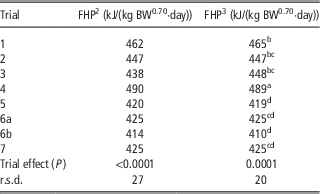
As indicated in Table 3 and illustrated in Figure 1, the FHP expressed per kg BW0.70 varied significantly (P<0.0001) between studies. However, most of the variation is due to the high value observed in trial 4 (490 kJ/(kg BW0.70·day)), which was carried out over a much shorter fasting duration. This duration (6 h after the last meal plus 8 h without feed), even it was combined with darkness, may have been insufficient to reach the asymptotic value of FHP. In other words, a longer duration of fasting (24 h) is required for getting a reliable estimate of FHP. Even though studies using Ross broilers were not conducted simultaneously, our results also suggest a lower FHP in trials 5 to 7 (420 kJ/(kg BW0.70·day)) conducted on Ross broilers. The four values obtained in trials 5 to 7 are remarkably similar, even though they were conducted over an 8-year period (from 2004 to 2012). However, a conclusion on the existence of a breed effect on FHP should be formulated with caution since the studies were not contemporary. In addition, the trials on ISA birds were conducted using ad libitum fed birds while those on Ross were carried out using meal-fed birds, even though the mode of distribution had a negligible effect on FHP (trials 6a and 6b; Table 3).
Fasting heat production (FHP) at zero activity in group-housed broilers: trial effectFootnote 1

1 See Table 1 for description of trials.
2 According to a covariance model where daily FHP is a linear function of metabolic BW (BW0.70), the coefficient of BW0.70 being dependent on trial. The FHP value in each trial represents the slope of the relationship adjusted for the trial effect; r.s.d. of the covariance model. The effect of BW0.70 was significant (P<0.0001).
3 According to a variance model with FHP per kg of metabolic BW (BW0.70) as affected by trial number. The diet effect within trial was not significant; values within the column without common superscript are different (P<0.05). If data of trial 4 were excluded (see Table 1), FHP per kg of metabolic BW (BW0.70) was higher (P<0.01) in trials 1, 2 and 3 (ISA breed) than in trials 5, 6 and 7 (Ross breed).
Measurements of FHP or starving HP are quite numerous in the literature but most of these have been obtained before the 1990s. The compilation of data by Johnson and Farrell (Reference Johnson and Farrell1985) represents a global estimate of FHP in growing poultry (layer pullets, broilers). They proposed that starving HP was equal to 400 kJ/(kg BW0.646·day) in immature birds by using the model given in equation (1). Applying that formula to 1 and 2 kg birds results in an FHP of 400 and 626 kJ/day, respectively. The corresponding values according to our results (420 kJ/(kg BW0.70·day) in the Ross broilers) are 420 and 682 kJ/day. Both sets of calculations are rather similar, despite differences between the two sets of measurements in terms of characteristics of birds (i.e., slow growing and probably fatter in the compilation of Johnson and Farrell, Reference Johnson and Farrell1985) and the experimental protocol (e.g., direct measurement of starving HP that includes HP related to physical activity in the late studies v. extrapolated FHP at zero activity in our more recent studies). If we extrapolate the observations on pigs with higher FHP when they get leaner or achieve faster growth (van Milgen et al., Reference van Milgen, Bernier, Lecozler, Dubois and Noblet1998), the slightly higher FHP in our studies would result from both a decrease due to subtraction of activity HP and an increase in FHP due to changes in broiler characteristics. Finally, the statistical approach based on equation (1) in the studies of Johnson and Farrell (Reference Johnson and Farrell1985) did not take into account the effect of trial or layer v. broiler, for instance, yielding much lower accuracies of the coefficients they obtained: s.d. of 0.108 for b and R 2 of 0.32 (v. s.d. of 0.012 and R 2 of 0.98 in the compilation of our results).
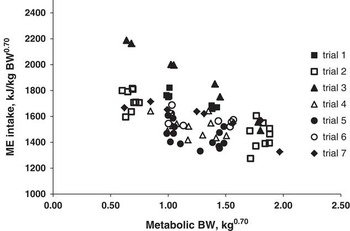
As indicated above, FHP can be used for estimating the energy requirements for maintenance, either on a NE basis (i.e., FHP) or on a ME basis by assuming an efficiency of ME for NE. Using our estimate of FHP (420 kJ/(kg BW0.70·day)) and the 76% average efficiency of using apparent metabolizable energy (AME) for NE in broilers proposed by Carré et al. (Reference Carré, Lessire and Juin2014), an AME requirement for maintenance (AMEm) of 550 kJ/(kg BW0.70·day) can be estimated. Comparing this value to the average AME intake over the trials (1.60 MJ AME/(kg BW0.70·day); Table 1 and Figure 2) indicates that the voluntary AME intake in modern growing broilers is equivalent to about three times AMEm. The compilation of our energy balance measurements on the days before the fasting day also indicates that this AME intake expressed per kg of MBW decreases regularly with increasing BW and represents only 2.5 times AMEm at the highest BW of our study (Figure 2).
Relationship between metabolic BW and metabolizable energy intake in 3 to 6 weeks broilers according to trial number (see Table 1).

In conclusion, the compilation of a large number of FHP measurements conducted according to a common methodology and with appropriate statistical methods that explain most of the variability between measurements allows an update of the exponent for expressing the MBW in modern fast-growing broilers. As for other farmed growing animals, the use of a 0.75 exponent will bias the FHP and AMEm values during growth and a value of 0.70 is recommended for broilers. When expressed per kg BW0.70 and excluding trial 4, the FHP at zero activity and under thermoneutral conditions ranges between 420 (trials 5, 6 and 7) and 450 kJ/(kg BW0.70·day) (trials 1, 2 and 3) with corresponding AMEm values ranging between 550 and 590 kJ/( kg BW0.70·day). These results represent new bases for estimating the energy requirements of broilers and NE values of broiler diets.
Acknowledgments
The authors acknowledge R. Vilboux and G. Guillemois for feeds preparation, F. Le Gouevec, V. Piedvache and A. Roger for animal care and P. Bodinier, S. Hillion, Y. Jaguelin and A. Pasquier for chemical analyses.