INTRODUCTION
For as long as parasite systems have been studied, parasitologists have sought to explain variation in the assemblage of species parasitizing different individuals within and among host species. Variation in parasitic guild structure among host species is surely influenced by a range of factors, such as host specificity and host ecology. Within a species, however, discerning patterns beyond random variation among individuals has been as fascinating as it has been perplexing. Overarching patterns governing faunal variation are rare and universal laws difficult to determine (Guégan et al. Reference Guégan, Morand, Poulin, Thomas, Renaud and Guégan2005). Perhaps the most consistent patterns, when patterns exist, governing a host individual's parasite fauna have been linked to the distance decay hypothesis (Poulin and Morand, Reference Poulin and Morand1999; Morand and Guégan, Reference Morand and Guégan2000; Poulin, Reference Poulin2003) and the latitudinal gradient hypothesis (Rohde, Reference Rohde1993; Poulin, Reference Poulin1998b). The distance decay hypothesis, in relation to parasite systems, predicts that the similarity in the make-up of the parasite fauna of conspecific host populations will decrease with an increase in the geographical distance between them (Poulin and Morand, Reference Poulin and Morand1999). The latitudinal gradient hypothesis is directed more specifically at overall species richness of the assemblage parasitizing a given host and is based on the observation, both in parasite and non-parasite systems, that species richness is higher in ecosystems closer to the equator than in those closer to the poles (Hawkins et al. Reference Hawkins, Field, Cornell, Currie, Guégan, Kaufman, Kerr, Mittlebach, Oberdorff, O'Brien, Porter and Turner2003). However, these patterns do not necessarily apply to all systems (Kennedy et al. Reference Kennedy, Hartvigsen and Halvorsen1991; Brown, Reference Brown1995; Rosenzweig, Reference Rosenzweig1995) and, although they have been used successfully in some systems occurring over large geographical areas, the utility of distance decay and latitudinal gradients across smaller geographical ranges or, in the case of the latitudinal gradient hypothesis, longitudinally broad rather than latitudinally long ranges, is perhaps somewhat limited. A major obstacle in defining non-random patterns in parasite systems is the remarkable array of parasitic behaviours and life-cycles. Perhaps a more targeted approach of searching for non-random patterns in more specific systems in which there are fewer confounding obstacles, such as intermediate hosts, will provide a simpler system for investigations leading to additional discernment of useful patterns in the variation of parasite assemblages.
For any parasite, one of the most ‘dangerous’ periods of its life-cycle is the time during which it must exist outside of its host. Multi-host life-cycles, such as those found in many platyhelminths and protists, represent a common adaptation which helps overcome this danger by allowing life-cycle stages to shelter in intermediate hosts. Many parasites, such as the oxyurid nematodes (‘pinworms’), do not have intermediate hosts, and thus have direct modes of transmission.
In pinworm systems, females produce eggs which are shed in the host's faeces and must survive in the external environment long enough to be ingested by a new host (Adamson, Reference Adamson1984). Numerous studies have suggested that oxyurid eggs are sensitive to environmental conditions, particularly moisture (Geller, Reference Geller1944; Anya, Reference Anya1966; Adamson, Reference Adamson1989; Grice and Prociv, Reference Grice and Prociv1993). Geller (Reference Geller1944) showed that eggs of the human pinworm, Enterobius vermicularis, required humidity levels of ∼100% to develop. Similar requirements were observed by Skrjabin et al. (Reference Skrjabin, Schikhobalova and Lagodovskaya1960) for the horse pinworm, Oxyuris equi. Grice and Prociv (Reference Grice and Prociv1993) demonstrated that eggs of the rat pinworm, Syphacia obvelata, collapsed if exposed to conditions that were too dry and ruptured or opened prematurely in excessive moisture. However, these responses are not universal; levels of susceptibility vary among species (McSorley, Reference McSorley2003), suggesting that some species are more or less suited than others to the external environment across a range of climates. From these findings, it can be predicted that the pinworm fauna of widely distributed hosts varies in response to different local climatic conditions. There is presently little information available to test this hypothesis.
Macropanesthia rhinoceros (Blattodea: Geoscapheinae) has an unusually wide geographical distribution relative to the other burrowing cockroaches (Roth, Reference Roth1977; Walker et al. Reference Walker, Rugg and Rose1994). Jex et al. (Reference Jex, Schneider, Rose and Cribb2006) reported the thelastomatoid fauna of this species from a number of localities across Queensland, Australia. Here, we extend this previous study and examine in detail the relationship between local climate and the observed and estimated richness and overall composition of the thelastomatoid guilds parasitizing this host species. We test for patterns in thelastomatoid distribution both at the individual species and the guild levels. Additionally, we examine ecological and physiological characteristics which may explain these distribution patterns.
MATERIALS AND METHODS
Data collection
Specimens of Macropanesthia rhinoceros (n=114) were collected from 13 localities across Queensland, Australia, over ∼20 years. All cockroach specimens were preserved in 70% ethanol, where they remained until recent dissection. A transverse incision was made along the posterior end of the abdomen. The hindgut was then teased out and severed at the point immediately anterior to the origin of the Malpighian tubules. The excised hindgut was dissected, and all nematodes found were extracted and preserved in fresh 70% ethanol. Preserved nematodes were placed in a (v/v) solution of 100% glycerol in 100% ethanol to a final concentration of 5% glycerol and 95% ethanol. These were left uncovered for 48 h to allow the ethanol to evaporate, thereby leaving the specimens in 100% glycerol. This was done to limit any damage to the worms caused by rapid transfer to pure glycerol. The nematodes were mounted in glycerol using the wax-ring method described by Hunt (Reference Hunt2002). All nematodes were identified using a morphological character database compiled from the literature as described by Jex et al. (Reference Jex, Schneider, Rose and Cribb2005).
Climate comparisons
Relative aridity was calculated using Budyko's Aridity Index (θ) (Budyko, Reference Budyko1974). We used the equation as defined by Arora (Reference Arora2002) : θ=P/PE, where P is annual precipitation and PE is annual potential evapotranspiration. We employed areal potential evapotranspiration, which is defined as “the evapotranspiration that would take place, if there is unlimited water supply, from an area large enough such that the effects of any upwind boundary transitions are negligible, and local variations are integrated to an areal average”. This was done to limit the impact of micro-climate variation at individual localities. All climate and ‘potential evapotranspiration’ data were provided by the Bureau of Meteorology, Victoria, Australia (webclim@bom.gov.au).
Estimation of species richness and non-linear regression analysis
Species richness estimates were calculated using the software package EstimateS v.7.0 (available at http://viceroy.eeb.uconn.edu/estimates). Although this software package provides many species richness estimators, only Bootstrap (Smith and van Belle, Reference Smith and van Belle1984), Chao2 (Chao, Reference Chao1987) and Jack1 (Burnham and Overton, Reference Burnham and Overton1978, Reference Burnham and Overton1979; Heltshe and Forrester, Reference Heltshe and Forrester1983; Smith and van Belle, Reference Smith and van Belle1984) were used, as recommended by Walther and Morand (Reference Walther and Morand1998) and Poulin (Reference Poulin1998a). Richness estimation values were calculated over 1000 runs, using a randomized dataset for each run. Trend analysis was performed using the software package Statistica Kernel release 5.1 (available at www.statsoft.com). Trend lines were fitted using the least squares method.
Egg morphometrics
The eggs were measured (at 400× magnification) using an ocular micrometre employing an Olympus BH-2 light compound microscope. Egg length and width were measured from the longest and widest portion of each egg. Egg volume was estimated by calculating the volume of an ellipsoid of the same dimensions (=4/3π∗polar radius∗equatorial radius2; where polar radius is one half of the total egg length, and equatorial radius is one half of the total egg width). Egg surface area was estimated as the surface area of an ellipsoid of the same dimensions (=2π∗equatorial radius2∗(1+(polar radius/equatorial radius)∗arcsin(e)/e), where e=eccentricity and is calculated as e=(1−(polar radius2/equatorial radius2))1/2).
RESULTS
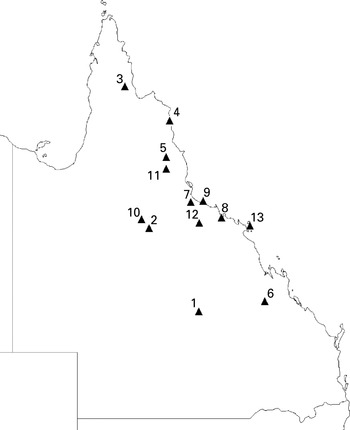
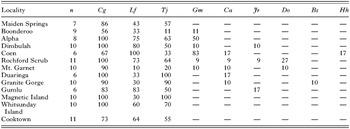
We examined 114 adult M. rhinoceros from 13 localities in Queensland, Australia (Fig. 1). These localities represent the known distribution for M. rhinoceros (see Roth, Reference Roth1977 and Walker et al. Reference Walker, Rugg and Rose1994). We identified 9 species of Thelastomatoidea. The prevalences of infection for the species at each site ranged from 9 to 100%, with the lower figure representing a single infection (Table 1). Abundance and intensity values were not considered here.
Map of the sampling sites for Macropanesthia rhinoceros in Queensland, Australia. Alpha (1), Boonderoo (2), Coen (3), Cooktown (4), Dimbulah (5), Duaringa (6), Gumlu (7), Granite Gorge (8), Magnetic Island (9), Maiden Springs (10), Mt Garnet (11), Rochford Scrub (12), Whitsunday Island (13).

Prevalence of infection for each thelastomatoid species parasitizing Macropanesthia rhinoceros in Queensland, Australia
(Localities ranked by decreasing aridity. Cordonicola gibsoni (Cg), Leidynemella fusiformis (Lf), Travassosinema jaidenae (Tj), Geoscaphenema megaovum (Gm), Coronostoma australiae (Ca), Jaidenema rhinoceratum (Jr), Desmicola ornata (Do), Blattophila sphaerolaima (Bs) and Hammerschmidtiella hochi (Hh).)

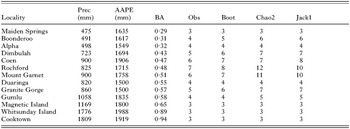
Observed species richness ranged from 3 species, at Cooktown, Magnetic Island, Maiden Springs and Whitsunday Islands, to 7 species at Rochford Scrub (Table 2). Estimated species richness ranged from 3 species at Cooktown, Magnetic Island, Maiden Springs and Whitsunday Islands, to 8, 12 and 10 at Rochford Scrub for the estimators Bootstrap, Chao2 and Jack1, respectively. All 9 species were never found at a single locality.
Observed and estimated thelastomatoid species richness, climate variables, Budyko's aridity index by locality for Macropanesthia rhinoceros in Queensland, Australia
(Precipitation (Prec), average areal potential evapotranspiration (AAPE), Budyko's aridity (BA), observed species richness (Obs), bootstrap based richness estimation (Boot), Chao2 based richness estimation (Chao2) and Jack1 based richness estimation (Jack1).)

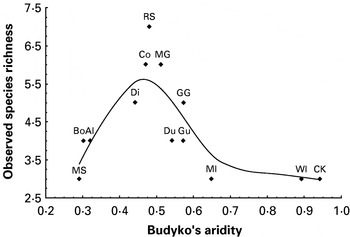
Localities were ranked by Budyko's aridity index (Table 2). The aridity index ranged from 0·29 for Maiden Springs (driest locality) to 0·94 for Cooktown (wettest locality). Trend analysis using the least squares fitting method suggested a strong curvilinear relationship between species richness and climate aridity (Fig. 2). Only the comparison between observed richness and aridity is shown. However, comparisons between estimated richness and aridity revealed a similar trend, regardless of the estimation method used.
Non-linear regression analysis of observed species richness versus relative aridity for Macropanesthia rhinoceros by locality in Queensland, Australia. Locality (◆); Alpha (Al), Boonderoo (Bo), Coen (Co), Cooktown (Ck), Dimbulah (Di), Duaringa (Du), Granite Gorge (GG), Gumlu (Gu), Magnetic Island (MI), Maiden Springs (MS), Mount Garnet (MG), Rochford Scrub (RS), Whitsunday Island (WI). (Note: Although not included here, analysis using estimated richness, regardless of the estimation method used, produces a similar trend.)

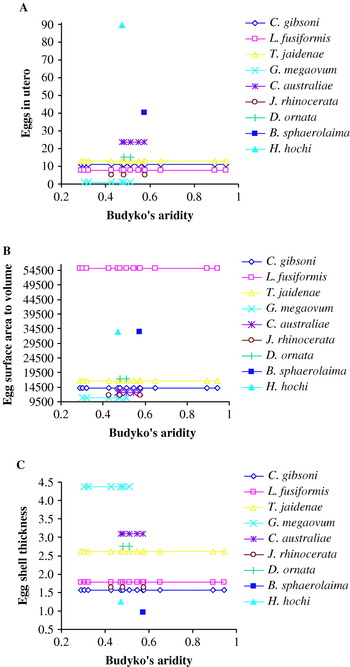
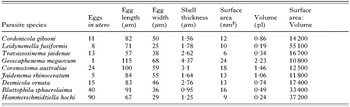
Overall fecundity, as measured by number of eggs in utero, ranged from a mean of 90 per female for Hammerschmidtiella hochi to just 1 per female for Geoscaphenema megaovum (Table 3). Egg volume ranged from 0·19 pl (L. fusiformis) to 2·23 pl (G. megaovum). Egg surface area ranged from 6 nm2 (T. jaidenae) to 24 nm2 (G. megaovum). Egg shell thickness ranged from 0·95 μm (B. sphaerolaima) to 4·37 μm (G. megaovum). We compared the climate range, as indicated by Budyko's aridity index, for each thelastomatoid species with these 3 parameters (Fig. 3); the findings of which are discussed in detail in the following section on egg morphology.
Comparison of climate range with egg characteristics for each Thelastomatoidea species parasitizing Macropanesthia rhinoceros across Queensland, Australia; eggs in utero. (A) Egg surface area to volume ratio; (B) egg-shell thickness (C).

Mean number of eggs in utero and egg morphometrics for each thelastomatoid species parasitizing Macropanesthia rhinoceros

DISCUSSION
Species richness
For all localities examined, except Rochford Scrub and Mount Garnet, estimated richness was within 2 species of observed richness, suggesting that a high proportion of the thelastomatoid species infecting M. rhinoceros at these localities have been found. Rochford Scrub and Mount Garnet had observed species richness levels of 6 and 7, respectively (Bootstrap=8 and 7, Chao2=11 and 12, and Jack1=10 and 10, respectively). These localities were highly species rich and all included several species found in only a single cockroach individual; C. australiae, G. megaovum and J. rhinoceratum at Rochford Scrub and L. fusiformis, C. australiae, G. megaovum and D. ornata at Mt. Garnet. It is rare species (particularly singletons or doubletons) which relate to estimated richness levels that are greater than observed species richness. This effect is exacerbated for smaller sample sizes. Walther and Morand (Reference Walther and Morand1998) indicated that “the Chao2 and Jack1 estimation methods performed best and should be used … in studies of parasite species richness”. The present data appear to agree with this observation. In most localities for which estimated richness differed from the observed richness, the Bootstrap based richness estimates were consistently lower than those predicted by Chao2 or Jack1, with the exception of the dataset for the locality Duaringa, where Bootstrap was slightly higher than Chao2 (4.42 vs. 4.33). In addition, in most of these localities, the differences between Chao2- and Jack1-based richness estimates were less than the differences between the values calculated via either of these estimators as well as those calculated using the Bootstrap method. The exceptions to this apparent trend were Rochford Scrub and Mount Garnet, the 2 localities with the highest richness levels or, perhaps more importantly, the greatest number of singletons. It may be that in systems with a high number of singletons, the Chao2 method overestimates richness levels. We take the view here that there may be species that we have not detected in some localities and, therefore, all subsequent analyses of the data were repeated for observed richness and the 3 richness estimators. In either case, Coen, Mt. Garnet and Rochford Scrub are clearly the most species-rich of the sites surveyed; any uncertainty about their true richness is unlikely to have a negative impact/effect on the subsequent analysis.
Distribution of thelastomatoids by local climate
Macropanesthia rhinoceros is found in some of the driest to some of the wettest areas of Australia. There appears to be a clear relationship between thelastomatoid guild richness and local climate aridity. Wet localities, such as Cooktown (observed species: 3), Whitsunday Island (3) and Magnetic Island (3) and dry localities, such as Alpha (4), Boonderoo (4) and Maiden Springs (3) have lower species richnesses than mid-range localities, such as Coen (6), Mt. Garnet (6) and Rochford Scrub (7).
Importantly, the relationships between guild richness and climate aridity correspond to real species not just numerical variations in richness statistics. Three species of thelastomatoid, C. gibsoni, L. fusiformis and T. jaidenae, were found at all localities. Geoscaphenema megaovum was found in all localities with a dry climate, except Maiden Springs, and was not found in the 6 wettest sites. The other 5 species were all found only in mid-range aridity sites; none was found in any of the 3 wettest or the 3 driest sites.
Egg morphology
The survival of any parasite species depends upon its ability to successfully infect new hosts. Successful infection is certainly improved by maximizing the number of host encounters. In parasites with direct life-cycles, the number of encounters can be increased by increasing egg longevity, maximizing the time over which an encounter may occur or, by increasing fecundity, allowing greater frequency of host encounters by weight of numbers. Clearly, climate may have an effect on egg longevity when eggs are shed into the environment. Conversely, it seems unlikely that climate directly impacts fecundity. Certainly, any impact that climate may have on fecundity will be indirect and exceedingly difficult to predict.
We propose that egg longevity varies from site to site, largely due to the climatic conditions encountered. Based on previous studies (Geller, Reference Geller1944; Anya, Reference Anya1966; Adamson, Reference Adamson1989; Grice and Prociv, Reference Grice and Prociv1993), we predict that in dry climates desiccation is the greatest threat to egg longevity and that in wet climates it is threatened by osmotic lysing and egg suffocation in water-logged soils. We hypothesize that, under these circumstances, the most likely indicators of egg longevity in response to environmental stress will be egg surface-area to volume ratios and egg-shell thickness. Presumably, eggs with lower surface area to volume ratios (i.e. large eggs) will be less susceptible to desiccation. Also, we predict that eggs with thick shells will be less susceptible to desiccation and, hence, more successful in dry environments.
A comparison of the egg characteristics from the 9 species examined suggests that there is some correlation with the climate-related distributions of these species. Three species, Cordonicola gibsoni, Leidynemella fusiformis and Travassosinema jaidenae, were reported from all localities surveyed and had by far the broadest climate ranges. An examination of the egg characteristics of these 3 species relative to all others showed that they were in the mid-range in most respects. The mean numbers of eggs in utero for these species were 8 (L. fusiformis), 11 (C. gibsoni) and 13 (T. jaidenae). Two species, G. megaovum (1 egg) and J. rhinoceratum (5), had fewer eggs in utero, and the other 4 species, D. ornata (15), C. australiae (24), B. sphaerolaima (40) and H. hochi (90) had more. Egg surface area to volume ratios were 14·2 nm2/pl for C. gibsoni, 16·7 nm2/pl for T. jaidenae and 55·1 nm2/pl for L. fusiformis. With the exception of L. fusiformis, these had also mid-range levels. Three species, G. megaovum (10·8 nm2/pl), Jaidenema rhinoceratum (11·8 nm2/pl) and C. australiae (12·5 nm2/pl), had lower surface area to volume ratios and 3 other species, Desmicola ornata (17·4 nm2/pl), B. sphaerolaima (33·4 nm2/pl) and H. hochi (37·2 nm2/pl) had higher ratios. All 3 common species had an approximately mid-range shell thickness; 1·56 μm, 1·78 μm and 2·62 μm thick for C. gibsoni, L. fusiformis and T. jaidenae eggs, respectively. Two species, H. hochi (1·25 μm) and B. sphaerolaima (0·95 μm), had thinner shells, 1 species, J. rhinoceratum (1·64 μm) had similar shell thickness and 3 species, D. ornata (2·76 μm), C. australiae (3·10 μm) and G. megaovum (4·37 μm), had thicker shells.
Overall, the eggs of the 3 dominant species are unremarkable in comparison with the other 6 species examined here. We suspect that the unremarkable morphology and morphometrics of the eggs for these dominant species is precisely what permits them to be so widespread. By producing eggs of moderate size (with the exception of L. fusiformis), shell thickness and number, the 3 dominant species may represent a generalist compromise that allows them to survive in a broad range of climatic conditions.
Eggs of Geoscaphenema megaovum are the largest and have the thickest shells of any of the thelastomatoids reported here. In addition, this species never had more than 1 egg in utero. This species was found in all of the dry localities, except Maiden Springs. Conversely, it was not found in any of the wet localities. In fact, although we found a number of cockroach species harbouring this parasite across large geographical areas within Australia, we have yet to find it in a wet locality (Jex et al. Reference Jex, Schneider, Rose and Cribb2007). These distributional data and the combination of large egg size and thick shell for this species suggest that G. megaovum is an arid climate specialist. Coronostoma australiae and J. rhinoceratum also have large, thick-shelled eggs and broad distributions across most arid localities and no wet localities for M. rhinoceros. Jaidenema rhinoceratum may also be an arid climate specialist as it has also been found in many cockroach species in Australia but not in wet localities (Jex et al. Reference Jex, Schneider, Rose and Cribb2007). However, although not found in any wet climates in this study, C. australiae has been reported previously from another cockroach species, Panesthia tryoni tryoni, from a particularly wet locality, Lamington National Park, Queensland (Jex et al. Reference Jex, Schneider, Rose and Cribb2005). Therefore, we cannot consider this species to be an arid specialist, although it is apparently more successful in arid regions. None of the species reported here could be considered a wet climate specialist based on the present data.
Overall, we showed that the thelastomatoid fauna of M. rhinoceros, across its entire range, is heterogeneous. The variation in the fauna appears to be correlated to local climate aridity and some of this variation appears to be ascribable to egg morphology. However, inconsistencies between egg surface area to volume ratio, thickness of egg-shell and width of climate range presented by the 3 dominant thelastomatoids, C. gibsoni, L. fusiformis and T. jaidenae, demonstrate that egg morphology is not the only important factor.
Local climate may be a significant component in shaping non-random variation in parasite fauna of a host species existing across a broad climate range. This, of course, depends largely on the extent to which stages of the parasite's life-cycle are exposed to the external environment and undoubtedly will be more pronounced in, if not confined to, terrestrial systems and those parasites utilizing a simple life-cycle with a directly infective stage that is shed into the external environment. Clearly, variation in the parasite fauna among individuals is the result of highly complex interactions and, undoubtedly, much of the variation, particularly at a local level, will be the result of chance. The extent to which the observations presented here occur in other systems or can be developed into any predictive model remains to be tested. Despite potential limitations, such patterns may offer useful insights into additional parasite systems.
This study was supported by the Queen Elizabeth II Centennial Scholarship (Government of British Columbia, Canada), the University of Queensland International Postgraduate Research Scholarship, the International Postgraduate Research Scholarship (Government of Australia), and the Australian Biological Research Study. The authors thank Leslie Rohland, the Australian Bureau of Meteorology, for the provision of precipitation and evapotranspiration data and Dr David Marcogliese and Professor Ian Beveridge for comments, advice and suggestions.