





Introduction
Politics, at its core, is an arena of contestation; disagreement and alignment are constitutive features rather than pathologies. According to this Schmittian view, the political is characterized by the friend-enemy distinction (Schmitt Reference Schmitt2024). Yet, while contemporary democratic theory’s aim is to transform this antagonism into agonism, understood here as a structured and legitimate contestation among political opponents (Mouffe Reference Mouffe2000), public discourse increasingly treats ‘polarization’ as a social problem in its own right. For instance, evidence from Sweden shows that the use of the term ‘polarization’ in national newspapers quadrupled between 2010 and 2021 and has become increasingly associated with urgency, conflict, and threat, which can signal growing public concern and salience (Farjam, Bruhn, Gustafsson et al. Reference Farjam, Bruhn, Gustafsson and Segesten2024). Indeed, even scholars have emphasized that the study of political polarization has become central to contemporary political science (Nugent Reference Nugent2020). Within this broader discussion, scholars have identified affective polarization as a distinct phenomenon: the widening of partisan animosity and social distance, where citizens tend to trust and empathize with in-partisan peers more than out-partisans, regardless of policy preferences (Iyengar, Sood and Lelkes Reference Iyengar, Sood and Lelkes2012). In this sense, research considers affective polarization as a dangerous development, reflected in the erosion of democratic norms, a decline in social trust, and the increase in partisan prejudice (Harteveld and Wagner Reference Harteveld and Wagner2023).
Despite considerable scholarly effort, which is often rooted in orthodox cognitive-psychological explanations (Balinhas Reference Balinhas2023), few studies have systematically synthesized the underlying processes of affective polarization. We argue that such endeavors are urgently needed, given the growing concern about the potentially adverse consequences of affective polarization for social cohesion, trust in institutions, and the overall support for democracy (McCoy, Rahman and Somer Reference McCoy, Rahman and Somer2018). Against this background, we address the following research question: What causal drivers of affective polarization have been empirically investigated in the scientific literature to date?
To answer this question, we conducted a systematic literature review (SLR) to map and synthesize empirical research on the causal drivers of affective polarization. Our aim is twofold: (a) to provide a quantitative overview of the evidence base (ie what has been studied, where, with which designs and measures) and (b) to deliver a qualitative synthesis that identifies where findings converge, where they diverge, and where consequential gaps remain. In this review, we use the term causal evidence in a graded sense. To be included, studies had to examine putative antecedents of affective polarization and make an explicit claim about causal direction or causal process. At the same time, we do not assume that all included studies provide equally strong causal identification. We therefore distinguish among experimental, quasi-experimental, panel or longitudinal observational, and cross-sectional associative evidence, while also retaining a residual category of other designs that do not fit these groups. Substantively, we organize the field around five driver families that serve as an organizing taxonomy for the evidence base: (1) psychological factors, (2) media and information environment, (3) identity and group processes, (4) institutional factors, and (5) socioeconomic factors. We interpret relationships across these domains through an emergence perspective, rather than treating any one of them as a single master cause. Following recent conceptual developments (Harteveld et al. Reference Harteveld, Berntzen, Kokkonen, Kelsall, Linde and Dahlberg2026; Röllicke Reference Röllicke2023), we distinguish vertical (attitudes toward parties/elites) from horizontal (attitudes toward fellow citizens) affective polarization.
We first searched Google Scholar and Scopus (2012–2025) for studies that empirically test the causes of affective polarization. We then filtered the results to peer-reviewed journal articles indexed in SCImago Journal Rank (SJR), yielding 135 articles for analysis. Each study was coded for five classes of factors, as well as the outcome studied (vertical or horizontal affective polarization), the research design, country, measures, and key findings. Taken together, our study represents the first comprehensive attempt to integrate the existing literature on the causal processes of affective polarization, paving the way for future research.
Our review shows that research on the causes of affective polarization is growing but centered on the United States, with additional work from cross-national and scattered single-country studies. Scholars examine both horizontal (citizen-citizen) and vertical (citizen-elite) polarization roughly equally, though far fewer papers study their interaction. In terms of identification strength, the literature is dominated by cross-sectional associative studies, followed by experimental and panel designs. Quasi-experimental studies are rare, which suggests that stronger causal identification remains limited in the field. Three families of explanations dominate, namely, psychological factors, media environment, and identity/group processes, while institutional and socioeconomic factors receive comparatively less attention. Since 2020, research on causes of affective polarization has accelerated, especially on psychological and media drivers, with more recent growth in institutional explanations of affective polarization. Overall, the field offers a substantial but imbalanced foundation, pointing to the need for stronger causal identification and closer integration of horizontal and vertical dynamics of affective polarization.
Our systematic review presents several contributions. First, we present, to our knowledge, the most up-to-date systematic review of causal drivers of affective polarization (2012–2025), integrating evidence across countries, populations, and identification strategies. Second, we provide a clear organising taxonomy that categorizes drivers into five families and distinguishes between vertical and horizontal affective polarization. We then interpret links across these domains through an emergence perspective, clarifying how multiple mechanisms may jointly shape different outcomes. Third, we provide a reproducible literature matrix, including a coding scheme, reliability assessment, and journal metadata that supports cumulative research and highlights priority gaps in identity/group mechanisms, institutional and contextual factors, and socioeconomic/external shocks.
The paper proceeds as follows. We first situate our study within the existing research literature and outline the conceptual foundations of affective polarization. We then detail our methodological approach, including the development of (a) the search strategy as well as (b) the screening, (c) filtering, and (d) coding. Next, we provide a descriptive mapping of the identified drivers of affective polarization and synthesize the findings across different identification strategies and contexts. Afterwards, we reflect on theoretical implications of our results and propose directions for future empirical strategies for identifying causal drivers. Finally, the paper concludes by summarizing the key insights from our systematic literature review.
Conceptual foundations of affective polarization
Politics naturally involves conflict, and disagreement is not a flaw but a normal feature of the political process. Today, public debate often treats ‘polarization’ as a problem in itself. This raises a key question: if conflict is normal, when and how does routine policy disagreement turn into identity-based conflict, marked by viewing opponents as an existential threat and by increased social distance, ie what scholars call affective polarization (Iyengar, Lelkes, Levendusky et al. Reference Iyengar, Lelkes, Levendusky, Malhotra and Westwood2019)? What moves people from competitive policy debate to deep, hostile feelings? Do these forces arise mainly from individual psychological processes (Luttig Reference Luttig2018; Stone Reference Stone2019; Bram Reference Bram2022), the media environment (Lee, Rojas and Yamamoto Reference Lee, Rojas and Yamamoto2022; Matthes, Nanz, Kaskeleviciute et al. Reference Matthes, Nanz, Kaskeleviciute, Reiter, Freiling, Neureiter, Stubenvoll, Sherrah, Juricek, Munzir and Noronha2023; van Erkel and van Aelst Reference Van Erkel and Van Aelst2025), institutional and contextual factors (Bassan-Nygate and Weiss Reference Bassan-Nygate and Weiss2022; Tilley and Hobolt Reference Tilley and Hobolt2025b), or broader social and cultural mechanisms (Bettarelli and van Haute Reference Bettarelli and Van Haute2022; Harel et al. Reference Harel, Nir, Vandermeulen, Maoz and Halperin2025)?
To address these questions, we need a clear picture of what causes have been tested and with what evidence. We therefore map the current state of causal research on affective polarization by reconstructing how it has been studied and summarizing what is known about its drivers. Despite a sizable literature, there is no systematic review that organizes and synthesizes this evidence. We provide that synthesis.
Our review is guided by an emergence perspective that helps link these strands without presuming a single master cause (Sawyer Reference Sawyer2005). Following Schelling (Reference Schelling1978), we view affective polarization as arising from numerous small, reasonable choices people make in their daily lives, such as unfriending political opponents, curating feeds that align with one’s own views, or signaling loyalty to one’s side. These choices interact through social networks, political cycles, and institutions (eg elections). Because people have different thresholds for disengaging or speaking harshly, even modest shocks, such as elections, scandals, or crises, can tip the system toward higher hostility. By contrast, credible unity or coalition signals can act as focal points that shift expectations toward lower hostility. Even mild preferences for like-minded interaction can produce strong informational and social segregation, which in turn heightens perceived extremity and moralization. Partisan sorting reinforces these dynamics by aligning political preferences with social identities (eg geography, religion, education, etc.), thereby reducing cross-cutting ties and making everyday environments more homogeneous (Mason Reference Mason2015). In such settings, identity cues carry more weight (Iyengar and Westwood Reference Iyengar and Westwood2015). This perspective implies nonlinear, event-driven dynamics, strong dependence on local network composition, and path dependence. It also explains why platform features and elite strategies often amplify existing divisions rather than create them from scratch (Törnberg Reference Törnberg2022; Bäck, Carroll, Renström et al. Reference Bäck, Carroll, Renström and Ryan2023).
Read as an interpretive framework, the emergence perspective yields three empirical implications for the literature reviewed here. First, affective polarization should be strongest where psychological predispositions, identity cues, and reinforcing media environments coincide, rather than where any single driver operates in isolation. Second, short-run institutional shocks, such as campaigns, elections, scandals, or coalition signals, should have their largest effects where baseline partisan sorting or out-group negativity is already elevated. Third, cross-cutting contact, heterogeneous discussion environments, and credible unity signals should be more likely to reduce affective polarization among weak or moderate partisans than among strong identifiers. These propositions do not presume a single causal sequence, but they provide a way to interpret how micro-level choices, meso-level environments, and macro-level contexts may interact in producing affective polarization.
Methods
We map the research on causal factors of affective polarization and provide a qualitative synthesis that reveals where findings converge across articles, where divergences can be identified, and where research gaps need to be addressed. When conducting our study, we consistently followed the updated 2020 edition of the Preferred Reporting Items for Systematic reviews and Meta-Analyses (PRISMA) framework, a common guideline designed to enable authors of systematic literature reviews to report their approach transparently and comprehensibly (Page, McKenzie, Bossuyt et al. Reference Page, McKenzie, Bossuyt, Boutron, Hoffmann, Mulrow, Shamseer, Tetzlaff, Akl, Brennan, Chou, Glanville, Grimshaw, Hróbjartsson, Lalu, Li, Loder, Mayo-Wilson, McDonald, McGuinness and Moher2021). Our sampling strategy is presented in Figure 1.
Literature review flowchart.

Search strategy
We developed a search string to identify studies that empirically examine causal factors of affective polarization. We combined terms describing the focal construct with terms denoting causality using an AND operator. Searches were conducted in Google Scholar and Scopus to balance sensitivity and specificity, minimizing the risk of missing key studies while avoiding unmanageable result sets. The search strategy was limited to the period between 2012 and 2025 and was conducted between August 14 and 22, 2025. Studies published after these dates were not included. The following search string was used in Google Scholar:
(intitle:“affective polarization“ OR intitle:“affective polarisation“) AND (causes OR predictors OR drivers OR roots OR origins OR determinants)
Since Google Scholar does not offer a structured filter option, the ‘intitle’: operator was used. In Scopus, we applied the following string:
(affective polarization OR affective polarisation) AND (causes OR predictors OR drivers OR roots OR origins OR determinants)
Using the built-in filter, we restricted results to articles in which the search terms appeared in the title or abstract, making additional ‘intitle’: operators unnecessary. We then used a multi-step screening process to distinguish articles relevant to the research questions from those that were not. Because our aim was precision rather than maximal recall, we focused on studies that explicitly examined affective polarization and reported causal identification. To assess possible bias from term choice, we conducted a sensitivity analysis using related constructs from the literature, including negative partisanship, hostility toward the opposition party, and partisan animosity, while holding all other search parameters constant. In the identification phase shown in Figure 1, before applying exclusion criteria, the original search for affective polarization yielded 761 records, compared with 138, 9, and 8 records for negative partisanship, hostility toward the opposition party, and partisan animosity, respectively. This suggests that affective polarization captures most of the literature directly centered on the concept, whereas related terms identify smaller, partly overlapping strands of research. Broad synonym sets, such as out-party hostility, negative partisanship, or antecedents, as well as references to specific identification strategies like field experiments, survey experiments, or difference-in-differences, would have introduced substantial heterogeneity, increased noise, and reduced tractability without clear benefits for our purposes. Our strategy, therefore, targets publications that explicitly use the concept in their titles or abstracts and make causal claims, thereby improving the interpretability and replicability of the corpus. The 2012 to 2025 window reflects the period in which affective polarization became standard terminology following Iyengar, Sood and Lelkes (Reference Iyengar, Sood and Lelkes2012). Therefore, earlier foundational contributions are acknowledged contextually but fall outside our inclusion criteria.
Screening
We first screened all database results at the title-abstract level to assess whether a study aimed to empirically test factors that cause affective polarization. We excluded items that offered only theoretical claims about causal processes, examined consequences rather than causes, or were student theses (bachelor’s, master’s) or PhD dissertations. The initial search yielded 761 records (638 from Google Scholar; 123 from Scopus). After title-abstract screening, 247 articles met the inclusion criterion (197 Google Scholar; 50 Scopus). Following deduplication and removal of items without institutional access, the final screening set comprised 187 articles.
Peer-review filtering
In the second stage, we assessed all post-screening items to determine whether and in which outlet they were published, with the goal of separating peer-reviewed journal articles from non-peer-reviewed outputs (eg working papers, preprints, policy briefs, book chapters, and other grey literature). We retained only articles published in journals indexed by the SJR, using SJR indexing as a pragmatic proxy for formal peer review. We did not condition inclusion on quartile (Q1-Q4), as rankings vary across years and disciplines. This procedure yielded 153 articles for analysis.
Coding and categorization
We next developed an initial overview of the corpus by constructing a literature matrix and coding each article along multiple dimensions: title, year, authors, identification strength, target population, country, sample size, instruments, hypotheses, findings, type of affective polarization, category of causes, specific factors, journal, and journal rank. This inductive coding informed a preliminary category scheme. During this stage, we also detected and removed several misclassified items. The resulting dataset comprised 135 articles for subsequent analysis.
Because the preliminary scheme was too granular, we aggregated causes of affective polarization into five domains: psychological factors, media and information environment, identity and group processes, institutional factors, and socioeconomic factors. These domains function as an organizing taxonomy for the reviewed literature. We interpret their interrelationships through an emergence perspective, in which macro-patterns arise from many small, interdependent choices (Schelling Reference Schelling1978; Sawyer Reference Sawyer2005). This structure reflects our expectation that affective polarization is shaped by the interaction of individual, social, informational, and institutional mechanisms, rather than by a single master cause. The full literature matrix, including the coding scheme and aggregated categories, is provided in Appendix C (https://osf.io/c4kv3/files/yv4wp).
To evaluate the stability of the coding scheme regarding the causes of affective polarization, one of the authors re-coded all 135 items 15 days after the initial coding to minimize recall effects. Because the five categories are nominal and mutually exclusive, we used Krippendorff’s alpha for nominal data as a chance-corrected measure of coding reliability. Krippendorff’s alpha is widely used in content analysis because it is appropriate for categorical coding decisions, does not assume an ordering or equal distance between categories, and assesses the extent to which observed agreement exceeds what would be expected by chance. In the present case, because the same coder repeated the classification, the statistic should be understood as a measure of intra-coder stability over time rather than inter-coder agreement. We obtained an alpha of 0.689 (one-sided permutation test: p = 0.0005; bootstrap 95% CI: [0.689, 1.000]). Following Krippendorff’s guidelines, we interpret this value as indicating moderate, tentatively acceptable stability, while recognizing that it falls below the conventional threshold for strong reliability (alpha ≥ 0.80 for strong conclusions; alpha ≥ 0.667 as the minimum for tentative ones, Krippendorff (Reference Krippendorff2018)). At the same time, this coefficient should be interpreted as an aggregate measure across the full five-category scheme and may therefore mask differential stability across domains, especially for smaller categories where a small number of reclassifications can have a disproportionate effect on reported distributions. To assess this more directly, we examined the distribution of mismatches across the two coding rounds. Overall, 32 of the 135 studies were coded differently, but these disagreements were not randomly distributed. Rather, they clustered at a small number of conceptually adjacent boundaries between the five aggregated domains. The most frequent boundary was between identity and group processes and psychological factors (9 mismatches: 7 shifts from identity and group processes to psychological factors, and 2 in the reverse direction), suggesting that many disputed studies could plausibly be understood either as emphasizing individual-level psychological predispositions or group-based identity processes. The next most frequent boundaries were identity and group processes vs. institutional factors (5 mismatches, all shifting toward institutional factors) and psychological factors vs. institutional factors (5 mismatches: 2 shifts toward institutional factors, and 3 in the reverse direction), indicating ambiguity in studies where institutional or electoral contexts appeared to operate through identity-based or psychological mechanisms. A further notable boundary was psychological factors vs. media and information environment (4 mismatches), suggesting overlap between explanations centered on individual dispositions and those centered on the information environment. By contrast, socioeconomic factors were involved in comparatively few mismatches, indicating that this category was more clearly delimited. Taken together, these results suggest that the aggregate alpha reflects localized ambiguity at overlapping analytical boundaries rather than uniform unreliability across all five domains; accordingly, the smaller categories should be interpreted with appropriate caution. Discrepancies between waves were adjudicated by another author. We did not revise the category definitions after the reliability assessment because doing so would have introduced post hoc adjustments to the coding scheme. Instead, we retained the pre-established five-domain taxonomy, investigated the location of ambiguity, and used author adjudication to resolve final classifications. This approach is consistent with our use of the five domains as an organizing taxonomy for a heterogeneous literature, rather than as a claim that causal mechanisms are always fully separable in substantive terms.
Geographic coverage
We distinguished studies that examined a single nation from those that examined exactly two nations. A study analyzing only the United States counted the United States once. A study covering the United States and Japan counted the United States once and Japan once. Studies examining more than two nations were coded as ‘cross-national’ and not assigned to individual countries. This approach yields comparable counts while preventing multi-country designs from inflating country totals.
Vertical vs. horizontal affective polarization
We distinguish between vertical and horizontal affective polarization, following the two-dimensional framework proposed by Harteveld et al. (Reference Harteveld, Berntzen, Kokkonen, Kelsall, Linde and Dahlberg2026) and elaborated by Röllicke (Reference Röllicke2023). Vertical affective polarization concerns feelings toward political parties and elites, ie actors at the top of the political system. Horizontal affective polarization concerns feelings toward fellow citizens, ie actors at the same political level. Consistent with this distinction, recent evidence indicates that respondents differentiate between evaluations of elites and voters (Areal and Harteveld Reference Areal and Harteveld2024). While Röllicke (Reference Röllicke2023) proposes further subdivisions within the horizontal dimension, we restrict our analysis to the basic vertical-horizontal split, as current concepts and measures do not yet support reliable finer classification. Coding proceeded as follows: articles that examined only one dimension were counted once in that category (‘vertical’ or ‘horizontal’); articles that analyzed both dimensions were assigned to a separate ‘both’ category to ensure unambiguous classification.
Identification strength
We categorized studies by the strongest identification strategy used in each article. We distinguished five groups. (1) Cross-sectional associative studies used observational data without temporal or exogenous leverage. This category also included analyses of multiple cross-sectional studies, survey waves, or samples that did not track the same units over time or apply a stronger causal identification strategy. Although such designs could strengthen confidence in the findings through replication or comparison, they remained cross-sectional associative. (2) Panel studies followed the same units over time and used longitudinal leverage. (3) Quasi-experimental studies exploited plausibly exogenous variation, such as natural experiments, instrumental variables, matching, regression discontinuity, difference in differences, or timing-based designs. (4) Experimental studies used survey, laboratory, or field experiments with researcher-controlled random assignment. (5) Other studies used designs that did not fit these categories, for instance, computational social science approaches such as social media analyses and agent-based modeling. Coding was conducted at the article level. When an article combined more than one design, we coded it according to the strongest identification strategy. For example, a study that combined cross-sectional and experimental evidence was coded as experimental.
Quality of journals
To assess sample quality, we examined the outlets in which included articles were published. As noted above, we retained only articles appearing in journals indexed by the SJR. For each SJR quartile (Q1-Q4), using classifications current through September 2025, we counted the number of articles per quartile. We then summarized the distribution across Q1–Q4 to indicate where the evidence is concentrated.
Due to the substantial conceptual and methodological heterogeneity remaining, we did not conduct a meta-analysis.
Results
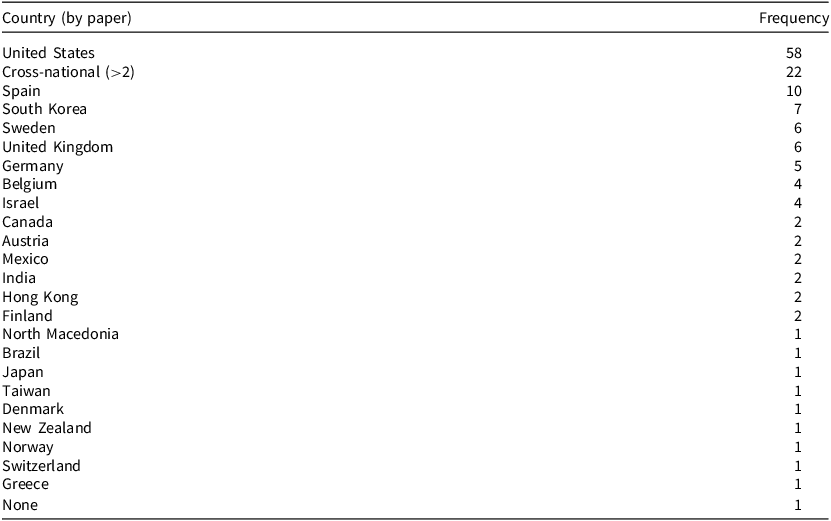
We first present the main descriptive patterns from the corpus of articles before examining the major categories of causes of affective polarization. We summarize the geographical concentration of the evidence (Table 1), the form of affective polarization examined, and the quality of the publications’ outlets (Figure 2).
Geographic distribution of included studies (2012–2025, counted by paper)

Table 1. Long description
A table titled ‘Geographic distribution of included studies (2012–2025, counted by paper)’ presents the frequency of studies conducted in various countries. The table has two columns: ‘Country (by paper)’ and ‘Frequency’. The ‘Country (by paper)’ column lists different countries and regions, while the ‘Frequency’ column shows the number of studies conducted in each country. The table includes the following data: United States with 58 studies, Cross-national (>2) with 22 studies, Spain with 10 studies, South Korea with 7 studies, Sweden with 6 studies, United Kingdom with 6 studies, Germany with 5 studies, Belgium with 4 studies, Israel with 4 studies, Canada with 2 studies, Austria with 2 studies, Mexico with 2 studies, India with 2 studies, Hong Kong with 2 studies, Finland with 2 studies, North Macedonia with 1 study, Brazil with 1 study, Japan with 1 study, Taiwan with 1 study, Denmark with 1 study, New Zealand with 1 study, Norway with 1 study, Switzerland with 1 study, Greece with 1 study, and None with 1 study.
Note: Each row lists the study country and the number of articles in our corpus focusing on it. Cross-national (>2) refers to papers analyzing more than two countries. Counts by country (143) slightly exceed the total number of papers (135), reflecting multi-site designs, totals are thus not strictly additive.
Descriptive overview of the corpus.
Note: Category ‘Others’ in Panel b appears last because it is a residual category, and the ordering reflects conceptual classification rather than category size.

As shown in Table 1, most studies analyze the United States (58 papers), with a sizable set of cross-national designs (22). After that, coverage thins into a long tail: Spain (10); South Korea (7); Sweden and the United Kingdom (6 each); Germany (5); then several countries with 4–2 studies (eg Belgium, Israel, Canada, Austria, Mexico, India, Hong Kong), and many single-paper cases (eg Finland, North Macedonia, Brazil, Japan, Catalonia, Taiwan, Denmark, New Zealand, Norway, Switzerland, Greece). This distribution indicates a strong U.S. skew, with growing but still limited coverage in other democracies.
When it comes to the forms of affective polarization (Figure 2a), attention is balanced between ‘horizontal’ (57 papers) and ‘vertical’ (53) conceptions, with ‘both’ (23) being studied less often but still notableFootnote 1 . This suggests researchers are treating citizen-citizen and citizen-elite dynamics as comparably important, with a smaller but meaningful effort to analyze their interaction.
Figure 2b shows that the corpus is dominated by cross-sectional associative studies (60, 44.4%). Experimental studies form the second largest group (39, 28.9%), followed by panel studies (27, 20.0%). Quasi-experimental studies are rare (4, 3.0%), and the residual ‘other’ category is also small (5, 3.7%). Overall, the literature still leans toward weaker associational evidence, while stronger identification strategies remain less common. This distribution points to the need for more studies that combine complementary identification strategies, such as experiments, panels, and quasi-experimental designs, in order to strengthen causal claims and improve external validity.
As shown in Figure 2c, publications are concentrated in Q1 (122 papers) and Q2 (13 papers) journals, indicating that the field’s causal evidence is widely published in top outlets, which supports the credibility and visibility of the findings.
Overview of major causes
Figure 3 summarizes the distribution of causal explanations of affective polarization. Three clusters dominate: psychological factors (44; 32.6%), media and the information environment (34; 25.2%), and identity and group processes (31; 23.0%). Explanations tied to institutions (18; 13.3%) and socioeconomic factors (8; 5.9%) are less common, indicating clear opportunities for expansion beyond psychology and media-centered studies.
Five categories of causes of affective polarization.

The time series in Figure 4 shows a sharp rise in output after 2020, suggesting a growing scholarly focus on uncovering the mechanisms that give rise to affective polarization. Contributions on media/information and psychological factors grow most consistently through 2022–2025, while identity/group studies surge around 2021–2022 and then fluctuate. Work on institutions has increased only recently, and socioeconomic drivers remain sparse, with occasional one-year spikes.
Categories of causes of affective polarization, 2014–2025.

Disaggregating by form of affective polarization (horizontal, vertical, and both) underscores these patterns (Figure 5). Horizontal studies (citizen-citizen) account for most of the post-2020 growth, led by psychological, identity, and media factors. Vertical studies (citizen-elite) show steadier, lower counts, with a recent increase in institutional/contextual drivers, but still fewer than those for individual and media. Research that analyzes both forms in tandem remains rare and episodic, limiting our understanding of how these dynamics interact.
Causes of affective polarization by year and form of affective polarization (raw counts), 2014–2025.

In the sections that follow, we examine illustrative studies from each category in turn.
Psychological factors
To move from aggregate patterns to underlying mechanisms, we begin at the micro level. The psychological factors category is both the most frequently examined and conceptually foundational. It specifies the cognitive, attitudinal, and affective processes through which citizens evaluate political opponents, providing mechanisms that media, institutions, and contexts may later amplify. Starting here clarifies what is plausibly ‘built in’ at the level of perceptions and motives before layering on environmental influences. We therefore first review individual-level drivers, such as gender-based differences, cognitive biases, personality traits, emotions, and moral beliefs, before turning to the remaining categories.
Cognitive biases/perception-related distortions
A substantial share of the articles attributes affective polarization to systematic cognitive biases and perception-related distortions. Across diverse empirical designs, studies converge on the finding that citizens tend to overestimate the ideological distance, misjudge the shared knowledge and intentions of out-partisans, and process political information in systematically biased ways. For instance, confirmation bias (Lefebvre, Deroy and Bahrami Reference Lefebvre, Deroy and Bahrami2024) and focalism (Bram Reference Bram2022) foster affective polarization by directing attention toward conflictual cues, while overprecision, ie the exaggerated belief in the correctness of one’s own beliefs, directly increases antipathy toward political opponents (Stone Reference Stone2019). Similarly, the curse of knowledge captures the tendency to assume that others possess the same information as oneself. Beattie and Beattie (Reference Beattie and Beattie2023) conclude that partisans systematically overestimate the extent to which the opposing side knows what they know, leading to harsher judgments. Because opponents are perceived as having the same knowledge yet holding different views, they are often seen as lazy, biased, or malicious, rather than simply uninformed. Encouraging individuals to reflect on such epistemic asymmetries has been shown to mitigate this effect. In a related vein, Druckman, Klar, Krupnikov et al. (Reference Druckman, Klar, Krupnikov, Levendusky and Ryan2022) demonstrate that the widely reported magnitude of affective polarization may be partly a measurement artifact. Respondents substantially overestimate the share of extreme and politically engaged members within the opposing party, thereby anchoring their judgements on the most visible and vocal, rather than typical, partisans. A similar pattern emerges in Spain, where Crespo-Martínez, Rodríguez and Martínez (Reference Crespo-Martínez, Mora-Rodríguez and Rojo-Martínez2024) find that affective polarization increases with ideological distance between individuals and political parties and is amplified by stereotypical misperceptions. Taken together, this line of research conceptualizes affective polarization as a kind of cognitive construction: it arises not solely from fixed ideological conflict, but also from distorted perceptions, biased information processing, and false mental representations of the political outgroup.
Gender differences
Recent research identifies gender as a significant correlate of affective polarization. Using data from the Comparative Study of Electoral Systems (CSES), Han (Reference Han2025) finds that women in Western Europe are significantly more affectively polarized than men, which is mediated by stronger issue positions, particularly on gender- and environment-related topics, as well as by greater disapproval of populist radical right parties. Next, evidence from the American National Election Studies (ANES) shows that women in the United States exhibit greater levels of affective polarization, explained by stronger partisan identification and more pronounced attitudes on salient moral issues, most notably abortion (Ondercin and Lizotte Reference Ondercin and Lizotte2021). In summary, these findings indicate that gender shapes affective polarization not primarily as a biological factor, but as a product of political socialization, differentiated issue priorities, and heightened moral sensitivity.
Emotions
Research shows that not all emotions have the same effect, and that this effect depends on both the form and the object of reference. Nguyen, Mayer and Veit (Reference Nguyen, Mayer and Veit2022) differentiate between generalized and issue-specific anger and demonstrate that the latter, in particular, intensifies affective polarization by promoting emotional distancing from the out-group. Similarly, as another study shows, enthusiasm for the in-group and fear of the out-group reinforce polarization, while positive emotions toward the out-group can depolarize it (McLaughlin, Holland, Thompson et al. Reference McLaughlin, Holland, Thompson and Koenig2020). Effects are also evident in the context of climate change discussions: fear of climate threats can mitigate polarization, while anger shows no effect or even reinforcing effects (Remsö, Renström and Bäck Reference Remsö, Renström and Bäck2025). Overall, the findings suggest that emotions can act as catalysts or dampeners of political hostility.
Moral-related factors
Garrett and Bankert (Reference Garrett and Bankert2020) find that certain moral commitments are tied to partisan bias, social distancing, and out-group animus. A high need for cognitive closure predicts stronger affective polarization among the politically engaged (Luttig Reference Luttig2018), and political efficacy – belief in one’s political influence – correlates with polarization (Stapleton and Wolak Reference Stapleton and Wolak2024). Personality traits also play a role: narcissism, particularly its rivalry facet, is strongly associated with polarization, largely via in-group favoritism rather than out-group antipathy (Tilley and Hobolt Reference Tilley and Hobolt2025a); extraversion tends to relate to lower polarization, and agreeableness to reduced out-group antipathy (Webster Reference Webster2018). Interventions and dispositions that promote openness can mitigate these patterns: intellectual humility is linked to lower polarization and greater willingness to engage across lines of disagreement (Knöchelmann and Cohrs Reference Knöchelmann and Cohrs2025). Finally, Haerter, Filziger and Freitag (Reference Haerter, Filsinger and Freitag2025) report that higher endorsement of individualized moral foundations (eg fairness, harm) can widen emotional divides between vaccination groups. In short, while some psychological characteristics and cognitive tendencies appear to amplify affective polarization, others attenuate it.
Media & information environment
Having mapped individual-level factors, we turn to the media and information environment – the arena that structures what citizens see, how often group identities are cued, and which emotions are activated. If individual dispositions create a propensity to polarize, media exposure provides opportunities and triggers that can amplify or dampen those tendencies.
Platforms and usage patterns
Matthes, Nanz, Kaskeleviciute et al. (Reference Matthes, Nanz, Kaskeleviciute, Reiter, Freiling, Neureiter, Stubenvoll, Sherrah, Juricek, Munzir and Noronha2023) distinguish between active and passive social media use and find that active engagement with political content is associated with higher affective polarization. By contrast, use of traditional media (both quality and tabloid) shows no significant relationship, and news avoidance is linked to lower polarization. The authors caution, however, that stronger causal inference designs are needed and suggest that reduced exposure may lessen both in-group reminders and out-group misperceptions. In a similar vein, Lee, Rojas and Yamamoto (Reference Lee, Rojas and Yamamoto2022) compare emerging platforms across the United States and Japan and show that social media news use correlates positively with affective polarization in both countries, whereas messaging-app news use correlates negatively, particularly among highly partisan Americans. Van Erkel and van Aelst (Reference Van Erkel and Van Aelst2025) reach comparable conclusions in a Flemish panel study, where Facebook news use predicts higher affective polarization, especially during election campaigns when polarization typically peaks. Yet, the absence of content-level controls (eg pro- vs. counter-attitudinal exposure) limits interpretation.
However, not all evidence points in the same direction. Using South Korean data, Lee and Rojas (Reference Lee and Rojas2025) find no significant relationship between either mass-media or social-media use and affective polarization, underscoring that effects are context- and platform-dependent.
From platform to message
Moving from platforms to content, what matters is both where people get news and whether the content affirms or challenges their views. This shift from medium to message clarifies the emotional pathways through which exposure shapes affective polarization. Lu and Lee (Reference Lu and Lee2019), drawing on ANES panel data, show that party-congenial news consumption is linked to higher affective polarization, mediated by anger and fear. They note limits, including cross-sectional measurement of program exposure and retrospective reports of emotion. Likewise, Willnat, Ogan and Shi (Reference Willnat, Ogan and Shi2023) find that ideologically aligned viewing coincides with greater polarization, whereas cross-partisan viewing reduces it. In contrast, cross-partisan viewing coincides with lower polarization (eg Republicans watching CNN vs. Democrats watching Fox News). Using data from the United States and Israel, Garrett, Long and Jeong (Reference Garrett, Long and Jeong2019) report that pro-attitudinal media use heightens out-party animus and social distance, while counter-attitudinal use decreases them; notably, the magnitudes of these effects are similar. In the U.S., however, balanced exposure can still exacerbate polarization when opposing content is consumed primarily to criticize or refute it. Consistent with an emotion-first mechanism, Zhu, Weeks and Kwak (Reference Zhu, Weeks and Kwak2024) show that seeking attitude-congruent content correlates with anger toward opponents and enthusiasm for co-partisans, while incidental counter-attitudinal exposure does not reliably dampen those emotions. Finally, a two-wave panel in South Korea (Lin, Jiang, Lee et al. Reference Lin, Jiang, Lee, Wang and Kim2025) finds that cross-cutting exposure modestly reduces polarization, but the benefit diminishes and may even reverse at higher doses, with ideological extremity moderating the effect (depolarization among moderates, little or none among strong ideologues).
In sum, the medium matters, but message alignment and emotional activation are pivotal. Pro-attitudinal exposure tends to amplify affective polarization, while counter-attitudinal exposure has the potential to attenuate it, chiefly for moderates and at modest levels of exposure.
Identity & group processes
Moving beyond media influences, this section focuses on identity and group processes as roots of affective polarization. This perspective originates in social identity theory, which posits that intergroup differentiation and self-categorization shape attitudes toward political in- and out-groups. Studies in this corpus examine whether affective polarization is primarily driven by identity and ideology, how homogeneous social environments and intergroup contact shape affective dynamics, and whether non-partisan identities can also fuel affective divides.
Identity versus ideology
Dias and Lelkes (Reference Dias and Lelkes2022) conducted five studies disentangling party-branded from unbranded policy issues and identifying partisan identity as a principal mechanism of affective polarization. Policy disagreement contributes, but mainly by signaling partisan identity rather than directly generating animosity. Consistent with these findings, Satherley, Sibley and Osborne (Reference Satherley, Sibley and Osborne2020) show in a nationally representative New Zealand survey that identity-based motives outweigh ideological ones in shaping affective polarization. Political identity centrality, ie the extent to which political beliefs are integrated in one’s self-concept, more than doubles the effect of ideological alignment on out-party hostility. Thus, even in a multiparty context, affective polarization appears primarily expressive rather than instrumental.
Homogenous environments and intergroup contact
Turning to the role of social environments, Hobolt, Lawall, and Tilley (Reference Hobolt, Lawall and Tilley2024) conducted a large preregistered lab-in-the-field experiment in the United Kingdom, where partisans of the Labour and the Conservative parties discussed a controversial immigration policy either in homogeneous groups (only like-minded participants) or in heterogeneous groups (a balanced mix of labour and conservative supporters). The results show that members of homogeneous groups moved closer to their party’s position and that the affective distance between parties increased by about one quarter of a standard deviation. Interestingly, this effect was pronounced among Labour supporters but absent among Conservatives. The study provides compelling causal evidence that partisan echo chambers can actively generate affective polarization by reinforcing in-group attachment and out-group animosity. On the other hand, intergroup contact has been shown to reduce perceived hostility between opposing partisans. In line with this reasoning, another study (Jin, Klar, Neuner et al. Reference Jin, Klar, Neuner and Ramirez2025) finds that affective polarization arises in part from a lack of cross-cutting social ties that bridge the two camps. The authors argue that this dynamic is particularly relevant among non-Latino white Americans but less so among Latinos, who constitute a politically diverse group bound by strong intraethnic networks. Drawing on six years of American National Election Studies (ANES) data and original surveys from 12 U.S. states, they demonstrate that cross-cutting group memberships predict warmer out-party affect and that Latinos, who possess more such ties, consistently express less animosity toward out-partisans. The results from Thomsen and Thomsen (Reference Thomsen and Thomsen2023) fit into this conclusion. They investigate how intergroup contacts influence affective polarization and whether this relationship depends on the strength of party-political identification. Using a large Danish survey, they found that contacts between party insiders and outsiders reduce affective polarization among non-partisans, weak partisans, and moderate partisans. However, they note that this effect disappears among strong partisans, whose loyalty and motivated reasoning appear to block the positive consequences of contact.
Other politicized identities
A growing body of literature further shows that affective polarization can arise around nonpartisan yet politicized identities. Wagner and Eberl (Reference Wagner and Eberl2025) show that during the COVID-19 pandemic, vaccine identities emerged as a new social cleavage characterized by in-group solidarity and out-group stereotyping, largely independent of party affiliation. Likewise, Zhirkov and Valentino (Reference Zhirkov and Valentino2022) attribute the affective divide between Democrats and Republicans to racialized party schemas that link partisan loyalties to racist attitudes and historical shifts in party coalitions. Beyond the political and ethnic domain, Zumbrunn (Reference Zumbrunn2026) shows that place-based identity promotes asymmetric affective polarization in Switzerland, where rural residents express resentment toward urban residents, but not vice versa. These articles extend our previous understanding by attributing affective polarization both to partisan and to other politicized lines of conflict.
In summary, affective polarization is primarily rooted in identity-based processes. It tends to intensify in homogeneous social environments but can be mitigated by intergroup contact, depending on the strength of partisan identification. Importantly, recent research highlights that affective divides are not limited to partisan identity but also emerge around other politicized forms of identity, all of which have the potential to deepen the emotional distance between groups.
Institutional factors
Here, we present studies of how election cycles and contextual signals, especially those tied to elections, shape affective polarization. This strand of literature treats campaigns, results, and coalition cues as exogenous shifts in salience and status that modulate in-group warmth and out-group evaluations.
A growing literature shows that affective polarization rises as elections approach and recedes afterward. Using a natural experiment across seven Israeli elections, Bassan-Nygate and Weiss (Reference Bassan-Nygate and Weiss2022) find that proximity to election day heightens affective polarization, whereas information suggesting a likely unity coalition reduces it; effects are statistically detectable but small. In a similar vein, Singh and Thornton (Reference Singh and Thornton2024) report that the gap between in-group and out-group evaluations widens as the election date nears, driven mainly by stronger in-group favoritism rather than increased out-group hostility. Panel evidence from Spain in Rodríguez, Santamaría and Miller (Reference Rodríguez, Santamaría and Miller2022) likewise shows that election proximity shifts feelings inside and outside one’s group, with the net increase in affective polarization explained largely by rising in-group sympathy; negative out-group affect also increases but is less central. Complementing these results, Hernández, Anduiza and Rico (Reference Hernández, Anduiza and Rico2021) find that affective polarization declines after elections: this pattern is linked to weaker partisan identification and reduced ideological polarization once campaign salience fades.
Randomized survey experiments by Hamrak (Reference Hamrak2025) indicate that results can move perceived status and threat: victories boost in-group warmth, whereas defeats show weaker or null effects on affective polarization.
In summary, institutional dynamics modulate affective polarization in predictable ways. Campaign salience increases polarization primarily via in-group activation, which eases after elections; victories further elevate in-group evaluations; and signals of unity or coalition formation can depolarize. Across studies, effect sizes are generally modest and operate more through in-group favoritism than out-group animus, underscoring the value of designs that leverage exogenous electoral timing and repeated observations across contexts.
Socioeconomic factors
This category covers macroeconomic conditions and exogenous shocks, as perceived by citizens, that can shape intergroup evaluations beyond individual psychology or media exposure. We focus on studies that probe whether economic inequality, mobility, and hardship operate as causes of affective polarization.
Merten and Niedringhaus (Reference Merten and Niedringhaus2025) examine the subjective side of inequality and the moderating role of perceived social mobility, ie belief that one can advance socioeconomically through effort. In an experimental design, they find that perceived inequality alone does not increase affective polarization. Polarization rises only when high perceived inequality coincides with low perceived mobility. Put differently, inequality becomes polarizing when people doubt the fairness and openness of opportunity structures.
Vanagt and Russo (Reference Vanagt and Russo2024) analyze experienced economic hardship at the individual level and report no robust association with affective polarization across multiple model specifications, including controls for partisanship strength (non-partisan, weak, strong). This result challenges the common assumption that personal economic strain directly fuels out-party animus.
Adding a collective lens, García-Sánchez, Turner-Zwinkels, Kesberg et al. (Reference García-Sánchez, Turner-Zwinkels, Kesberg, Marot, Rodríguez-Bailón, Willis and Kuppens2024) distinguish individual from collective economic threat. Mirroring the patterns above, individual economic threat shows little effect. In contrast, collective perceptions of national economic unfairness are associated with stronger negative feelings toward political opponents, particularly among those with salient political or national identities.
Taken together, the evidence suggests that economic factors matter less through personal hardship and more through collectively framed perceptions of unfairness and blocked mobility.
Discussion
Our review depicts a field that has grown rapidly since 2020, yet remains uneven in scope, methods, and coverage. We conceptualize the causes of affective polarization across three broad families: (1) individual psychology, (2) media and information environments, and (3) identity and group processes, while noting that institutional contexts and socioeconomic factors are comparatively underexamined. Overall, the evidence supports the multi-level, interactional view suggested by the emergence perspective. In line with the propositions outlined above, psychological predispositions provide propensity, media and identity processes supply triggers and channels, and institutions provide timing and structure. Within this structure, increasing ideological consistency can lead to the substantive fuel for conflict, while long-term trends in negative partisanship can raise the baseline of out-group animus on which short-term mobilization operates. Affective polarization emerges from these components jointly rather than from a single master cause. Below, we highlight directions for future empirical strategies for identifying causal drivers.
First, psychological mechanisms are plausible but often inferred rather than identified through strong research designs, such as experiments and robust causal inference identification strategies, and many studies link cognitive biases and value orientations to dislike of the out-party. A complementary, and in the U.S. especially salient, account centers on ideological sorting. As Abramowitz (Reference Abramowitz2021) argues, rising partisan consistency drives affective polarization: as issue positions align along party lines, people come to dislike out-party partisans across an expanding set of domains (eg healthcare, gender/LGBT issues, policing, climate, etc.). Sorting magnifies psychological processes when party conflict is programmatically clear and cross-cutting ties are weak. Accordingly, more research is needed that focuses on sorting – its causes, cross-national variation, and interactions with psychological mechanisms – to assess when and how it intensifies affective polarization. This supports the first implication of the emergence perspective: the strongest explanations are likely to involve interactions between individual predispositions and surrounding identity or media environments.
Second, the balance between in-group favoritism and out-group antipathy remains a contested issue. Much of the causal literature we review points to in-group activation as the modal channel, for example, around elections or identity cues. This also speaks to the second implication of the emergence perspective: short-run shocks appear to operate on top of longer-run baselines of sorting and out-group negativity. Yet Abramowitz and Webster (Reference Abramowitz and Webster2016) document a long-run rise in negative partisanship, because feeling thermometer ratings for the opposing party fell markedly between 1980 and 2012, while feelings toward one’s own party were relatively stable. Their findings suggest that the increasing explanatory power of party loyalty stems more from growing dislike of out-groups than from warmer feelings towards in-groups. The apparent tension between these results and the in-group emphasis in recent studies likely reflects differences in measurement, design, and timeframe. Short-run, event-focused studies often capture mobilization of in-group warmth, whereas long-run observational trends highlight cumulative shifts in out-group animus. Both patterns can hold, and together they point to a dynamic in which episodic in-group activation interacts with a slowly rising baseline of out-group negativity. To adjudicate these dynamics, future work should employ longitudinal and panel designs with repeated measures of in- and out-group affect to track short-run shocks and slow-moving trends within the same individuals over time.
Third, measurement has diversified, with studies using feeling thermometers, trait ratings, trust items, and social-distance scales to capture affective polarization (Druckman and Levy Reference Druckman and Levy2022). For cumulative progress, the discussion should shift from defending a single indicator to building comparable measurement systems. Concretely, future work should (1) combine multiple indicators into validated latent constructs and report within-study correlations; (2) test cross-national and over-time invariance to ensure that scores are comparable across contexts and waves; (3) pre-register plans to address intrinsic data-quality issues, such as scale-use differences, acquiescence bias, and differential item functioning; and (4) triangulate survey measures with behavioral or consequential outcomes where possible (eg partner choice, cooperation, or willingness to share resources, etc.). These steps would enhance comparability, minimize construct drift, and more closely link measured attitudes to behavior.
Fourth, horizontal (citizen-to-citizen) and vertical (citizen-to-elite) affective polarization are rarely examined jointly, which limits inferences about how mass-elite and inter-citizen dynamics interact. This problem is reinforced by a U.S. skew, despite platform effects and electoral cycles being strongly context-dependent. Comparative work that leverages variation in media and electoral systems, as well as party structures, can disentangle system-specific from general mechanisms and clarify when cross-cutting exposure mitigates or fails to mitigate polarization. The limited evidence on cross-cutting exposure and heterogeneous settings is consistent with the third implication of the emergence framework but remains too sparse to generalize systematically across contexts.
Limitations
Our search strategy balances precision and coverage and therefore misses studies that examine the construct under alternative labels (eg partisan animus, out-party hostility, negative partisanship) or that signal causality through mentions of specific methods (eg survey experiment, difference-in-differences, regression discontinuity design, etc.) rather than generic causal terms. Moreover, reliance on Google Scholar and Scopus can introduce database coverage bias, and our focus on English-language publications may skew findings toward U.S. and Western European contexts. Next, the 2012–2025 window centers on the period when affective polarization became standard terminology, which may underrepresent earlier terms. Thus, this review should be read as a best-evidence map of causal studies, using contemporary terminology, rather than an exhaustive catalog of all related work.
Conclusion
Our systematic literature review on the causes of affective polarization provides a valuable overview of contemporary research and reveals a field that is both growing and disparate. Interpreted through an emergence perspective, the literature points less to a single dominant cause than to the interaction of psychological, identity-based, media, and institutional mechanisms. The clearest gap is therefore not simply the underrepresentation of particular categories, but the limited evidence on how these drivers combine, especially how media environments amplify identity-based and psychological predispositions, how institutional shocks interact with pre-existing partisan hostility, and how these processes connect horizontal and vertical forms of affective polarization. Future progress will depend on comparative, longitudinal, and panel designs that capture both cross-context variation and within-person change over time. These approaches would make it possible to assess how media systems, party systems, and electoral contexts shape affective polarization, while also testing how mechanisms interact across levels, for example, whether media environments amplify identity-based predispositions, how institutional shocks operate under different baselines of partisan hostility, and when cross-cutting contact can meaningfully reduce polarization. In this sense, the literature now offers a strong foundation for a next generation of research focused less on isolated drivers and more on the interaction of mechanisms across levels and over time.
Supplementary material
The supplementary material for this article can be found at https://doi.org/10.1017/S1682098326100642
Data availability statement
Replication R scripts, data, and appendices can be found here: https://osf.io/c4kv3
Financial support
This study was supported by RPTU Center for Early Career Researchers (REaCh) and the RPTU Kaiserslautern-Landau.
Competing interests
The authors have no relevant financial or non-financial interests to disclose.
Ethical standards
IRB approval was waived because we did not conduct any invasive research involving human participants but instead used publicly available content, which is not subject to the DGPs’ ethical guidelines or the Declaration of Helsinki, the binding ethical standards at our faculty.
Pre-registration
No pre-registration was conducted for this study.
Use of AI
During the preparation of this work, the authors used Deepl Translator and Grammarly for translation, grammar, spelling corrections, and language refinement. After using these tools, the authors reviewed and edited the content as needed and take full responsibility for the final publication.



 Open access

