Introduction
Teladorsagia circumcincta is the principal cause of ovine parasitic gastroenteritis in temperate regions (Taylor et al., Reference Taylor, Coop and Wall2007). The principal detrimental effects of infection are observed in growing lambs, which are infected by third-stage larvae (L3) derived from eggs passed in faeces. Symptoms of disease include reduced weight gain and condition loss, while dehydration, due to profuse watery diarrhoea, leads to emaciation and, in extreme cases, death (Scott, Reference Scott2007). Control of teladorsagiosis relies primarily on the administration of effective anthelmintics (Scott, Reference Scott2007), but there are now many reports of parasitic nematodes, including T. circumcincta, developing multiple resistance (Wrigley et al., Reference Wrigley, McArthur, McKenna and Mariadass2006; Sargison, Reference Sargison2011). This is a major problem, as commercial sheep farms with multiple resistance are not economically viable (Sargison et al., Reference Sargison, Jackson, Bartley, Wilson, Stenhouse and Penny2007). Sheep can develop protective immunity against T. circumcincta after a ‘trickle’ infection (Smith et al., Reference Smith, Jackson, Jackson and Williams1983; Seaton et al., Reference Seaton, Jackson, Smith and Angus1989). This supports the rationale that vaccination represents a feasible alternative control strategy against T. circumcincta. Recent work has identified several potential vaccine candidates (Redmond et al., Reference Redmond, Smith, Halliday, Smith, Jackson, Knox and Matthews2006; Nisbet et al., Reference Nisbet, Knox, McNair, Meikle, Smith, Wildblood and Matthews2009, Reference Nisbet, Bell, McNeilly, Knox, Maizels, Meikle, Wildblood and Matthews2010a, Reference Nisbet, Smith, Armstrong, Meikle, Wildblood, Beynon and Matthewsb, Reference Nisbet, Zarlenga, Knox, Meikle, Wildblood and Matthews2011) and a combination of recombinant proteins has been shown to stimulate significant levels of immunity against challenge when worm burdens and faecal nematode egg output were compared in vaccinates and control animals (Nisbet et al., Reference Nisbet, McNeilly, Wildblood, Morrison, Bartley, Bartley, Longhi, McKendrick, Palarea-Albaladejo and Matthews2013). Other studies have tried to discover novel vaccine and drug targets against T. circumcincta by analysing its transcriptome (Menon et al., Reference Menon, Gasser, Mitreva and Ranganathan2012). Nevertheless, increasing gene datasets suggest that novel control target selection would be greatly enhanced by rational screening protocols such as RNAi.
RNAi is a reverse genetic mechanism that causes potent, highly specific gene silencing in the presence of gene-specific double-stranded RNA (dsRNA; Fire et al., Reference Fire, Xu, Montgomery, Kostas, Driver and Mello1998). It was initially described in the free-living nematode, Caenorhabditis elegans (Fire et al., Reference Fire, Xu, Montgomery, Kostas, Driver and Mello1998), in which it has been successfully used as a tool for functional analysis of the genome (Maeda et al., Reference Maeda, Kohara, Yamamoto and Sugimoto2001; Kamath et al., Reference Kamath, Fraser, Dong, Poulin, Durbin, Gotta, Kanapin, Le Bot, Moreno, Sohrmann, Welchman, Zipperlen and Ahringer2003). The RNAi pathway has already been reviewed and the genes implicated in the technique can be viewed in Duxbury & Whang (Reference Duxbury and Whang2004), Grishok (Reference Grishok2005), Hammond (Reference Hammond2005), Fischer (Reference Fischer2010) and Maule et al. (Reference Maule, McVeigh, Dalzell, Atkinson, Mousley and Marks2011). Despite the success of RNAi in C. elegans, its application in parasitic nematodes has proven to be more problematic (Britton & Murray, Reference Britton and Murray2006; Geldhof et al., Reference Geldhof, Visser, Clark, Saunders, Britton, Gilleard, Berriman and Knox2007). To date, RNAi has been applied with some success in a variety of parasitic nematodes (Hussein et al., Reference Hussein, Kichenin and Selkirk2002; Issa et al., Reference Issa, Grant, Stasiuk and Shoemaker2005; Geldhof et al., Reference Geldhof, Murray, Couthier, Gilleard, McLauchlan, Knox and Britton2006b; Visser et al., Reference Visser, Geldhof, De Maere, Knox, Vercruysse and Claerebout2006). One hurdle in using this technique in these species has been a lack of consistency of knockdown, not only amongst species, but also amongst genes within species (Geldhof et al., Reference Geldhof, Murray, Couthier, Gilleard, McLauchlan, Knox and Britton2006b; Visser et al., Reference Visser, Geldhof, De Maere, Knox, Vercruysse and Claerebout2006). Even though there have been several suggestions to explain this inconsistency (Knox et al., Reference Knox, Geldhof, Visser and Britton2007; Viney & Thompson, Reference Viney and Thompson2008; Samarasinghe et al., Reference Samarasinghe, Knox and Britton2011), there remain a number of unanswered questions regarding cases where RNAi has not been successful. Here, we have examined RNAi pathway genes that could be used as markers for activation of the pathway in C. elegans. Three candidate marker genes were chosen: Ce-dcr-1 (Dicer), Ce-ego-1 (Enhancer of Glp-One family member) and Ce-rsd-3 (RNAi Spreading Defective). Ce-dcr-1 encodes a ribonuclease that is required by RNAi and microRNA pathways to produce the active small RNA components that repress gene expression (Bernstein et al., Reference Bernstein, Caudy, Hammond and Hannon2001). EGO-1 protein produces triphosphorylated small RNAs derived from mRNA templates which modulate gene expression through the targeting of their cognate mRNAs (Maniar & Fire, Reference Maniar and Fire2011). The protein product of Ce-rsd-3 is involved in vesicle trafficking and may play a role in systemic RNAi, possibly by mediating transport and packaging of dsRNA and/or small interfering RNA (siRNA) inside cells (Tijsterman et al., Reference Tijsterman, May, Simmer, Okihara and Plasterk2004). These pathway genes were chosen as they are highly conserved amongst parasitic nematodes (Dalzell et al., Reference Dalzell, McVeigh, Warnock, Mitreva, Bird, Abad, Fleming, Day, Mousley, Marks and Maule2011) and allow analysis of components of different parts of the pathway. In addition, attempts were made to develop RNAi for use in T. circumcincta by examining knockdown of selected Activation-associated Secreted Proteins (ASPs) which are present in excreted/secretory (ES) proteins of T. circumcincta and are immunogenic in infected sheep (Nisbet et al., Reference Nisbet, Smith, Armstrong, Meikle, Wildblood, Beynon and Matthews2010b).
Materials and methods
RNAi in Caenorhabditis elegans
Adult worms of C. elegans (N2 strain; Brenner, Reference Brenner1974) were used to assess utility of the potential marker genes to indicate activation of the RNAi pathway. The nematodes were cultured in vitro (Brenner, Reference Brenner1974). Two target genes were selected as controls to assess possible markers for pathway activation, including a cysteine protease encoding gene, Ce-cpr-4, which was previously shown to be consistently susceptible to RNAi (Geldhof et al., Reference Geldhof, Molloy and Knox2006a) and a superoxide dismutase encoding gene, Ce-sod-4, which has proved to be consistently refractory to RNAi in our hands. Sequence-specific dsRNAs (167 bp, cpr-4; 188 bp, sod-4) were prepared from mRNA using a polymerase chain reaction (PCR), cloned into the L4440 plasmid vector, and in vitro transcription was conducted using the T7 Ribomax Express RNAi System (Promega, Southampton, UK) as described by Geldhof et al. (Reference Geldhof, Molloy and Knox2006a). Soaking worms in dsRNA was conducted as described in the same study. Briefly, 50 adult C. elegans were incubated at room temperature in 15 μl of 1 × phosphate buffer solution (PBS) containing 1 mg/ml dsRNA pre-mixed with 1 μl of lipofectamine (Life Technologies™, Paisley, UK). The worms were incubated for 1 h in dsRNA targeting Ce-cpr-4 or Ce-sod-4 with 1 × PBS used as a control. Experiments were conducted in quadruplicate. After the end of the incubation period, total RNA was extracted from the worms using TRIzol® reagent (Life Technologies™). The integrity and concentration of the total RNA was confirmed using a nanodrop spectrophotometer (Nanodrop® ND-1000 UV–Vis Spectrophotometer; Thermo Scientific, Rockford, Illinois, USA). Finally, the total RNA was treated with RQ1 RNase-Free DNase (Promega) to degrade any genomic DNA contamination, following the manufacturer's protocol. Approximately 100 ng of DNase-treated total RNA was then used as a template in a reverse-transcriptase PCR (RT-PCR), employing primers specific for Ce-cpr-4, Ce-sod-4, Ce-dcr-1, Ce-rsd-3 and Ce-ego-1 (table 1). Equal loading and integrity of each total RNA preparation were verified by amplifying a fragment of the C. elegans pmp-3 (peroxisomal membrane protein) gene (table 1). SuperScript™ One-Step RT-PCR System with Platinum® Taq DNA Polymerase kit (Life Technologies™) was used with the following cycling conditions: 50°C for 30 min, 94°C for 2 min, 40 cycles of 94°C for 30 s, 55°C for 1 min and 72°C for 2 min, with a final extension at 72°C for 7 min. Amplification products were separated on 1% (w/v) agarose gels and visualized by staining with GelRed™ (Biotium, Cambridge Bioscience, Cambridge, UK).
Accession numbers and primer sequences (orientated from 5′ to 3′ end) of the target genes (cpr-4 and sod-4), the candidate marker genes (dcr-1, rsd-3 and ego-1) and the housekeeping gene (pmp-3) for the end-point RT-PCR in C. elegans.

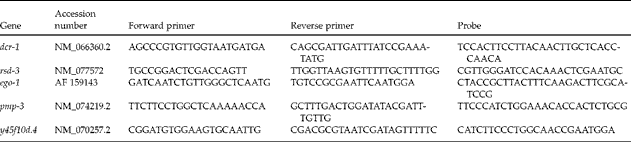
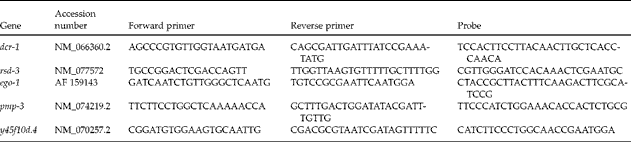
The same amount of total RNA as in end-point PCR was used as a template in quantitative reverse-transcriptase PCR (qRT-PCR) experiments. Gene-specific primers and hydrolysis probes were designed for Ce-dcr-1, Ce-rsd-3, Ce-ego-1, Ce-pmp-3 and Ce-y45f10d.4 (table 2) using Primer Express 3.0 software (Life Technologies). Both primers and probes were high performance liquid chromatography (HPLC) purified and purchased from Eurofins MWG operon (http://www.eurofinsdna.com). Hydrolysis probes were labelled with the fluorescent dye 6-carboxyfluorescein (FAM) at the 5′ end and the non-fluorescent quencher dye Black Hole Quencher 1 (BHQ1) at the 3′ end. The qRT-PCR was performed using SuperScript® III Platinum®One-Step qRT-PCR kit (Life Technologies™) and the ABI 7500 system (Life Technologies) with the following cycling conditions: 50°C for 15 min; 95°C for 2 min; and 40 cycles of 95°C for 15 s, 57°C for 30 s and 60°C for 32 s. Each reaction in qRT-PCR was run in duplicate and standard curves generated using five fourfold dilutions of a total RNA template, to determine efficiency of the primers. Negative, ‘no template’ controls were included. Finally, Ce-pmp-3 and Ce-y45f10d.4 were chosen as housekeeping genes based on previous studies (Hoogewijs et al., Reference Hoogewijs, Houthoofd, Matthijssens, Vandesompele and Vanfleteren2008). Relative transcript levels of the candidate marker genes in the worms soaked in Ce-cpr-4 and Ce-sod-4 dsRNA were calculated as a fold-change compared with untreated worms (soaked in 1 × PBS) and normalized against both control genes (Ce-pmp-3 and Ce-y45f10d.4) by using the formula:
 $$\begin{eqnarray} \end{eqnarray}$$
where ΔΔCt = ΔCttreated – ΔCt untreated; ΔCt treated = Ct marker gene treated − Ct housekeeping gene treated; ΔCtuntreated = Ct marker gene untreated − Ct housekeeping gene untreated.
Accession numbers, primer and probe sequences (orientated from 5′ to 3′ end) of the candidate marker genes (dcr-1, rsd-3 and ego-1) and the housekeeping genes (pmp-3 and y45f10d.4) for the qRT-PCR in C. elegans.
Exsheathment protocols for Teladorsagia circumcincta and the effect of exsheathment on Tci-asp-1 transcript and protein level
Exsheathed L3 larvae were used for testing the efficacy of RNAi in T. circumcincta. L3 larvae were cultured from the faeces of sheep experimentally infected with the isolate, ‘MTci2’ (an anthelmintic-susceptible laboratory isolate from Moredun Research Institute) and larval exsheathment was compared using sodium hypochlorite and CO2. Sodium hypochlorite exsheathment was conducted as described in the Manual of veterinary parasitological laboratory techniques (Ministry of Agriculture, Fisheries and Food, 1986). Briefly, 10,000 L3 were transferred in a pointed tube in 5 ml tap water, then sodium hypochlorite was added (750 μl ‘Milton’ sterilizing fluid, 2% w/w hypochlorite; Laboratoire Rivadis, Nantes, France). A 100 μl sample containing L3 was observed under the microscope until all L3 in the sample were exsheathed. These were then washed three times with PBS and retained for RNA extraction. CO2 exsheathment of approximately 10,000 L3 was conducted as described previously (Halliday et al., Reference Halliday, Lainson, Yaga, Inglis, Bridgett, Nath and Knox2012) and L3 were retained for RNA extraction. The effect of exsheathment was examined at transcript and protein level. Approximately 100,000 T. circumcincta L3 were exsheathed as described above (Halliday et al., Reference Halliday, Lainson, Yaga, Inglis, Bridgett, Nath and Knox2012). After 90 min of CO2 exposure, larvae were divided into five tubes, each one containing 20,000 L3 in 4 ml Earle's balanced salt solution (EBSS, Sigma®, Gillingham, Kent, UK), and kept in culture in a shaking waterbath (at 40°C and 100 strokes/min) for 24, 48, 72 and 96 h, respectively. At each time point, 10,000 L3 were used for total RNA extraction and the remaining 10,000 used for immunoblotting with sera to a recombinant version of Tci-ASP-1 (rTci-ASP-1) (Nisbet et al., Reference Nisbet, Smith, Armstrong, Meikle, Wildblood, Beynon and Matthews2010b).
RNAi in Teladorsagia circumcincta
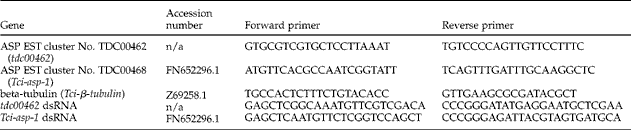
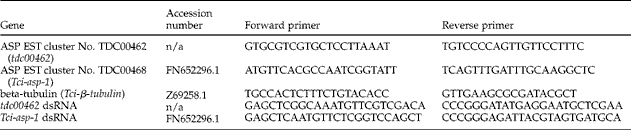
Members of the ASP gene family, Tci-asp-1 and tdc00462 (T. circumcincta EST cluster No. TDC00468 and TDC00462, respectively; Nisbet et al., Reference Nisbet, Smith, Armstrong, Meikle, Wildblood, Beynon and Matthews2010b) were selected as RNAi targets, these being selected on the basis that they are targets of serum antibody responses in experimentally infected sheep and represent potential vaccine targets (Nisbet et al., Reference Nisbet, Smith, Armstrong, Meikle, Wildblood, Beynon and Matthews2010b). Sequence-specific gene fragments (asp-1, 218 bp; tdc00462, 168 bp) were amplified from L3 cDNA using primers indicated in table 3 and cloned into the L4440 vector prior to dsRNA synthesis as described before (Geldhof et al., Reference Geldhof, Whitton, Gregory, Blaxter and Knox2005). Subsequently, ~10,000 exsheathed L3 were incubated in a shaking waterbath (40°C and 100 strokes/min) in 50 μl of EBSS containing 1 mg/ml dsRNA pre-mixed with 1 μl of lipofectamine (Life Technologies™). The L3 were soaked in dsRNA for 1 h to target asp-1 or tdc00462, with ~10,000 exsheathed L3 incubated with EBSS alone as a control. At the end of the incubation, total RNA was prepared as described above and experiments were conducted in quadruplicate. For the end-point RT-PCR, approximately 100 ng of DNase-treated total RNA was used as a template in a RT-PCR employing primers specific for asp-1 and tdc00462 (table 3). Equal loading and integrity of each RNA preparation were verified by amplifying a fragment of the T. circumcincta β-tubulin gene (accession number: Z69258 (Elard et al., Reference Elard, Comes and Humbert1996)). SuperScript™ One-Step RT-PCR System with Platinum® Taq DNA Polymerase (Life Technologies™) was used with the following cycling conditions: 50°C for 30 min, 94°C for 2 min, 40 cycles of 94°C for 30 s, 56°C for 1 min and 72°C for 1 min, with a final 7-min extension at 72°C. Amplification products were examined as described above.
Accession numbers and primer sequences (orientated from 5′ to 3′ end) of the target genes (tdc00462 and Tci-asp-1) and the housekeeping gene (Tci-β-tubulin) for the end-point RT-PCR and dsRNA production in T. circumcincta.
The genetic capability of T. circumcincta for RNAi
To examine whether T. circumcincta has the genetic capability for RNAi, a bioinformatics search was undertaken to detect the orthologues of 77 C. elegans proteins that are considered to be essential for RNAi. The methodology was the same as used in a previous study (Dalzell et al., Reference Dalzell, McVeigh, Warnock, Mitreva, Bird, Abad, Fleming, Day, Mousley, Marks and Maule2011). As T. circumcincta's genome is not fully annotated yet (http://www.sanger.ac.uk/cgi-bin/blast/submitblast/t_circumcincta), some of the RNAi pathway genes were searched for in the genome of the related parasitic nematode, Haemonchus contortus (Laing et al., Reference Laing, Kikuchi, Martinelli, Tsai, Beech, Redman, Holroyd, Bartley, Beasley, Britton, Curran, Devaney, Gilabert, Hunt, Jackson, Johnston, Kryukov, Li, Morrison, Reid, Sargison, Saunders, Wasmuth, Wolstenholme, Berriman, Gilleard and Cotton2013), with the search based on the methodology of Dalzell et al. (Reference Dalzell, McVeigh, Warnock, Mitreva, Bird, Abad, Fleming, Day, Mousley, Marks and Maule2011).
Delivery of dsRNA to T. circumcincta for RNAi and the effect of storage
Approximately 1000 L3 were exsheathed using CO2, divided into five aliquots, and pelleted by centrifugation at 1000 rpm for 2 min. Subsequently, the supernatant was removed and fluorescein isothiocyanate (FITC)-labelled siRNA (AllStars Neg. siRNA AF 488; Qiagen, Manchester, UK), pre-mixed with 1 μl of lipofectamine (Life Technologies™), was added to each tube at a final concentration of 1 mg/ml in a final volume of 40 μl. The tubes were covered with aluminium foil to protect the FITC-labelled siRNA from daylight and kept in a shaking waterbath at 40°C and 100 strokes/min. The L3 were photographed after 1, 24, 48, 72 and 96 h of exposure to the siRNA, to monitor uptake of the siRNA, using an inverted microscope (Zeiss Axiovert 25; Zeiss, Cambridge, UK) fitted with a UV blue-range filter (495 nm). At the same time points, images were captured of L3 soaked in EBSS alone, to estimate autofluorescence. The same experiment was repeated with fluorescent-labelled dsRNA for Tci-asp-1 and labelled using a Silencer® siRNA labelling kit (Life Technologies™), following the manufacturer's protocol. Finally, an experiment was conducted in quadruplicate where ‘old’ L3 (stored for a year but viable as judged by microscopic examination) and ‘fresh’ L3 (stored for less than a month) were exsheathed and soaked in Tci-asp-1-specific dsRNA for 1 h, as described above.
Data analysis
Minitab® 15.1.0.0 (www.minitab.com) was used for statistical analysis of the qRT-PCR results. The normality of the data was considered using the Anderson–Darling test. A two-sample t-test was used to show whether or not there was a difference in relative transcript levels of the pathway genes between worms with an activated and inactivated RNAi pathway, the outcome results being considered significant when the P value was less than 0.05.
Results
RNAi in Caenorhabditis elegans
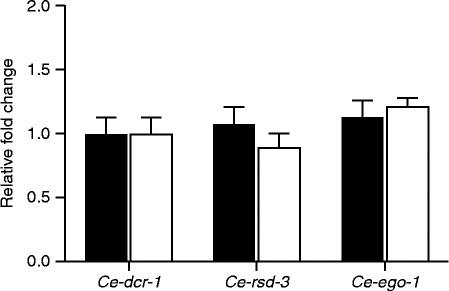
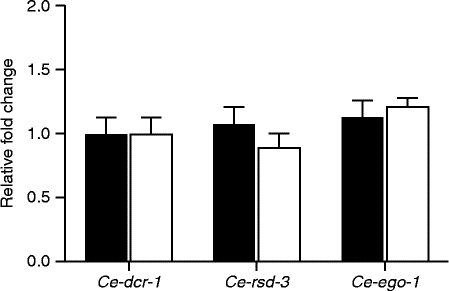
The end-point RT-PCR showed a substantial reduction in the Ce-cpr-4 transcript of worms soaked in Ce-cpr-4-specific dsRNA, similar to previous studies (Geldhof et al., Reference Geldhof, Molloy and Knox2006a), although there was no obvious change in the Ce-sod-4 transcript levels of worms soaked in Ce-sod-4-specific dsRNA (data not shown). The qRT-PCR data (fig. 1) were indicative of a stable transcription pattern regardless of worm treatment. The Anderson–Darling normality test showed that the data were normally distributed and the two-sample t-test revealed no significant differences between the activation, or not, of the RNAi pathway for any of the pathway genes.
Relative fold changes (mean values ± SE) in three candidate RNAi pathway genes (Ce-dcr-1, Ce-rsd-3 and Ce-ego-1) in Caenorhabditis elegans with activated (■) and inactivated (□) pathways.
RNAi in Teladorsagia circumcincta
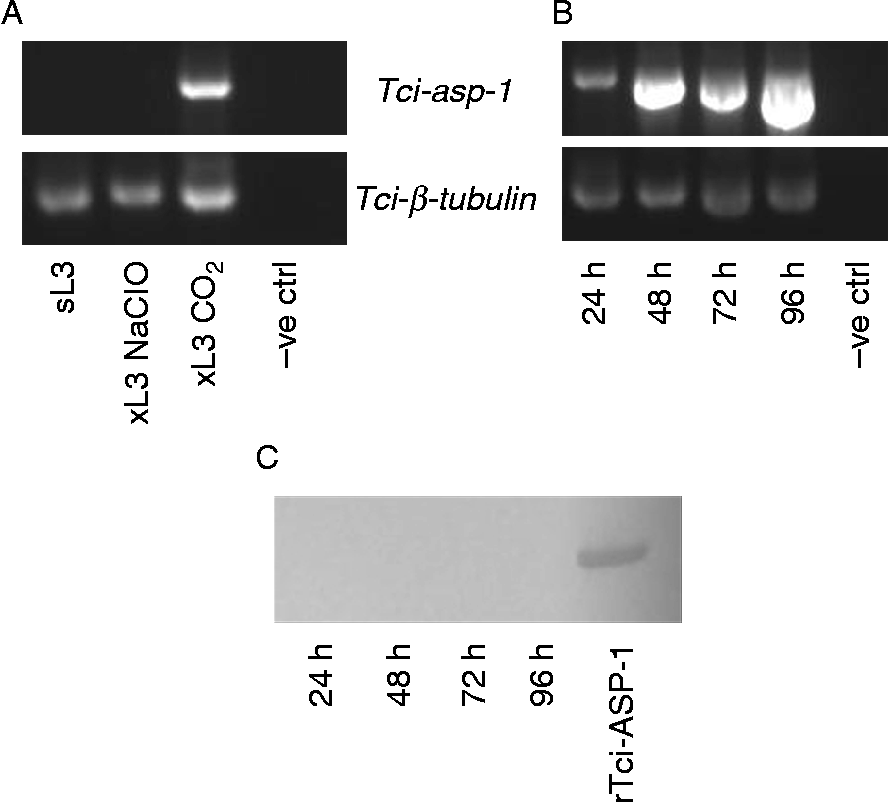
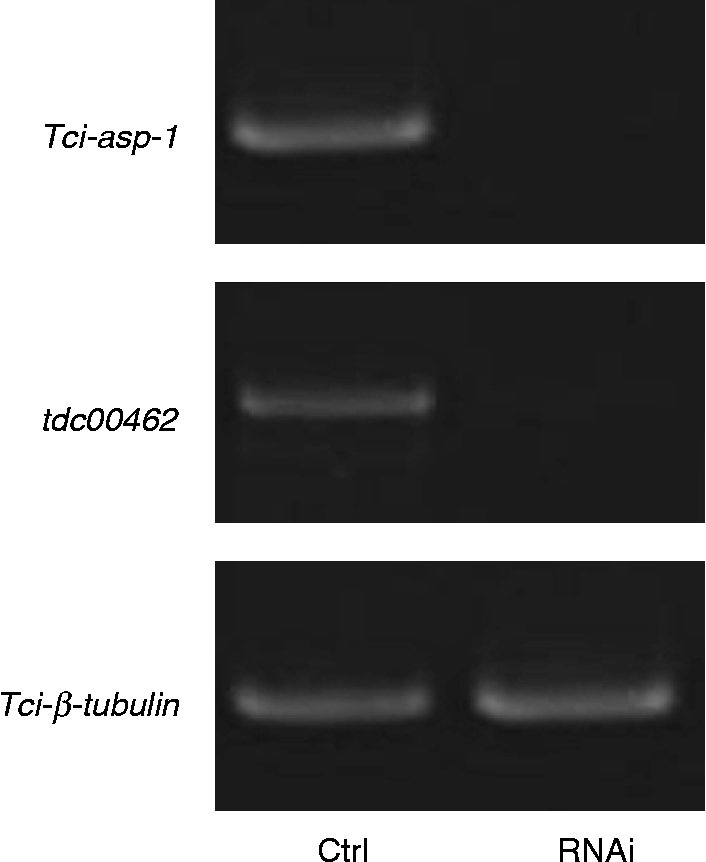
A comparison of both exsheathment methods indicated that the transcription of Tci-asp-1 (fig. 2) and tdc00462 (data not shown) was activated only after exsheathing L3 by CO2. The transcripts could be detected within 1.5 h of exposure to CO2 and transcript levels of Tci-asp-1 increased proportionally with time (fig. 2) as did those of tdc00462 (data not shown). Detection of the Tci-ASP-1 protein by probing L3 with rTci-ASP-1-specific antisera indicated that the protein was not detectable by immunoblotting at these time points (fig. 2). The end-point RT-PCR showed a substantial reduction in Tci-asp-1 and tdc00462 transcripts of worms soaked in Tci-asp-1 and tdc00462-specific dsRNA, respectively (fig. 3). However, after four successful repeats, inconsistencies were observed and the silencing effect was not found to be reproducible.
The effect of larval exheathment of Teladorsagia circumcincta on Tci-asp-1 transcript and protein levels to show (A) RT-PCR detection of the transcript only in L3 exsheathed with carbon dioxide ( × L3 CO2) compared with sheathed L3 (sL3) and L3 exsheathed with sodium hypochlorite ( × L3 NaClO). Tci-β-tubulin was used as a housekeeping gene and ‘no template’ controls ( − ve ctrl) were included. (B) Transcript abundance increased markedly with time after in vitro maintenance of CO2-exsheathed L3, for up to 96 h. Tci-β-tubulin was used as a housekeeping gene and ‘no template’ controls ( − ve ctrl) were included. (C) In the immunoblot, Tci-ASP-1 was not detected after in vitro maintenance of CO2-exsheathed L3, for up to 96 h. Pure recombinant Tci-ASP-1 (rTci-ASP-1) was used as a positive control.

RT-PCR detection of Tci-asp-1 and tdc00462 transcripts in Teladorsagia circumcincta L3 exsheathed with CO2 after soaking in gene-specific dsRNA for 1 h (RNAi) compared with untreated worms (Ctrl). Tci-β-tubulin was used as a housekeeping gene.
The bioinformatics search identified 25 RNAi pathway genes in the T. circumcincta database, out of the 77 that were used by Dalzell et al. (Reference Dalzell, McVeigh, Warnock, Mitreva, Bird, Abad, Fleming, Day, Mousley, Marks and Maule2011) and were considered to be essential for a functional RNAi pathway (data not shown). A further search in H. contortus revealed 18 genes that were not identified in the past by Dalzell et al. (Reference Dalzell, McVeigh, Warnock, Mitreva, Bird, Abad, Fleming, Day, Mousley, Marks and Maule2011), including rde-4 (data not shown).
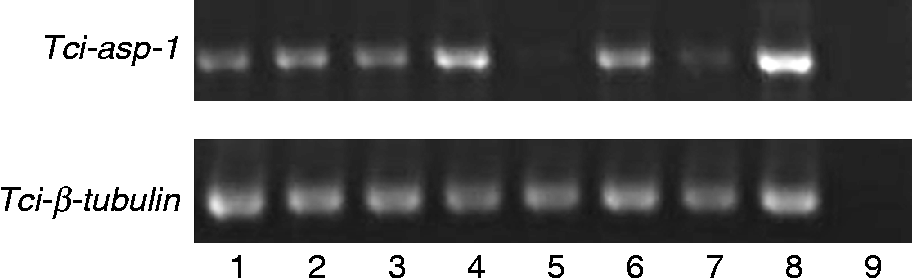
Uptake of labelled siRNA was clearly evident after soaking for 48, 72 and 96 h, the intensity of fluorescence in worms soaked in labelled siRNA being considerably higher than the fluorescence observed in control worms (data not shown). Soaking in fluorescently labelled dsRNA revealed distinct foci of uptake along the exsheathed L3 after 48, 72 and 96 h, but the intensity of the fluorescence was not as high compared to the siRNA-treated worms (data not shown). The degree of autofluorescence observed in control L3, did not allow a detailed time course in the protocol (for example, 1 h of soaking, 90 min after CO2 exposure). Finally, a comparison between ‘fresh’ and ‘old’ L3 showed successful knockdown in ‘fresh’ (stored for less than a month) but not in L3 stored for a year. This was a consistent finding in all four experiments (fig. 4).
Effective RNAi was evident in Teladorsagia circumcincta L3 stored for less than a month after harvesting from fresh faeces (lanes 5–8); however, efficacy was lost after storing the L3 for a year (lanes 1–4). Lanes 1, 3, 5 and 7 correspond to CO2-exsheathed L3 soaked in Tci-asp-specific dsRNA for 1 h, and lanes 2, 4, 6 and 8 to untreated exsheathed L3. Tci-β-tubulin was used as a housekeeping gene and lane 9 is a ‘no template’ control.
Discussion
The present study has shown that measuring transcription levels of the RNAi pathway genes Ce-dcr-1, Ce-ego-1 and Ce-rsd-3 does not provide an indication of RNAi pathway activation in C. elegans because their transcript levels were similar irrespective of treatment here. Successful RNAi could be achieved after as little as 1 h of soaking in gene-specific dsRNA. The study also showed that successful RNAi can be achieved in T. circumcincta but is inconsistent. To our knowledge, this is the first report in the literature of successful RNAi in T. circumcincta. The data presented strongly suggest that the storage period of the L3 prior to exposure to dsRNA may play a role in the consistency of the RNAi results in this species.
After successful repetition of the experiments performed previously in C. elegans by Geldhof et al. (Reference Geldhof, Molloy and Knox2006a), the soaking protocol was adapted here by increasing the number of C. elegans soaked from 15 to 50, to increase recovery of total RNA, and reducing the soaking period from 24 to 1 h. The rationale behind the reduction in soaking period was that RNAi is considered to be a defence mechanism of cells against viruses (Vance & Vaucheret, Reference Vance and Vaucheret2001) and thus it should be triggered shortly after exposure to ‘intruding’ dsRNA. The results confirmed this rationale since there was successful knockdown of Ce-cpr-4, Tci-asp-1 and tdc00462 by 1 h after soaking. However, qRT-PCR showed no difference in transcript levels of the candidate marker genes in C. elegans where RNAi was successful (e.g. soaked in Ce-cpr-4-specific dsRNA) or unsuccessful (e.g. soaked in Ce-sod-4-specific dsRNA) and in untreated worms (soaked in PBS). Thus, the candidate pathway genes selected here do not qualify as markers for activation of the RNAi pathway in response to exogenous dsRNA.
The RNAi targets that were chosen for T. circumcincta belong to the ASP group. The ASPs form one of the largest nematode-specific groups of proteins (Parkinson et al., Reference Parkinson, Mitreva, Whitton, Thomson, Daub, Martin, Schmid, Hall, Barrell, Waterston, McCarter and Blaxter2004). Although their precise function remains to be elucidated, ASP molecules are considered to be virulence factors that manipulate host immune responses and contribute to parasite survival (Lu et al., Reference Lu, Villalba, Coscia, Hoffman and King1993; Hawdon et al., Reference Hawdon, Jones, Hoffman and Hotez1996, Reference Hawdon, Narasimhan and Hotez1999; Tawe et al., Reference Tawe, Pearlman, Unnasch and Lustigman2000; Geldhof et al., Reference Geldhof, Vercauteren, Gevaert, Staes, Knox, Vandekerckhove, Vercruysse and Claerebout2003; Wang & Kim, Reference Wang and Kim2003; Zhan et al., Reference Zhan, Liu, Badamchian, Williamson, Feng, Loukas, Hawdon and Hotez2003; Asojo et al., Reference Asojo, Goud, Dhar, Loukas, Zhan, Deumic, Liu, Borgstahl and Hotez2005). Members of the ASP family have been found to provide some protection against challenge in a number of nematode vaccine trials (Schallig & Van Leeuwen, Reference Schallig and Van Leeuwen1997; Ghosh & Hotez, Reference Ghosh and Hotez1999; Geldhof et al., Reference Geldhof, Claerebout, Knox, Vercauteren, Looszova and Vercruysse2002). Moreover, they are considered as vaccine candidates in T. circumcincta because they are found in abundance in this nematode's excretory/secretory products and are targets of the early immune response in infected sheep (Nisbet et al., Reference Nisbet, Smith, Armstrong, Meikle, Wildblood, Beynon and Matthews2010b). Before the RNAi experiments commenced, transcripts of Tci-asp-1 and tdc00462 were sought in T. circumcincta exsheathed L3. In previous studies, the protein and transcript of Tci-asp-1 were identified in L4, but not in exsheathed L3 (Nisbet et al., Reference Nisbet, Smith, Armstrong, Meikle, Wildblood, Beynon and Matthews2010b), exsheathment in these former studies being stimulated using sodium hypochlorite. Here, we compared two exsheathment methods and the results showed that transcription of Tci-asp-1 and tdc00462 was activated only after exsheathing L3 with CO2. The transcript levels of Tci-asp-1 and tdc00462 appeared to increase proportionally with time, with the highest levels observed 4 days after exposure to CO2. ASP-1 protein was not detectable by immunoblotting using sera to a recombinant version of this protein. Successful RNAi knockdown of both T. circumcincta target genes was observed after soaking 10,000 L3, exsheathed by CO2, in gene-specific dsRNA for 1 h. However, after four successful repeats using the same batch of L3, the results became inconsistent. The inconsistencies coincided with ageing of a particular batch or the replacement with a different batch derived from the same isolate but which had been stored at 4°C for several weeks. However, effective RNAi was observed with four separate batches of L3, each freshly harvested on the day of the experiment. Inconsistencies in the outcome of RNAi have been observed previously with other parasitic nematode species (Britton & Murray, Reference Britton and Murray2006; Geldhof et al., Reference Geldhof, Visser, Clark, Saunders, Britton, Gilleard, Berriman and Knox2007) and it has been proposed these might be due to inappropriate dsRNA delivery methods, or the absence or non-functional RNAi pathway genes (Viney & Thompson, Reference Viney and Thompson2008). Soaking T. circumcincta in FITC-labelled siRNA and dsRNA showed that delivery is successful in soaking periods greater than 48 h, but was difficult to observe after 1 h of soaking because of the levels of autofluorescence in the control worms.
The bioinformatics search in the T. circumcincta genome revealed a relatively small number of RNAi pathway genes present compared to those in other parasitic nematodes (Dalzell et al., Reference Dalzell, McVeigh, Warnock, Mitreva, Bird, Abad, Fleming, Day, Mousley, Marks and Maule2011). This is not surprising because the current genome coverage available for T. circumcincta is not as good as for other species. A comparative search in the H. contortus genome (Laing et al., Reference Laing, Kikuchi, Martinelli, Tsai, Beech, Redman, Holroyd, Bartley, Beasley, Britton, Curran, Devaney, Gilabert, Hunt, Jackson, Johnston, Kryukov, Li, Morrison, Reid, Sargison, Saunders, Wasmuth, Wolstenholme, Berriman, Gilleard and Cotton2013) revealed genes such as rde-4, which had been thought to be absent (Geldhof et al., Reference Geldhof, Murray, Couthier, Gilleard, McLauchlan, Knox and Britton2006b; Dalzell et al., Reference Dalzell, McVeigh, Warnock, Mitreva, Bird, Abad, Fleming, Day, Mousley, Marks and Maule2011); this is probably because the H. contortus genome was not fully annotated until recently (Laing et al., Reference Laing, Kikuchi, Martinelli, Tsai, Beech, Redman, Holroyd, Bartley, Beasley, Britton, Curran, Devaney, Gilabert, Hunt, Jackson, Johnston, Kryukov, Li, Morrison, Reid, Sargison, Saunders, Wasmuth, Wolstenholme, Berriman, Gilleard and Cotton2013). The combination of the two bioinformatics searches suggested that the parasitic nematodes probably possess the genes required for successful RNAi.
Finally, our results indicated that the outcome of RNAi experiments in T. circumcincta is associated with the time of L3 storage after culture from faeces. This observation, in combination with previous studies that demonstrated that consistency of silencing may depend on the expression site of the gene (Samarasinghe et al., Reference Samarasinghe, Knox and Britton2011), might produce more optimal protocols. Moreover, the majority of the studies that used RNAi in parasitic nematodes soaked worms for 24–72 h (Britton & Murray, Reference Britton and Murray2006; Geldhof et al., Reference Geldhof, Murray, Couthier, Gilleard, McLauchlan, Knox and Britton2006b, Reference Geldhof, Visser, Clark, Saunders, Britton, Gilleard, Berriman and Knox2007; Visser et al., Reference Visser, Geldhof, De Maere, Knox, Vercruysse and Claerebout2006; Samarasinghe et al., Reference Samarasinghe, Knox and Britton2011). It can be suggested that another potential reason for inconsistencies could be the prolonged soaking periods, as RNAi might have been successful in the first hours of soaking but, after 48–72 h, transcripts might have recovered to normal levels. By incorporating the effect of these parameters in future RNAi studies, this may lead to the wider use of this technology in studying parasitic nematodes.
Acknowledgements
The authors thank the Parasitology Laboratory at Moredun for provision of parasite material and Bioservices for their expertise in the care of our sheep. The authors also thank Dr Alasdair Nisbet for providing us with primers and the sera for the immunoblotting, and helpful discussions.
Financial support
This project was funded by the Easter Bush Research Consortium–Zoetis Partnership Platform.
Conflict of interest
None.