


Introduction
Challenges associated with recruiting older adults for clinical research have been well-described in the literature, particularly among individuals with multimorbidity or frailty [Reference Forsat, Palmowski, Palmowski, Boers and Buttgereit1–Reference Harris and Dyson3]. These challenges arise in part because study protocols often set upper age limits or impose health-related exclusion criteria that disqualify a substantial segment of the older adult population. Such exclusion criteria may stem from assumptions about older individuals’ ability to participate, a form of ageism identified by the NIA [Reference Bernard, Clayton and Lauer4], or from the concerns that multimorbidity may complicate interpretation of the study results. In addition, a lack of targeted outreach to older adults limits awareness of research opportunities and may exclude individuals who are motivated to participate but remain underrepresented. Practical barriers, including transportation limitations and caregiver or healthcare provider gatekeeping may further deter older adults from enrolling.
Older adults, including clinical patient populations, are highly heterogeneous with respect to health, functional status, cognition, presence of co-morbidities, and medication use. To optimize research recruitment strategies are needed to efficiently match older adults with studies they perceive as personally relevant, while also addressing specific eligibility criteria [Reference Olsen, DePalma and Evans5], Studies examining older adults’ willingness to participate in research have reported mixed findings. Some suggest that willingness to participate decreases with age [Reference Petty, Zermansky and Raynor6,Reference Ridda, MacIntyre, Lindley and Tan7], whereas others report continued interest driven by personal or altruistic motivations [Reference Townsley, Chan, Pond, Marquez, Siu and Straus8]. Additional barriers identified in the literature include co-morbidities, transportation challenges, difficulty understanding consent forms, mistrust, and perceived lack of personal benefit [Reference Lamb, Backhouse and Adderley9].
Use of the electronic medical record (EMR) to recruit older patients
The use of EMR systems to support targeted recruitment of patients with specific diagnoses, multimorbidity, or frailty has emerged as a valuable and cost-effective alternative to traditional recruitment methods [Reference Chishtie, Sapiro and Wiebe10–Reference Kalankesh and Monaghesh15]. O’Brien et al. conducted qualitative focus groups with 446 site investigators and found that complex EMR queries used to identify eligible participants can reduce screen failures and improve recruitment efficiency [Reference OBrien, Raman and Ellis16]. Screening for likely eligible participants through EMRs can also substantially reduce study personnel workload, particularly in systems that route alerts directly to research staff in addition to, or in place of, providers [Reference Kochar, Cheng and Lehto17,Reference Saxena, Meldon, Hashmi, Muir and Ruwe18]. EMR-based recruitment may also improve enrollment among populations often underrepresented in research, including individuals from rural areas and those with lower socioeconomic status [Reference Effoe, Katula and Kirk11,Reference Hau, Efird and Leatherman12]. Inclusion of these populations is essential for improving the generalizability of research findings.
EMR-based alerts represent an advancement beyond traditional EMR query reports which typically generate lists of potentially eligible participants for later contact. When integrated into routine clinical workflows, EMR alerts provide real-time notifications about research opportunities, facilitating timely identification of eligible older adults, reducing recruitment burden on study teams and improving the efficiency of participant enrollment. These alerts are embedded, encounter-level notifications designed to support clinical decision-making by reminding providers of relevant research opportunities, in real-time, when they are seeing a patient during a medical appointment. When a patient with an eligible diagnosis presents for a visit or becomes eligible through a new diagnosis made during the encounter, a study-specific EMR alert can notify the provider that the patient may be a candidate for recruitment. This enables real-time identification of potentially eligible participants for studies requiring timely enrollment based on diagnostic inclusion criteria. [Reference Peters, Ogunniyi and Hegde14].
EMR alerts may be especially valuable for studies requiring enrollment shortly after diagnosis, injury, or symptom onset, when traditional outreach methods are too slow. Real-time notifications during clinical encounters allow immediate identification and referral before eligibility windows close [Reference Peters, Ogunniyi and Hegde14,Reference Chow, Zuberi, Seto, Hota, Fish and Morra19]. Further, patients are more likely to enroll and complete studies when invitations come from trusted providers [Reference Peters, Ogunniyi and Hegde14]. Thus, embedded automated systems that identify potentially eligible older patients, notify providers in real-time, and streamline the referral process, enhances the effectiveness of recruiting using EMR-based recruitment strategies [Reference Kochar, Cheng and Lehto17].
Real world obstacles to EMR recruitment
Although EMRs can efficiently identify patients with and without desired study-relevant diagnoses or other eligibility criteria, EMR data may be inaccurate, incomplete, or missing details. These limitations can result in the identification of patients who do not ultimately qualify or the exclusion of patients who would have otherwise be eligible. [Reference Devoe, Gabbidon and Schussler20–Reference Poulos, Zhu and Shah22]. Research has demonstrated that EMR systems contribute to provider burnout, particularly in the United States [Reference Kroth, Morioka-Douglas and Veres21,Reference Linzer, Poplau and Babbott23,Reference Yan, Jiang, Harbin, Tolbert and Davies24]. US providers report greater administrative burden compared to their counterparts in other countries, a difference that has been linked to regulatory, policy, and payer requirements that increase time spent on non-patient care activities, including documentation for reimbursement and regulatory compliance [Reference Effoe, Katula and Kirk11,Reference Hau, Efird and Leatherman12]. Prior research also suggests that frequent exposure to alerts can lead to providers desensitization, increasing the likelihood that alerts are overlooked.
Institutional policies regarding the use of EMR data or EMR-based alerts for recruitment can either facilitate or hinder successful study enrollment [Reference Miller, Lindo and Fish2]. Regulatory barriers to direct patient recruitment often stem from institutional interpretations of the Common Rule and HIPAA Privacy Rule, both of which are intended to protect patient privacy and protected health information [Reference Wipke-Tevis and Pickett25]. Although federal regulations do not prohibit research staff from contacting patients directly about research, many Institutional Review Boards and healthcare systems require that initial contact be made by a member of the clinical team before the research team contacts potentially eligible patients. These policies can create additional logistical barriers, including provider gatekeeping and delays in recruitment. Under such policies, the principal investigator or research staff must engage with medical providers in order to notify patients of research opportunities, thereby complicating recruitment procedures, adding to provider burden, and creating additional barriers, related to provider awareness and buy-in.
Additional limitations arise in the case of research focused on older adults. Although a substantial proportion of medical care is provided to older adults, and older adults with complex health needs are at a greater risk for poor outcomes and higher healthcare costs, data on geriatric syndromes and frailty measures related to clinical outcomes have historically been excluded by many EMR vendors. This limits the ability of researchers to recruit for studies focused on functionally vulnerable adults or patients with complex chronic conditions. Researchers recruiting older adults with specific diagnoses or clinical conditions may therefore encounter multi-faceted barriers to meeting enrollment goals [Reference Ancker, Edwards and Nosal27,Reference Barry, Hatchman, Fan, Guralnik, Gao and Kuchel28]. Older patients with these conditions often have multiple complex healthcare needs, frequent hospitalizations, and transportation limitations. [Reference De Meyer, Verhaeghe, Van Hecke and Beeckman30,Reference Pajewski, Lenoir, Wells, Williamson and Callahan31]. In addition, providers may be less likely to refer patients to studies based on perceived limitations or assumptions about their ability to participate [Reference Townsley, Chan, Pond, Marquez, Siu and Straus8].
Newer efforts are underway to expand EMR capacity for research involving older adults. Examples include adding data elements aligned with the Age-Friendly Health Systems movement, implementation of the “4Ms” Framework (What Matters, Medication, Mentation, and Mobility), using EMR systems to calculate an electronic Frailty Index and most recently, collecting objective measures of physical performance, such as gait velocity during routine clinical encounters [Reference Kochar, Cheng and Lehto17,Reference Clegg, Bates and Young26–Reference Pajewski, Lenoir, Wells, Williamson and Callahan31]. EMR-based screening offers an efficient alternative to manual chart review or self-report for identifying eligible research participants. Real-time EMR alerts may provide a more accurate, timely, and targeted recruitment approach by using EMR data to identify patients who meet study criteria at the point of care. Automated EMR recruitment screening can help identify large numbers of eligible participants in a timely and cost-efficient manner.
This paper applies the Consolidated Framework for Implementation Research (CFIR) framework to a case study illustrating the potential benefits and challenges of EMR-based recruitment of older adults [Reference Reardon, Damschroder and Ashcraft32]. To assess the potential of EMR alerts to enhance recruitment for a study of early-stage lower-extremity wound healing in adults aged 50 years and older, we implemented both traditional and passive EMR alert strategies as the primary recruitment approach. Our objective was to identify facilitators and barriers to EMR-based recruitment, with particular attention to challenges unique to older adult populations.
Materials and methods
EMR recruitment in a study of older adults with early-stage lower extremity wounds: a case study
A feasibility study of early-stage lower-extremity wound healing study was conducted at a single-site academic medical center in the Northeastern United States. The study aimed to recruit participants aged 50 years and older, with newly diagnosed lower-extremity wounds, defined as wounds occurring within one to three weeks of onset. Eligible wound types included acute traumatic wounds, early-stage diabetic foot ulcers, and ulcers related to venous or arterial insufficiency.
In the absence of a centralized wound care clinic, potentially eligible participants were identified across multiple clinic settings, where adults aged 50 years or older commonly received care for acute and chronic wounds. These settings included the Emergency Department, Urgent Care, Dermatology, Podiatry, and Geriatrics clinics. This age group was selected because the incidence of impaired wound healing, vascular disease, and diabetes-related complications increases substantially beginning in midlife. Based on the annual wound-related patient volume at the institution, the wound study team anticipated recruiting 40 participants aged 50 years or older with newly developed lower-extremity wounds over an 18-month period.
In-person recruitment was not feasible because of the number and geographic distribution of these clinical sites, as well as institutional policy prohibiting direct recruitment by research staff. In addition, because eligibility was linked to newly developed wounds, traditional recruitment methods were unlikely to identify participants within the narrow eligibility window. To address these challenges, the study team worked with university EMR analysts and the institutional IT team to obtain IRB approval for creating EMR alerts, also referred to as Best Practice Advisories, as the primary recruitment strategy. Both traditional pop-up alerts and passive alerts were implemented.
EMR-based alerts were customized for the outpatient clinic settings in Dermatology, Podiatry, and Geriatrics using traditional pop-up alerts, which appeared during patient encounters and required providers to take action to clear the alert from the screen (Figure 1). Because of the differences in clinical workflow, passive alerts were implemented in Urgent Care and the Emergency Department. Passive alerts are similar to traditional pop-up alerts in that both appear in real-time during a patient encounter. However, passive alerts appear in the discharge module (DISPO) as banner notifications and do not require providers to take action to clear the alert from the screen (Figure 2). Both types of alerts were triggered when an ICD-10 billing code was entered for an encounter or when a patient had a relevant lower-extremity wound code on their existing problem list. Although passive alerts do not interrupt provider workflow, providers must notice the alert and decide whether to discuss the study with the patient. Building and testing an EMR alert typically requires approximately 10–20 hours before it can be added to the EMR system.
Traditional EMR ALERT pop-up notification © 2024 Epic Systems Corporation.

Passive EMR ALERT notification appears in discharge (DISPO) tab in the patient chart © 2024 Epic.

Patients aged 50 years or older with an ICD-10 code for a lower-limb wound were identified during clinical encounters. Alert criteria were intentionally kept broad to avoid inadvertently excluding patients whose medical records contained outdated diagnoses or incomplete documentation, allowing the research team to conduct comprehensive screening to determine final study eligibility. For traditional EMR alerts, when providers documented an encounter that met study criteria, a pop-up message appeared indicating potential eligibility (Figure 1). Providers could then ask patients about their interest in the study. If verbal permission was obtained, the provider clicked “Respond to Study” and selected the “interested” option, which generated an electronic message sent directly to the research team through the EMR. A study team member then contacted the patient to provide additional details, confirm eligibility, and schedule the initial study visit.
If the patient was not interested, providers selected “Respond to Study” and clicked “declined.” Other options included “defer for 30 minutes,” “unable to address,” or “dismiss” which closed the pop-up alert without further action. Passive EMR-based alerts required the provider to click on the banner alert to select one of these response options.
Throughout the study, provider feedback was obtained informally through debriefing conversations and emails. Because this was the first time EMR alerts were used at the institution to support research recruitment, the implementation process functioned as a form of beta testing. These discussions helped the study team understand providers’ experiences with the alerts, including factors that facilitated or limited their use in identifying potentially eligible patients. In addition to EMR alerts, other recruitment methods included flyers in clinic spaces, provider schedule reminders generated from EMR reports, and monthly check-in meetings and emails with clinic staff to reinforce awareness of the study protocol.
We applied the CFIR to evaluate operational, regulatory, and workflow factors influencing the implementation and effectiveness of EMR-based alerts for participant recruitment [Reference Reardon, Damschroder and Ashcraft32]. Factors were categorized within relevant CFIR domains, including intervention characteristics, inner setting, outer setting, and individual characteristics, to identify key barriers and facilitators.
Results
Implementation of EMR alerts
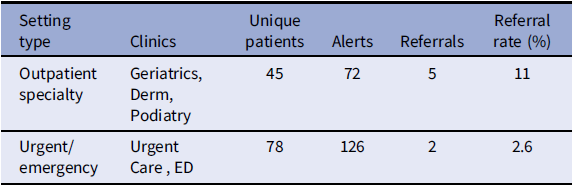
Traditional pop-up EMR alerts were active for nine months in the Geriatrics, Dermatology, and Podiatry clinics, while passive EMR alerts were implemented for eight months in Urgent Care clinic and the Emergency Department. Over the study period, the two alert types were triggered a total of 198 times for 123 unique patients, with Traditional alerts accounted for 72 triggers and passive alerts accounted for 126 triggers.
In the Geriatrics clinic, pop-up EMR alerts appeared 45 times for 39 unique patients. Providers took action in 21 encounters by selecting one of the following response options: “Interested,” “Declined,” “Unable to Address,” “Defer for 30 min” or “Dismiss.” Among the 39 patients identified, four (10%) were referred, while the remaining 35 (90%) were dismissed without further action. In Dermatology and Podiatry, alerts appeared 27 times for six unique patients; one patient (17%) was referred, and the remaining patients (83%) were dismissed or deferred.
In the Emergency Department, 66 passive alerts were triggered for 51 unique patients. Providers took action in seven encounters (14%) by selecting either “Interested” or “Declined,” resulting in two referrals (4%).
In Urgent Care, 60 passive alerts were triggered for 27 unique patients, but no referrals were generated. Overall, across all clinical sites, seven of the 123 patients (6%) identified through EMR alerts were referred.
Referral yield was substantially higher in outpatient specialty settings (11%) than in Urgent Care and Emergency settings (2.6%). This suggests that provider continuity, lower-acuity encounters, and greater opportunity for patient discussion may improve the effectiveness of alert-based recruitment (Table 1).
Recruitment outcomes by care setting

Table 1. Long description
Referral yield was substantially higher in outpatient specialty settings (11%) than in Urgent Care and Emergency settings (2.6%). This suggests that provider continuity, lower-acuity encounters, and greater opportunity for patient discussion may improve the effectiveness of alert-based recruitment.
Other recruitment methods including flyers, provider schedule reports, and provider reminders about the study by email and in meetings, yielded no referrals.
Application of the Consolidated Framework for Implementation Research
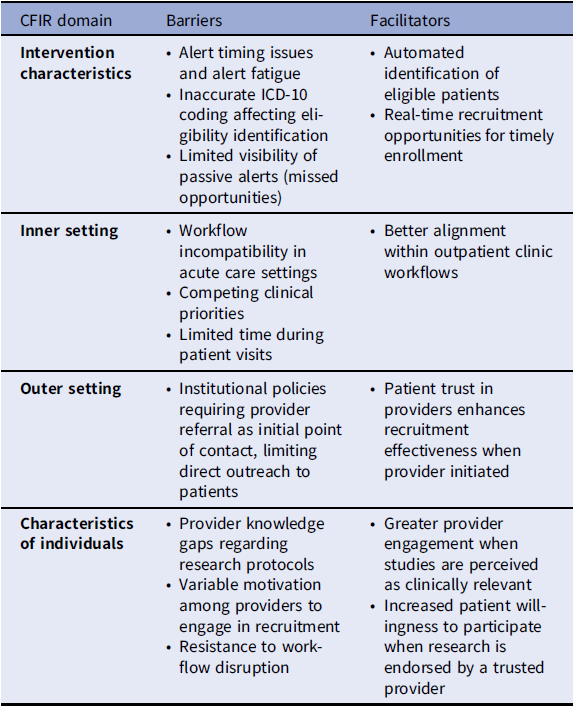
Applying the CFIR (Table 2), we evaluated multilevel determinants influencing implementation of EMR-based recruitment strategies for older adults. Barriers and facilitators occurred across multiple domains.
CFIR domains, barriers, and facilitators

Table 2. Long description
Applying the Consolidated Framework for Implementation Research, we evaluated multilevel determinants influencing the implementation of EMR-based recruitment strategies for older adults. Barriers and facilitators occurred across multiple domains.
Intervention characteristics
Intervention-level barriers included alert timing, provider alert fatigue, inaccurate ICD-10 coding, and visibility challenges, particularly for passive alerts. Alert timing emerged as a significant challenge, with traditional pop-up alerts appearing or disappearing at inopportune moments during clinical encounters. Even after the deferral interval was reduced from four hours to 30 minutes, the clinical visit had often concluded by the time the alert reappeared. Some providers also reported not seeing alerts, despite system logs indicating that alerts had been triggered and required provider action to clear them from the screen. In these instances, alerts may have been dismissed because of poor timing or provider alert fatigue. In addition, electronic filters did not always identify appropriate patients because of the multiple ICD-10 codes used when treating wounds, which further complicated recruitment. Facilitators at the intervention level included automated identification of potentially eligible patients and real-time opportunities for recruitment.
Inner-setting
Inner-setting barriers included workflow incompatibility in acute care settings, competing clinical priorities, and limited time during patient visits. Although one provider described the alerts as helpful reminders, most providers perceived them as disruptive and often ignored them. In Urgent Care settings in particular, providers expressed concern that research alerts should not interfere with timely patient care. Facilitators included better alignment of alerts with outpatient clinic workflows, particularly in settings where continuity of care increased opportunities for providers to discuss research participation with patients.
Outer-setting
Outer-setting barriers included institutional policies requiring initial recruitment contact to come from providers rather than research staff. Providers offered several suggestions to improve the effectiveness of EMR-based recruitment, including leveraging support staff, such as medical assistants, case managers, and social workers, to help identify eligible patients and trigger alerts earlier in the clinical encounter. Providers also suggested that embedding dedicated research staff within clinical settings could facilitate recruitment; however, this approach would require changes to health system-wide recruitment policies. Facilitators included patient trust in providers, which may make provider-initiated recruitment more effective, as patients often value provider recommendations when considering research participation [Reference Reardon, Damschroder and Ashcraft32].
Characteristics of individuals
Individual-level barriers included provider knowledge gaps, variable motivation to recruit patients for research studies, and resistance to workflow disruption. Despite study presentations and the provision of study-specific alert tip sheets, providers often lacked sufficient familiarity with the study protocol, which may have limited their confidence in discussing the study with patients. Some providers felt protective of their patients and were hesitant to make referrals, while others appeared resistant to deviations from established clinical workflows. Providers also noted that older adults frequently involve family members in healthcare decisions, which can add complexity to the recruitment process.
Facilitators included provider engagement and endorsement of research participation, particularly when providers perceived the study as clinically relevant and aligned with patient care goals. Providers who were familiar with the study protocol or directly involved in research activities appeared more willing to discuss participation with patients and facilitate referrals. Trusted provider recommendations also appeared to increase patient receptiveness to research participation among older adults.
Conclusion
In this case study, EMR-based alerts facilitated the identification and referral of potentially eligible patient; however, multiple operational, workflow, and structural barriers limited the effectiveness of this strategy. Although EMR-based alerts were triggered 198 times for 123 unique patients across clinical settings, most did not lead to referrals, highlighting the gap between identifying potentially eligible patients and achieving successful enrollment.
Recruitment yield was substantially higher in outpatient specialty clinics than in Urgent Care and Emergency Department settings. This suggests that continuity of care, lower-acuity workflows, and stronger patient-provider relationships may improve the effectiveness of alert-based recruitment methods for older adults.
Using the CFIR framework, barriers were identified across all domains. Key challenges included provider alert fatigue, poor alert timing, limited visibility of alerts, competing clinical priorities, limited time during visits, institutional policies restricting direct patient outreach, and variable provider interest and comfort in engaging patients in research recruitment.
Despite these challenges, several facilitators supported implementation of this recruitment method. EMR-based alerts provide automated, real-time identification of potentially eligible participants during clinical encounters, which is particularly valuable for studies requiring short enrollment windows following diagnosis or clinical presentation. Provider endorsement also appeared to increase patient receptiveness to research participation.
Additional recruitment methods for older adults with specific diagnoses or health conditions
Providers recommended several strategies to improve recruitment efficiency, including incorporating study information into after-visit summaries, distributing take-home study materials, providing individual providers with feedback reports on unresolved or unaddressed EMR alerts, embedding research coordinators within clinics, and involving clinical staff, such as medical assistants or case managers, in recruitment workflows.
Other EMR-based methods, such as identifying patients for direct mailings or patient portal messaging, may further enhance recruitment while reducing provider burden. However, these approaches also present challenges for studies requiring time-sensitive recruitment and older adults who do not have access to, or regularly use, patient portals.
Direct invitation through the EMR patient portal
EMR reports can be used to generate lists of potentially eligible patients based on criteria applied to discrete EMR fields, such as demographics, visit diagnoses, or billing codes. These reports can then be used to create mailing lists of patients who may meet study criteria. At institutions that require provider referral as the initial point of contact, researchers may consider using a proxy administrative agreement that allows research staff to mail recruitment materials on behalf of providers while still complying with referral requirements. Interested patients receiving these letters can then initiate contact with the study team directly. One concern raised by providers with this approach is that patients may contact their providers with study-related questions rather than reaching out to the research team.
Disadvantages of patient portal-based recruitment that are particularly relevant for older adults include the absence of provider endorsement, limited familiarity with or ability to access the patient portal, and reliance on family members or proxies [Reference Sherman, Langford, Chodosh, Hampp and Trachtman33,Reference Vaterkowski, Daniel and La Rosa34], who may introduce additional gatekeeping. Prior studies have shown that portal use is lower among older adults, non-White populations, uninsured individuals, or Spanish-speaking patients [Reference Sun, Alvarez, Callahan and Sheikh35–Reference Schwinne, Woods and Chan37]. Within this academic health system, 37.89% of patients aged 60 years or older have an active patient portal account, however, only 0.23% have a formal proxy designation based on institutional data. This likely underestimates the true number of family members or care partners managing portal access on patients’ behalf, a pattern consistent with prior studies showing that care partners often support patient portal use among older adults [Reference Wolff, Berger and Clarke38,Reference Gleason, Wu and Wec39]. Although patient portal recruitment is a promising strategy, it requires further refinement and a clearer understanding of best practices to improve both efficiency and effectiveness [Reference Sherman, Langford, Chodosh, Hampp and Trachtman33].
Effective patient recruitment through EMR-based alerts depends on appropriately timed notifications, clearly defined alert parameters, and strong provider engagement. Provider buy-in is critical to the success of this recruitment strategy. In this case study, routine follow-up meetings after implementation helped reinforce provider awareness and use of the alert-based referral process. In addition, IT staff developed provider instructional tip sheets for providers to support alert functionality and referral procedures.
EMR systems constitute substantial institutional investments, and expanding their use beyond clinical care to support research activities may enhance their overall value to the health systems. EMR-based alerts offer a mechanism for timely identification of older adults with specific health conditions, often more efficiently than traditional recruitment methods. However, as demonstrated in this case study, operational and workflow challenges can limit their effectiveness. Although alerts can be valuable, their utility varies across providers and clinical settings. Maximizing recruitment effectiveness while minimizing provider burden is essential for improving recruitment outcomes.
We found that sustained communication with providers throughout the recruitment period helped ensure that alerts functioned accurately and were better integrated into clinical workflows. Collaborative refinement of implantation details such as alert timing and placement may further improve system performance. Complementary strategies, including direct patient outreach through EMR patient portals, may also enhance overall recruitment. In high-acuity environments, such as the Emergency Department, EMR alerts may be less suitable, as even passive alerts were perceived as intrusive to clinical care.
Provider referrals remain an important recruitment mechanism particularly when timely enrollment is essential. However, exclusive reliance on provider-initiated referrals may limit patient autonomy and overall recruitment. Hybrid approaches that combine provider engagement with direct-to-patient recruitment strategies are likely to be most effective for achieving representative samples within required timelines, while supporting patient autonomy among older adults interested in participating in clinical research.
This case study suggests that EMR-based alerts are not universally effective across settings and require further refinement before they can be used as a stand-alone recruitment method. Rather, their success depends on workflow integration, provider engagement, institutional policies, and the clinical environment in which they are implemented. Alerts performed best in outpatient specialty clinics, where providers had ongoing relationships with patients and more time for research-related discussions.
Enhancing the accuracy and completeness of EMR data, particularly measures of functional status and frailty, may improve recruitment of older adults for studies targeting participants across the continuum of healthy aging. Continued work is needed to optimize alert design, improve integration of geriatric measures within EMR systems, and develop more effective EMR-based recruitment workflows that minimize clinician burden while maximizing patient access to research opportunities.
Author contributions
Lisa Kenyon-Pesce: Conceptualization, Investigation, Methodology, Project administration, Writing – original draft, Writing – review & editing, Roshanak Sharafieh: Conceptualization, Investigation, Methodology, Writing – original draft, Writing – review & editing, Karina M. Berg: Writing – review & editing, Tina M. Ferrarotti: Writing – review & editing, George A. Kuchel: Writing – review & editing, Richard H. Fortinsky: Writing – review & editing, Iman M. Al-Naggar: Writing – review & editing, Julie T. Robison: Conceptualization, Investigation, Methodology, Writing – review & editing.
Funding statement
This work was supported by the National Institutes of Health, UConn Claude D. Pepper Older Americans Independence Center (Grant/Award Number: P30AG067988).
Competing interests
The authors that have contributed to this manuscript and work have no conflict of interest to declare.



 Open access

