Introduction
Falls can lead to serious morbidity and mortality among seniors (i.e. persons aged 65 years and older) and they are a major public health concern in many countries around the world. (Clemson et al. Reference Clemson, Finch, Hill and Lewin2010; Scott et al. Reference Scott, Wagar, Sum, Metcalf and Wagar2010; Stevens et al. Reference Stevens, Baldwin, Ballesteros and Sleet2010). The physical and psychological consequences of a fall can be profound and can include disability, chronic pain, loss of independence, social isolation, reduced quality of life and even death (Scott et al. Reference Scott, Wagar, Sum, Metcalf and Wagar2010). Over 85 per cent of all injury-related hospitalisations are due to falls among persons 65 years of age or greater (Weir and Culmer Reference Weir and Culmer2004). In a recent study of older Canadians who visited the Emergency Department because of a fall, 11 per cent sustained lacerations and 33 per cent experienced fractures (Woolcott et al. Reference Woolcott, Khan, Mitrovic, Anis and Marra2012). The majority of fractures (55%) were of the hip or pelvis, while the remainder involved the upper body and face (Woolcott et al. Reference Woolcott, Khan, Mitrovic, Anis and Marra2012). However, the majority of people (63%) in this study did not require hospitalisation and were discharged back to the community after receiving care in the Emergency Department (Woolcott et al. Reference Woolcott, Khan, Mitrovic, Anis and Marra2012). For those seniors who visited the Emergency Department because they sustained an injury through a fall, social support can play a major role in helping them recover their former health and independence.
Social support can present itself in various forms and be offered by many different people. Many formal support services in Canada can be accessed by citizens without direct costs because they are funded by provincial or federal governments. A variety of formal community support services are provincially funded and delivered in the home or community to assist those with health or social problems to facilitate their functioning and enhance their quality of life (Denton et al. Reference Denton, Ploeg, Tindale, Hutchinson, Brazil, Aktar-Danesh, Lillie and Plenderleith2010). Through these services, various forms of assistance such as meal and transportation services are offered. In addition, publicly funded home health services such as nursing or physiotherapy can be accessed (Denton Reference Denton, Ploeg, Tindale, Hutchinson, Brazil, Aktar-Danesh, Lillie and Plenderleith2010). Targeted federal programmes, such as those available to veterans, provide additional support services to seniors, enabling them to remain independent in their home (Government of Canada 2014).
Informal support networks can comprise family, friends, neighbours and co-workers (Mor-Barak Reference Mor-Barak1991). In a recent study examining the provision of assistance to community-dwelling older people by spouses and grown-up children in England and Finland, the authors concluded that functional limitations are a strong predictor of assistance from spouses and grown-up children (Blomgren et al. Reference Blomgren, Breeze, Koskinen and Martikainen2012). Chappell and Funk (Reference Chappell and Funk2012) found that parental health, cultural factors, living arrangements and the quality of the relationship can influence filial care-giving behaviours. In Canada, family members are reported to be the main source of informal care for older relatives (Vézina and Turcotte Reference Vézina and Turcotte2010). In 2012 about 8.1 million individuals, or 28 per cent of Canadians aged 15 years and older, provided care to a family member or friend with a long-term health condition, disability or ageing needs (Statistics Canada 2013). Parents were often the recipients of care-giving activities. Nearly half of care-givers reported caring for their own ailing parents (39%) or parents-in-law (9%) over the past year. Care-givers performed a range of tasks in caring for their family member or friend which included providing transportation (73%), assistance with housework (51%), house maintenance and outdoor work (45%), scheduling and co-ordinating appointments (31%), managing finances (27%), helping with medical treatments (23%) and providing personal care (22%) (Statistics Canada 2013).
However, care from family is not always forthcoming, or easily arranged. It is also embedded in family histories, some of which carry tensions or conflict. Seniors themselves may be reluctant to signal a need for help or to ask for it, for a range of reasons. The choices regarding who they ask for help may provide information about their preferred identity and/or perceived threats to their identity.
While studies in the area of falls and rehabilitation commonly treat identity as an enduring feature of a person, social constructionist paradigms view identity as contingent on relationships and circumstances (Burr Reference Burr2003). From a social constructionist perspective, dilemmas of identity can arise as a result of falls and in relation to the possibility of falling. Tideiksaar (Reference Tideiksaar2010) suggests that falls can symbolise a senior's increasing frailty and an inability to maintain independence and competence. In a recent study by Dollard et al. (Reference Dollard, Barton, Newbury and Turnbull2012), where seniors were interviewed to explore their perceptions of their own and other older peoples' risk of falling, falls were seen to imply a lack of physical competence and responsibility which threatened valued identities. Participants in this study took great efforts to differentiate themselves from others who had fallen and they described strategies they had put in place to prevent falls as a way of demonstrating their own responsibility and vigilance. In another study by Walker, Porock and Timmons (Reference Walker, Porock and Timmons2011), community-dwelling seniors appeared to be participating in a falls prevention programme because they respected the health professionals who referred them to the programme and those who were delivering the programme, not because they believed they needed the service or anticipated to benefit from it. These participants appeared to be distancing themselves from the stereotype of a ‘typical faller’ who had ill health and poor mobility.
While there is some information about the impact of falls and falls prevention programmes on the identity of older people at risk of falling, there is little known about the impact of asking for help upon one's identity. In a recent study by Lloyd et al. (Reference Lloyd, Canlan, Cameron, Seymour and Smith2014), where the impact of ageing and health problems on older people's dignity and identity was explored, many British participants resisted asking for help because they saw virtue in being self-reliant and independent (Lloyd et al. Reference Lloyd, Canlan, Cameron, Seymour and Smith2014). In another study, Kong et al. (Reference Kong, Lee, Mackenzie and Lee2002) explored the psycho-social consequences of falling among a group of older Hong Kong Chinese who were hospitalised as a result of a fall. Three themes emerged: feelings of powerlessness and of fear, and seeking care. Powerlessness related to the senior's lack of confidence in regards to controlling past and future falls. Participants were fearful of losing their independence and afraid of being a burden to their family by not being able to fulfil their usual roles. The participants sought care from their family members after the fall and appreciated their attention after the fall. While the emotional consequences arising from the fall were described, the link to the older person's sense of identity as it related to asking for help (or considering asking for help) was not discussed.
The purpose of the study reported in this paper was to undertake a narrative analysis of the stories recounted by seniors in an urban Canadian city about the assistance or care they received after they had experienced a fall which necessitated a visit to the Emergency Department but did not result in hospitalisation. This study focuses on the informal care networks that were used after the fall, and specifically considers seniors' reflections on processes of asking for and receiving help, the implications for identity, and the factors that either eased or made difficult that process.
Because individuals construct identities through storytelling (Riessman Reference Riessman2008), narrative analysis, applied to stories about recovering from a fall, provides a useful way to gain insight into how seniors' identities are affected by their changing bodily and social circumstances. More specifically, in this study, narrative analysis was used to consider the identity-related implications of asking for and receiving help after a fall. An exploration of how identity, independence and support are negotiated by seniors after a fall might enable health and social care providers to be more proactive in supporting seniors (or be better able to anticipate seniors' needs) at the time of a fall.
Methods
While there are many varieties of narrative analysis (Holstein and Gubrium Reference Holstein and Gubrium2012), for this study we sought to understand both the content of participants' stories, and some of the features of how they told their stories, as we believed both aspects of the story to be relevant to questions of identity. Thematic and structural narrative analysis, two central approaches to narrative inquiry as described by Riessman (Reference Riessman2008), were employed. In thematic narrative analysis, the investigator focuses on ‘what’ was said by the participant. Themes arise through the identification of consistent patterns arising across participants' stories, with attention to the informants' reports of events and experiences. The investigator also attends to the broader context that shapes the personal accounts (Riessman Reference Riessman2008). Like thematic analysis, structural approaches are concerned with content but they include attention to narrative form, adding insight ‘beyond what can be learned from referential meanings alone’ (Riessman Reference Riessman2008: 77). In structural analysis, the investigator focuses on the form and language used by the person to achieve particular results or effects and considers how speech is used to construct identity (Reissman Reference Riessman2008).
This study used a convenience sampling approach. Seniors who visited an Emergency Department as a result of a fall, but whose injuries were not severe enough to warrant hospitalisation, were included. The participants were taking part in a larger, longitudinal study examining the physical and social functioning of seniors who had visited one of three Emergency Departments in a city in south-western Ontario, seeking attention for any unintentional injury (Griffith et al. Reference Griffith, Raina, Worster, Émond, Sirois, Clayton and Shannon2011). All community-dwelling seniors living in households or transitional living arrangements where minimal assistance was provided were included. Exclusion criteria included an inability to speak English, residing in a long-term care facility and cognitive impairment that could impact on the senior's ability to give informed consent, as evaluated by the interviewer. As part of this larger study, interviewers administered telephone surveys, including the Medical Outcomes Study Social Support Survey (Sherbourne and Stewart Reference Sherbourne and Stewart1991), to people within two weeks of their visit to the Emergency Department, and then at one month following the initial call. At the end of the initial telephone call, the interviewer asked those seniors whose injuries resulted from a fall if they would be interested in participating in this study where face-to-face interviews would be used to examine social supports associated with the fall. The names and telephone numbers of those who expressed interest were forwarded to the principal investigator (PI) of the qualitative study reported here. She contacted those individuals by phone and described the purpose and format of the study. This sample represents the first 20 people who agreed to participate.
All interviews were conducted by the PI in the participants' homes between March 2010 and February 2011. Informed consent was secured and demographic data were collected prior to the semi-structured interviews. The interview script was developed by two investigators and the interviews lasted approximately one hour. Participants were asked to describe who provided help to them at the time of the fall and upon return to home after visiting the Emergency Department, what sorts of help they needed, how it felt to ask for help and the sorts of factors they considered when asking different individuals for help.
Interviews were audiotaped and transcribed. An iterative, inductive process was utilised by the two investigators who reviewed the transcripts individually and met regularly throughout the data-collection period to discuss ideas and identify possible themes and structural features of participants' talk until the data were organised into the findings presented here. Representative quotations were selected to illustrate the findings. This study received ethical approval from the Faculty of Health Sciences Research Ethics Board, McMaster University, Hamilton, Ontario, Canada.
Sample
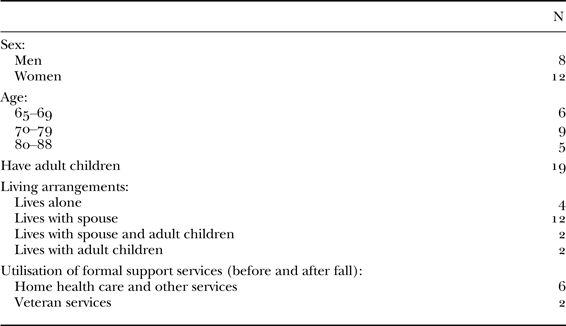
Eight men and 12 women participated. The mean participant age was 74.6 (range 65–88). All participants were residing in their own homes in the community. Four female participants lived alone. All eight men resided with their wives and one also had four adult children in the home. Participants sustained a variety of injuries as a result of their fall, including cuts and bruises, and broken bones in the upper limb, fractured ribs, fractured nose and concussion. These participants reported a variety of pre-existing medical conditions, including diabetes, stroke, Parkinson's disease, bi-polar disease, knee replacement surgery and early Alzheimer's disease.
Eight participants were using government-sponsored formal support services at the time of their fall which included health-care providers offering assistance with activities of daily living (i.e. bathing and dressing) and nursing services to care for a wound that resulted from the fall. Two people did not require these support services once their physical condition improved. Two of the participants were veterans who received assistance with instrumental tasks such as getting groceries, shovelling snow and lawn care (see Table 1 for demographic information).
Demographics of participants

Note: N = 20.
The mean time between the visit to the Emergency Department and the interview was 45 days (range 33–75 days). None of the participants reported falling since the incident that precipitated the visit to the Emergency Department.
Findings
Participants identified a variety of persons, including spouses, family members, friends and neighbours, who provided help at the time of the fall. The help came in a variety of forms, including providing transportation to and from the Emergency Department, transportation to and from subsequent medical appointments, and helping with personal care activities (e.g. getting dressed) and household activities (e.g. making meals).
There were some instances where it seemed that asking for help was unnecessary because it was offered or simply given, without any apparent threat to the senior's identity. This was especially true for assistance that came from spouses and from some adult children. In regards to the adult children, the ease of the relationship may have been facilitated by sharing a home, but this was not always the case. For two participants, grandchildren were the primary source of assistance from family.
We managed quite well you know and we could use the barbecue, you know [name, husband] barbecued meat and we would bake potatoes in the microwave or things like that. Yeah we managed alright. (Participant 11, married woman)
He [son, who lives outside the house] is my godsend … He helps me with anything and everything that I ask for. (Participant 18, married man)
And he'd [grandson] do anything that I wanted done. He'd sit and give me tea or do that sort of thing. (Participant 9, married man)
…usually [name, daughter-in-law who shared the house] would come down and help me get dressed [after the fall] you know. (Participant 13, widow)
However, a genuine reluctance to ask for and accept help was noted, and the valued identity of independence was apparent. The majority of the participants in our study explained that they do not like to ask for help.
And quite honestly if [the cleaning lady] had not been here when I had fallen I probably would have waited till I felt like it and then just crawled back into the house and not said anything. (Participant 5, widow)
This participant resisted calling for help at the time of the fall that ultimately necessitated a visit to the Emergency Department. Another reported:
I don't like to bother anybody you know to come and help me and I won't ask for it unless it's absolutely, positively necessary. (Participant 15, widow)
Like many others, this woman was adamant about wanting to remain independent and self-sufficient. The explanation of only asking for help when it was ‘absolutely, positively necessary’ indicates the passion and fervor with which this participant asserts her identify as someone who can manage successfully without the assistance of others. For these individuals, asking for help would only come in response to a serious circumstance, and where managing on one's own was perceived not to be possible.
Valuing independence
Many participants spoke of the importance of maintaining their independence. They took pride in not needing the help of others. Their reluctance to ask for help appeared to be closely linked to this.
Participant: Well I tend to be a very independent person so I will struggle rather than get help … Well I just like to be independent. If I don't if I don't absolutely need the help I'll do it myself.
Interviewer: Right. And where do you think that drive comes from?
Participant: I'm not sure I've just been like that most of my life (laugh). (Participant 14, married man)
Another participant indicated that soliciting help from others is unbecoming behaviour.
I try to avoid asking for help … Most of my life I have you know if I don't need somebody then I don't want [to ask for help] you know. I don't like people that overdo those kind of things … You know what I mean like, ‘oh I don't feel good can you come up’ you know and all that stuff. (Participant 12, married man)
For some, the concept of independence and self-sufficiency was directly linked to previous generations. Independence was greatly valued and there appeared to be a sense of pride associated with carrying on these family traditions, as well as national or regional traditions or cultural practices. When asked by the PI where the drive to be independent arose from, participants gave the following answers:
Hmm probably my father … Yeah my family, my mother was very independent. In fact my mother died reasonably young, 71, and the doctor told her she didn't complain enough … Yeah. That's right. And you know I think about that a lot. (Participant 12, married man)
But I'm trying to answer your question in a long way that I guess I'm independent. I want to keep that part the independence and growing up with a hardy [Newfoundland] background. (Participant 7, married woman)
I think it's the English probably that comes out in me. (Participant 8, widow)
'Cause we've always always been immigrants, we've always kind of looked after ourselves and not bothered other people. And [name]'s like that, my husband, he would say we can do it [her name], like it's alright, we can do it. (Participant 11, married woman)
Indeed, independence seemed to be conceived as being valiant and sustaining oneself (and not complaining) in difficult circumstances. In this married man's response, we see that he frames his own struggle to regain independence after his fall in the context of his son's battle against cancer.
He's coming again this month. So he's done a sterling job of fighting back [against the cancer] … keeping himself going. And I keep saying I've got to do this, I just can't be the one that lets down here because he's got pretty serious trouble. (Participant 9, married man)
These narratives reflect two slightly different meanings of independence. On the one hand, there are ideas about being strong, doing things oneself, getting on in the face of adversity without complaint. On the other hand, there is the more specific idea of avoiding dependence on others.
In the context of the significant value assigned to independence and autonomy by the participants in the study, three threats to personal identity were identified in the participants' stories about asking for and receiving help. These were: becoming indebted, feeling devalued and becoming a burden. A key factor linked to the fear of becoming a burden was the perception that asking for help disrupted the lives of family members expected to provide assistance. The participants' stories highlighted threats to identity that arose when they had to ask for help. In the section that follows, we consider the nature and sources of these identity threats.
Becoming indebted
Some reported that asking for help was akin to requesting a favour.
I'm, I'm, by nature I don't like asking favours of people. (Participant 9, married man)
This suggests that the participant would subsequently assume a position of indebtedness to the one who provided assistance. Thus, asking for help can threaten the cherished identity of independence and self-sufficiency. The concept of asking for favours was illustrated by one participant who suggested that offering assistance can be treated like an exchange of goods and addressed as fair trade among friends.
Oh. Well I guess in some ways you call in your markers don't you? You know I mean if you've done favours for people then you don't feel so badly asking for help. (Participant 13, widow)
The idea of assistance as ‘a favour’ could be unproblematic if, as Participant 13 suggests, you have ‘markers’ to call in. However, this might not be the case for everyone. The concept of owing someone assistance in the future might pose a distinct challenge to seniors who have limited resources, energy and, in some cases, additional health conditions or concerns which limit their ability to reciprocate the assistance in the future.
Feeling devalued
For some participants, the provision of assistance was linked to the unpredictable availability of the provider, and this appeared to threaten the senior's identity. Unable to express their independence and autonomy by being able to shop or do what they wanted when they wanted, the senior needed to relinquish their control to the person providing the assistance. Participants spoke of their dislike of needing to conform to another person's schedule.
It's hard for him [son] to [help me], I wouldn't say he wouldn't say yes [if I asked him for help] but it wouldn't be on my time. (Participant 7, married woman)
Several participants had implemented a similar strategy to address this situation. They had organised a routine whereby friends or family were available on specific days each week to help with errands and other needs.
She's been helping for about a couple of years now. Yeah … Always on a Tuesday because she's off work on a Tuesday … if she's not working she's right here and helps us out. (Participant 1, married woman)
Like my son takes me out every Wednesday, it's our day out … So you know I try to arrange any appointments you know that I might have. (Participant 8, widow)
The use of a pre-set schedule not only eliminated the perceived disruption to the helper that could accompany a request for his/her assistance, it also meant that the participants did not experience being ‘slotted in’ at a time that depended on the helper's schedule (or at the helper's whim). The senior was able to make appointments and set the agenda for the days when transportation was available, thus leaving their identity uncompromised. Indeed, these arrangements (which involved access to a car because both participants had recently given up driving) enabled them to be much more in control of when and how their needs were met.
Becoming a burden to others
The fear of becoming a burden to or inconveniencing family and friends was widely reported by participants. The role of family is particularly present in this theme. The participants' stories appear to indicate the ambivalence that accompanies the asking for and receiving of assistance from others.
And … you know you just, you don't want you don't want to inconvenience people so I have only asked people that I … almost predictably knew would be happy [to help me]. (Participant 13, widow)
While there are circumstances where receiving assistance from family appears to be almost effortless (described earlier), there were many more that were not, and where seniors described the trouble they experienced associated with needing to ask for help. Many seniors were particularly troubled by disrupting the lives of their family members.
Well I would be, I would think ‘Can we do it?’ ‘Can we manage it ourselves?’ you know. And whether they're busy or whether I'm interrupting in their lives kind of you know. Whether I'm putting too much on them by asking them to do something for me. But they, they're so willing. They really are, yeah. (Participant 11, married woman)
While all of the participants required some additional assistance after their fall, there were clearly circumstances where participants excused the people around them, including their grown-up children, from helping. Demanding jobs and the many responsibilities that come with raising a young family were cited as reasons not to call on them for help. These explanations did not appear to be accompanied by resentment or other negative connotations, rather the participants appeared to indicate that their family members' efforts and energy were legitimately allocated elsewhere.
But they're kind of busy, it's hard for them to come over really because they're teaching so you know, they're, it's busy. And like [daughter's name]'s the principal and she's at a meeting every night you know and things like that. So that was difficult, [they would come to see me] only at the weekends. (Participant 11, married woman)
I have relatives, like a cousin whose daughter lives outside Simcoe … But she's got four kids so I'm not going to say help help help. (Participant 5, widow without children)
My daughter works 12 hours a day so she's not really around. (Participant 4, married woman)
In these quotes, the younger generation's circumstances were reported in a matter-of-fact manner, and this was without any effort to minimise their responsibilities and activities. The identity and status of the younger family members did not appear to be compromised in any way in the participants' stories (i.e. the younger family members were almost never blamed or chastised for their absence). Their family and work commitments appeared to be valued and accepted. The decision to excuse the younger generation as a source of help or assistance appears to be made consciously and did not go unnoticed by participants themselves. One participant indicated that her grown-up children wanted to help more than they were able to because she did not offer them that opportunity.
I don't like to ask [for help]. They [her children] have their, they work and they have their own homes to look after. I know they get after me sometimes because I don't ask (laugh). (Participant 6, married woman)
The ambivalence of asking for help from an adult child – someone who is understood to have plans and responsibilities and the right to pursue them – is highlighted in this woman's response:
You know I say well in an emergency I would call him [my son] but I wouldn't call him, it would be a last resort to call him because he's got a life to live too you know. (Participant 8, widow)
Not surprisingly, illness was another situation where family members were excused from providing assistance without hesitation.
My son age 54 phoned just before Christmas and said ‘we're not coming. Doctor thinks I've got cancer in the hip’ … And as it spilled out he was operated on in January and … you never know whether they've caught all that stuff or not. (Participant 9, married man)
I have a brother-in-law and sister-in-law but he was in the hospital in April he had both his knees replaced … So they've been so busy and he can't drive any more, not for three months, so they really didn't give me any support. I'm sure they would have if they'd been able to. (Participant 5, widow)
As with work and responsibility for young children, illness appeared to create the circumstance where seniors did not ask family members for help (or why they in fact did not help). Especially apparent in the second quote is how the potential criticism of ‘they really didn't give me any support’ is erased by the participant's reporting of multiple barriers to her family helping her, and by the explicit statement that they ‘would have if they'd been able to.’
With family members often identified by the seniors as unavailable to provide assistance, seniors discussed the important role of friends. For many participants, friends appeared to be their preferred source of help. Asking for help appeared to be easy because the participants often had longstanding and close relationship with these friends. The help offered by close friends (some of whom were neighbours) appeared to be given and taken with ease.
But I know that I did have offers of help from quite a few friends [after the fall]. And then I had another friend come over and spend a few hours with me and the next day she came back and worked out in the backyard, cleaned up all my backyard for me. (Participant 5, widow)
And the gals [friends] that I have breakfast with all of them have said give us a call [if you need a drive anywhere] … And I know if I were to call any of them, I mean I feel, I'm particularly blessed I think. I really have a wonderful social network. (Participant 13, widow)
Oh it would be easier to ask a girlfriend [than my son] because we are good friends you know … They're all around my age and they're kind of like me, independent. (Participant 8, widow)
The last quote is especially interesting as it explicitly contrasts asking a friend with asking a family member. The participant suggests that between her and a friend (unlike between her and her son) there is a kind of equity, a similarity of life circumstance and a shared valuing of independence. The friend can be relied on, perhaps, to act in ways that preserve the participant's independence, or at least to recognise the struggle of being (even temporarily) dependent. In regards to asking friends for help, some participants indicated that there was an implicit understanding that both parties would offer help to the other when necessary.
I've got good friends, I've got great friends … And I got great neighbours. Well I try to be a great neighbour to them. (Participant 7, married woman)
You know we [as neighbours] help one another back and forth all the time. There's nothing involved in asking for help. (Participant 17, married man)
This tacit understanding that help goes ‘back and forth’ appeared to facilitate the acceptance of help that occurred at the time of the fall because it was known that the help would likely be needed by the friend/neighbour, and reciprocated by the participant, in the future. This comment links directly to the earlier section of indebtedness where assistance is a valued good that is shared among peers. Here the provision of assistance appears to occur in a context of recognised and appreciated mutual dependence, so the threat to independence that often comes with asking is not applicable.
Discussion
The narratives of seniors who required assistance after a fall indicate that most participants cherish their independence and would prefer not to ask for help. Participants in our study described the fear of being a burden to others, and particularly to their grown-up children. This emotion appears to be present across countries and cultures. Participants in a study exploring ageism among older people in Australia reported that they did not want to become a burden to their family or society (Minichiello, Browne and Kendig Reference Minichiello, Browne and Kendig2000). Being cared for by family members was felt to characterise a loss of autonomy and independence for these participants (Minichiello, Browne and Kendig Reference Minichiello, Browne and Kendig2000). Similarly, adults living in the United Kingdom who were having difficulty walking indicated that they did not want to inconvenience others and reported working with spouses, friends and family in order to retain their independence (Gooberman-Hill and Ebrahim Reference Gooberman-Hill and Ebrahim2006). The fear of being a burden to others was also reported among older Chinese people who had recently fallen (Kong et al. Reference Kong, Lee, Mackenzie and Lee2002). These seniors were particularly fearful of being unable to fulfil their usual role expectations at home. But in contrast to other findings in our study, the older Chinese participants in the study of Kong et al. (Reference Kong, Lee, Mackenzie and Lee2002) demonstrated a strong desire for care from family members and were happy to receive care. Cultural and social differences in response to needing help requires further study.
Participants in this study frequently portrayed their grown-up children as very busy due to work and family responsibilities. Recent surveys indicate that more than one-quarter of Canadian care-givers (28%), or 2.2 million individuals, are ‘sandwiched’ between raising children and care-giving (Statistics Canada 2013). According to Seibert, Mutran and Reitzes (Reference Seibert, Mutran and Reitzes1999), role identity theory suggests that older people's increased reliance on family members for assistance can ‘bolster their role identity as needy dependents' (Seibert, Mutran and Reitzes Reference Seibert, Mutran and Reitzes1999: 529) and threaten their self-perception as persons who are competent and giving. Furthermore, it may create a situation where the family contributes more instrumental help than can be repaid (Seibert, Mutran and Reitzes Reference Seibert, Mutran and Reitzes1999). Perhaps the description of grown-up children as unavailable serves to remove the expectation of having to ask them for help, and in doing so, eases those accompanying threats to the seniors' identity. The reluctance to seek assistance from one's adult children is an important area for future study, and it would be interesting to explore whether or not sustaining greater injuries, and needing more assistance as a result, would alter the participants' views towards asking for or receiving assistance.
Alternatively, many participants highlighted the role of friends and neighbours who offered assistance. These friends and neighbours appeared to share similar circumstances (i.e. widowhood), values (i.e. independence) and expectations (i.e. reciprocity of assistance). Reliance by seniors on informal support networks comprised of friends and neighbours in order to promote mobility and independence has been reported elsewhere, and frequently a reluctance to ask for help is also reported. In a study originating in the United Kingdom, which investigated the impact of a recent fall on seniors' lifestyle and care networks, Roe et al. (Reference Roe, Howell, Riniotis, Beech, Crome and Ong2009) identified the important role of neighbours in the community who took care of each other after the fall. In a study of community-dwelling older Canadians who had fallen or were afraid of falling, a dynamic tension of two life forces was identified: the participants were described as ‘striving for independence’ at the same time as ‘exercising precaution’ (Ward-Griffin et al. Reference Ward-Griffin, Hobson, Melles, Kloseck, Vandervoort and Crilly2004: 313). These participants utilised various strategies to maintain a sense of autonomy in their life by securing and utilising the support of other seniors in their community in order to remain active (Ward-Griffin et al. Reference Ward-Griffin, Hobson, Melles, Kloseck, Vandervoort and Crilly2004). Similar strategies were described by participants in this study. Seibert, Mutran and Reitzes (Reference Seibert, Mutran and Reitzes1999) suggest that in contrast to asking family for support where one could appear needy, offering support to peers lends itself to the reassuring identity as a friend.
Several of the participants described assistance as a good to be traded, and to our knowledge, this finding has not been reported in other qualitative studies. While reciprocity was noted in the study by Lloyd et al. (Reference Lloyd, Canlan, Cameron, Seymour and Smith2014), where older people reportedly gave their family and friends advice, financial help and accommodation in return for assistance, the return of assistance was not noted. Hupcey (Reference Hupcey1998), who described social support as a complex and dynamic concept which involves interactions between recipients and providers where the potential recipients of support weigh the costs and benefits of asking for and accepting support, has reported several reciprocal models of social support interactions that match this conceptualisation. The models where the recipient provides direct reciprocal acts to the provider (i.e. direct reciprocation) or where the recipient of social support reciprocates at a later time, or does not need to reciprocate because of his or her past relationship with the provider (i.e. delayed reciprocal model) (Hupcey Reference Hupcey1998) were similar to those described by our participants. Conceptualising assistance as a product or good to be traded among peers may be one strategy to minimise the threat to one's identity when needing assistance. However, difficulties could arise within such models because not everyone will have the capacity to reciprocate the indebtedness due to a variety of factors including failing health or limited resources. But within the reciprocal models of support, there could be less likelihood of the identity threats that were noted in this study arising (i.e. becoming indebted and burdening others). McGee et al. (Reference McGee, Molloy, O'Hanlon, Layte and Hickey2008) identified that 12 per cent of their sample of older people living in Ireland were providing care to others, and 5 per cent were both providing and receiving care. The role of seniors as providers of informal care to their friends and neighbours requires further exploration, as well as the issue of reciprocal support.
Limitations and future research
There are several limitations to this study. Because the participants only sustained minor injuries from the fall and were able to return home from the Emergency Department, these findings may not be similar to results of a study of seniors who suffered greater injuries necessitating hospitalisation following a fall. Our ability to explore further some interesting comments by the participants and findings was limited by a lack of demographic information. For example, more information about the participants' ethnic and cultural heritage would have been useful and could have permitted an examination of perceptions about receiving assistance relative to these factors. While ethnic and cultural differences and other factors may impact on the transferability of these findings to other settings, this sample drawn from a central Canadian city included individuals representing a variety of socio-economic, cultural and social situations. Additionally, a more detailed analysis along gender lines regarding the negotiation of care between the senior and his or her grown-up children could be considered because there is evidence that male and female grown-up children approach the prevention of falls differently (Horton and Arber Reference Horton and Arber2004). Investigating how the receipt of formal services might impact on the need for assistance from family and friends could perhaps shed more light upon the circumstances and situations where seniors are comfortable and uncomfortable in seeking help from family.
Additionally, a more detailed exploration of the participants' reported comfort relying on close friends instead of their adult children would possibly add clarity to this interesting finding. An examination of the conceptualisation of assistance as a good negotiated among peers could provide greater understanding of factors that may influence the receipt and provision of assistance among friends and neighbours.
Implications for practice and policy
With the number of community-dwelling seniors growing rapidly, these findings provide some insight into the attitudes of community-dwelling seniors in central Canada and into some of the factors considered by seniors who may need to ask for assistance. Reciprocity and interdependence are important concepts to acknowledge in health and social care practice. With seniors describing their drive for independent functioning, health and social care professionals will need to consider that although family members might be living nearby, the senior may be reluctant to ask them for help. Furthermore, for seniors needing assistance following a fall, it may be important to provide him or her with specific information about the various community support services that are available. Denton et al. (Reference Denton, Ploeg, Tindale, Hutchinson, Brazil, Aktar-Danesh, Lillie and Plenderleith2010) found that only one in five older adults in the same community as our study were able to identify community social supports as a potential source of assistance for instrumental activities of daily living such as cooking, cleaning, shopping and yard work. Interventions are needed to increase the awareness of community-dwelling seniors about available community resources that can assist them to maintain their independence and remain in their homes (Denton et al. Reference Denton, Ploeg, Tindale, Hutchinson, Brazil, Aktar-Danesh, Lillie and Plenderleith2010), especially for those reluctant to ask for help.
Conclusion
Seniors who returned home after visiting the Emergency Department as a result of a fall valued their independence and reported relying on spouses, family and friends as their key sources of assistance. Narrative analysis identified three sources of threats to the identity of the participants linked to asking for help. Certain family members were excused from providing assistance because of their family and work responsibilities or because of illness. Often friends were identified as a key source of assistance. Findings suggest that some participants viewed assistance as a good to be traded among peers. This study has offered some insight into the factors considered by seniors when they are seeking help and our findings suggest that many seniors value their independence and may not seek help even when it appears to be available. Health and social care practitioners and policy makers responsible for planning and delivery of services should take this into account to ensure the best possible care for injured community-dwelling seniors.
Acknowledgements
At the time of this study, Dr Miller held the Raymond and Margaret Labarge Post-doctoral Fellowship for Research and Knowledge Application for Optimal Aging in the School of Social Work, McMaster University, Hamilton, Ontario, Canada. Funds from the Ontario Research Coalition also supported the work of both Dr Miller and Dr Griffith. This study was supported by a Canadian Institutes of Health Research (CIHR) Catalyst Grant: Pilot Projects in Aging awarded to Dr Sinding. CIHR also provided funding to Dr Griffith for the longitudinal study through an Interdisciplinary Capacity Enhancement grant on Injuries Across the Life Span sub-study. There are no conflicts of interest to report.