Background
The success of mental health care (MHC) reforms has resulted in the availability of a multitude of services to address the different needs of patients, in particular in outpatient care. The challenge of modern community-oriented MHC lies in bringing all the involved services and service providers together to cooperate, thereby overcome the fragmentation of the system and allow for the ‘uninterrupted movement of patients among the diverse elements of the service delivery system’ (Bachrach, Reference Bachrach1981). Continuity of care has been linked to better outcomes in terms of health and economic aspects (Lasker et al. Reference Lasker, Weiss and Miller2001; Adair et al. Reference Adair, McDougall, Mitton, Joyce, Wild, Gordon, Costigan, Kowalsky, Pasmeny and Beckie2005; Mitton et al. Reference Mitton, Adair, McDougall and Marcoux2005) and is believed to be an important performance and outcome measure in general health and MHC (Haggerty et al. Reference Haggerty, Reid, Freeman, Starfield, Adair and McKendry2003). However, in MHC providing continuity of care is additionally challenging because of the very nature of mentally ill patients, who often require particular guidance through the system, and because of the stigma that is attached to certain services, and thereby blurs their visibility. Thus providing continuity of care in MHC requires a specific effort for cooperation across services and service providers. This is a subject of concern in MHC across countries (WHO/OMS, 2001; WHO European Ministerial Conference on Mental Health, 2005).
Multiple care models, including case-management, integrated and managed care, aim to overcome the problems related to the fragmentation of MHC (Gensichen et al. Reference Gensichen, Beyer, Muth, Gerlach, Von Korff and Ormel2006; Weinmann et al. Reference Weinmann, Puschner and Becker2009). However, at least in the context of the German MHC system, case management and integrated care have so far remained (model) projects confined to specific areas (Schmidt-Michel et al. Reference Schmidt-Michel, Kuhn and Bergmann2008). Thus, besides experimenting with new care models attention should be drawn to the regular MHC and its practice of cooperation. The research presented here aims to explore the practice of cooperation in regular MHC in Germany and tries to identify conditions that promote or inhibit cooperation functioning across disciplines, services and service sectors. By doing this, the study aims to identify measures that can be taken to improve cross-service and sector cooperation in regular MHC.
Method
Focus groups on cooperation practice in MHC were set up in four different regions in Germany. The regions were chosen to represent rural and urban areas as well as East and West Germany. We chose these distinguishing characteristics as there are fewer services available in rural areas and resources, especially human resources, seem to be scarcer in East Germany. In addition, mental health reforms in East Germany started in the early 1990s, at least 10 years later than in West Germany (Bauer et al. Reference Bauer, Kunze, von Cranach, Fritze and Becker2001; Bramesfeld, Reference Bramesfeld2003).
The regions chosen were
• Eisenhüttenstadt, a small city of 30 000 people in the rural environment of Brandenburg, East Germany, situated near the border to Poland with an unemployment rate of 11.4% in 2007 (Bundesagentur für Arbeit, 2007).
• Günzburg, a small city of 30 000 people in rural Bavaria, West Germany with an unemployment rate of 2.8%.
• Leipzig, a city of 500 000 people in Saxony, East Germany, with good infrastructure and an unemployment rate of 17.4%.
• Regensburg, a city of 130 000 people in Bavaria, with large rural hinterlands and an unemployment rate of 4.2.%.
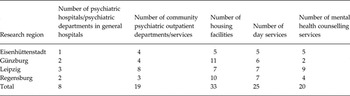
A rough overview of the different services available in all regions is provided in Table 1.
Mental health services available in the research regions

Focus group set up
Focus group participants were chosen to represent all relevant services and services providers involved in core MHC. Core MHC includes psychiatric and psychotherapeutic inpatient and outpatient care (usually provided by office-based psychiatrists and psychotherapists), long-term living facilities, representatives of counselling services and the so-called social psychiatric services. These social psychiatric services support the severely and chronically mentally ill and handicapped in mastering daily living and seek to integrate them into society. General practitioners are not considered as part of ‘core MHC’ in Germany. Two focus groups were planned for each region. In Günzburg, it was decided to have only one focus group because participants were available only at one suggested appointment time. Since this focus group was rather large, in the end, the number of focus group participants equalled the number of participants in the other regions (Eisenhüttenstadt 16, Günzburg 10, Leipzig 10 and Regensburg 11). Of the 47 focus group participants, half of them were social workers (23), who worked in acute clinical care, long-term living facilities, psychiatric outreach teams and counselling services. Thirteen of them were physicians, either psychiatric residents in training or registered psychiatrists. Eight of them worked in inpatient services and five in outpatient care. Six participants were psychologists who worked in psychiatric inpatient care, in outpatient psychotherapy and in outreaching teams. Five participants had a different professional background. They worked in housing counselling for the local public health authority in coordinating services and as patient's ombudsman.
The focus groups were organised and assisted by the local project partners and led by the project coordinator from Leipzig. Therefore, comparability of the discussion-leading style across the groups was assured. All focus groups were audio-recorded. However, at the second focus group in Eisenhüttenstadt, a technical error occurred and recording was not completed. A protocol of this discussion was provided and included in this analysis.
The focus group discussion was oriented on a protocol that included the following issues:
• Introduction
• Understanding and relevance of cooperation
• Aims of cooperation
• Elements of cooperation
• Conditions for successful cooperation/problems with cooperation
• General appraisal of quality of cooperation experienced
• Feedback and conclusion.
Focus group analysis
The audio-recorded discussions were transcribed and their content analysed. This content analysis was then supplemented by thematic work. Therefore, three independent researchers read the transcripts and coded paragraphs and statements by using abstract concepts, inspired by the coding paradigm of the Grounded Theory methodology (Strauss & Corbin, Reference Strauss and Corbin1998; Charmaz, Reference Charmaz2007). These concepts were then further differentiated and set into groups so that networks of codes developed. From these networks, relevant codes were selected and transferred into central categories. On the basis of these categories, theoretical statements on the practice of cooperation in MHC were posted.
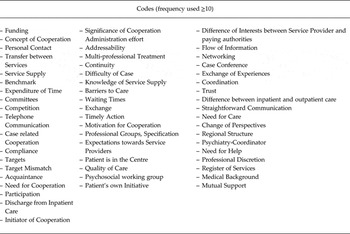
In total, 1037 paragraphs and statements were identified and assigned to 216 codes. Codes that were given at least 10 times are listed in Table 2. Finally, seven central categories were developed:
(1) Involved service providers
(2) Comprehension of cooperation
(3) Reasons for cooperation (including subcategories need, motive, motivation and target)
(4) Instruments for cooperation
(5) Cooperation promoting and inhibiting conditions
(6) Interdisciplinarity
(7) Regional and personal networks
Codes given at least 10 times in analysing the text

The frequency of codes given goes from top to bottom and from right to left (total codes: 216, frequency of assigning individual codes to statements 1–55, median 6).
Results
Cooperation in MHC is described by the focus groups as operating on two levels: the institutional level where different services cooperate for building inter-institutional networks and planning, and the case-related level where different service providers cooperate across services in the context of care for individual patients. The latter case is further distinguished by inner-disciplinary cooperation (inpatient psychiatrists get in touch with outpatient psychiatrists) and interdisciplinary cooperation (psychiatrists get in touch with social workers). The cooperation on ‘case-related level’ was referred to as most significant and received most attention in the discussions.
Involved service providers
Overall cooperation in MHC is characterised by a multitude of service providers involved. Who these service providers are depends on the specific case and might change according to the needs of the situation and the patient/client. Thus, cooperation neither always follows fixed processes or routines, nor does it always operate in fixed cooperation relationships. It rather takes place in networks of service providers in which cooperation is carried out in sporadic as well as in fixed relationships. Cooperation between inpatient and outpatient psychiatric services, as well social mental health services including housing, day care and counselling services, was the cooperation most frequently mentioned in the focus groups. Cooperation with public authorities and paying authorities is less significant for the understanding of professional cooperation. However, it is mentioned as a cause of conflicts. Cooperation with service providers within the general living environment, such as employers or family members, is less frequent.
Comprehension of cooperation
The comprehension of cooperation is based on the day-to-day experiences of service providers. Theoretical concepts of cooperation are rarely mentioned. The orientation of individual patient/client needs was named in all focus groups as the main reference for the definition of cooperation. Cooperation is thus understood as a very case-centred issue. Before the reasons for cooperation become relevant, the form in which cooperation is carried out matters:
‘Well, this is a lot and difficult to describe (…) from the practical point of view, we have a less theoretical understanding of it (cooperation), but rather a more practical approach towards it – I call it – quality of care or service provision oriented cooperation. The first thing that comes to mind on that issue is that you need to know one another well, that you can work together fast without barriers and also without antagonism …’ (psychologist, local public health authority).
Fast and easy access to the other cooperation partners, a dialogue on an equal footing and a fast, target-oriented clear communication style are felt to be essential elements of cooperation. Personal acquaintance with the other cooperation partners is understood as the basic requirement to achieve this. Therefore, networks are believed to be indispensable.
‘Therefore it is very important to really have this networking going on so that you really know each other. And so, I'd like to point out that it is necessary to meet with each other regularly….’ (staff of a residential home).
Routine processes, such as referrals or medical reports and written expert reports, are not understood as cooperation by the focus groups participants. However, the focus groups were dominated by non-medical professionals.
The focus groups distinguished between positive and restrictive cooperation. Positive cooperation was characterised as having flexibility in interfaces, common targets, common knowledge, sharing of information and no direct dependency of the cooperation partners. Restrictive cooperation, as one in which the interaction with administrative bodies and paying authorities was labelled, was characterised by having clearly defined and narrow interfaces, often antagonistic targets (such as patient care v. cost containment), limited sharing of knowledge and information, direct dependency and unequal distribution of responsibilities between cooperation partners. This sort of cooperation was considered a necessary evil.
Cooperation is understood by the majority of focus group participants as cooperation between professionals.
Reasons for cooperation (including sub-categories need, motive, motivation and target)
Specific conditions need to be fulfilled for service providers to get involved and cooperate. Beyond basic willingness, cooperation needs palpable circumstances to bring service providers into contact with each other. These circumstances are determined by the sub-categories of need, motive, motivation and target.
Need
Need for cooperation arises when patients/clients have complex problems that cannot be handled by the routine care of just one service. Codes that have been given in context with the sub-category ‘Need’ include: difficulty of the case, fast intervention, case conference, need for help in more than one sector, situation of crisis, mental impairment and prevention of homelessness.
Motive
The sub-category ‘Motive’ refers to the actual situation that initiates the cooperation. This can be a referral or a change of service. The motive for service providers to work together across service boundaries is usually initiated by a single patient/client, who, through his or her need for particular services, creates the motive. The occasion on which these motives arise is constituted by the structure of the mental health system. Continuous cooperation of services beyond the handling of single patients/clients is rarely reported. Motives in this case include exchange of experiences, consultation and lobbying.
Motivation
‘Motivation’ is understood as the willingness of service providers to cooperate. This can be driven either by a general attitude towards cooperation or by the requirements of the situation. In contrast to the sub-category ‘Need’ that justifies cooperation from the patient/client perspective, motivation refers to the justification from the point of view of services. Codes constituting ‘Motivation’ include: relevance of motivation, motivation for working together, patient-centred care, quality of care, exchange of experience, mutual support, consulting/education, case exceeds own competencies, division of labour, capacities of own institution, sympathy and care.
Targets
The main target for cooperation is the aim to provide good quality of care for individual patient/clients. One of the most relevant targets related to this was providing continuity of care when patient/client transfer from one service to another was needed. Some focus group participants expect that cooperation will make it possible to link professional help closer to the living environment of patients/clients and replace professional help by networks within the living environment:
‘…very practical targets, when I think about people using the day-care centre. They all live in their own apartment or with their parents. Only under this condition is day-care possible. Cooperation is necessary to preserve this independent living situation and prevent hospital admission. I think it is very important that we work together with supported housing, carers, family, whoever, to preserve this situation that is so important to the clients.’ (Social worker, inpatient service). Beyond this, cooperation is understood as an instrument to use resources efficiently: ‘I find cooperation important for really making use of the help and resources that are available at a place to prevent the doubling up of service provisions. But therefore you need to know everyone….’ (Social worker, inpatient service).
Targets of cooperation that are not patient/client related but relate to the service providers include networking, public relation and lobbying, as well as arrangements and planning of services.
Instruments of cooperation
The communication medium that was rated to be the most important to patient-/client-related cooperation is the telephone. The telephone allows for direct and timely communication in a more informal style and is usually not documented as comprehensively as written communication which was seen as an advantage.
‘..it is my usual medium of communication, written yes, now and then but preferably the telephone. On the phone you can be a bit more articulate than if you write, for example, a report’; (Psychologist in private practice). This citation illustrates that cooperation relies a great deal on informal information and processes involved. In contrast, written communication is mainly restricted to areas of formal communication, such as referrals, medical reports and expert reports. Interestingly, although e-mail communication is used a lot within services, it is less relevant in the actual cooperation in individual cases. This shows again the great relevance that person to person contact plays in cooperation.
Cooperation promoting and inhibiting conditions
Conditions promoting and inhibiting cooperation were identified on a structural level as well as on a service and service provider level. Most important conditions on the structural level include the challenges to continuity of care when service sectors and thus service providers have to be changed. Examples are transfer from inpatient to outpatient services or to complementary social services such as day care and housing support.
On the service and service provider level, the factor considered to be most important for promoting cooperation was time: time for agreements concerning individual patients/clients, time for networking, time to acquire the necessary information about service supply and structure within the region. Attached to the factor time is the experience that time that is not dedicated to direct case-related work such as networking, is becoming ever shorter:
‘(…) what I see as a problem for cooperation is the fact that the time span for cooperation is becoming shorter and shorter and the issue of financial reimbursement, I mean. (….) this is a development that I am currently experiencing when providing help for social reintegration, where there is a current heated debate about direct and indirect service provision – services should be provided as far as possible direct to the client and thus the time left for cooperation is steadily getting shorter’ (Social worker, social psychiatric service).
A further relevant condition for cooperation is competition and the general feeling that competition in health and social care is growing. One particular issue was the economically driven interest for service providers to have their own service working at full capacity:
‘I see growing competition, in particular when it comes to our budget (…) when – for example – the possibility of outpatient therapy for an addiction is withheld. This is what I experience. I think these are the financial constraints that are spreading everywhere and are also very visible in our work.’ (Social worker, addiction counselling service). ‘There are patients that would opt for rehabilitation, if they knew it would be possible as an outpatient. But sometimes the information is lacking or, I want to have this patient for my own day-clinic.’ (Social worker, addiction counselling service).
Contrary to these statements, others state that in fact all services are working at full capacity, that competition is not reality.
Financial issues play a role in the incentives to providing cooperation on three levels:
• Financial constraints, motivated by shortage of funds by the paying authorities were raised very often by the focus group participants as impeding cooperation. Although such statements mostly describe unsatisfactory cooperation practices with paying authorities, these financial constraints were believed to also influence possibilities and willingness for cooperation between services.
• Lack of reimbursement makes cooperation, e.g. meeting and getting in contact with other participants, less likely to happen. This is particularly true with regard to general networking between service providers which is not directly related to a particular patient/client. Even if reimbursement is possible, service provider does not always know about it.
• The involvement of several sectors and thus paying authorities, as is the case in the German system, is a particular challenge to cooperation. This is not only because these different sectors have to be coordinated but also because sectors try to shuffle financial responsibilities from one to the other.
Finally, the regional structure of service supply is crucial to cooperation. This relates to the availability of services, their free capacities and their visibility: Willingness to cooperate is pointless if services do not have the capacity to admit patients. The question as to whether supply in the regions was sufficient was judged differently by the participants. In all regions there were statements that available capacity was too low, but only in Regensburg was this concordantly stated by the participants. However, Regensburg was also the only region in which there was no register of psychiatric services available. Therefore, it cannot be excluded that the feeling of insufficient service capacities might be due to lack of knowledge about service availability.
In general, knowing what services were available was a challenge in most parts. An updated systematic register of all mental health services in the region was available only in Leipzig.
‘Yes, there used to be a handbook (…) but then there were no financial resources to update it. It would be a good thing if we had such a book again because now – you go on the Internet and search, if you look for a specific service or you have people, people you know, who you can ask.’ (Social worker, social psychiatric service).
Further barriers that were raised include lack of interest or will for cooperation, lack of mutual sympathy, incompetence of cooperation partner, and data protection rules.
Interdisciplinarity
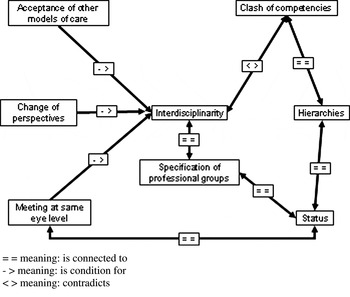
The focus group participants deemed interdisciplinary cooperation a basic requirement in MHC, but also recognised that it was the most challenging task. Conditions for successful interdisciplinary cooperation include meeting each other on an equal footing, changing perspectives and accepting other therapy approaches and concepts. In contrast, disputes over competence and hierarchies were experienced as impeding interdisciplinary cooperation (see Fig. 1). Interdisciplinary cooperation and, in particular, changing one's perspective seems to be especially difficult in the cooperation between professionals of the non-medical psychosocial services and physicians.
Codes given in relation to the category ‘Interdisciplinary’. = = meaning: is connected to; - > meaning: is condition for; < > meaning: contradicts.

Having common therapy targets and concepts was raised in all focus groups as a precondition to interdisciplinary cooperation.
‘Sure, pharmacological therapy, which – the patients tell me, is increasingly used, however, therefore other, non-pharmacological interventions are rejected. Really, this is a different concept of illness that it is based on. This biology model has the notion ‘we can do everything with drugs’, but social psychiatry says, well there are also other things that matter. This plays an important role.’ (Social worker, outpatient service).
Beyond common targets, it is also the knowledge about the other disciplines involved that matter and the struggle for common interests:
‘And then there is more cooperation, it is not just working together well, but also the knowledge about the respective other working conditions and as a consequence perhaps the other value systems and objectives. Or maybe it is also possible to succeed in having common value systems and objectives.’ (Psychologist, local public health authority).
The difficulties in interdisciplinary cooperation are such that some even doubt that cooperation across disciplines is possible:
‘Well, I think the problem is that there are different ideas according to the professional group, and who is in charge in the service; whether it is a physician in private practice, a psychotherapist or professionals working in inpatient services. Well, this multi-professionalism, it is not really there in the cooperation. Everyone has his own view’. (Social worker, addiction counselling)
Regional and personal networks
Regional networks are indispensable for securing continuity and comprehension of care even if care is dissected into different service providers and sectors. The target is to offer help as though it is coming from ‘one hand’ (Armbruster et al. Reference Armbruster, Schulte-Kemna, Kluza and Armbruster2006). Regional networks in the urban areas (Leipzig and Regensburg) are largely determined by the non-medical psychosocial services including the social psychiatry services; whereas in the rural regions cooperation is determined more by psychiatric inpatient services. These inpatient services in rural areas seem to be more closely integrated with the non-medical social services than the inpatient services in urban areas. Inpatient services and psychosocial services are connected through social psychiatric committees or social psychiatric working groups. This kind of networking within the committees and working groups is highly appreciated by all focus groups. However, they also report about the varying intensity of the work of these committees. Structures that were highly relevant after having been commonly built up (especially in East Germany after reunification) and which were understood by the service providers as opportunities to shape service supply, have lost relevance over time:
‘The psycho-social working group once started with high expectations, well really cooperation. Now it is more about information, what else is there? This is fine, and then everybody gets to know what is available. But looking specifically at case-related matters and what we do, this was planned to be an issue, but this is not happening; at least not in our region.’ (Social worker, outpatient care).
For a network of service providers to stay active and alive, it is necessary to nurse the network continuously:
‘This is in fact an ongoing task, because the moment you reduce your efforts to promote cooperation and offer conditions for cooperation to happen, those who have little time for cooperation or are about to taper down their participation will further loose motivation for it (…).’ (Psychologist, local public health authority).
According to participants, committees only make sense if they meet regularly and at least twice a year. For networking across sectors in these committees, it seems to be important that beyond discussing single patients/clients, common objectives are necessary, such as the organisation of person-centred care or the planning of service provision.
Participation in these committees of representatives from psychiatric hospitals and psychiatrists in private practice is described as scarce. Beyond the work carried out in the committees, these meetings also serve for service providers to get to know each other better. Informal exchange at these meetings is not to be underestimated. This informal exchange and the personal bonds that are built at such meetings are the important prerequisites for cooperation:
‘You really have to know many people, if you want to help mentally ill people, help them out of difficult situations’ (Social worker, social psychiatric service).
Discussion
Multi-professionalism and cooperation between different services, service providers and professional groups are not a choice in modern MHC but a basic necessity (WHO/OMS 2001). Despite the high-theoretical value that is paid to cooperation, astonishingly clear concepts of cooperation are lacking. On the one hand, this might be due to the fact that the type of cooperation that is needed in MHC is somehow unpredictable and varies according to the needs of the particular patient/client situation (Sommerseth & Dysvik, Reference Sommerseth and Dysvik2008). On the other hand, the lack of concept and also the lack of financial reimbursement – or even if there is reimbursement, the lack of knowledge about it – indicate that cooperation with other services is not considered a key task in the role model of many professionals working in MHC. If good cooperation takes place, it seems to be more by chance and due to individual cooperation competence of the professionals involved rather than as a matter of course. This is even more true for physicians (Mitchell, Reference Mitchell2009) and should be considered a loss of opportunity for quality care (Laditka & Jenkins, Reference Laditka and Jenkins2000; Sommerseth & Dysvik Reference Sommerseth and Dysvik2008; Koekkoek et al. Reference Koekkoek, van Meijel, Schene and Hutschemaekers2009; Crompton et al. Reference Crompton, Groves and McGrath2010).
Numerous integrated care models are currently popping up in the German health systems and others. They usually focus on specific, narrowly defined cooperation mainly between in- and outpatient care for specific psychiatric diagnosis. It is questionable how far these models meet the requirements for cooperation when complex needs have to be addressed. To meet complex MHC needs, as this research has revealed, it is necessary to have broadly defined, flexible and interdisciplinary cooperation networks in place that exist beyond the individual case. For such networks, long-term relationships that lead to good acquaintances between counterparts are needed as well as space and time (Lasker et al. Reference Lasker, Weiss and Miller2001). Also, building and maintaining a network require leadership to guarantee network sustainability, network targets and provide for more efficiency (Laditka & Jenkins Reference Laditka and Jenkins2000).
Structural factors that seem to impact on interdisciplinary cooperation include: (1) illness concepts, (2) environmental factors and (3) competition:
(1) The change in psychiatry from a social focused illness concept in the 1980s to a more bio-medical driven one was discussed repeatedly in the focus groups as a reason for dwindling interdisciplinary cooperation between the health and social sector. Practice shows that where the bio-medical model dominates, solutions for patients are rather sought within the medical profession than in sectors that address the social determinants of health (Battams & Baum, Reference Battams and Baum2010). This might be exacerbated by the fact that cooperation with the social sector is not addressed as a priority in the education of psychiatrists.
(2) Environmental factors related to social capital have been shown to influence service system integration in social institutions and organisations, including human service organisations such as those found in the MHC system (Rosenheck et al. Reference Rosenheck, Morrissey, Lam, Calloway, Stolar, Johnsen, Randolph, Blasinsky and Goldman2001; Battams & Baum Reference Battams and Baum2010). Such environmental factors include conditions of sustained trust, long-term involvement, frequent contact and reciprocal exchange. These factors match the qualities indicated by the focus groups that are required for good cooperation. Building up regional networks in MHC can be understood as building up social capital within the MHC system.
(3) The issue of competition (whether felt or real) has often been raised in the focus groups as a barrier to cooperation. Experiences from the Netherlands revealed that introducing competition in MHC lead to a shift from setting targets at community and public health level to attaining them at institutional and organisational level (Plochg et al. Reference Plochg, Delnoij, Hoogedoorn and Klazinga2006). Thereby, cooperation changed from interdisciplinary to medical focused cooperation. While introducing competition might promote single service quality in the sense that service providers ‘do things right’, it does not ensure that ‘the right things are done’ on a systemic, e.g. community and public health level (Plochg et al. Reference Plochg, Delnoij, Hoogedoorn and Klazinga2006). Further competition in MHC can be understood as an environmental factor that undermines sustained trust, long-term involvement and reciprocal exchange. As this research reveals, the atmosphere of competition in the health and social sector is already felt to be impacting negatively on cooperation practice.
Limitations
Many participants of the focus groups have had professional contact among themselves before. Thus, the information from the focus groups is more likely to mirror the working level of cooperation practice rather than raising controversial issues. The experience in Günzburg with recruiting participants for the focus groups revealed that persons who expected that they would have an opinion opposing that of the majority or who held an extreme view, were less likely to participate.
Physicians, in particular psychiatrists in private practice, were under-represented in the focus groups. While this fact seems to mirror the finding that physicians are also under-represented in cooperation practice, their under-representation in the group discussion holds the potential for distorting the findings. To address this and following the focus groups, we assessed psychiatrist and psychotherapist experiences with cooperation in MHC by way of a standardised postal questionnaire. The questionnaire was based on the results from the focus groups and sent to every psychiatrist and psychotherapist in private practice in the survey regions. The results will be published elsewhere. The questionnaire confirmed that psychiatrists and even more so psychotherapists in private practice are usually not part of interdisciplinary cooperation networks in MHC. If they cooperate, they usually cooperate among themselves.
The focus groups were conducted in areas chosen to represent rural and mid-size cities. Specific issues in cooperation that might apply to large metropolitan areas are thus not considered in this work.
Conclusion
To improve cooperation across service interfaces in MHC and to have cooperation in MHC that matters at a community and public health level, it has to be acknowledged that active cooperation networks are needed (Scott & Hofmeyer, Reference Scott and Hofmeyer2007). These networks should be interdisciplinary and exist beyond the managing of individual cases and defined narrow interfaces. To promote the existence of such networks, time for personal contacts, meetings and exchange of views within the network has to be made available to the serviced providers involved (Lasker et al. Reference Lasker, Weiss and Miller2001). A pre-condition for time spent on cooperation is sufficient financial reimbursement (Dewa et al. Reference Dewa, Hoch and Goerin2001). Additionally, these cooperation networks need an institutionalised leadership that provides for sustainability, targets, structure and overview of the networks. Strong political commitment at the regional level towards the existence of these networks is needed to promote and maintain their existence and their effective work. Finally, concepts for interdisciplinary cooperation need to be developed and passed on to the professionals (Tansella & Thornicroft, Reference Tansella and Thornicroft1998). Currently, the role model of medical professionals still follows the traditional model aligned at acute care, meaning that one individual professional is prepared to meet health needs that can be addressed during a single course of treatment. The growing chronic burden of disease that requires the coordinated input from different professions and specialists is not addressed in this role model (McKee et al. Reference McKee, Delnoij, Brand and Saltman2004). Medical students as well as residents in psychiatry need to understand the necessity of cooperation between disciplines in chronic care and should be systematically trained in executing it.
Acknowledgements
We are thankful to all service providers in the regions of Regensburg, Eisenhüttenstadt, Günzburg and Leipzig, who supported this work by offering their knowledge to us. Further we are grateful to Sharon Janicke for editing the article for English.
Declaration of Interest
This study was funded by the health services research initiative of the German Federal Association of Physicians (Bundesärztekammer). Grant: 08–32, funding period: 16 January 2009–30 April 2010. The authors declare no potential conflict of interest in relation to this paper.