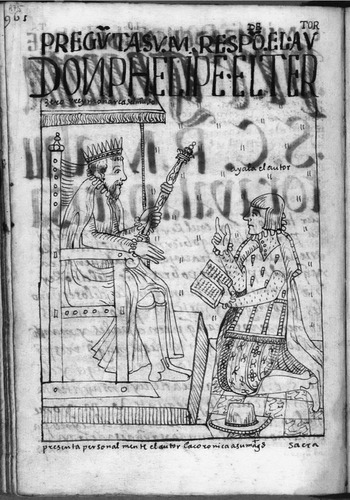
One of the most famous manuscripts to survive from the Spanish colonial Americas is El primer nueva corónica y buen gobierno (The First New Chronicle, and Good Government). The title is usually abbreviated, as it is here, to Nueva corónica. The indigenous Andean author, Felipe Guaman Poma de Ayala (c. 1535–c. 1616), was nearly 80 years old when he completed the work in 1615.Footnote 1 Written in Peru in Spanish, Quechua, and Aymara, it consists of 1,189 pages with 398 full-page ink line drawings, produced in the form of a letter to Philip II (r. 1556–1598), who was the Spanish king when Guaman Poma began drafting it, and later to Philip III (r. 1598–1621). While Guaman Poma also intended the Nueva corónica to be published “for all the world” to see, he makes his intent to address the king explicit through an illustration titled “His Majesty Asks, the Author Responds.”Footnote 2 The illustration depicts the author kneeling before Philip III, offering a book and gesticulating with his free hand (Figure 1).Footnote 3
His Majesty Asks, the Author Responds (Pregunta su M[ajestad], responde el autor)

In the discussion accompanying the drawing, Guaman Poma designates himself a “prince” and the “grandson to the tenth king of Peru, Topa Inka Yupanqui,” titles implying his noble status and right to converse with the king.Footnote 4 He wears an Andean unku (sleeveless tunic worn by men) that is decorated with small kantuta flowers and parallel dots in rows. Beneath the unku is a European collared and sleeved shirt, breeches, and a cape, with his hat cast to his left side. With its mixture of local and imported elements, this ensemble speaks to the dynamic sociocultural changes then occurring in colonial Peru.
Guaman Poma clearly understood the power of portraits. While “His Majesty Asks” presents an engaging interaction between the two men, they never met: the scene is both a discursive tool and an imagined encounter between the Spanish monarch and Guaman Poma. The Andean author presents his audience with the king in such a way that no one observing the illustration could argue that it was fiction. It is as if Guaman Poma made manifest their meeting through a process of visualization, bringing the king's presence into being in a royal portrait—but also his own presence in the form of a self-portrait.Footnote 5
Addressing the king via images had a long-standing tradition in Europe, as pictured in offering pages in medieval and Early Modern manuscripts, and Guaman Poma realized the value of both words and images in making a compelling visual argument for his royal audience.Footnote 6 “His Majesty Asks” drew on compositional conceits from these offering pages: a royal subject presents a book to a ruler, employing visual concepts familiar to Philip III as a way to facilitate understanding and reception.Footnote 7 Moreover, imagining oneself before the Spanish king corresponded to a tradition of portraits serving as representational stand-ins for any absentees.Footnote 8 If indeed the Nueva corónica is, as Mary Louise Pratt has described it, an autoethnographic text—one in which Guaman Poma attempted to describe himself to the king of Spain based on how Europeans perceived Andeans—then “His Majesty Asks” and Guaman Poma's other self-portraits reveal significant information about the author and the status of self-portraiture in colonial Peru.Footnote 9 Guaman Poma, like other Early Modern artists, sought to augment his social and intellectual position and gain social recognition through his self-portraits.Footnote 10
The Nueva corónica is remarkable for numerous reasons, but here I emphasize two of them: its incorporation of the first five self-portraits from the Spanish Americas, and the way in which Guaman Poma cleverly connects himself to his male ancestral lineage by including portraits of his ancestors wearing the same familial unku he dons in his letter. As I will demonstrate, Guaman Poma's self-portraits demonstrate how he cast himself apart from society at large and placed himself among nobles, as he clearly does in “His Majesty Asks” by conversing with the Spanish ruler. I examine these self-portraits in conjunction with Guaman Poma's ancestral portraits because I make the claim that he intended to place them in conversation with one another in the Nueva corónica as a key strategy of elevating his and his family's social status.
A plethora of documented court cases and legal battles that occurred in the sixteenth and seventeenth centuries demonstrate that many of his fellow Andeans shared the aim of distinguishing themselves within colonial Andean culture, as Guaman Poma did in his self-portraits. Indigenous Andean men claimed noble status that simultaneously spoke to their indigeneity; yet, as Joanne Rappaport and Thomas Cummins note, they demonstrated this noble status by portraying themselves as “assuming all the trappings of high-status Europeans, including their clothing, their language, their liberty of movement across the Atlantic, and their direct access to legal literacy and to the ear of the king.”Footnote 11
Later elite portraits use clothing, objects, and ancestors as a way to advertise a person's elite lineage and status within the imperial order. Guaman Poma was one of the first to do so in Andean portraiture.Footnote 12 Clothing and ancestors are closely connected to Guaman Poma's self-presentation, and thus his very identity.Footnote 13 Even before this mode of establishing authority became common in portraiture, Guaman Poma's use of the technique would help to authenticate his narrative account. It would also allow him to shape himself as the recorder of “true” history or an author of a crónica de Indias, as well as present himself as the natural choice for a position advising the Spanish ruler in the Andes.
While the text reveals key information regarding Guaman Poma and the social context within which he produced the Nueva corónica, the visual elements provide an expansive resource for understanding his self-portraits and the motivations behind their inclusion. As art historian Daniela Bleichmar rightly argues, the significance of the pictorial archive is often downplayed or overlooked in favor of the textual archive, even though we are offered a broader history when images and objects are considered as both historical sources and the subjects of their own histories.Footnote 14 For this reason, I look to the illustrations included in a set of legal documents referred to as Y no ay [sic] remedio . . . (1594–1646), which relate Guaman Poma's argument for acquisition of land titles and include several drawings to aid his case. The drawings are not mentioned in Y no ay remedio, perhaps a reason for their relative absence from scholarly discussions of Guaman Poma's pictorial works, even though they are related to the author's later, more comprehensive project.Footnote 15 I also compare objects and images (such as textiles, painted portraits, and other illustrated manuscripts) contemporaneous with Guaman Poma to ascertain whether his self-portraits borrowed from existing images or were completely fictive, a notion espoused by several scholars in an effort to illuminate the production of knowledge and the construction of “seeing” in the colonial Andes.Footnote 16
As I will demonstrate, Guaman Poma's self-portraits clearly drew from images he viewed and objects he encountered during his lifetime. The self-portraits thus not only provide us with a colonial Andean approach to the genre of self-portraiture, but also function as type of visual archive of the period. Guaman Poma's familial unku, while not an actual textile, operated as an index for his elite claims in the same manner as did Inka-style garments from the period. The drawings also speak to Guaman Poma's decision to base his illustrations on colonial unkus, imbuing his self-portraits with special meaning. The self-portraits reveal that Guaman Poma was interested in molding his identity in texts and images, borrowing from myriad sources available to him in viceregal Peru.
Guaman Poma's familial unku is an Inka-style garment that evidences elaborate decoration and a “European design vocabulary,” such as the inclusion of the kantuta flower; yet, it works to explicitly connote Guaman Poma's Andean ancestry and ethnicity.Footnote 17 This parallels what art historian Carolyn Dean has argued for indigenous Andean nobles who “transformed their own bodies into vessels of Andean history” by “performing” their ancestry during public processions of the Catholic feast of Corpus Christi.Footnote 18 She suggests that this transformation was largely enacted in the clothing and accouterments these elites wore, such as their Inka-style clothing. Wearing elaborate unkus, for example, could emphasize an individual's royal heritage. Legal disputes of the period, evidenced in archival documents, speak to people's claims to Inka noble titles, but so do the Inka-style garments represented in the Nueva corónica, offering a visual counterpoint to textual documents that projected one's noble Inka ancestry (even if it might be dubious).Footnote 19 Indigenous wills and inventories often reveal the significance of clothing, such as unkus, in the self-presentation of an individual identity in the colonial Andes. Guaman Poma's portraits of himself and his ancestors, when analyzed as a group, also present an analogue to the Inka genealogical portrait series commissioned by indigenous nobles during the seventeenth and eighteenth centuries to advertise their lineage, to which the visual and textual archival records attest.Footnote 20
Guaman Poma's letter is one of the most studied texts from the Spanish colonial Americas, offering scholars in diverse fields the perspectives of an indigenous Andean man, one who not only wrote but also illustrated this kaleidoscopic work. As a result, a vast bibliography exists on Guaman Poma and the Nueva corónica, with scholars investigating themes ranging from native agency and gender codes to artistic style and graphic modes.Footnote 21 More recently, scholars have turned to Guaman Poma's relationship with the Mercedarian friar, Martín de Murúa, and the similarities between the Nueva corónica and Murúa's Historia general del Piru (1616, J. Paul Getty Museum Ms., Ludwig XIII 16, 83.MP.159) and Historia del origen y genealogía real de los reyes ingas del Perú, de sus hechos, costumbres, trajes y manera de gobierno (c. 1589–1615, private collection of Seán Galvin, Dublin), hereafter the Getty Murúa and Galvin Murúa.Footnote 22 Thomas Cummins, for instance, details the Andean author's imitation, emulation, and assimilation of the Spanish friar's works, particularly the Galvin Murúa.Footnote 23 While Cummins rightly downplays the idolization—or idealization—of Guaman Poma's Nueva corónica in discussions of the viceregal Andes, its inclusion of five self-portraits, which Murúa's manuscripts never had, remains significant. Scholars have often underestimated the potential value of Guaman Poma's self-portraits in terms of what they reveal about dress, lineage, visual sign systems, and the notion of self-presentation in the viceregal Andes and the Early Modern period more broadly.
It is possible that the very level of detail in Guaman Poma's chronicle, and the many ways it has aided in understanding Inka and early colonial culture, has contributed to the oversight of these self-portraits. They are the first documented from this period, in either the viceroyalty of Peru or New Spain. One of the earliest surviving examples in New Spain, for instance, is Juan Rodríguez Juárez's self-portrait, painted ca. 1719. The subject of portraiture in the Spanish colonial Americas has received attention typically in relation to the late seventeenth and eighteenth centuries, in part due to the relative dearth of portraits that remain from the sixteenth and early seventeenth centuries.Footnote 24 Most discussions of the Nueva corónica portraits center on representations of the Sapa Inka or colonial administrators and mention Guaman Poma's self-portraits only in passing.Footnote 25 Indeed, self-portraiture has received little attention in the Spanish colonial Americas in general, and the fact that an Andean man created the first set makes them a fruitful place for further study of the production of colonial Andean identities.
The First Self-Portraits in the Spanish Viceroyalties
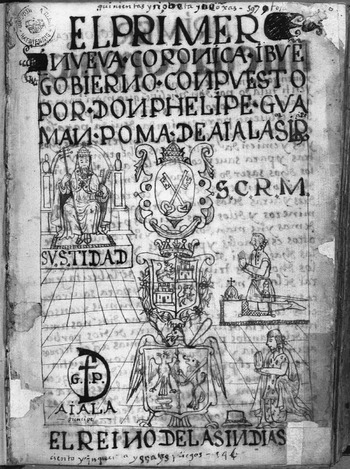
Guaman Poma placed his five self-portraits in different sections of the Nueva corónica, with three in the first section featuring the history of the Andes and two others in the section focused on colonial government. While five self-portraits seem relatively insignificant against the 1,189 pages of the Nueva corónica, the fact that other manuscripts of its type and period did not use self-portraits, coupled with Guaman Poma's representational goals, underscore their importance.Footnote 26 At the time, portraiture was an emerging genre in the Americas, with important social resonances, and it is almost as if Guaman Poma were experimenting with this new form of depiction. His first self-portrait, on the Nueva corónica frontispiece, conveys his Christianized identity as it visually and textually proclaims his perceived importance. Kneeling before the Pope with Philip III, Guaman Poma boldly stated that he was “don Phelipe Guaman Poma de Ayala, lord and prince, Holy Catholic Royal Majesty, Your Holiness, Ayala, prince” (Figure 2).
Title Page, El primer nueva corónica i buen gobierno

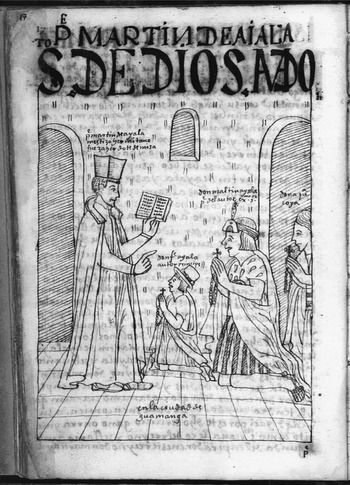
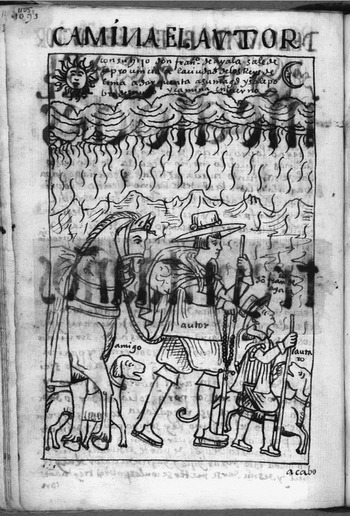
Notably, Guaman Poma accorded to himself the noble Spanish title of “don,” conveying his elite status by using Spanish social protocols.Footnote 27 Art historian Rocío Quispe Agnoli notes that the other portraits in the work depict Guaman Poma aging over time, first as a young boy in “Father Martín de Ayala” (folio 17 [17]), and much later as an elderly man in “The Author Walks” (fol. 1095 [1105] (Figures 3–5).Footnote 28 His portrait as a young boy conveys once again that he is a good Christian, displaying him kneeling with his parents, also converted, before his half-brother Martín de Ayala, a mestizo who became a friar.
Father Martín de Ayala . . . (P[adr]e Martín de Aiala, S[an]to Dios Amado)

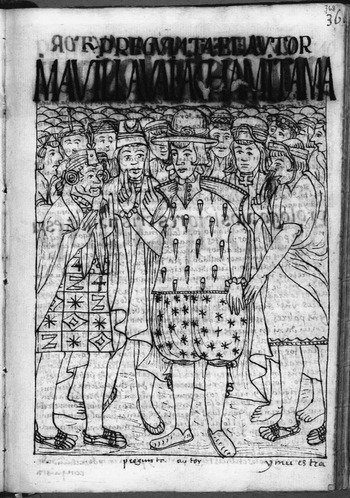
The Author Asks . . . (Pregunta el autor, “Ma, Villavai [“Pero, díganme”] Achamitama” ["Tu llanto desde allí])

The Author Walks (Camina el autor)

Guaman Poma created his self-portraits in the context of the Andean colonial world, so it is important to consider how he or his contemporaries might have understood the term retrato (portrait). In his 1611 Treasury of the Castilian Language, Sebastián de Covarrubias described a retrato as “the imitation of some person of account, intended to preserve their memory for centuries to come.”Footnote 29 European inventories of artists listed “retratos” of hunts, animals, cities, angels, kings, and holy figures, many of which would not be categorized under the rubric of portraiture today.Footnote 30 The word retrato conveyed ideas of truthfulness and faithful description, whether used in reference to paintings or within literary genres, yet it was not always connected to ideas about likeness. The term was more loosely delineated in the Early Modern period than it is now. Portraits did however assert the “primacy of reality,” as if they illustrated an accurate reflection of a person's lived reality.Footnote 31
In general, European humanist discourses at the time stressed the significance of the individual, fostering dialogue about the social status of artists and art.Footnote 32 Portraiture, specifically self-portraiture, functioned as a way to project such aspirations through the process of self-fashioning. For Early Modern artists, capturing their own image involved making specific decisions regarding their self-presentation. Famous artists often gifted portraits of themselves to royalty. For example, Titian sent several self-portraits to powerful Spanish monarchs: two to Charles V and another to Philip II. Portraits and self-portraits could also function as social types—for example, Guaman Poma's presentation of himself as a noble and trustworthy advisor—to precondition a viewer's general response to them.Footnote 33
Guaman Poma's use of self-portraits in the Nueva corónica also compares to the European practice of embedding self-portraits in illustrated texts, murals, and sculpture groups. Some medieval scribes, such as friar Pietro da Pavia, embedded their self-portraits, or self-images documenting the act of writing, into the colophons of illuminated manuscripts, while painters like Masaccio included themselves in biblical and secular narratives.Footnote 34 Israhel van Meckenem, whose imported prints influenced some of Guaman Poma's illustrations, even created one of the earliest stand-alone engraved self-portraits, which helped to fashion his status as a successful printmaker. In an environment where social status was of the utmost concern, art occupied a preeminent position for communicating the nuances of one's social status.
The mutability of visual language allowed artists and sitters (sometimes the same individual) to take liberties in crafting a particular identity. While today we recognize the drawbacks of reading the face as an index of a sitter's personality, people in Europe and the Americas in the Early Modern period often engaged in physiognomic readings of other people. They considered a person's outward appearance, which includes skin color, clothing, and physiognomy, to be a reflection of the identity it housed.Footnote 35 They read clothing and accouterments adorning a person's body as markers of identity as much as they read the face; American genres like colonial Mexican casta paintings also reflect this understanding.Footnote 36
In his self-portraits, Guaman Poma included certain physiognomic and ethnic markers to identify himself consistently. He always has the same hairstyle: a short bob with distinctive sheered bangs (a “bowl cut”) typical of many Andean men at this time. Moreover, he wears European-style clothing, including a brimmed hat, breeches (valones), shoes, a calf-length cape, and a high-necked shirt. Guaman Poma also adopted the distinctive Andean unku shown over his shirt in four of his self-portraits; as an old man on his way to Lima, Guaman Poma omits his familial unku from his self-portrait.Footnote 37 Guaman Poma's mixture of local and European dress connects his representations to those of other elites and political leaders around the globe who used and still use elements of clothing to convey nuanced power dynamics.Footnote 38 His self-portraits also favor clothing over his face, a practice akin to European portraiture; one only has to think about the virtuosity and care with which Spanish artists, including Alonso Sánchez Coello and Juan Pantoja de la Cruz, painted clothing in court portraits as a way to herald an individual's status and wealth.Footnote 39 Guaman Poma parallels these pictorial projects, adding further distinctions to our understanding of the Early Modern Hispanic world in general. Self-imaging or self-representation was thus a process of visual construction whereby the sitter and artist, or here Guaman Poma, produced a fiction of objectivity.Footnote 40 To unpack the significance of these self-portraits and Guaman Poma's visual strategies of self-presentation in greater detail, in what follows I outline the reasons for the production of the Nueva corónica.
Creation of the Nueva corónica
Guaman Poma articulated his reasons for creating the Nueva corónica on the first page: “This chronicle is very useful and beneficial; it will improve the life of Christians and pagans, help the Indians confess, improve their lives, correct their errors, [and] idolatries and help the priests know how to take the confessions of the Indians.”Footnote 41 He produced this ambitious account to valorize the preconquest history of the region, to document the colonial present, and to promote a treatise of good government that would end Andean suffering at the hands of the Spaniards.Footnote 42 In his opinion, Spaniards were destroying Andean culture and its people by carrying out abusive violence, engaging in cruel labor practices, and spreading life-threatening diseases.Footnote 43 He had firsthand knowledge of colonial governance, having worked as a translator during the creation of visitas (censuses of native tributaries) around 1568–1570 under the visitador (ecclesiastical inspector) Cristobál de Albornoz, who sought to extirpate idolatrous Andean religious practices.Footnote 44 Guaman Poma hoped his work might bring the Spanish king to remove his Spanish subjects from the Andes and ameliorate at least some aspects of the colonial situation, especially the treatment of native Andeans—ideas influenced by Dominican friar Bartolomé de las Casas's discussion of the mistreatment of Amerindians.Footnote 45
Guaman Poma also used the Nueva corónica to criticize mestizaje. In his opinion mestizos were destroying Andean culture and harming Andean peoples.Footnote 46 He saw his own social status and lineage as directly threatened by the growing mestizo population, which partly explains his desire to demonstrate his importance. He even claimed that the Chachapoyas, against whom he had been in bitter legal disputes over land in Chupas and who are criticized in the Nueva corónica for that reason, were responsible for the increase in mestizos.Footnote 47 He does not mention in the Nueva corónica that he lost this legal battle and was subsequently exiled from Huamanga in 1600 for falsely presenting himself as a kuraka (Andean lord, or cacique), but these experiences fed his anti-mestizo sentiment and his corresponding desire to emphasize his “Andeanness” with his lineage, noble titles, and clothing. He hoped that the Nueva corónica would convince King Philip III to return his lands.
Given his training and experience, Guaman Poma was certainly aware of other colonial documents sent to influence the Spanish king. However, the Andean competitors for the king's attention were not illustrated, making the Nueva corónica unique and highlighting Guaman Poma's attempts to provide compelling visual arguments to the Spanish ruler as well. He sought to distinguish his work by demonstrating the pains he had gone to in collecting detailed information, which he repeatedly described as deriving from reputable and reliable sources “from throughout the four quarters of this kingdom and from very old Indians who lived to be 150 years of age.”Footnote 48 He actively presented himself as the author, using the word “autor” 69 times to describe himself, thereby stressing his act of recording information, in both text and images, as the self-designated “first chronicler of this kingdom.”Footnote 49 He demonstrated his intellectual acumen by his ability to weave together complex ideas, drawing on contemporary thinking in moral theology, law, geography, and current history, even as he characterized himself as a man of “many failings, poverty of intellect, . . . not being a man of letters, nor a doctor, nor a Latin scholar.”Footnote 50 He nonetheless harnessed the power of alphabetic writing in a context in which, as theorist Ángel Rama has noted, “those who wrote had special access to the power of the colonial state but also depended on the state for a livelihood.”Footnote 51 Guaman Poma's claims are similar in ways to those made in a probanza or información de méritos y servicios, understood as a certified or legal testimony of witnesses to an individual's “inherited merits and personal deeds accomplished in the service to a higher authority,” as literary historian Rolena Adorno has defined it.Footnote 52
Given his self-proclaimed ability to pen the truth about Andean history and the colonial situation, it is no wonder that Guaman Poma aspired to a position as a royal advisor to the Spanish monarch on Andean matters.Footnote 53 In pursuing the role of the king's royal advisor of the Andes, or what was possibly an earlier version of the valido (royal favorite), he sought to assist in ending Andean suffering and abuses, but also to improve his own social station in the imperial order as the Spanish monarch's right-hand man. He wanted as well to secure, at least in part, the return of the privileges native elites had once enjoyed prior to their compromise by the new distribution of authority that occurred under Spanish imperial rule.Footnote 54 Remarkably, Guaman Poma's own decision to create his project emphasizes its unique nature. Pedro Sarmiento de Gamboa's Historia de los Incas (1572) or the Relaciones geográficas (1579–85) were produced under official or royal direction, but the Spanish king had never asked Guaman Poma to write the letter. Thus, his explicit criticism of Spanish imperial governance posed a risk to himself.Footnote 55
The Nueva corónica uses the ideological tool of alphabetic writing and visual representation to articulate its argument that Guaman Poma and others should return to power in the Andes. This use contrasts with Rama's argument about the “lettered city,” wherein the written word functioned as an ideological tool of domination.Footnote 56 The arguments of scholars who offer more complex and nuanced examinations of colonial Andean power relations, even questioning an Indian versus Spanish divide, bear on this discussion. Andeans were literate.Footnote 57 Various lettered Andean subjects, both indigenous and mestizo, lived in Guaman Poma's time, among them Jerónimo Lorenzo Limaylla, Titu Cusi Yupanqui, Joan de Santacruz Pachacuti Yamqui Salcamaygua, and El Inka Garcilaso de la Vega. Titu Cusi Yupanqui (1529–1571), for instance, produced a history of the Spanish invasion, known as the Relación de cómo los españoles entraron en el Peru (History of How the Spaniards Arrived in Peru, 1570), which was written in part to secure his identification as the head of the Inka dynasty and to restore political, economic, and social rights to himself and his family after decades of accusations of rebellion against the Spanish crown.Footnote 58 As historian Alcira Dueñas has noted, authors like Titu Cusi Yupanqui drew on “selected European categories of moral and political theology to defend their right to retain ethnic power.”Footnote 59 Both Titu Cusi and Guaman Poma intended their words to represent them at the viceregal court, and at the royal court in Spain as well. Few others created accounts focused on personal and familial concerns in the way the Nueva corónica did, or emphasized the importance of the author and his male ancestors as Guaman Poma's work did.
Guaman Poma's extensive writing on Andean life in the Spanish viceroyalty bears some similarities to that of his contemporaries, but his exhaustive account necessitated visual literacy as well. For all the valence of alphabetic writing, Guaman Poma also recognized the power of images. By skillfully weaving word and image together he created a complementary effect, exemplifying the Andean conception that there is no linguistic or semantic differentiation for the words ‘painting,’ ‘drawing’, and ‘writing’, all of which are denoted in Quechua by the word quilca.Footnote 60 These points of difference show the Nueva corónica to be part of a broader field of Andean intellectual activity, in which authors employed alphabetic, visual, and oral literacy tools to reclaim certain rights associated with their self-perceived identity. Borrowing from myriad traditions, Guaman found a discursive space within the Nueva corónica to legitimize his views, to benefit his own social standing, and to deal with colonialism, the imperial power structures, and the transformation of Andean identities.Footnote 61
Considering these strategies of presentation and representation reveals how Guaman Poma mediated the various visual, written, and oral traditions with which he came into contact in late sixteenth- and early seventeenth-century Peru. Such traditions allowed him to build evidence of value; in the Nueva corónica, he supported his pursuit of the role as royal counselor in the Spanish imperial landscape within a letter made for the Spanish monarch and “for all the world” to see.Footnote 62 To convince the king that he was the natural choice for this advisory position, he skillfully wove into his larger project personal and genealogical data in his self-portraits, and connected them to genealogical portraits, specifically those of his male ancestors: his grandfather, Guaman Chaua (alt.: Chava); his father, don Martín Guaman Malque de Ayala; and his uncle, Guaia (Carua) Poma.
Genealogy, or the notion of a good lineage, was an important component of Guaman Poma's overall project, especially in relation to his anti-mestizo stance. He sought to showcase himself as a legitimate descendant of royalty and nobility in the American context, basing his claim mainly on ancestral evidence rather than European affiliations. As historians Gabriela Ramos and Yanna Yannakakis have noted, “genealogical discourses proved particularly effective in legitimating political claims in both New Spain and the Andes, since lineage represented an important point of intersection between Spanish and indigenous understandings of social status and right to rule.”Footnote 63 Guaman Poma claimed matrilineal descent from Inka royalty through his mother doña Juana Curi Ocllo, a coya (princess) and daughter of Topa Inka Yupanqui, the tenth Inka ruler, but he emphasized his patrilineal descent from the pre-Inka Yarovilca dynasty of Huánuco through his father and grandfather even more.Footnote 64 He made these claims outside of the Nueva corónica as well, for example, in the letter he wrote to Philip III in 1615 regarding the completion of his work. The letter's opening sentence proudly proclaims he is an “hijo legítimo” (legitimate son) of “Capac apo don Martín Guaman Malque de Ayala . . . segunda persona y su virrey de Tupac Inka Yupanqui” (capac apo [Quechua: Second Person to the Sapa Inka] don Martín Guaman Malque de Ayala . . . the second person and viceroy of Tupac Inka Yupanqui).Footnote 65
Even though the maternal line in the preconquest Andes had an important genealogical role, Guaman Poma's stress on his paternal line seems to be in keeping with European gender hierarchies and ideologies that influenced colonial Andean culture. Paternal lineage was also stressed in Inka royal genealogical paintings.Footnote 66 This emphasis on the male line of succession resembled the claims of other indigenous intellectuals as well, as they drew on the Spanish idea of linea recta de varón (the direct male line), to lodge economic, political, and historical claims.Footnote 67 For these reasons, the discussion here focuses on Guaman Poma's self-portraits but turns to his male ancestral portraits for the strongest evidence of how he amplified his importance and ethnic, cultural, and social identity as he sought social recognition from the Spanish monarch. This accords with what art historian Eduardo de Jesús Douglas has observed about mid sixteenth-century historical manuscripts promoted after Spanish colonization, that “genealogies . . . encompass ideology.”Footnote 68
Entangled Visual Ideologies
Prior to European contact, portraiture as we might define it in the European sense today did not exist as an artistic genre in the Andes.Footnote 69 Andeans had a more fluid notion of identity, or more accurately, states of being, wherein things might embody or even transfer kamay (a person or thing's unique identity). Stones could embody the kamay of an ancestor, a deity, or another living thing.Footnote 70 Inka rulers did not have themselves represented as powerful military conquerors, wealthy patrons, or fertile men, possibly because their identity would be embodied in perpetuity within the mallqui (mummies) housed in the Qorikancha, or “golden enclosure,” located in the capital in Q'osqo (alt. Cusco).Footnote 71 Mallqui could own property and possess political authority, and were treated as if alive when paraded before people during festivals, as depicted in Guaman Poma's drawing of “The Eleventh Month, November, Festival of the Dead ”(256 [258]). The drawing displays a mummy, richly dressed and adorned with a prominent collar and headdress, carried on a litter. Wawqi were rocks that embodied the kamay of important men, which might be treated with the same deference as the men themselves. The famous Q'osqo rock, Marawasi Wanakawri, for example, was the rock version of the brother of the city's founder.Footnote 72 Clearly, Andean notions of embodiment and materiality differed from European notions of representation and the production of likeness.
With the Spanish colonization of Peru after 1534, visual signs and their meanings began to transform, standards of literacy changed, and power and status became tied increasingly to alphabetic writing. Classical Renaissance ideals about representation came into contact with Andean notions of embodiment. After the collision of these two systems, one predicated on representation and the other on embodiment, portraiture as an art form gained traction early on in the viceroyalty of Peru.Footnote 73 Even if true portraiture did not exist prior to the Spanish invasion, the power of portraits became important in the viceregal era, from the production of Inka and monarchial portraits to secular elite and donor portraits.
Some of the earliest portraits produced after the initial Spanish conquest figured Sapa Inkas. In 1572, the same year as the execution of the last Sapa Inka, Tupac Amaru, Viceroy Francisco de Toledo commissioned a series of Inka portraits from Andean artists to send to Philip II in Spain; he hoped that these works, known as paños, would be made into tapestries. His gift was intended to represent the royal Sapa Inka genealogy using classical European visual vocabulary—including mimetic imagery—that the king would understand. Artists ignored the female bloodlines, depicting Inka rule as solely based on the male bloodline.Footnote 74 Because the Inka did not have a tradition of portraiture, the physiognomy of the Sapa Inkas was ripe for invention (and reinvention in other versions), as was these rulers' istoria (narrative or manner of communicating and engaging with viewers). The artist suggested Andeanness through the use of elements such as dress and hairstyles. Although the portraits never left Madrid, they were hung in the Alcázar in the midst of Titian's portraits of Charles V and Philip II, and were viewed by court painters (among them Juan Pantoja de la Cruz) and esteemed for their high quality. Regrettably, a fire destroyed them all in 1734.Footnote 75 Portraits of Spanish monarchs, such as Titian's portraits of Philip II, also played important roles in communicating Spanish imperial power throughout the viceroyalties, especially since no Spanish ruler ever visited the Americas. As with the Sapa Inka portraits, these Spanish royal portraits functioned as stand-ins for rulers, making the king present in his absence and providing opportunities for encounters with royalty in the far reaches of the Spanish empire.Footnote 76
Significantly for our understanding of Guaman Poma's self-portraits and ancestral portraits, some indigenous Andean elites quickly recognized that portraits not only demonstrated Early Modern European artistic ideologies and trends but also functioned as powerful pieces of persuasive evidence. They recognized that portraits conveyed an “a priori assumption of verisimilitude” and thus truthfulness.Footnote 77 Dean recounts that, in 1603, some Inka noblemen commissioned a visual genealogy of their ancestors and descendants to advertise their royal heritage as well as to secure specific advantageous rights, such as the exemption from paying tribute.Footnote 78 This genealogical painting also included the Spanish monarch as the descendant of the Sapa Inka line, a visual trope that appeared regularly in later eighteenth-century depictions of Inka genealogies, such as Effigies of the Incas or Kings of Peru from the Convent of Our Lady of Copacabana in Lima.Footnote 79 The noblemen sent these images to the Spanish king, with the hope that he would repair the injustices or damages inflicted upon their dignity and social station as Andean elites.Footnote 80 Despite the visibly European appearance of portraits, Dean suggests that may also have encoded Inka ideas about the Sapa Inka's body and its kamay.Footnote 81 It is within this cultural milieu that Guaman Poma began the ambitious project that included his own portraits. Thus he is easily positioned within this tradition of Andeans who borrowed and transformed European visual and textual elements where they served their agendas.
Fashioning Identities in the Contact Zone
Guaman Poma's self-portraits exemplify the myriad negotiations born from the encounter of different worlds as a result of the Spanish conquest, providing tangible visual and textual evidence of Pratt's “contact zone,” or the “social spaces where cultures meet, clash, and grapple with each other, often in contexts of highly asymmetrical relations of power.”Footnote 82 Guaman Poma's dexterous use of self-portraits and invocation of his ancestors suggest that he was intimately aware of how the visual genre encoded ideas about the person depicted and functioned as a worthwhile exercise in self-presentation, and this realization set him apart from his Andean contemporaries. Similar to other Inka nobleman before him, he used Inka genealogy portraits to articulate his message about good government.
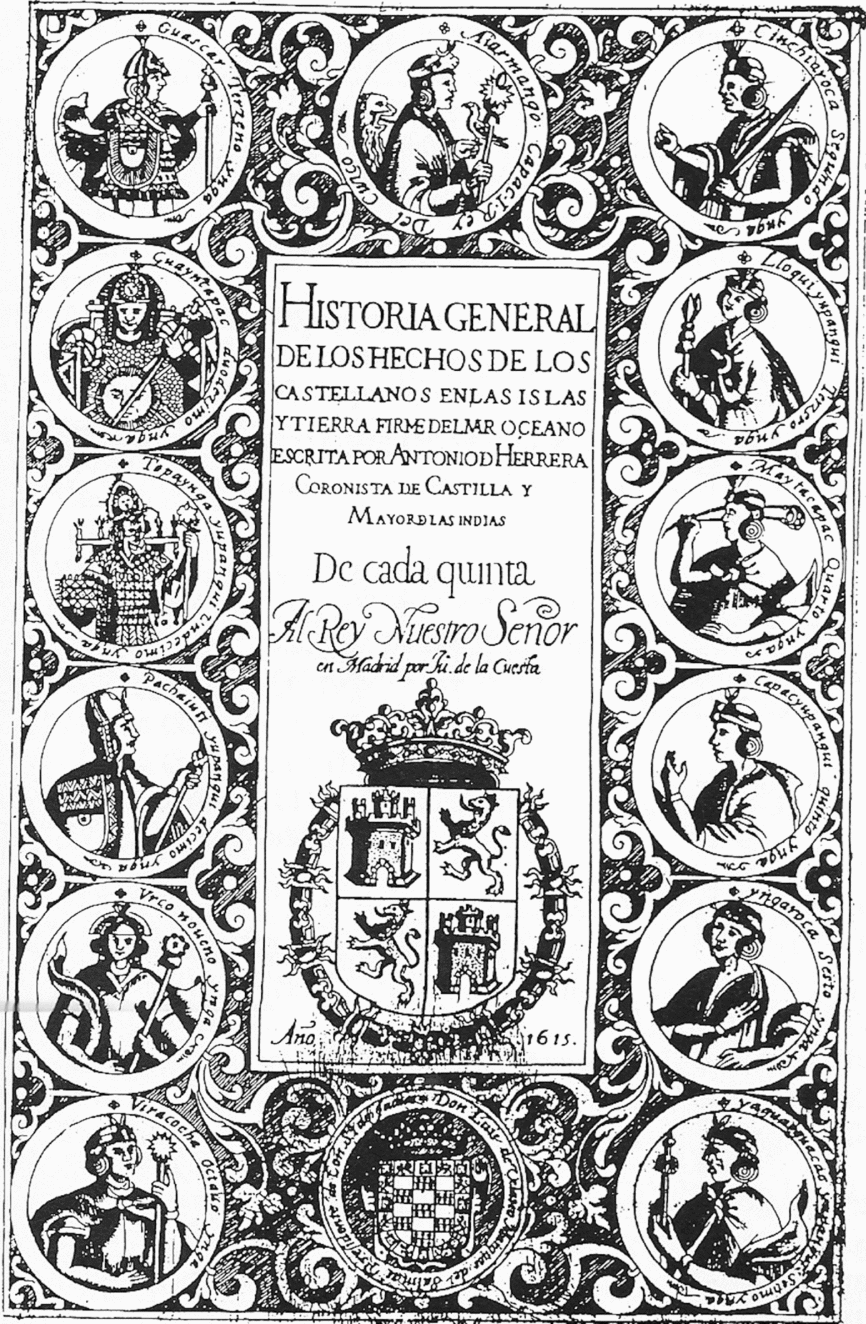
Guaman Poma was clearly aware of the use of similar visual strategies by artists who had created the portraits commissioned for viceroy Toledo and for other Inka noblemen. One of the sources for the engraved frontispiece by Juan Peyrou for Decada quinta, the second volume of Antonio de Herrera y Tordesilla's Historia general, a four-volume work published between 1601 and 1615 in Madrid, may have served as a model. It exhibits 13 Sapa Inka in roundels (Figure 6).Footnote 83 This Peruvian source, either Toledo's paños or an oil painting possibly commissioned by descendants of Inka rulers to be submitted as a legal document to support their hereditary claims as recognized by the Spanish courts, may have prompted Guaman Poma's idea about genealogical portraits and the value of portraiture more generally.Footnote 84
Juan Peyrou, for Decada quinta

Guaman Poma's working relationship with Murúa also influenced his portraits. He had drawn more than 90 illustrations for the Galvin Murúa.Footnote 85 This collaboration gave Guaman Poma access to Murúa's library, which included a wide assortment of historical and ecclesiastical books, as well as documents published in Spanish. Guaman Poma would later appropriate many of these for the Nueva corónica. Footnote 86 Although Guaman Poma claimed that Murúa had inaccurately documented the history of the Inka, Adorno and others have proposed that in presenting his own conceptualization of it, he followed the outline of Murúa's 1590 manuscript.Footnote 87 Cummins notes that both authors knew of Toledo's interest in Inka history, suggesting that the commissioned portraits for Philip II could have influenced them both.Footnote 88 In short, the cultural context in which Guaman Poma lived made him aware of European intellectual trends, ideologies of representation, and the inherent power and symbolic gravitas of portraiture.
Guaman Poma's self-portraits resemble earlier Sapa Inka genealogical portraits in that they rarely detail individualized physiognomic traits.Footnote 89 Guaman Poma did identify himself consistently, as did other important individuals, with labels, recognizable clothing, and accouterments as a way to aid readers in making concrete identifications.Footnote 90 Andean elements coincide with European ones in his portraits. He uses European symbols to express Andean values and indicate his own status as a Christianized, European-acculturated, Castilian-speaking, elite Andean man—what Spaniards called an indio ladino. Footnote 91 Even Covarrubias uses this chameleon-like descriptor, defining a ladino as one who spoke Latin elegantly in Spain or was a foreigner “who learned our language, with such care that we hardly distinguish him from ourselves.”Footnote 92 Described by some as “chameleon-like,” indios ladinos, in the words of Dueñas, “functioned as cultural brokers who learned to manipulate and negotiate the signs and symbols of Spanish and Andean cultures.”Footnote 93
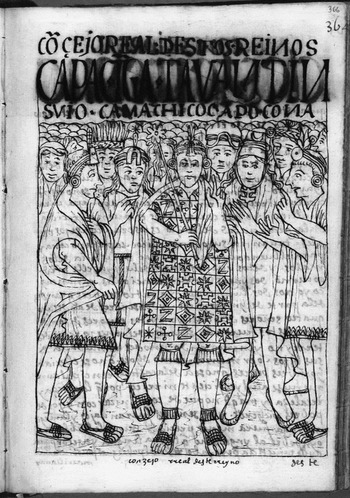
Guaman Poma's self-portrait in “The Author Asks” (folio 366 [368]) demonstrates this negotiation of European and Andean signs and symbols to highlight his importance. He places himself in the company of men of supreme power, as he does on the frontispiece, where he kneels alongside Philip III before the Pope (Figure 2), and in “His Majesty Asks” (Figure 1). In “The Author Asks,” Guaman Poma locates himself in the center of the composition, surrounded by other high-ranking indigenous men as he gathers information for his chronicle, demonstrating to the Spanish monarch his diligence in collecting data (Figure 4). He gestures with his right hand, raising one finger as he questions the men, who look toward him as they converse. Guaman Poma stands taller than anyone else, aided by his voluminous clothing and tall bowler hat. He wears the same clothing in “His Majesty Asks.” The composition and Guaman Poma's pose parallel the illustration that precedes it, which displays the Sapa Inka and the royal Inka council of Tawantinsuyu, filled with “lords, viceroys, capac apos, apos, curacas, allicacs, and others,” and he points out that wealthy men “of high lineage” hold these positions (Figure 7).Footnote 94
Royal Council of These Kingdoms, The Inka Lords Who Govern Tawantinsuyu (Consejo real destos reinos, capac inga tauantin suio camachicoc apocona)

Guaman Poma's self-portrait thus places him among the royal Inka council, asking these dignitaries to provide information about the Inka empire. That he centered himself in the composition in the same way as the true Sapa Inka in the preceding image underscores his role as an intermediary between the pre-Hispanic and Christian Andean eras. He emphasized his role not only through his position and visual connection with the royal council illustration, but also by naming himself “administrator, protector, lieutenant general of the official province of Lucana, lord and prince of this kingdom.”Footnote 95 Additionally, the text that precedes “The Author Asks,” asserts that the Inka royal council “never spoke to a poor Indian man or woman, but rather the Inka had an interpreter and adviser to hear their reasoning.”Footnote 96 The juxtaposition stresses that Guaman Poma was no “poor Indian man” but someone of high lineage, because he speaks directly to the royal council.
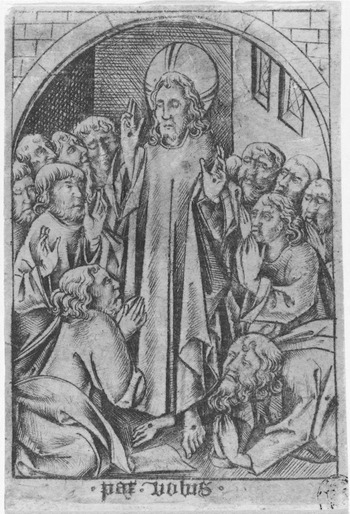
“The Author Asks” also reveals Guaman Poma's adaptation of European visual models to augment his desired identity. The illustration borrows from Christian iconography specifically to emphasize Guaman Poma's importance as a “lord and prince.” Previous scholars have demonstrated his borrowing from European print sources and imported illustrated chronicles to produce his drawings, such as his adaptation of van Meckenem's print of the marriage of the Virgin Mary for his illustration of the marriage of Sayri Tupac and the princess Beatrice.Footnote 97 Here, Guaman Poma's depiction of himself conversing with other Andeans appears similar to van Meckenem's fifteenth-century engraving of Christ appearing to his disciples after his resurrection (Figure 8). Their compositional similarity suggests Guaman Poma had seen this print.
Israhel van Meckenem, Christ Appearing to His Disciples, c. 1465, engraving

In Van Meckenem's print, Christ stands centrally, gesturing upward with his right hand. His apostles cluster around him, but without blocking his body. Some apostles raise their arms, either clasping their hands together or pointing upward with their left hands. Guaman Poma's drawing has an analogous composition with 12 Andeans, several of whom point upward as the apostles do. The man to Guaman Poma's left even touches his hand, as can be seen in representations wherein the Apostles, such as Thomas, seek to feel Christ's body. Reimagining a Christian image using Andean individuals is a strategy Guaman Poma uses throughout his chronicle, as Valerie Fraser has noted, when comparing images such as the death of Atahualpa and Tupac Amaru with Christ's entombment. This effort is intended to present a Christianized Andes or, perhaps more appropriately, an “Andeanized view of Christianity.”Footnote 98
“The Author Asks” accompanies Guaman Poma's prologue to Spanish Christian readers, suggesting that the substitution of Christ among his apostles with himself among Andeans was intentional. Through the allusion to Christ and his apostles, Guaman Poma asserts his own Andean Christian identity, experience as a translator in the colonial administration, and importance. Both Christ and Guaman Poma engage in good deeds such as aiding the poor or protecting Andeans from further abuses, spread knowledge (such as the Word of God, the words of the royal council), and leads others to have faith in God. Here, he leads Andeans as a Christian nobleman.
The Unku and Andean Identity
Guaman Poma's incorporation of Andean elements into his self-portraits and throughout the Nueva corónica highlights his complex act of self-representation and his “mapping and responding,” in Adorno's words, to both his own and European beliefs and practices.Footnote 99 The most important Andean element he includes in these self-portraits is his familial unku. Guaman Poma used it as a signifier to constitute his social body and to contrast himself not only to those individuals without an unku, but also to those wearing any other unku.Footnote 100 His unku ends above the knees—the standard length for men, as the Spanish Jesuit Bernabé Cobo described it.Footnote 101 It is decorated on the bottom half with parallel vertical rows of circular motifs and fringed ends. The top half of the unku is ornamented with stylized kantuta flowers, also called the “flower of the Inka” (Cantua buxifolia, Polemonaceae). A seventeenth-century Inka-style tunic from the southern Andes, currently in a private collection, while not identical to Guaman Poma's ancestral unku, shows similar kantuta flowers below the tocapu waistband, which usually bears colorful, patterned rectangular designs.Footnote 102 Guaman Poma depicted his family unku with same attention to spacing and organization of visual motifs, in this case the sacred flower. In the colonial Andean era, the kantuta functioned as an Inka status symbol—one among many that included feline imagery and shields.Footnote 103 It is a dramatic contrast to the largely geometric designs of preconquest textiles, such as the elaborate sixteenth-century unku in the Dumbarton Oaks Collection in Washington, DC.Footnote 104
These markers—the Inka-style unku with the lavish use of the kantuta—point to the social roles Guaman Poma either filled or wished to fill and connected him to other colonial portraits of native elites and high-ranking administrators. Scholars of clothing and costume have discussed how such signs function as “material expression[s] of genealogy,” or as nexuses for selfhood, social identity, and even subjectivity, because they act as a way of visual remembering and self-presentation. This was undoubtedly the case with Guaman Poma's familial unku.Footnote 105 The unku is an active agent, functioning as a “social skin” that constitutes Guaman Poma's social body, which was based more on how a person acted and dressed rather than on their physical and biological makeup.Footnote 106 Guaman Poma's unku demonstrates how dress became “entangled with the politics of empire,” a notion historical archaeologist Barbara Voss has addressed.Footnote 107
The Nueva corónica asserts that European-style clothes were the appropriate clothing of an indio ladino. At one point, Guaman Poma grumbled that Andeans of lower classes were permitted to clothe themselves above their station, which suggests his anxiety over the blurring of clearly defined social boundaries established since the European invasion.Footnote 108 Strict rules had previously prevented such blurring, but in the viceregal era individuals of lower social classes began to emulate the elite in their garments—especially as high-quality cumbi cloth became more available to everyone. This emulation suggests a greater social fluidity associated with clothing, as the meanings of garments such as the unku transformed.
Guaman Poma sought to reassign clear signifiers to clothing. In folio 786 [800], he illustrates these anxieties by trying to represent and describe how people should to dress to make their station clearly identifiable.Footnote 109 In the illustration, a native lord dons European-style clothing, including a bowler hat, high-necked shirt, cape, breeches, and boots—the same garments worn by Guaman Poma. Noticeably, the indigenous lord also has the same distinctive haircut as the author. The lower-class native tributary, or indio, wears Andean style garments, including the unku that ends below his knees, sandals, a shawl, and a headband. Guaman Poma suggests that people who dressed above their rightful station were falsely elevating themselves, criticism that easily could have applied to him as represented in the Nueva corónica.
Guaman Poma's discussion of false representation is all the more poignant in light of his exile around 1600 from Huamanga (today, Ayacucho), in the Chupas valley. A viceregal court convicted him of falsely representing himself as a kuraka, and exiled him for two years, even after he produced Y no ay remedio, a set of legal documents that aimed to define him as the rightful possessor and hereditary lord of Chupas territory.Footnote 110 Kurakakuna worked under the Spaniards, learned the Spanish language and law, and adopted Christianity. To be a kuraka, one had to “prove” hereditary descent from Inka royal ancestry, which suggests that the power and status of a kuraka rested in a person's ability to make such claims.Footnote 111 The depiction of a coat of arms granted to the descendants of Inka Topa Inka Yupanqui by Charles V around 1545 (today in the Archivo General de Indias, Seville) is one early example of the significance of portraiture, genealogy, and dress for making legal and political claims.Footnote 112 By the late seventeenth century, and in the eighteenth, oil paintings such as a portrait of don Marcos Chiquathopa made in the 1740s displayed kurakakuna wearing clothing and holding accouterments intended to showcase their sociopolitical status. Their use of the portrait form in itself signified their higher social position in Andean society.Footnote 113
Guaman Poma advertised, through his combination of European and Andean clothing, that he should be recognized as a native lord, not a common indio tributario (native tributary). Testamentary documents, such as the case of an elite woman named Angelina Palla, who listed both Andean anacos (squared cotton wrap, pinned and belted) and llicllas (mantles) along with European-style mangas (false sleeves), headscarves, and velvet caps among other items, show the prevalence of the strategy. Palla's conscientious combination of Andean and European clothing, like Guaman Poma's, helped to define her status, regional associations, and ability to navigate contact zones in Peru.Footnote 114 The wills of indigenous men throughout the sixteenth and early seventeenth century did not focus so much on clothing, but where they did they often listed “camisetas y mantas,” with the former often denoting the unku with a Spanish term.Footnote 115 The general lack of interest in men's clothing aside from the unku demonstrates the significance of this item of dress. We know from the visual archive that these “camisetas” combined European and Andean symbols, a process that the textual record does not necessarily reveal.
Guaman Poma's familial unku, decorated with the kantuta flower, is arguably more important than the European clothes and accessories he wears. This indigenous Andean flower was sacred to the Inka and associated with the Inka royal house, waman chambi (Inka staves), and Inka shields.Footnote 116 Likely, Guaman Poma showcased the kantuta on his familial unku because of its symbolic significance: it had potent associations with Inka power, and would thus emphasize his own family's royal associations, noble status, and power, as it had continued to do on objects such as kero vessels.Footnote 117 His mother, after all, was an Inka princess. Given that he chose to repeat his familial unku throughout the Nueva corónica, he clearly ascribed meaning to the unku itself and recognized the power of dress to make associations about his social status, as had Titu Cusi Yupanqui when he alluded to the importance of clothing and appearance in understanding Inka identity when writing his History.Footnote 118
Under viceregal rule, textiles continued to evoke Inka heritage and Andean traditions because they continued to play an integral role in communicating political, social, religious, and even visual values and ideas.Footnote 119 Garments were intimately connected to identity, for they supposedly connoted a person's place of origin as well as status. Place was thus tied to ethnic identity and clothing, with particular markers on textiles even denoting an individual's ayllu (familial clan) within a specific region.Footnote 120 Despite new circumstances and new audiences, garments continued to evoke prior eras of Inka rule. The unku itself was a powerful signifier of Andean identity in Peru, so much so that in 1575 Viceroy Toledo prohibited wearing it and other elements of Inka-style dress, and even banned Inka ruler portraits.Footnote 121 Many people continued to don Andean-style clothing in spite of his insistence that everyone wear Spanish-style clothing. The unku was banned yet again in 1781 due to potentially subversive connotations, made palpable by the rebellion of Tupac Amaru II (1780–c. 1782).Footnote 122
Dress thus functioned as an important signifier of Guaman Poma's perceived social status as an elite, as his inclusion of a chapter on how clothing should distinguish different social stations suggests. Significantly, in his self-portrait as an elderly man traveling from Huamanga to Lima with his son (folio 1095 [1105]), Guaman Poma portrayed himself without his decorated familial unku, likely a result of his second exile in 1611 and thus the stripping of his social status associated with the garment (Figure 5). The absence alludes to Guaman Poma's social situation at that time, and therefore to his desire to write the Nueva corónica as a means to resituate the colonial world order and regain his former privileges.Footnote 123
Ancestral Portraits
The handful of other individuals who wear Guaman Poma's distinctively decorated unku in the Nueva corónica were his male ancestors from the pre-Inka Yarovilca bloodline. As he noted, his male ancestors occupied important roles prior to the conquest within the Inka imperial administrative system and thereafter in the newly established colonial one. He repeatedly portrayed them, all from the region of Chinchaysuyu, as high-ranking administrators and functionaries in the Inka imperial system, naming them as khipukamayoq (khipu readers), and often referring to them as princes and capac apos, or the Second Person to the Sapa Inka. Significantly, in light of his role as an Andean historian, Guaman Poma inserted the same kantuta-decorated unku that he himself wears into his preconquest genealogical history, invoking both a familial attribute and a valued colonial textile. He clearly portrays his grandfather, father, and uncle throughout his manuscript to manifest a genealogy that is both imagined and real, echoing the broader cultural production of Inka portraits of the seventeenth and eighteenth centuries.Footnote 124
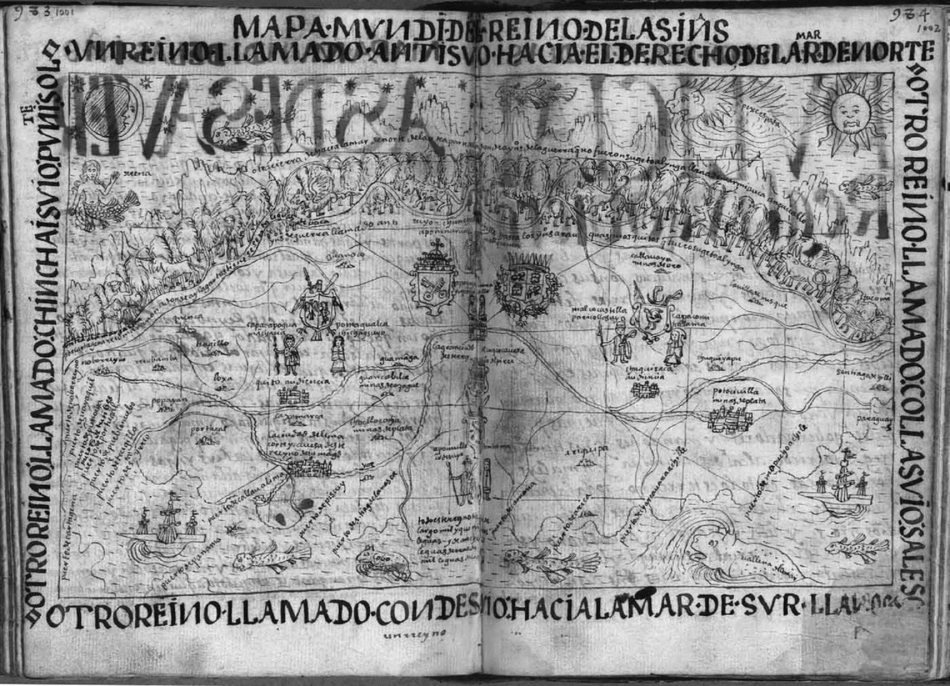
Guaman Poma often found ways to extol the region of Chinchaysuyu over other suyus (territories), claiming at one point that “for fighting in wars, the Inca recognized the strengths of the Indians of Chinchaysuyo quarter.”Footnote 125 Guaman Poma's map of the Inka world shows the division of the Inka empire, Tawantinsuyu, or Realm of the Four Parts, with his ancestors occupying an important spatial zone (Figure 9).
Mappamundi of the Indies (Mapa Mundi del Reino de la In[di]as)

Positioned in the center of the world is the Inka capital of Q'osqo, flanked by the papal and Spanish monarchy's coat of arms. In Chinchaysuyu, to the left of Q'osqo, a male-female pair appears below a coat of arms decorated with a falcon (waman) and puma (poma).Footnote 126 It belongs to Guaman Poma's family, and it also appears with the author on the frontispiece.Footnote 127 The two ruling administrators of this suyu are Capac apo Guaman Chaua and Poma Gualca, his grandfather and grandmother. This representation is significant for several reasons: Guaman Poma first portrays his grandfather wearing the distinctive unku seen previously on the author himself. His grandfather is also crowned with a unique headdress adorned with a single kantuta bud and wears a rayed collar. Moreover, Guaman Poma emphasized in the text the important administrative role his grandfather occupied, since the man who governed a particular suyu was extremely powerful, second in importance to the Sapa Inka.Footnote 128 His grandfather's title, capac apo, which Guaman Poma defines as “administrator, lieutenant general of the Corregidor, protector of the province,” underscores this role.Footnote 129
Guaman Poma consistently referred to his ancestors as capac apos, second persons, and princes, suggesting that these terms were important to him. Capac apo was a title and position derived from the preconquest Inka administration system, but its exact definition remains a subject of scholarly debate. Historian Catherine Julien understands capac as a “hereditary status that passed through the male [Inka] line to each new generation of Inca brothers and sisters in the dynastic line.” However, some non-Inka groups identified people as capac; Julien notes that it suggested individuals who were “closest, in descent terms, to the [Inka] dynastic line.”Footnote 130 At the time Guaman Poma was writing the Nueva corónica, the term ‘capac’ actually had more nuanced meanings. Juan de Betanzos used the term to mean “very much more than King.”Footnote 131 The dictionary of friar Domingo de Santo Tomás relates that the term capac means “King,” and capac apo means “sovereign ruler.”Footnote 132 Similarly, another Quechua dictionary from 1608 defines capac apo as “the principal lord of noble gentleman.”Footnote 133 The Quechua word apo can also be translated as chief or lord, and Guaman Poma himself states that it means “prince.”Footnote 134 The term apo, especially when used in conjunction with capac, also referred to a person who functioned as the “Second Person” to the Inka ruler.Footnote 135 The inclusion of these visual and textual signs help to construct a collective portrait of Guaman Poma's family, allowing readers to connect his ancestral lineage throughout his letter, paralleling other colonial Inka portrait genealogies (Figure 6). These signs also aligned him with important functionaries: he was able to refer to himself as both capac apo and préncipe.Footnote 136 As Adorno points out, after completing the Nueva corónica Guaman Poma inserted the title of “prince” in numerous places within the text, often changing “cacique, ques prencipal” to “capac, ques prencipe,” no doubt to cull the powerful associations of the Quechua term.Footnote 137
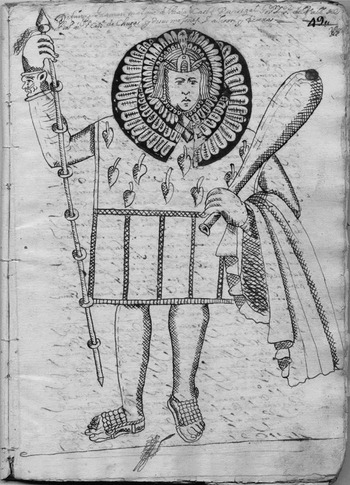
Guaman Poma had earlier emphasized his ancestral ties in another document, Y no ay remedio, in the 1590s.Footnote 138 There, he included maps and ancestral portraits as claims to land titles.Footnote 139 As in the Nueva corónica, he drew on powerful visual and textual signs to define or redefine not only his own identity, but also a broader Andean identity based on Andeans' adaptability and innovation in the face of Spanish colonization, as well as their transformation and emulation of European practices.Footnote 140 In the map of Chupas accompanying Y no ay remedio, three figures stand above the town, similar to the position of his ancestors in the mappa mundi in the Nueva corónica. Topa Inka Yupanqui is in the center, flanked by don Juan Tingo and don Domingo Guaman Mallque de Ayala (his father, don Martín de Ayala by another name). He refers to his father as “Lord and Governor who was the first conqueror and inhabitant of the city of Huamanga.”Footnote 141 While not as detailed as the figures in the miniature mappamundi portraits, the three men have recognizable attributes. Don Martín, on the right, is festooned with an elaborate, mane-like crown and an unku (Figure 10).
Guaman Malque in Y no ay remedio

In the two full-length portraits that accompany the documents, don Martín is adorned with the inverted, u-shaped headdress with the single kantuta and distinctive rounded collar in which Guaman Poma dressed his grandfather in the Nueva corónica. Don Martín also wears an unku reminiscent of Guaman Poma's ancestral one, with the same bordered edges and stripes on the lower half. Given that this is an earlier representation of his familial unku, it may be that the motifs on its top half, which appear almost as leaves or hearts, are precursors to the kantuta buds decorating the unku in the Nueva corónica.
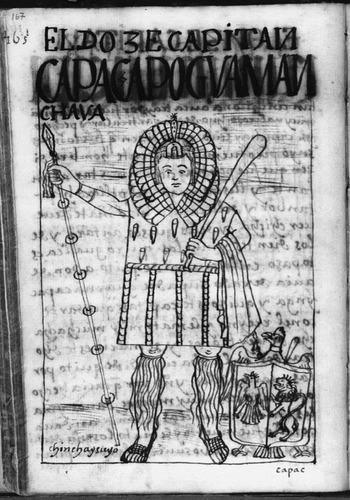
The visual consistency across Guaman Poma's texts and legal documents suggests the significant role of clothing and other accouterments in conveying his familial identity, social status, and social role, a visual act also typical of European portrait conventions of the time. In the Nueva corónica, all the portraits of Guaman Poma's grandfather, uncle, and father show each man wearing the distinctive unku decorated with kantuta flowers. Folio 165 [167] features Guaman Poma's grandfather as one of the Sapa Inka's captains, and describes him as the “second person of the [Sapa] Inka,” the captain general of Chinchaysuyu under Sapa Inka Huayna Capac (Figure 11).Footnote 142
The Twelfth Captain, capac apo Guaman Chaua (El doze capitán, Capac Apo Guaman Chaua)

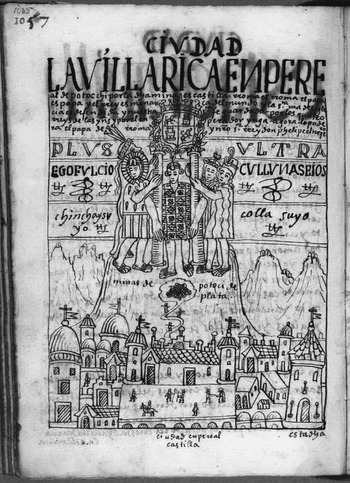
The Rich Imperial Town of Potosí (La Villa Rica Enpereal de Potocchi)

As a political mitmaqkuna, provincial elite such as Guaman Chaua were subjected to the Inka, but enjoyed special privileges.Footnote 143 In his chapter titled “Ages of the Indians,” in the fourth age (known as Auca Runa, and prior to the establishment of the Inka empire), Guaman Poma once again lauds his grandfather as a powerful individual: “There have been great kings, prominent lords and ladies, knights, dukes, counts and marquis. Apo Guaman Chaua Yarovilca was emperor [or apo señor] over all this land, including Chinchasuyo, Antisuyo, Collasuyo, Condesuyo: Tahuantinsuyo.”Footnote 144 Interestingly, when producing illustrations for Murúa's Historia del origen, Guaman Poma listed his grandfather as the first great lord of Peru, even inserting his own ancestral coat of arms into the one designated to symbolize the kingdom of Peru.Footnote 145
Guaman Poma employed the unku and headdress to associate his ancestors with one another and to himself, and he used textual descriptions to elaborate further on their administrative roles, as well as to manipulate chronology to mold his genealogy to the story he wanted to tell. The image “Administrator of the Provinces, Carua Poma” (348 [350]) displays his uncle, Guaia (Carua) Poma, “the son of capac apo Chaua Poma” and an “apo, señor,” in the distinctive familial unku.Footnote 146 In another image (375 [377]), Guaman Poma's father, again bedecked in the familial unku and headdress, embraces Francisco Pizarro, the Spanish conquistador. An inscription proclaims that he was “the primary ambassador to Huascar Inka” and the “viceroy and second person to the Sapa Inka.”Footnote 147
Guaman Poma also recounted his father's loyalty to the Sapa Inka and the Spanish king. In the fictional letter from Guaman Poma's father—included near the beginning of the Nueva corónica, and supposedly written in support of the author—Don Martín claims he is a “son and grandson of great lords and kings of old, captain general and lord of the kingdom, capac apo which means prince, lord of the provinces of Lucana, Andamarca, Circamarca, Sora, the city of Huamanga [Ayacucho] and Santa Catalina de Chupas which is in its jurisdiction, prince of Chinchaysuyo, and second in command after the Inca of this kingdom of Peru, to his royal Majesty King Philip III our lord.”Footnote 148 Don Martín was thus a viceroy and capac apo, just as his father before him and even his brother.Footnote 149
The origins of the capac apo title loomed large for Guaman Poma. In his chapter on the ages of the Indians, he emphasized that to be named or referred to as capac apo, one must be a legitimate descendant of Vari Viracocha Runa, Pacarimoc (Uari Uira Cocha Runa, pacarimoc).Footnote 150 Earlier in the same chapter, Guaman Poma observed that Vari Viracocha Runa was a descendant of Spaniards and claimed he had come on Noah's ark after the Flood to the “Indies” in his attempt to weave together Andean and biblical histories. He declared that the descendants of these peoples are great and powerful lords, the pacarimoc capac apo.Footnote 151 He also wrote that the men who occupied the office of capac apo come from the lineage of “capac apo Yaro Bilca” who was a friend of Topa Inka Yupanqui. The former was succeeded by the very family members Guaman Poma illustrated and discussed in similar fashion elsewhere: Guaman Cahua, Guaman Lliuyac, Guayac Poma, Carua Poma, and even Lluiyac Poma.Footnote 152 By extension, Guaman Poma and his patrilineal ancestors were descended from Noah, Spaniards, and a series of capac apos. He carefully positioned the Yarovilca, the pre-Inka dynasty from which he descended, in a better position than the Inka one. By weaving biblical, historical, and genealogical information together, he positioned his family as having social, political, and even ethnic advantage over those who could claim any lesser heritage.
To add emphasis to their titles, Guaman Poma portrayed his ancestors with a specific type of headdress. It consists of an inverted, u-shaped object positioned on the crown of the forehead, with a single kantuta flower rising from the center, the same one worn by his grandfather in the mappa mundi.Footnote 153 In the illustration for the Inka's council (340 [342]), Guaman Poma depicted his grandfather adorned with the kantuta bud headdress and seated on a litter in his role as an “incap rantin capac apo” (“the Inka's replacement great lord”) and “second person, [and] viceroy of the Inka.”Footnote 154 Interestingly, Guaman Poma's illustration for “November, Festival of the Dead” (folio 256 [258]), depicts the Sapa Inka mummy wearing the same headdress and rayed collar as Guaman Chaua and other elite members of Chinchaysuyu. The same collar appears on the dead in “Burial of the Chinchaysuyu” (289 [291]) and on individuals in “Feast of the Chinchaysuyus” (320 [322]). Perhaps Guaman Poma's decision to dress the dead Sapa Inka mummy in this clothing was a subtle reference to his grandfather having been a Yarovilca ruler. Here, he is inserted into a powerful association, that of a mummy to be honored by the Inka. Moreover, to describe the celebrations of the people of Chinchaysuyu, Guaman Poma drew four individuals dancing, singing, and playing music. Two men wear the distinctive kantuta headdress, collar, and an unku with the same line elements as Guaman Poma's ancestral one. Song lyrics accompanying the illustration of the Chinchaysuyu celebration make the connection between these clothing elements, Chinchaysuyu, and Guaman Poma's ancestors explicit:
In Aucaypata [the main square in Cuzco], in Cucipata [the market in Cuzco], with the powerful Inca, which one is your captain? Are you the great lord Guaman Chaua, Poma Chaua, Yaro Vilca, are you Viracocha? By Lake Apa in Cajamarca to the powerful lord, emperor king, offering homage, conferring with him is Guaman Poma de Ayala, the noble Apu Chaua, Uayac Poma's companion.
As historian Roland Hamilton notes, Guaman Poma composed this song to place his grandfather Guaman Chaua, together with the Sapa Inka, Poma Chaua, Yarovila, and himself, in the main square of Q'osqo. The song conveys a similar identity rhetorically, as Guaman Poma's invented ancestral unku and associated accouterments do visually, and also adds further layers to his genealogical history.Footnote 155
Guaman Poma's use of a specific unku and headdress for his ancestors functions not only as a sign of familial identity, but as a sign of his ancestral or ethnic origins. That he assigned to himself and family members the most elaborately decorated unku—only those worn by the Sapa Inkas in the Nueva corónica were more grand—speaks to the notion that perhaps the Sapa Inka had granted Guaman Poma's grandfather the right to clothe himself in a textile specific to his status as a capac apo. Guaman Poma's ancestral unku was adorned with something akin to the tocapu designs found on the Sapa Inka's own unku, something akin to the tocapu designs foud on the Sapa Inka's own tunic. While the specific meanings of tocapu remain unknown, it is clear that tocapu had associations with high-ranking social status, the Inka administrative hierarchy, a person's place of origins, and visual communication.Footnote 156
The role of Guaman Poma's unku echoes Bernabé Cobo's discussion of how the Inka associated specific regions and ethnicities with garments and their elaboration: “[People] were so well known by these insignia that on seeing any Indian or when any Indian came before him, the Inca would notice what nation and province the Indian was from; and there is no doubt that this was a clever invention for distinguishing one group from another.”Footnote 157 Guaman Poma, like Cobo, was aware of the identities dress communicated to the public, and articulated his identity by drawing attention to his family's unku. However, it is worthwhile noting that the unku's design betrays its colonial origins. An unku decorated with identifiably naturalistic kantuta flowers was an effect of colonialism, since interaction with Europeans caused unku designs and motifs to transform, as certain surviving colonial unku ornamented with kantuta demonstrate. Guaman Poma drew on these transformations to decorate his ancestors, which aided in his own attempts at self-projection for the Spanish monarch. He literally fashioned history by clothing himself and his ancestors in clothes befitting his desired status in the viceregal era.
Conclusion: A Capac Apo, Prince, and Royal Advisor for All the World to See
Guaman Poma's allusion to Philip III as the new Sapa Inka further strengthened his claim to a role as the new royal advisor and his nobility. In the author's image of the mines of Potosí (1057 [1065]), borrowed from the Galvin Murúa, the Sapa Inka presides over the mines and is accompanied by the coat of arms of Castile and León (Figure 12).Footnote 158
The columns of Hercules frame the Sapa Inka, as do the words “Plus Ultra,” and four men brace the columns. Guaman Poma named these men “rreys de las Yndias [sic]”. To the Sapa Inka's right is Guaman Poma's ancestor, the ruler of Chinchaysuyu, who wears the familial unku and floral headdress. Guaman Poma mentions in the text that the Sapa Inka and his four kings defend church and crown. Here, this claim is strengthened visually by their support of the Spanish coat-of-arms and the columns of Hercules. Plus Ultra was the motto of the Spanish Empire, evocative of its imperial ambitions to go “further beyond” the boundaries of the Strait of Gibraltar.Footnote 159 Guaman Poma thus suggests that the Spanish monarch and Sapa Inka are related: the Spanish monarch controls the mines of Potosí, here defended by the Sapa Inka. Guaman Poma's ancestor plays a key role in supporting church and crown, a role Guaman Poma purports to fill as well.
Guaman Poma used European and Andean signs, both visual and textual, to make himself and his male family members recognizable and identifiable as meriting an elevated social position within the “contact zone” of the Nueva corónica. Collectively, these portraits create a visual archive, one intended “to document, communicate, and transport claims” about Guaman Poma and his ancestors across the Atlantic to the Spanish court.Footnote 160 Guaman Poma intended to take the claims even further, and had plans to reach a much broader audience. His self-portraits and those of his ancestors, while not physiognomic likenesses, incorporated specific markers of elite and ethnic identity, including the kantuta-decorated unku and headdress that acted as social skins by which these men became known to Guaman Poma's readers as capac apos and princes.
He attempted to secure a role as the advisor to the king of Spain by showing himself donning the same Inka-style tunic as his powerful male ancestors, with the addition of European-style garments worn by indios ladinos. Lineage and clothing are also ascribed significant meaning in relation to Guaman Poma's anti-mestizo position and his desire to reclaim what he felt were his ancestral lands; together they served to further emphasize his pure-blooded Andeanness, and the dedication of his male ancestors to serving the rightful ruler (whether Inka or Spanish). He used the power of the written word to name his ancestors capac apo and princes and assign the same titles to himself. These self-designated titles placed him in the desired role as a royal advisor to Philip III and helped to legitimize his position as an intermediary in the plea to restore order to Peru.Footnote 161 By visually representing himself and his ancestors as high-ranking elites, the portraits actively constructed the author's self-identity by rendering an ideal vision of himself and his family in perpetuity.Footnote 162 Although the Nueva corónica was never mass-produced in the Early Modern period as Guaman Poma had hoped, the entire manuscript is now available for all the world to see, with its digitization by the Denmark Royal Library.