WHAT ARE POETS FOR IN A RACIST TIME? CITIZEN AND LYRIC HYBRIDITY
In one of the defining speeches of the 2008 United States presidential campaign,Footnote 1 then Senator Barack Obama spoke eloquently about the continual plight faced by most African Americans, stating that
for all those who scratched and clawed their way to get a piece of the American Dream, there were many … who were ultimately defeated, in one way or another, by discrimination … Even for those blacks who did make it, questions of race and racism continue to define their worldview in fundamental ways.Footnote 2
Nearly eight years on, the Charleston church shootings of 17 June 2015 brought the President into the pulpit at the Emanuel AME Church, where he lamented the senseless loss of black lives in the wake of other similar deaths at the hands of a racist national police force and other white supremacists. In light of this, Claudia Rankine's Citizen is an urgent and timely book that sustains America's conversation on race and racial injustice on a level of national grief, even as she brings it to the level of personal intimacy as she asks, “How do you make a body accountable for its language, its positioning?”Footnote 3 In another interview, Rankine phrases the book's thematic concern as such: “What happens when I stand close to you? What's your body going to do? What's my body going to do?”Footnote 4
I argue that Citizen is Rankine's attempt at creating a poetics of racial trauma which meditates on the effects of racial injustice as it manifests in the bodies of traumatized individuals. I draw upon theorists such as Judith Butler and Cathy Caruth whose work bears testament to how trauma often begins and ends with language (or its lack thereof), since moments of linguistic hurt tend to revisit individuals via memory as speech. Rankine's keen awareness of how linguistic injury registers in the body leads her to an adoption and adaptation of the lyric form, with Citizen aptly subtitled “An American Lyric.” While a complete historical genealogy of the lyric would lie beyond the scope of this article, I do wish to note that the lyric continues to defy easy definition and categorization. In his seminal book The Lyric Poem: Formations and Transformations, editor Marion Thain notes that “where ‘lyric’ is a form, it has often been used to denote primarily song forms of poetry … as a genre, lyric represents one overall type of poetry in distinction to others such as ‘epic’ or ‘dramatic.’”Footnote 5 Such observations indicate that any suggestions of the lyric's “newness” must come with an awareness of the lyric's historical evolution in response to philosophical, sociopolitical and cultural transformations, with Peter Nicholls noting how modernists were already well aware of the “limits of the lyric, seeking to frame it with varying degrees of skepticism and irony.”Footnote 6 Writing about the development of the lyric in the twenty-first century, Ian Paterson contends that “lyric poems … [have been] written … with a new awareness of … a structural complicity in capitalist oppression.”Footnote 7 Such reflexivity among poets reflects the lyric's legacy of hybridization, which has contributed towards its longevity despite long-standing criticism about the narcissism of the lyric “I.”
Rankine's own work emerges out of a critical awareness of the need to refashion the lyric in response to the tribulations of being a black citizen in contemporary America, particularly by drawing upon writers who champion “the open text.”Footnote 8 According to Lyn Hejinian, the open text is concerned with making “variousness and multiplicity … articulate and clear,”Footnote 9 thereby encouraging readers to actively pursue the possibility of multiple interpretations. Yet it is noteworthy that Rankine's syntactic and linguistic choices remain firmly grounded within a recognizable lyric tradition, since “there is … no need to swim in new syntaxes or interpret broken words.”Footnote 10 In Citizen, Rankine eschews the use of rhyme and enjambment for a plainer and more prosaic form of lyricism that embodies her search for a form adequate to conveying the particularities of trauma caused by systemic racism in contemporary America. Throughout the book, Rankine is also in conversation with writers, theorists and artists whose inclusion effectively challenges the locus of lyric authority within Citizen, thus situating the text as a lyric hybrid that claims its distinctiveness by worrying “at the boundary between public and private.”Footnote 11
As the “pronoun barely holding the [black] person together,”Footnote 12 Rankine's lyric “I” is a speaker whose positionality is inherently unstable (thus often morphing into the second-person “you”), since his/her bodily existence is threatened on a daily basis by micro-aggressions which treat the black body either as an invisible object, or as something to be derided, policed or imprisoned: “Sometimes ‘I’ is supposed to hold what is not there until it is. Then what is comes apart the closer you are to it.”Footnote 13 The black body calling itself “I” is an aberration in a world that treats it as if it is “not there,” a society that continually thwarts any concerted attempt to answer a fundamental question: “What does a man want? What does the black man want?”Footnote 14 In the following scenario, the black self “comes apart” during a moment of linguistic rupture, as the white individual contemplates the physical presence of the person standing in front of him:
At the end of a brief phone conversation, you tell the manager you are speaking to that you will come by his office to sign the form. When you arrive and announce yourself, he blurts out, I didn't know you were black!
Whilst conventional uses of the lyric tend to feature a singular poetic voice at work, Rankine chooses to emphasize the relationality of the lyric “I” vis-à-vis the second or third person in order to accentuate the unequal power relations that exist between racialized bodies:
Here, Rankine brings the relationship between the lyric and the body into sharp focus, through emphasizing the link between one's addressability as a human being and the potential for injury as a result of that linguistic encounter between “you” and “I.” In the above excerpt, Rankine hints at the power that the white “I” has over the diminished “you” – since to refer to another person simply as “you” is a demeaning form of address: a way of emotionally displacing someone from the security of their own body, their skin color rendering them “hypervisible in the face of such language acts.”Footnote 17
In this article, I contend that Citizen is a work that seeks to extend the lyric's possibilities through creating a hybrid text containing lyric essays, photography, public art and video scripts, which are juxtaposed for intertextual and polyphonic effects. I wish to draw upon John D'Agata's concept of the “lyric essay” to partially characterize Rankine's work, not simply because Citizen has been so described by literary critics, but also because the term crucially suggests how “nomenclature, while often limiting, polarizing, inadequate … can also be the thing that opens up our genre to new possibilities and new paths of inquiry.”Footnote 18 What remains essayistic about Citizen is its clarity of thought and language – an investigation and performance of linguistic hurt and racial trauma that makes evident the ways we “fail each other and ourselves” through ignorance, apathy or fear.Footnote 19 However, unlike the academic essay, which demands a clear argument and conclusion to be drawn through a process of exposition – the lyric, Rankine notes, “has no investment in anything besides openness.”Footnote 20 Rather than gesturing towards a foregone conclusion, the lyric allows for complex subjectivity, polyphony and the possibility of intimate address and eventual dialogue. As such, lyric hybridity appears crucial to Citizen, since race, racial trauma and racism are subjects that require respectively a making-sense-of, a talking-back-to and a calling-out that can only occur if two bodies are willing to place themselves in proximity to one another: “Anyway, sit down. Sit here alongside.”Footnote 21
In what follows, I seek to provide the sociopolitical and literary context for Citizen by discussing the politics of hybrid poetics within contemporary American letters, followed by an examination of how Rankine uses spectatorship and positionality as a means of bearing intimate witness to racial injustice. Later, I draw upon Judith Butler's notion of “linguistic vulnerability” and Ed Roberson's concept of the “lucid interval” to interrogate two of Citizen’s video scripts,Footnote 22 which illustrate how Rankine adapts the lyric through the use of tone, syntax and reference to convey how racial trauma registers in the body: “Occasionally it is interesting to think about the outburst if you would just cry out – / To know what you'll sound like is worth noting.”Footnote 23 Finally, I offer a brief meditation on the possibilities that a work such as Citizen bequeaths to its fellow citizenry, both locally and elsewhere.
WHITHER THE RACIALIZED AVANT-GARDE? CITIZEN AND THE POLITICS OF AMERICAN HYBRID POETICS
I wish to draw particular attention to the importance of race within American literary criticism and avant-garde poetics, not simply because of Citizen’s subject matter, or due to the fact that Rankine is a black poet, scholar and critic. Rather, it is as Toni Morrison so eloquently put it in her book Playing in the Dark: Whiteness and the Literary Imagination: “a criticism that needs to insist that literature is not only ‘universal’ but also ‘race-free’ risks lobotomizing that literature … [since] for both black and white American writers, in a wholly racialized society, there is no escape from racially inflected language.”Footnote 24 While disciples of the New Critics remain loyal to the notion of the text as significant qua text, others such as the language poets,Footnote 25 in conjunction with the New Historicists, have left a crucial legacy of emphasizing the importance of “critical intelligence,”Footnote 26 alongside an awareness that poets and their work “are the consequence of a multitude of conflicting and over-determined social forces.”Footnote 27 As such, formal and aesthetic choices made within the realm of poetry possess political ramifications, particularly in a capitalistic, patriarchal and racialized country such as the United States.
Citizen is inherently a political work of art given its thematic concerns, yet it is Rankine's poetics that deserves deeper scrutiny, not least because of its ability to offer incisive commentary on the contemporary politics of American avant-garde poetry. In situating her work among such figures as Ralph Ellison, Frantz Fanon and James Baldwin,Footnote 28 Rankine signals to the reader that Citizen is a book that “extends infinitely into a poetics of politics.”Footnote 29 From Brown v. Board of Education (1954) to the Charleston church shootings of June 2015, it is likely that, for most Americans, “language is haunted by a history of trauma”:Footnote 30 one that, in this context particularly, has witnessed the continual enslavement and exploitation of black bodies despite the Constitutional promise that “all men are created equal.”Footnote 31 Despite having secured the right to vote following the Civil Rights Act of 1964, African Americans continue to face unequal access to resources and unwarranted violence from local and federal police forces, thus resulting in significant disparities in terms of “income, employment, education, health, housing, and criminal justice” when compared to white Americans.Footnote 32
Such exclusions extend into the realm of American letters, not simply owing to the continual marginalization of writers of color, but also as a result of a concomitant elevating of white voices that at times perpetuate an ideology of white supremacy in their depiction of race relations. At the 2011 Associated Writing Programs (AWP) Conference, Rankine began an open dialogue with Tony Hoagland,Footnote 33 accusing him of expressing racist sentiment in his poem “The Change,”Footnote 34 wherein lines such as “I couldn't help wanting / the white girl,” this “tough European blond,” “to come out on top, / because she was one of my kind, my tribe, / with her pale eyes and thin lips” were juxtaposed with phrases such as “so big and so black,” “big black girl from Alabama” with “cornrowed hair and Zulu bangles on her arms.” While “The Change” can perhaps be read sympathetically as a work that serves to reveal the insidious nature of white liberal racism, the problem with the poem remains that it lies too uncomfortably close to racist speech. Rankine continues this dialogue on race and poetry with Hoagland in Part II of Citizen, with her essay on Serena Williams meditating on the question “What does a victorious or defeated black woman's body in a historically white space look like?”Footnote 35 Serena's incredible success as a tennis player has not shielded her from even the most overt kinds of racism, with Mariana Alves, the distinguished tennis chair umpire, making four bad calls during Serena's semifinal match against fellow American Jennifer Capriati.Footnote 36 Five years on, Serena loses her composure after erroneously being accused of a foot fault during a critical moment in her semifinal match against Belgium's Kim Clijsters.Footnote 37 Rankine writes,
it is difficult not to think that if Serena lost context by abandoning all rules of civility, it could be because her body, trapped in a racial imaginary, trapped in disbelief – code for being black in America – is being governed … by a collapsed relationship that had promised to play by the rules … and to call this out by calling out “I swear to God!” is to be called insane, crass, crazy. Bad sportsmanship.Footnote 38
Similarly, it appears to be bad sportsmanship when poets of color seek greater recognition and representation within the American literary avant-garde. Dorothy Wang examines prominent American critic Marjorie Perloff's stance on “identity politics literature” in her groundbreaking book Thinking Its Presence: Form, Race and Subjectivity in Contemporary Asian American Poetry, quoting an excerpt from the Spring 2006 Modern Language Association (MLA) newsletter:
Under the rubrics of African-American, other minorities, and post-colonial, a lot of important and exciting novels and poems are surely studied. But what about what is not studied? Suppose a student wants to study James Joyce or Gertrude Stein? Virginia Woolf or T. E. Lawrence or George Orwell? William Faulkner or Frank O'Hara? … Where do such prospective students turn?Footnote 39
Wang and others have since commented on the defensiveness and “delusion” of the white imagination when it comes to anything beyond offering writers of color token inclusion at high-profile poetry conferences and within contemporary American poetry anthologies.Footnote 40 What does Perloff's positing of a stark binary between the works of “African-American, other minorities, and post-colonial” writers” and their mainstream (white) counterparts say about the current landscape of American literature?Footnote 41 And what is one to make of Harvard critic Helen Vendler's criticism regarding former US Poet Laureate Rita Dove's anthology-editing skills, claiming that “anthologists may now be extending too general a welcome [to] multi-cultural poets [whose work is] of little or no lasting value”?Footnote 42 Ailish Hopper observes in her essay “Can a Poem Listen? Variations on Being White” that aesthetic judgment is intrinsically political because of the way white power is easily “euphemized in stories of ‘standards’ and supposedly ‘objective’ measurements … [when] it is of course not time, but human beings – and non-multicultural ones at that – who ‘objectively’ measure art.”Footnote 43 Such attitudes have invariably led to great oversight in terms of the kinds of literary contribution that have been made by writers of color, particularly in the realm of American avant-garde poetry.
In American Hybrid Poetics: Gender, Mass Culture, and Form, Amy Robbins cogently argues that the very notion of hybridity in American poetics has never been “race-free” or “post-identity,” particularly when one considers the historical narrative on hybrid poetics offered by the coeditors of Norton's American Hybrid, who identify “hybrid poetic forms as those … neither purely lyric nor Language … neither coherently narrative nor completely epic … but instead … mixings of the features attendant on all of these schools and forms.”Footnote 44 If one accepts such a definition of hybridity, then it is evident that such aesthetics have been prevalent among writers such as those associated with the black arts movement and the Harlem Renaissance, among others. Native American literature also abounds with examples of polyvocality, collage and improvisation, with Louis Owens invoking the concept of “mixed blood” in Other Destinies by depicting the Native literary text as “a hybridized narrative within which the author is in dialogue with himself.”Footnote 45 More contemporary examples include Theresa Hak Kyung Cha's Dictée, a memoir that relies heavily on multimedia methods stemming from Cha's training as a multidisciplinary artist. Though it has long been considered “as seminal … among Asian American circles,” Hong notes that Dictée “is still treated like a fringe classic in the [American] avant-garde canon.”Footnote 46
A continual privileging of hybridity as (white) aesthetics over other forms of hybridity renders invisible contributions made by writers such as Rankine who have sought to introduce radical languages and forms that seek to destabilize and challenge Eurocentric practices. Citizen emerges out of the interstices of a poetic legacy that has for too long sought to govern and critique the works of poets of color based on whether, and how, they address race. As such, I have sought to examine the politics of American avant-garde poetics that Citizen is informed by, and clearly seeks to critique. In doing so, I hope to set the stage for a close reading of Citizen as an exemplar of contemporary hybrid poetics – one which seeks, above all, to depict a reality that is “race-real” as it meditates powerfully on the complexities of linguistic injury through the lens of race and racial trauma in contemporary America.Footnote 47
LYRIC “I” OR LYRIC EYE? RACE, SPECTATORSHIP AND POSITIONALITY IN CITIZEN
This section seeks to examine how Citizen bears witness to racism and racial trauma, with particular attention to how Rankine reinvents the American lyric to convey an embodied understanding of the way micro-aggressions structure the daily lives of black Americans.Footnote 48 In what follows, I shall analyse Rankine's use of color and visual images in Citizen as a form of social commentary on race and racial dynamics in contemporary America, as well as discuss her adoption of the second-person perspective as a way of exploring how one's positionality crucially determines the way one negotiates the world as a racialized being. That Rankine is a poet and scholar from an upper-middle-class background is evident within Citizen, yet one does not feel trapped within her particular experience. Rather, it is as if Citizen is a racial landscape that the reader must painstakingly traverse by inhabiting an experience of systemic racism amidst its particularities:
Rankine's list of names is historically contingent, capturing a particular moment in American history that has resulted in the loss of specific, individual lives – each worthy of being mourned. Through such a gesture, Rankine rejects the seeming timelessness and decontextualization of the lyric, which must instead respond directly to the exigencies of contemporary politics if it is to bear adequate witness to the complexities of race, racism and racial injustice in America. As such, it is noteworthy that the text of Citizen has been updated since its first publication, with the second Graywolf edition initially containing only two names on page 134: “November 23, 2012 / In Memory of Jordan Russell Davis,” followed by “August 9, 2014 / In Memory of Michael Brown,” with page 135 stating simply, “February 15, 2014 / The Justice System.”
Nick Laird from the New York Review of Books notes that Rankine initially let page 135 “stand in for a joint elegy” in the second edition of Citizen,Footnote 50 but that the third edition issued by Graywolf (which this article cites) includes
two more names: that of Eric Garner, an African American who died in July 2014 … after Police Officer Daniel Pantaleo put him in a chokehold, and John Crawford, the twenty-two-year-old African American who picked up an unpackaged BB gun in an Ohio Walmart and continued talking on the phone … before being gunned down by policemen.Footnote 51
That the body of Citizen itself requires updating with an ever-lengthening list of dead men points to the terrible normalcy and frequency of black deaths in America, alongside the paradoxical truth that “Citizen is a breathing text … that will not need to be updated … [since its concerns] are moving out of the same structural dynamics in terms of ingrained racism in [America].”Footnote 52
DID YOU SEE THAT? REPRESENTATIONS OF RACIAL TRAUMA THROUGH TEXT AND IMAGE
In depicting micro-aggressions faced by black Americans, Citizen presents the reader with representations of racism that come across as quotidian and ubiquitous: “This girl, looking over at you, tells her mother, these are our seats, but this is not what I expected. The mother's response is barely audible – I see, she says. I'll sit in the middle.”Footnote 53 This excerpt establishes the importance of spectatorship within Rankine's poetics by training a keen eye on “each undesired desired encounter” between racialized individuals.Footnote 54 In Trauma: Explorations in Memory, Cathy Caruth contends that “to be traumatized is … to be possessed by an image or event,”Footnote 55 an observation which Emma Kimberley echoes in her contention that “the eye is often the wound through which traumatic representations enter.”Footnote 56 Not only does such trauma reside within the black body; for the white body, there exists a “melancholia” that stems from a continual thwarting of national ideals: that of “freedom and liberty whose betrayals have been repeatedly covered over.”Footnote 57 For white individuals, proximity to a black person is therefore likely to trigger a certain cultural trauma that remains entrenched within the nation's psyche.
Drawing on James Heffernan's concept of “visual rhyme,”Footnote 58 I argue for the need to read Citizen’s text as images that reverberate off one another to generate repetitions that create “a feeling of accumulation … [and] saturation” amidst the incessant onslaught of racist speech.Footnote 59 Each moment is depicted through the unit of the paragraph, rather than relying on standard forms of lineation that involve the use of enjambments or caesuras. When viewed on the page, blocks of black letters appear to be resisting the white borders that surround the words like a ring fence, thus alerting the reader to how each racist encounter represents a period of tension and potential threat – one which leaves the speaker (“you”) bereft. Very often, the speaker can only muster the following response: “What did you say?”Footnote 60 In particular, these verbal images could be read as diptychs connected across separate pages by the use of refrains: “you smell good,”Footnote 61 “rain(s) down,”Footnote 62 “the ache.”Footnote 63 That each encounter is presented on a separate page within Citizen embodies the notion of disparate black bodies echoing one another across the oceanic expanse of white that frames each encounter with others and with the self.
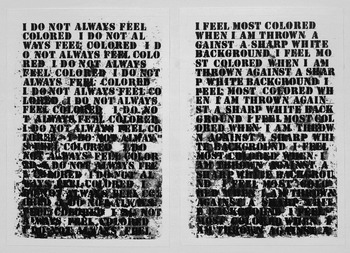
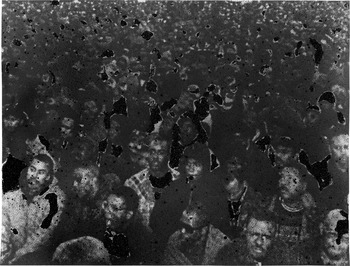
Color comes across as a powerful material presence in Citizen, with Rankine framing the entire text with the following line from Chris Marker's Sans Soleil: “If they don't see happiness in the picture, at least they'll see the black.”Footnote 64 This opening quote not only serves to heighten the reader's perception of black and white, thus evoking the racial dynamics of contemporary America, but also acknowledges that “even as white negates and excludes black, it necessarily … includes blackness as something essential to its meaning and history.”Footnote 65 Rankine calls attention to the materiality of black bodies within the cultural imaginary of white America through incorporating Glenn Ligon's piece Untitled (I Feel Most Colored When I Am Thrown against a Sharp White Background), which presents a repetition of a famous quote by Zora Neale Hurston as oil stick, gesso, and graphite on wood, as the letters meld into black towards the bottom half of the piece (Figure 1). This effect is mirrored in another Untitled piece by Ligon, which Rankine includes in Part VI of Citizen, showing blurred faces of black Americans in a crowd (Figure 2), interspersed with black dots that recall a familiar yet disturbing racist stereotype, that “all black people look the same.”Footnote 66 Rankine's use of intertextuality throughout Citizen allows it to contain multiple layers of signification that energize and open the text, such that it becomes “traversed by forces and desires that are invisible or unreadable to those who see it as … a totalizable collection of signifieds.”Footnote 67 For what Rankine is interested in is not truth qua facts, but rather the emotional truths that pertain to a kind of “self-consciousness around race,”Footnote 68 those that require the reader to endure repeated “passage(s) back to the unbearable moment or [encounter].”Footnote 69
© 1990–91, Untitled (Four Etchings) 1992 (A), courtesy of Glenn Ligon and Luhring Augustine, New York.

© 2000, Untitled (Speech Crowd 2), courtesy of Glenn Ligon and Luhring Augustine, New York.

In the following excerpt, Rankine's juxtaposition of text and visual image creates a space for dialogue between two forms of art – a space which the reader is invited to enter, thus effectively destabilizing the text and preventing what Roland Barthes saw as a kind of interpretive “closure [that] arrests meaning”:Footnote 70
The new therapist specializes in trauma counselling. You have only ever spoken on the phone …
At the front door the bell is a small round disc that you press firmly. When the door finally opens, the woman standing there yells, at the top of her lungs, Get away from my house. What are you doing in my yard?
It's as if a wounded Doberman pinscher or a German shepherd has gained the power of speech. And though you back up a few steps, you manage to tell her you have an appointment. You have an appointment? She spits back. Then she pauses. Everything pauses. Oh, she says, followed by, oh, yes, that's right. I am sorry.
I am so sorry, so, so sorry.Footnote 71
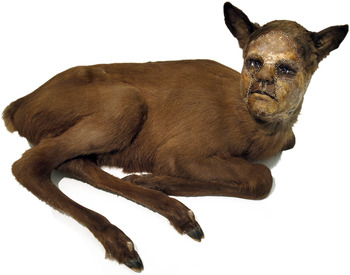
Upon reading the text, the reader is left with the tableau of a speechless person whose encounter with a trauma-counselling specialist reinscribes the very trauma he or she has sought to ameliorate. On the following page, the reader immediately encounters an image of a caribou with a human head crouched low on the ground, its front legs tucked underneath its body, a stance exhibiting vulnerability, fear and helplessness. Since Citizen does not offer any captions alongside its images,Footnote 72 the reader is left to ponder the meaning of each image in relation to the surrounding text. In this instance, Kate Clark's art piece titled Little Girl, 2008 (Figure 3) represents a moment during which the reader is drawn into the purview of the very gaze that the speaker experiences as a kind of condemnation, arising from racial prejudice and hatred. That the reader is now subject to the artwork's gaze is highly significant, because it is thus that the “traditional opposition between subject and object breaks down.”Footnote 73 Though one might be tempted to classify the racist therapist as subject and the speaker as object given his or her diminished state, the human–beast exercises its agency as it stares back at us, its face impassive, as if daring us to deny that this moment of linguistic injury traumatizes both subject and object alike. By holding the reader's gaze, the human–beast invites us to ask of ourselves how we look at and judge others without ever considering, “What does suspicion mean? What does suspicion do?”Footnote 74
© 2008, Little Girl, courtesy of Kate Clark and Kate Clark Studio, New York.

By leaving her images uncaptioned, I argue that Rankine offers an incisive social critique of the use of images in a world dominated by visual media. Commenting on another work by Rankine entitled Don't Let Me Be Lonely: An American Lyric, Kimberley contends that “in order to understand the effect called ‘reality’ we have to attend to … the rhetorical strategies by which one dominant picture or version of events is established and validated.”Footnote 75 In refusing to offer the reader a verbal interpretation of the image, Rankine crucially invites us to meet her halfway – to do the necessary cultural work by learning about the political and social context that gave birth to such an image, and to respond to another person's “looking up … talking back, and, as insane as it is, saying please,”Footnote 76 by professing a willingness to learn about their experience of racism through continual witness and dialogue.
RACING THE SUBJECT: “BLACKNESS AS THE SECOND PERSON”
In Citizen, Rankine writes, “You said ‘I’ has so much power, it's insane.”Footnote 77 On the next page, an imperative: “Drag that first person out of the social death of history, then we're kin.”Footnote 78 These lines call attention to the historical sovereignty of the lyric “I” – a literary trope “understood to be historically indeterminate … a fictional person of all times and all places,”Footnote 79 thus devoid of any social markings such as race. Indeed, Theodor Adorno notes how “part of the ideal of lyric poetry … is to remain unaffected by bustle and commotion, a sphere of expression whose very essence lies in either not acknowledging the power of socialization or overcoming it through the pathos of detachment.”Footnote 80 The lyric's focus on subjectivity renders it seemingly ahistorical and decontextualized, yet its usage throughout the centuries by much of Western civilization (beginning with Sappho in Greece and Horace in Rome) points to the fact that the lyric “I” is often assumed to be white unless otherwise stated.
This presumption about the speaker's race (or lack thereof) is of great interest to Rankine,Footnote 81 who seeks to reinvent the lyric to allow for the emergence of racialized subjects within Citizen, subtitled “An American Lyric.” Rankine's lyric essays invoke a multitude of voices and positionings (“I,” “he,” “she,” “they” and “we”) in support of the second-person perspective (“you”), such that the reader can never be sure where to place oneself vis-à-vis the speaker and other cast members, all of whom revolve around one another in a shifting constellation of “linguistic reciprocity patterns.”Footnote 82 In an interview, Rankine reveals her intention to rely primarily on the second-person perspective in Citizen as a way to “disallow the reader from knowing immediately how to position themselves” within a particular scenario.Footnote 83 In Part III of Citizen, Rankine describes a complex encounter on a train between three entities: a person standing, a person sitting and the empty space next to the seated person:
On the train the woman standing makes you understand that there are no seats available. And, in fact, there is one. Is the woman getting off at the next stop? No, she would rather stand all the way to Union Station.
The space next to the man is the pause in a conversation you are suddenly rushing to fill …
The man doesn't acknowledge you as you sit down because the man knows more about the unoccupied seat than you do. For him, you imagine, it is more like breath than wonder; he has had to think about it so much you wouldn't call it thought.Footnote 84
At first glance, the opening paragraph is easily read from the black man's point of view: he is made aware by the empty seat that “there are no seats available,” and that the woman “would rather stand all the way to Union Station” than place her body alongside his. Or is this “you” the person standing, possibly a white person who suddenly feels complicit in her fellow passenger's unwillingness to place herself in proximity to a black body? I argue that the “you” is Rankine's intended foil for the lyric “I,” for in contrast to the racially unmarked/white “I,” there is the implicated, racialized “you” who is forced to inhabit a universe where identities are suddenly rendered unstable, shifting momentarily between speaker and reader, spectator and participant, subject and object. This “you” compels the reader to acknowledge the salience of race amidst the prevalence of “post-identity” rhetoric, and to reckon with one's own culpability in instances where one might be tempted to say, “it had nothing to do with me.”Footnote 85
It is precisely this desire for the subject's “partiality … and situational, contingent existence” that compels Rankine to persist with the lyric despite its problematic incarnations in its more traditional forms,Footnote 86 where the narcissism of the lyric “I” becomes all too evident – a key example being William Stafford's speaker in his poem “Traveling through the Dark” as he proclaims, “I thought hard for us all” in the face of a collective moral dilemma.Footnote 87 In Precarious Life, Judith Butler calls for “the de-centering of the first-person narrative … to consider the ways in which our lives are profoundly implicated in the lives of others.”Footnote 88 The facade of a transcendent and unified speaker is one which the lyric often perpetuates, which is why Rankine is careful to call this notion into question by pointing to the plurality of selves inherent within each individual, particularly insofar as we position ourselves as historical subjects:
A friend argues that Americans battle between the “historical self” and the “self self.” By this she means you mostly interact as friends with mutual interests and, for the most part, compatible personalities; however, sometimes your historical selves, her white self and your black self, or your white self and her black self, arrive with the full force of your American positioning.Footnote 89
The use of “you” within a lyrical framework allows Rankine to exploit how the lyric mode demands that an address be both specific and immediate. Such specificity discourages empiricism or attempts at generalization, allowing instead for “emotions [to] stand equal to facts.”Footnote 90 Furthermore, Rankine's American lyric is one that demands all of us to be rendered visible to one another – not in spite of, but in light of, one's race. In contrast to Hoagland's poem “The Change,” wherein the black tennis player is clearly objectified by the white spectator, Rankine's encounters within Citizen allow for us to be fully present as racialized beings – ”her white self and your black self, or your white self and her black self” – whilst calling attention to the reader's unique “positioning.”Footnote 91 The second-person perspective crucially invites the reader to engage in self-reflexivity by drawing on one's own racialized experiences whilst inhabiting the text of Citizen, in order to better cultivate empathy towards others.
TOWARDS A POETICS OF RACIAL TRAUMA: TONE, SYNTAX AND REFERENCE IN CITIZEN
In Excitable Speech, Judith Butler notes how linguistic vulnerability is inherent to the human condition, since “it is by being interpellated within the terms of language that a certain social existence of the body first becomes possible.”Footnote 92 Rankine references Butler when she notes how “language that feels hurtful is intended to exploit all the ways that you are present”Footnote 93 – that is, our very desire for social interaction exposes us to the possibility of injurious address. While most of Citizen depicts micro-aggressions that are “illocutionary” in their effects (i.e. the speech act injures in the very moment of its utterance),Footnote 94 Section VI illustrates scenarios constituted by “perlocutionary acts” whereby “saying something will produce certain consequences” that occur in a different temporal space.Footnote 95 In an interview, Rankine states that “the scripts in chapter six seemed necessary to Citizen because … I don't think we connect micro-aggressions … to the creation and enforcement of [racist] laws.”Footnote 96 Indeed, Butler notes that the racist is merely a part of the wider apparatus of white power which “operates without a subject, but … constitutes that subject in the course of its operation,”Footnote 97 as evidenced by the perpetuation of racism through systems of legal enforcement that routinely police, harass and imprison black bodies.
In what follows, I wish to draw on Ed Roberson's concept of the “lucid interval” to examine two of Citizen's video scripts created by Rankine in collaboration with John Lucas.Footnote 98 These examples illustrate how Rankine attempts to refashion the lyric through the use of tone, syntax and reference to evoke the particularities of racial trauma. In particular, I wish to consider how Rankine's use of poetic devices such as repetition and metonymy effectively bridges the gap between what is uttered with great difficulty, and what is left unsaid in the wake of racial injustice. In her video script entitled “Stop-and-Frisk,” Rankine bears testament to how the act of racial profiling is fundamentally indifferent to the specificities of the black body singled out for derogatory treatment:
Then flashes, a siren, a stretched out roar – and you are not the guy and still you fit the description because there is only one guy who is always the guy fitting the description.
Get on the ground. Get on the ground now. I must have been speeding. No, you weren't speeding. I wasn't speeding? You didn't do anything wrong. Then why are you pulling me over? Why am I pulled over? Put your hands where they can be seen. Put your hands in the air. Put your hands up.
Then you are stretched out on the hood. Then cuffed. Get on the ground now.
…
Each time it begins in the same way, it doesn't begin the same way, each time it begins it's the same. Flashes, a siren, the stretched-out roar –
…
And still you are not the guy and still you fit the description because there is only one guy who is always the guy fitting the description.Footnote 99
As one of the most often quoted passages in Citizen, “Stop-and-Frisk” has been performed by Rankine on multiple occasions.Footnote 100 At each reading, it is noteworthy that Rankine adopts a voice that is monotonic, almost resigned, as if beleaguered by the very act of having to utter aloud what has been traumatic to witness, remember and record. Rankine's readings of “Stop-and-Frisk” bring to mind Roberson's poems from Lucid Interval as Integral Music, most of which features poems that are “visually halved or barred by a thin, horizontal black line.”Footnote 101 The black line which slices the poem in half introduces a liminal space which allows what is being said between the poem above and its counterpart below to reverberate, with the repetition of words creating a blurred reflection that embodies the discontinuities in the traumatized speaker's consciousness. In Citizen, Roberson's black line is replaced by a gaping expanse of whiteness that intrudes repeatedly into the writing with the force of a “police vehicle [coming] to a screeching halt … like they were setting up a blockade.”Footnote 102 The blank (white) space is a silence that speaks, for the reader is acutely aware of the violence that is taking place despite the speaker's inability to talk back to the barrel of a gun: “You need to be quiet … You need to close your mouth now.”Footnote 103
Since language refuses to be purged of its “traumatic residue,”Footnote 104 what is said in the wake of trauma requires a form that is syntactically “as complex as thought.”Footnote 105 As such, “Stop-and-Frisk” functions as an embodiment of the lyric present: “Each time it begins in the same way, it doesn't begin the same way, each time it begins it's the same. Flashes, a siren, the stretched-out roar.”Footnote 106 It is difficult to tell when the event begins or ends; indeed, it seems that the traumatic moment is cyclical, doomed to reenact itself in precisely the same manner as its predecessor, an effect which trauma theorist Caruth describes as a “breach in the mind's experience of time.”Footnote 107 In order to convey this mental rupture, Rankine sets up the reader to expect a certain meaning syntactically, only to thwart it through a reversal of, or layering upon, what has been said: “And still you are not the guy and still you fit the description because there is only one guy who is always the guy fitting the description.”Footnote 108 Each rereading of this utterance thrusts the reader back into the whirling machinery of racism; as such, the sentence begins with “and still” – a phrase that insists on its own reiteration despite any evidence to the contrary (“you are not the guy”). Racism's logic is necessarily tautological (“because there is only one guy who is always the guy …”), based on a legal system that deems blackness “a life sentence”Footnote 109 – a criterion which, if fulfilled, would render anyone “fitting the description” to be frisked, violated and jailed.
When such trauma revisits the speaker as memory, it can only be spoken aloud through the use of repetition, since there is “no way to work through trauma except through the arduous effort it takes to direct the course of its repetition.”Footnote 110 The speaker experiences this retelling as a kind of fracturing of the self into multiple (at times contradictory) voices: “I must have been speeding. No, you weren't speeding. I wasn't speeding? You didn't do anything wrong. Then why are you pulling me over?”Footnote 111 What results is a form of polyphonic speech that expresses the internalization of “social heteroglossia … [such that] the dialectics of the object are interwoven with the social dialogue surrounding it.”Footnote 112 For a moment, the reader is unsure whether it is the policeman who is speaking, or the speaker who is desperately worrying at the moment of arrest, in an attempt to outstrip the site of linguistic injury – to leave behind the past in the “worrying exhale of an ache.”Footnote 113
In another video script entitled “In Memory of Trayvon Martin,” Rankine describes an exchange between a loved one and the American teenager moments before he was shot in the chest by George Zimmerman, a Neighborhood Watch volunteer, in Sanford, Florida:Footnote 114
If I called I'd say goodbye before I broke the goodbye. I say goodbye before anyone can hang up. Don't hang up. My brother hangs though he is there. I keep talking. The talk keeps him there. The sky is blue, kind of blue. The day is hot. Is it cold? Are you cold? It does get cool. Is it cool? Are you cool?
Eventually, he says, it is raining. It is raining down. It was raining. It stopped raining. It is raining down.Footnote 115
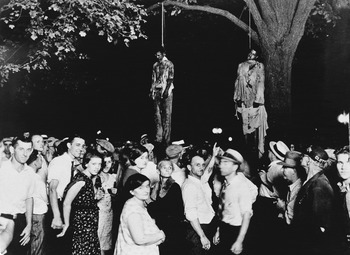
Rankine immediately follows this video script with an altered photograph of a public lynching (Figure 4),Footnote 116 with the two black bodies edited out to leave behind nothing but sky. Though the reader is presented with a visual image, the effect is aural and haunting, for we hear the quiet as a voice silenced, in contrast to the bustle of activity below, the white bodies ecstatic in mid-speech. This excerpt invites the reader to enter into the “lucid interval” of mourning: “the chaotic but productive space between sign and sound … between the visual and aural.”Footnote 117 To enter into this “lucid interval,” the reader must partake in what Umberto Eco calls an “inferential walk”;Footnote 118 that is, “the reader has to ‘walk’ … outside the text, in order to gather intertextual support …[moves] elicited by discursive structures and forseen by the whole textual strategy as indispensable components of the construction.”Footnote 119 Rankine leaves it to the reader to associate her various refrains to the jazz of Miles Davis, his album Kind of Blue a musical staple during and since the years of the American civil rights movement. The lyricism of Rankine's work is epitomized by the use of apostrophe as the speaker urges Trayvon Martin not to “hang up,” these words metonymic as a double entendre – the notion of Trayvon ceasing to speak evoking the possibility of his death and murder – of his being “hung up” in a manner akin to the black bodies that were publicly lynched in the American South from the late eighteenth century up until the 1960s.
© Courtesy of Getty Images.

During the call, the speaker asks frantic questions that are met initially by silence: “Is it cold? Are you cold? … Is it cool? Are you cool?” The proliferation of caesuras throughout this utterance is an attempt by the speaker at provoking conversation, at eliciting signs that her loved one is still alive. As such, the speaker is asking, Is where you are an unfeeling place? (“Is it cold?”) Are you dead? (“Are you cold?”) Is anything wrong? (“Is it cool?”) Is what is happening right now alright by you? (“Are you cool?”) Eventually, Trayvon replies: “it is raining. It is raining down. It was raining. It stopped raining. It is raining down.” Rankine evokes the imagery of rain throughout Citizen to illustrate the relentless drip of racism as daily micro-aggression and physical harassment: “Did that just come out of my mouth, his mouth, your mouth? The moment stinks … And as light as the rain seems, it still rains down on you.”Footnote 120 As such, the link between linguistic injury and physical harm crystallizes in the words “it is raining [down]” – the idiom “blows raining down” heard intermittently by the reader in the gaps between “the unsaids, the saids, [and] the spaces within a conversation holding up the encounter, both in the sense of sustaining it and of blocking it.”Footnote 121 The traumatic moment is transmuted tonally into the downpour of rain in the speaker's memory, as evidenced by the frequent use of caesuras and the obsessive repetition of variations on the same theme: “It is raining down.”Footnote 122 As such, Rankine recalls moments of racist injury as both linguistic and physical, with language morphing into a fist or the barrel of a gun, leaving behind battered bodies which bear witness to Rankine's observation that “you're not sick, not crazy, / not angry, not sad – / It's just this, you're injured.”Footnote 123
WHAT POETS ARE FOR IN A RACIST TIME: “TELL ME A STORY”
In the last few pages of Citizen, Rankine writes, “I want to interrupt to tell him her us you me I don't know how to end what doesn't have an ending.”Footnote 124 For the longest time, to even speak about racism seemed to run contrary to what we are told as citizens in a multicultural world: “Come on. Let it go. Move on.”Footnote 125 Yet Rankine proves through Citizen that poetry is indeed as W. H. Auden deems it: “a way of happening, a mouth.”Footnote 126 While Citizen meditates powerfully on racial trauma as it registers in the black body, Rankine ends the book on a faint note of desire – involving a lover's touch – a brief moment of reprieve amidst the daily onslaught of racism:
Tell me a story, he says, wrapping his arms around me.
Yesterday, I begin, I was waiting in the car for time to pass. A woman pulled in and started to park her car facing mine. Our eyes met and what passed passed as quickly as the look away. She backed up and parked on the other side of the lot. I could have followed her to worry my question but I had to go, I was expected on court, I grabbed my racket.
The sunrise is slow and cloudy, dragging the light in, but barely.
Did you win? he asks.
It wasn't a match, I say. It was a lesson.Footnote 127
This last episode encapsulates the entire collection's ethos, which derives so much of its emotional and intellectual power from the juxtaposition of racialized bodies as they encounter one another in the most mundane of situations: at the grocery store, a checkout line, or a parking lot. It is what we do or fail to do in these fleeting moments of encountering another person that determines how we as national and global citizens contribute to this fraught yet crucial conversation on race, racism and racial injustice. Rankine's speaker choses to “move on” in the immediate aftermath of this micro-aggression, even though she wanted to “follow [the racist woman] to worry her question” about why her black body was not worthy of another car being parked alongside hers. The sunrise's lack of enthusiasm injects a note of pathetic fallacy into the scene: the light is being “[dragged] in … barely,” like the reluctant movement of the speaker's body across the parking lot and onto the tennis court, emotionally injured but unwilling to collapse, trying to keep her composure in a world which consistently conspires to bring the black body to its knees.
The lover finally asks a seemingly simple question, “Did you win?” To which the speaker replies, “It wasn't a match … It was a lesson.” A match implies a back-and-forth, some kind of repetitive exchange between two willing bodies. Throughout Citizen, encounters between racialized bodies have often been unwilling, reluctant, forced – even dangerous or life-threatening – the black body historically enslaved or lynched to death, nowadays easily handcuffed or threatened by a police gun. As such, Rankine's speaker aptly notes that there has been no “match” in America between people of all races, at least no match which functions on the premise of equality. The speaker follows this profound observation with an enigmatic statement: “It was a lesson.” Does the speaker imply a lesson learnt by all parties, or simply one which the black body learns over and over, since he/she is always the one who has more to lose? At times, a black American's refusal to engage with another body (in the case of a policeman pulling him/her over) might result in imprisonment or sudden death. Other times, a lack of engagement (as when the white woman chooses to park her car elsewhere) leaves the black body bereft. Is this Rankine's speaker giving us all an intimate lesson about the black body's refusal to give in – her own body always ready on the tennis court – willing us to pick up the racket on the other end, to finally learn what it means to abide by the rules of civility and citizenship?
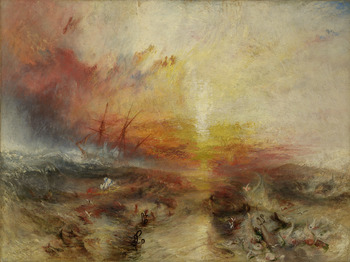
At the book's conclusion, Rankine leaves the reader with two iconic paintings by Joseph Mallord William Turner, set side-by-side on two white pages like a diptych: The Slave Ship, circa 1840 (Figure 5), juxtaposed with a zoomed-in section of the bottom-right corner of the same painting, which depicts giant fish devouring a drowning slave (Figure 6).
© 1840 Slave Ship (Slavers Throwing Overboard the Dead and Dying, Typhoon Coming On), courtesy of Joseph Mallord William Turner and the Museum of Fine Arts, Boston.

© 1840, detail of Slave Ship (Slavers Throwing Overboard the Dead and Dying, Typhoon Coming On), courtesy of Joseph Mallord William Turner and the Museum of Fine Arts, Boston.

That Citizen ends on a visual rather than a verbal note attests to its lyric hybridity, through which Rankine bequeaths to her American and global citizenry a historic “lesson” of slavery in America that has left its terrifying legacy of systemic racism, a legacy which continues to resist “the moment when [a black person] will be seen … as another first person.”Footnote 128 Under a post-Obama administration, what might a poet do to contribute towards the realization of a more racially just society? I argue that along with other African American poets such as Robin Coste Lewis,Footnote 129 Danez Smith,Footnote 130 and Jericho Brown,Footnote 131 whose differing meditations on the black body all offer profound ways of perceiving the urgent need for racial justice, Rankine galvanizes her readers through creating a poetics of racial trauma in Citizen with the hope of transforming them and their fellow citizens into allies who might someday help usher in “a truce” between all races – “a truce with the patience of a stethoscope.”Footnote 132