As political scientists, many of us encourage our students to get involved in community activities and local politics; and in fact many of our political science colleagues have run for state and local (and, less frequently, national) office. While the literature on parties, elections, and voting behavior may help provide us with some context when we (or our students) enter the political arena, there is a striking dearth of literature on voting behavior (and candidate behavior) in local elections. What Herson (1957) referred to as “the lost world of municipal government” can still be so characterized today, though a few recent studies have attempted to predict winners of municipal races (for example, McGleneghan and Ragland 2002; Lieske 1989). This article analyzes my own education in local politics, which resulted from my candidacy for the Town Council of Cazenovia, New York in November, 2005. I came to the experience of participating in a local campaign with expectations shaped by my teaching and research in American politics at the national level, and found that these expectations often gave way to the specifics of context. Jennifer Lawless, a political scientist running for Congress in 2006, expressed this sentiment as: “Political science is all generalities. Politics is all individual circumstances” (Fischer 2006).
My 2005 campaign broke a long tradition of uncontested elections with turnouts as low as 10%. Voter turnout reached 54%, and my friend and candidate for supervisor, Liz Moran, defeated the incumbent 54%–46%. I was one of two people elected to a seat on the five-member Town Council.1
The third member of our slate, a man who had served on the School Board for many years and been active in youth sports, among other activities, was not elected. The Town Council consists of five members: the supervisor and four councilors.
The common wisdom focuses on candidates and parties as “rational prospectors” who aim to “choose prospects who are likely to become active in response to a request and … who have the capacity to participate effectively” (Verba, Schlozman, and Brady 2000, 257). The assumptions that I held going into the campaign were that people would make heavy use of party cues in this relatively low-salience, low-information election; and that gender would play a role, especially by increasing turnout among women. Finally, my overall analysis of the campaign assigns a significant role to the community's civic associations and non-profit organizations and to the sometimes conflictual way that they have related to local government.
The Campaign in Context
Cazenovia is a picturesque New England-style town situated on a lake, about 20 miles southeast of Syracuse. In the nineteenth century it enjoyed a brief industrial heyday (thanks to water power from Chittenango Creek), then suffered when the Erie Canal bypassed it, and later revived as a summer destination for the wealthy, who built huge shingle-style “summer camps” along the lake. The community has had a long history of preservation-minded elites (which accounts for its attractive downtown and streets of nineteenth-century houses) and is close enough to Syracuse to attract commuters, but far enough away that it is still more an autonomous community than a suburb (for local histories, see Grills 1977 and Hugill 1995). The fact that development pressures have been somewhat muted, however, has allowed for a sort of head-in-the-sand attitude and a lack of proactive attempts to manage growth. For example, Cazenovia's comprehensive plan has been updated less recently than any of the other 14 towns in Madison County.
My decision to run for office was shaped in part by the successful campaign, earlier in the year, of a new candidate for village trustee who had run explicitly on a platform of better planning and more thoughtful growth. Our campaign organization consisted of the three candidates, a very energetic campaign manager, and a few “committee heads” (in charge of publicity, fund-raising, yard signs, neighborhood coffees, phone banks, and so forth). Our field plan called for a large amount of candidate-voter contact—doorbell-ringing and phoning.2
Recent experimental research, such as Green et al. (2003), suggests that this high level of voter contact may have been responsible for the relatively high turnout.
We had 922 identified supporters by Election Day. I received 1,109 votes.
We also had a committee which made sure there were letters to the editor in each edition of the weekly local paper. We purchased ads in that paper and the local penny saver, and placed over 200 signs on supporters' lawns. These are the standard actions of most local campaigns, though we certainly engaged in more campaigning than has been the norm in Cazenovia. During the fall, the League of Women Voters sponsored one candidate forum, and the library sponsored another. We organized a number of neighborhood coffees, and there were opportunities for voter contact at the weekly farmers' market, high school athletic events, and meetings of local organizations. In sum, I suspect that though our campaign was more intense because we started from such a disadvantageous position, it closely resembled most local campaigns in terms of its organization and activities.
Confirming an Assumption: Voters Have Clout
As the quote from Verba, Schlozman, and Brady (2000) above suggests, the political science literature (if not journalistic accounts of campaigns) supports the idea that politicians pay more attention to people who vote. This claim appears (in my classes, at least) in two places—when we are talking about reasons to vote; and when we are reading about and discussing research on participatory inequality (e.g., Verba and Nie 1972; Verba, Schlozman, and Brady 1995).
But nothing has brought this maxim to life as much as being suddenly transformed into a politician with a limited amount of time and energy. We sorted the registered voters by street, and our lists were further ordered (by my daughter, who was serving as our campaign strategist) to give priority to Democrats, frequent voters, and women. These were the groups we assumed would be supportive, and thus the people we wanted to reach.
To begin with, of course, the non-registered voters on a particular street or road did not even appear on our list: they were effectively non-people. And because we knew that those who voted regularly were more likely to vote in this election, it made all the sense in the world to skip the homes of registrants who were infrequent voters. Though we had a few “campaign events” such as the League of Women Voters forum, the bulk of our campaign consisted of calling people on our lists and going door-to-door. Thus non-participants were effectively denied an opportunity to make their views known to the candidates. Obviously they could vote in the election, and I'm sure that some did—but by their previous inactivity they became categorized as non-participants and, therefore, people whom it was rational to ignore.
Questioning Assumptions: What about Party and Gender?
Second, the undermined assumptions. As a political scientist who has written and taught about political parties and about women and politics for years, I came to this experience prepared to understand the political divisions in Cazenovia through a lens shaped by party and gender. Such a perspective reflects my research and teaching and was confirmed by the way we were recruited to run. The Democrats at the county level, still far outnumbered by Republicans, have entered a building phase, with active local leaders working to strengthen the party at the grassroots. These activists approached us to run, convinced that the time was particularly right for female candidates. We received money from the county organization and support from elected Democratic officials. I went into the campaign thinking that while we would have a tough fight, if we could mobilize a goodly portion of the 1,100 Democratic voters (many of whom were conveniently concentrated in the village) and the 1,164 “non-enrolled”4
In New York State, registered voters who do not declare a party are referred to as “non-enrolled” voters.
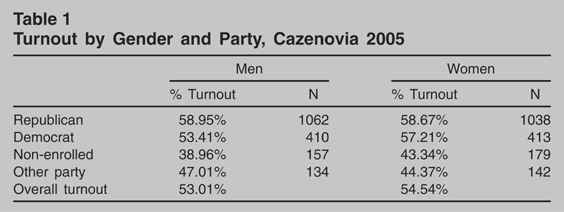
Similarly, many campaign supporters believed that our candidacies would be welcomed by women, and that women would both turn out and support us disproportionately. We debated (but eventually rejected) newspaper or direct mail ads that specifically referred to women's historical under-representation in local government offices. Nonetheless, from our contacts with the electorate we felt as if we were mobilizing women to vote at a high rate. We were not, as Table 1 indicates. Though Democratic women and non-enrolled (no party) women turned out to vote at a somewhat higher rate (by 4 percentage points in each case) than their male counterparts, in general female and male voting rates were comparable (and comparable to those in previous elections). And, similarly, Democrats did not rush to the polls in unusually high numbers.
Turnout by Gender and Party, Cazenovia 2005

Party was not irrelevant. Our list of supporters was much more heavily Democratic (42%) than the pool of registered voters (25%). Nonetheless, party was clearly not the only factor in voters' decision-making. We received our strongest support in the traditionally Republican, high-income districts near the lake, while results were disappointing in the village district which has the highest Democratic registration. Of the town's five voting districts, District 5 (surrounding the lake) has the highest proportion of Republican registrants at 54%, but in this district our supervisor candidate received her highest vote: 63%. In contrast, the village district with the highest Democratic registration (33%) provided her with only 50% of its votes, higher only than the 33% in the heavily rural and Republican home district of the incumbent.
Essentially, it appears that well-educated professionals, many of whom are “first-generation” Cazenovians, voted for us despite the fact that we were Democrats, while the “old line,” middle- and working-class residents whose families had resided in the community for generations voted against us, even if they were Democrats. Social position trumped party; gender didn't seem particularly relevant. We convinced a number of non-native Republicans that we were well-qualified, agreed with them on important local issues, and were in fact more similar to them in background and outlook than were the traditional Republican elites. “Nativity,” that is whether one was born in the community (or, more generally, whether one's family has “roots” there), is not a variable which appears in typical voting analyses, but in this instance (and, I suspect, in other local contests), it was quite significant. At a public forum one of our opponents, when asked what his chief qualification for office was, said “I'm a sixth-generation Cazenovian.” People who have lived in the community all their lives see it as having improved, in many ways, without much government interference; and they are passionately attached to Cazenovia and worry that undertaking anything “new” will turn out to be a mistake. In contrast, residents who have lived elsewhere are much more sensitive to the perils of suburbanization and unplanned growth, and possibly more comfortable with the idea of taking government action in this area.
The Third Sector and Electoral Politics
Finally, I want to suggest that our success had partly to do with the relationship between electoral politics and civic engagement, specifically involvement with non-profits and other civic associations. Behavioral political science research (e.g., Verba, Schlozman, and Brady 1995) has generally seen organizational participation as an opportunity to build political skills useful for electoral participation. Taking a more institutional approach, Peter Dobkin Hall (1999), in his study of organizational life in New Haven, sees the emerging models of civic association and third-sector organizations as threatening the efficacy of public institutions and encouraging voter nonparticipation. Another view is that of Jeffrey Berry (2005), who argues that the lobbying provisions of the charity law discourage public involvement of non-profit organizations, and that this negatively impacts the representativeness of the political system.5
See Marshall (2002) for research which investigates the ways electoral activism and community organizations interact at the local level. For an interesting picture of how this relationship played out in a small town in the 1950s, see Vidich and Bensman's classic Small Town in Mass Society (1958).
Cazenovia has always had a vital civic life, including active churches and successful volunteer fire and ambulance companies. The Rotary and Lions clubs, the American Legion, the League of Women Voters, all maintain substantial and active memberships. Over the past 40 or 50 years, a significant non-profit sector has emerged to work for preservation of the area's natural and historic resources, provide services (child care, assistance for the disadvantaged), and support education, youth sports, and the arts. This sector has worked collaboratively with the school district and with Cazenovia College (a former seminary, then a two-year women's college, now a four-year liberal-arts college of about 900 students), and has channeled a huge amount of volunteer energy over these years.
We clearly won the support of those actively involved in this non-profit sector. Of course we don't have data on individuals' votes, but the strength of the relationship can be suggested by an analysis of our supporter list. During the campaign we constructed a database of 922 identified supporters. We were quite conservative in building this list, instructing campaign workers to give us names only when they were highly confident of the individual's vote (turnout was 84% among those on this list). I obtained the lists of the boards of directors (in 2005) of six of the central non-profit organizations in Cazenovia:
- Cazenovia Preservation Foundation (Board of Directors)
- Cazenovia Public Library (Board of Trustees)
- Stone Quarry Hill Art Park (Board of Directors)
- Friends of Lorenzo, a New York State Historic site (Board of Directors)
- Greater Cazenovia Area Chamber of Commerce (Board of Directors)
- Project Café, an organization of high school students and adult volunteers that runs after-school and tutoring programs and community activities (Adult Board of Directors)
In total there were 92 people who served on these six boards (two individuals were members of two boards). Of those, 80 were residents of the Town of Cazenovia (most of the remaining 12 lived in adjacent towns; as such they are members of the larger community but could not vote in this election), and three of those 80 were not registered voters. The vast majority—88.3%—of those 77 names appear on our list of identified supporters. The board members were a bit more Democratic than registered voters in the town and much less likely than voters as a whole to be non-party registrants or to support a third party. Still, like voters overall, the board members were predominantly Republican (53%, to 35% Democratic)—yet there was absolutely no partisan difference in the likelihood of appearing on the list of supporters.
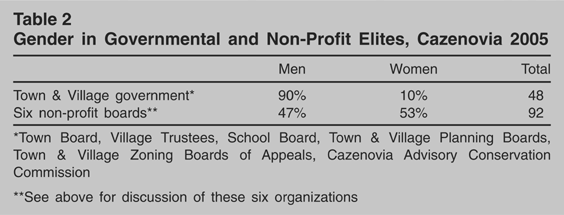
And gender may come into play at this level. As Table 2 shows, about half of these current third sector activists are women. The village's retail proprietors are also increasingly female. Putting aside the hotels, the hardware store, and the auto-related businesses (gas stations and an auto-parts store), a hefty majority of the main street stores are owned or co-owned by women. But as women increasingly came to head the town's businesses, the leaders of its government institutions remained solidly male, and solidly “old Cazenovia,” while many of the leaders of the retail and non-profit sectors are “newcomers” (i.e., people who were not born here). Only the School Board has been open to women candidates (three of the five women in government are members of that body).
Gender in Governmental and Non-Profit Elites, Cazenovia 2005

While the relationship between the municipalities and the various civic organizations has generally been cordial, there has been a certain level of distrust on the part of elected officials, and a certain level of frustration on the part of the third sector about perceived governmental inertia. When the Chamber of Commerce and others raised enough money to set up and fund the Cazenovia Area Community Development Association (CACDA) to work on obtaining grant funding and to serve as a catalyst for community projects, one village official referred disparagingly to “organizations beginning with “C” (Cazenovia Preservation Foundation and the Chamber of Commerce, as well as CACDA) that he regarded as “special interests.” Meanwhile, after the community successfully blocked the building of a Wal-Mart superstore in 1999, work on a new comprehensive plan slowed, and the Preservation Foundation took matters into its own hands, raising money from its members to buy the land which Wal-Mart had sought to purchase in order to preserve it for what they viewed as more appropriate development.
As development pressures have increased, and farmland and open space have been threatened, many of these third sector leaders became concerned about land use issues and worried that the traditional political elites were not willing to work with all parts of the community to construct ways to intelligently manage growth. Hence they turned to candidates who put issues of growth and planning squarely on the local agenda. Support from these sources, and good connections with these organizations, has helped us move forward in this area. With the assistance of the Community Development Association, we have applied for a state Shared Municipal Services Incentives Grant which would help the town, village, school district, and an adjacent town coordinate their comprehensive plans. In 2006 we won a state grant of almost a million dollars which will purchase the development rights to a 250-acre farm, in order to preserve this land for agricultural uses. The Cazenovia Preservation Foundation will hold the permanent easement on this land. We have hired a planning firm to help us plan for commercial development along an important highway corridor. My hope is that our election has helped usher in an era where local organizations and local governments can work together in a synergistic manner.
To summarize, in many respects the campaign described above was probably a typical local campaign—fairly inexpensive, no television ads, lots of personal contact, a focus on purely local issues. But in this particular election campaign some of the expected cleavages—gender and party—were not as important as positions on important local issues (largely having to do with planning and land use, and more vaguely, the idea that it was “time for a change”) or as “nativity” (whether one was a long-time or newer member of the community), social class, and involvement with civic groups and non-profit organizations. Thus this election campaign, like many other local elections, serves to remind us that the general patterns we deal with as political scientists are not nearly so clear when they collide with the particularities of local cleavages and issues.
Author Bio
Kristi Andersen is Laura J. and R. Douglas Meredith Professor of Political Science at the Maxwell School of Syracuse University. She has written on political parties, women and politics, political participation, and the political incorporation of immigrants.