Introduction
The Upper Ordovician is one of the most significant periods in the evolutionary history of crinoids. Following their first appearance in the fossil record during the Early Ordovician, crinoids underwent a major taxonomic radiation during the Middle to Late Ordovician, with most major clades reaching peak diversity during the Sandbian–Katian (Wright and Toom, Reference Wright and Toom2017; Cole, Reference Cole2018). This increase in taxonomic diversity corresponded with the Great Ordovician Biodiversification Event (GOBE; Webby et al., Reference Webby, Paris, Droser and Percival2004) and resulted in the formation of some of the first crinoid communities that were taxonomically, morphologically, and ecologically diverse (Foote, Reference Foote1994; Peters and Ausich, Reference Peters and Ausich2008; Deline et al., Reference Deline, Ausich and Brett2012; Cole et al., Reference Cole, Wright and Ausich2019). As a result, better characterizing diversity, community structure, and ecology of Upper Ordovician faunas is an important step in understanding the early evolutionary history of crinoids and the development of ecologically complex communities during the GOBE.
The Upper Ordovician (Sandbian–Katian) rocks of southern Ontario, particularly the Bobcaygeon and Verulam formations in the Lake Simcoe region, contain a diverse assemblage of fossil crinoids. Although this fauna has been recognized for nearly 150 years (e.g., Billings, Reference Billings1858, Reference Billings1859; Springer, Reference Springer1911), the only taxonomic evaluation of the fauna until recently was Springer's (Reference Springer1911) monograph on the ‘Kirkfield’ fauna. More recently, the extensive collection of crinoid material from the Bobcaygeon and Verulam formations near Brechin, Ontario produced a substantial new collection of exceptionally preserved crinoids. To better understand the taxonomic diversity and paleoecology of this Upper Ordovician crinoid community, we undertook a comprehensive taxonomic re-evaluation of the crinoids from the Bobcaygeon and Verulam formations, which has been documented in a series of recent papers (Ausich et al., Reference Ausich, Wright, Cole and Koniecki2018; Cole et al., Reference Cole, Ausich, Wright and Koniecki2018; Wright et al., Reference Wright, Cole and Ausich2019). This exceptionally preserved fauna has been identified as a Konservat-Lagerstätte and has been subsequently referred to as the Brechin Lagerstätte, in reference to the nearby town of Brechin, Ontario (Cole et al., Reference Cole, Ausich, Wright and Koniecki2018).
We present here the fourth and final systematic contribution in the series on crinoids from the Brechin Lagerstätte. The three preceding publications focused on taxonomy of diplobathrid camerates (Cole et al., Reference Cole, Ausich, Wright and Koniecki2018), disparids and hybocrinids (Ausich et al., Reference Ausich, Wright, Cole and Koniecki2018), and eucladids and flexibles (Wright et al., Reference Wright, Cole and Ausich2019). We evaluate the remaining camerate crinoids known from the fauna, including all monobathrids and a new diplobathrid camerate. Taxa described here bring the total diversity of the fauna to 27 genera and 39 species. Of these, 3 genera and 15 species are new. In addition, to better understand the structure and complexity of the Brechin Lagerstätte, we summarize the taxonomic composition of the fauna as a whole and fit model-based rank abundance distributions (RADs) to species abundance data. Because the abundance of taxa within a community is an important ecological parameter, RADs can be used to investigate a suite of processes that control community structure, e.g., resource partitioning, dimensionality of resource axes, and the number of ecological guilds. Previous work on the Brechin Lagerstätte used ecomorphological traits to evaluate the phylogenetic structure of niche partitioning and community assembly within the fauna (Cole et al., Reference Cole, Wright and Ausich2019). The inclusion of abundance data and the application of RAD-based modeling here provides quantitative insight into an additional aspect of the Brechin Lagerstätte as a paleocommunity: its ecological complexity. These complementary approaches provide a more synthetic view of the Brechin Lagerstätte's paleoecology and refine our understanding of Late Ordovician ecosystems.
Geologic setting
Crinoids and other invertebrate fossils from the Brechin Lagerstätte are preserved in multiple horizons of Upper Ordovician rocks in the vicinity of Brechin, Ontario. Stratigraphic division and nomenclature for this region have been in flux for many years, and as a result, crinoids from the same or equivalent strata have been associated with multiple formation names, including the Hull, Kirkfield, Cobourg, Bobcaygeon, and Verulam formations (Liberty, Reference Liberty1969; Uyeno, Reference Uyeno1974; Armstrong, Reference Armstrong2000; see Swisher et al., Reference Swisher, Westrop and Amati2015). Although the Bobcaygeon and Verulam formations have been the favored stratigraphic divisions in recent years (Armstrong, Reference Armstrong2000), work by Paton and Brett (Reference Paton and Brett2019) suggested subdividing the Bobcaygeon into the Kirkfield and Coboconk formations and elevating the Bobcaygeon to a subcategory within the Simcoe Group. To maintain consistency with our previous work on the Brechin Lagerstätte, we continue to follow the stratigraphic nomenclature of Armstrong (Reference Armstrong2000) that uses the Bobcaygeon and Verulam formations. However, we note that stratigraphic horizons referred here as belonging to the Bobcaygeon Formation are equivalent to the Kirkfield Formation of Paton and Brett (Reference Paton and Brett2019). For more detailed discussions of stratigraphic divisions and nomenclature of Upper Ordovician strata of southern Ontario, see Armstrong (Reference Armstrong2000), Cole et al. (Reference Cole, Ausich, Wright and Koniecki2018), and Paton and Brett (Reference Paton and Brett2019).
The Bobcaygeon Formation and the overlying Verulam Formation are each made up of bioclastic wackestones, grainstones, and packstones with interbedded calcareous shales and siltstones. The rocks are interpreted to have been deposited in a proximal carbonate shelf environment that ranged in depth and proximity from shoal to shallow shelf in the Bobcaygeon and deep shelf to shoal/shallow shelf in the Verulam (Armstrong, Reference Armstrong2000). The Verulam contains more shale than the underlying Bobcaygeon (Liberty, Reference Liberty1969). The Bobcaygeon and Verulam formations are part of the middle Simcoe Group, which is equivalent to the Trenton and Ottawa groups (Armstrong, Reference Armstrong2000). Each formation is considered Late Ordovician (late Sandbian–Katian) in age (Sproat et al., Reference Sproat, Jin, Zhan and Rudkin2015). Because the fossiliferous horizons of the Bobcaygeon are largely restricted to the uppermost portions of the formation (Liberty, Reference Liberty1969), specimens described here are all Katian in age.
The Brechin Lagerstätte has yielded a spectacular diversity of exceptionally preserved crinoid echinoderms with arms, stems, and holdfasts intact (Cole et al., Reference Cole, Ausich, Wright and Koniecki2018). Specimens often occur in dense accumulations on hardground surfaces and on nonhardground bedding planes. In particular, hardground surfaces from the Bobcaygeon and Verulam formations have been investigated in detail with regard to both formation and sedimentology (Paton et al., Reference Paton, Brett and Kampouris2019) and the paleoautecology of taxa occurring on hardgrounds (Brett and Liddell, Reference Brett and Liddell1978; Brett and Brookfield, Reference Brett and Brookfield1984; Brett and Taylor, Reference Brett, Taylor, Hess, Ausich, Brett and Simms1999). Many of these hardground assemblages include completely intact crinoid specimens that can be directly cemented to the hardgrounds themselves. As a result, these horizons represent in situ species assemblages that can be considered ‘ecological snapshots’ (sensu Ausich, Reference Ausich, Allmon and Yacobucci2016; Meyer and Ausich, Reference Meyer and Ausich2019) of once-living communities (Cole et al., Reference Cole, Wright and Ausich2019; Paton et al., Reference Paton, Brett and Kampouris2019). Crinoid assemblages from nonhardground horizons in the Brechin Lagerstätte are authochthonous to parauthochthonous, and their taphonomic grade indicates minimal transport and time averaging (Brett et al., Reference Brett, Moffat and Taylor1997; Cole et al., Reference Cole, Ausich, Wright and Koniecki2018). Thus, assemblages within these horizons should reflect the original composition and abundance of the community with high fidelity (Ausich, Reference Ausich, Allmon and Yacobucci2016).
Paleocommunity analysis: diversity and relative abundance of crinoids from the Brechin Lagerstätte
The ecological literature is rich with theories concerning how ecosystem complexity affects the diversity, abundance, and distribution of species within communities. In particular, the distribution of species abundance by rank order within a community is shaped by ecological processes and therefore has implications regarding patterns of resource partitioning, dimensionality of resource axes, and overall number of ecological types (i.e., guilds) within a community (Gray, Reference Gray, Gee and Giller1987; Magurran, Reference Magurran2004; McGill et al., Reference McGill, Etienne, Gray, Alonso, Anderson, Benecha, Dornelas, Enquist, Green, He and Hurlbert2007; Baldridge et al., Reference Baldridge, Harris, Xiao and White2016). Because taphonomic studies indicate that fossil assemblages retain their biological rank order with strong fidelity (Kidwell, Reference Kidwell2001; Meyer and Ausich, Reference Meyer and Ausich2019), models of taxon relative abundance distributions (RADs) can be used to investigate patterns of community structure and ecological dynamics in ‘deep time’ (Wagner et al., Reference Wagner, Kosnik and Lidgard2006; Alroy, Reference Alroy2015; Darroch et al., Reference Darroch, Laflamme and Wagner2018). Consistent with its use in paleoecological literature (e.g., Ausich Reference Ausich1980; Bennington and Bambach, Reference Bennington and Bambach1996; Holterhoff, Reference Holterhoff1997a; Patzkowsky and Holland, Reference Patzkowsky and Holland2003; Wagner et al., Reference Wagner, Kosnik and Lidgard2006; Darroch et al., Reference Darroch, Laflamme and Wagner2018; Perera and Stigall, Reference Perera and Stigall2018), we use ‘paleocommunity’ to refer to the recurrence of fossil species within local assemblages that span a relatively brief interval of geological time.
We used likelihood-based implementations of RAD models to test whether crinoids in the Late Ordovician Brechin Lagerstätte represent an ecologically ‘simple’ or ‘complex’ paleocommunity (Wagner et al., Reference Wagner, Kosnik and Lidgard2006; Darroch et al., Reference Darroch, Laflamme and Wagner2018). ‘Simple’ RADs assume that species utilize and compete for similar resources. These models effectively treat niche space as a single resource axis partitioned according to models of niche preemption (geometric series) or random fractionation (i.e., broken stick). In contrast, ‘complex’ RAD models, e.g., lognormal or Zipf distributions, invoke additional resource axes. Consequently, complex RAD models imply disparity in niche-space utilization and the presence of multiple ecological types (i.e., guilds) within the paleocommunity (Gray, Reference Gray, Gee and Giller1987; Magurran, Reference Magurran2004; Darroch et al., Reference Darroch, Laflamme and Wagner2018).
We fit two simple (broken stick and geometric series) and two complex (lognormal and Zipf distributions) RAD models to a dataset comprised of 756 specimens spanning all 39 nominal species (27 genera) of crinoids in the Brechin fauna. Taxonomic abundance data were collected from multiple years of field-based observations by J. Koniecki and include specimens now reposited in UMMP (see Suppl. Data 2). Only specimens that could be confidently identified to the species level were included. To test whether results were sensitive to differences in taxonomic scales, we conducted analyses at the species and genus levels. Model fitting was performed using the R package Vegan (Oksanen et al., Reference Oksanen, Blanchet, Kindt, Legendre, O'Hara, Simpson, Solymos, Stevens and Wagner2010). The Bayesian Information Criterion (BIC) was used to assess relative fit among RAD models. We chose to use BIC over Akaike's Information Criteria because BIC carries a larger penalty term for adding parameters (i.e., equal to the natural logarithm of the number of parameters; see Burnham and Anderson, Reference Burnham and Anderson2002) and thus minimizes potential biases toward supporting complex RAD models.
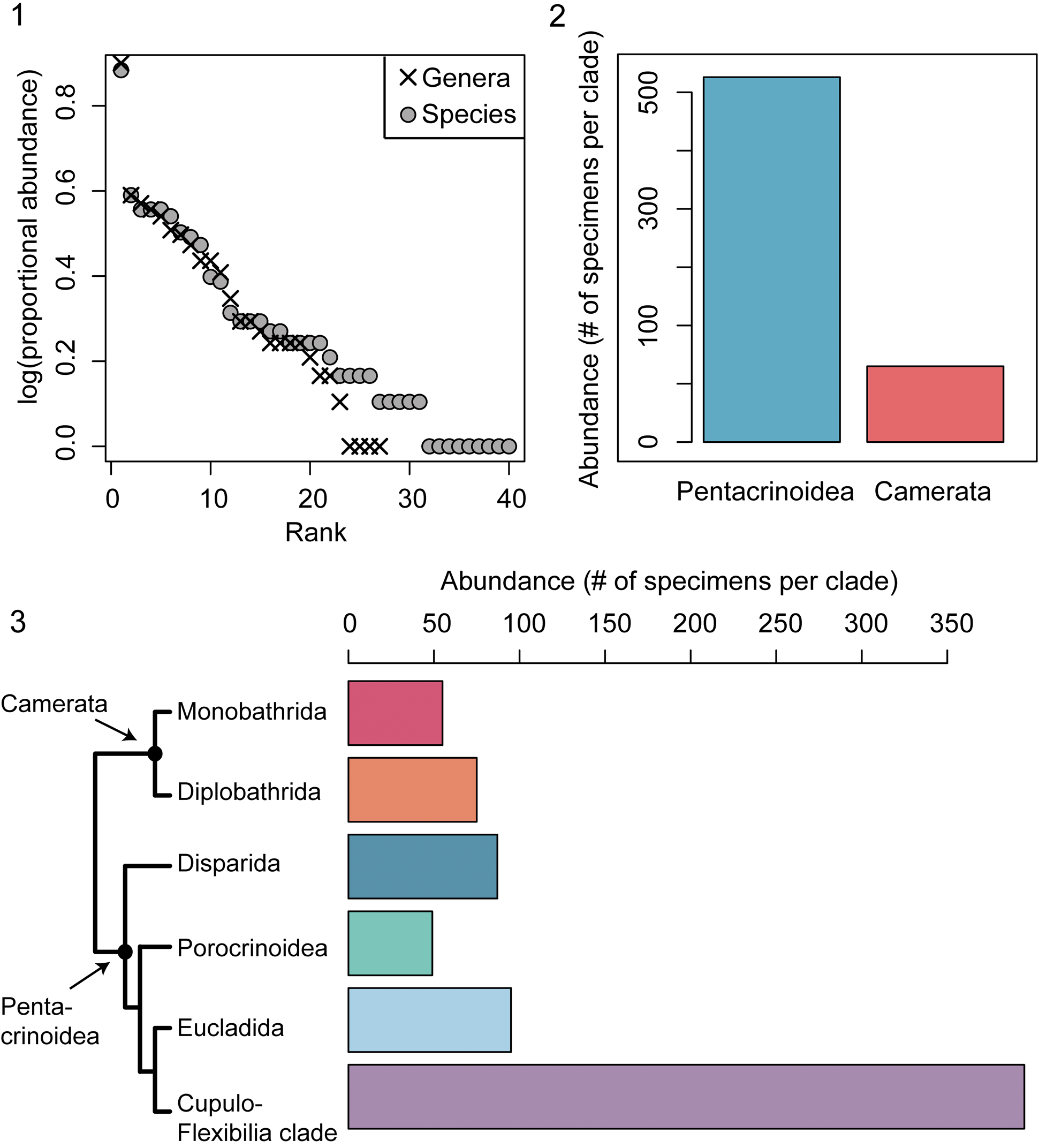
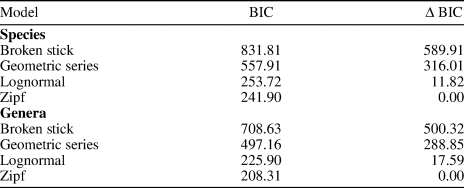
The rank-order abundance distribution for crinoids from the Brechin Lagerstätte is presented in Figure 1.1. The most numerically abundant subclade is the species-poor Cupulocrinus-Flexibilia lineage (Fig. 1.2, 1.3), primarily due to the abundance of Cupulocrinus humilis Springer, Reference Springer1911 (Suppl. Fig. 1). However, in terms of both species richness and abundance, the overall taxonomic composition is dominated by members of the subclass Pentacrinoidea (25 species, 626 specimens; Suppl. Data 2) regardless of whether members of the Cupulocrinus-Flexibilia subclade are considered or not considered. In contrast, subclass Camerata has lower species richness and abundance (15 species, 130 specimens; Suppl. Data 2). Bayesian Information Criterion (BIC) scores for RAD models indicate that crinoid abundances best fit Zipf distributions (Table 1), with ΔBIC scores providing strong evidence against all other RAD models according to Kass and Raftery's (Reference Kass and Raftery1995) statistical guidelines. Moreover, the preference for Zipf RAD models are independent of the taxonomic scale analyzed (Table 1).
Diversity and abundance of crinoids from the Brechin Lagerstätte: (1) Whittaker plot showing taxon rank-abundance distributions at the species and genus levels, as indicated; (2) histogram depicting the relative abundance of specimens belonging to species within the crinoid subclasses Pentacrinoidea and Camerata; (3) phylogeny of major crinoid subclasses plotted alongside a histogram showing the relative abundance of specimens belonging to species within each subclade.

Taxon rank abundance distribution models and their Bayesian Information Criterion (BIC) values.

Assuming that divergence of crinoids from other echinoderms occurred by at least the Early Ordovician, the ecological diversity of crinoids from the Brechin Lagerstätte represents the cumulative outcome of < ~ 10% of the clade's total evolutionary history. In contrast with extant crinoids and their extinct precursors, Ordovician crinoids had not yet evolved several complex morphological and/or behavioral adaptations that contribute to niche disparity today, e.g., muscular articulations or increased motility/swimming. For example, consider the dramatic disparity in ecological life modes exhibited by species of modern isocrinids, shallow-water ‘feather stars,’ and cyrtocrinids (e.g., Holopus). From these considerations, one might predict that early Paleozoic crinoid communities would be dominated by one (or few) ecological types and characterized by relatively simple patterns of niche preemption. Such communities would be expected to fit ecologically “simple” RAD models. Instead, our results indicate that the Brechin fauna is best characterized by an ecologically ‘complex’ RAD model, which suggests that crinoids partitioned niches along multiple resource axes. Standard interpretations of ecologically complex RAD models imply a multidimensional niche space partitioned into two or more groups, each with a different ecological strategy or guild. Other possible interpretations suggest that increased niche space arises from biotic interactions among species (Darroch et al., Reference Darroch, Laflamme and Wagner2018). We note that these interpretations are not mutually exclusive. In the case of the Brechin crinoid fauna, there is possible evidence for each explanation.
Cole et al. (Reference Cole, Wright and Ausich2019) documented trait-based patterns of ecological disparity among Brechin crinoids. Niche differences were determined to have been influenced by several ecomorphological traits, including filtration fan density, fan shape, body size, and stem length (Cole et al., Reference Cole, Wright and Ausich2019). Of these traits, differences in filtration fan characters were found to be the most important dimensions for defining niche space; these results are broadly consistent with those from previous studies of crinoid communities (Ausich, Reference Ausich1980; Meyer and Ausich, Reference Meyer, Ausich, Tevesz and McCall1983; Brower, Reference Brower2007). Further, traits such as filtration fan density and body size exhibited strong phylogenetic signal, indicating that subclades could also be characterized (on average) by differences in feeding ecology and life mode (Kammer, Reference Kammer1985; Holterhoff, Reference Holterhoff1997b). Experiments on living species indicate that crinoids with different fan densities and/or stalk lengths have different dietary preferences and often consume different resources (Kitazawa et al., Reference Kitazawa, Oji and Sunamura2007; Kitazawa and Oji, Reference Kitazawa and Oji2010). In the Brechin fauna, Cole et al. (Reference Cole, Wright and Ausich2019) concluded that ecological differences were most pronounced at high taxonomic scales, separating the pinnulate Eucamerata from the nonpinnulate Inadunata. It is possible that these major ecomorphological differences have been similarly related to differences in resource use and/or consumption between these two lineages. Considering the degree of ecomorphologic variation among these clades reported by Cole et al. (Reference Cole, Wright and Ausich2019), our finding that the Brechin fauna fits a ‘complex’ RAD supports and complements this previous study.
Finally, the Brechin Lagerstätte records a paleocommunity immediately following the culmination of the GOBE, which introduced a significant increase in ecological organization across Earth's global biota (Muscente et al., Reference Muscente, Prabhu, Zhong, Eleish, Meyer, Fox, Hazen and Knoll2018). Given that biotic interactions have played an important role in crinoid evolution (e.g., Meyer and Ausich, Reference Meyer, Ausich, Tevesz and McCall1983; Baumiller and Gahn, Reference Baumiller and Gahn2002; Gorzelak et al., Reference Gorzelak, Salamon and Baumiller2012), the ecological complexity of the Brechin fauna could be related to changes in Ordovician ecosystems more broadly. Similarly, the diversity and abundance of crinoids within communities has been linked with ‘ecosystem engineering’ mechanisms (sensu Erwin, Reference Erwin2008), such as positive taphonomic feedback (Kidwell and Jablonski, Reference Kidwell, Jablonski, Tevesz and McCall1983; Ausich, Reference Ausich, Brett and Baird1997), which notably increased following the GOBE (Pruss et al., Reference Pruss, Finnegan, Fischer and Knoll2010).
Based on our series of comprehensive taxonomic re-evaluations (Ausich et al., Reference Ausich, Wright, Cole and Koniecki2018; Cole et al., Reference Cole, Ausich, Wright and Koniecki2018; Wright et al., Reference Wright, Cole and Ausich2019), including those presented here, the Brechin Lagerstätte is the most taxonomically diverse Katian crinoid fauna in the world. To the best of our knowledge, the Brechin Lagerstätte contains more nominal crinoid species and genera than the well-known Middle Ordovician Bromide Formation of Oklahoma (Sprinkle, Reference Sprinkle1982; see Webster and Webster, Reference Webster and Webster2014). Although the presence of fragmentary and undescribed material indicates that the Bromide Formation might have higher species diversity (Sprinkle, Reference Sprinkle1982), the Brechin fauna is significant as one of the oldest, ecologically complex, and taxonomically diverse crinoid paleocommunities in the fossil record.
Materials and methods
Specimen collection and preparation
The crinoid material described here was collected in the Lake Simcoe region of Ontario from the Carden Quarry (44°34'03.35''N, 79°06'09.5'W), the LaFarge Quarry (44°31'55.9'N, 79°09'04.78'W), and the James Dick Quarry (44°29'56.2'N, 79°09'37.0'W) (see Cole et al. [Reference Cole, Ausich, Wright and Koniecki2018] for additional locality details). All localities are within ~ 6 km of the town of Brechin, Ontario. Material from the Carden and LaFarge quarries was primarily collected from blast piles. As a result, stratigraphic resolution was coarse for many specimens but can be constrained to an interval spanning ~ 15 m of the upper Bobcaygeon Formation and 5 m of the lower Verulam Formation, hereafter referred to as the Bobcaygeon-Verulam boundary interval (Cole et al., Reference Cole, Ausich, Wright and Koniecki2018). More precise stratigraphic data are given when possible. Localities and collection horizons are summarized for all specimens in the Supplemental Materials (Suppl. Data 1).
The majority of the specimens described here are from the collection of J. M. Koniecki and are now reposited at the University of Michigan Museum of Paleontology (UMMP). Exceptions are UMMP 74688.2, prepared and donated by K. Brett; UMMP 74900, prepared by K. Kidd and M. Thornley and donated by K. Kidd; and UMMP 74863–74863.3, collected by S. Hyne and prepared by J. M. Koniecki. Except where otherwise noted, specimens were coated with ammonium chloride sublimate before photographing.
The superordinal and ordinal classification of Camerata follows Cole (Reference Cole2017) and Wright et al. (Reference Wright, Ausich, Cole, Rhenberg and Peter2017). Family-level classification follows Moore and Teichert (Reference Moore and Teichert1978). General morphologic terminology follows Ubaghs (Reference Ubaghs, Moore and Teichert1978a) and the shorthand notation used to describe heteromorphic columns follows Webster (Reference Webster1974).
The plating in the interrays is given as the number of plates in each range from the proximalmost plate to the last range before the tegmen. In the posterior interray, the primanal is indicated by “P” and the first interradial in regular interrays is indicated by the numeral “1”. A question mark in the interray series indicates that more distal plating is unknown.
Repositories and institutional abbreviations
All new specimens described here are reposited in the University of Michigan Museum of Paleontology (UMMP). Other material considered is from the collections of the Geological Survey of Canada (GSC).
Systematic paleontology
Class Crinoidea Miller, Reference Miller1821
Subclass Camerata Wachsmuth and Springer, 1885
Infraclass Eucamerata Cole, Reference Cole2017
Order Diplobathrida Moore and Laudon, Reference Moore and Laudon1943
Superfamily Rhodocrinitoidea Roemer, Reference Roemer and Brown1855
Family Rhodocrinitidae Roemer, Reference Roemer and Brown1855
Genus Pararchaeocrinus Strimple and Watkins, Reference Strimple and Watkins1955
Type species
Pararchaeocrinus decoratus Strimple and Watkins, Reference Strimple and Watkins1955, by original designation.
Other species
Pararchaeocrinus convexus Brower and Veinus, Reference Brower and Veinus1974; Pararchaeocrinus rugulosus Kelly and Pope, Reference Kelly and Pope1979.
Diagnosis
A rhodocrinitid crinoid with a low, globular aboral cup; regular interrays wide, proximal plating 1-3; posterior plating 1-3 proximally, with an anitaxis originating from either the center of the interray or the C radial; arms 10, entirely uniserial or transitioning distally to biserial, unbranched or branching up to four times (emended from Kolata, Reference Kolata and Sprinkle1982).
Occurrence
Upper Ordovician (Sandbian–Katian); United States (Indiana, Oklahoma, Tennessee).
Pararchaeocrinus kiddi new species
Figures 2.1–2.3, 3.1, 3.2
- Reference Cole, Wright and Ausich2019
Pararchaeocrinus sp. A; Cole et al., p. 86.
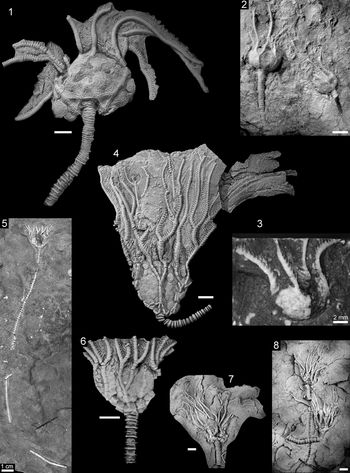
Camerate crinoids from the Brechin Lagerstätte: (1–3) Pararchaeocrinus kiddi n. sp.: (1) UMMP 74900, holotype, lateral view of crown; (2) UMMP 74863.1, 74863.2, lateral view of two subadult specimens; (3) UMMP 74863, paratype, subadult specimen with posterior interray preserved, photographed under alcohol; (4) Abludoglyptocrinus steinheimerae n. sp., UMMP 74817, holotype, lateral view of crown; (5–8) Glyptocrinus ramulosus: (5, 6) UMMP 74816: (5) lateral view of cup with much of the column preserved, photographed without whitening; (6) closeup of the calyx showing the CD-interray (right) and proximal arms; (7) UMMP 74814, subadult with nearly complete crown and proximal stem; (8) UMMP 74814.1, 74814.2, two subadults with stems and nearly complete crowns. Scale bars = 5 mm unless otherwise indicated.

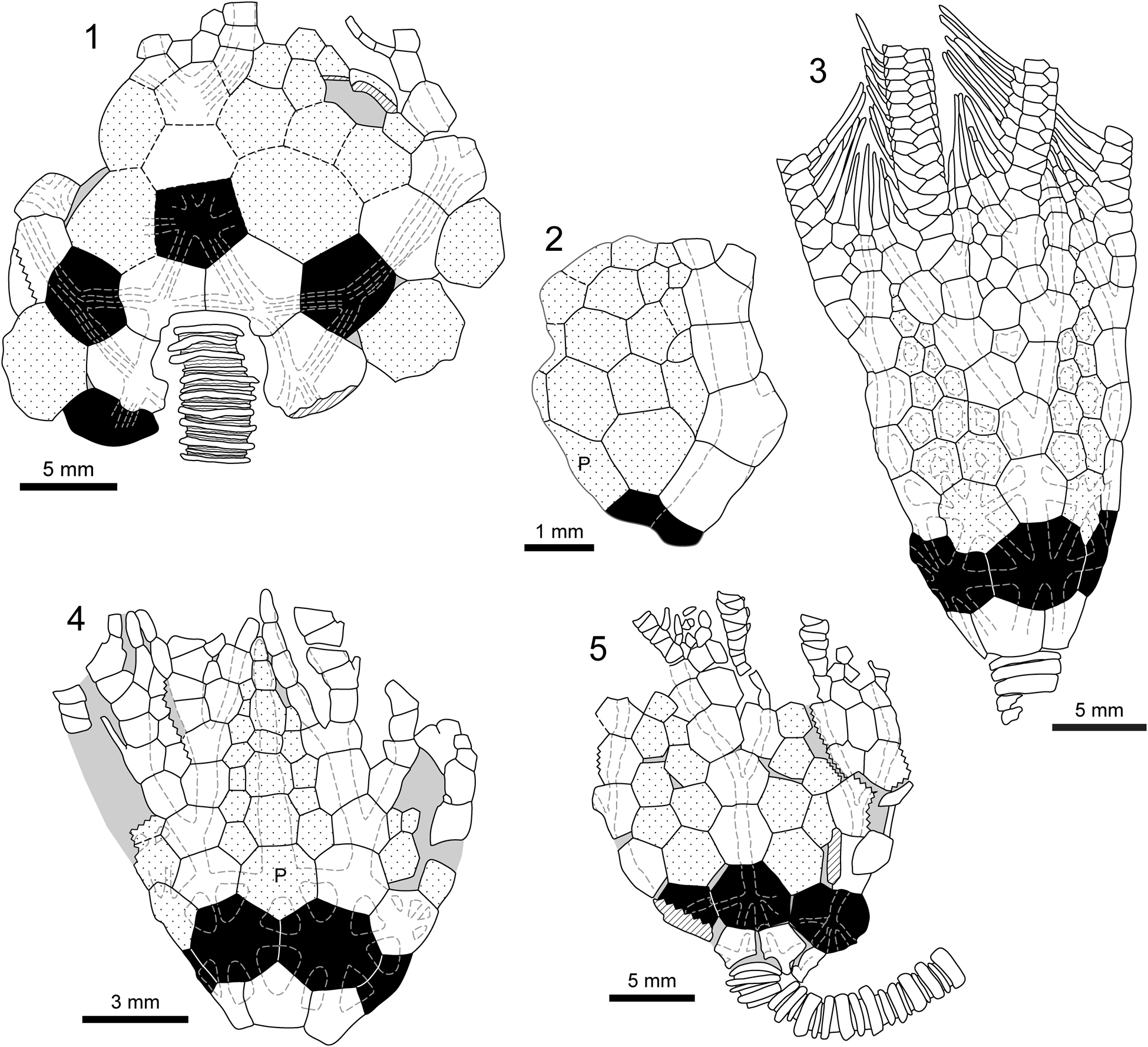
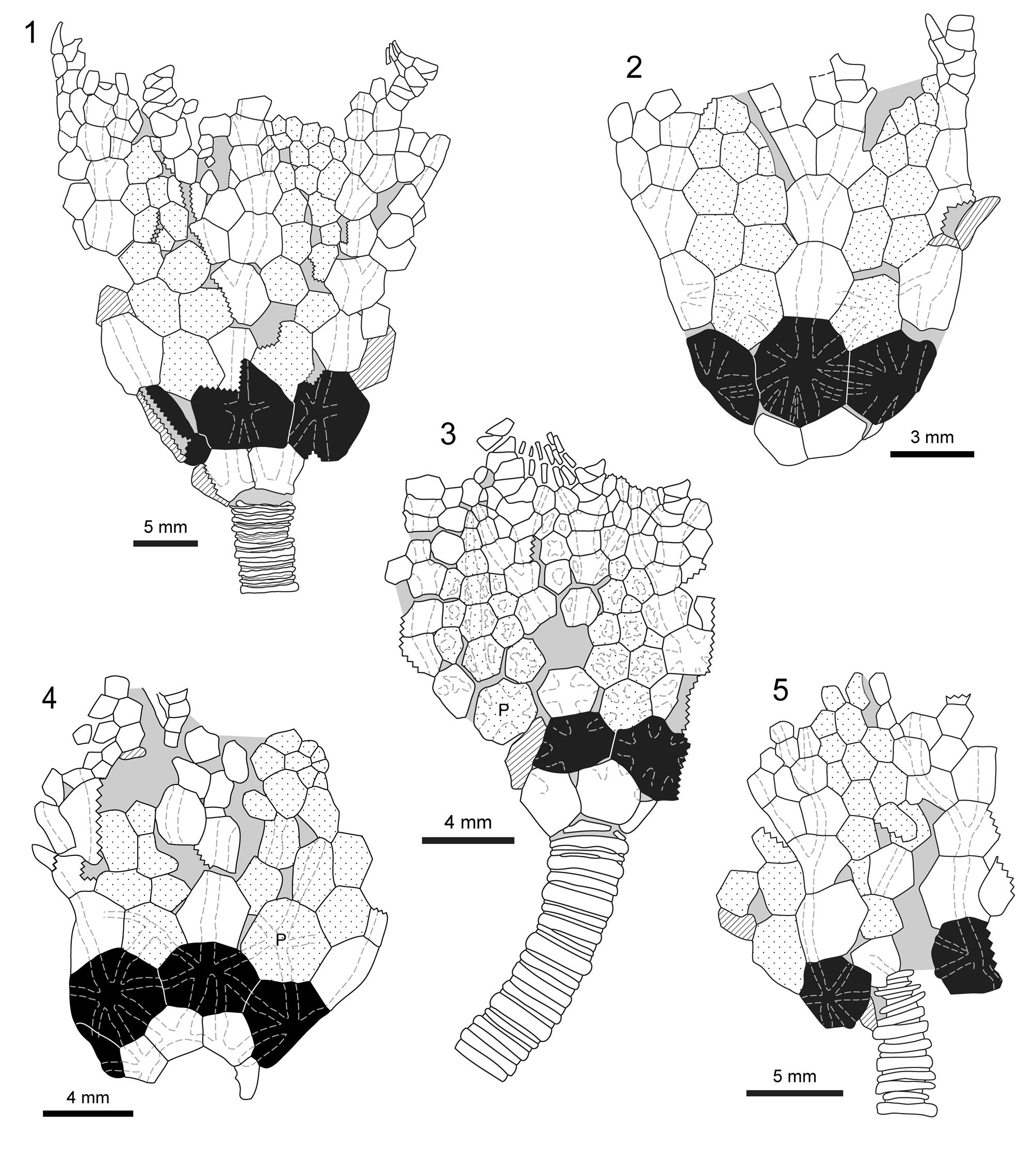
Camera lucida drawings of camerate crinoids from the Brechin Lagerstätte: (1, 2) Pararchaeocrinus kiddi n. sp.: (1) UMMP 74900, holotype; (2) UMMP 74863, paratype, CD-interray view of subadult specimen; (3, 4) Periglyptocrinus astricus n. sp.: (3) UMMP 74819, paratype, lateral view of calyx; (4) UMMP 74820, holotype, CD-interray view; (5) Abludoglyptocrinus steinheimerae n. sp., UMMP 74817, holotype. P = primanal; fill: black = radials; gray = matrix/plating unknown; ruled = plate edges/undersides; stippled = interray plates; lines: dashed black = inferred plate boundaries; dashed gray = ray ridges/plate ornamentation; jagged = broken plate margins; solid black = plate boundaries.

Type specimens
UMMP 74900, holotype; UMMP 74863, paratype.
Diagnosis
Pararchaeocrinus with granulose ornamentation; median ray ridges and ridges on basals and radials composed of multiple, parallel ridges; wide anitaxis originating from the center of the posterior interray; arms unbranched, predominantly uniserial.
Occurrence
The holotype specimen of Pararchaeocrinus kiddi n. sp. is from the upper Bobcaygeon Formation, James Dick Quarry. All other known specimens of Pararchaeocrinus kiddi n. sp. are from the Bobcaygeon-Verulam boundary interval, Carden Quarry (Ontario, Canada).
Description
Calyx low to medium globose, with concave base; plate sutures flush with plate surface. Basals and radials ornamented with ridges composed of multiple, parallel, raised striations; ridges on basals forming a pentagonal structure around base of calyx, extending onto radials in a star pattern. Median ray ridges wide and prominent, connected proximally to radial plate ridges, similarly composed of multiple, parallel ridges. Granulose ornamentation on most or all calyx plates.
Infrabasals not observed, presumably five, entirely confined to basal concavity. Basal circlet forming the distal margin of the basal concavity. Basal plates five, wider than high, hexagonal, approximately equal in size to radials.
Radial circlet interrupted in all rays by contact of basals with primanal and first interradial plates. Radial plates five, pentagonal or hexagonal, slightly higher than wide.
Regular interrays wide, in contact with tegmen, not depressed, interrupting the radial circlet in all interrays. First interradial plate octagonal (where observed), wider than high, largest plate in calyx; second range with three plates, proximal plating 1-3, followed by two or more higher rows of four or more plates each (Fig. 2.1).
Posterior interray wider than regular interrays and with additional plates, in contact with tegmen; proximal plating 1-3 followed by at least four rows of higher plates with four or more plates each; medial column of plates forming a wide anitaxis, with no anitaxial ridge (Figs. 2.3, 3.2).
First primibrachial fixed, hexagonal, wider than high; second primibrachial axillary, pentagonal, wider than high. Secundibrachials fixed into calyx through approximately the third secundibrachial; second secundibrachial giving rise to a fixed pinnule. Fixed intrabrachials between secundibrachials of each half-ray, comprised of at least two rows of two plates each.
Arm openings 10, evenly spaced around the calyx margin. Free arms unbranched, pinnulate; brachials thin, predominantly cuneate uniserial but becoming weakly biserial in portions of the distal arms (Fig. 2.1).
Stem circular, heteromorphic; columnals thin; nodals and internodals with slightly undulatory margins. Proximal column with two orders of internodals, N2221222 where fully differentiated; priminternodals approximately half the thickness of nodals, secundinternodals approximately one-third the thickness of priminternodals. Lumen round, large, ~ 60% of total stem diameter.
Etymology
The specific name is in honor of Kevin Kidd, who collected, prepared, and donated the holotype specimen for study.
Materials
UMMP 74863.1, 74683.2.
Remarks
Pararchaeocrinus kiddi n. sp. is most closely aligned with Pararchaeocrinus on the basis of its distinctive 1-3 plating in the proximal portion of the regular interrays, globose cup, 10 arm openings, and predominantly uniserial free arms (Figs. 2.1, 3.1). Of the three species of Pararchaeocrinus previously known, only Pararchaeocrinus decoratus preserves the posterior interray. The posterior interradius in Pararchaeocrinus decoratus consists of an anitaxis arising from the C radial that is ornamented by an anitaxial ridge. Although the posterior interray of Pararchaeocrinus kiddi n. sp. also has an anitaxial ridge, it appears to originate from the CD basal at the center of the ray rather than from the C-ray radial (Figs. 2.3, 3.2). Despite this difference, the new species is here assigned to Pararchaeocrinus based on the characters listed above, particularly the 1-3 plating in the regular interrays, which is uncommon in Ordovician diplobathrids (Kolata, Reference Kolata and Sprinkle1982).
Pararchaeocrinus kiddi n. sp. is most like Pararchaeocrinus decoratus. However, the two species differ in several notable features. Pararchaeocrinus kiddi n. sp. has unbranched arms, an anitaxis that originates from the center of the posterior interray, granulose plate ornamentation, and median ray ridges consisting of multiple, parallel ridges, whereas Pararchaeocrinus decoratus has arms that branch at least three times, an anitaxis that originates from the C radial, stellate ornamentation, and median ray ridges made up of single ridges.
Pararchaeocrinus kiddi n. sp. is here described from one adult and four subadult specimens. Although the smaller, subadult specimens (UMMP 74863–74863.3; Fig. 2.2, 2.3) can be confidently assigned to Pararchaeocrinus kiddi n. sp. based on similarities in the structure of arms, column, and overall calyx plating, they do not display any of the ornamentation observed in the adult specimen (UMMP 74900) except for median ray ridges (Fig. 2.1–2.3). This suggests that the granulose ornamentation and striations on the median rays are features that developed later in ontogeny.
Cole et al. (Reference Cole, Wright and Ausich2019) included Pararchaeocrinus kiddi n. sp. in an analysis of Brechin crinoid community paleoecology using the placeholder name of Pararchaeocrinus sp. A. Pararchaeocrinus kiddi n. sp. had the highest filtration fan density (90.23 terminal feeding appendages per cm2) within the fauna (Cole et al., Reference Cole, Wright and Ausich2019).
Order Monobathrida Moore and Laudon, Reference Moore and Laudon1943
Suborder Glyptocrinina Moore, Reference Moore1952
Superfamily Glyptocrinoidea Zittel, Reference Zittel1879
Family Glyptocrinidae Zittel, Reference Zittel1879
Genus Abludoglyptocrinus Kolata, Reference Kolata and Sprinkle1982
Type species
Glyptocrinus charltoni Kolata, Reference Kolata1975.
Other species
Abludoglyptocrinus gregatus Guensburg, Reference Guensburg1984; A. laticostatus Kolata, Reference Kolata and Sprinkle1982; Glyptocrinus pustulosus Kolata, Reference Kolata1975.
Diagnosis
A glyptocrinid with 10 uniserial arms free above secundibrachials 3–5; median anal and ray ridges present; variable ornamentation consisting of small pustules or fine ridges; some species possessing smooth plates (after Kolata, Reference Kolata and Sprinkle1982).
Occurrence
Upper Ordovician (Sandbian–Katian); United States (Indiana, Minnesota, Oklahoma, Tennessee).
Abludoglyptocrinus steinheimerae new species
Figures 2.4, 3.5
Holotype
UMMP 74817.
Diagnosis
Abludoglyptocrinus with prominent median ray ridges; stellate ornamentation on basals and radials connecting to median ray ridges; fine granulose ornament on all calyx plates; primibrachials approximately as high as wide; proximal plating of regular interrays 1-2-2-2.
Occurrence
Abludoglyptocrinus steinheimerae n. sp. is known from a single specimen from the Upper Ordovician (Katian) Bobcaygeon-Verulam boundary interval and was collected from either the Carden Quarry or LaFarge Quarry (Ontario, Canada).
Description
Calyx medium bowl, approximately as wide as high; base of calyx upright, surrounded by a circular ridge; plate sutures flush with plate surface. Stellate ornamentation on basals and radials connecting to ridge around base of calyx; granulose ornamentation on all calyx plates including basals and radials. Median ray ridges narrow, sharply defined.
Basal circlet upright; basal plates five, pentagonal, equant, small. Radial circlet uninterrupted; radial plates heptagonal, wider than high, largest plates in calyx.
Regular interrays narrow, tapering distally, narrowly in contact with tegmen. First interray plate hexagonal, slightly wider than high, somewhat smaller than radial plates; proximal plating 1-2-2-2-1 (Fig. 3.5). Posterior interray unknown.
First primibrachial hexagonal, equant; second primibrachial axillary, heptagonal. Arms free above secundibrachials 3–5; fourth secundibrachial irregularly giving rise to a fixed pinnule adaxially. Fixed intrabrachials between secundibrachials of each half-ray in four or more rows of one or two plates each; intrabrachial areas narrowly in contact with tegmen.
Arm openings 10, ungrouped. Free arms cuneate uniserial; branching up to three times isotomously; pinnulate (Fig. 2.4).
Stem circular, holomeric. Proximal stem heteromorphic, N121; nudinodals and priminternodals with rounded latera, priminternodals slightly thinner than nudinodals. Other details of stem, holdfast, and tegmen unknown.
Etymology
The specific name is in honor of Margaret Steinheimer, a lifelong friend of J. Koniecki who encouraged him throughout his fossil collecting years. She was also a teacher, mother, and friend to many.
Remarks
Abludoglyptocrinus steinheimerae n. sp. superficially resembles Periglyptocrinus kevinbretti new species, which also occurs in the Brechin Lagerstätte (e.g., Figs. 2.4, 5.1). However, the two taxa are readily differentiated in construction of the arms; A. steinheimerae n. sp. has uniserial arms and Periglyptocrinus kevinbretti has biserial arms. This is also one of the major features that identifies A. steinheimerae n. sp. as belonging to the genus Abludoglyptocrinus rather than Periglyptocrinus (Kolata, Reference Kolata and Sprinkle1982; Ausich, Reference Ausich1985).
Abludoglyptocrinus steinheimerae n. sp. is most like other species of Abludoglyptocrinus, particularly A. pustulosus from the Upper Ordovician Forreston Member of the Grand Detour Formation, Illinois and A. laticostatus from the Upper Ordovician (Sandbian) Pooleville Member of the Bromide Formation, Oklahoma. All three species have conspicuous ray ridges, stellate ornamentation on the basals and radials, and granular ornamentation on the calyx plates. They differ most noticeably in that A. steinheimerae n. sp. has free arms that branch twice and proximal interray plating in a 1-2-2-2 pattern, whereas A. pustulosus has unbranched free arms and proximal interray plating in a 1-2-3-4 pattern, and A. laticostatus has unbranched free arms and proximal interray plating in a 1-2-2-3 pattern.
Genus Glyptocrinus Hall, Reference Hall1847
Type species
Glyptocrinus decadactylus Hall, Reference Hall1847.
Other species
Glyptocrinus circumcarinatus Parks and Alcock, Reference Parks and Alcock1912; G. fornshelli Miller, Reference Miller1874; G. nodosus Kallmeyer and Ausich, Reference Kallmeyer and Ausich2015; G. ottawaensis Wilson, Reference Wilson1946; G. ramulosus Billings, Reference Billings1856; G. tridactylus Brower and Veinus, Reference Brower and Veinus1978. Glyptocrinus quinquepartitus Billings, Reference Billings1859 was defined on the basis of column material and might not represent a valid species of Glyptocrinus.
Diagnosis
Glyptocrinidae with basals smaller than radials, only partially visible in side view; fixed brachials bifurcating twice, giving rise to 20 free arm openings; arms cuneate uniserial, branched or unbranched (emended from Ubaghs, Reference Ubaghs, Moore and Teichert1978b).
Occurrence
Upper Ordovician (Sandbian–Hirnantian); United States (Indiana, Kentucky, New York, Ohio, Pennsylvania, Tennessee), Canada (Ontario, Quebec), and the United Kingdom.
Glyptocrinus ramulosus Billings, Reference Billings1856
Figures 2.5–2.8, 4.1, 4.2
- Reference Billings1856
Glyptocrinus ramulosus Billings, p. 48, figs. 1, 3–8.
- Reference Billings1857a
Glyptocrinus ramulosus; Billings, p. 258.
- Reference Billings1857b
Glyptocrinus ramulosus; Billings, p. 54, figs. 1–8.
- Reference Shumard1868
Glyptocrinus ramulosus; Shumard, p. 373.
- Reference Bigsby1868
Glyptocrinus ramulosus; Bigsby, p. 20, 196.
- Reference Wachsmuth and Springer1883
Archaeocrinus? Ramulosus; Wachsmuth and Springer, p. 265.
- Reference Miller1889
Glyptocrinus ramulosus; Miller, p. 248.
- Reference Wachsmuth and Springer1897
Glyptocrinus ramulosus; Wachsmuth and Springer, p. 273, fig. 5a, b.
- Reference Grabau and Shimer1910
Glyptocrinus ramulosus; Grabau and Shimer, p. 552.
- Reference Bassler1915
Glyptocrinus ramulosus; Bassler, p. 556.
- Reference Bassler1915
Archaeocrinus? ramulosus; Bassler, p. 556.
- Reference Bassler and Moodey1943
Glyptocrinus ramulosus; Bassler and Moodey, p. 494.
- Reference Wilson1946
Glyptocrinus ramulosus; Wilson, p. 28.
- Reference Webster1973
Glyptocrinus ramulosus; Webster, p. 138.
- Reference Cole, Wright and Ausich2019
Glyptocrinus ramulosus; Cole et al., p. 86, fig. 2B.
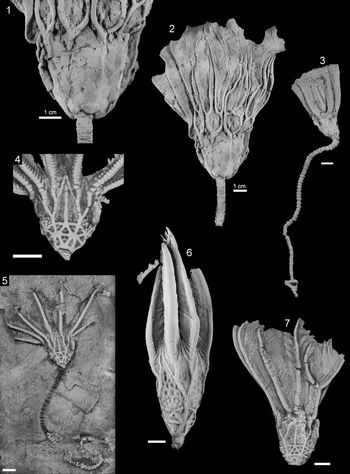
Monobathrid camerate crinoids from the Brechin Lagerstätte: (1, 2) Glyptocrinus ramulosus, UMMP 74815: (1) close-up of calyx interray plates; (2) lateral view of crown; (3–7) Periglyptocrinus astricus n. sp.: (3) UMMP 74686.5, paratype, subadult with complete crown, stem, and holdfast; (4, 5) UMMP 74820, holotype: (4) close-up of posterior interray; (5) lateral view of crown with partial stem; (6) UMMP 74819, paratype, lateral view of nearly complete crown and regenerating arm; (7) UMMP 74821, CD-interray view of crown. Scale bars = 5 mm unless otherwise indicated.

Type specimens
GSC 1456 m, holotype; GSC 1579, paratype.
Diagnosis
Glyptocrinus with medium conical calyx; plates flat and unornamented; median ray ridges broad; base of calyx surrounded by a prominent dropped flange; interrays broad and flat, proximal plating 1-2 with 5–7 higher rows of two or three plates each; intrabrachials between half-rays numerous; 20 free arm openings; free arms branching once; stem round.
Occurrence
Glyptocrinus ramulosus was previously known from the Upper Ordovician (Katian) Hull Member of the Ottawa Formation, Ontario and Quebec; the Cobourg Member of the Ottawa Formation, Ontario; the Glens Falls Limestone, New York; and the Sherman Fall Member of the Ottawa Formation, Ontario. The occurrences documented here are from the Upper Ordovician (Katian) Bobcaygeon-Verulam boundary interval, LaFarge and Carden Quarries (Ontario, Canada).
Description
Calyx medium bowl, wider than high; plates unornamented except for basals; median ray ridges low and broad on radials and primibrachials, becoming more distinct and rounded on fixed secundibrachials; plate sutures flush with plate surface; base of calyx upright, surrounded by a circular ridge.
Basal circlet upright, slightly recessed beneath radial circlet. Basal plates five, small, wider than high, pentagonal, ornamented with a flared ridge at the base encircling the stem with narrow ridges angled toward the adjoining radial plates.
Radial circlet uninterrupted; radial plates heptagonal, approximately as wide as high, largest plates in calyx.
Regular interrays in contact with tegmen, not depressed, narrowing distally. First interradial plate hexagonal, wider than high, larger than basals, slightly smaller than radials. Second range with two plates; proximal plating 1-2-2 followed by 4–6 higher rows typically with two or three plates each (Fig. 4.1).
Posterior interray much wider, in contact with tegmen, narrowing slightly distally. Primanal hexagonal, wider than high, approximately equal in size to first interray plates. Proximal plating P-3-5-5-5-5, at least three higher rows of plates with five or more plates each; medial column of plates forming a distinct anitaxis ornamented with a low anitaxial ridge (Fig. 2.6).
First primibrachial fixed, hexagonal, approximately as high as wide; second primibrachial axillary, heptagonal. Secundibrachials typically becoming free above fifth plate; second and fourth secundibrachials giving rise to fixed pinnules abaxially and adaxially, respectively; fixed pinnules marked by thin, sharp ray ridges. Fixed intrabrachials between secundibrachials of half-rays; intrabrachial plates large, proximal plating 1-1-2-2, commonly with additional higher rows of one or two plates each. Arm openings 20, grouped by half-rays. Free arms cuneate uniserial; brachials very thin, ~ 6.5 times wider than high; arms branching once isotomously near the calyx, densely pinnulate; pinnules long and thin (Fig. 4.2).
Stem circular, holomeric, heteromorphic. Proximal stem with nudinodals and three orders of closely spaced, well-differentiated internodals, N3231323 where fully differentiated; distance between nudinodals and internodals increasing in medial and distal stem. Tegmen, anal opening, and other details of column unknown.
Materials
UMMP 74814–74814.2, 74815, 74816.
Remarks
A formalized diagnosis for Glyptocrinus ramulosus has not been previously published to our knowledge. The diagnosis presented here combines our own observations of new material with descriptions given by previous workers, especially Billings (Reference Billings1857a, Reference Billings1857b) and Wachsmuth and Springer (Reference Wachsmuth and Springer1897). Notably, we figure and describe in detail the posterior interray of G. ramulosus (Fig. 2.6).
Glyptocrinus ramulosus is one of the largest species recovered from the Brechin Lagerstätte. The maximum size of the crown reaches ~ 11 cm (UMMP 74815; Fig. 4.1, 4.2). Smaller specimens (UMMP 74814–74814.2; Fig. 2.7, 2.8) are likely juveniles. The height to width ratios of the proximal brachials in these specimens are much higher than those for the adult specimens, which commonly indicates earlier stages of ontogenetic development (Brower, Reference Brower1974; Cole et al., Reference Cole, Ausich, Colmenar and Zamora2017).
Genus Periglyptocrinus Wachsmuth and Springer, Reference Wachsmuth and Springer1897
Type species
Periglyptocrinus billingsi Wachsmuth and Springer, Reference Wachsmuth and Springer1897.
Other species
Glyptocrinus priscus Billings, Reference Billings1857a; Periglyptocrinus spinuliferus Brower and Veinus, Reference Brower and Veinus1978; Periglyptocrinus astricus new species; Periglyptocrinus kevinbretti new species; Periglyptocrinus mcdonaldi new species; Periglyptocrinus silvosus new species.
Diagnosis
Glyptocrinidae with large, upright basals almost entirely visible in side view; 10 or 20 free arm openings; arms biserial, branched or unbranched; fixed pinnules; stellate ornamentation on at least proximal calyx plates (emended from Ubaghs, Reference Ubaghs, Moore and Teichert1978b).
Occurrence
Upper Ordovician (Sandbian–Katian); United States (Kentucky, Minnesota) and Canada (Ontario, Quebec).
Remarks
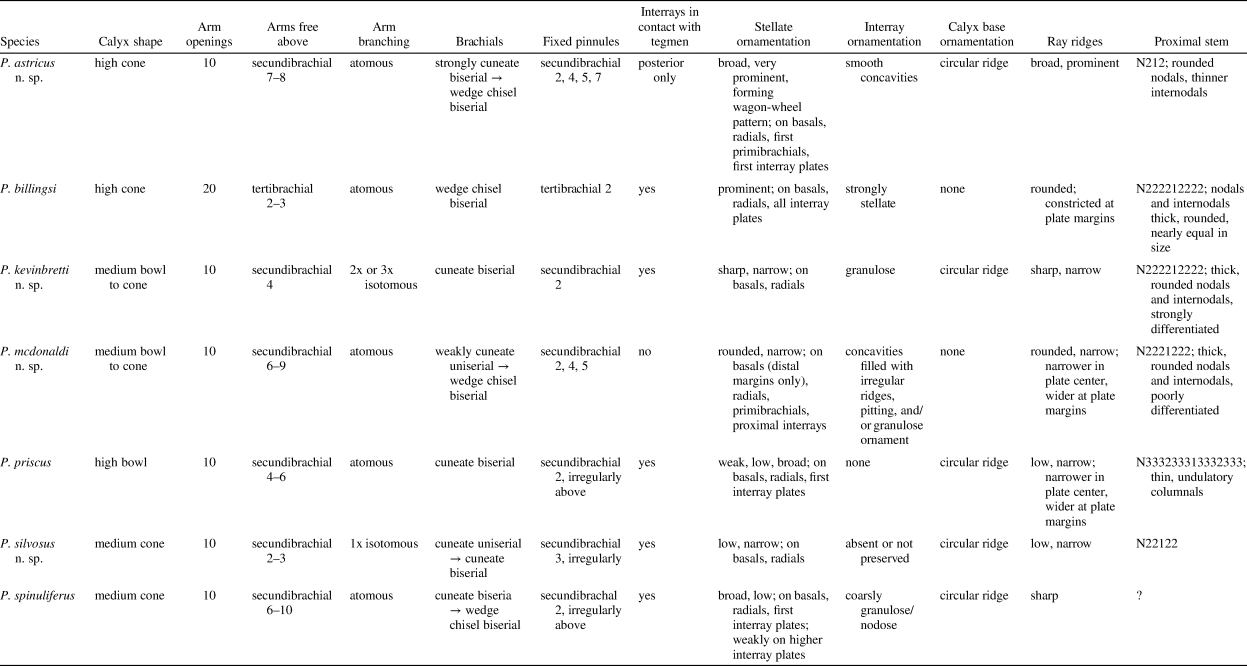
Springer (Reference Springer1911) referred all specimens of Periglyptocrinus from Kirkfield to Periglyptocrinus priscus but noted that many of the specimens had much stronger stellate ornamentation on the calyx plates than had been previously recognized. We assign specimens of Periglyptocrinus from the Brechin Lagerstätte to five species, including Periglyptocrinus priscus and four new species. Because three species of Periglyptocrinus were previously recognized, the description of these new species more than doubles the known species richness of the genus. Although the four new species are similar in many aspects of calyx plating, they differ with regard to calyx shape, plate ornamentation, contact of the interrays with the tegmen, stem morphology, and arm branching. Major differences between species of Periglyptocrinus are summarized in Table 2.
Major features used for differentiating Periglyptocrinus spp. Information given for all currently valid Periglyptocrinus spp. described from calyx material, including the four new species described here.

Periglyptocrinus astricus new species
Figures 3.3, 3.4, 4.3–4.7; Table 2
- Reference Cole, Wright and Ausich2019
Periglyptocrinus sp. C; Cole et al., not mentioned in text, associated with supplemental data.
Type specimens
UMMP 74820, holotype; UMMP 74819, 74686.5, paratypes.
Diagnosis
Periglyptocrinus with high conical calyx; 10 unbranched arms; prominent stellate ridges on basals, radials, and proximal interray plates, higher plates with smooth central depressions; numerous fixed pinnules preventing contact of interrays with tegmen; thick, strongly differentiated nudinodals and internodals in proximal stem.
Occurrence
The occurrences documented here are from the Upper Ordovician (early Katian) Bobcaygeon-Verulam boundary interval, Carden and LaFarge Quarries (Ontario, Canada).
Description
Calyx high cone, higher than wide; base of calyx upright, surrounded by a low, narrow ridge; plate sutures flush with plate surface. Ornamentation consisting of prominent, broad stellate ridges on basals, radials, and first interray plates that connect to form a distinctive wagon-wheel pattern (Fig. 4.4, 4.6); upper interray plates with smooth, rounded concavities. Median ray ridges prominent, narrow, rounded; slightly constricted at plate sutures.
Basal circlet upright; basal plates five, pentagonal, slightly wider than high.
Radial circlet uninterrupted; radial plates heptagonal, as wide as high, largest plates in calyx.
Regular interrays narrow, not in contact with tegmen, tapering distally. First interradial plate hexagonal, equant, equal in size to basals and smaller than radials. Second range with two plates; proximal plating 1-2-3-2-2-2 or 1-2-2-2-2, plating often in biseries (Fig. 3.3).
Posterior interray slightly wider than regular interrays, tapering distally; in contact with the tegmen very narrowly or not at all. Primanal heptagonal, approximately as wide as high, slightly larger than first interray plates. Posterior plating consisting of primanal followed by anitaxis of six or more plates with a single column of small plates on each side of the anitaxis; roughly P-3-3-3-3-3-3 but with some additional plates lateral to anitaxis. Primanal ornamented with heavy stellate ridges; anitaxis originating from distal ridge, other ridges extending proximally to adjacent radials and laterally to first primibrachials.
First primibrachial fixed, hexagonal, approximately as wide as high; second primibrachial axillary, heptagonal. Proximal secundibrachials fixed, second giving rise to fixed pinnule abaxially, fourth giving rise to fixed pinnule adaxially, fifth to seventh giving off pinnules on alternate sides; arms becoming free above seventh or eighth secundibrachial (Figs. 3.3, 4.6). Fixed intrabrachials between secundibrachials of half-rays, typically in 4–6 rows of one or two plates each; intrabrachials with smooth central concavities; a few small plates irregularly positioned between secundibrachials and first fixed pinnules.
Arm openings 10, ungrouped. Arms strongly cuneate biserial immediately where they become free, transitioning to wedge biserial just above the calyx. Arms unbranched, pinnulate; pinnules long and thin, densely arranged.
Stem circular, holomeric. Proximal stem heteromorphic, N212, nudinodals thick with rounded latera, priminternodals thinner. Medial stem strongly heteromorphic, thick nudinodals widely separated by two or three internodals. Distal stem weakly heteromorphic or homeomorphic. Holdfast composed of terminal rhizoids.
Tegmen, anal opening, and other details of stem unknown.
Etymology
The specific name is from the Latin, astricus, meaning starry, in reference to the prominent stellate ornamentation on the calyx plates.
Materials
UMMP 74821, 74822, 74681.5, 74686.6, 74686.7.
Remarks
Periglyptocrinus astricus n. sp. is most similar to the other Periglyptocrinus species from the Brechin Lagerstätte, especially Periglyptocrinus mcdonaldi n. sp. The two species differ primarily in terms of ornamentation, overall shape, and stem construction. Periglyptocrinus astricus n. sp. has a conical calyx; narrow stellate ridges that completely cover the basals, radials, first interray plates, and first primibrachials to form a distinctive wagon-wheel pattern; smooth, rounded concavities on distal interray plates; and a stem with construction N212. In contrast, Periglyptocrinus mcdonaldi n. sp. has a medium bowl-shaped calyx; broad stellate ridges on the distal basals, radials, proximal interray plates, and primibrachials with granulose ornamentation between ridges; a combination of irregular stellate ridges, granulose ornament, and irregular concavities on more distal interray and fixed brachial plates; and a stem with construction N2221222. Although differences in ornamentation are subtle, they are consistently expressed across many specimens and do not appear to be a function of ontogeny, with subadult specimens showing fully developed ornamentation consistent with one species or the other without any gradation between the two (Fig. 4.3; UMMP 74686.5–74686.7, 74686.10). See Table 2 for a summary of other characters that differ between species of Periglyptocrinus.
Cole et al. (Reference Cole, Wright and Ausich2019) included Periglyptocrinus astricus n. sp. in an analysis of Brechin crinoid community paleoecology using the placeholder name of Periglyptocrinus sp. C.
Periglyptocrinus kevinbretti new species
Figures 5, 6.4, 6.5; Table 2
- Reference Cole, Wright and Ausich2019
Periglyptocrinus sp. B; Cole et al., not mentioned in text, associated with supplemental data.
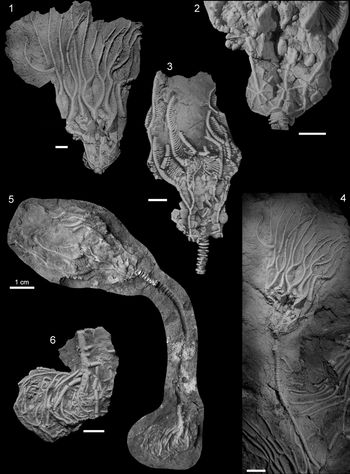
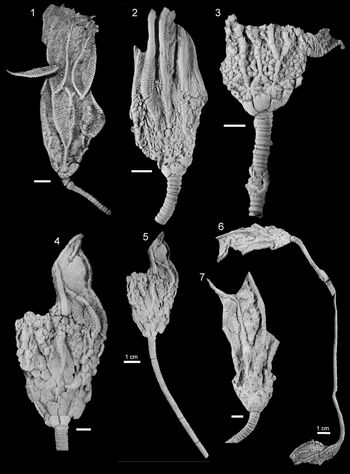
Periglyptocrinus kevinbretti n. sp. from the Brechin Lagerstätte: (1, 2, 4) UMMP 74688.2, holotype: (1) lateral view of nearly complete crown; (2) close-up of calyx plating with CD-interray on right; (4) lateral view showing partial stem; (3, 5, 6) UMMP 74823, paratype: (3) close-up of crown; (5) lateral view of crown, partial stem, and holdfast, unwhitened; (6) close-up of holdfast. Scale bars = 5 mm unless otherwise indicated.

Type specimens
UMMP 74688.2, holotype; UMMP 74823, paratype.
Diagnosis
Periglyptocrinus with medium cone- to bowl-shaped calyx; 10 arms branching up to three times; sharp stellate ridges on basals, radials, and primanal; granulose ornamentation on all calyx plates; interrays in contact with tegmen; few fixed pinnules; proximal stem strongly heteromorphic, multiple secundinternodals separating nodals and priminternodals.
Occurrence
The occurrences documented here are from the Upper Ordovician (early Katian) lower Verulam Formation, James Dick Quarry and from the Bobcaygeon-Verulam boundary interval, Carden Quarry (Ontario, Canada).
Description
Calyx medium cone- to bowl-shaped, height and width approximately equal; base of calyx upright; plate sutures flush with plate surface. Median ray ridges prominent, narrow, maintaining width across plates. Ornamentation on basals, radials, first interray plates, and primanal consisting of stellate ridges with granulose ornamentation between ridges; other calyx plates with granulose ornamentation only (Fig. 5.2, 5.3).
Basal circlet upright; basal plates five, pentagonal, wider than high; ridge on proximal margins forming a circular ridge around the base of the calyx, with two additional ridges on each plate extending upward and connecting to ridges on adjacent radial plates.
Radial circlet uninterrupted. Radial plates heptagonal, slightly wider than high; largest plates in calyx. Each radial plate with seven ridges that converge in the center of the plate to form a stellate pattern.
Regular interrays in contact with tegmen, slightly depressed, tapering distally. First interradial plate hexagonal, wider than high, slightly larger than basals, much smaller than radials. Second range with two plates; proximal plating 1-2-3?-2-3-4 followed by at least two higher rows of four or more plates each (Fig. 6.5).
Posterior interray wider than regular interrays, apparently in contact with tegmen, tapering distally. Primanal heptagonal, approximately as wide as high, larger than first interray plates, ornamented with five ridges that converge in the center of the plate to form a stellate pattern. Proximal plating in the posterior interray P-3-3? followed by at least two higher rows of three or more plates; medial column of plates forming an anitaxis ornamented with an anitaxial ridge (Figs. 5.2, 6.4).
First primibrachial fixed, hexagonal, wider than high, nearly as large as radials; second primibrachial axillary, heptagonal. Proximal secundibrachials fixed, second secundibrachials giving rise to fixed pinnules abaxially; arms becoming free near fourth secundibrachial. Fixed intrabrachials between secundibrachials of half-rays, proximal plating 1-1-2 or 1-1-1, higher rows grading into tegmen. Additional plate positioned between secundibrachials and fixed pinnule.
Arm openings 10, ungrouped. Free arms predominantly cuneate biserial but becoming uniserial in places; branching poorly isotomously twice in most arms, but some arms unbranched or branching three times; pinnules long, relatively robust at the bases (Fig. 5.1).
Stem circular, holomeric; stem articular facets with radial symplexy, narrow areola surrounding lumen; lumen circular. Proximal stem heteromorphic, N222212222 where fully differentiated, nudinodals and priminternodals with rounded latera, priminternodals slightly thinner, secundinternodals very thin, of identical diameters. Medial stem with priminternodals becoming less distinct, more similar in diameter and thickness to secundinternodals. Distal stem homeomorphic, columnals circular (Fig. 5.4, 5.5).
Holdfast composed of many terminal rhizoids branching irregularly from lowermost portion of the stem (lower sixth in UMMP 74823); rhizoids mostly unbranched, protruding outward and downward, composed of uniformly thin segments, penetrated by axial canal (Fig. 5.6).
Tegmen and anal opening unknown.
Etymology
The specific name is given in honor of Kevin Brett, who collected, prepared, and donated the holotype specimen.
Remarks
Periglyptocrinus kevinbretti n. sp. is most similar to the other species of Periglyptocrinus from the Brechin Lagerstätte. However, it differs from all other species in the fauna in that the arms branch isotomously two or three times (Fig. 5.1). See Table 2 for a summary of other differences between Periglyptocrinus kevinbretti n. sp. and other species of Periglyptocrinus.
Cole et al. (Reference Cole, Wright and Ausich2019) included Periglyptocrinus kevinbretti n. sp. in an analysis of Brechin crinoid community paleoecology using the placeholder name of Periglyptocrinus sp. B.
Periglyptocrinus mcdonaldi new species
Figures 6.3, 7.2, 7.3, 7.6, 7.7; Table 2
- Reference Cole, Wright and Ausich2019
Periglyptocrinus sp. A; Cole et al., not mentioned in text, associated with supplemental data.
Camera lucida drawings of Periglyptocrinus spp. from the Brechin Lagerstätte: (1) Periglyptocrinus priscus, UMMP 74677.2; (2) Periglyptocrinus silvosus n. sp., UMMP 74826, holotype; (3) Periglyptocrinus mcdonaldi n. sp., UMMP 74825, holotype, C-ray view; (4, 5) Periglyptocrinus kevinbretti n. sp.: (4) UMMP 74688.2, holotype, D-ray view; (5) UMMP 74823, paratype. P = primanal; fill: black = radials; gray = matrix/plating unknown; ruled = plate edges/undersides; stippled = interray plates; lines: dashed black = inferred plate boundaries; dashed gray = ray ridges/plate ornamentation; jagged = broken plate margins; solid black = plate boundaries; solid grey = embedded in matrix.

Periglyptocrinus spp. from the Brechin Lagerstätte: (1) Periglyptocrinus silvosus n. sp., UMMP 74826, holotype, lateral view; (2, 3, 6, 7) Periglyptocrinus mcdonaldi n. sp.: (2) UMMP 74825, holotype, C-ray view of nearly complete crown, posterior interray preserved on left; (3) UMMP 74824, paratype, CD-interray view of calyx; (6, 7) UMMP 74818, paratype: (6) lateral view with complete stem and holdfast; (7) close-up of crown; (4, 5) Periglyptocrinus priscus, UMMP 74677.2: (4) close-up of calyx with partial arms; (5) lateral view of calyx with partial stem. Scale bars = 5 mm unless otherwise indicated.

Type specimens
UMMP 74825, holotype; UMMP 74824, 74818, paratypes.
Diagnosis
Periglyptocrinus with medium cone- to bowl-shaped calyx; 10 unbranched arms; basals large, rounded proximally, lacking ornamentation except on distal margin; plate ornamentation transitioning from stellate ridges on lower calyx plates to concave on higher calyx plates, concavities commonly filled with irregular ridges, granulose ornamentation, and/or pitting; numerous fixed pinnules preventing contact of interrays with tegmen; proximal stem heteromorphic with thick nudinodals.
Occurrence
The specimens documented here are from the Upper Ordovician (early Katian) Bobcaygeon-Verulam boundary interval, Carden and LaFarge Quarries (Ontario, Canada).
Description
Calyx medium cone- to bowl- shaped, height and width approximately equal; base of calyx upright; plate sutures flush with plate surface. Ornamentation on distalmost margin of basals; radials and proximal interray plates ornamented with broad stellate ridges; upper interray plates concave, some with fine pitting and/or granulose ornamentation in concavities. Median ray ridges low, narrow, rounded; slightly constricted at regular intervals within plates, widest at plate margins.
Basal circlet upright; basal plates five, pentagonal, wider than high.
Radial circlet uninterrupted; radial plates heptagonal, slightly wider than high; largest plates in calyx.
Regular interrays narrow, not in contact with tegmen, not depressed, tapering distally. First interradial plate hexagonal, approximately as wide as high, slightly smaller than basals, much smaller than radials. Second range with two plates; proximal plating 1-2, with two to five higher rows of plates with two plates each, less commonly with three plates in some rows (Figs. 6.3, 7.2).
Posterior interray wider, not in contact with tegmen, tapering distally. Primanal heptagonal, approximately as wide as high, slightly larger than first interray plates. Proximal plating P-3-3-3-3, with two or more higher rows of plates with one to three plates each; medial column of plates forming a distinctive anitaxis ornamented with a prominent anitaxial ridge (Figs. 6.3, 7.2, 7.3).
First primibrachial fixed, hexagonal, approximately as wide as high; second primibrachial axillary. Proximal secundibrachials fixed, second and fifth secundibrachials giving rise to fixed pinnules abaxially, fourth secundibrachial giving rise to fixed pinnule adaxially; arms becoming free between sixth and ninth secundibrachial. Fixed intrabrachials between secundibrachials of half-rays, proximal plating 1-1-2 or 1-1-1. Additional plate commonly positioned between secundibrachials and first fixed pinnule.
Arm openings 10, ungrouped. Free arms weakly to moderately cuneate uniserial in proximal arms, becoming strongly wedge chisel biserial in mature arms. Arms unbranched, pinnulate; pinnules long and thin, densely arranged, proximal pinnule bases more robust than distal pinnules (Fig. 7.2, 7.7).
Stem circular, holomeric; stem articular facets with radial symplexy, narrow areola surrounding lumen; lumen circular. Proximal stem heteromorphic, two orders of nodals nearly in contact just below calyx, separated by three to five internodals where fully differentiated, N2221222 to N22222122222; nodals thick with rounded margins (Fig. 7.6). Medial stem weakly heteromorphic, internodals nearly equal in diameter to nodals, nodals thinner than in proximal stem. Distal stem not heteromorphic, columnals very thin. Holdfast composed of at least 12 rhizoids that branch irregularly from the central stem; rhizoids unbranched, downward-facing, composed of uniformly thin segments, penetrated by axial canal (Fig. 7.6).
Tegmen and anal opening unknown.
Etymology
The specific name is given in honor of Terry McDonald, a long time collector of the Brechin Lagerstätte, who collected some of the specimens described in this series of papers.
Materials
UMMP 74665.2, 74686.10.
Remarks
Periglyptocrinus mcdonaldi n. sp. is most similar to the other species of Periglyptocrinus from the Brechin Lagerstätte, especially Periglyptocrinus astricus n. sp. (e.g., Figs. 4.6, 4.7, 7.2, 7.3). See Remarks under Periglyptocrinus astricus n. sp. and Table 2 for a summary of the differences between these and other species of Periglyptocrinus.
Cole et al. (Reference Cole, Wright and Ausich2019) included Periglyptocrinus mcdonaldi n. sp. in an analysis of Brechin crinoid community paleoecology using the placeholder name of Periglyptocrinus sp. A.
Periglyptocrinus priscus (Billings, Reference Billings1857a)
Figures 6.1, 7.4, 7.5; Table 2
- Reference Billings1857a
Glyptocrinus priscus Billings, p. 257.
- Reference Billings1859
Glyptocrinus priscus; Billings, p. 56, pl. 7, fig. 1a–f.
- Reference Shumard1868
Glyptocrinus priscus; Shumard, p. 373.
- Reference Bigsby1868
Glyptocrinus priscus; Bigsby, p. 20.
- Reference Wachsmuth and Springer1886
Ptychocrinus priscus; Wachsmuth and Springer, p. 301.
- Reference Miller1889
Glyptocrinus priscus; Miller, p. 248.
- Reference Miller and Gurley1894
Glyptocrinus mercerensis Miller and Gurley, p. 28, pl. 2, fig. 23.
- Reference Miller1897
Glyptocrinus mercerensis; Miller, p. 746.
- Reference Wachsmuth and Springer1897
Periglyptocrinus priscus; Wachsmuth and Springer, p. 278, pl. 21, fig. 2.
- Reference Grabau and Shimer1910
Periglyptocrinus priscus; Grabau and Shimer, p. 552.
- Reference Bassler1915
Periglyptocrinus priscus; Bassler, p. 957.
- Reference Bassler1915
Glyptocrinus priscus; Bassler, p. 957.
- Reference Bassler1915
Ptychocrinus priscus; Bassler, p. 957.
- Reference Bassler1915
Glyptocrinus mercerensis; Bassler, p. 555.
- Reference Bassler and Moodey1943
Periglyptocrinus priscus; Bassler and Moodey, p. 602.
- Reference Bassler and Moodey1943
Glyptocrinus priscus; Bassler and Moodey, p. 602.
- Reference Bassler and Moodey1943
Glyptocrinus mercerensis; Bassler and Moodey, p. 602.
- Reference Wilson1946
Periglyptocrinus priscus; Wilson, p. 30.
Holotype
GSC 1522.
Diagnosis
Periglyptocrinus with high bowl-shaped calyx; 10 unbranched arms, cuneate biserial; circular ridge on basals surrounding calyx base; weak stellate ornamentation on basals, radials, and first interray plates; few fixed pinnules; proximal stem composed of thin, undulatory columnals.
Occurrence
Periglyptocrinus priscus was previously known from the Upper Ordovician (Katian) Hull Member of the Ottawa Formation, Ontario; the Leray or Rockland Formation, Ontario; and the Curdsville Member of the Hermitage Formation, Kentucky. The occurrences documented here are from the Upper Ordovician (early Katian) Bobcaygeon-Verulam boundary interval, Carden Quarry (Ontario, Canada).
Description
Calyx high bowl, slightly higher than wide; plates thin and flat. Radials typically ornamented with low stellate ridges, the two proximal ridges extending from radials onto basals, first interray plates occasionally ornamented with stellate ridges, higher plates unornamented; plate sutures flush with plate surface; base of calyx surrounded by a thin but prominent circular ridge; median ray ridges low, narrow, constricted in the center of the plates, widening near the plate margins.
Basal circlet upright; basal plates five, pentagonal, widening distally, approximately as wide as high, smaller than radial plates.
Radial circlet uninterrupted. Radial plates heptagonal, slightly wider than high, largest plates in calyx.
Regular interrays in contact with tegmen, not depressed, slightly narrowing distally. First interradial plate hexagonal, approximately as wide as high, slightly larger than basals, much smaller than radials. Second range with two plates; proximal plating 1-2-2-2, followed by three or four higher rows with two to four plates each (Figs. 6.1, 7.4).
Posterior interray wider than regular interrays, in contact with tegmen, tapering distally. Primanal heptagonal, higher than wide, slightly larger than first interray plates. Proximal plating P-3-3-3-3-?, medial column of plates forming a distinctive anitaxis. Primanal ornamented with an inverted Y from which an anitaxial ridge originates; the two proximal ridges extending to the adjacent radial plates.
First primibrachial fixed, hexagonal, higher than wide; second primibrachial axillary, heptagonal. Secundibrachials typically becoming free above fourth to sixth plate, second secundibrachial giving rise to fixed pinnules abaxially, higher brachials variably giving rise to fixed pinnules. Fixed intrabrachials between secundibrachials of half-rays numerous, proximal plating 1-2-2. Arm openings 10, ungrouped. Free arms becoming cuneate biserial almost immediately above the calyx, unbranched, densely pinnulate; pinnules long and thin (Fig. 7.4).
Stem circular, holomeric, heteromorphic. Proximal stem with thin columnals, nudinodals and internodals separated by a series of three very thin tertinternodals, N333233313332333; columnal margins slightly undulatory. Distal stem becoming less distinctly heteromorphic. Holdfast composed of irregular rhizoids.
Tegmen, anal opening, stem lumen, and columnal articulation unknown.
Materials
New specimens examined here are UMMP 74677.2, 74686.8, 74686.9.
Remarks
Although Periglyptocrinus priscus is similar to the other Periglyptocrinus species in the Brechin Lagerstätte, it is the only species that possesses unbranched arms and interrays that are all in contact with the tegmen (Figs. 6.1, 7.4). Additional features that differentiate Periglyptocrinus priscus from other species of Periglyptocrinus are given in Table 2.
Periglyptocrinus silvosus new species
Figures 6.2, 7.1; Table 2
- Reference Cole, Wright and Ausich2019
Periglyptocrinus sp. D; Cole et al., not mentioned in text, associated with supplemental data.
Holotype
UMMP 74826.
Diagnosis
Periglyptocrinus with medium conical calyx; low, narrow stellate ornamentation on basals and radials; 10 free cuneate biserial arms branching once isotomously; first pinnule only irregularly fixed; heteromorphic stem with construction N22122.
Occurrence
Periglyptocrinus silvosus n. sp. is known from a single specimen collected from the Bobcaygeon-Verulam boundary interval, LaFarge Quarry (Ontario, Canada).
Description
Calyx medium cone, approximately as high as wide; base of calyx upright, surrounded by a circular ridge; plate sutures flush with plate surface. Stellate ornamentation on basals and radials, narrow and low; no ornamentation on distal calyx plates. Median ray ridges narrow and low.
Basal circlet upright; basal plates five, pentagonal, equant.
Radial circlet uninterrupted; radial plates heptagonal, equant, largest plates in calyx.
Regular interrays in contact with tegmen, tapering slightly distally. First interray plate hexagonal, as wide as high, larger than basals, smaller than radials. Second range with two plates; proximal plating 1-2-2-3-3-? (Figs. 6.2, 7.1). Posterior interray not preserved.
First primibrachial fixed, hexagonal, higher than wide; second primibrachial axillary, heptagonal. Proximal secundibrachials fixed, free above second or third secundibrachials. Third secundibrachial typically giving rise to first pinnule that might or might not be fixed; fifth and all higher secundibrachials giving rise to free pinnules. Fixed intrabrachials present between secundibrachials of half-rays, typically a single plate.
Arm openings 10, ungrouped. Free arms cuneate uniserial proximally, becoming cuneate biserial distally; branching isotomously once; pinnulate (Fig. 7.1).
Stem circular, holomeric, stem articular facets with radial symplexy. Proximal stem heteromorphic, N22122, nudinodals and priminternodals with rounded latera, priminternodals slightly thinner, internodals approximately half as thick as priminternodals. Lumen, distal stem, and holdfast unknown.
Etymology
The specific name is from the Latin, silvosus, meaning branched or branching, in reference to the branched arms of this species.
Remarks
Periglyptocrinus silvosus n. sp. is most similar to other species of Periglyptocrinus from the Brechin fauna, particularly Periglyptocrinus kevinbretti n. sp., which is the only other species of Periglyptocrinus in the fauna with free arms that branch, although the arms of Periglyptocrinus kevinbretti n. sp. branch up to three times whereas those of Periglyptocrinus silvosus n. sp. branch only once (Figs. 5.1, 7.4). Additional differences between Periglyptocrinus silvosus n. sp., Periglyptocrinus kevinbretti n. sp., and other species of Periglyptocrinus are summarized in Table 2.
Cole et al. (Reference Cole, Wright and Ausich2019) included Periglyptocrinus silvosus n. sp. in an analysis of Brechin crinoid community paleoecology using the placeholder name of Periglyptocrinus sp. D.
Acknowledgments
We thank J. Bauer, M. Friedman, and D. Miller (UMMP) for assistance with curating specimens. This paper benefited from access to taxonomic literature kindly provided by M. Foote. This manuscript was improved by helpful comments from F. Gahn and an anonymous reviewer. We thank B. Lefebvre for helpful comments and editorial services throughout the manuscript review process. SRC was supported by a Kathryn W. Davis postdoctoral fellowship from the American Museum of Natural History (AMNH), an Arthur James Boucot Award from the Paleontological Society, and a J. Thomas Dutro Jr. Student Award from the Paleontological Research Institute. DFW was supported by a Gerstner Scholar and Lerner-Gray postdoctoral fellowship from AMNH and a James R. Welch scholarship from the Association of Applied Paleontological Sciences.
Accessibility of supplemental data
Data available from the Dryad Digital Repository. DOI: https://doi.org/10.5061/dryad.7pvmcvdq6.