


One of the goals of the European Higher Education Area (EHEAFootnote 1) is to enhance the employability of university graduates because this will contribute to better professional careers (EHEA Ministerial Conference, 2015). EHEA assumes that this employability enhancement can be achieved through a more professionally oriented instruction at the university (i.e., instruction that is more linked to professional and workplace needs).Footnote 2 However, there is a scarcity of empirical studies investigating the relationship between professionally oriented university instruction (henceforth POUI) and future graduates’ employability. Moreover, we do not know whether this instruction is linked to university graduates’ early career outcomes via employability.
These omissions are worrisome for several reasons. First, the assumptions that inspire educational strategies and policies should be investigated to discover whether they are appropriate and have a solid empirical basis. Otherwise, it is not clear whether these strategies and policies can be maintained or should be changed. Second, to advance knowledge about the consequences of POUI, we need to know the mediators that explain the relationship between this type of instruction and graduates’ career outcomes. Without uncovering these mediators, our understanding of the investigated phenomena will be limited (Mathieu et al., Reference Mathieu, DeShon and Bergh2008).
Considering these gaps, the goals of this study are (1) to ascertain whether POUI is positively related to future university graduates’ employability and (2) to examine whether the latter variable mediates the relationship between POUI and graduates’ early career outcomes: finding a job within 6 months after graduation and the quality of the job obtained (henceforth job quality). These outcomes were chosen for several reasons.
First, we focused on finding a job within 6 months after graduation because having a job allows graduates to start their professional career. Whereas unemployment represents a blockage of graduates’ careers, being employed after graduation provides the opportunity to start achieving one’s professional goals and develop a professional career. Second, in recent decades, several factors (i.e., increasing flexibility and job market de-regularization) have led to a decrease in the quality of many jobs in Western countries (Kalleberg, Reference Kalleberg2018). This is unfortunate because having a job of sufficient quality is what allows people to have a decent life and grow professionally and personally. Thus, different institutions (e.g., European Commission, International Labor Organization) have made efforts to improve job quality. Third, finding a job after graduation and job quality are two important issues in Spain, where this study was conducted. Based on data provided by the Spanish Statistical Office, 20% of Spanish young (25–29 years) university graduates were unemployed when the data were collected (2015). In the case of job quality, data reported by the OECD (Cazes et al., Reference Cazes, Hijzen and Saint-Martin2015) show that Spain is among the countries with the worst scores on several job quality indicators. Therefore, research on variables that influence these socially relevant criteria is warranted.
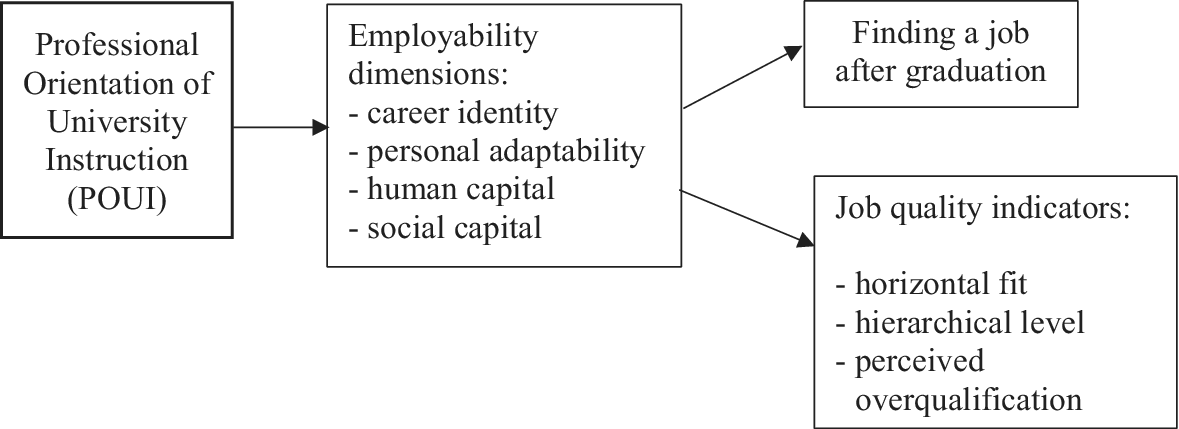
Our research model is depicted in Figure 1. By conducting this study, we aim to contribute to the literature in several ways. First, we show that POUI has a positive influence on certain employability dimensions, and we offer an explanation for these relationships. These results and the associated theoretical justifications help us to improve our understanding of how and why university instruction is related to future graduates’ employability. Second, we uncover which employability dimensions play a mediator role and help to explain the indirect relationship between POUI and the early career outcomes considered. By doing so, we contribute to improving our understanding of the mechanisms that underlie this relationship. Third, the results we obtained provide some empirical support for the assumption that university instruction that is closely linked to professional needs improves future graduates’ employability and early career outcomes. This means that educational strategies and policies aimed at enhancing POUI yield some of their intended consequences. Finally, overqualification (having more education or qualifications, skills, and/or experience than one’s job requires; Maynard et al., Reference Maynard, Joseph and Maynard2006), one of the job quality indicators considered, is an important phenomenon in developed countries. The average rate of overqualification among young (aged 25–34) university graduates in the European Union was 24.1% in 2019. In Spain, this percentage equaled 38.8%Footnote 3. Moreover, meta-analytical evidence shows that perceived overqualification is negatively related to psychological well-being, job satisfaction, and organizational citizenship behaviors (Harari et al., Reference Harari, Manapragada and Viswesvaran2017). For these reasons, overqualification is a topic that has attracted the attention of researchers in the past few decades (Erdogan & Bauer, Reference Erdogan and Bauer2021). However, “research on overqualification antecedents remains scarce compared to the studies on overqualification outcomes” (Erdogan & Bauer, Reference Erdogan and Bauer2021, p. 5). As far as we know, no study has investigated the impact of university instruction on graduates’ overqualification. Thus, our study contributes to the literature by expanding the set of overqualification antecedents.
The research model.

Conceptual and Theoretical Background
The Study Constructs Defined
We conceptualized the professional orientation of university instruction (POUI) as the extent to which the instruction received at the university provides good preparation for professional practice. This can be exemplified by showing the relationship between the curricular contents and professional practice, developing key professional skills, providing practical training and internships as preparation for professional practice, and offering information about the different professional career paths. As mentioned above, we focused on POUI because it is assumed that it can contribute to improving employability and career outcomes (Humburg et al., Reference Humburg, van der Velden and Verhagen2013). Professionally oriented university instruction can be considered a form of Work-Integrated Learning (WIL). This instructional approach can be characterized by an effort to integrate theory and practice, the provision of real learning contexts, the development of professional competence through the acquisition of key skills, and facilitating the transition to work (Billett, Reference Billett2009; Cooper et al., Reference Cooper, Orrell and Bowden2010). The theoretical basis of POUI as a form of WIL are the theories of active and experiential learning (Bonwell & Eison, Reference Bonwell and Eison1991; Kolb, Reference Kolb1984) and the model of situated learning (Lave & Wenger, Reference Lave and Wenger1991). According to the former theories, learners should be allowed to do what they were taught. Based on the latter model, the learning process is facilitated when learners participate in a community of practice, such as real work environments in which they can develop authentic work activities (Jackson, Reference Jackson2015). Work-Integrated Learning has a long history in higher education institutions. It was first implemented by Herman Schneider (an engineering professor) in 1906 in the USA after realizing that his students could not develop the key skills for professional practice only in the classroom. Thus, he started to combine on- and off-campus activities to link theory with engineering practice (Cooper et al., Reference Cooper, Orrell and Bowden2010). Nowadays, many universities embrace the WIL instruction approach as a way to increase graduates’ employability and career outcomes (Jackson, Reference Jackson2015).
We define employability as “a form of work specific active adaptability that enables workers to identify and realize career opportunities” (Fugate et al., Reference Fugate, Kinicki and Ashforth2004, p. 16). It is a multidimensional construct that comprises these dimensions: career identity, personal adaptability, and human and social capital. Career identity is “one’s self-definition in the career context” (ibid., p. 17). It refers to who the person is or wants to be professionally, and it represents the motivational component of employability because it helps individuals to direct, regulate, and maintain their work and job search behaviors (Fugate et al., Reference Fugate, Kinicki and Ashforth2004; González-Romá et al., Reference González-Romá, Gamboa and Peiró2018). Personal adaptability refers to the willingness and ability to change behaviors in response to environmental demands (Fugate et al., Reference Fugate, Kinicki and Ashforth2004; McArdle et al., Reference McArdle, Waters, Briscoe and Hall2007). It is increasingly relevant in today’s dynamic labor market (Fugate & Kinicki, Reference Fugate and Kinicki2008). Human capital refers to personal factors such as education, work experience, training, knowledge, skills, and abilities (Fugate et al., Reference Fugate, Kinicki and Ashforth2004; McArdle et al., Reference McArdle, Waters, Briscoe and Hall2007). Individuals with greater human capital will be better equipped to obtain and keep high-quality jobs. Finally, social capital reflects the social and interpersonal dimension of employability. It refers to networks that provide individuals with interpersonal relationships that can offer career-related information and the possibility of identifying and fulfilling career opportunities (Seibert et al., Reference Seibert, Kraimer and Liden2001).
We adopted Fugate et al.’s (Reference Fugate, Kinicki and Ashforth2004) conceptualization of employability as a multidimensional construct for several reasons. First, this conceptualization specifies the concrete dimensions involved, herewith allowing researchers to estimate the specific relationships that each dimension has on specific outcomes. This provides more detailed knowledge than treating employability as a single global construct. Second, these dimensions refer to individual properties that can be developed.
Job quality is a complex, multidimensional construct as well (Findlay et al., Reference Findlay, Kalleberg and Warhurst2013), making it difficult to formulate a universally accepted definition. However, there is some consensus, endorsed by the European Commission (2001, p. 65), that job quality refers both to the extent to which a job displays desirable characteristics and to the degree of the match between the employee’s attributes and the job requirements. Moreover, there is also consensus that it must include objective and subjective aspects of the job and individual assessments of employee-job fit (Findlay et al., Reference Findlay, Kalleberg and Warhurst2013). Thus, in this study, we conceptualized job quality as the extent to which a job has a specific objective characteristic (higher hierarchical level), and there is a fit between the job requirements and the job incumbent’s characteristics. Regarding fit, we focused on two types of fit: vertical fit and horizontal fit. Vertical fit refers to the relationship between the qualification level required by the job and the qualification level the job incumbent has. We operationalized vertical fit by using a perceived overqualification measureFootnote 4 (Maynard et al., Reference Maynard, Joseph and Maynard2006). Horizontal fit refers to the relationship between graduates’ field of study (i.e., their university degree subject) and the content of their job. We acknowledge that job characteristics such as job autonomy, work meaningfulness, or social support and work–life balance opportunities at work also constitute important aspects of job quality (Findlay et al., Reference Findlay, Kalleberg and Warhurst2013). However, we believe that these job features are probably more influenced by job design and organizational context, whereas the indicators used in the present study are expected to be more proximally shaped by educational factors and personal employability.
The Relationship between POUI and the Employability Dimensions
Below, we explain why we expect POUI to be positively related to the four employability dimensions considered.
Career Identity
Informing students about potential jobs and careers in the labor market is one of the key characteristics of POUI. Providing this information will help students to reflect on the professional career they want, allowing them to better evaluate whether specific jobs and careers fit their desired profiles. Thus, we posit that POUI contributes to defining students’ career identities and who they want to be professionally. In line with this argument, Freudenberg et al. (Reference Freudenberg, Brimble and Cameron2009) implemented a program for business students to create a stronger career identity. The program consisted of providing knowledge about the relevant professions, the industry, and the professional skills involved, as well as increasing exposure to firms and industry representatives. Similarly, Anakwe et al. (Reference Anakwe, Hall and Schor2000) showed that MBA students who were taught to reflect on their career-related values, needs, and motivations had stronger career identities and, consequently, were more effective at setting career goals and decision-making.
Personal Adaptability
Informing about professional careers and jobs that students were not aware of should open their minds to different professional paths. It should also make them more attentive to identifying new career opportunities and more motivated to change their behaviors to respond to these opportunities. Moreover, by developing key professional skills, students should become more confident about their ability to deal with new job opportunities in a changing labor market. Thus, POUI can contribute to improving two core aspects of students’ personal adaptability: openness to change and the ability to respond to environmental demands and opportunities (Fugate et al., Reference Fugate, Kinicki and Ashforth2004; Humburg et al., Reference Humburg, van der Velden and Verhagen2013). Finally, internships expose students to unpredictable real-life situations that require some degree of adaptable behavior and thus foster personal adaptability (Vaatstra & De Vries, Reference Vaatstra and De Vries2007).
Human Capital
POUI promotes the development of professional skills that are highly valued by employers, such as teamwork, time management, planning, problem-solving, and communication (e.g., Hernández-March et al., Reference Hernández‐March, Martín del Peso and Leguey2009). There is “a rising demand that students should develop transferable or generic skills [such as those mentioned above] in addition to subject-specific qualifications” (Aamodt & Hovdhaugen, Reference Aamodt and Hovdhaugen2008, p. 2). POUI fosters these skills by providing students with opportunities to develop them in real situations, such as those represented by practical training and internships (Humburg et al., Reference Humburg, van der Velden and Verhagen2013).
Social Capital
POUI facilitates contact with professionals, professional associations, and employers. POUI fosters the planning of internships in real organizations. This provides students with the opportunity to initiate relationships with professionals and employers. Moreover, POUI encourages showing the relationship between the subjects’ content and professional practice. In the university where the data were collected, a strategy implemented to achieve this was to invite practitioners and professional associations to give seminars about key professional skills and teach subjects using an applied approach. These activities provide students with an opportunity to extend their social network of professional contacts, increasing their social capital (De Janasz & Forret, Reference De Janasz and Forret2008). Finally, POUI promotes the acquisition of professional competencies and skills like networking. Nowadays, building social networks through different types of contacts (e.g., coworkers and employers within the work setting, and friends and relatives outside the work setting) and using different means (e.g., direct personal relationships and Internet social networks) is critical for career development (Akkermans et al., Reference Akkermans, Brenninkmeijer, Huibers and Blonk2013). Thus, we expect that by developing the skill of building social networks, POUI is positively related to social capital.
Considering all the arguments presented above, we hypothesize the following:
Hypothesis 1: POUI is positively related to the four employability dimensions considered: career identity (Hypothesis 1a), personal adaptability (Hypothesis 1b), human capital (Hypothesis 1c), and social capital (Hypothesis 1d).
The relationships between the employability dimensions and early career outcomes
We used Fugate et al.’s (Reference Fugate, Kinicki and Ashforth2004) model of employability to justify our hypotheses about the relationship between the employability dimensions and the early career outcomes considered (finding a job after graduation and job quality). At a general level, these authors state that employability “affects the self-regulatory job search process and associated [career] outcomes” (p. 32). They also suggest that employability is positively related to job quality. Specifically, they assert that “employability is likely to improve the ultimate quality of reemployment …. The employment goals of those with high employability are likely to be consistent with career identities, resulting in more satisfactory (i.e., quality) employment outcomes” (p. 32). Next, we specify these relationships by focusing on each employability dimension.
Career Identity
It represents the motivational component of employability (Fugate et al., Reference Fugate, Kinicki and Ashforth2004) and provides future graduates with direction, structure, and focus throughout the job search process (González-Romá et al., Reference González-Romá, Gamboa and Peiró2018). Individuals with a stronger career identity have higher motivation in the job search process than individuals with a weaker career identity. Moreover, because their job search activity is more focused and planned, they are generally more successful than individuals with a weaker career identity. The likely result is that individuals with a stronger career identity will have a greater probability of finding a job after graduation. Previous studies support the relationship between career identity and finding a job (Koen et al., Reference Koen, Klehe and Van Vianen2013; McArdle et al., Reference McArdle, Waters, Briscoe and Hall2007). Therefore, we hypothesize the following:
Hypothesis 2a: Career identity is positively related to finding a job within 6 months after graduation.
Individuals with a strong career identity know what they want to become in their professional careers. “This desired self will give them the motivation to direct, regulate, and maintain their job search behavior until they obtain the high-quality jobs for which they are prepared” (González-Romá et al., Reference González-Romá, Gamboa and Peiró2018, p. 135). Supporting this idea, Day and Allen (Reference Day and Allen2004) found that career motivation was positively related to job quality indicators (salary and subjective career success). Career identity provides the graduate with a feeling of direction (Wijers & Meijers, Reference Wijers and Meijers1996), both in a cognitive and emotional sense (Krieshok et al., Reference Krieshok, Black and McKay2009), which we expect to drive the quality of their job choice (cf. Meijers et al., Reference Meijers, Kuijpers and Gundy2013). The self-awareness and motivation that characterize a strong career identity can help the graduate to structure and focus the job search activity (McArdle et al., Reference McArdle, Waters, Briscoe and Hall2007), which is of utmost importance for finding a suitable job. Indeed, previous empirical work already found that a strong career identity is related to better career outcomes (Meijers et al., Reference Meijers, Kuijpers and Gundy2013). As such, forming a well-developed career identity seems to be crucial for obtaining a high-quality job that fits in relation to the graduate’s personal needs, desires, and capabilities. Thus, we hypothesize the following:
Hypothesis 2b: Career identity is positively related to hierarchical level and horizontal fit and negatively related to perceived overqualification.
Personal adaptability
University graduates must flexibly adapt to a changing labor market where new job opportunities appear constantly (Tomlinson, Reference Tomlinson2012). Students with higher personal adaptability are better equipped to detect these new job opportunities after graduation and bring them to fruition than those with lower personal adaptability (Fugate et al., Reference Fugate, Kinicki and Ashforth2004), who may not be aware of many of these new job opportunities. Moreover, graduates with high adaptability are more attractive to employers because they can more easily adapt to changing working environments (Chan, Reference Chan and Ferris2000). Thus, we hypothesize the following:
Hypothesis 3a: Personal adaptability is positively related to finding a job within 6 months after graduation.
Individuals with greater adaptability may detect high-quality jobs in a broader spectrum of work domains because they have the intention to explore a variety of job opportunities that fit their qualifications. These are jobs that graduates with low adaptability may not even see (Van der Heijde & Van der Heijden, Reference Van der Heijde and Van der Heijden2006). Because highly adaptable job seekers can handle the novelties associated with these high-quality jobs in different work domains, they are likely to take advantage of these job opportunities. Thus, we hypothesize the following:
Hypothesis 3b: Personal adaptability is positively related to hierarchical level and horizontal fit and negatively related to perceived overqualification.
Human capital
Human capital theory states that job seekers’ investments in human capital increase their value to organizations (Becker, Reference Becker1964). Thus, employers will tend to hire people with higher human capital because they are more valuable and better equipped to perform jobs. Some empirical evidence supports the relationship between human capital and employment status. Jackson (Reference Jackson2014) found that a human capital variable (development of generic skills) was positively related to employment among university graduates. Furthermore, a study conducted by Humburg et al. (Reference Humburg, van der Velden and Verhagen2013) with a large sample of European employers showed that graduates with higher human capital were preferred by employers over those with average or low human capital. Thus, we hypothesize the following:
Hypothesis 4a: Human capital is positively related to finding a job within 6 months after graduation.
According to human capital theory (Becker, Reference Becker1964), organizations reward job seekers’ investments in human capital and its associated value by offering better job conditions, compensation, and career promotion (Judge et al., Reference Judge, Klinger and Simon2010). Moreover, individuals with higher human capital are more attractive to employers for high-quality jobs because they are in a better position to meet employers’ high expectations. Finally, Ng et al.’s (Reference Ng, Eby, Sorensen and Feldman2005) meta-analysis showed that investments in human capital (e.g., education and training) were related to job quality indicators (promotions and higher salary). Therefore, we hypothesize the following:
Hypothesis 4b: Human capital is positively related to hierarchical level and horizontal fit and negatively related to perceived overqualification.
Social capital
Individuals with higher social capital have better access to career-related networks and informational resources (Fugate et al., Reference Fugate, Kinicki and Ashforth2004). These advantages are crucial in detecting job opportunities that may be realized later (Adler & Kwon, Reference Adler and Kwon2002). There is empirical evidence supporting the relationship between social capital and obtaining a job. Jackson (Reference Jackson2014) found that networking with professional contacts, family, or friends (i.e., a way to foster one’s social capital) was positively related to having a job. González-Romá et al. (Reference González-Romá, Gamboa and Peiró2018) found in a sample of university graduates that social capital was positively related to being employed. Thus, we hypothesize the following:
Hypothesis 5a: Social capital is positively related to finding a job within 6 months after graduation.
Social capital theory (Adler & Kwon, Reference Adler and Kwon2002) suggests that “social capital facilitates access to broader sources of information and improves information’s quality, relevance, and timeliness” (p. 29). Thus, the greater the social capital of individuals, the more the information about high-quality job opportunities. This information is crucial for accessing career opportunities that meet graduates’ qualifications and expectations. There is empirical evidence supporting the relationship between social capital and job quality. Boxman et al. (Reference Boxman, De Graaf and Flap1991) found that social capital was positively related to managers’ salaries. Similarly, Seibert et al. (Reference Seibert, Kraimer and Liden2001) found a positive relationship between social capital and salary, promotions, and career satisfaction. González-Romá et al. (Reference González-Romá, Gamboa and Peiró2018) found that social capital was positively related to the hierarchical level and horizontal fit. Therefore, we hypothesize:
Hypothesis 5b: Social capital is positively related to the hierarchical level and horizontal fit and negatively related to perceived overqualification.
The indirect effects of POUI on early career outcomes via the employability dimensions
Considering the previous sections, we expect POUI to have an indirect “effect” on finding a job within 6 months after graduation and on job quality indicators through the considered employability dimensions. The proposed indirect effect in our mediation model is congruent with the assumptions that: (1) employability can be enhanced by a more professionally oriented instruction and (2) employability can contribute to developing a better professional career (EHEA, 2015). Moreover, as Tomlinson (Reference Tomlinson, Tomlinson and Holmes2017) suggests, “any link between educational experiences and employment outcomes may be mediated by factors outside formal provision” (p. 12).
The hypothesized indirect effect is also congruent with the protean career model (Hall, Reference Hall1996, Reference Hall2004). This model posits that individuals are responsible for their career choices, which requires a well-defined career identity. The model also emphasizes that individuals should rely on continuous learning (human capital), networking (social capital), and adaptability to develop their careers. Thus, our hypothesized indirect effect and the protean career model assign the investigated employability dimensions a crucial role in graduates’ careers. Therefore, we posit that the employability dimensions transmit the influence of POUI on graduates’ early career outcomes:
Hypothesis 6a: POUI has a positive indirect effect on finding a job within 6 months after graduation, so that POUI is positively related to the employability dimensions, which in turn are positively related to finding a job within 6 months after graduation.
Hypothesis 6b: POUI has an indirect effect on job quality indicators, so that POUI is positively related to the employability dimensions, which in turn are positively related to hierarchical level and horizontal fit (yielding a positive indirect effect) and negatively related to perceived overqualification (yielding a negative indirect effect).
Method
Sample
Our hypotheses were tested in a sample of undergraduate and master students from a public university in Spain. Initially, 10,307 students were contacted via email approximately 2 months before graduation (Time 1, May 2015) and asked to participate in the study. They were also informed that they would receive another questionnaire approximately 6 months after graduation (Time 2). This six-month time lag has typically been used by other longitudinal studies with unemployed individuals (e.g., McArdle et al., Reference McArdle, Waters, Briscoe and Hall2007), and it was long enough to allow participants to find a job after graduation. To encourage participation, several reminders were sent, and a free training course of their choice (e.g., leadership, team building, and time management) was offered to those who participated in the different waves. All the participants were asked for their informed consent. The project was approved by the corresponding Research Ethics Committee, and anonymity and confidentiality of the information were guaranteed.
A total of 1,087 students responded to the survey at Time 1, and 503 of them also responded at Time 2. We compared individuals who responded at both times to those who responded only at Time 1 to see whether attrition was related to gender, social class, field of study, or age. The results revealed no significant relationships. We also compared Time 2 respondents and non-respondents on the Time 1 model variables. None of the t-tests performed were statistically significant.
Next, 188 of the 503 participants who responded to the questionnaire at T2 were removed from further analyses for several reasons. First, 84 graduates were inactive (neither employed nor looking for a job). Second, 91 maintained the job they had before graduation. Thus, we could not assess the impact of university instruction on finding a job after graduation. Finally, 23 participants showed incongruent responses at different places in the questionnaire (e.g., at T2, they said that they had not been employed since graduation and that they had a job). Of the remaining 315 participants, 173 had been unemployed since graduation, and 158 had found a job after graduation.
Finally, to monitor the quality of the responses, we considered participants’ responses to three instructed response items at both measurement times. On these items, we asked participants to choose a particular response option (e.g., Mark the option “agree”). We only retained participants who had correctly marked at least 2/3 of the items at both Time 1 and Time 2. After applying this filter, our final sample consisted of 303 graduates: 159 had been unemployed since graduation, and 144 had found a job within 6 months after graduation. In the latter group, 106 graduates were employed at T2, and 38 had obtained a job after graduation but had lost it and were unemployed at T2. Because the goal was to test the indirect impact of POUI on finding a job after graduation, the 144 graduates who had found a job within 6 months after graduation were coded as “1. Found a job” in the corresponding variable (the remaining 159 graduates were coded as “0. Did not find a job”).
Of the 303 final participants used to test the hypotheses involving the variable “finding a job after graduation,” 62% had completed a bachelor’s degree, and 38% a Master’s degree; 73% were female, and the average age was 25.19 (SD = 5.21). Participants also obtained degrees in different subjects, with 52.5% holding a degree in Social Sciences, 11.2% in Humanities, 27.1% in Health Sciences, 7.6% in Natural Sciences and Mathematics, and 1.7% in Engineering. Regarding the subsample of 144 employed participants used to test the hypotheses about job quality, 61.8% had completed a bachelor’s degree and 38.2% a Master’s degree; 72.2% were female, and the average age was 24.93 (SD = 5.04). Regarding the participants’ degree fields, 53.5% had a degree in Social Sciences, 11.1% in Humanities, 29.2% in Health Sciences, 4.8% in Natural Sciences and Mathematics, and 1.4% in Engineering.
Measures
Professional Orientation of University Instruction (POUI) was measured at Time 1 by using a 4-item scale developed by the Graduate Employment Service of the university in which the data were collected (see the Appendix to read all the scales’ items). Items were responded to on a 6-point Likert scale (1. Strongly Disagree, 6. Strongly Agree). This scale has been used multiple times by the aforementioned service in its graduate employment surveys since 2003, showing good indicators of reliability and validity. For instance, González-Romá et al. (Reference González-Romá, Hernández, Gamboa, Peiró and Gracia2015) reported a Cronbach’s alpha of .81 and a positive relationship between POUI and rate of change in vertical fit over time in a sample of university graduates. In our study, Cronbach’s alpha values were .74 and .73, for the total sample and the subsample of graduates who found a job after graduation, respectively.
Employability. The four employability dimensions were measured at Time 1 with the following scales.
Career identity was measured with a 4-item scale developed by González-Romá et al. (Reference González-Romá, Gamboa and Peiró2018). Items were responded to on a 6-point Likert scale (1. Strongly Disagree, 6. Strongly Agree). In González-Romá et al.’s (Reference González-Romá, Gamboa and Peiró2018) study, this scale showed satisfactory reliability (Cronbach’s alpha was .80), factorial validity (one-factor solution that explained 64.9% of the variance), and concurrent validity (positive correlations with employment status and several job quality indicators). In our study, Cronbach’s alpha was .82 in the total sample and .85 in the sample of graduates who found a job after graduation.
Personal adaptability was measured using a 3-item scale based on previous measures (Ployhart & Bliese, Reference Ployhart, Bliese, Burke, Pierce and Salas2006). Items were responded to on a 5-point graded scale (1. Not at all, 5. A lot). Cronbach’s alpha was .85 in both the total sample and the sample of graduates who found a job after graduation.
Human Capital was measured by focusing on several generic competences required of university graduates by the labor market that were identified by Hernández-March et al. (Reference Hernández‐March, Martín del Peso and Leguey2009). Respondents indicated to what degree they had each of those generic competences (see the Appendix) on a 5-point graded scale (1. Low degree, 5. High degree). Cronbach’s alpha was .74 in both samples analyzed.
Social Capital was measured using a 4-item scale based on González-Romá et al.’s (Reference González-Romá, Gamboa and Peiró2018) 2-item scale. This latter scale has two items: “I have an extensive network of friends and family members who will help me to find job opportunities,” which we split into two items: one referring to friends and the other referring to family members, and “I have an extensive network of professional contacts who will help me to identify job opportunities.” We added a new item referring to contacts in social networks (see the Appendix). In González-Romá et al.’s (Reference González-Romá, Gamboa and Peiró2018) study, the 2-item scale showed acceptable concurrent validity (positive correlations with employment status and several job quality indicators). In the current study, the 4-item scale showed a Cronbach’s alpha of .85 in the total sample and .87 in the sample of graduates who found a job after graduation.
Career outcomes. All the career outcomes analyzed were measured at Time 2.
Finding a job after graduation. First, participants answered the question: “Have you been employed since graduation?” Those who answered “No” were coded as 0. Those who answered “Yes” were asked the question: “When did you get the job?” This last question had three response options: 1. before starting your degree, 2. while studying your degree, and 3. after completing your degree. Those graduates who responded 1 or 2 were removed from the analysis, and those who responded 3 were coded as 1 (Yes) in the variable “finding a job after graduation.”
Job quality indicators. These variables were measured in the subsample of graduates who indicated at Time 2 that they were employed or had been employed in a job obtained after graduation. In the former case, the questions referred to participants’ current job. In the latter case, the questions referred to the last job participants had after graduation. Below, we provide examples of items that referred to the current job (i.e., the job subjects had at Time 2). The same items, but focused on the most recent job, were used when participants had been employed in a job obtained after graduation and lost it.
Hierarchical level. We asked participants about the hierarchical level of their current job. They answered on a response scale with six graded options: 1. entry-level workers, 2. administrative personnel, 3. mid-level technical staff, 4. high-level technical staff, 5. middle managers, and 6. top managers. Horizontal fit was measured with the single question used by González-Romá et al. (Reference González-Romá, Gamboa and Peiró2018): “To what extent is your current job related to your university degree subject?” The response scale ranged between 1 (not at all) and 4 (a lot). Perceived overqualification was measured with Maynard et al.’s (Reference Maynard, Joseph and Maynard2006) 9-item scale (e.g., “My job requires less education than I have”). Items were responded to on a 6-point Likert scale (1. Strongly Disagree, 6. Strongly Agree). Cronbach’s alpha was .95.
To examine the validity of our scales, we conducted a series of Confirmatory Factor Analyses (CFA) involving all multi-item scales by means of Mplus 8 (Muthén & Muthén, Reference Muthén and Muthén1998–2015). Specifically, we compared the hypothesized multidimensional models with theoretically meaningful, simpler nested models. For the full sample, the theoretical model comprised five factors: POUI, career identity, personal adaptability, social capital, and human capital. In line with Fugate et al. (Reference Fugate, Kinicki and Ashforth2004), who initially considered social and human capital together as a form of career capital, we also tested a model combining these two dimensions (social capital and human capital) into a single factor. Additionally, we estimated a model collapsing the four employability dimensions into an overall employability factor. Finally, we tested a one-factor model where all indicators loaded on the same factor. For the subsample of graduates who found a job after graduation, we included perceived overqualification as an additional factor, resulting in a six-factor theoretical model. Parallel to the analyses for the full sample, we tested simpler nested models combining social and human capital, collapsing all employability dimensions into one factor (resulting in five- and three-factor models, respectively), and, finally, combining all indicators into one factor. Considering that not all the items followed an approximately normal distribution, with values of skewness and/or kurtosis larger than 1 in absolute terms, we used Robust Maximum Likelihood estimation methods (MLR).
The results supported the initially proposed measurement models, both in the total sample and in the subsample of graduates who found a job after graduation. In both samples, the model fit of the proposed measurement model was significantly better than the fit of any of the simpler nested models, with differences in RMSEA larger than .015 and differences in CFI and TLI larger than .01, in favor of the proposed model (Chen, Reference Chen2007; Cheung & Rensvold, Reference Cheung and Rensvold2002). In fact, the 5- and 6-factor models in the full sample and the sample of employed graduates, respectively, were the only ones that showed satisfactory goodness of fit (see Table 1). In the multidimensional measurement models that were supported, completely standardized factor loadings were larger than .45 in both samples, except for one of the Human Capital items related to teamwork in the subsample of graduates who found a job after graduation (.31). However, because deleting this item did not contribute to increasing the reliability of the scale and teamwork is a key competence in current organizations, we decided to retain this item. Thus, results provide evidence for the convergent and discriminant validity of the scales.
Goodness-of-fit for the CFA models

Table 1. Long description
From the top row, columns are Sample, Model, chi-squared, S C F, degrees of freedom, p, R M S E A, C F I, T L I, and S R M R. The first sample, Full sample, includes four models: Five factors (P O U I plus C I plus P A plus S C plus H C) with chi-squared 313.95, S C F 1.052, d f 179, p less than point zero zero one, R M S E A point zero five, C F I point nine four, T L I point nine three, S R M R point zero five. Four factors (P O U I plus C I plus P A plus S C and H C) with chi-squared 733.72, S C F 1.050, d f 183, p less than point zero zero one, R M S E A point one zero, C F I point seven four, T L I point seven zero, S R M R point one three. Two factors (P O U I plus Employability) with chi-squared 1272.75, S C F 1.045, d f 188, p less than point zero zero one, R M S E A point one four, C F I point four eight, T L I point four two, S R M R point one two. One factor with chi-squared 1511.67, S C F 1.044, d f 189, p less than point zero zero one, R M S E A point one five, C F I point three seven, T L I point three zero, S R M R point one four. The second sample, Sample of graduates who found a job, includes four models: Six factors (P O U I plus C I plus P A plus S C plus H C plus O Q) with chi-squared 539.16, S C F 1.023, d f 390, p less than point zero zero one, R M S E A point zero five, C F I point nine three, T L I point nine three, S R M R point zero six. Five factors (P O U I plus C I plus P A plus S C and H C plus O Q) with chi-squared 754.42, S C F 1.023, d f 395, p less than point zero zero one, R M S E A point zero eight, C F I point eight four, T L I point eight two, S R M R point one zero. Three factors (P O U I plus Employability plus O Q) with chi-squared 1096.07, S C F 1.017, d f 402, p less than point zero zero one, R M S E A point one one, C F I point six nine, T L I point six six, S R M R point one one. One factor with chi-squared 1597.48, S C F 1.046, d f 405, p less than point zero zero one, R M S E A point one four, C F I point four six, T L I point four two, S R M R point one seven. Across both samples, models with more factors show better fit indices, with the highest C F I and lowest R M S E A and S R M R in the most complex models. S C F values are near one in all cases. The note defines abbreviations and states that the Satorra–Bentler scaled chi-squared difference test was significant for all comparisons.
Note: SCF = Scaling Correction Factor for MLR estimation method; POUI = professional orientation of university instruction; CI = career identity; PA = personal adaptability; SC = social capital; HC = human capital; OQ = perceived overqualification.
a The chi-square difference test using the Satorra–Bentler scaled chi-square was significant in all cases.
Control variables. Because sex (0. Women, 1. Men) and age are related to unemployment and job quality (Farber et al., Reference Farber, Herbst, Silverman and Von Wachter2019; Weststar, Reference Weststar, Maynard and Feldman2011), we controlled for both variables. Because graduates’ social class influences their labor market orientations and choices (Tomlinson, Reference Tomlinson2012), such as investments in postgraduate education and social contacts, which in turn influence their careers, we also controlled for it by asking participants to indicate their social class (1. Lower, 2. Middle -low, 3. Middle, 4. Middle -upper, 5. Upper). Because the educational level attained (1. Bachelor’s vs. 0. Master’s degree) is a form of human capital that can affect career outcomes, we also controlled for this variable. Because the degree field (e.g., Humanities) has an influence on the likelihood of finding a job and the job quality (González-Romá et al., Reference González-Romá, Gamboa and Peiró2018), we also controlled for this variable by means of four dichotomous dummy variables (taking Engineering as the reference category). Finally, in the subsample of graduates who found a job after graduation, we controlled for their employment status (employed vs. unemployed) at T2 when examining the relationships between the predictor and mediator variables and the job quality indicators.
Analysis
The hypothesized relationships were estimated with Mplus 8 (Muthén & Muthén, Reference Muthén and Muthén1998–2015). Considering the different nature of the outcomes, different estimation methods were used. When the outcome was finding a job within 6 months after graduation, a probit model was fitted using Weighted Least Square Mean and Variance adjusted (WLSMV) estimation methods, which are adequate for binary outcomes. When focusing on the job quality indicators, and considering that the variables’ distribution departed from normality, we used Robust Maximum Likelihood estimation methods. All our hypotheses specified directional relationships and had the corresponding theoretical justification. Therefore, based on logical consistency, we conducted one-tailed, α = .05 hypothesis tests (Cho & Abe, Reference Cho and Abe2013). In addition, mediation methodologists suggest that one-tailed tests are generally suitable for mediation research (Preacher et al., Reference Preacher, Zyphur and Zhang2010, p. 217).
To test the hypothesized indirect effects, we used the distribution-of-the-product method because it “has the best statistical performance of existing methods for building CIs for the mediated effect” (Tofighi & MacKinnon, Reference Tofighi and MacKinnon2011, p. 692). This method is implemented in the RMediation package.Footnote 5
Results
The correlations among the study variables are displayed in Tables 2 and 3 for the total sample and for the sample of graduates who found a job within 6 months after graduation, respectively. When estimating the hypothesized relationships, and to increase the degrees of freedom of the fitted models, we only introduced those control variables that showed statistically significant correlations with the mediator and outcome variables.
Descriptive statistics and correlations among the study variables in the full sample

Table 2. Long description
From the top row, columns are: variable name, mean, standard deviation, and correlations with variables 1 to 13. The main diagonal lists Cronbach reliability coefficients in parentheses. Variables are: 1 Sex mean 0.27 SD 0.44, 2 Age mean 25.19 SD 5.22, 3 Social class mean 2.63 SD 0.74, 4 Educational level mean 0.38 SD 0.49, 5 Dummy 1-Humanities mean 0.11 SD 0.32, 6 Dummy 2-Natural Sci. mean 0.08 SD 0.27, 7 Dummy 3-Health Sci. mean 0.27 SD 0.45, 8 Dummy 4-Social Sci. mean 0.52 SD 0.50, 9 P O U I T1 mean 3.53 SD 0.95, 10 Career identity T1 mean 4.74 SD 0.95, 11 Personal adaptability T1 mean 4.17 SD 0.70, 12 Human capital T1 mean 4.19 SD 0.48, 13 Social capital T1 mean 2.54 SD 1.07, 14 Finding a job after graduation T2 mean 0.48 SD 0.50. Correlations are shown as values at the intersection of each variable pair, with negative values indicated by a minus sign. Statistically significant correlations are marked with one asterisk for p less than 0.05 and two asterisks for p less than 0.01. For example, Social class and Age correlation is minus 0.15 with one asterisk, Educational level and Age is 0.29 with two asterisks, and Social capital T1 and Human capital T1 is 0.50 with two asterisks. The main diagonal values in parentheses are reliability coefficients, such as 0.74 for P O U I T1. The note below the table states N equals 303, values in parentheses are Cronbach reliability coefficients, P O U I stands for professional orientation of university instruction, T1 is Time 1, T2 is Time 2, one asterisk p less than 0.05, two asterisks p less than 0.01, two-tailed.
Note: N = 303. Values in the main diagonal within parentheses are Cronbach reliability coefficients. POUI = professional orientation of university instruction; T1: Time 1; T2: Time 2.
*p < .05; **p < .01 (two-tailed).
Descriptive statistics and correlations among the study variables in the sample of graduates who found a job within 6 months after graduation

Table 3. Long description
The table contains 17 rows, each representing a study variable, and 20 columns. The first column lists variables: 1. Sex, 2. Age, 3. Social class, 4. Educational level, 5. Dummy 1-Humanities, 6. Dummy 2-Natural Sci., 7. Dummy 3-Health Sci., 8. Dummy 4-Social Sci., 9. Employment status T2, 10. P O U I T1, 11. Career identity T1, 12. Personal adaptability T1, 13. Human capital T1, 14. Social capital T1, 15. Hierarchical level T2, 16. Horizontal fit T2, 17. Perceived overqualification T2. The next two columns show mean (M) and standard deviation (S D) for each variable. The remaining columns display Pearson correlations between variables, with the main diagonal showing Cronbach's alpha reliability in parentheses for scales. Significant correlations are marked with a single asterisk for p less than .05 and double asterisks for p less than .01, two-tailed. For example, Educational level has a mean of .62, S D of .49, and is negatively correlated with Sex (r equals minus .31, p less than .01) and Age (r equals minus .38, p less than .01). Social capital T1 has a mean of 2.70, S D of 1.14, and reliability of .87. Perceived overqualification T2 has a mean of 3.73, S D of 1.50, and reliability of .95. The table note defines N equals 144, and abbreviations: P O U I equals professional orientation of university instruction, T1 equals Time 1, T2 equals Time 2.
Note: N = 144. Values in the main diagonal within parentheses are Cronbach reliability coefficients. POUI = professional orientation of university instruction; T1: Time 1; T2: Time 2.
*p < .05; **p < .01 (two-tailed).
Finding a Job within 6 months after Graduation
The hypothesized model when the outcome variable was finding a job after graduation showed a satisfactory fit to data (χ2 = 17.39, df = 16, p = .36; RMSEA = .017; CFI = .991; SRMR = .075). We compared the fit of this model with the fit of a partial-mediation model that included the direct path from POUI to the outcome variable. The fit of this model (χ2 = 15.37, df = 15, p = .43; RMSEA = .009; CFI = .998; SRMR = .065) was not significantly better than the fit of the hypothesized model. The chi-square difference test between the two models using Satorra and Bentler’s (Reference Satorra and Bentler2010) scaled chi-square was not statistically significant (2.02, df = 1, p = .15). Therefore, the hypothesized (more parsimonious) model was retained.
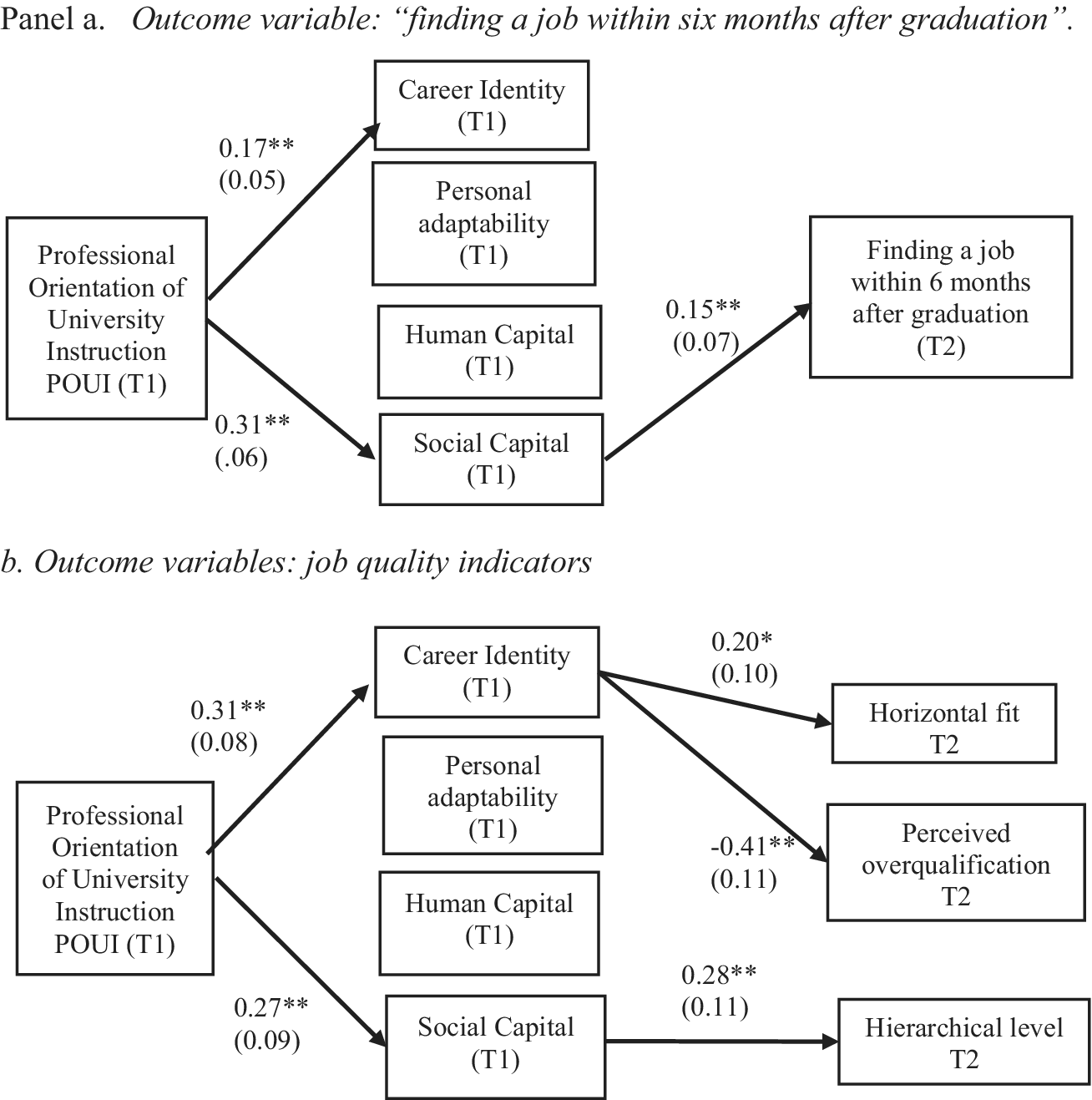
The results obtained for the hypothesized relationships are presented in Table 4 and summarized in Figure 2 (Panel A). As expected, POUI was positively related to career identity (B = 0.17, p < .01) and social capital (B = 0.31, p < .01). However, the relationships between POUI, on the one hand, and personal adaptability (B = 0.00, p > .05) and human capital (B = 0.03, p > .05), on the other, were not statistically significant. Thus, the results provided empirical support for Hypotheses 1a and 1d, but they did not support Hypotheses 1b and 1c.
Parameter estimates

Table 4. Long description
The table is organized with five columns. The first column lists relationships between variables, grouped into three sections: POUI at Time 1 to Employability dimensions at Time 1, Employability dimensions at Time 1 to Finding a job at Time 2, and Employability dimensions at Time 1 to Job quality at Time 2. The second and third columns show B coefficients and standard errors for the full sample. The fourth and fifth columns show B coefficients and standard errors for the employed sample. Significant coefficients are marked with one asterisk for p less than point zero five and two asterisks for p less than point zero one. In the first section, POUI to Career identity and POUI to Social capital are significant in both samples. In the second section, only Social capital to Finding a job is significant in the full sample. In the third section, Career identity to Horizontal fit, Career identity to Perceived overqualification, Personal adaptability to Perceived overqualification, and Social capital to Hierarchical level are significant in the employed sample. However, contrary to expectations, Personal adaptability to Perceived overqualification has a positive coefficient. Missing values are indicated by empty cells, which indicate that the effect was not studied in that sample. The note explains sample sizes, abbreviations, and significance thresholds.
Note: Full sample (N = 303). Employed sample (N = 144). B: unstandardized regression coefficients; SE = standard errors; POUI = professional orientation of university instruction; T1. Time 1; T2: Time 2.
*p < .05; **p < .01 (one-tailed).
Parameter estimates.
Note: The control variables included are not depicted for the sake of clarity. For the same reason, only the hypothesized relationships supported by the results are shown; non-supported relationships are shown in Tables 4 and 5. Unstandardized regression coefficients are displayed. Standard error values appear between parentheses. The four dimensions of employability were allowed to correlate. T1: Time 1; T2: Time 2. *p < .05; **p < .01 (one-tailed).

Figure 2. Long description
Panel a shows Professional Orientation of University Instruction P O U I at Time 1 on the left, with arrows to Career Identity (0.17, standard error 0.05, double asterisk) and Social Capital (0.31, 0.06, double asterisk), both at Time 1. Career Identity, Personal Adaptability, Human Capital, and Social Capital are aligned in the center. An arrow from Career Identity at Time 1 points to Finding a job within 6 months after graduation at Time 2 (0.15, 0.07, double asterisk). Panel b shows P O U I at Time 1 with arrows to Career Identity (0.31, 0.08, double asterisk) and Social Capital (0.27, 0.09, double asterisk), both at Time 1. Career Identity at Time 1 connects to Horizontal fit at Time 2 (0.20, 0.10, single asterisk) and Perceived overqualification at Time 2 (negative 0.41, 0.11, double asterisk). Social Capital at Time 1 connects to Hierarchical level at Time 2 (0.28, 0.11, double asterisk). All coefficients are unstandardized, standard errors are in parentheses, and asterisks indicate significance. The four employability dimensions are allowed to correlate.
Regarding the relationships between the employability dimensions and finding a job within 6 months after graduation, the estimates were statistically significant only for social capital (B = 0.13, p < .05). Thus, the results supported Hypothesis 5a, but they did not support Hypotheses 2a, 3a, and 4a.
Finally, we tested the hypothesized indirect effects of POUI on finding a job after graduation (Hypothesis 6a). For the sake of brevity, we focused on the only indirect effect in which the involved relationships were statistically significant: POUI → social capital → finding a job 6 months after graduation. The estimated indirect effect was 0.04 (SE = 0.024; 90% confidence interval (CI) = [0.004, 0.083]) and showed the expected sign. Moreover, the corresponding CI did not include the value of zero, which means that the indirect effect was statistically significant. Therefore, the results only partially supported Hypothesis 6a.
Job Quality Indicators
The hypothesized model on job quality indicators showed a satisfactory fit to data (χ2 = 26.65, df = 25, p = .37; RMSEA = .021; CFI = .99; SRMR = .045). We compared the fit of this model with the fit of a partial-mediation model that included the direct path from POUI to each of the three job quality indicators. The fit of this model (χ2 = 26.93, df = 22, p =. 21; RMSEA = .039; CFI = .98; SRMR = .044) was not better than the fit of the hypothesized model. The chi-square difference test of the two models using Satorra and Bentler’s (Reference Satorra and Bentler2010) scaled chi-square was 0.65 (df. = 3, p = .88). Therefore, the difference in fit between the two models was not statistically significant, and the hypothesized (more parsimonious) model was retained.
The estimates obtained for the hypothesized relationships are presented in Table 4 and Figure 2 (Panel B). As expected, for graduates who found a job after graduation, POUI was also positively related to career identity (0.31, p < .01) and social capital (0.27, p < .01). However, the relationships between POUI, on the one hand, and personal adaptability (0.04) and human capital (0.06), on the other, were not statistically significant. Thus, the results provided empirical support for Hypotheses 1a and 1d, but they did not support Hypotheses 1b and 1c.
Regarding the relationships between the employability dimensions and the job quality indicators, the results showed that only career identity and social capital were related to some of the job quality indicators, as expected. Career identity was positively related to horizontal fit (0.20, p < 05) and negatively related to perceived overqualification (−0.41, p < .01). Social capital was positively related to hierarchical level (0.28, p < .01). Contrary to our expectations, personal adaptability was positively related to perceived overqualification (0.44, p < .01). Therefore, we only found partial empirical support for Hypothesis 2b (involving career identity) and Hypothesis 5b (involving social capital). We found no empirical support for Hypothesis 3b (involving personal adaptability) or Hypothesis 4b (involving human capital).
Finally, we tested the hypothesized indirect effects of POUI on the job quality indicators via the employability dimensions (Hypothesis 6b). For the sake of brevity, we focused on the indirect effects in which the component relationships were statistically significant (i.e., POUI → career identity → horizontal fit; POUI → career identity → overqualification; POUI → social capital → hierarchical level). The indirect effect of POUI on horizontal fit via career identity was 0.06 (SE = 0.038; 90% CI = [0.007, 0.129]) (Completely Standardized Indirect Effect, CSIE = .05). The estimated indirect effect of POUI on perceived overqualification through career identity was −0.13 (SE = 0.05; 90% CI = [−0.056, −0.219]) (CSIE = −.08). The estimated indirect effect of POUI on hierarchical level via social capital was 0.08 (SE = 0.036; 90% CI = [0.024; 0.14]) (CSIE = .08). These three indirect effects showed the expected sign. Moreover, the corresponding confidence intervals did not include zero, which means that the three indirect effects were statistically significant. Therefore, the results obtained partially supported Hypothesis 6b.
Discussion
The goals of the present study were to ascertain whether the professional orientation of university instruction (POUI) is positively related to university graduates’ employability and examine whether the latter variable mediates the relationship between POUI and graduates’ early career outcomes. The results obtained provided partial empirical support for the hypothesized relationships. POUI was positively related to the employability dimensions of career identity and social capital. Moreover, the latter variable mediated the positive indirect relationship between POUI, on the one hand, and finding a job within 6 months after graduation and the hierarchical level of the graduate’s job, on the other. Additionally, career identity mediated the positive indirect relationship between POUI and horizontal fit and the negative indirect relationship between POUI and perceived overqualification.
Theoretical Implications
First, our study shows that POUI is positively related to two employability dimensions (career identity and social capital), and it provides a theoretical explanation for these relationships. One of the characteristics of POUI is that it provides students with information about future jobs and careers in the labor market. This information should foster reflection about who they want to be in the professional arena, helping them to shape and strengthen their career identity. This explanation is congruent with the results we obtained and those achieved with programs designed to increase career identity by providing career-related information and fostering reflection about one’s future career (Anakwe et al., Reference Anakwe, Hall and Schor2000; Freudenberg et al., Reference Freudenberg, Brimble and Cameron2009). POUI also promotes contacts between students, on the one hand, and professional associations and employers, on the other, fostering social capital. This is usually done by providing internships in organizations, inviting practitioners and professional associations to give seminars and teach practical subjects, and offering employers the opportunity to present their job openings. Moreover, POUI can promote the development of key professional skills, such as building social networks (Akkermans et al., Reference Akkermans, Brenninkmeijer, Huibers and Blonk2013), through professional and non-professional contacts. All this helps students to broaden their social networks, which contributes to increasing their social capital. Moreover, these activities can increase students’ awareness of the importance of networking for their professional careers (De Janasz & Forret, Reference De Janasz and Forret2008), as resources through social relations are only beneficial when these social relations are activated. For example, relevant information possessed by a job seeker’s social relation only becomes valuable when the job seeker discusses job searching with this social relation (Baay et al., Reference Baay, Van Aken, De Ridder and Van der Lippe2014). By promoting students’ networking skills, POUI can thus result in valuable additions to other sources of social capital that foster the school-to-work transition, such as family social capital (Broschinski et al., Reference Broschinski, Feldhaus, Assmann and Heidenreich2022).
Unexpectedly, POUI was not related to either personal adaptability or human capital. There are several explanations for these results. Assuming that personal adaptability is “primarily determined by individual differences (Chan, Reference Chan and Ferris2000) that predispose individuals to engage in (pro)actively adaptive efforts” (Fugate et al., Reference Fugate, Kinicki and Ashforth2004, p. 21), and that it shows certain stability across situations (Van Dam & Meulders, Reference Van Dam and Meulders2021), it is possible that improving personal adaptability requires a specific intervention program to provide participants with adaptability resources, such as exploring not only career options but also possible selves or anticipating career-related obstacles (Koen et al., Reference Koen, Klehe and Van Vianen2012). Koen et al. (Reference Koen, Klehe and Van Vianen2012) showed that these intervention programs can improve career adaptability. Regarding human capital, it is possible that the increase in human capital provided by POUI in the field of soft skills (i.e., teamwork, time management) is not salient enough to have as much of an impact as the increase in human capital (knowledge) in a specific field (e.g., chemistry) provided by non-professionally oriented university instruction.
Second, we identified two mediators (career identity and social capital) that help to understand how and why POUI is related to certain career outcomes (finding a job within 6 months after graduation, hierarchical level, overqualification and horizontal fit). Specifically, POUI is indirectly related to: (1) finding a job after graduation and hierarchical level via social capital and (2) horizontal fit and perceived overqualification via career identity. Identifying some of the mechanisms involved in the relationship between two variables contributes to advancing the knowledge and provides a more detailed explanation of the examined relationship (Mathieu et al., Reference Mathieu, DeShon and Bergh2008). Based on our study, we can say that we now have a theoretical explanation and some empirical evidence supporting the influence of POUI on graduates’ early career outcomes.
Third, among the job quality indicators we considered, perceived overqualification, being at the core of the notion of Person-Job fit (Erdogan & Bauer, Reference Erdogan and Bauer2021), has received the most attention in scholarly work in this domain so far. Our investigation contributes to this important area of research by extending the set of overqualification antecedents. We identified career identity as a direct antecedent of perceived overqualification. This result suggests that a strong career identity provides university students with the motivation to guide and maintain their job search behavior until they find a job that fits their qualifications. Moreover, the indirect effect of POUI on perceived overqualification via career identity suggests that contextual factors (e.g., the university instruction received) should be included in models that explain overqualification in university graduates. This finding is of high theoretical relevance as it supports the notion that fostering one’s career sustainability starts at the very first phase, that is, the school-to-work-transition, wherein shaping one’s career should be aimed at striving for aligning one’s personality with work- and career-related roles instead of merely striving for material rewards (cf. Career construction theory; Savickas & Porfeli, Reference Savickas and Porfeli2012, p. 661). In doing so, students increase their chances to find employment that fits with their values and career goals and wherein both their personal and work-related needs can be fulfilled. The latter is highly determinant for their happiness, health, and productivity (Van der Heijden, Reference Van der Heijden2005), being the three indicators of sustainable careers (De Vos et al., Reference De Vos, Van der Heijden and Akkermans2020; Van der Heijden, Reference Van der Heijden2005; Van der Heijden et al., Reference Van der Heijden, De Vos, Akkermans, Spurk, Semeijn, Van der Velde and Fugate2020). Considering the scarcity of research on antecedents of overqualification (Erdogan & Bauer, Reference Erdogan and Bauer2021), our study contributes to filling this gap in the literature.
Our findings also show that, contrary to our expectations, personal adaptability was positively related to perceived overqualification. A possible explanation for this result would be the following. In a labor market (Spain) where the unemployment rate for young (25–29 years) university graduates was high by the time of data collection (20%), personal adaptability, rather than helping graduates to find jobs with requirements that fit their qualifications, makes it easier for them to accept jobs for which they are overqualified because this is an easier and faster way to begin their professional careers. So, the unemployment rate could be a moderating factor for this relationship. Future studies should investigate whether there is a “dark side” of personal adaptability when it comes to clarifying its relationship with perceived overqualification and whether this relationship depends on the unemployment rate.
Finally, human capital, particularly generic competences, did not show a significant relationship with any of the employment outcomes under study. The absence of a significant relationship may reflect the less visible nature of generic competences at labor market entry. From a signaling perspective (Spence, Reference Spence1973), employers may rely more on observable indicators of human capital, such as training credentials or work experience, than on generic competences that require time and context to be demonstrated (Connelly et al., Reference Connelly, Certo, Ireland and Reutzel2011). In contrast, career identity and social capital may guide effective job search behaviors and provide immediate access to job opportunities, respectively, leading to positive shorter-term effects (Fugate et al., Reference Fugate, Kinicki and Ashforth2004). Future research should consider the relationship between generic competences and long-term career outcomes as well as additional indicators of human capital such as previous work experience, training credentials, and job-related competences.
Practical Implications
Two important assumptions of the European Higher Education Area (EHEA) are that improving future graduates’ employability contributes to a better professional career, and employability can be fostered by a more professionally oriented instruction at the university (EHEA, 2015). These two assumptions were partially supported by our results: POUI was positively related to two employability dimensions (career identity and social capital), which in turn were related to the early career outcomes considered. Therefore, our results provide some empirical evidence supporting university educational policies that foster professionally oriented instruction. Of course, providing students with basic academic training is essential for achieving good preparation. However, combining it with instruction with a clear professional orientation can improve their employability and early career outcomes. In doing so, university staff strives for the realization of a strong career learning environment, on top of a high-quality curriculum, enabling their graduates to develop a strong career identity.
There are several ways to implement a more professionally oriented university instruction. In this regard, collaboration with employers and professional associations is crucial (EHEA Ministerial Conference, 2015; Humburg et al., Reference Humburg, van der Velden and Verhagen2013). These agents can be invited to give seminars and lectures about different professional fields related to specific degree subjects. The information provided in these events can be useful for shaping future graduates’ career identity. Moreover, these events themselves provide a unique opportunity to make new contacts and increase future graduates’ social capital. University instructors also play an important role in implementing more professionally oriented instruction. As experience shows (Anakwe et al., Reference Anakwe, Hall and Schor2000; Freudenberg et al., Reference Freudenberg, Brimble and Cameron2009), instructors can provide project-based or challenge-based class activities as well as information about potential occupations and foster students’ reflections about their career-related values, needs, and motivations, thus helping them to develop and strengthen their career identity.
Limitations
First, the study sample was collected in a single university located in a specific country (Spain). The Spanish labor market presents some characteristics (e.g., high unemployment and overqualification rates) that make it a unique context. All this limits the generalizability of our results. Future studies should investigate whether the relationships observed here also appear in other countries. Second, the data were collected from the same source and by means of self-reports. Thus, common-method variance might have inflated the relationships observed. However, some study variables showed correlations close to zero, which suggests that common-method variance was not a serious concern. Third, some variables were measured with single-item measures (e.g., horizontal fit, hierarchical level), which might have affected the reliability of the corresponding data and the relationships with other variables. However, the correlations among all job quality indicators investigated (horizontal fit, hierarchical level, and perceived overqualification) were statistically significant and showed the expected sign. These results support the validity of our single-item measures. Moreover, Bergkvist and Rossiter’s (Reference Bergkvist and Rossiter2007) study suggests that single-item measures may be appropriate to measure specific attributes (such as horizontal fit and hierarchical level). Fourth, our predictor and mediator variables were measured at the same time, which precludes any causality conclusions based on the relationships observed and might have inflated these relationships. However, the close-to-zero correlations POUI showed with some employability dimensions (e.g., .05 with personal adaptability) suggest that this potential inflation did not occur. The fact that the early career outcomes considered were measured 6 months after graduation is a strength of our study. Finally, we focused only on a subset of job quality indicators. Future research should consider other relevant indicators of job quality, particularly job characteristics such as job autonomy, job meaningfulness, or work–life balance opportunities at work, to determine the extent to which POUI and personal employability also help young graduates find jobs with desirable characteristics.
Data availability statement
The data supporting the findings of this study are available from the corresponding author upon reasonable request.
Author contribution
A.H.: conceptualization, methodology, formal analysis, writing—original draft, writing—review and editing, funding acquisition. V.G.R.: conceptualization, methodology, formal analysis, writing—original draft, writing—review and editing, funding acquisition. J.P.G.: investigation, data curation, writing—original draft, writing—review and editing. B.I.J.M.H.: investigation, writing—original draft, writing—review and editing. P.M.B.: investigation, writing—original draft, writing—review and editing. A.H. and V.G.R. contributed equally to this work and share first authorship.
Funding statement
This work was supported by two research grants provided by (1) the Spanish Ministry of Economy and Competitiveness (MINECO) and the European Regional Development Fund (ERDF) (grant number PSI2013-47195-R) and (2) the Spanish Ministry of Economy and Competitiveness (MINECO), the Spanish State Research Agency (AEI), and the European Regional Development Fund (ERDF) (grant number PSI2017-86882-R).
Competing interests
The authors declare none.
Appendix
Items of the study scales.
Professional Orientation of University Instruction (POUI)
-
1. The practical training and internships carried out provide adequate preparation for professional practice.
-
2. Teachers show the relationship between the subjects’ content and professional practice.
-
3. Students receive sufficient information about the different professional opportunities their degree provides.
-
4. The teaching methods used facilitate the acquisition of professional competencies and skills.
Career identity
-
1. I strongly identify with my chosen line of work/career field.
-
2. I have a clear idea about where I want my professional career to go.
-
3. I do whatever I can to develop the professional career that I want to achieve.
-
4. I’m highly motivated to develop my desired professional career.
Personal adaptability
-
1. I am able to adapt to the changing circumstances of my environment.
-
2. I am able to effectively manage the changes that take place in my environment.
-
3. I am open to change.
Human capital
-
1. Oral and written communication skills.
-
2. Problem-solving skills.
-
3. Time and resource management abilities.
-
4. Capacity for teamwork.
-
5. Continuous learning, ongoing education, lifelong learning.
-
6. Capacity to take on responsibilities.
Social capital
-
1. I have an extensive network of friends who will help me to find job opportunities.
-
2. I have an extensive network of family members who will help me to find job opportunities.
-
3. I have an extensive network of professional contacts who will help me to identify job opportunities.
-
4. I have an extensive network of contacts in Internet social networks (Facebook, LinkedIn, etc.) who will help me to identify job opportunities.



 Open access

