


In 1508, just after the death of his wife, Liesbeth Aelgoet, a shipper and Ghent alderman named Jan Schoutheete appeared before the aldermen of the Gedele bench.Footnote 1 The purpose of his appointment was to have an inventory drawn up of his and his wife's belongings. This was common practice in the city, as it ensured that their children would see the rights to their parents' belongings honoured. The couple's wealth portfolio was similar to that of the other aldermen at this time: they held a few houses in the city, some landed property outside Ghent (in Munte and Voorde, two parishes south of the city), as well as some jewellery. The couple also owned annuities, including four that they had bought on the private market, which together yielded a little under two pounds Flemish a year.Footnote 2 One annuity yielding two pounds Flemish yearly was issued by the council of the Land van Rode, a fiefdom near Alost. Finally, like many members of the town council, they owned annuities issued by the city of Ghent. For this long-term loan to the city, the pair received a fixed interest payment of two pounds Flemish a year, secured by revenues from urban taxation.Footnote 3
In 1596, at the end of the sixteenth century, the wife of alderman Jan Jooris, Margriet Ackaert, also appeared before the bench of aldermen after the death of her husband. Again, an inventory was drawn up. The couple's wealth portfolio was similar to other inventories recorded at the end of the sixteenth century: they possessed a house in the city, real estate outside Ghent, jewellery, gold, silver and annuities. However, in their case, no annuities issued by the city of Ghent were part of their wealth portfolio. This is not an isolated example. In general, one finds fewer and fewer urban annuities in the town magistrates' inventories by the end of the sixteenth century and into the seventeenth century.Footnote 4
Although various elements have to be taken into account in seeking an explanation for this evolution – economic changes, new investment opportunities, declining profitability of annuities due to inflation, and changes in the institutional framework – I will claim here that a major explanation for the reluctance to invest in urban annuities was related to the changing profile of the city's political elite. In the early sixteenth century, Jan Schoutheete belonged to an established power elite that typically decided when to issue annuities, at what interest rate they would be sold and how interest would be guaranteed.Footnote 5 This power elite had also prioritised selling annuities to urban politicians whom they knew. By contrast, Jan Jooris, living at the end of the sixteenth century, belonged to a group of political newcomers who had never been embedded in this political and financial nexus.
In this article, I examine the changing composition and social profile of Ghent's political elite in order to understand the participation of urban leaders in the city's market for public credit. My aim is to provide an additional variable to help understand why political elites did – or did not – invest in urban public debt. My argument is that the decision whether or not to purchase urban debt was linked to membership and to the power structures of Ghent's benches of aldermen, which themselves had resulted from a series of institutional, economic and religious transformations. These transformations had brought to power a substantial group of political newcomers with a fundamentally different attitude towards managing the public debt. The old urban elite, which consisted of urban patricians – referred to as the poorterij – and craft guilds, favoured selling annuities to fellow urban politicians and their allies. By contrast, the new urban notables – the group of political newcomers that became dominant at the end of the sixteenth century – had much more of a market-oriented attitude in managing urban debt, and largely refrained from investing in urban annuities themselves.
I will develop this argument along four lines. In Section i, I discuss the importance of annuities as a credit device in the cities of the Low Countries. In Section ii, I focus on the investment behaviour of urban political elites in the market for public debt, thereby critically examining earlier historical explanations of investment behaviour on the part of the elites. In the third section, I argue that, in the case of sixteenth-century Ghent, changes in the power structure of the elites are a more convincing explanation for understanding their financial activity than models based on morality, political strategy or economic reasoning. In Section iv, I extensively analyse investments by urban elites in urban public debt and use the changing composition of the urban political elite to explain shifting attitudes towards debt management in Ghent's benches of aldermen. Section v summarizes and concludes.
The findings presented in this article are based on a new dataset, which contains information on the city's officeholders as well as their investments in urban public debt. In order to reconstruct the lives and practices of the urban political elite, I have relied on original sources that list Ghent's officeholders.Footnote 6 To reconstruct the extent to which the city's political elites invested in urban annuities, I have studied the city's accounts that list the names of annuity purchasers, the sums of their investments and the interest rates.Footnote 7 I have limited the data sampling to Ghent's three largest annuity sales, namely 1521–2, 1540–1 and 1585–94.
I
The financial markets in the sixteenth-century Low Countries were among the most developed and efficient in northwestern Europe, allowing a variety of social groups to lend and borrow (Hanus Reference Hanus2009; Van Zanden, Zuijderduijn and De Moor Reference van Zanden, Zuijderduijn and de Moor2012; Zuijderduijn Reference Zuijderduijn2009). Urban officeholders were especially active in the market for urban debt. In late fifteenth-century Bruges, for instance, the major investors in annuities belonged to the political elites (Derycke Reference Derycke, Boone, Davids and Janssens2003, pp. 176–7). In Dordrecht, during the 1555 annuity sale, urban officeholders and their relatives made up 48.4 per cent of the investors in urban public debt. In 1572, during the Revolt, the Dordrecht rulers and their relatives accounted for 58.1 per cent of the investors. In 1604, 60 per cent of the investors in annuities were urban officials or their relatives (van der Heijden Reference van der Heijden, Boone, Davids and Janssens2003, p. 194; Reference van der Heijden2006a, p. 167). In sixteenth-century Haarlem and Zwolle, political elites and their relatives accounted for respectively 55 per cent and 66 per cent of the investors in urban annuities (van der Heijden Reference van der Heijden2006a, p. 167; 2006c, p. 127). In Amsterdam, the urban politicians' share in the credit market was somewhat less predominant than in the other cities of the Low Countries. Between 1542 and 1565, 35 per cent of the annuities were sold to the city's political leaders. Between 1584 and 1604, this figure dropped to 22 per cent, although they still accounted for no less than 38 per cent of the total investment (van der Burg and 't Hart Reference van der Burg, 't Hart, Boone, Davids and Janssens2003, p. 210). In the city of Den Bosch, 62 per cent of the aldermen were active investors in annuities (Hanus Reference Hanus2004, p. 143). Finally, the political elite of late fourteenth- and early fifteenth-century Antwerp dominated the city's public annuity market (Cannelloni Reference Canneloni, Zuijderduijn and Raeymaekers2015, pp. 82–3). Later, during the seventeenth century, members of the Antwerp council accounted for 22 per cent of the investors and for 31 per cent of the investment in the urban public debt (De Vijlder and Limberger Reference de Vijlder and Limberger2014, pp. 317–19).
The urban rulers not only invested in annuities, but they also decided when to issue these annuities, how many they could bring on the market and what the interest rate would be. Annuities were issued for various reasons: to finance large infrastructural works (van der Heijden Reference van der Heijden2006b, p. 441), to cover existing urban debt, or to ensure the cash flow from the city to the state's coffers. In this article, I will focus on the latter. The 1521–2 annuity sale was organised to finance Emperor Charles V's war against the French Valois dynasty. In contrast with France and England, where monarchs successfully imposed direct taxes on their citizens in order to finance warfare (Bonney Reference Bonney1981, p. 13; Reference Bonney and Bonney1999, pp. 133–4; Gelabert Reference Gelabert and Bonney1995, pp. 544–5, 549, 550–1, 562; Henneman Jr Reference Henneman and Bonney1999, p. 149; O'Brien and Hunt Reference O'Brien, Hunt and Bonney1999, pp. 60–1), the rulers of the Low Countries had to rely on the cities for cash. They could accomplish this by requesting beden, which are financial requests by the ruling dukes and princes (Blockmans Reference Blockmans and Bonney1999, pp. 284–8; van der Heijden Reference van der Heijden2006b, pp. 432–3). According to the customs of the principalities that composed the Low Countries, princely rulers could not impose taxes without the permission of the citizens, who were represented through their political leaders in the Estates. Usually, the Estates acceded to financial requests from the central authorities in return for new political privileges or the confirmation of existing ones (Blockmans Reference Blockmans and Blickle1997, p. 269). For the County of Flanders, for instance, the princely authorities had to negotiate with the Flemish Estates, in which the Four Members of Flanders were represented: the towns of Ghent, Ypres and Bruges as well as the Franc of Bruges (the countryside around Bruges). Once the Four Members and the princely administration had reached an agreement on the amount of the financial contribution, this sum was divided between the different cities and rural villages of the County according to a fixed quota. The local authorities, in their turn, could choose to raise these sums by issuing annuities.
The state also had other ways to secure urban resources. In the particular case of Ghent, where rebellions against the prince were frequent (Blockmans Reference Blockmans and Koenigsberger1988; Boone Reference Boone, Prak, Davids and Lucassen1995; Dumolyn and Haemers Reference Dumolyn and Haemers2005), the state often fined the town as a punishment for such revolts. One of the ways to finance these fines was by issuing annuities. On the one hand, this ensured the cash flow from the city to the state's coffers, and on the other, it weakened the city's power vis-à-vis the state administration. The Burgundian dukes first employed this fining mechanism in the second half of the fifteenth century: after the Ghent Revolt of 1449–53, the dukes fined Ghent 17.5 million Flemish groats (henceforth: Fl. Gr.), or the equivalent of 3.5 million summer's day wages of a mason (Dambruyne Reference Dambruyne2002, p. 395; Prevenier and Boone Reference Prevenier, Boone and Decavele1989, pp. 101–3). The urban government decided to finance this payment by issuing annuities between 1453 and 1455 (Ryckbosch Reference Ryckbosch2007, pp. 245–61). In the sixteenth century, the Habsburg princes followed in the Burgundians' footsteps: they fined the city in the aftermath of the 1540 Rebellion and the Ghent Calvinist Republic (1577–84), and the city council saw no alternative other than to issue annuities to ensure the payment of these fines.
Whether by negotiations or fines, the Burgundian dukes and their Habsburg successors secured a cash flow from the cities of the Low Countries. Usually, the urban rulers issued annuities to ensure these payments. They could sell perpetual annuities, on which interest was paid until the capital value was redeemed, or life annuities, in which case the interest payments ended when the buyer passed away. Life annuities could be sold on one life, with only a single creditor receiving an interest payment, or on multiple lives, in which case more than one individual received a yearly interest payment (for instance, a father purchasing urban debt for himself and his wife, son, or daughter). Not only in the Low Countries, but also in France and on the Iberian Peninsula, annuities became the credit device par excellence to ensure payments to the ruling monarchs, princes or dukes (Boone Reference Boone1990b, pp. 57–60; Decelle Reference Decelle2010b, p. 341; Marsilje Reference Marsilje1985, pp. 285–8; Tracy Reference Tracy, Boone, Davids and Janssens2003, pp. 16–20; Van Nieuwenhuysen Reference van Nieuwenhuysen1984, pp. 361–2; Zuijderduijn Reference Zuijderduijn2009, pp. 141–2). In order to guarantee the interest payments on these annuities, the urban authorities opted to increase indirect taxation – assizes – on mass consumption goods, especially on beer (Boone Reference Boone1991, p. 5; 1997, pp. 246–7; de Vries and van der Woude Reference de Vries and van der Woude1997, pp. 92–3; Limberger Reference Limberger, Andrés Ucendo and Limberger2012, pp. 142–3; Pezzolo Reference Pezzolo and Dursteler2013, 270; 't Hart Reference 't Hart, 't Hart, Jonker and van Zanden1997, p. 34; van der Heijden and van der Burg 2012, p. 157). Thus, the financial burden of the system fell indirectly on the lower and middle classes.
II
Financial historians have devoted considerable attention to the fact that many urban officials invested in urban debt, and also to their reasons for doing so. The two most important factors they have identified are the elite's investment rationale and the nature of prevailing institutional structures.
With respect to the elite's rationale, historians have pointed out that political elites often had political and economic motivations for investing in urban annuities. From a political point of view, it was considered wise to invest in urban debt, as it could increase one's power within the city. In fifteenth-century Bruges, for instance, a small group of major investors who held offices in the urban government or were involved in the administration of public finances invested massively in urban public debt to strengthen their power position within the city (Derycke Reference Derycke, Boone, Davids and Janssens2003, pp. 177, 181). In Dordrecht as well, investing in urban annuities could bolster an individual's power in the urban administration: in return for their investment, the magistracy granted major investors trade agreements, lucrative offices or tax farming (van der Heijden Reference van der Heijden2006c, pp. 135–6). Other authors have gone a step further and suggested that investing in urban public debt gradually intertwined the financial interests of the urban elites with those of the state. By buying annuities, urban dwellers increasingly bound up their own finances with those of the central administration. This point has been made for Ghent, where, during the second half of the fifteenth century, urban politicians deliberately bought urban debt to underscore their loyalty to Burgundian rule (Boone Reference Boone1997).
From an economic point of view, it has been argued that urban rulers bought annuities because of economic incentives (van der Heijden Reference van der Heijden2006c, p. 127), but there is some debate as to how this mechanism actually worked. On the one hand, there is the case of Dordrecht. In 1572, at the beginning of the Dutch Revolt, the urban elites of Dordrecht invested massively in urban annuities. Although this proved to be an era of political and military uncertainty, the prospect of higher interest rates due to the unfavourable political situation encouraged the members of the town council to invest in urban debt (van der Heijden Reference van der Heijden, Boone, Davids and Janssens2003, pp. 193–5). Yet a recent analysis by De Vijlder and Limberger, published in this journal, suggests exactly the opposite (De Vijlder and Limberger Reference de Vijlder and Limberger2014). Starting from the case of Antwerp, they argue that the town council abstained from purchasing urban annuities during the height of the Spanish War of Succession, and provided barely 5 per cent of the total investment (De Vijlder and Limberger Reference de Vijlder and Limberger2014, p. 318). It seems logical to assume that town magistrates had similar goals in Dordrecht and Antwerp, namely to try to earn as much profit as possible in the market for urban public debt. Yet the two elites behaved differently: while the urban rulers of Dordrecht invested heavily during times of political uncertainty caused by warfare, the Antwerp officials kept their purses closed.
Rather than looking at a political or economic rationale, the institutional school explains investment behaviour by focusing on the impact of institutional adaptations on investment behaviour. As a rule, inclusive governance led to broader participation in the market for urban credit, whereas in oligarchical systems of governance, access to public debt was limited to an inner circle of relatives, friends and allies of the ruling elite. So North and Weingast (Reference North and Weingast1989) argued that in seventeenth-century England, more representative forms of government would eventually broaden access to the market for public debt. More recently, Stasavage argued that representative assemblies were more successful in gaining access to public credit (Stasavage Reference Stasavage and Caselli2008, p. 238; Reference Stasavage2011). In other words, the more open and participative a political system is, the greater numbers of non-political investors in urban debt it will attract. Conversely, in a closed and oligarchic political system, the majority of investors in annuities were members, relatives and allies of the ruling oligarchy. For instance, the Florentine Medici regime witnessed the rise of ‘a typical system of borrowing associated to a personal rule’ (Pezzolo Reference Pezzolo and Dursteler2013, p. 74). Here, a narrow group of rulers and their allies lent to the regime at high interest rates of up to 16 per cent (ID).
A variable that has gone unnoticed in most explanations of the political elite's investment in urban public debt is the way that the changing composition and social profile of the ruling elites affected their investment behaviour. Over the past decades, social historians have emphasised that the composition of elite groups was changing continuously (a few examples of this emerging literature are Buylaert Reference Buylaert2015; Sacks Reference Sacks1991; Tittler Reference Tittler1998). It is striking that financial historians studying the investment behaviour of urban elites failed to take into account this important historiographical development. This is an interesting observation, given that a change in the social outlook of the ruling group could be one of the main variables to explain the willingness of town magistrates to invest in urban annuities. With this hypothesis in mind, I propose social change in the benches of aldermen as an additional variable that helps us to understand the elites' investment behaviour. My argument is not that we need to abandon the models based on rational thinking or institutional adaptations, nor do we have to ignore the political situation, business cycle or alternative investment opportunities at a given time. Rather, I would suggest that by also taking into account the changing social profile of the urban rulers, we might better understand their behaviour in the markets for urban public debt.
III
I would like to illustrate the relation between the changing composition and profile of a ruling elite and their investment behaviour by examining a town council that witnessed intensive social transformations, namely that of sixteenth-century Ghent. The changing outlook of the town council was the result of three transformations, which were of an institutional, economic and religious nature, respectively.
First, the institutional framework that regulated urban politics in the city was adapted three times over the course of the sixteenth century (Boone Reference Boone1990a; Blockmans Reference Blockmans1978, pp. 71–4; Reference Blockmans1987, pp. 76–7; Decavele Reference Decavele1990, pp. 135, 141–5; Prevenier and Boone Reference Prevenier, Boone and Decavele1989, pp. 88, 94). Political power in the city had originally been divided between three political groups by the Three Members System: the urban patricians (the poorterij), the economically dominant weavers' guilds and, finally, the 53 smaller guilds (the so-called kleine neringen). In this system, the total of 26 seats in Ghent's two benches of aldermen – 13 in the Keure-bench and 13 in the Gedele-bench – were distributed as follows: three seats per bench were reserved for the poorterij, five seats for the weavers, and the remaining five seats in each bench were reserved for the kleine neringen. These aldermen were elected by four herekiezers, who were appointed by the monarch, and four stedekiezers, who were chosen by the aldermen.
The Three Members System existed until 1540, when it was abolished due to the Concessio Carolina, the punishment meted to Ghent by emperor Charles V for its rebellion between 1537 and 1540 (see Decavele and Van Peteghem Reference Decavele, van Peteghem and Decavele1989, pp. 107–13). From that moment on, power was no longer divided between the poorterij, weavers and kleine neringen. By means of these reforms, the emperor was able to curtail the power of the politically important craft guilds, which generally defended urban liberties against the increasingly powerful Habsburg administration. The reforms also enabled those urban dwellers who belonged neither to the poorterij nor to one of the craft guilds to participate in urban politics. In the literature, this group is referred to as the new urban notables or nieuwe stadsnotabelen (Dambruyne Reference Dambruyne2002). Between 1577 and 1584, during the era of the Ghent Calvinist Republic, the Three Members System was briefly reintroduced. However, in 1584, Habsburg commander Alexander Farnese put an end to the Republic and once again abolished the Three Members.
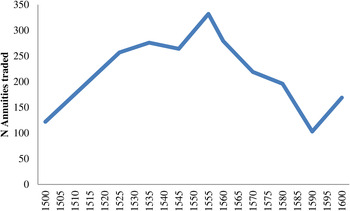
Second, economic changes had an impact on the social profile of the city's aldermen. During much of the sixteenth century, the economy of the Low Countries was booming (Blondé and Hanus Reference BLONDé and Hanus2010, p. 180; Blomme and van der Wee Reference Blomme, van der Wee, Maddison and Van der Wee1994). In order to reconstruct the evolution of Ghent's economy, Johan Dambruyne used the number of traded annuities as a proxy: in times of economic growth, the demand for capital, and thus for annuities, increased because of the need to finance businesses. Hence, an elevated number of traded annuities reflects economic growth. During an economic recession, the opposite was true: businesses no longer needed large amounts of new credit, resulting in a decline in the number of traded annuities (Dambruyne Reference Dambruyne2001, pp. 125–9). Starting from this assumption, Dambruyne showed that until 1555, the economy was growing, meaning that much revenue could be drawn from investments in goods and services, the economic activities with which the craft guilds accumulated their wealth. After 1555, however, the economy declined, hitting an all-time low around 1590 (see Figure 1).
Growth and decline of Ghent's economy during the sixteenth century

Ghent's economic decline resulted in pronounced socio-economic polarization in the ranks of Ghent's craftsmen-aldermen. As a reconstruction of the tax assessments shows,Footnote 8 many of the politically active families witnessed a decline in wealth before leaving the town council. Others, such as the Everwijn family, leaders of the wealthy shippers' guild, saw both their political power and wealth increase significantly.
Third, along with economic polarization due to the recession, sixteenth-century Ghent saw an increase in the religious antagonism between Catholics and Calvinists (see Arnade Reference Arnade2008, pp. 125–65; Bauwens Reference Bauwens2016; Decavele Reference Decavele1975; Despretz Reference Despretz1963). During the 1560s, religious quarrels intensified into the Iconoclastic Fury, in which radical Calvinists destroyed no fewer than seven churches, 25 cloisters, ten hospitals and seven chapels. Ultimately, such religious antagonism had led to the creation of the Ghent Calvinist Republic (1577–84). The Calvinist-inspired craft guilds, in particular, gave political support to this short-lived Republic. Calvinists held no fewer than 72 out of 200 offices reserved for the craft guilds (both the weavers' guild and the kleine neringen).Footnote 9 Some Calvinist poorterij families, such as the Van Hembieze and Utenhove families, also provided extensive support for this Republic. In the long run, being a Calvinist had severe political consequences: typically, Calvinist politicians failed to obtain a political office after the crushing of the Republic in 1584. Eventually, they were replaced by politicians – both established members and newcomers – with a strong Catholic background.
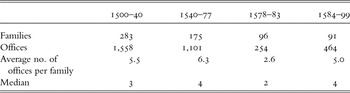
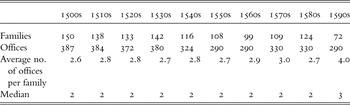
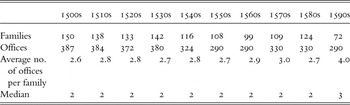
The restoration of power in 1584 did not bring the elite of 1540–77 back to the benches of aldermen. On the contrary, a group of political newcomers now held the power in the city. Institutional changes had resulted in a group of new urban notables becoming increasingly powerful at the expense of the guild families. The consequence of the economic recession was that impoverished families were no longer able to devote their time to the unpaid activity of urban politics. Finally, the 1584 Catholic backlash against Calvinism meant that families that had chosen a Calvinist affiliation were no longer considered eligible for public office. These changes also significantly restricted the pool from which potential urban officeholders were recruited. While in the first decade of the sixteenth century, 150 families contributed their members to Ghent's urban political world, this number dropped to barely 72 families during the last decade. Similarly, those families that were politically active were able to hold more offices at the end of the sixteenth century than they did at the beginning (Tables 1 and 2).
Families involved in urban politics per institutional era

Sources: Vander Meersch Reference Vander Meersch1852–61; Ghent City Archives, Series 101, List of Aldermen, nos. 4, 5, 7; own calculations.
Families involved in urban politics per decade
Sources: Vander Meersch Reference Vander Meersch1852–61; Ghent City Archives, Series 101, List of Aldermen, nos. 4, 5, 7; own calculations.
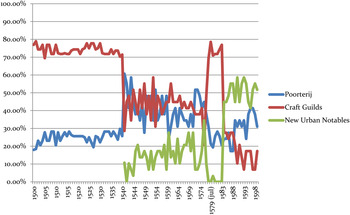
Not only did Ghent evolve from an inclusive to an exclusive system of urban governance, but the social profile of the leading families changed as well (Figure 2). Until 1540, the craft guilds (weaver's guild and kleine neringen) dominated urban politics, holding four times as many offices as the members of the poorterij. However, as a consequence of the Concessio Carolina, the guilds saw their political power decrease: the poorterij became more influential and the new urban notables made their first appearance in urban politics, gradually increasing their power. After the fall of the Ghent Calvinist Republic, the composition of Ghent's benches of aldermen changed radically. The craft guilds lost their political hegemony, while the new urban notables filled the seats emptied by the craftsmen-aldermen, making them the dominant group in urban politics. The poorterij more or less consolidated their political power. In the following section, I explain how this changing profile of the Ghent political elites influenced the magistracy's public debt management.
Division of offices between the poorterij, the craft guilds and the new urban notables

IV
A combination of political, economic and religious transformations in sixteenth-century Ghent forged a new political elite. By the end of the century, its membership was chiefly drawn from a far more restricted number of families and was mainly composed of political newcomers. This change in both the size and identity of the city's political elite had an impact on the extent that the leading establishment invested in urban public debt. Let us first focus on investments by politicians in Ghent.
Three extensive annuity sales took place during the sixteenth century, the first in 1521–2, the second in 1540–1, and the last sale between 1585 and 1594. In choosing to focus on these three sales, I have taken into account three out of four of Ghent's largest annuity sales. I have omitted the annuity sales of the 1560s because they were organised for entirely different purposes: while the annuity sales studied in this research were organised to ensure the cash flow from the city of Ghent to the Habsburg authorities, the various smaller sales of the 1560s were meant to cover Ghent's existing debts (Decelle Reference Decelle2010b, pp. 352–61). Of course, selling annuities was not limited to the sixteenth century: Ghent's authorities had already begun to sell both life and perpetual annuities as early as the thirteenth century (more specifically in 1275 and 1288; see Van Werveke Reference van Werveke1934, pp. 283, 289).
The political elite's investment in annuities underwent a marked decline throughout the course of the sixteenth century (Table 3). In 1521–2, when the city issued annuities to finance the Habsburg war against France, the city's officeholders accounted for 27 per cent of the investors and contributed 27 per cent of the capital for this annuity sale. If we also include their relatives, using the surname as a criterion, the urban politicians and their relatives contributed over half of the capital in this sale. This approach admittedly excludes the investors' wives and in-laws. The reason for this omission is that we currently lack information about marriage partners of the political elites. Thus, the figures presented in Table 3 represent an absolute minimum.
Ghent's urban politicians and their relatives as investors in annuities

Sources: Ghent City Archives, Series 400, City accounts, nos. 44, 48–9, 95–103; own calculations.
After Ghent's rebellion in 1540, the city was fined 4,224,000 Fl. Gr. and an additional 896,000 Fl. Gr. in 1541. By selling new annuities, the magistracy was able to raise more than half of this sum. The other half was borrowed by Antwerp merchants and by means of a forced, non-interest-bearing loan (Dambruyne Reference Dambruyne2002, p. 459). Compared to the sale of 1521–2, the urban political elites were less keen on participating in the annuity sale of 1540–1. For the most part, they invested only a small share of their wealth in the annuities issued in the wake of the 1540 institutional reforms. Consequently, political elites represented only 18 per cent of the creditors in 1540, and their share in the raised sum declined to 23 per cent, or 39 per cent if we also include their relatives.
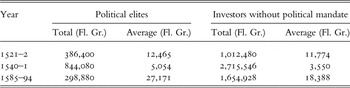
Finally, in the aftermath of the Ghent Calvinist Republic, the city leaders raised 2 million Fl. Gr. by selling annuities to help finance a fine of 24 million Fl. Gr. This annuity sale, which took place between 1585 and 1594, attracted a historically low number of urban politicians. Only 11 per cent of the investors in urban public debt were among the city's officeholders, accounting for barely 15 per cent of the investment, or 26 per cent when taking their relatives into account. However, the average sum invested by this small number of urban politicians was considerably higher than that at the beginning of the sixteenth century. While the average investments of the political and non-political groups were largely similar at the beginning of the sixteenth century, by the end of the century, the gap between these two groups had increased significantly (Table 4).
Comparison of the investments made by political and non-political creditors

Sources: Ghent City Archives, Series 400, City accounts, nos. 44, 48–9, 95–103; own calculations.
Because the sharp decline in the elite's investment in annuities took place well before the economic recession of the 1570s and 1580s, an explanation based merely on the thesis that the political elites withdrew from the credit market in times of economic hardship would not work for the Ghent case. Emphasising political strategy does not really work, either. The 1540 Concessio Carolina abolished the city's age-old political framework, challenging the craft guilds' and poorterij's secured access to political power. If one were to follow the line of argument based on political rationality, one would expect that the elites would invest considerably more in urban debt in order to increase or consolidate their prominence in urban politics. Yet they did just the opposite and abstained from a massive investment in annuities. Similarly, one could argue that the political elites would invest heavily in urban debt, because they felt morally obliged to do so since their city had to make a major financial effort. Once again, the rather modest sums they devoted to purchasing annuities between 1540 and 1541 suggest exactly the opposite. Finally, the parallel trend towards oligarchy in Ghent's urban politics and declining participation of the political rulers in the market for annuities goes against the grain of the institutional thesis. As Ghent evolved from an open, representative system of urban government to a more closed, oligarchic system, the share of non-political investors increased significantly. In other words, purchasing urban debt no longer was the exclusive privilege of urban rulers but became accessible to all.
Neither an explanation based on the ruling elites' political and economic thinking nor an institutional model based on the openness of a political system can be reconciled with the investment pattern of Ghent's aldermen. An alternative explanation for these remarkable shifts in the political elites' investments may be found in the social changes that took place in the benches of aldermen.
In part, the declining participation of the political elites as investors in urban public debt is a reflection of the smaller number of urbanites involved in urban politics. While there were 31 political investors in 1521–22, this number declined to eleven by the end of the sixteenth century. However, there was more at stake than a mere reduction in the number of urban politicians: the changing social configuration of Ghent's aldermen meant that new practices were introduced with respect to issuing annuities. We can see these clearly if we compare the annuity sale between 1521 and 1522 with the two following sales. Before 1540, when the poorterij and craft guilds were firmly in control, the political elite deliberately tried to reduce access to the urban credit market for groups that were not embedded in the political networks. When annuities were issued between 1521 and 1522, the politicians purchased 30 of the 72 annuities sold during the first year (42 per cent), and only 14 of the 75 annuities sold during the second year (19 per cent). In terms of cash, they provided 274,560 Fl. Gr. in 1521 and 111,840 Fl. Gr. in 1522. These figures suggest that during the Three Members era, Ghent's political rulers first sold annuities to those who belonged or had belonged to the city's political establishment, and only broadened this circle in a later phase of the sale to include individuals without access to the political networks.
This pattern changed after 1540, when the Three Members System was abolished, and more dramatically after 1584, when the new urban notables rose to power. Between 1540 and 1541, the broadest annuity sale in Ghent's history took place: no fewer than 932 investors were found, 167 of them belonging to the city's political networks. The combination of political and non-political investors contributed over 3.5 million Fl. Gr. to the city's coffers (Table 3). Although there were more investors that belonged to the city's political elite, those same investors were much more reluctant to invest in urban annuities than had been the case between 1521 and 1522. Whereas in the 1520s, the urban rulers and their relatives enjoyed first-choice access to the annuities, this was no longer true in the 1540s. This is reflected in the far lower number of annuities purchased by urban politicians during the first year of the sale: in 1540, they bought 244 of the 969 annuities (or 25 per cent, compared to 42 per cent in the previous sale), while they purchased 55 out of 325 annuities (or 17 per cent) in the following year. Moreover, the ruling elites only invested modest sums in urban debt, especially when compared to the previous annuity sale (Table 4). While the elite had on average contributed 12,000 Fl. Gr. in the 1520s, they only invested sums around 5,000 Fl. Gr. between 1540 and 1541. To some extent, we can explain the hesitation on the part of the political elites to invest intensively in urban debt by looking at the insecurity after the 1540 reforms. Now that the power of the established elites was no longer ensured by the Three Members System, and as political neophytes gained access to power, established members of the political elite were reluctant to make major investments in urban debt. At the same time, however, we can presume that the size of the fine imposed by the Habsburg authorities may well have forced the city's leadership to broaden access to non-political groups in order to raise the necessary sums.
The low point in the number of politicians investing in urban annuities can be seen in the sale that took place between 1584 and 1595. This is partially explained by the fact that new investment opportunities were available by the end of the sixteenth century: by that time, cheap credit increasingly allowed urbanites to invest in landed property (Devos, Lambrecht and Paping Reference Devos, Lambrecht, Paping, Vanhaute, Devos and Lambrecht2011, p. 172). Although the price of landed property has not yet been researched for sixteenth-century Ghent, evidence from other cities suggests that wealthy urbanites made major investments in land situated in the nearby countryside at the end of the sixteenth century and in the centuries to follow (Degryse Reference Degryse2005, pp. 214–24; Soly Reference Soly1977, pp. 67–8). However, the changing social profile of Ghent's aldermen also had a considerable impact on investment behaviour. By the time annuities were sold between 1584 and 1595, the composition of Ghent's benches of aldermen had changed fundamentally from what it had been in the early sixteenth century. The group of political newcomers had become the dominant political force in the city, holding considerably more seats in the benches of aldermen than the poorterij and the craftsmen-aldermen. This reconfiguration of the political elite resulted in new investment patterns. Even though the town council had already started selling the annuities in 1585, members of the political elite bought most of their annuities only five years later: nine annuities were sold to urban politicians in 1585, raising 63,520 Fl. Gr., one in 1587 raising 16,000 Fl. Gr. and, finally, 31 in 1590, raising 219,360 Fl. Gr. These figures illustrate how the political newcomers managed public debt. While the rulers in the first half of the sixteenth century prioritised selling debt to members of the political network, the rulers at the end of the century had adopted more of a market-oriented attitude, letting the market do its thing first, and only stepping in themselves if insufficient capital for credit was secured in the free market.
One could argue that it was the Wars of Religion in the Low Countries during the second half of the sixteenth century and the resulting political instability that made the ruling urban elite reluctant to invest heavily in urban pubic debt. Yet, an analysis of investment behaviour per political group suggests, instead, that it was the influx of new rulers that had brought new practices of debt issuance to the town council. This can be confirmed by focusing on the exact moment when the poorterij, craftsmen-aldermen and new urban notables purchased their annuities. Of the nine annuities sold to members of the political elite in 1585, four were obtained by members of the craft guilds (Gillis Brecht and Lieven Sanders), three by Filips Triest, a member of the poorterij, and only two by the group of new urban notables, namely Jan de Castille and Jacob Taccoen. Gillis Brecht, a craftsman, bought an annuity again in 1587, while the other groups abstained from investing. Only in 1590 did the new urban notables step in, ensuring that sufficient cash would be raised. During that year, 25 annuities were sold to new urban notables, accounting for 167,520 Fl. Gr. – which is 56 per cent of the investment provided by the urban political elites between 1585 and 1594. The poorterij politicians Jan Bette and Frans Borluut bought a total of five annuities, while craftsman Gillis Brecht again purchased one annuity. The timing of the investment on the part of the political elites thus illustrates a fundamentally different attitude towards debt management. While the old elite invested immediately in urban annuities as they became available and granted privileged access to their own political and family networks, the new urban notables sought out investors outside the benches of aldermen first, and only stepped in themselves when they could not raise sufficient liquid means in the free market.
V
In this article, I have argued that changes in the power structure led to different attitudes towards investments in urban public debt. In explaining the urban elite's investment behaviour, (financial) historians have focused mostly on the impact of institutional changes, political motivations, economic tendencies and new investment opportunities on the decision whether or not to invest in annuities. In this article, I have proposed that changes in the composition of the urban leadership are an important complementary element to help us understand investment behaviour on the part of the elites. When studying urban magistracies that had undergone a profound change in the composition of their benches of aldermen, we need to seriously consider the concept of social change as an explanatory factor for the elite's investment behaviour, even while fully acknowledging the political, economic and institutional context.
I have tried to make my case by focusing on the political elite of sixteenth-century Ghent. Here, the changing composition of the benches of aldermen and the influx of political neophytes resulted in shifting practices of debt management. While the old political rulers of the city – namely the poorterij and the craft guilds – prioritised their sales of annuities to individuals belonging to the political networks of their time, the group of new urban notables that came to dominate urban politics after 1584 adopted more of a pro-market attitude. They gave priority to non-political investors in the free market, and only stepped in as purchasers when they were unable to find a sufficient number of outside creditors. At the heart of this article is the observation that substantial changes in the composition of Ghent's benches of aldermen, caused by changes in the city's political and economic structure, could result in a profoundly new attitude towards public debt management.
As I have highlighted, models based on morality or political and economic strategy fail to explain the declining participation of Ghent's political elites in the public credit market. While the morality line of argument holds that urban rulers would support their city in times of need, this was not the case in Ghent. Rather, the political elite limited their investment after the turbulent events of 1540. Political strategy also fails to adequately explain the behaviour of Ghent's political leaders in the credit market. Immediately after the 1540 reforms, which put an end to the fixed division of power in Ghent's benches of aldermen, urban politicians did not invest massively in urban debt to consolidate their political power. In fact, they were reluctant to buy urban debt. Finally, the homo economicus argument does not explain the case of Ghent, because the ruling elites had already started withdrawing from the market for urban debt at a time when Ghent's economy was still booming. Therefore, I hope that this article has successfully highlighted the importance of social change as one of the elements that helps explain the changing attitude of the political elite regarding investment in urban public debt.
The analysis of the investment behaviour of Ghent's sixteenth-century political elite in urban public debt also argues against the thesis that the development of a more representative political system eases access to credit. In the case of Ghent, exactly the opposite happened: due to the institutional, economic and religious events of the sixteenth century, Ghent was transformed from an open, inclusive system of urban governance into a more closed, oligarchic political system. Yet, at the same time, investment in urban debt became less the sole privilege of the ruling elite, and broadened increasingly to include non-political groups. According to an institutional perspective, one could not tie a more oligarchic system of governance to a freer market for urban credit. However, focusing on the changing social makeup of the urban rulers and the new attitudes towards urban public debt that came along with this change helps explain what might seem, at first sight, an institutional paradox. As this study of investment behaviour shows, concepts from social history might thus help us to understand some issues in financial history. Finally, in order to explore more deeply the interaction between social change and investment patterns, future research will need to focus on minutes of town council meetings, personal correspondence and other qualitative sources in order to understand the decision-making process that preceded annuity sales as well as to gain insight into how the rise of a new class of leaders influenced the decisions that were taken.