Children undergoing cancer therapy or bone marrow transplantation (BMT) are at high risk of serious infection and receive frequent, prolonged courses of broad-spectrum antimicrobial agents.Reference Abbo and Ariza-Heredia 1 , Reference Tverdek, Rolston and Chemaly 2 Although some antimicrobial exposure is appropriate, usage in many cases is inconsistent with evidence-based guidelines and results in significant toxicity, resistance, antibiotic-associated infections, and financial cost.Reference Sandora, Fung and Flaherty 3 – Reference Rosa, Goldani and dos Santos 6 Many institutions have attempted to optimize antimicrobial prescribing by implementing antimicrobial stewardship programs (ASPs).Reference Newland, Gerber and Weissman 7 , 8 However, little is known about the main antimicrobial stewardship goals, current interventions, or barriers to those interventions in this group. Proposed barriers include insufficient time-allocation or expertise; patient complexity; and perceptions or attitudes of oncology physiciansReference Abbo and Ariza-Heredia 1 , Reference Tverdek, Rolston and Chemaly 2 , Reference Mihu, Paskovaty and Seo 9 but these have not been examined in pediatric oncology. We addressed this knowledge gap by conducting a survey assessing the goals and perceived barriers for ASP clinicians practicing in pediatric hematology and oncology.
METHODS
A focus group at the annual Pediatric Infectious Diseases Society Antimicrobial Stewardship Conference was asked to identify goals for, and barriers to, antimicrobial stewardship in pediatric oncology or BMT patients. These were combined with published informationReference Abbo and Ariza-Heredia 1 , Reference Tverdek, Rolston and Chemaly 2 , Reference Mihu, Paskovaty and Seo 9 to create an online survey exploring goals and barriers to antimicrobial stewardship (Supplementary Figure 1).
Antimicrobial stewardship and infectious diseases clinicians were contacted by email and invited to participate in the survey (SurveyMonkey). Email addresses were collated from 2 mailing lists (pediatric infectious diseases listservs from North America and Australasia), attendees at the Pediatric Infectious Diseases Society Antimicrobial Stewardship Conference, and other relevant clinicians. Data were collected from July 30 through August 25, 2014.
After we excluded duplicate responses, data were deidentified. Responses from clinical pharmacists or infectious diseases clinicians working in institutions that care for pediatric oncology patients were included. Oncology, malignant hematology, and BMT are grouped as “oncology” for this report. Respondent or institutional characteristics were described as a proportion of all included responses for each question. Stepwise multiple logistic regression was used to determine associations between respondent characteristics and barriers or goals. Barriers were dichotomized, with responses of “quite important,” “very important,” and “important” regarded as important, and responses of “not at all important,” “not very important,” or “somewhat important” regarded as not important. For geographic associations, responses from the United States, Mexico, and Canada were regarded as a single group, as were those from Australia and New Zealand. These analyses were performed with SAS, version 9.3 (SAS Institute), and unadjusted P values less than .05 were considered significant. Clustering analysis for reported barriers was performed by visual inspection of an unsupervised hierarchical clustering dendrogram (Spotfire Decision Site; TIBCO).
The project was approved by the institutional review board of St. Jude Children’s Research Hospital, and all participant data were deidentified before analysis. Respondents, except for the 10 named authors, were eligible to win a prize valued at $50. Participants were given an opportunity to opt out of the study prior to deidentification.
RESULTS
The survey link was sent to 149 recipients in North America and 123 in Australasia; 102 responses were received. Of the 102 responses, 5 were excluded (3 ineligible type and 2 worked in institutions without pediatric oncology patients). The remaining cohort of 97 included 18 from Australasia, 72 from North America, and 7 who did not report a geographic location or institutional affiliation. The analysis cohort comprised 55 infectious diseases physicians, 13 fellows, and 29 clinical pharmacists; 65 respondents (67%) reported that stewardship was at least 10% of their work effort. Participants represented at least 45 institutions in the United States, Australia, New Zealand, Mexico, and Canada. Respondents from 41 of the 45 institutions reported having a formal ASP, with 15 of the 41 (37%) reporting the program had been active for at least 3 years. Twenty-four of the 41 centers (59%) had at least 0.5 full-time equivalent personnel assigned to antimicrobial stewardship.
All respondents from hospitals with formal ASPs reported they undertake stewardship activities in the pediatric oncology patient population (median number of activities, 6). Commonly reported activities in pediatric oncology included clinical guideline development (36 [80% of 45 institutions]), dose optimization (35 [78%]), resistance monitoring (34 [76%]), prospective audit with feedback (32 [71%]), monitoring of cultures (30 [67%]), clinician education (29 [64%]), and encouraging oral switch (28 [62%]). Other reported interventions included audit with delayed feedback (13 [29%]) and antibiotic cycling (4 [9%]).
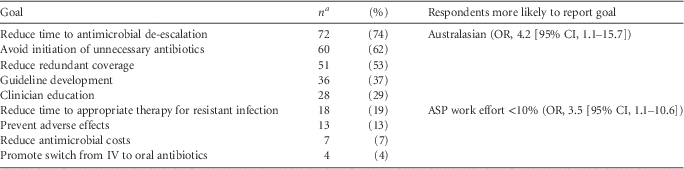
Respondents’ reports of their top 3 antimicrobial stewardship goals for the pediatric oncology patient population are shown in Table 1. Overall, 90 (93%) of 97 respondents reported either reducing time to de-escalation or avoiding initiation of unnecessary antibiotics as a priority. Only 2 goals, reducing time to effective therapy for resistant infection and preventing adverse effects of antimicrobials, were found to be correlated with respondent or institutional characteristics.
Antimicrobial Stewardship Goals in Pediatric Oncology From 97 Respondents

NOTE. ASP, antimicrobial stewardship program; ASP work effort, proportion of work effort dedicated to antimicrobial stewardship; IV, intravenous; OR, odds ratio.
a n = number of respondents reporting this as one of their top 3 antimicrobial stewardship goals in pediatric oncology.
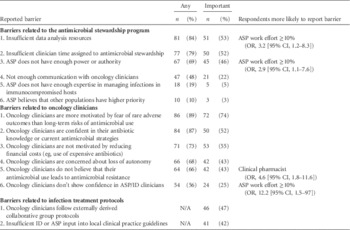
Reported barriers to effective stewardship in pediatric oncology patients are show in Table 2. Additional reported barriers were inconsistency or conflict within the infectious diseases or ASP team (n=5) and lack of electronic prescribing (n=2). Sixty-seven clinicians (69%) reported that inclusion of antimicrobial guidelines in internally or externally derived treatment pathways, such as clinical practice guidelines or collaborative group clinical trial protocols, was an important barrier to stewardship. Participants devoting at least 10% of their time to stewardship were more likely than others to report several barriers as important, but most barriers were otherwise not significantly associated with respondent or institutional characteristics. On clustering analysis, 4 main groups of related barriers were evident: (1) ASP lack of interest or expertise in pediatric oncology; (2) lack of communication, trust, or shared beliefs between ASP and oncology clinicians; (3) lack of ASP resources (data analysis or clinician time); and (4) oncology clinicians’ reliance on current strategies or fear of rare adverse outcomes (Supplementary Figure 2).
Barriers to Antimicrobial Stewardship in Pediatric Oncology From 97 Respondents

NOTE. Any, barrier reported as at least “somewhat important”; ASP, antimicrobial stewardship program; ASP work effort, proportion of work effort dedicated to antimicrobial stewardship; ID, infectious diseases; Important, barrier reported as “quite important,” “important,” or “very important”; N/A, not available; OR, odds ratio.
DISCUSSION
This report explores the experiences of antimicrobial stewardship clinicians as they try to optimize antimicrobial use in pediatric oncology and BMT patients. We aimed to describe current stewardship activities and to identify the goals and barriers experienced by antimicrobial stewardship clinicians working in this field and determine whether these were linked to clinician or institutional characteristics.
We found that stewardship clinicians are actively working to improve antimicrobial use in the treatment of pediatric oncology and BMT patients in North America and Australasia. Despite significant differences between practitioners and institutions, these clinicians report very similar goals and strategies; most prioritize the goals of reduced initiation or expedited cessation of unnecessary antimicrobials, and most use the commonly recommended approaches of guideline development, prospective audit with feedback, clinician education, and formulary restriction to achieve those goals.Reference Abbo and Ariza-Heredia 1 , Reference Tverdek, Rolston and Chemaly 2 , Reference Newland, Gerber and Weissman 7 – Reference Mihu, Paskovaty and Seo 9 Barriers to effective stewardship are also strikingly homogeneous, with resource limitations and differences in risk perception or motivation between the ASP and the oncology teams appearing most frequently.
Use of audit with delayed feedback is an unexpected finding. This differs from the usual method of prospective audit by delivering feedback in batches (eg, a monthly summary of antimicrobial usage by individual clinicians or units). In contrast to prospective audit, it is not well described outside of the ambulatory setting. It may be less resource intensive and should be further explored.
Reported stewardship goals may be important for determining ways to assist ASP efforts or conducting collaborative research and quality-improvement programs. Because many goals were shared by most respondents, effective strategies addressing these might help improve stewardship at most institutions.
Only 2 goals were significantly correlated with clinician or institution characteristics. Australasian clinicians appear to view prevention of adverse effects as more central to their role than those in North America, perhaps because of local cultural expectations. Similarly, clinicians spending more time attending to stewardship apparently focus on reducing overall antibiotic use, leading to a surprising inverse association between ASP work effort and the goal of decreasing time to effective therapy in resistant infections. Future studies could explore the extent to which the proportion of work effort clinicians dedicate to stewardship and local cultural expectations influence decision-making within ASPs or affect ASP effectiveness in other settings.
The study also identified important barriers faced by stewardship clinicians in the pediatric oncology population. Reported barriers clustered tightly according to identifiable themes. The importance of understanding and addressing barriers to stewardship implementation is supported by evidence that adherence to ASP recommendations in the treatment of patients with cancer can be relatively poor and that adherence improves patient outcomes.Reference Rosa, Goldani and dos Santos 6 , Reference Yeo, Wu, Chung, Chan, Fisher and Hsu 10 Future prospective collaborative research that focuses on addressing these barriers is likely to be attractive to ASP clinicians and could identify ways to improve important institutional and patient outcomes. Previous publications have listed possible challenges to effective ASP in this population,Reference Abbo and Ariza-Heredia 1 , Reference Tverdek, Rolston and Chemaly 2 , Reference Mihu, Paskovaty and Seo 9 but to our knowledge this study is the first to investigate the relative importance of specific barriers to ASP clinicians.
Many clinicians reported that collaborative group treatment protocols interfere with stewardship. This could be addressed by ensuring that oncology research protocols allow flexibility for stewardship, provide evidence for antimicrobial recommendations, or include research aims to help support future recommendations. Indeed, these networks might provide opportunities for stewardship or quality-improvement projects.
The formal response rate for the survey was relatively low (38%) and was higher in North America (~50%) than Australasia (~17%). However, it should be noted that the survey link was distributed to a large group to maximize the number of eligible participants, and that the listservs used to contact potential recipients include both adult clinicians and pediatric clinicians not involved in antimicrobial stewardship. Some recipients were therefore ineligible to complete the survey and, if identifiable, would not be included in the denominator for calculation of the formal response rate. Conversely, because the survey was distributed by email, recipients could pass the link to other clinicians. The number of evaluable responses from Australasia was small (n=18) but is proportional to the size of the clinician and patient population in that region (where there are only 8 free-standing pediatric hospitals).
Additionally, the data were analyzed at the level of the individual respondent, and some institutions were represented by multiple respondents; respondent institution was not included in the regression analysis because the number of institutions was large compared with the sample size. Similarly, grouping different countries by geographic region may mask differences between those countries. Infectious diseases fellows were grouped with attending physicians because their responses to all survey components were similar, but this may not be appropriate in other studies. Lastly, the study describes the perceptions of antimicrobial stewardship clinicians, rather than objective facts about beliefs or behavior of others.
Antimicrobial stewardship clinicians are actively working to optimize antimicrobial use in the pediatric oncology patient population. Regardless of individual or institutional characteristics and geographic boundaries, ASP clinicians report similar goals and strategies. Important barriers to stewardship in this setting include personnel and data-analysis limitations, challenging relationships, and differences in priorities and risk assessment between stewardship and oncology clinicians. Further research and quality improvement efforts directed towards these shared goals and barriers may help improve antimicrobial use in this uniquely vulnerable population.
Pediatric Hematology and Oncology Antimicrobial Stewardship Interest Group
In addition to the authors, members of the Pediatric Hematology and Oncology Antimicrobial Stewardship Interest Group are Cynthia Acosta, MD, University Children’s Hospital, Torreón, Coahuila, Mexico; Duha Al-Zubeidi, MD, Children's Mercy Kansas City, Kansas City, MO; Monica I. Ardura, DO, MSCS, Nationwide Children’s Hospital, Columbus, OH; Michelle Barton, MBBS, MSc, University of Western Ontario, London, ON, Canada; David M. Berman, DO, MS, All Children’s Hospital, Johns Hopkins Medicine, St. Petersburg, FL; Adam W. Brothers, PharmD, Seattle Children’s Hospital, Seattle, WA; Joshua D. Courter, PharmD, Cincinnati Children’s Hospital Medical Center, Cincinnati, OH; Kelli Cunningham, PharmD, BCPS, Unity Point–Blank Children's Hospital, Des Moines, IA; Ankita Desai, MD, Rainbow Babies and Children's Hospital/University Hospitals, Cleveland, Ohio; Kelly B. Flett, MD, Boston Children’s Hospital, Boston, MA; Aditya H. Gaur, MD, St. Jude Children's Research Hospital, Memphis, TN; William L. Greene, PharmD, St. Jude Children's Research Hospital, Memphis, TN; Margaret L. Heger, PharmD, BCPS, Children’s Hospital of Illinois at OSF, Peoria, IL; Amanda L. Hurst, PharmD, Children’s Hospital Colorado, Aurora, CO; George M. Johnson, BA, MD, University of Illinois College of Medicine at Peoria, Peoria, IL; Rebecca E. Levorson, MD, Inova Children's Hospital, Fairfax, VA; Kanokporn Mongkolrattanothai, MD, Children’s Hospital Los Angeles, Los Angeles, CA; Jared Olson, PharmD, BCPS, Primary Children’s Hospital, Salt Lake City, UT; Sameer J. Patel, MD, MPH, Northwestern University Feinberg School of Medicine, Chicago, IL; Craig Shapiro, MD, Emory University School of Medicine, Atlanta, GA; Kari A. Simonsen, MD, University of Nebraska Medical Center, Omaha, NE; Kevin A. Slavin, MD, Joseph M. Sanzari Children’s Hospital at Hackensack, Hackensack, NJ; Mary R. Tanner, MD, St. Jude Children's Research Hospital, Memphis, TN; Emily Thorell, MD, MSCI, University of Utah, Salt Lake City, UT; Scott J. Weissman, MD, Seattle Children’s Hospital, Seattle, WA.
ACKNOWLEDGMENTS
We thank Keith A. Laycock, PhD, for editorial assistance.
Financial support. None reported.
Potential conflicts of interest. All authors report no conflicts of interest relevant to this article.
SUPPLEMENTARY MATERIAL
To view supplementary material for this article, please visit http://dx.doi./org/10.1017/ice.2015.295