Introduction
In 2005, Searleman and colleagues reported the existence of a correlation between left and right nasal airflow and left- and right-handedness.Reference Searleman, Hornung, Stein and Brzuszkiewicz 1 The explanation for their finding was discussed as a tendency for a positive correlation between lateral preferences, for example left-handers are more likely than right-handers to be left-eyed.Reference Bourassa, McManus and Bryden 2 This correlation suggests an underlying inherent propensity for sidedness.Reference Searleman, Hornung, Stein and Brzuszkiewicz 1 Given that there are two separate nasal passages which function independently, the existence of a dominant nasal passage, synonymous with a dominant eye or hand, is possible.Reference Searleman, Hornung, Stein and Brzuszkiewicz 1
The finding by Searleman et al.,Reference Searleman, Hornung, Stein and Brzuszkiewicz 1 of a correlation between nasal airflow and handedness, is unusual. Many different research groups have performed observational studies on nasal airflow in healthy individuals. Although they have not explicitly looked for a relationship between nasal airflow and handedness, it has not been identified incidentally. As 90 per cent of the population is right-handed,Reference McManus, Sommer and Khan 3 it is likely that other studies of nasal airflow would have observed that the majority of their participants had right nasal passage dominance.
The present study aimed to measure the so-called nasal cycle of alternation of airflow in healthy participants, and determine if there was any correlation between handedness and left or right nasal airflow dominance.
Materials and methods
Ethics
The authors assert that all procedures contributing to this work complied with the ethical standards of the relevant national and institutional guidelines on human experimentation, and with the Helsinki Declaration of 1975, as revised in 2008. This study was approved by the Cardiff University School of Biosciences Ethics Committee.
Design
The study was designed as a prospective pilot study, based on the methods used by Searleman et al.Reference Searleman, Hornung, Stein and Brzuszkiewicz 1 The handedness of each participant was recorded as part of the screening procedure. Following this, nasal airflow was measured at 15-minute intervals over a continuous 6-hour period using the modified Glatzel mirror.
Participants
Participants were recruited from Cardiff University campus via an advertisement seeking normal, healthy, non-smoking adults.
Potential participants attended for a screening visit, which involved assessment by the study clinician (AP) to ensure all inclusion criteria (aged 18 years or over, provision of written informed consent) and exclusion criteria (history of chronic nasal conditions or trauma to the nose, sinuses or central nervous system, including surgery; active nasal disease (e.g. current upper respiratory tract infection); significant septal deformity; any condition or drug use deemed to affect nasal physiology (e.g. chronic respiratory disease or use of nasal decongestants); current smoker; pregnancy; mixed-handedness) were met.
Those enrolled onto the study attended at a later, convenient date for testing. The aim was to recruit between 25 and 30 participants, with the final number dependent on the number of left-handed participants included. A power calculation based on the previous study by Searleman et al.Reference Searleman, Hornung, Stein and Brzuszkiewicz 1 was not possible given limited data presented; however, statistical significance was reportedly achieved with 20 participants.
Measuring handedness
Handedness can either be measured by preference or skill, and there is good correlation between both types of test, especially for complex movements such as writing.Reference McManus, Bryden, Rapin and Segalowitz 4 Observation of handwriting alone as a test for handedness can miss those with mixed-handedness. A questionnaire was therefore used to ascertain participants’ handedness for several different activities. The Edinburgh Handedness Inventory is the most widely used preference questionnaire,Reference Corballis, Badzakova-Trajkov and Häberling 5 and the Short Form is a revised version that has been shown to have good validity and reliability.Reference Veale 6 Participants were asked which hand they prefer to use for four different actions: writing, throwing, using a toothbrush and using a spoon. They were assigned scores that were used to determine left-, right- or mixed-handedness.
Measuring nasal airflow
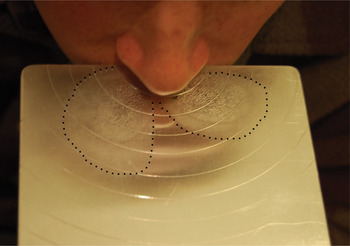
Nasal airflow was measured using the modified Glatzel mirror, as described by Gertner et al.Reference Gertner, Podoshin and Fradis 7 The instrument used was a polished aluminium plate, measuring 10 cm × 12 cm, marked with arches 1 cm apart. The temperature difference between the nasal cavity and the plate causes condensation of the vapour in the expired air, producing a brief reflection of the nasal airway on the plate (Figure 1). Several factors, such as temperature and positional errors, can affect the reliability and reproducibility of these measurements.Reference Brescovici and Roithmann 8 These errors can be minimised by using anatomical landmarks to correctly position the plate, using the same examiner for repeated measurements, and allowing participants to acclimatise to the room temperature and humidity for 30 minutes prior to taking measurements.Reference Brescovici and Roithmann 8 In addition, using the average of three readings can improve reliability.Reference Brescovici and Roithmann 8
A photograph of the modified Glatzel mirror in use. The participant is exhaling through the nose, with the modified Glatzel mirror positioned horizontally, just beneath the columella. The condensation areas produced during exhalation can be seen on the plate and are marked with a dotted line. On this occasion, the right nasal passage produced a larger condensation area than the left, indicating right nasal passage dominance at that time.

Trial environment and procedure
All visits and testing procedures were carried out at the Common Cold Centre, Cardiff University. Every attempt was made to minimise factors known to affect nasal airflow that could potentially affect the study results. Alcohol ingestion increases nasal airway resistance;Reference Eccles and Tolley 9 therefore, participants were asked not to drink more than four units of alcohol the night before testing. As exercise effectively abolishes the reciprocal changes in nasal airway resistance, leading to an overall increase in nasal airflow,Reference Hasegawa and Kern 10 participants were asked to refrain from any vigorous exercise such as running, cycling or swimming for 3 hours prior to testing.
On the test day, participants arrived 30 minutes prior to the start time for nasal measurements, to ensure any effects of exertion and the external environment on the nasal mucosa were eliminated, and to allow for acclimatisation to the temperature and humidity of the test environment. During the test period, participants remained at rest and in the same room, with allowances for use of the bathroom. They were permitted to read, use their computers or watch television, but were not permitted to lie down, as changes in posture and pressure stimuli can lead to alteration of nasal airflow.Reference Babatola 11 They were provided with a standard cold lunch between 12.00 pm and 12.30 pm.
Recording of nasal airflow using the modified Glatzel mirror, to determine the dominant nasal passage, was performed at 15-minute intervals over a 6-hour period, giving a total of 24 readings. Participants were positioned sitting upright with their head in a neutral position. They were asked to inhale deeply through the nose and hold their breath. The modified Glatzel mirror was positioned horizontally under the columella, with the vertical axis at 90 degrees towards the upper lip. They were then asked to gradually exhale through the nose, keeping their eyes and mouth closed. This procedure was repeated 3 times at each 15-minute interval. A judgement was made by the investigator as to which nasal passage produced the largest condensation area, and was therefore dominant, and this was recorded as either left or right. If it was unclear which nasal passage had produced the largest condensation area, the result was recorded as equal. Of the three measurements taken, the majority reading was used as the final result. There were three possible outcomes at each measurement: ‘left’, ‘right’ or ‘equal’. The same investigator (AP) carried out all measurements in an attempt to minimise user variation. A trial run was performed during the 30-minute rest period after each participant arrived at the test centre, to allow them to become familiar with the testing method. Results from this trial run were not recorded or included in the data analysis.
Blinding
In order to avoid potential investigator bias (given the subjective nature of the recordings), the investigator taking the nasal airflow measurements (AP) was, as much as possible, blinded to the participants’ handedness. Handedness questionnaires were completed by participants and checked by another researcher. Throughout data collection, participants’ demographics were monitored by another researcher to ensure that roughly equal numbers of right- and left-handers were recruited. The investigator was not blinded to the last three participants’ handedness, as only left-handed volunteers were recruited (participant numbers 034, 035 and 036). The handedness of all participants was revealed once all data had been collected and analysed.
Statistical analysis
The data collected were compiled into a Microsoft Excel® spreadsheet for further analysis. Binomial distribution was used to define each participant as either left or right nasal passage dominant, or unclear. The chi-square test was used to look for a correlation between nasal passage dominance and handedness in those participants who had a dominant nasal passage.
Results
In total, 36 participants were recruited into the study. Of those, seven were excluded because of: mixed-handedness (n = 3), significant septal deviation (n = 2), rhinitis (n = 1) and concomitant medication affecting the nasal mucosa (n = 1). Of those included, the average age was 20.8 years, with a range of 18–30 years. Fifteen participants were left-handers, including 6 males and 9 females, and 14 were right-handers, including 8 males and 6 females. The demographics of both groups were comparable.
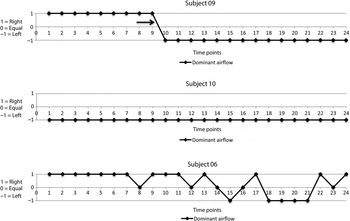
There was considerable variability in the nasal airflow patterns observed (Figure 2). Sixteen participants (55 per cent) demonstrated at least one definite and sustained reversal of nasal airflow dominance, indicating some degree of reciprocity. The others either had little or no change in nasal passage dominance (n = 8), or had fluctuations in nasal passage dominance without any obvious pattern (i.e. without clear reciprocity or regularity; n = 5).
Graphical representation of nasal airflow patterns of three participants. The dominant nasal passage is demonstrated by the black diamond; this is placed on the top line for right nasal passage dominance and on the bottom line for left nasal passage dominance. Participant 09: there is a definite and sustained reversal of nasal passage dominance from the right to the left nasal passage (indicated by the arrow). Subject 10: the left nasal passage is dominant for the whole measurement period. Participant 06: there are multiple fluctuations of nasal passage dominance throughout the measurement period, without a definite and sustained reversal of nasal passage dominance.

Determining nasal passage dominance using percentage of time
The percentage of time that each nasal passage was dominant was calculated for each participant, as in the study by Searleman et al.,Reference Searleman, Hornung, Stein and Brzuszkiewicz 1 and this was compared in left- and right-handers. In left-handers, the percentage of time that the left nasal passage was dominant ranged from 0 to 100 per cent. In right-handers, the percentage of time that the right nasal passage was dominant ranged from 4.2 to 95.8 per cent. In left-handers, the left nasal passage was dominant an average of 11.6 times out of 24, or 48.3 per cent of the time, whereas the right nasal passage was dominant for 46.4 per cent of the time. In right-handers, the right nasal passage was dominant an average of 10.8 times out of 24, or 44.9 per cent of the time, whereas the left nasal passage was dominant for 51.8 per cent of the time. These percentages do not total 100 per cent because in some participants, nasal passage dominance was divided equally (50 per cent and 50 per cent) between both sides. From this simple analysis, it is evident that there is no clear correlation between nasal passage dominance and handedness.
Determining nasal passage dominance using binomial distribution
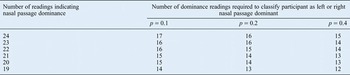
Binomial distribution was used as an alternative, more robust method of classifying participants as either left or right nasal passage dominant. It determined the number of successes, namely dominant nasal passage readings (vs non-dominant readings), required to classify a participant as either left or right nasal passage dominant across the measurement period with a specific probability (p). These data are shown in Table I.
Use of binomial distribution to determine nasal passage dominance with different probabilities

In some participants, some readings were ‘equal’; in other words, a dominant nasal passage could not be observed. As these readings were essentially unknowns, they had to be excluded, and this was taken into account when calculating the probability of successes (Table I). For a p value of 0.1, when all of the 24 readings were known values (i.e. either left or right), 17 dominant readings were required to allow a participant to be classified as left or right nasal passage dominant. For example, if a participant had 18 readings that were left and 6 readings that were right, they were classified as left nasal passage dominant. However, if they had 16 readings that were left and 8 readings that were right, they were classified as unclear, meaning that there was no overall nasal passage dominance.
The disadvantage of using this method to determine whether a participant was classified as having a dominant nasal passage is that, of 29 participants tested, the final number used for analysis was reduced, as some participants did not exhibit a dominant nasal passage. In an attempt to counteract this, the analysis was repeated using p values of 0.1, 0.2 and 0.4, meaning that fewer dominant readings were required to classify a participant as having a dominant nasal passage. These p values may seem relatively high; however, even at a p value of 0.4, the null hypothesis is not outside the extreme quartiles; at this level, 20 per cent would be left nasal passage dominant, 20 per cent would be right nasal passage dominant and 60 per cent would have no overall dominance.
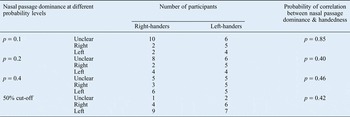
The nasal passage dominance of the left- and right-handers at the different probability levels is shown in Table II.
Nasal passage dominance determined using binomial distribution and correlation with handedness

Correlation between handedness and nasal passage dominance
The chi-square test was used to determine whether there was a correlation between right and left nasal passage dominance and right- and left-handedness. This was done for each of the different probability levels used to determine nasal passage dominance (p = 0.1, 0.2, 0.4), and using the 50 per cent cut-off, resulting in p values of 0.85, 0.40, 0.46 and 0.42, respectively (Table II).
Even using 50 per cent of readings as the cut-off to define a nasal passage as dominant, more right-handers had left nasal passage dominance, and more left-handers had right nasal passage dominance, although the numbers were very similar.
Discussion
This study was conducted to determine whether there was any correlation between right and left nasal passage dominance and right- and left-handedness. The existing literature in this field is very limited, with only one published study by Searleman et al.Reference Searleman, Hornung, Stein and Brzuszkiewicz 1 The very notion of this relationship may seem unusual, and one could question how and why nasal airflow would be related to handedness. However, humans have a tendency for lateral preferences,Reference Searleman, Hornung, Stein and Brzuszkiewicz 1 and the nose is considered to be two separate passages rather than a single entity. Therefore, if people can be left-handed and left-eyed, perhaps they could also be left-nosed.
Nasal airflow was measured 24 times over a 6-hour period in 29 healthy individuals consisting of 15 left-handers and 14 right-handers. The nasal airflow patterns were found to be highly variable, which is consistent with previous reports of significant intra- and inter-individual variation in nasal airflow.Reference Gilbert and Rosenwasser 12 , Reference Williams and Eccles 13 However, the majority of participants demonstrated at least one definite and sustained reversal of nasal airflow dominance. On average, in left-handers, the left nasal passage was dominant for 48.3 per cent of the measurements, whereas in right-handers, the right nasal passage was dominant for 44.9 per cent of the measurements. Just from this simple calculation, a correlation between nasal airflow and handedness seemed unlikely.
For a more in-depth analysis, binomial distribution was used to classify participants as left or right nasal passage dominant or unclear (no dominant nasal passage) at different probability levels: p = 0.1, 0.2 and 0.4. Even at the highest p value of 0.4, 10 participants (5 right-handers and 5 left-handers) could not be classified as having a dominant nasal passage, as the division of airflow between the right and left nasal passages was not significantly different over the course of the 6-hour measurement period. In fact, 3 participants had 12 readings of left nasal passage dominance and 12 readings of right nasal passage dominance out of a total of 24 readings, meaning that the division of airflow between the nasal passages was exactly equal throughout the measurement period.
Unfortunately, using binomial distribution to define nasal passage dominance led to a reduction in the number of participants that could be included to detect a relationship with handedness. For those participants who were classified as having a dominant nasal passage, a correlation between left and right nasal passage dominance and left- and right-handedness was not identified (p = 0.46). Even when nasal passage dominance was defined by having either right or left nasal passage dominance for over 50 per cent of the measurement period, there was still no correlation between nasal airflow and handedness (p = 0.42).
There are several possible reasons for this. First, there could be a lack of statistical power, meaning that the effect was too small to be detected in this sample. Conducting the same analysis in a much larger sample could possibly reveal a correlation. It should be noted, however, that a smaller sample size was used by Searleman et al., in which statistical significance was reported.Reference Searleman, Hornung, Stein and Brzuszkiewicz 1 Second, the measurement period could have been too short. Alternation of nasal passage dominance, sometimes referred to as the nasal cycle, has been reported to occur up to 8-hourly.Reference Gilbert and Rosenwasser 12 Therefore, with a measurement period of 6 hours, it is possible that in some participants the alternation of nasal passage dominance had not happened yet. In three participants, one nasal passage remained dominant for the entire measurement period, and it is possible that they would have had alternation in nasal passage dominance that either occurred just before the first measurement or after the last one. Additionally, in participants who did demonstrate alternations in nasal passage dominance, some alternations could have been missed by the 6-hour measurement period. For example, if the next few readings after the 6-hour period had demonstrated another switch in nasal passage dominance, the classification of the participant as left or right nasal passage dominant may have been different. Third, unlike other nasal airflow measurement methods, such as rhinomanometry, the modified Glatzel mirror does not provide quantitative values. It is possible, therefore, that some reversals of nasal passage dominance could have been missed if the difference between nasal airflow on each side was small. Nevertheless, the modified Glatzel mirror has been shown previously to reliably demonstrate the changes in nasal airflow caused by the nasal cycle.Reference Brescovici and Roithmann 8
In contrast to our findings, Searleman et al. reported that healthy individuals exhibited nasal passage dominance, and this dominance correlated with handedness.Reference Searleman, Hornung, Stein and Brzuszkiewicz 1 They found that nasal airflow was divided roughly 60:40, with overall left nasal passage dominance in left-handers and right nasal passage dominance in right-handers (p < 0.01).Reference Searleman, Hornung, Stein and Brzuszkiewicz 1 In the current study, the division of nasal airflow was closer to 50:50, with no clear correlation between nasal passage dominance and handedness. Searleman et al. did not state that nasal passage dominance could not be ascertained in any of their participants.Reference Searleman, Hornung, Stein and Brzuszkiewicz 1 There are several reasons to doubt the findings of Searleman et al.Reference Searleman, Hornung, Stein and Brzuszkiewicz 1 Their method of measuring nasal airflow involved the insertion of hot wire anemometers inside the nares, which could have affected the accuracy of nasal airflow readings. No formal test was used to determine handedness, despite the availability of validated objective and subjective measures. Furthermore, data analysis and statistical methods were not described in any detail, making it difficult to reliably interpret the results.
It is possible, therefore, that there is no relationship between handedness and nasal airflow, and that the results reported by Searleman et al.Reference Searleman, Hornung, Stein and Brzuszkiewicz 1 occurred by chance. Nasal airflow patterns have been shown to vary when measured in the same individual on different days.Reference Williams and Eccles 13 Had the experiment by Searleman et al.Reference Searleman, Hornung, Stein and Brzuszkiewicz 1 been repeated on a different day, the opposite relationship may have been discovered.
In addition, the physiological reasoning underlying this relationship is implausible. Handedness has been shown to correlate with other behavioural lateral preferences, for example eye preference, hand clasping and leg crossing; however, the correlations are small and these measures cannot be reliably used to determine handedness.Reference McManus, Bryden, Rapin and Segalowitz 4 Nasal airflow is controlled by the autonomic nervous system, and is dissimilar to behavioural lateral preferences such as hand clasping and leg crossing. Handedness may be related to speech development, which usually occurs in the left hemisphere,Reference Annett 14 and the lateralisation of speech may be advantageous.Reference Annett 15 When a complex action originates in the brain, there may be advantages to having it arise in only one hemisphere.Reference Corballis, Badzakova-Trajkov and Häberling 5 The conductance of air through the nasal passages is not a complex action, unlike speech or hand gesturing, and therefore having a dominant nasal passage would not be advantageous in this respect.
A relationship between nasal airflow and handedness is not supported by the other literature concerning nasal airflow. In the wealth of observational studies performed over the last century investigating nasal airflow patterns in healthy individuals, to our knowledge none have reported an incidental finding of overall right nasal passage dominance. If Searleman and colleagues’Reference Searleman, Hornung, Stein and Brzuszkiewicz 1 findings were correct, this would be extremely surprising given the overwhelming majority of right-handers in the general population. In a study comparing the nasal airflow patterns of schizophrenic versus healthy individuals, 53.1 per cent of the healthy cohort had no overall lateralisation of nasal airflow, meaning that the left and right nasal passages were dominant for roughly equal amounts of time.Reference Ozan, Dane, Yildirim, Tatar, Tanisman and Yazici 16 This was a larger study, with 64 healthy control participants who were all right-handed, conducted over a longer period of 12 hours.Reference Ozan, Dane, Yildirim, Tatar, Tanisman and Yazici 16
-
• A relationship between handedness and nasal airflow was reported in 2005 in a single study
-
• That study showed that left-handers had a dominant left nasal passage and right-handers had a dominant right nasal passage
-
• There is no other supporting evidence of this relationship in the literature
-
• The present study measured nasal airflow in 15 left- and 14 right-handed participants over a 6-hour period using the modified Glatzel mirror
-
• No correlation between right and left nasal airflow dominance and right and left hand dominance was identified
In conclusion, the present study did not find any evidence to support the hypothesis that right and left nasal airflow dominance is related to right and left hand dominance.
Acknowledgements
This study was supported by research funds from Cardiff University. We would like to thank Dr Ben Carter, Lecturer in Medical Statistics at Cardiff University, for providing statistical analysis advice.