Many scholars, policymakers, and citizens believe that international organizations (IOs) constrain domestic policy. Recent developments, such as the International Monetary Fund (IMF) loan programs in Ireland and Greece, seem to support this conventional wisdom, since they stipulate policy reforms that must be undertaken by the Irish and Greek governments to receive vital monies from the IMF. Although IOs may constrain domestic policy, they do not do so equally in all countries. The IMF, for example, requires more extensive policy reforms in some countries than in others. Explaining this variation is integral to understanding how IOs influence the formulation of domestic policy.
We argue that the extent to which IOs influence domestic policy depends, in part, on domestic interests. For example, Greek citizens poured into the streets to protest the austerity policies that were expected to accompany an IMF loan. Although the agreed-upon loan conditions stipulated significant policy reforms, important compromises were made—the lowest-paid workers received protection from the cuts in public-sector wages and pensions, and no binding conditions were set for state employee layoffs or controls on private-sector wage increases.Footnote 1 These compromises were, in part, a response to the public protests by Green citizens.
The Greek case points to the importance of considering domestic interests as a potential determinant of international negotiations' outcomes. To this end, we explore when and under what conditions citizens' interests influence negotiations between national government executives and IMF staff. Specifically, we examine the extent to which workers' interests shape IMF loan conditions.
The IMF is often at the center of debates about the role of citizens' interests in international negotiations. Although citizen groups are frequently assumed to be unable to significantly influence IMF policy, we find evidence that the economic interests of an important group of citizens, namely workers, can influence IMF loan conditions. Among democratic countries that borrowed money from the IMF between 1980 and 2000, those with stronger domestic labor received less-intrusive labor-related conditions (that is, conditions that stipulate domestic labor market reforms). When workers have the potential to be politically powerful, governments not only negotiate with the IMF to minimize labor-related conditions, but the IMF is also more likely to accede to these demands.
This finding has several important implications for studies of IMF conditionality and international organizations more generally. First, governments facing powerful labor at home receive fewer and less intrusive labor-related loan conditions by leveraging their opposition to reforms as bargaining chips in international negotiations. This finding confirms the logic of Putnam's two-level game and Milner's argument that domestic actors' preferences shape the terms of international cooperation.Footnote 2 It also raises questions about precisely when and under what conditions governments use IOs as “political cover” to enact unpopular policy reforms.
Second, citizens' interests matter for international negotiations even during times of crisis. When a national government faces an economic crisis, domestic workers are particularly vulnerable. Workers might be made to bear the brunt of the costs of adjustment and governments desperate for IMF funds may be unable or unwilling to push workers' interests at the bargaining table. However, our results suggest that even in such times, workers can defend their interests. Democratically elected governments will negotiate with the IMF on behalf of powerful domestic labor even during times of crisis, which suggests that the fate of labor in a world of volatile finance may not be as bleak as researchers have commonly thought.
If citizens' interests matter during a crisis, they likely also matter for international negotiations that occur during good times. Membership in many IOs, such as the World Trade Organization (WTO), is commonly negotiated during noncrisis periods. Although previous research demonstrates that citizens' interests influence countries' compliance with WTO rules,Footnote 3 our study suggests that citizens' interests may also influence the terms by which countries join the WTO. Accession agreements affect the magnitude of the increase in trade that countries receive from WTO membership.Footnote 4 Citizens' interests may therefore play a critical role not only in negotiations with IOs and but also in the benefits from IO membership.
A third, related implication is that domestic interests condition the relationship between IOs and domestic policy reform. Loan programs vary in the intrusiveness of their loan conditions, and this variance is in part a product of the political power of domestic interests. If we wish to understand how IOs affect specific domestic economic and political outcomes, the missing link of citizens' interests is a crucial mediating variable.
Labor Conditions in IMF Programs
Loan conditions stipulate policy reforms that borrowing countries must undertake to receive IMF fundsFootnote 5 and are ultimately an outcome of negotiations between national governments and the IMF staff. Governments may choose to represent the interests of their citizens at the bargaining table. For example, governments may leverage citizens' opposition to a proposed loan condition as a bargaining chip in their negotiations with the IMF. In this case, citizens' interests will be reflected in the loan conditions. However, the extent to which citizens' interests actually influence loan conditions remains unknown, despite the large and still growing literature on IMF conditionality.
The paucity of research about the role of citizens' interests in IMF negotiations is due, in part, to data limitations. The IMF only recently made details of its loan programs publicly available and easily accessible. For every loan, there exist multiple documents containing vast quantities of detail. Previous studies have quantified this immense amount of information by calculating the total number of conditions in each country's loan.Footnote 6 However, citizens are unlikely to care about the total number of loan conditions per se. Citizens likely care more about some policies than others.
We aim to solve this problem by examining the substance of IMF loan conditions. Rather than look at the total number of conditions, we examine instead what the conditions require of recipient governments. We focus our attention on labor-related conditions. These stipulate reforms of the country's domestic labor market and/or have direct effects on employment, wages, and social benefits (for example, privatization, wage freezes, pension reform).
Labor-related conditions are a subset of IMF conditions (see the appendix). Although labor-related conditions are increasingly common in IMF programs, they are still far from ubiquitous. Figure 1 displays the count of all IMF programs with and without labor conditions from 1980 to 2000. The height of the bar represents the total number of IMF programs in that year (that is, forty-two in 1993). The lower portion, in gray, represents the number of programs that include conditions on labor market reforms (for example, five in 1993).Footnote 7 The upper portion in black represents the number of programs without binding labor conditions (for example, thirty-seven in 1993).
IMF loan programs by year
Note: Labor conditions reported here include only performance criteria coded from staff reports made at the time of the initial loan request.

Labor conditions were not included in IMF programs prior to 1987.Footnote 8 Since then, however, the number of labor conditions has increased significantly. On average, about a quarter of the IMF programs after 1987 have labor conditions. Labor conditionality reached a sample peak in 1999 when nearly 44 percent of all IMF programs included at least one labor condition.
Although labor-related conditions are increasingly frequent in IMF programs, labor conditionality varies considerably from country to country. Even at their most frequent in 1999, the majority of countries under IMF programs did not face labor market reform conditions. Why do some countries' programs include labor conditions while others do not? Why do some countries receive far more intrusive labor reform conditions than others? We argue that this variation is due, in part, to citizens' interests and the role they play in negotiations between national governments and IMF staff. But first we briefly review existing explanations for variation in the total number of loan conditions across countries.
Existing Explanations
Previous studies of conditionality have generally offered three explanations for why some countries receive more IMF conditions than others. The first focuses on the potential importance of domestic institutions and political constraints, specifically institutional or situational factors that impel governments to pay greater attention to the policy preferences of the opposition parties.Footnote 9 Some argue that highly constrained governments will accept more conditions in order to evade the constraints of domestic politics.Footnote 10 Others argue that borrowing countries prefer fewer conditions and use domestic constraints to reduce the scope of conditionality.Footnote 11
A second explanation for the cross-national variation in the number of loan conditions focuses on a country's economic circumstances. A country in severe economic distress may receive fewer conditions in light of their dire economic situation.Footnote 12 However, some have argued that the most vulnerable countries receive the largest number of conditions, in part because the IMF maximizes conditionality in the neediest countries.Footnote 13
Third, some scholars ascribe an important role to geopolitics in determining the total number of conditions in a country's IMF program. Previous studies show that countries important to the United States tend to receive fewer conditions. As a consequence of the disproportionate influence of the U.S. in the IMF, its allies receive fewer conditions, all else equal.Footnote 14 Copelovitch further demonstrates that given the predominant position of the Group of Five (G5) in the IMF, the intensity and heterogeneity of G5 governments' preferences affect loan conditions.Footnote 15
In addition to studies of the total number of conditions, several previous studies examine the effects of conditionality. For example, Fang and Owen suggest that loan conditions help nondemocracies lock in domestic policy reforms.Footnote 16 In nondemocracies, domestic policy reforms lack credibility because autocratic regimes face few domestic audience costs. IMF loan conditions help to impose such audience costs thereby making reforms in nondemocracies relatively more credible than they would be in the absence of IMF conditionality.
Mukherjee and Singer find that IMF conditions engender greater policy reform when governments spend more on welfare programs because welfare spending mitigates the negative impacts of reform and liberalization.Footnote 17 Mukherjee and Singer's findings provide indirect evidence of the disruptive effects of IMF-induced reforms that include, for example, spikes in unemployment and increases in income volatility. Our analytical framework reflects Mukherjee and Singer's exhortation to examine the effects of domestic groups on negotiations between the IMF and national governments.Footnote 18 We do so by concentrating on the intrusiveness of conditions that are of particular interest to workers.
Since domestic actors have varying interests, outlining interests precisely is necessary to assess their impact on conditionality. However, existing scholarship that discusses the influence of voters and interest groups generally treats them in an undifferentiated fashion. Authors sometimes acknowledge that different domestic actors have distinct interests, but the modeling strategies in existing studies do not incorporate this fact.Footnote 19 Domestic interests are sometimes conceptualized quite bluntly as “the opposition,” which is assumed will oppose all reforms.Footnote 20 Similarly, authors who focus on the number of veto players—actors that can block policy change—often do not make the connections among actors, interests, and program design.Footnote 21 By focusing on labor, which has well-known preferences regarding labor-related conditionality in IMF programs, we can pinpoint the extent to which workers' economic interests influence conditionality in the areas of most concern to them.
It is unlikely that workers or citizens generally care about the total number of conditions. Because citizens are interested in those conditions that most directly affect their economic well-being, it is difficult (perhaps impossible) to examine the effect of their interests on IMF programs using the total number of conditions. We therefore focus on conditions in IMF programs that affect employment, wages, social benefits, and labor market flexibility. Public-sector reforms such as privatization, reductions in the size of government, and freezes on government salaries, have direct effects on workers, since they result in layoffs and reduced wages for state employees. Likewise, demands to control minimum wage or private-sector wage increases affect worker incomes in the private sector. Structural reforms to public pensions and health care systems affect the benefits that workers covered by these programs receive. Enhancing labor market flexibility by reducing the cost of firing workers, legalizing nonpermanent labor contracts, or decentralizing collective bargaining affects workers by making jobs more precarious and/or by weakening unions' bargaining power.Footnote 22
Since actors' interests vary, and since these interests will be differentially affected by specific components of IMF programs, future scholarship on the role domestic actors play in shaping conditionality must specify actors' interests and power, and attend to the content of conditionality. In the case of labor, we argue that the power of domestic labor determines, in part, the intrusiveness of labor market reform conditions in IMF programs. Countries with stronger labor movements will receive less intrusive, labor-related loan conditions than those with weak labor movements, all else equal.
Negotiating Loan Conditions
IMF programs are the end products of a negotiation process between governments and IMF staff.Footnote 23 Since the IMF does not negotiate directly with domestic interest groups, labor's influence on conditionality depends on both its direct effect on the government's negotiating posture and its indirect effect on the IMF's willingness to agree to less intrusive labor conditions. We therefore develop our argument in several interconnected steps. First, we explain why workers oppose labor-related reform conditions. Second, we examine when and under what conditions governments are willing to advocate for workers' interests when negotiating with the IMF. Finally, we account for why the IMF is willing to accommodate demands for less intrusive labor conditionality.
Workers oppose intrusive labor conditionality because these reforms negatively affect their welfare.Footnote 24 Extensive cross-national research demonstrates that IMF programs reduce labor's share of income, increase income inequality, and reduce public spending on wages and salaries.Footnote 25 Workers' interests are often expressed through unions, and organized labor has consistently opposed IMF labor-related reforms at the local, regional, and international level.Footnote 26 Internationally, the largest confederation of trade unions, the International Trade Union Confederation (ITUC)—and its predecessors, the International Confederation of Trade Unions (ICFTU) and the World Confederation of Labor—have stridently opposed IMF reforms.Footnote 27 The ITUC and its affiliates oppose reforms that enhance labor market flexibilityFootnote 28 and have supported efforts to block IMF-backed privatization programs.Footnote 29 At the regional level, unions in Latin America have avidly opposed IMF programs. In 1987, the principal labor confederations in Argentina, Bolivia, Brazil, Chile, Paraguay, and Uruguay formed the Coordinator of Trade Union Centers of the Southern Cone (CCSCS), with the explicit goal of resisting the IMF presence in the region.Footnote 30 Union opposition to conditions in IMF programs has taken place not only in Latin America but also in Africa, Asia, Eastern Europe, and the Middle East.Footnote 31
Because the IMF negotiates directly with national governments, not with domestic labor groups, national governments' responsiveness to the demands of workers depends critically on labor's political power and organization. When labor is powerful, national governments will be less willing to accept stringent labor conditions as part of an IMF program. Such conditions bind the government to carry out reforms that powerful unions will oppose. Powerful labor groups can disrupt the economy in their opposition to IMF conditions, threatening the political future of the government. Given this, governments facing powerful labor at home have incentives to represent workers' interests in their negotiations with the IMF.
Labor's demands will be more influential in countries where governments are electorally accountable. In democracies, political leaders must succeed at the polls to maintain office, so they must gain the support of voters. In most countries, the median voter earns a majority of their income from their labor.Footnote 32 In other words, the majority of voters in most countries are workers. To maximize their chances of reelection, governments seek to gain the electoral support of workers. Given that IMF labor conditions reduce workers' welfare in the short to medium term, electorally minded governments have incentives to minimize labor conditionality. Where labor is particularly powerful and/or politically important, governments have even greater incentives. Democratically elected governments use labor's power as bargaining leverage with the IMF.Footnote 33
In contrast, autocratic leaders are far less constrained by electoral concerns. In autocracies, elections, when they occur, are not free or fair and so the populace has much less control over political leaders.Footnote 34 Leaders in autocracies are therefore relatively less concerned with winning or maintaining workers' support. Autocratic leaders may be confident in their ability to retain power even after accepting an IMF program with stringent labor market reform conditions, since the leaders' authority does not rest on the support of workers. In addition, workers are often more constrained in their capacity to mobilize collectively in nondemocracies, so autocratic governments are less fearful that workers will derail the IMF program and/or disrupt the national economy. As a result, nondemocratic governments are less likely to represent the concerns of workers at the international bargaining table.
Among democratic countries, left-leaning governments may be more sympathetic to labor's demands than right-leaning governments because left governments are more likely to have political ties to unions and/or to be ideologically inclined to oppose IMF reform conditions. However, even governments on the right may fear the disruptive effects of labor protest, particularly when labor is powerful. Regardless of their ideology, governments will therefore endeavor to lessen the intrusiveness of labor conditions when facing powerful domestic labor. By negotiating hard to reduce the depth and scope of labor conditionality, national governments gain increased flexibility in navigating the path of economic reform. Even if government leaders support policies that labor opposes, they may prefer the freedom to negotiate the required reforms without stringent labor conditions. Conversely, where labor is weak, the authorities have little incentive to bargain hard on labor conditions, since workers are unlikely to mount disruptive protests that could derail the reform program or jeopardize the government's survival or reelection.
Our argument challenges claims that governments seek out high conditionality in order to bind themselves to painful reforms in the face of strident domestic opposition. Ramcharan, for example, argues that IMF conditionality increases the cost of opposing domestic reform, since derailing reforms could result in a suspension of the IMF program.Footnote 35 As Vreeland notes, however, binding oneself is risky if the costs of suspending an IMF program are low for the opponents of reform.Footnote 36 Since workers are made worse off by intrusive labor reform conditions, the reduction in workers' incomes as a result of labor market reforms may offset any potential aggregate benefits to the country's economy. Given this, the costs of rejecting an IMF program with intrusive labor conditions may be relatively low for workers. Union leaders who acquiesce to IMF programs with stringent labor conditions may face a revolt by their members. Governments that agree to such a program risk labor unrest and losing popular support. Therefore, governments facing powerful labor will accept fewer and less intrusive labor-related conditions than governments facing weak labor.
Given that the IMF commonly advocates conditions that workers oppose, why would the IMF ever agree to less intrusive labor conditions? First, the IMF may want to appear responsive to domestic interests. Paragraph four of the 1979 guidelines on conditionality includes language suggesting that the IMF should pay due regard to the country's social and political objectives, economic priorities, and circumstances.Footnote 37 By reducing the intrusiveness of labor market reform conditions in countries with powerful domestic labor, the IMF demonstrates sensitivity to the political realities in borrowing countries. Second, the IMF wants its programs to be successful and success depends on implementation—powerful domestic actors can thwart the implementation of IMF conditions.Footnote 38 According to one IMF study, only 25 percent of structural adjustment programs between 1986 and 1997 were completed without interruptions. Domestic political constraints such as political upheavals, flagging commitment from the authorities (often a consequence of difficulty in mustering political support for new policies), and opposition from domestic interest groups played a role in most of the program interruptions.Footnote 39 Because the IMF is interested in maximizing the success/implementation of its programs, the organization is unlikely to require highly intrusive labor market reforms in the face of powerful domestic labor.
These considerations lead to the following hypotheses:
H1: Among countries under IMF programs, those with powerful domestic labor will tend to have less intrusive labor conditions than those with weaker labor.
H2: Among countries under IMF programs, the influence of domestic labor on the intrusiveness of labor conditions will be greater in democracies than autocracies.
We pursue two strategies for substantiating these hypotheses: case studies and statistical tests. The case study of South Korea, followed by a short contrast with the case of Bolivia, maps out the causal dynamics that underlie the statistical models, providing a rich picture of how labor opposes IMF labor-market reform conditions, how national governments respond to labor, and the IMF's support for government efforts to integrate labor into the reform process. Statistical analyses then provide a rigorous empirical test of our argument's plausibility.
Case Study: South Korea
The Asian financial crisis struck South Korea in late 1997. The South Korean government appealed to the IMF for an emergency bailout program, and in December 1997, the IMF initiated a three-year standby arrangement. South Korea underwent seven IMF reviews during this period. Although these reviews contained a considerable number of performance criteria, there were few labor-related conditions.Footnote 40 Among other things, the rescue plan called for restructuring of the financial sector and the chaebol (large family-controlled conglomerates), which entailed closing companies, privatizing state banks, and forcing the chaebol and state enterprises to compete on the market without state subsidies. The IMF program would result in massive layoffs in the private and public sectors. Although temporary workers were already a large component of South Korea's workforce,Footnote 41 much of the required shedding of workers would be in firms that employed permanent workers. Existing law did not permit employers to lay off permanent workers until early 1999, which meant that mass layoffs could not take place immediately unless South Korea amended its labor laws.Footnote 42 Firing costs were high by international standards, so layoffs would require employers to make significant payments to workers.Footnote 43
Since the success of the program depended on labor bearing much of the burden of adjustment, organized labor's strength in South Korea posed an obstacle to the IMF program's implementation. The unionization rate in 1998 was 13.8 percent of the regularly employed, nonagricultural workforce.Footnote 44 Although low by Western European standards, this figure is quite high for non-European nations. Union organization is also highly concentrated. Most unionized workers belong to the two peak federations, the Federation of Korean Trade Unions (FKTU) and the Korean Confederation of Trade Unions (KCTU), and the unionization rate is far higher in the chaebol. Unions are therefore strongest in the most strategically important sectors of the economy. In addition, Korean unions actively exercise their collective power in protests and strikes.Footnote 45
The government and the IMF fully expected labor to oppose the reforms. The issue of layoffs was particularly important, since the restructuring of public enterprises and the chaebol would be hampered if businesses could not lay off workers.Footnote 46 Worker discontent over labor law revisions that liberalized layoffs were one of the core issues of the month-long national strike that took place just months before the Asian financial crisis hit.Footnote 47 Given this recent history, the incoming government recognized that the IMF program would provoke fierce resistance from labor unions and that the government needed to secure their assent if the reform program was to succeed.Footnote 48 Immediately after the election, president-elect Kim Dae-Jung met with union leaders and proposed the formation of a tripartite commission in hopes that the government, employers, and unions could conclude a social pact, based on the principle of fair burden sharing, to navigate the crisis.Footnote 49 Unions were eager to participate.Footnote 50 The commission formed in mid-January 1998, and in just three weeks, it reached an agreement.Footnote 51 Labor made important concessions, agreeing to allow employers greater scope in the use of temporary workers and most importantly, immediate layoffs of permanent staff not only for corporate emergencies but also for mergers, acquisitions, and corporate restructuring. In return, unions secured some long-desired improvements in basic labor rights and the expansion of the unemployment insurance system.Footnote 52 In addition, employers had to follow strict notification policies for laying off workers and laid-off workers were still entitled to generous severance pay.
However, the agreement was rejected by many parts of the KCTU, which promptly voted out its leadership and withdrew from the negotiations at the tripartite commission.Footnote 53 The government revived the tripartite commission later in the year to negotiate the restructuring of public-sector utilities and state-owned enterprises; discussions were fractious, with both trade union confederations and even employers withdrawing from negotiations only to return to the bargaining table later.Footnote 54 Unions remained committed to mass mobilization throughout the negotiations, at one point mobilizing 120,000 workers in sixteen major cities, and staging a two-month sit-in strike at Hyundai Motors, a subway worker walkout, and massive mobilizations by finance industry workers in response to layoffs.Footnote 55
The IMF recognized the delicacy with which the adjustment program had to be carried forward and stressed the importance of maintaining “social consensus and stability” during the reform process.Footnote 56 In a program that had numerous structural performance criteria, the IMF program had few labor conditions. The IMF did not ask for lower severance payments or less time-consuming procedures for mass layoffs, even though it supported such policies; it also used a light touch on privatization and even supported some deficit-financed compensatory programs to lessen the pain of adjustment on workers.Footnote 57 In a column in the Korea Times, Managing IMF Director Michel Camdessus applauded the labor movement for its
high sense of responsibility in working with the government and business under the tripartite arrangement; it has made some hard choices that required courage on the part of the leadership and a shared sense of solidarity by the workers…. Unfortunately, there is a human cost to restructuring, something that Koreans know all too well these days…. That is one reason the IMF has encouraged the Korean government to take every possible step to ease the burden of joblessness. The authorities have broadened the scope of the unemployment insurance program, and the difficult decision to boost the budget deficit to 5 percent of gross domestic product in 1998 and 1999 is precisely justified by this need to keep the social safety net in place, and to sustain recovery, and with it, job creation.Footnote 58
In a staff report published in 2000, the IMF also noted the importance of the tripartite commission's work and supported government subsidies to firms that opted to retain rather than layoff workers.Footnote 59
Given the power of unions, policymakers knew that strict conditionality on labor-related policies had the potential to backfire. By refraining from setting tough labor-related conditions, the IMF gave the Korean government greater flexibility in negotiating the restructuring process with unions and employers. Such flexibility was necessary because Korea's labor unions had the potential to wreak havoc, and in a democratic setting, citizens and workers had the capacity to derail unpopular policies in the streets and at the ballot box. Such an outcome not only threatened the success of the IMF program but also the popularity of the government. In the end, the IMF got many of the policy changes it wanted, even though it did not impose intrusive labor conditions. Policies agreed to through a relatively consensual process, and without the threat of punitive conditionality hanging over its head increased the probability that the reforms to which the government committed would be implemented successfully.
Case Study: Bolivia
The South Korean case study illustrated some of the dynamics through which we hypothesize that strong labor results in less intrusive labor conditionality. The flip side of this argument is that countries with weak labor are more likely to have substantial labor conditionality in their IMF programs. Bolivia, which was under an almost continuous sequence of IMF arrangements from 1986 through 2000, demonstrates how democratic governments facing weak labor movements are more willing to accept numerous labor-related conditions.Footnote 60 According to the IMF, structural reforms in the country during this period “were among the most extensive of any Latin American country.”Footnote 61 During this period, IMF programs contained numerous benchmarks and performance criteria pertaining to privatization, public-sector employment, public-sector wages, pensions, and labor-market flexibility.
One reason that the government agreed to such intrusive labor conditionality is that labor was weak in Bolivia. Although historically labor had been quite strong in Bolivia, by the early 1980s, the union movement entered a profound period of decline.Footnote 62 The privatization and decline of Bolivia's mining sector, combined with increases in informal and urban unemployment, undercut labor's strength. Consequently, by the time the IMF began pushing labor market reforms in the late 1980s, the Bolivian labor movement had lost much of its organizational strength, leaving it incapable of mounting a viable resistance to the reforms proposed by the IMF.Footnote 63 Facing little threat from a weakened labor movement, the government accepted labor-related conditions with little fear that workers would derail the reform program. Similarly, the IMF was more willing to ask for these conditions, since the government was not threatened by labor.
No doubt, other factors also contributed to the exceptionally high level of intrusive labor conditionality. Bolivia was an extremely indebted small country with large fiscal deficits at the time of the reforms. The legacy of the 1952 left-oriented revolution included a large public sector and decidedly protective labor legislation. Not only public utilities, but also mineral extraction and other productive enterprises were in state hands. Bolivia had among the highest firing costs in Latin America. All these factors made the country a prime target for deep IMF market-oriented reforms. The IMF had a strong incentive to pursue highly intrusive labor reforms, and the government faced a weak and fragmented labor movement that posed little threat to its survival.
To summarize, South Korea demonstrates how a relatively strong labor movement was able to moderate IMF labor conditionality during an economic crisis, while Bolivia displays how a weak labor movement in a country with deep economic imbalances resulted in highly intrusive conditionality.
Quantitative Evidence
Using new data from IMF loan documents for countries under IMF programs between 1980 and 2000, we construct a measure of the “intrusiveness” of labor conditions. First, labor conditions are identified in key IMF loan documents including letters of intent and arrangement letters. Letters of intent are prepared by the borrower in consultation with the IMF. They are usually, but not always, called Memoranda of Economic and Financial Policy. Arrangement letters are essentially the contract for the loan. They spell out the conditions that a country must meet in order to receive the next loan disbursement. Because the terms of the arrangement letters change over the course of the loan, we code every arrangement letter.
This is an important empirical innovation. Previous studies focus almost exclusively on the letters of intent. However, the letter of intent is often used to lay out the entire policy program and in some cases, even includes technical assistance, advice, and policy priorities at other international financial institutions, such as the World Bank, regardless of whether the IMF has the intention to make these conditions for its financing.Footnote 64 In contrast, the arrangement letter spells out only those reforms that the IMF intends to make conditions for financing. Arguably, the conditions in the arrangement letters are the most relevant for national governments, investors, and citizens. We test for and find important substantive differences between conditions included in the loan contracts and the letters of intent.
Using the letters of intent and the arrangement letters, we identify conditions in nine issue areas relevant for labor, including wage levels and labor market flexibility. For a complete list of all nine issue areas, see the appendix.
Each labor condition is weighted by its relative stringency. Performance criteria and prior actions are weighted most heavily (by a value of 4). Prior actions outline steps that a country must take before the IMF agrees to a loan (or completes a review). Performance criteria are conditions that a loan recipient has to meet; failure to do so results in the loan's suspension. Benchmarks and indicative targets are weighted less heavily (by a value of 3). Benchmarks are conditions that the IMF expects countries to meet, but failure to do so does not result in a suspension of the loan. Indicative targets are similar to benchmarks, except that they are quantitative (for example, a ceiling on the public wage bill). Soft conditions are weighted less heavily than benchmarks and indicative targets (by a value of 1) because there are no sanctions for failing to fulfill a soft condition. Soft conditions refer to policy steps that the IMF would like to see but that have no explicit conditionality attached to them. Soft conditions are not included in the loan contract.
The dependent variable equals the sum of the total number of labor conditions in a country's loan program in a given year, where each condition is weighted by its relative “intrusiveness.” Thus, the dependent variable measures the intrusiveness or stringency of labor-related conditions in a country's loan program in a given year. In general, labor conditions are more intrusive in the letters of intent than in the arrangement letters, as reported in Table 1. This reflects the fact that labor conditions are frequently soft conditions that are not included in arrangement letters. Less than half of all labor conditions included in IMF programs from 1980 to 2000 are hard conditions: 10 percent are performance criteria while 20 percent are benchmarks. Indicative targets are rare; only twenty-four labor-related indicative targets are included in IMF programs during this period. Labor-related prior actions are also quite rare; only 5 percent of conditions in the sample are prior actions.
Intrusiveness of labor conditions in IMF loan programs

Notes: Higher values indicate more intrusive loan conditions. Details about the construction of these measures are included in the main text. Further details are provided in the appendix.
Among countries that received IMF monies between 1980 and 2000, 41 percent received no labor conditions in their loan contracts. This includes, for example, South Korea. At the other extreme, three countries received very intrusive labor conditions in their loan contracts. For these three countries, the sum of all labor conditions included in the arrangement letters (weighted by their intrusiveness) over the period from 1980 to 2000 is greater than sixty. These high conditionality countries include Bolivia, Chad, and Mali.
Measuring Labor Power
To test the hypotheses, we need a comparable measure of labor strength that covers our sample of 120 countries from 1980 to 2000. However, measuring labor strength is difficult, particularly in developing countries, which constitute the majority of the sample. Direct indicators of labor power, such as unionization rates, are generally not available. Where unionization rates are available, it is not clear that they are comparable across developing countries. Some developing countries mandate compulsory membership in unions.Footnote 65 China, for example, has one of the highest union density rates in the developing world yet labor has very little bargaining power.Footnote 66
To overcome this data limitation, we use a proxy for labor power—potential labor power (plp)—that is comparable across developing countries and captures the dynamic nature of labor's influence. This measure, developed by Rudra, takes the ratio of skilled to unskilled workers and multiplies it by one over the percentage of surplus labor.Footnote 67 The first component of the plp measure is the ratio of skilled to unskilled workers. Unskilled workers are those who have a primary or secondary education (or less) and are likely to be employed in labor-intensive, low-skill manufacturing industries. In contrast, skilled workers have more than a basic general education and are employed in high-skill manufacturing industries. We use the classification scheme originally developed by Wood and Mayer and subsequently used by Rudra to identify high-skill and low-skill industries in developing countries.Footnote 68
The second component of the plp measure, surplus labor, is drawn from the development economics literature, and refers to how much “hidden” unemployment is prevalent in the economy. Surplus labor is “hidden” in the sense that it can be removed without reducing the total amount of output produced and is considered to have low (or zero) marginal productivity. As a result, surplus workers are not counted as part of the official unemployed. This concept is operationalized by taking the total working-age population in a country (aged between fifteen and sixty-five) minus the total labor force minus students enrolled in secondary and tertiary educations. This total is taken as a percentage of the economically active population.
Theoretically, the bargaining potential of labor is likely to increase with the ratio of skilled to unskilled workers and decrease with the size of surplus labor. The theoretical bases for the plp measure are Marshall's four conditions for labor power and Silver's marketplace bargaining power. Marshall found that labor power decreases when labor is easily replaceable. The ease of replacing workers depends on the level of unemployment (or surplus labor) and their skill, which suggests that labor's marketplace bargaining power in developing countries is influenced by the proportion of skilled and unskilled workers and surplus labor.Footnote 69 Wright and Silver argue that skilled workers facing tight labor markets are more likely to form larger, stronger, and more sustainable labor union organizations.Footnote 70
By combining two measures of the structural conditions in labor markets, the plp measure estimates labor's marketplace bargaining power. If labor is in a better position vis-à-vis the market, and assuming that structural power allows labor to form stronger organizations, then labor is likely to have more bargaining power in policy debates. Empirical evidence supports this point. For example, Rudra reports a positive correlation between plp and McGuire's labor strength index that is equal to .61. In our sample, we find a positive correlation between plp and union density that equals .5.Footnote 71
Control Variables and Model Specification
We used PolityIV to measure the level of democracy in a given country.Footnote 72 For ease of interpretation, the PolityIV score is rescaled so that 0 is the minimum value indicating the most autocratic state and 20 is the maximum value indicating the most democratic state.Footnote 73 To test the conditional hypothesis (H2), an interaction term equal to the product of democracy and potential labor power (plp) is included in the estimated model. All models that include the interaction term also include both constitutive terms (that is, democracy and plp).
We include several important control variables in all estimated models:
• The log of gdp per capita as a proxy for overall economic development—previous studies consistently find a negative correlation between economic development and the number of IMF loan conditions.Footnote 74 Countries with fewer conditions may receive fewer labor conditions. Controlling for gdp per capita also helps to ensure that the coefficient on plp is not picking up any effects of economic development.
• debt service, measured as a percent of exports (excluding remittances)—countries that use a large portion of their exports for debt service are likely to be particularly dependent upon nonmarket sources of financing. Previous studies have found that countries with significant external debt are more likely to seek IMF support.Footnote 75 High-debt countries may be more willing to accept labor conditions in return for IMF programs.
• Existing domestic policies—some part of the observed cross-national variance in labor conditionality may be due to existing labor market regulations. The IMF is unlikely to demand that a country liberalize its labor laws if the labor market is already very flexible.Footnote 76 The IMF will likely seek greater labor market reforms in countries with heavily regulated domestic labor markets.Footnote 77 We therefore include an estimate of a country's firing costs, which measures the cost of severance pay and advance notice (in weeks of pay) for laying off one worker with twenty years of service.Footnote 78 Higher firing costs are taken as an indicator of more restrictive labor market regulations.Footnote 79
• Geopolitics—a measure of how closely countries are allied with the United States based on voting in the UN General Assembly. This variable (un voting) measures the extent to which a country votes in line with the United States. Votes in agreement with the United States are coded as 1, votes in disagreement are coded 0, and abstentions or absences are coded 0.5.Footnote 80 Votes where more than 80 percent of the countries agreed are discarded. The resulting numbers are then divided by the total number of votes in each year. Higher values indicate greater correspondence between a country's UN voting record and the voting record of the United States.
• The log of gdp—larger countries tend to have higher plp measures. plp is positively correlated with gdp at 0.47. If larger countries tend to receive fewer loan conditions and have higher values of plp, a correlation between plp and labor conditionality may be driven by economic size rather than domestic politics. By controlling for gdp, the possibility of a spurious correlation is minimized.
• Linear time trend—IMF conditionality has increased over time.Footnote 81 Conditionality was not originally stipulated in the IMF's Articles of Agreement. As late as the late 1970s, only 26 percent of IMF loans included any substantial conditions.Footnote 82 Since then, the use of loan conditions has steadily increased. At the same time, the scope of conditionality has also increased as the fund ventures into new areas of domestic economic policy traditionally outside its purview.Footnote 83 Labor conditions are one such example. Labor market reform conditions are increasingly frequent from 1980 to 2000. To ensure that we do not report a spurious correlation between two variables that tend together over time but are not causally related, we include a simple linear time trend (time trend) in all estimated models. Seminal empirical studies of IMF conditions have also included linear time trends.Footnote 84
• Number of documents—since some countries have more than one loan in one year, and since a complete set of documents is unavailable for some loans, we also control for the number of documents (# of documents).
The models are estimated using negative binomial regression with all explanatory variables lagged one year. The negative binomial regression model is appropriate given the discrete, nonnegative properties of the dependent variable. Lagging the explanatory variables avoids simultaneity and accounts for the length of the negotiation process.
Results
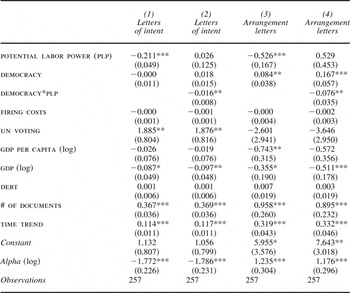
Table 2 reports the coefficient estimates for the negative binomial regression of the intrusiveness of labor market reform conditions on plp and key control variables. The coefficient estimates provide evidence that the potential power of domestic labor influences the design of IMF loan conditions. Powerful labor reduces the intrusiveness of labor market reform conditions in IMF loans to democracies, holding all else equal.
Domestic labor power and IMF labor conditionality

Notes: Negative binomial regressions with robust standard errors clustered by country reported in parentheses.
*** p < .01;
** p < .05;
* p < .10.
In columns (1) and (2) in Table 2, the dependent variable equals the intrusiveness of labor conditionality in the letters of intent. In columns (3) and (4) the dependent variable is the intrusiveness of labor conditions in the arrangement letters. In both the letters of intent and the arrangement letters, stronger domestic labor corresponds with less intrusive labor market reform conditions, all else equal. The unconditional (or average) effect of plp is negative and statistically significant at the .01 level, as reported in columns (1) and (3).
Results reported in columns (2) and (4) demonstrate the importance of countries' domestic institutions for labor conditionality. plp has a significant and negative marginal effect on the intrusiveness of labor conditions in democracies. This is true even though the estimated coefficient on plp is not statistically significant in columns (2) and (4). Because columns (2) and (4) contain the interaction term democracy* plp, the coefficient on plp reports the effect of plp on labor conditionality when the mediating variable, democracy, equals 0. In other words, the only inference that can be drawn from the standard errors on plp in columns (2) and (4) is whether plp has a significant marginal effect on labor conditionality for the unique case where democracy equals 0.Footnote 85 However, there are no observations where democracy equals 0 in the sample and therefore the coefficients on plp in columns (2) and (4) are substantively meaningless. The marginal effects (and corresponding standard errors) of plp for substantively meaningful values of democracy are calculated using the relevant elements of the variance-covariance matrix from columns (2) and (4). These results are presented graphically in Figures 2 and 3.
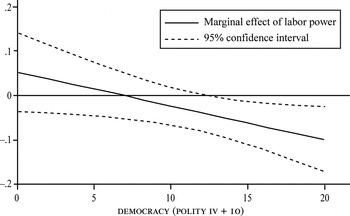
Marginal effect of potential labor power on the intrusiveness of labor conditions in Letters of Intent
Note: Estimated using column (2) from Table 2.

Marginal effect of potential labor power on the intrusiveness of labor conditions in Arrangement Letters
Note: Estimated using column (4) from Table 2.

The solid line in Figure 2 is the marginal effect of plp on labor conditions' intrusiveness in the letters of intent. The magnitude of this effect varies across levels of democracy. As democracy increases, the negative marginal effect of labor power becomes larger in magnitude. For example, the estimated coefficient on plp when democracy equals its maximum value (20) is more than twice as large as the estimated plp coefficient when democracy equals 10.
As democracy increases, the standard errors on the plp coefficient also become smaller. In Figure 2, the broken lines represent the 95 percent confidence intervals for two-tailed tests. Whenever the upper and lower bounds of the confidence interval are both above (or below) the zero line, the relationship is statistically significant.Footnote 86 When democracy is greater than 9 (that is, −1 in PolityIV), the marginal effect of plp is statistically significant at the .05 level. In other words, the interests of workers matter for IMF loan conditions only in non-autocratic countries. This finding suggests that democratically elected governments are relatively more responsive to the economic interests of their citizens and consequently are more willing to represent these interests at the international bargaining table. Democratically elected leaders can credibly point to workers' opposition to loan conditions and argue that they are constrained in their ability to implement the required policy reforms. The IMF may therefore be more lenient with democratic governments that face strong labor and impose less stringent labor conditions.
Figure 3 illustrates the marginal effect of plp on the intrusiveness of labor conditions in IMF arrangement letters. Again, the negative marginal effect of labor power on labor conditionality increases as the level of democracy increases. When democracy is greater than 12 (that is, 2 in PolityIV), the negative marginal effect of plp is statistically significant at the .05 level.
Holding regime type constant, the marginal effect of plp on labor conditionality is generally larger for arrangement letters than letters of intent. One reason may be that workers and national governments expend relatively more effort to minimize labor conditions in the actual contract of the loan. They do so with the knowledge that the soft conditions contained in the letters of intent can be ignored with few, if any, consequences. This points to the importance of examining both the letters of intent and arrangement letters to fully understand the logic of IMF conditionality.
The coefficient estimates for un voting in Table 2 provide further evidence that examining arrangement letters in addition to the letters of intent is important. U.S. allies receive relatively more intrusive labor market reform conditions in their letters of intent. This is somewhat surprising in light of previous studies that show U.S. allies tend to receive fewer total conditions.Footnote 87 Although U.S. allies tend to receive fewer loan conditions, they receive relatively more intrusive labor market reform conditions, all else equal. However, this finding disappears in columns (3) and (4) where the dependent variable is the intrusiveness of labor conditions in loan contracts. U.S. allies receive no more (or less) intrusive labor market reform conditions in IMF arrangement letters than non-U.S. allies. One interpretation of this finding is that U.S. influence does not extend to the actual loan contracts. While the United States may be able to influence the letters of intent, U.S. influence over loan contracts appears to be more limited, at least with respect to labor market reform conditions.Footnote 88 This finding may have important implications for our understanding of geopolitics' role in IMF lending. It also points to the fact that focusing only on the letters of intent may lead to incorrect conclusions about IMF conditionality and, in particular, the role of the United States in IMF lending.
Firing costs are not a robust predictor of the intrusiveness of IMF labor conditionality. Countries with strict labor market regulations (that is, high firing costs) are no more likely to receive labor market reform conditions than countries with flexible labor markets (that is, low firing costs), controlling for labor power. One interpretation of this finding is that the IMF tends to suggest labor market reforms where they are most likely to be implemented (that is, weak labor countries), rather than where firing costs are highest.
Two other robust results emerge from Table 2. First, larger countries receive less intrusive labor conditionality, as demonstrated by the negative and significant coefficients on gdp. Second, labor conditionality increases over time as shown by the positive and significant coefficients on the linear time trend. This finding is consistent with the previously observed and well-documented increase in the scope of IMF conditionality over time.Footnote 89
Possible Role for Ideology
Democratically elected governments are responsive to the potential power of labor. This suggests a possible role for government ideology in negotiations between democratic governments and the IMF. For example, left governments may be particularly beholden to workers for electoral support. Labor power may therefore have a larger reductive effect on labor conditionality in countries with left governments. Alternatively, all elected governments, regardless of ideology, are sensitive to electoral politics and therefore may be responsive to labor's potential power. By minimizing the intrusiveness of labor conditionality, governments of all stripes gain increased flexibility in navigating the path of economic reform. Even those governments who support policies that labor opposes may prefer to have the freedom to negotiate the required reforms without stringent labor conditions being imposed.
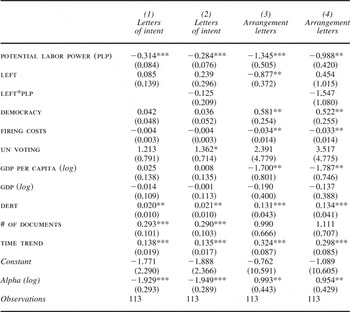
To test for the possibility that government ideology mediates the effect of labor power on labor conditionality, we reestimate all models with a variable that indicates the ideology of the national government. The variable (left) is a simple dummy variable coded 1 for left governments and 0 otherwise. Because IMF programs are negotiated with the national executive, the measure of ideology is specific to the executive. Also included is an interaction term equal to the product of left and plp. The sample is restricted to only those countries in which the national government is democratically elected (that is, PolityIV is greater than 0). These results are reported in Table 3.
Government ideology and IMF labor conditionality

Notes: Sample includes only those country-years with a PolityIV score greater than 0. Negative binomial regressions with robust standard errors clustered by country reported in parentheses.
*** p < .01;
** p < .05;
* p < .1.
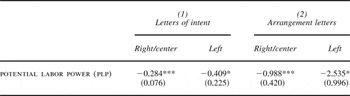
As before, the unconditional effect of plp is negative and statistically significant for both the letters of intent and the arrangement letters. Higher values of plp correspond with less intrusive labor market reform conditions, all else equal. The estimated coefficient on left is statistically significant in column (3) only. This provides some limited evidence that left governments are more resistant to labor market reform conditions than right/center governments. However, both left and right/center governments are responsive to the potential power of domestic labor. This is demonstrated by the estimated coefficient on plp in columns (2) and (4). In columns (2) and (4), the coefficient on plp reports the marginal effect of labor power on labor conditionality in countries with right/center governments. In these countries, plp has a significant reductive effect on labor conditionality. However, the reductive effect of plp is even greater in countries with left governments. The coefficients and corresponding standard errors for plp when left equals 1 are calculated using the relevant elements of the variance-covariance matrix from columns (2) and (4) and reported in Table 4. plp has a larger reductive effect on labor conditionality when left governments are in power, all else equal. This finding provides further evidence of the importance of domestic politics for IMF conditionality.
Marginal effects of potential labor power on the intrusiveness of labor conditions

Notes: Marginal effects of plp for left governments estimated using columns (2) and (4) from Table 3.
*** p < .01;
** p < .05;
* p < .1.
Robustness Checks
To evaluate the robustness of our empirical results, we conduct a number of sensitivity analyses. For example, we estimate a two-stage Heckman selection model to address the fact that selection into an IMF program is not random. Results from the second stage of the Heckman selection model are virtually identical to the negative binominal results reported in Table 2.Footnote 90 We also test to see if the key results are sensitive to changes in dependent variable's coding. The dependent variable is first recoded to include only public-sector (or private-sector) labor conditions. Then, the dependent variable is recoded to separate structural labor market reforms from stabilization reforms. Across all variations of the dependent variable, we find strikingly similar results: higher values of plp correspond with less intrusive labor-related loan conditions. However, there are some slight differences. The magnitude of the reductive effect of plp is larger for private-sector labor conditions than public-sector conditions. The IMF may be more willing to compromise on private-sector labor conditions than on public-sector labor conditions because private-sector labor conditions are often less critical for balancing government budgets. Again, these results are omitted due to space constraints but are available in the online appendix.
In sum, the reductive effect of plp on labor conditionality is robust to various specifications of the dependent variable. The key results are also robust to alternative model specifications including a two-stage Heckman selection model. Reestimating the models using ordinary least squares regressions produces very similar results. Furthermore, the key results are robust to the inclusion of country fixed-effects, the exclusion of the linear time trend, and the inclusion of a lagged dependent variable. Additionally, when the sample is restricted to only those years after 1986, we find the same substantive results.
Conclusion
Citizens' interests play an important role in negotiations between national governments and international organizations. This is true even in times of economic crisis. This study finds that the interests of a key group of citizens—workers—influence negotiations over IMF loans. When negotiating loan conditions, democratically elected governments press for workers' economic interests when workers are politically powerful at home. By representing workers' interests at the international bargaining table, democratically elected leaders hope to maximize their chances of reelection and increase the likelihood of a successful IMF program. As a result, labor-related conditions are relatively less stringent in IMF loan programs for democratic countries with politically powerful labor than in democratic countries with weak domestic labor.
This research has several important implications for our understanding of IMF lending and international negotiations more generally. First, this study demonstrates that the IMF is sensitive to domestic politics and citizens' interests. The IMF has often been criticized for applying one-size-fits-all economic policy prescriptions without sensitivity to context and ignoring borrowers' domestic political constraints.Footnote 91 Contrary to the IMF's institutional self-image as technocratic and apolitical, we find evidence that the IMF is responsive to domestic politics in borrowing countries and specifically the interests of workers. Second, our results suggest that national governments tend not to use the IMF for political cover when they face powerful labor at home. When labor is strong, governments risk both their political survival and the derailment of the loan program by agreeing to the inclusion of intrusive labor reform conditions. Labor may prefer not to get a loan program at all than to accept a program with intrusive labor conditionality. The combination of low rejection costs and political power allows labor to influence the negotiating posture of national governments and shapes the IMF's willingness to be more flexible about labor-related conditions.
Third, since citizens' interests influence negotiations between government executives and IMF staff, even in times of economic crisis, they likely play an important role in other international negotiations that occur in good times, such as negotiations over membership in the WTO. While previous research demonstrates that workers' interests influence countries' compliance with WTO rules,Footnote 92 this study suggests that workers' interests may also influence the terms a country negotiates to join the WTO. Countries' accession agreements determine the magnitude of trade increases they receive from WTO membership.Footnote 93 Domestic interests can therefore play a critical role not only in negotiations with IOs but also in the benefits of IOs' membership.
Fourth, our argument also has implications for how domestic political constraints shape the bargaining power of national governments with IOs. Putnam has famously described these negotiations as a two-level game in which national leaders must construct a domestic win-set to reach successful international agreements.Footnote 94 As Putnam notes, when the cost of no agreement is small for powerful actors, the domestic win-set shrinks in size. However, as he further notes, domestic governments can use these domestic constraints as bargaining leverage in their international negotiations. Our empirical results provide support for these theoretical expectations. When domestic governments face powerful labor movements, they leverage this opposition as a bargaining chip in their negotiations with the IMF. By recognizing this domestic constraint and imposing less intrusive labor-related conditions, the IMF contributes to the formation of a larger domestic win-set and consequently a mutually acceptable loan program.
Our results have important policy implications. First, additional work on the number and nature of special interest groups, their reaction to reforms envisaged in IMF-supported programs, and inclusive negotiation processes may help the IMF to design better programs and improve their probability of implementation.Footnote 95 As some IMF scholars have noted, if countries are to “own” a program, more than just the government needs to be on board with it.Footnote 96 Second, our results suggest that those concerned with the contents of IMF programs and their effects on labor may be better served by working for the promotion of democracy than for the reform of the IMF. Because democratically elected governments are relatively more responsive to workers and their economic interests vis-à-vis IMF loan conditions, democratic governments are more likely to represent workers' interests when bargaining with the IMF over the terms of their loan package and consequently may negotiate better deals for workers.
Work remains to be done to further our understanding of IMF lending and the role of citizens' interests in international negotiations. We have focused exclusively on the impact of domestic interests on conditionality. However, domestic interests may also matter for governments' compliance with IMF loan conditions. Although we leave the question of compliance for future research, the new data collected as part of this study may be particularly useful for examining the frequency and distribution of compliance with labor conditions.
A second important area for future study is the effect of IMF programs. Many previous studies estimate the effects of IMF programs on important economic outcomes relevant for workers. However, our research shows that not all IMF programs contain labor-related conditions; the distribution of labor reform conditions is neither randomly nor uniformly distributed across IMF programs. IMF programs with labor conditions will likely have different effects than IMF programs without labor conditions. To accurately estimate the effect of IMF programs on labor-related outcomes, such as wages, it is necessary to account for the systematic variation in labor market reform conditions demonstrated here.
Appendix
Documents Coded
We coded three types of documents: letters of intent, staff reports, and arrangement letters. In this study, we focus exclusively on the letters of intent and arrangement letters.
Letters of intent are prepared by the borrower in consultation with the IMF. They are usually, but not always, called Memoranda of Economic and Financial Policy. These documents present the borrower's analysis of the economic problems that the country faces and lays out the policies that it will carry out to address them.
Arrangement letters are essentially the contract for the loan. They spell out the conditions that a country must meet in order to receive the next loan disbursement. The terms of the arrangement letters change over the course of the loan.
For loans of one year in duration, we coded the documents issued at the time of the initial loan request. For loans of more than one year in duration, we coded one set of documents per year, coding the documents that were issued about twelve months after the previously coded report. Consequently, we coded all arrangement letters but only a proportion of letters of intent and staff reports.
Loan Types
We coded the following loan types: standby arrangements, extended arrangements, structural adjustment and enhanced structural adjustment facilities, and poverty reduction and growth facility.
Coding of Conditionality
We track four different types of conditionality that are weighted as follows:
• Performance criteria: 4
• Prior actions: 4
• Benchmarks: 3
• Indicative targets: 3
• Soft conditions: 1
Labor Issue Areas
We track nine issue areas and code each level of conditionality for each issue area. If there are multiple actions at the same level of conditionality for a particular issue-conditionality pair in a document, then we count it only once. If there are performance criteria, benchmarks, and/or indicative targets in an issue area in a document, then we do not code soft conditionality for that issue area in that document:
• Public-sector wage levels
• Public-sector employment levels—includes capitalization and outsourcing/contracting of functions formerly within a public enterprise
• Privatization—includes reorganization, denationalization, divestiture
• Minimum wages—private sector
• Private-sector wage restraint other than minimum wages
• Social security—reducing social security provisions, including health care, disability provisions, unemployment insurance, and payroll taxes
• Public pension reforms—reducing costs and changing public pension system
• Labor market flexibility—includes facilitating layoffs, reducing severance pay, the easing of limitations on fixed-term contracts, the easing of conditions for labor supply/outsourcing, and rationalization, modernization, deregulation, or other “general labor reforms”
• Collective bargaining decentralization